 Hacker Cinema
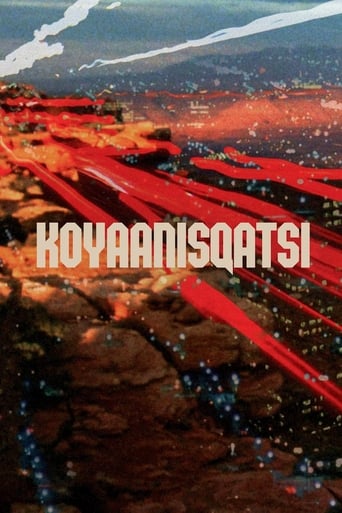
Koyaanisqatsi
1983 · Film · documentary · 86 min
Part of Qatsi Collection
Directed by Godfrey Reggio
Takes us to locations all around the US and shows us the heavy toll that modern technology is having on humans and the earth. The visual tone poem contains neither dialogue nor a vocalized narration: its tone is set by the juxtaposition of images and the exceptional music by Philip Glass.
53 positive5 negative2 mixed26 neutralfrom 86 commenters
Where to watch
No streaming data for this title.
103 comments on Hacker News
Thanks! Here's the full list: 2001: A Space Odyssey, 8½, Aguirre the Wrath of God, Ali: Fear Eats the Soul, All That Heaven Allows, Apocalypse Now, Ashes and Diamonds, A Woman Under the Influence, Barry Lyndon, Bicycle Thieves, Breathless, Casablanca, Céline and Julie Go Boating, Chinatown, Chinese Roulette, Citizen Kane, City Lights, City of Pirates, Contempt, Daisies, Damnation, Dishonored, Earth, Electra My Love, El Topo, Eraserhead, Eyes Wide Shut, Film Socialisme, Fitzcarraldo, Fuego en Castilla, Hiroshima Mon Amour, Holy Motors, Inauguration of the Pleasure Dome, In a Year with 13 Moons, India Song, Inland Empire, Irma Vep, Koyaanisqatsi, La Dolce Vita, La Jetée, Late Spring, L'Eau de la Seine, Le Voyage dans la Lune, Lolita, Los Olvidados, Lost Highway, Lucifer Rising, Man with a Movie Camera, Metropolis, Mirror, Mulholland Drive, Night Music, Ordet, Orpheus, Persona, Pickpocket, Playtime, Psycho, Rebecca, Rosemary's Baby, Rumble Fish, Scarface, Seven Samurai, Sherlock Jr., Singin' in the Rain, Stalker, Sunset Boulevard, Taste of Cherry, Taxi Driver, Testament of Orpheus, The 400 Blows, The Blood of a Poet, The Cabinet of Dr. Caligari, The Color of Pomegranates, The Green Ray, The Holy Mountain, The Isle, The Lady from Shanghai, The Night of the Hunter, The Passion of Joan of Arc, The Seventh Seal, The Spirit of the Beehive, The Tales of Hoffmann, The Tree of Life, The Turin Horse, Time of the Gypsies, Tokyo Story, Touch of Evil, Trans-Europ-Express, Ugetsu, Un Chien Andalou, Uncle Boonmee Who Can Recall His Past Lives, Vampyr, Videodrome, Wavelength, Werckmeister Harmonies, Wild Strawberries, Moonlight Sonata, Stellar, The Haunted House Biased toward European art cinema, experimental work, and directors who broke conventional narrative rules.
> it is a strategy employed to slow down development at other companies, and so help preserve the moat.
Worked at Google for 7 years, and your post reminds me it is time to share a secret: it is Koyaanisqatsi* and people's base instincts unbridled, no more. There is no quicker route to irrelevancy than being the person who cares about something from last years OKRs.
* to be clear, s/Koyaanisqatsi/too big to exist healthily and yet it does exist -- edited this in, after I realized it's unclear even if you watched the movie and know the translation of the word
Whoa, the first film poster it presented to me was for Koyaanisqatsi, a 1982 film I was unfamiliar with until I saw it in a Metafilter post just this morning[1]. Baader-Meinhof in action[2].
[1] https://www.metafilter.com/209750/Godfrey-Reggios-Koyaanisqatsi
[2] https://www.damninteresting.com/the-baader-meinhof-phenomenon/
This game is truly a work of art. I literally got a migraine playing this game though and couldn't finish it unfortunately. This is the second piece of media to do this to me behind Koyaanisqatsi... now that I think of it, this seems like a modern interpretation of the film Koyaanisqatsi.
Strong agree: Upstream Color is poetry
Stanley Kubrick did something similar in `2001: A Space Odyssey`. In a scene where staff were being transported in a taxi... on the moon... 100% of the dialog is meaningless. They're discussing the merits of this or that sandwich, not how wonderful the Earth looks from space, or overcoming technical challenges.
It's so refreshing to be living in an environment vs being spoon fed.
Even better is very old or even silent movies ("M" is fantastic: modern-ish thriller from 1931 where sound is a character; Metropolis)
Also dialog-less movies: `Koyaanisqatsi` is incredibly beautiful and has a specific plot, even if there's no understandable dialog nor words.
In theaters _right now_ is `Flow`. No dialog, and no _human_ characters! It's all animated cats and dogs and other animals. It's startling how directly the characters transmit their goals and agenda and emotions.
Two instances where lossy compression failed for me are the movie Koyaanisqatsi and songs by the artist TOBACCO. Koyaanisqatsi has a lot of film grain and TOBACCO uses a lot of distortion. There is noise in there, but it's very deeply mixed into the signal.
What a great question! Many interesting movies to check out in these comments!
My own list, I re-watch movies the same way I re-listen to music, often to get in a particular mode of thinking, as they become familiar, I mostly daydream while appreciating some particular concept and whatever new minutiae, or ways of understanding, creeps into my mind.
Hackers - 30+ times, for dreaming about a world that never was and never will be, for reminding myself how cool computers used to seem.
The Crow - 20+ times, for thinking about the world
Koyaanisqatsi - 15+ times, for thinking about my life in the world
Alien - 10+ times, for thinking about the future that passed us by
Terminator 1 and 2 - 10+ times, for examining a time that never was, or passed me by, and because Arnold is awesome!
A Clockwork Orange, 10+ times, to reflect on violence and aesthetic
Event Horizon, 10+ times, mostly for the aesthetic, and who dosen't love spaceships from hell ?
1984 - 5+ times, for thinking about humanity and society
Requiem for a Dream - 5+ times, for thinking about the value of life, and what society is
Once upon a time in the west - 5+ times, for thinking about loss, revenge and justice
Genocyber - 5+ times, to think about what life is for anyway
Stalker - 5+ times, frankly, mostly to look at the pretty pictures.
Lots of other amazing movies, I probably forgot some (time to watch again?)
Bonus:
TV Shows I've watched more than 10 times:
Star Trek TNG
Neon Genesis Evangelion
> Maybe I'm old, but do we really watch the movies because they are sharper, have vivid colors, etc or because of the story ?
Where would, e.g., Koyaanisqatsi fit then?
Was probably the inspiration for the movie “Brazil”, released in 1985 where the pneumatic tube system is part of the complicated and extensive "Central Services" administration.
Incidentally Brazil is for today's digital dystopia what Koyaanisqatsi (1982) is for environmental instability.
it's a different kind of 'beauty' :)
In some strange way it reminds me of Koyaanisqatsi, now 40 years old (https://news.ycombinator.com/item?id=35764584)
I saw it in a movie theater a long time ago, the images where exiting, the music unlike anything I had every heard... It was stimulating and at the same time uncomfortable, I remember I was glad to finally see the credits after 1.5 hours of a bombardment of sound.
Still it made a big impression on me and made me discover a whole new genre of music and composers.
About 10 years ago I went to a lecture in Santa Fe by Reggio where he talked about the movie, screened it, and answered questions after. 10 years before that I saw Glass perform the music in Albuquerque with his orchestra while the movie played on a big screen above. At that point I had watched the movie perhaps 100 times. To say I am a huge fan is an understatement.
The overwhelming impression I got from Reggio and Glass was that they didn't so much create the experience as give birth to it. Of course they both intended to create something great, but I think the movie's success as a cultural artifact exceeded their wildest expectations.
There are very few movies I care to watch more than once. There are even fewer that will still be watched and studied 10,000 years from now (assuming we survive that long). Koyaanisqatsi is one of them.
It's remarkably difficult to find sources seeing as searching for 'Koyaanisqatsi' and 'Philip Glass' brings up a ton of renditions!
But the story goes something like this: He turned down the request to score the film, because he didn't consider himself a composer of film scores. So, the director went and got a load of Philip Glass music and overlaid it on the film himself and sent it to Glass. Once he saw it, he was in.
Nothing particularly mind-blowing in terms of a tale of how the film got made, but it could have easily gone in a completely different direction and not be the film we know.
He simply endorsed the film to help it get a wider audience. He didn't produce, direct, or have an involvement with the making of the film.
I think it's great that he did it, but it's surely one of those weird artefacts of why Koyaanisqatsi is successful.
Surely, we still live in a life out of balance. But something about how digital much of human life and industry is now makes it seemingly difficult to create a modern successor to Koyaanisqatsi. I suppose you could just have a panning shot across massive server farms and maybe some footage evoking the sheer amount of carbon and water requires for these operations, but not sure it translates to film in the same powerful way as other footage in films like Koyaanisqatsi, Baraka, and the most recent film along these lines that I have seen, Anthropocene (2018).
The soundtrack to Koyaanisqatsi is also used in the opening scene of Alan Partridge: Alpha Papa (2013), which pairs a deep feeling of foreboding over footage of the beaches of Norfolk.
While it might appear to be an incongruous choice to open a comedy film, I note that Koyaanisqatsi, Watchmen (book and film) and Alan Partridge are all works primarily concerned with whether it is in our own nature to destroy ourselves, and whether we might deserve it.
I used to watch Koyaanisqatsi in the Valhalla, an "encore" cinema in Glebe (Sydney, Australia). This, and Spinal Tap, and 2001. Oh, and A Clockwork Orange. This is back when VHS players were a luxury item, and seeing old movies was difficult or impossible. The Valhalla also ran controversial new movies, which usually meant gay themed like My Beautiful Laundrette, which mainstream cinemas would not touch.
The Valhalla published 3 month (or 6 month, I don't remember now) calendars that were about the size of a tabloid double-page spread. They were a common sight on fridge doors.
I think the aesthetic of Koyaanisqatsi had a large effect of on film aesthetics. Breaking Bad's best scenes IMO were the Timelapses which I found very reminiscent Koyaanisqatsi.
The film was shot and framed in 4:3 but was cropped down (for reasons unknown to me) into widescreen for the theatrical and later the Blu-ray releases.
There is a rare uncropped DVD release of it by a distributor called "IRE" out there. My understanding is that every copy of this release is autographed by the director, if you need some proof of artistic intent. AFAIK there's no definitive proof that this isn't just "open matte", but IMO the superiority of this release is pretty clear. You can find it on public torrent sites.
Some more info here: https://originaltrilogy.com/topic/Koyaanisqatsi-IRE-Fullscreen-Version-MORE-IMAGE-Released/id/5872
> Francis Ford Coppola’s name being on the artwork even though he had nothing to do with the film.
Sounds like a strange take. From [1]:
> Koyaanisqatsi opens with the words “Presented by Francis Ford Coppola.” This simple endorsement by one of cinema’s most renowned directors solidified the film’s reputation and propelled it into movie theaters around the world.
Not sure if FFC gave them money (I guess yes since he's credited as executive producer), even without money, his name would've been enough to open a lot of doors.
Reminds of how Werner Herzog got involved in "The Act of Killing" [2], watching an 8-minute excerpt at breakfast was enough.
[1] https://culturacolectiva.com/en/movies/francis-ford-coppolas-name-helped-koyaanisqatsi/
[2] https://www.youtube.com/watch?t=87&v=LLQxVy7R9qo
A high school near where I lived at the time (southern New Jersey) created a mural in the cafeteria inspired by, and titled, Koyaanisqatsi. And this was in the early 90's well after the film had been shown in theaters.
https://repositories.lib.utexas.edu/bitstream/handle/2152/83301/Of%20How%20a%20Hopi%20Ancient%20Word%20Became%20a%20Famous%20Experimental%20Film%20-%20Not%20Even%20Past.pdf?sequence=2 (found by Google Scholar search for "Koyaanisqatsi Hopi" seems to give decent context
> This episode of [Hopi] existence begins with the extraordinarily cruel act of the atomic bombing of Hiroshima and Nagasaki in August 1945 by the United States’ Air Force, near the end of World War II. Among the remote consequences of this attack, one or two years later, a group of Hopi of the Second Mesa at their ceremonial reunions (kivas) started “equating the atomic bomb with a prophetic story about a gourd of ashes which brought destruction when it was cast on the ground,” according to anthropologist Brian D. Haley. By 1948, with the devastation of planet Earth in mind because of human greed, elders and religious leaders of the Second and Third Mesa decided it was urgent to share this prophecy with the “White people” so that everyone could be prepared for Purification Day, the moment when deity of the current fourth world, Maasaw, would come and redeem humanity, creating a new paradise on Earth.
> The effort to spread the word on the ancient prophecies is what anthropologist Richard Clemmer designated the “Hopi Traditionalist Movement.” The Hopi agenda, though, was more than a spiritual calling; it was very political. In 1949 they sent President Truman a letter in which they detailed their prophecies and message of awareness, but also their position about land ownership, mineral extraction permits, the cultural and political rights of indigenous peoples, and pending US policies. With the help of non-Native People, the movement got the attention of conscientious objectors and draft resisters of the Second World War, pacifists, anarchists, spiritual radicals, and, in time, the different counterculture circles of the 1950s, 60s and 70s ...
> It’s the mid 1970s and Godfrey Reggio does not have a name for the film he is shooting. His co-workers are telling him they are not going to get distribution or financial aid if he does not name it. Reggio had resisted to do so until then, because for him the images were the message. Persuaded, he starts searching for a word “with no cultural baggage, a new word to describe the world.” ...
> Living in Santa Fe, Reggio was near the Hopi reservation and had friends that were “Hopi devotees,” as he calls them. They insisted on the connections between his creative project and the Traditional Hopi Movement’s prophecies. He met David Monongye, one of the Hopi spokesmen of Hotevilla, by giving him a ride from the reservation to a doctor’s appointment and they became friends. Reggio liked the idea of naming his film with an originally non-written language to evoke his argument that the literate culture he lived in was no longer a good describer for the insanity he saw all around. Thus, he contacted the linguist Ekkehart Malotki, who knew the Hopi language, and his Hopi co-worker Michael Lomatuway’ma. They introduced him to the word koyaanisqatsi, a concept that nailed his awareness. Reggio went to David Monongye for permission. “David said it’s an ancient word,” recalls Reggio today, “a word that’s not in popular use. He didn’t talk much about it, but he said the definition we had, took the meaning of the word.” ...
> Reggio not only asked for Monongye’s opinion, he also went through two more examinations by clan leaders of other villages: first by Mina Lansa, the traditional leader of Old Oraibi, and her husband John, then by a group of members of the 2nd Mesa. Reggio felt as he had gone through an ecclesiastical interrogation once again, and in a language he couldn’t understand, but with better results. All of them gave him consent.
I was a teenager riding a bicycle through a neighborhood, when I came across a yard sale. Heard that someone had died. Among their things was a tape of the Koyaanisqatsi soundtrack composed by Philip Glass. Bought it for a couple of bucks, and later that night was blown away by the music. I had heard nothing like it before - it made me shiver with awe and fear. It felt like the dead was reaching out through the sounds. A few years later I watched the film and had a vision of the monstrous beauty, this ancient swarming organism called humanity, of which I'm like a finger or toe, a leaf and flower. Hard to describe the influence this film has had on my view of the world, and what art can do to you - even now it gives me goose bumps remembering that aesthetic experience in my youth.
I saw PGE and the LA Philharmonic performing live with the movie in 2009 at the Hollywood Bowl, and they also performed other pieces, so you're likely remembering correctly.
https://www.nonesuch.com/journal/philip-glass-ensemble-la-philharmonic-perform-to-koyaanisqatsi-at-hollywood-bowl-2009-07-23
My kids (age 3 and 5) wanted to watch a movie and I didn't really want them watching one so I bluffed and put on Koyaanisqatsi. They (and I, for the first time in ~15 years) were enthralled. Ended up talking about poverty, etc.
Koyaanisqatsi is just one of those Magic films that you can start watching and think yeah whatever - and then as it goes on and on you just get more and more blown away by incredible intensity of the soundtrack and visuals. A really transcendental experience.
The backstory that Philip Glass originally didn’t want to score it is also amazing, as is the reason for Francis Ford Coppola’s name being on the artwork even though he had nothing to do with the film.
absolutely awesome
Does anyone have any information on the Hopi prophecies quoted in the article and in the film? Are they documented elsewhere? It seems a little suspicious to me that the Hopi text so closely matches 1970s American environmentalism/anxiety about nuclear weapons. I suspect there has been some creative translation.
I actually wrote to the linguist listed in the Koyaanisqatsi credits for the original text in Hopi and he said he couldn't find it....
Ron Fricke is person who made Koyaanisqatsi the beautiful visual journey that it is. I would recommend watching any of his other works. https://en.wikipedia.org/wiki/Ron_Fricke (FWIW, Powaqqatsi is also pretty good, but I would strongly suggest avoiding Naqoyqatsi which is just not very good).
Back in the 90s a bunch of us watched the whole movie by accident. Somehow it came up in conversation and the guy whose house we were in happened to have a copy on VHS and he put it in and we got so mesmerized that while we only intended to watch a few minutes of it, we watched the whole thing.
There are two “sequels” to Koyaanisqatsi: Powisqatsi and Naqoyqatsi, both also with Philip Glass soundtracks.
I remember coming out of the cinema completely mesmerized. A but like reading poetry when you cannot express why it touches you.
I watched quite a few experimental films and some can be long after only 5 minutes. Koyaanisqatsi on the other hand feels completely coherent and keeps its tension for 90 minutes even if I couldn’t re-tell the story.
If you like this then I can’t recommend Baraka highly enough, by the cinematographer of Koyaanisqatsi:
https://en.m.wikipedia.org/wiki/Baraka_(film)
No narration at all, just amazing visuals and music/sounds. Review by Ebert:
https://www.rogerebert.com/reviews/great-movie-baraka-1992
Koyaanisqatsi is a 1982 American experimental non-narrative film. It consists primarily of slow motion and time-lapse footage of cities and many natural landscapes across the United States.
Not a decade goes by, not a decade, without someone mentioning Koyaanisqatsi.
It's in my top 5 "must watch" movies.
completely tangential comment--the "criticism" section mentions the Pruit-Igoe development and it eventual demolition. Film of the derelict development and its demolition was in the Godfrey Reggio film Koyaanisqatsi, and the Philip Glass music behind that section is one of my favorite sections of the score.
Yeah, I came here to write that.. If he was a movie, maybe was that. I found out about the movie because I loved the music by Rob Hubbard, to the C64 game Delta, which is basically the theme from Koyaanisqatsi, but sped up.
Also one of my favorite films. In a similar vein, Baraka and Samsara are also great, but the score for Koyaanisqatsi is simply beautiful.
The ending sequence still gives me chills. Lots of scenes do, actually.
Replying to %root% b/c all the Koyaanisqatsi references: I learned about the movie(s) and Glass' works when accidentally tuning in to a Koyaanisqatsi airing briefly before the Challenger scene some 20 years back.
My definition of the perfect storm. Still remember set and setting and everything else.
There are already several film versions of Philip glass, starting with koyaanisqatsi
Philip Glass did the score for one of my favorite films, "Koyaanisqatsi"
Here is a YT cover of the opening song. I find the music has lots of feeling to it. https://www.youtube.com/watch?v=KC0FroHjB94
Be sure to checkout Koyaanisqatsi if you like experimental films and Philip Glass
These are my all-time favorites. Sorry if not fitting your "watched in 2022" criteria.
Brother Can You Spare a Dime (1975) https://www.imdb.com/title/tt0072742/
Thank You For Not Breeding (10+ years ago) https://www.youtube.com/watch?v=abDpktpk7Is
The Atomic Cafe (1982) https://www.imdb.com/title/tt0083590/
Born Rich (2003) https://www.imdb.com/title/tt0342143/
Bonus documentaries (reality projections):
Idiocracy (2006) https://www.imdb.com/title/tt0387808/
Koyaanisqatsi(1982) https://www.imdb.com/title/tt0085809/
Brazil (1985) https://www.imdb.com/title/tt0088846/
For many years, Koyaanisqatsi was the marker in my Netflix DVD queue between "movies I actually want to see" and "movies that I probably ought to see one of these days but don't really want to".
Whenever Koyaanisqatsi got near the top of the list, I'd find something else to bump above it. Then some new films would come out, and it would get pushed down more.
Eventually, though, enough new stuff came out on streaming that I needed the Netflix DVD service less and less. I'd watch it occasionally... and then one day Koyaanisqatsi arrived at my door.
As expected, I didn't really care for it. Not that it isn't brilliant; it's just not my thing. I'm glad that it brings so much pleasure to some people. But I won't be adding the other two to the queue.
(And in fact it's rapidly reaching time to jettison the Netflix DVD service. There used to be many things available only that way, but it's just not the case any more. Not only have they substantially pared down their once-vast catalog, but I have realized that I'm just not a movie buff who wants a vast back catalog.)
To those who complain about Koyaanisqatsi being dated, remember this film was made before such a thing as music videos existed. You might even say it was one of the first, the other being Disney's Fantasia.
I adore Philip Glass, and it was through Koyaanisqatsi that I discovered him back when the movie was released.
I have been fortunate enough to see PG & the PG ensemble perform Music in 12 Parts (I heard the piece twice that day: once traveling to the concert hall, and once live) as well as attend an evening of piano works by him performed by him and a series of other pianists. On my bucket list is seeing Einstein on the Beach live – easily my favourite opera.
I have been collecting his music since the early nineties, and much prefer his earlier works – his later symphonies, etc, while fine, do not, to my ear, retain the stark beauty of his younger days.
Koyaanisqatsi and Sunless by Chris Marker are movies I come back to and rediscover over and over.
Sunless can be watched on you tube: https://www.youtube.com/watch?v=fdusEgrbhgA
My wife and I recently went to see a showing of Koyaanisqatsi at a local art theater in Minneapolis. My wife fell asleep; she was snoring and completely unrousable despite my best efforts and minor embarrassment.
After the movie she said she really enjoyed what she had seen but found the Philip Glass soundtrack entirely too soothing.
I once took an MP4 of Koyaanisqatsi and reversed the whole video sequence. It was quite a joy to watch the film backwards.
I also experimented with time lapse videography after watching the film. I am surprised by what does and doesn't work as a time lapse.
Also, Phillip Glass is the cousin of Ira Glass from the radio program This American Life.
The Koyaanisqatsi cinematographer went on to become a director himself, and made the movie “Baraka” in the same style. IMHO, it’s even better.
Koyaanisqatsi is my favorite movie by a mile, so obviously I love this. Koy is interesting because it's not simply a movie painting a certain picture (which an experiment like this can't do), but because it's a format too (which this experiment focuses on).
The third in the trilogy of Qatsi movies, Naqoyqatsi, while the least well known is probably the closest fit for this experiment since it's almost entirely stock footage laid over the (orchestral – in contrast to Koy) soundtrack. For example: https://www.youtube.com/watch?v=jgM46I-ZryM
I do prefer Koyaanisqatsi to any movie that thinks it has a plot but really just has a bunch of surround sound and vibrant colors signifying nothing. Koyaanisqatsi is great for putting on a large flatscreen in the backround while you're playing a board game with friends.
My favorite movie of all time is City of God -- tons of plot, compelling characters, realistic situation, great music, a totally immersive experience. I consider it the greatest movie ever made in spite of the fact that you have to watch it with subtitles unless you speak Portuguese.
Meh, I see value in both The Magnificent Ambersons and the French atmospheric cinema of the '60s.
Film, as art, should not be forced into a box.
There's value to film with no plot at all. Consider Koyaanisqatsi.
Well, people whose opinions I respect say they're great movies and there's a lot to appreciate about them, so I suppose I'm wondering if there's a way I could learn to enjoy them more. The responses here have been helpful!
I really enjoy Koyaanisqatsi but I can understand how someone else might not like it at first, but perhaps enjoy it more after the theme and intended meaning become more clear.
Koyaanisqatsi, a film in a similar vein, had a profound impact on me when I first watched it in my twenties. The cinematography is also done by Ron Fricke, but it’s directed by Godfrey Reggio with a Philip Glass score.
I loved Koyaanisqatsi, trailer here: https://www.youtube.com/watch?v=PirH8PADDgQ Not your typical documentary.
Anything by Werner Herzog is incredible as well, I find his approach extremely sympathetic and respectful to the subjects but without sacrificing detail (EG Grizzly Man)
Not strictly a documentary, but Threads by the BBC is a researched film depicting life in the UK if every city was hit by a nuke and it was incredibly disturbing and informative: https://en.wikipedia.org/wiki/Threads_(1984_film)
Carl Sagan's Cosmos has to be one of the most charming and moving documentaries I've ever watched - arguably a little out of date now but it reached a place the subsequent Cosmos series just couldn't reach.
MayDay! Air crash investigations are all amazing documentaries that manage to balance pretty intense technical information with real life suffering very skilfully and they are incredibly engaging.
I love documentaries, and these are my favourites. All very worth a watch.
- The Crash Reel
- McConkey
- Buck
- Apollo 11
- Carts of Darkness
- The Wild and Wonderful Whites of West Virginia
- Samsara
- Baraka
- Brooklyn Castle
- Spellbound
- Drew: The Man Behind the Poster
- Crumb
- The Jinx
- The Art of Flight
- King of Kong
- Indie Game: The Movie
- Capturing the Friedmans
- OJ: Made in America
- The Barkley Marathons
- The Seven Five
- Murderball
- Unbranded
- Gringo: The Dangerous Life of John McAfee
- Big River Man
- Hoop Dreams
- Word Wars
- Free Solo
- Long Shot
- Meru
- Being Elmo
- All This Mayhem
- Jiro Dreams of Sushi
- The Cove
- Project Nim
- Alone in the Wilderness
- Behind the Curve
- The Dawn Wall
- Grizzly Man
- 13th
- Winnebago Man
- Man vs Snake: The Long and Twisted Tale of Nibbler
- Get Me Roger Stone
- Icarus
- 13th
- Koyaanisqatsi
- The Thin Blue Line
- An Inconvenient Truth
- Oklahoma City
- Virunga
- The Staircase
- Evil Genius
- Undefeated
- Betting on zero
Worth highlighting that part of the soundtrack of the video is from the 1982 movie "Koyaanisqatsi - Life Out of Balance" (as referenced in the blog post), soundtrack by Philip Glass, and which is an experimental movie about, I guess, humanity's urban life at odds with the natural world.
Just to be clear, the music in the video is not Philip Glass' Koyaanisqatsi at all. FWIW, Koyaanisqatsi was a 1982 film [1], effectively a 90 minute music video before videos were a thing.
The film has lots of unsavory city clips in contrast with nature clips [2] to make the point of Life Out of Balance, the subtitle of the film. The music and film clips are frequently used to illustrate decay. or the unhealthy nature of city life in general, most notably in a Grand Theft Auto commercial [3].
[1]. https://en.wikipedia.org/wiki/Koyaanisqatsi
[2]. https://www.youtube.com/watch?v=tDW-1JIa2gI
[3]. https://www.thefader.com/2007/03/30/video-grand-theft-philip-glass
I don't know if Koyaanisqatsi, or the Qatsi trilogy generally, classifies as a documentary or an art film, but I always stump for at least the first two if I can.
Careful what you say about movies that put you to sleep like that. I thought the same thing when I first watched Koyaanisqatsi... now I've seen it upwards of 30 times, probably :)
This design reminds me in some ways of the disastrous Pruitt-Igoe public housing project in St. Louis. It's demolition in the 1970's was prominently featured in the film "Koyaanisqatsi"
https://en.wikipedia.org/wiki/Pruitt_Igoe
"Apartments clustered around small, two-family landings with tenants working to maintain and clear their common areas were often relatively successful. When corridors were shared by 20 families and staircases by hundreds, public spaces immediately fell into disrepair.[20] When the number of residents per public space rose above a certain level, none would identify with these "no man's land[s]"
One would expect that a major University building would not suffer from disrepair but the psychological effect of "disowning" the common areas might remain.
The apartments in Pruitt-Igoe were also deliberately small.
This one of Berlin, though not as early as the ones you posted, is the most spectacular one I've found:
https://m.youtube.com/watch?v=_YSDgruADlE
This gives a much better view into what everyday life must have been like at that time, it almost reminds me in some ways of movies such as Koyaanisqatsi.
The problem I see is that the delivery system has evolved in many companies / tech in general to be JIT, but for human resources.
While at FAANG, I was at capacity every week. So a 'normal' week (which was actually quite rare), I expected to spend 35-45 hours in work + meetings.
But 75% of those weeks, some urgent issue would come up. Then you have an extra 15-25 hours of attending to the urgency, falling behind 5-15 hours on planned work, and then you spend all evening thinking about how to solve the Very Urgent Problem.
Even if you are good at compartmentalizing, you'll be confounded by redundant messages from middle managers asking you about the status of the Very Urgent Problem.
Taking a break / vacation means twice as much work for 1-3 weeks before the vacation, and 1-3 weeks after, as you must prepare for coverage for while you are out of office, and then catch up on what happened while you were gone.
Add in the death of a loved one, medical issue or even a string of minor problems and you're completely subjugate to external circumstances. This will lead to burnout, at a minimum.
As a younger person, this kind of environment made me feel important and necessary. Later I began to realize this is the opposite of the truth. Important and necessary people have the power to set their own terms.
I am not sure why things have evolved this way. I recently watched Koyaanisqatsi ('life out of balance') a film from the 80s about modernity and technology and found it as relevant as ever. However the busyness that used to be outwardly visible has now migrated into our minds and seems to be causing mass unhappiness and mental health issues.
Koyaanisqatsi requires watching the film at some point as well. Just listening is good to get a first experience. Then the film can give a more complete artistic picture/experience.
I don't think this is anywhere near as obvious as you make out. Film is an odd example, given that the films that lay claim to being great works of art (e.g, Koyaanisqatsi, Wild Strawberries, The Battle of Algiers) are rarely the most popular and highest-grossing films (e.g., Transformers, Avengers, Toy Story). We usually mean something by 'greatness' quite different from 'popular'.
Even if we just focus on popularity (i.e., first-order preference satisfaction), money is a very rough proxy for it:
1. Lots of profitable activities, once you price-in their externalised social costs, are net negative. Given the scale of the climate and ecological crisis, that is very far from a marginal phenomenon. Ecological economists like Herman Daly argue that once ecological costs are included in the national accounts, we are running a GDP loss.
2. Some commodities are instrumentally necessary but intrinsically negative. Many people acknowledge that social media is a net negative, but use it anyway because it helps build their profile and career. Market dynamics often transform intrinsically positive activities into merely instrumentally necessary activities, e.g., the marketisation of academia means researchers spend their whole career optimising for maximum articles and grants, not great work.
3. Market demand reflects the stratified incomes of people around the world. Markets are therefore heavily skewed in favour of the interests of the rich.
4. Market exchanges which are mutually beneficial for the transacting parties often have unintended effects in the aggregate, sometimes negative, e.g., no one wants Facebook to be a monopoly, and no individual makes it so, but it is the aggregate consequence of people joining Facebook.
"KOYAANISQATSI, directed by Godfrey Reggio; photography by Ron Fricke; edited by Mr. Fricke and Alton Walpole; music by Philip Glass; produced by Mr. Reggio; production company, the Institute for Regional Education; sponsored by the Film Society of Lincoln Center and Radio City Music Hall. At Radio City, Avenue of the Americas and 50th Street. Running time: 87 minutes. This film is not rated.·
"''Koyaanisqatsi'' is the first feature by the 42-year-old Godfrey Reggio, a former member of the Christian Brothers Teaching Order, who, according to his official biography, more recently has been ''interested in the impact of the media in conveying ideas rather than promoting commodities.'' Mr. Reggio must be something of a promotor to have been able to get the film's financing - approximately $2.5 million - from an organization called the Institute for Regional Education in Santa Fe, N.M. He was also successful in obtaining the collaboration of two talented artists, Philip Glass, the avant-garde composer (''Einstein on the Beach''), and Ron Fricke, the cameraman. Together, the three have made a frequently hypnotic ''folly'' of a movie.
I'm not sure that it conveys the ideas Mr. Reggio has in mind, but it's certainly not boring. At one point or another while watching it, one is sure to be reminded of everything from ''Modern Times'' and ''Fantasia'' to ''This Is Cinerama'' and ''Billy Jack.'' However, more than reminding me of any single film, it recalls the briefly fashionable 1960's idea that going to the movies should be a psychedelic experience. At its best, that's exactly what ''Koyaanisqatsi'' is."
I guess this boils down to what your mean by "inspiring"; let me give you some of my favorites by category:
> Movies about people doing stuff, usually investigating something - makes me want to get up and get stuff done
[1] Cold Case Hammarskjöld - IMDB: https://www.imdb.com/title/tt9352780/?ref_=nv_sr_srsg_0
[2] Tickled - Trailer: https://www.youtube.com/watch?v=iOBXuCYB4jQ
[3] Resurrect Dead: The Mystery of the Toynbee Tiles - Trailer: https://www.youtube.com/watch?v=VIWpJ5Jl4fE (full movie is on Youtube, Too)
[4] The Cove - Wikipedia: https://en.wikipedia.org/wiki/The_Cove_(film)
> Movies about ... the human condition, human life on earth? IDK, but if you watch the trailer, you get what I mean. WARNING: Might evoke the urge to travel
[1] Koyaanisqatsi - Wikipedia: https://en.wikipedia.org/wiki/Koyaanisqatsi - Pruitt Igoe Scene: https://www.youtube.com/watch?v=nq_SpRBXRmE
[2] Samsara - Trailer: https://www.youtube.com/watch?v=HCkEILshUyU
[3] Anthropocene - Trailer: https://www.youtube.com/watch?v=ikMlCxzO-94 (Check out his other movie "Watermark", too!)
> Movies about the work of particular people:
[1] Playing God - Trailer: https://www.youtube.com/watch?v=knK4lE3tZBM
I discovered Koyaanisqatsi and Glass after hearing a 10 second bit played on an episode a Scrubs! https://www.youtube.com/watch?v=sM2VZk560_g
Have to disagree - personally found those films to be too heavy-handed with their "message". Koyaanisqatsi maintains a certain ambiguity throughout, conveying both awe and fear at modern civilization.
Ron Fricke, the man behind Baraka and Samsara, was the director of photography (and writer, editor) for Koyaanisqatsi. I would keep in mind how novel Koyaanisqatsi was for its time, and that Baraka and Samsara are mere evolutions on a revolutionary film.
I discovered Philip Glass' music through the movie Koyaanisqatsi, which I heartily recommend. If you haven't seen it, go into it without expectations of what a movie is supposed to be like; it's weird.
Check out the movie Koyaanisqatsi they have a lot of similar time lapse segmentsa with interesting subjects, angles, lighting, as well as scored to music. It might give you some inspiration.
> If you want a weirder launching off point, watch koyaanisqatsi and look up Philip Glass who made the soundtrack - that's an interesting avenue, albeit not very mainstream.
Omg that film is absolutely amazing (maybe the best thing I've seen in the past 10 years) and easily half of the effect is the music.
For epic scores you can't also go wrong with "Requiem for a Dream"...
This is a solid answer, but I'd also add - there are very few general music buffs.
Maybe I'd count, with years in pro music performance, degree in Jazz and a lifetime of listing to and performing an insanely wide variety of genres... but not a buff for all styles.
Computer systems are actually not a bad analogy. How many people do you know that have an in-depth knowledge of Assembly in different systems (including the oldest ones), GPUs, ML, Python, JS, Haskell, C++, Rust, ALGOL, Compilers, Hardware development, etc. Then add into the mix having an in-depth knowledge of the creators of those things, what else they did, failures, influences, their mentors.
You always have the choice of breadth versus depth, within your time constraints. I think learning about a single artist or band, looking up the producer, label, members and following up on all those leads to see what else they have done - and see if you like it is a great beginning.
Some genres like jazz might seem difficult to get into, and that's fine. No need to delve in until you find a hook that peaks your interest. And then when you find out about a genre (and jazz is an excellent example) - you'll find sub-genres you like, and don't and maybe you are interested in the evolution - like many people love bebop, but don't listen to "dixieland jazz" or big band swing, or modern fusion.
You will never hear all the music. But depth (in my opinion) breads a lot more passion than breadth just for the sake of it. So rather than listening to all the top 40 singles of the last decades, you'd probably be better off listening to some whole albums, and exploring from there.
Spotify (and similar) make it very easy for breadth, and can help discover new music you like - but you'll need to put work into delving in deep yourself.
As you do have a passion for film I'd suggest this.
For interesting modern music Quentin Tarantino files always deliver.
Danny Elfman has some interesting stuff (like this Simpsons theme which is a great example of the Lydian mode...)
John Williams & Hans Zimmer have made loads of epic soundtracks, and if you like them - look up Holst, Tchaikovsky and Wagner
If you want a weirder launching off point, watch koyaanisqatsi and look up Philip Glass who made the soundtrack - that's an interesting avenue, albeit not very mainstream.
Another epic film score is 28 Days Later, John Murphey - parts of which have been used in loads of other huge features like Kick Ass...
You could also go a different route, and look up how the pre-classical Pachelbel's Canon contains the chord progression that is arguably the most popular of all time and watch this mash up of songs that use it (or the first part) https://www.youtube.com/watch?v=oOlDewpCfZQ
Hahahaha, I could go on forever! I hope you find something you love, and actually want to go deeper into.
Koyaanisqatsi has been my favorite movie ever since the first time I accidentally caught it on TV almost 20 years ago. I've since been to live screenings with Glass and his Ensemble playing it, etc. :-)
And.. despite eventually discovering what Reggio is about, I have always taken the opposite view of the movie. To me it feels like a neutral view of how systematized our world is, how technology enables such systems, and how such systems are a fundamental and valuable part of moving forwards as a species. Humans = technology = systems.. but positivity for such things is my world view anyway, and Koy is a blank enough canvas to take this on.
The second sequel Naqoyqatsi felt like a more on the nose critique of the ills of technology and modern society to me, made up entirely of stock video set to a fragile but very human soundtrack, in contrast to Koy.
12 Angry Men
----
Walkabout
----
Koyaanisqatsi
A profound movie with no words except the chanting of a Hopi word, meaning "life out of balance", or "a way of life that calls for another way of life".
----
My Dinner With Andre
"We're bored. We're all bored now. But has it ever occurred to you, Wally, that the process that creates this boredom that we see in the world now, may very well be a self perpetuating, unconscious form of brainwashing created by a world totalitarian government based on money and that all of this is much more dangerous than one thinks, and its not just a question of individual survival, Wally, but that somebody who's bored is asleep, and somebody who's asleep will not say no?"
----
The Third Man
(Long shot from Martins' eye line of the fairground far below and the people now on it.)
"Would you feel any pity if one of those dots stopped moving forever? If I offered you £20,000 for every dot that stopped - would you really, old man, tell me to keep my money? Or would you calculate how many dots you could afford to spare? Free of income tax, old man......free of income tax. It's the only way to save money nowadays."
I much preferred Samsara (2011) over Koyaanisqatsi or Baraka.
I show people Samsara to demonstrate how a movie can have an incredibly powerful message without saying a single word.
My own picks would be HyperNormalisation, The Pervert's Guide to Cinema, and Koyaanisqatsi
To be fair to SF, it's a clip from a film that's trying to evoke that exact sentiment: https://en.wikipedia.org/wiki/Koyaanisqatsi
Highly recommended, especially the score by Philip Glass.
> Games Are Not Art (Yet).
But pigment smeared on a piece of wood is?
> they will not be as culturally relevant as movies or books.
I'm sorry you missed the memo, but games are more culturally relevant than books now. It makes me sad too.
> A mind like Orson Welles will never be compelled to make the Citizen Kane of games.
This sentence is equivalent to "A mind like Langston Hughes will never be compelled to make the Mulatto of films." Except, well, there is Orson Welles and Citizen Kane, so it's obviously wrong. Your sentence probably is too.
Will Wright, Sid Meier, Markus Persson, Shigeru Miyamoto, etc. You may think, "These people are not the stature of Orson Welles", but you'll be hard pressed to come up with a definition of "stature" that isn't basically just equivalent to "I'm trying to evaluate games as if they were movies". Koyaanisqatsi would fare poorly if you evaluated it as if it were a play, but it is certainly art and a good film.
Highly recommend watching Powaqqatsi, sequel to Koyaanisqatsi. The opening scene is filmed in Serra Pelada. Does a much better job of capturing the atmosphere than these photos.
Despite how much I love technology and innovation, that 2 minute video made me a bit nauseous. It reminded me of the last part of the Koyaanisqatsi movie.
In addition to the “Existential Angst” there is...
Koyaanisqatsi - life out of balance - see also the film
That's interesting. I've been listening to the Koyaanisqatsi song for a while and absolutely loving it, I never realised that it's a movie as well. Definitely going to give that a watch.
There are many good critiques of Adam Curtis but this one is one of the less important ones to me imo?
Consider for example, the movie Koyaanisqatsi - I feel like you can make a similar critique on the linear/onedimensionality de facto property of an archival-footage-only movie. Though there is a big difference between music only and footage vs footage and narrative, I guess
One of the most stunning parts of the movie Koyaanisqatsi are the demolition of builds in the South Bronx (I'm pretty sure they're there, can someone confirm?). And, the scenes from the movie Wolfen look very similar to the above scenes.
The Microdata building in LA is a part of the seminal movie Koyaanisqatsi http://www.spiritofbaraka.com/koyanisa579
They don't mention Koyaanisqatsi!
https://youtu.be/r4WlNj1TTqA?t=30m20s etc
To me the Braaam inception sound is Koyaanisqatsi + loudness wars.
They do say this, to be fair to them:
> Zimmer is in good company: over the last thirty years, film composers have pressed the sound of Philip Glass, Steve Reich, and Arvo Pärt into service for their soundtracks. Their compositions rely on simple, repeating, and varying patterns that tend to avoid melody. They reduce or remove those foreground melodic elements that would normally carry a scene’s emotions. They rely on smaller ensembles, often entirely made up of strings.
Films seem to mostly use two Reich and Pärt tracks. That one from Glassworks https://youtu.be/6Stu7h7Qup8?t=27m20s and Spiegal Im Spiegal: https://www.youtube.com/watch?v=hV4LlCtvgwE
People define things like 'nature' and 'documentary' differently. Some people assume something is a 'documentary' genre even if there is no verbiage to suggest it. Fortunately it's not that tough to research which documentaries are legitimate and have a good reputation if you really care that much.
Narrative techniques and emphasis on 'the interesting stuff' is to be expected on TV. If you're trying to learn by watching docs airing on TV you're taking the wrong approach anyway IMO. I haven't had cable in years but I don't mind 'nature' footage in the background at all.
as a sidenote - I like the 'documentary' Koyaanisqatsi - to those who have not seen it, there's no spoken words, just a soundtrack. It's an interesting juxtoposition of scenery ranging from untouched by civilization to the heights of scientific achievement.
"Koyaanisqatsi" director Godfrey Reggio made a film using just the blank gazes of kids watching TV: https://www.youtube.com/watch?v=vuI_nCADnW0
When people talk about how kids are spending too much time on their smart phones or internet, at least it's interactive and participatory where as TV is a bizarre receptive one way experience.
An excellent film.
The cinematographer on Koyaanisqatsi (I forget his name) also directed two films called Baraka and more recently Samsara, which are in the same vein if you're into that kind of thing.
If you want something "easier" to start with I would suggest Naqoyqatsi soundtrack, the Symphony No. 3 is a nice listen as well.
http://grooveshark.com/#!/album/Naqoyqatsi/212925 http://grooveshark.com/#!/album/Symphony+No+3/3708522
Koyaanisqatsi was the first Glass' piece I remember hearing and to this day still remains my favourite. But perhaps it is best experienced while watching the movie, the score is meant to work along with the pictures.
http://grooveshark.com/#!/album/Koyaanisqatsi/296839
Now for a truly hardcore experience try Music in Twelve Parts or the massive opera Einstein on the Beach.
http://grooveshark.com/#!/album/Music+In+Twelve+Parts/4677966
http://grooveshark.com/#!/album/Philip+Glass+Einstein+On+The+Beach+Disc+1/5213820 http://grooveshark.com/#!/album/Philip+Glass+Einstein+On+The+Beach+Disc+2/5213777 http://grooveshark.com/#!/album/Philip+Glass+Einstein+On+The+Beach+Disc+3/5213813
If you still haven't got enough, why not listen to some hip-hop remixes :)
http://grooveshark.com/#!/album/Glassbreaks/465696
Hope this helps.
the fact that Glass’s music contains no fully developed melodies
I had to look up the date on this piece because taking into account Glass's post 1995 (at the very latest) works, I couldn't disagree more with the conclusion and perhaps misunderstand the author's concept of melody.
Glass's distant history with melody is not particularly strong (although Façades is a good example of early melodic work), but his work has become more (and to choose a rather tricky term) "human" over the years. Reviews of Naqoyqatsi (both the movie soundtrack and the concerto it turned into) frequently cite its "melodic" nature and "lyrical melodic lines" (BBC Music) and it is far from the only modern Glass piece to adopt a melodic approach (his epic first Violin Concerto comes to mind). Heck, I'm sure I even saw Glass and Yo Yo Ma being interviewed about Naqoyqatsi and how it was designed for the cello to drive a powerful melody to counteract the technological nature of the movie (note that Koyaanisqatsi was the other way around - more 'mechnical' electronic music set to scenes of the natural world).
One problem some new to Glass can encounter is Glass's melodies frequently occur in lower registers on instruments that don't generally play melodies, particularly in his operas, leaving the traditionally melodic instruments to instead provide the rhythm. Appomattox provides modern examples of this: https://www.youtube.com/watch?v=6J14flyMOQo
Amazing. Meditating upon time-lapsed video backed by drone music is something I've been addicted to ever since I first saw Baraka. If you like this and you're not aware of Baraka - watch it now, along with its sequel Samsara and the similar Koyaanisqatsi films.
And obviously, the Baraka soundtrack is a magical fit for this stream!
>>Or whether it's okay for you to stream a movie you can't find on the market anymore.
That would be a great idea. However, the Popcorn Time website states that they only use torrents from YIFY. A brief perusal of the YIFY website tells me that they only have recent or big blockbuster films. I tried searching for "Koyaanisqatsi" and "Intolerance", and neither showed up. As far as the status of the service goes right now, its main purpose is to stream pirated movies. This could change in the future as Popcorn Time opens up to accept more sources.
I remember seeing this at a repertory theatre about 15 years ago and having my mind blown. Yes Baraka and Samsara are both beautiful but IMO they lack the cohesiveness of Koyaanisqatsi, especially considering the interplay of music + images.
I echo the others who say that watching this with ads is a terrible idea. It completely kills the flow of it. I can't think of a worse movie to have interrupted by ads.
If you can, watch it any other way.
One of my favorite films when I was younger. I discovered the music composers Phillip Glass and subsequently Steve Reich through the films. Many documentaries and media productions play on the audio visual styles Reggio popularized in the film. It's interesting how often I detect sqatsi-ism in modern film (1). Just a couple days ago while watching "Home" I felt it's presence (2).
Koyaanisqatsi was the first of a trilogy of films:
Koyaanisqatsi: Life Out of Balance http://en.wikipedia.org/wiki/Koyaanisqatsi Trailer: http://www.youtube.com/watch?v=PirH8PADDgQ
Powaqqatsi: Life in Transformation http://en.wikipedia.org/wiki/Powaqqatsi Trailer: http://www.youtube.com/watch?v=sNVTmWRcUbY
Naqoyqatsi: Life as War http://en.wikipedia.org/wiki/Naqoyqatsi Trailer: http://www.youtube.com/watch?v=9PxT3MtTedw
The films creator, Godfrey Reggio has recently created a new work:
Visitors: 2013 http://en.wikipedia.org/wiki/Visitors_(2013_film) Trailer: http://www.youtube.com/watch?v=M1ZwYJI55Rs
The original cinematographer for Koyaanisqatsi, Ron Fricke, went on to produce similar styles of films:
Samsara: http://en.wikipedia.org/wiki/Samsara_(2011_film) Baraka: http://en.wikipedia.org/wiki/Baraka_(film) Chronos: http://en.wikipedia.org/wiki/Chronos_(film)
Phillip Glass: Music Composer: http://en.wikipedia.org/wiki/Phillip_Glass Sample of Phillip Glass's music: http://www.youtube.com/watch?v=Wkof3nPK--Y
Steve Reich: Music Composer http://en.wikipedia.org/wiki/Steve_Reich Sample of Steve Reich's music: http://www.youtube.com/watch?v=xU23LqQ6LY4
---
(1) Sqatsi-ism: Made up word to describe the type of audio visual style created and popularized in the original film, which can now be seen throughout media.
(2) Home: http://www.youtube.com/watch?v=jqxENMKaeCU. Interesting fact, the narrator of the film sounds almost identical to the woman in Phillip Glass's song "Einstein on the Beach Play 5", which was created back when he did the score for Koyaanisqatsi. Play 5: http://www.youtube.com/watch?v=WmX_GgozpQs.
Note: If you enjoy documentaries TrueFilms a great resources to discover new titles you may not have seen before: http://truefilms.com. In fact, many of the titles listed above are on this list.
If you liked Koyaanisqatsi, you'll love Baraka [1] and Samsara [2], both also Ron Fricke.
[1] http://en.wikipedia.org/wiki/Baraka_(film)
[2] http://en.wikipedia.org/wiki/Samsara_(2011_film)
Koyaanisqatsi is my favorite movie. I saw a part of it while skipping channels on late night TV about 10 years ago and had my mind blown. I've since seen it a ton of times, including live with Philip Glass's "Ensemble". Big thumbs up. Startup types might enjoy much of the San Francisco footage, including the long gone double decker Embarcadero Freeway.
It's amazing how many references (subtle or not) to Koyaanisqatsi you see in other movies or even commercials that ape its style. My favorite, however, has to be The Simpsons' Koyaani-SCRATCHY: https://vimeo.com/21283911 :-)
Koyaanisqatsi, the 1982 movie uses similar footage from the Apollo 12: http://www.youtube.com/watch?v=g9K0013nITs
Jesus, if there's one movie that ought to be seen without commercial interruption, that's it. The whole thing is about condemning the commercial interruption of the biosphere. Koyaanisqatsi on Hulu a bit like seeing advertisements for bacon during "Babe".
American Splendor - About comic creator Harvey Pekar, who isn't an artist, just a storyteller. But was the creator of some popular cult-classic comics detailing his ordinary life tribulations and trials. Creativity comes in all forms.
Koyaanisqatsi, Powaqqatsi - these are usually more considered artsy films but they also small views of different cultures busy at work and how they interact.
Some of the early Nova series programs (early = 1980's) they had some really great stuff such as the Exploratoruim - its history and a really good bit about how they designed/built exhibits (with the founder, Dr. Frank Oppeheimer)... and another one on Open Spaces, particularly centering on the public spaces in New York and the studies of maximizing planning and design for public usability. It just illustrated to me there are a wide variety of real life problems in need of solutions.
Bell Science Educational Series - (1956-64, available on VHS) covers a lot of ground in many aspects of sciences (not just physics and chemistry) Very approachable for a kid from the sticks. :-)
Yes, Koyaanisqatsi is my favourite too. This is a film with no characters, plot, or dialogue. Instead, it offers 90 minutes of images set to music. The film begins with shots of nature, such as clouds, lakes, and mountains, and slowly moves its way into civilization, with roads, mines, cities, factories, and endless throngs of people. Watching this film is a unique experience, and really allows you to see the world in a different light. Plus, it's great art.
Things with interesting music, but without lyrics. Nine Inch Nails' "Ghosts I-IV" is a good start, as is the NIN ambient 'music' of the sound-track to the original Quake.
The Canadian indie label Constellation has a number of artists that make good coding music, including Godspeed You! Black Emperor, Thee Silver Mt. Zion Memorial Orchestra, and Do Make Say Think.
Other relevant artists include: Mogwai, Boards of Canada, Dirty Three, Explosions In The Sky, LCD Soundsystem, Monolake/Robert Henke, The Necks, Ratatat, The Flashbulb, The Samuel Jackson Five.
There's a few particularly good movie soundtracks I like, as well: Koyaanisqatsi, Le Fabuleux Destin d'Amélie Poulain, and Blade Runner.
Another good source of quiet, interesting, music is videogame soundtracks. I'm particularly fond of the soundtrack to Ōkami, and the OCRemix tributes to Donkey Kong Country, Super Metroid, and Doom: http://ocremix.org/albums/?&offset=0&sort=nameasc