 Hacker Cinema
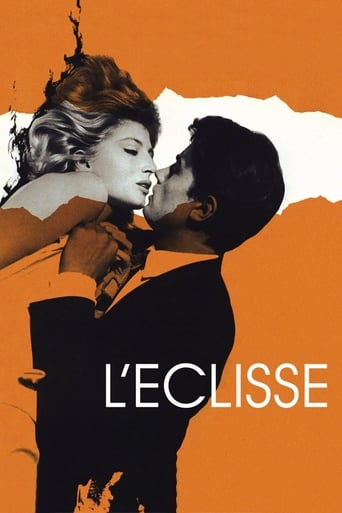
L'Eclisse
L'eclisse
1962 · Film · 126 min
Directed by Michelangelo Antonioni
Vittoria is a beautiful literary translator living in Rome. After splitting from her writer boyfriend, Riccardo, Vittoria meets Piero, a lively stockbroker, on the hectic floor of the Roman stock exchange. Though Vittoria and Piero begin a relationship, it is not one without difficulties, and their commitment to one another is tested during an eclipse.
1 positivefrom 1 commenter
Where to watch
No streaming data for this title.



1 comment on Hacker News
The ending of "L'Eclisse," directed by Michelangelo Antonioni, is one of the most mysterious endings in cinema. It's one of those scenes that doesn't impose a vision on you, but pulls something out of your subconscious, invites you to reflect on events that could have happened, should have happened, but didn't happen.
The two lovers never meet again after promising not only to see each other that day, but also every day thereafter.
For almost ten minutes, while we are waiting for Alain Delon and Monica Vitti to meet up, the camera points at small insignificant structures in the Roman suburbs, then at a balcony, water running on the ground, ants climbing a tree, leaves moved by the wind. A bus stops and one expects to see one of the two lovers appear, but it is only someone who looks like them.
It is a magical ending because it is not an ending, it is a fragment.
It reminded me of the ending of one of my favorite interviews. Donald Keene, the American-born Japanese scholar, was interviewed by David Pilling in the "Lunch with the FT" series. The interview closes off with a reflection by Pilling:
"Keene’s eyes are moist. He is staring past me or through me. The restaurant is still quite empty but Keene has flooded it with the memories of people, mostly long dead. He stands to leave and is helped up the narrow stairs to the city above. Down in the basement, I am left at the empty table. There is nothing, not even the wind in the pines."
As Antonioni, a director I recommend especially to Americans, who are culturally oriented toward appreciating stereotypical linear stories with unambiguous endings, said in an interview:
"What people ordinarily call the "dramatic line" doesn't interest me [...] Today stories are what they are, with neither a beginning nor an end necessarily, without key scenes, without a dramatic arc, without catharsis. They can be made up of tatters, of fragments, as unbalanced as the lives we lead."
I also cannot but recommend Antonioni's "La Notte" and its less ambiguous but still poignant ending. Do yourself a favor and watch it.