 Hacker Cinema
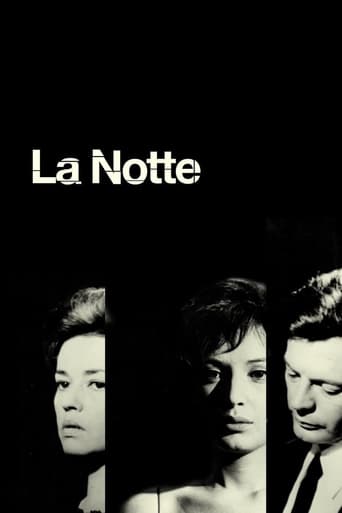
La Notte
La notte
1961 · Film · 122 min
Directed by Michelangelo Antonioni
A day in the life of an unfaithful married couple and their steadily deteriorating relationship in Milan.
4 positivefrom 4 commenters
Where to watch
No streaming data for this title.
Videos commenters linked
From YouTube links in the comments below. Most are clips and trailers; “Full” means the uploader says so.


5 comments on Hacker News
It is a terrific scene with equally terrific acting by Jeanne Moreau and Marcello Mastroianni.
She tells Mastroianni of having had in her life a man, whom we saw at the beginning of the film to be at the end of his existence in a hospital bed, who loved her, wanted her, but she preferred a man, the novelist played by Mastroianni, who never paid much attention to her. It is the usual story--I loved you but you loved and preferred somebody who did not--but the stillness of the two in the grass field, the broken voice of Jeanne Moreau, and the "lost and guilty look" of Mastroianni, made it so incredibly moving.
Another brilliant scene in "La Notte" is when Mastroianni is leaving the hospital--his wife has already left because she cannot bear to see the man who was in love with her die--and he is caught by another patient, a woman who seems to have some mental problem, and the two kiss.
As someone who has sometimes found himself inexplicably lost in the tourbillon of events--why am I doing this? This makes no sense!-- the scene was able to describe what I felt and saw in those bizarre moments.
Thank you for your detailed analysis. When I saw it I think I zoned out, but that's part of it I think - the lack of anything of note that happens, the nothingness.
Of the three films in the trilogy, my favorite part is the letter-reading scene at the end of La Notte. A married woman reads a letter to her husband, who had been conspicuously philandering all night, and he asks who wrote it. She says "you". So sad, the fading of love as memory.
https://www.youtube.com/watch?v=oOmEkqWnvsA
The ending of "L'Eclisse," directed by Michelangelo Antonioni, is one of the most mysterious endings in cinema. It's one of those scenes that doesn't impose a vision on you, but pulls something out of your subconscious, invites you to reflect on events that could have happened, should have happened, but didn't happen.
The two lovers never meet again after promising not only to see each other that day, but also every day thereafter.
For almost ten minutes, while we are waiting for Alain Delon and Monica Vitti to meet up, the camera points at small insignificant structures in the Roman suburbs, then at a balcony, water running on the ground, ants climbing a tree, leaves moved by the wind. A bus stops and one expects to see one of the two lovers appear, but it is only someone who looks like them.
It is a magical ending because it is not an ending, it is a fragment.
It reminded me of the ending of one of my favorite interviews. Donald Keene, the American-born Japanese scholar, was interviewed by David Pilling in the "Lunch with the FT" series. The interview closes off with a reflection by Pilling:
"Keene’s eyes are moist. He is staring past me or through me. The restaurant is still quite empty but Keene has flooded it with the memories of people, mostly long dead. He stands to leave and is helped up the narrow stairs to the city above. Down in the basement, I am left at the empty table. There is nothing, not even the wind in the pines."
As Antonioni, a director I recommend especially to Americans, who are culturally oriented toward appreciating stereotypical linear stories with unambiguous endings, said in an interview:
"What people ordinarily call the "dramatic line" doesn't interest me [...] Today stories are what they are, with neither a beginning nor an end necessarily, without key scenes, without a dramatic arc, without catharsis. They can be made up of tatters, of fragments, as unbalanced as the lives we lead."
I also cannot but recommend Antonioni's "La Notte" and its less ambiguous but still poignant ending. Do yourself a favor and watch it.
I'm not so sure you can find as many groundbreaking, experimental movies at the forefront of film in 2017-2020. Movies like La Notte or Hiroshima Mon Amour or Winter Light just wouldn't get distribution these days. Don't get me wrong—I agree that there's plenty of wonderful films made in the last three years. But in the 60's and 70's film was willing to be as risky and innovative and beautiful as the finest novels. I'm not sure that's true today
I have not seen cited in the comment section my favorite Fellini's movie: "La Strada". Anthony Quinn at the end of the movie shook me in ways that only Marcello Mastroianni (by the way, someone give me a call when they find a modern movie start with one third of Mastroianni's charming ways: there won't be any need for notifications on) was able to do in "La Notte". Fellini is very Italian in a sometimes decadent, sometimes lustful way. A great director, but not Italy's best (that's Michelangelo Antonioni).