 Hacker Cinema
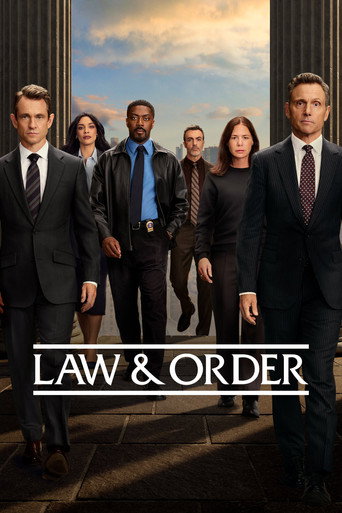
Law & Order
1990 · TV series · 26 seasons
Created by Dick Wolf
In cases ripped from the headlines, police investigate serious and often deadly crimes, weighing the evidence and questioning the suspects until someone is taken into custody. The district attorney's office then builds a case to convict the perpetrator by proving the person guilty beyond a reasonable doubt. Working together, these expert teams navigate all sides of the complex criminal justice system to make New York a safer place.
6 positive11 negative36 neutralfrom 53 commenters
Where to watch
No streaming data for this title.
55 comments on Hacker News
If it didn't originate with the show, Law & Order (the original run) has the line: "You could get a ham sandwich indicted" was said to Jack McCoy in one episode. I think I remember it coming up again in another episode.
I've heard this idea before but I think it's primarily hindsight. At the time The X Files was on, there were even more popular shows about strong institutions, like Law & Order or The West Wing. So if popular TV was influential, why didn't society evolve toward those portrayals? I think we can look back today and say "that looked like this," but it doesn't mean that caused this.
It took something far more powerful than a TV show that was mildly popular for a few years to create what we live today. It took the great flatness of the Internet. As Terry Pratchett predicted to Bill Gates back then.
The original Law & Order did a masterful job of this. Each episode (with very few exceptions) is self-contained, but deeper themes and character development run through them in long (often multi-season) arcs to reward the long-term viewer. But there was rarely more than one episode per season that was solely for the long-term viewer.
It's definitely. Notice how after the 1994 Crime Bill was put into effect you had a large wave of shows and movies that increasingly depicted police as tools of the state rather than as protectors of the public. The fact that police-centered media exploded in ever larger shockwaves after that, the Atlanta Centennial Olympic Park Bombing, 9/11, and the deaths of Trayvon Martin and George Floyd was no coincidence. Law & Order, NYPD Blue, NCIS, Chicago PD, and Blue Bloods each correspond to each of those periods. The shows and movies are designed to make the abusive and destructive actions of the police look gallant. The police themselves actually advocate on many of them in order to sensationalize depictions or manipulate points of view so that they can then take them and use them as emotional appeals when the public criticizes policing.
The name "Law & Order" is a blatant example of this, as it's a phrase used by Richard Nixon during his campaign in 1968, and was widely repeated when he created justifications for starting the War On Drugs in 1970. This same phrase was later used by Reagan and H.W. Bush when they planted their positions of wanting to wield state violence against countercultures that arose. The '90s was full of change as Gen-X started to become adults and formed their own powerful countercultures, and the title of the show was an emotional appeal to conservative older people who hated that change and wanted the state to shape society instead of the other way around.
> On a purely topical level, it was also neat to revisit the last three decades of news and politics and pop culture more or less in reverse.
It’s a fictional drama but it’s really interesting to watch ‘Law & Order’ episodes from the 90s and throughout the years.
You can kind of witness the erosion of civil liberties over the seasons and as someone who experienced it in real life, it’s pretty wild to see (at least in a fictional universe) how the police state (this is probably a misnomer, but I fail to find the proper wording in this moment) is enabled to supersede civil liberties in the interests of ‘security’ and law enforcement.
> It's whether you're punching up or punching down.
I disagree with the idea that one is "OK" and the other is "bad", "wrong" or, even worse, "problematic" (i.e., the bien-pensant's own "blasphemous"). It just makes one an eternal sacred cow, and the other the eternal punching bag, no matter either's virtues or vices.
And this, in fact, has already been the case for a long time. In the US, producer Dick Wolf's five Law & Order TV shows (and, now, his three Chicago shows) taught us over 30 years that the "wealthy CEO" or "high-powered corporate lawyer" is always guilty, and the large companies they own/work for are just as crooked. The only upscale demographic that is never the criminal is, strangely enough, the famous TV-show producer.
I would argue that hiding methods is one way to obscure motives of those building the case against a defendant.
The specific discussion was related to a "wait-and-see" attitude in regards to the motives of the justice system of France (not the motives of the alleged perpetrator). The suggestion was that if this was politically motivated then that motive would be revealed once the discovery process began. However, if the French legal systems wants to hide a political motivation then they can use parallel construction to hide their methods, thus obscuring their motives.
Also, I didn't "describe" anything. I pointed to a Wikipedia article that, in part, declares parallel construction as supported by the Supreme Court of the US. So, at least in US law, it is not at all an abuse of power but rather a totally valid approach that law enforcement can take to build a case against someone. The entire reason I even know the terms is because it showed up so often in the TV show Law & Order.
Could be, I'm not really old enough to remember how linear TV dealt with new television series. Perhaps it is mainly a problem of perception. When you turn on the hotel TV and see a Law & Order rerun playing for the umpeenth time you aren't really thinking about all the other shows that never got beyond a pilot because they couldn't outperform a juggernaut like Law & Order and earn a slot in the schedule.
The way Netflix seems to drive every season into a cliffhanger ending and then cancel seems pretty short-sighted though. If they just let stories be a little more self-contained, then these one-season shows (dare I say "miniseries"?) would accumulate into a catalog of stories that are actually worth a damn for the audiences that find them later. Every piece of content in the library that they don't have to pay to license can earn back an ROI from a niche audience over a much longer period of time since they don't have to optimize the limited number of hours in the schedule like linear TV.
I think there is an emotional difference also that plays a role here. With traditional TV, people I think were maybe more accustomed to the idea of "you get what you get". Don't like what's on? You can change the channel, but you can't pick out exactly what you want, so you have to get used to settling for "good enough". So you leave Law & Order playing in the background even if, really, police procedurals aren't something that inspire passion in you. But with streaming, there is the illusion of infinite choice. The magic of it is getting exactly what you want exactly when you want it, and the magic fizzles the moment the thing you like and very much want to continue watching gets unceremoniously cancelled. It feels like having a choice taken away.
If you've seen one episode of Law & Order or House you've seen every episode in the series.
the other side's lawyers might like a few wild-cards (as to increase the chance of a hung jury).
No, never. The defense never wants a hung jury, because the prosecution will just get another chance to have another jury trial, with a new jury, but having learned from the failure of the first trial. The defense always wants finality.
Prosecutions don't want hung juries either, because there is always the risk that the judge will either dismiss the charges (if more than half of the jury leaned toward the defense) or pressure prosecutors to offer a better plea deal to avoid wasting time on a new trial.
Usually people "too knowledgeable" get bumped from the pool
If by that you mean people who know too much about the case already, then yes, because the defendant deserves a fair trial. If you mean people who are "too knowledgeable" in general, then no, unless it's clear that they're going to take this "knowledge" and rely on that "knowledge" instead of what is presented to them in court. Lawyers generally try to exclude tech bros, because they think they know everything about criminal law based on watching a few episodes of Law & Order and CSI.
This is quite apparent in the most recent Law & Order season.
Compare/contrast an episode from season 22 which aired in 2022 vs season 1 which aired in 1990.
There are scenes in the original that have like a 15-20 people on screen doing a highly complex choreography for a crime scene with different actors playing uniformed cops, detectives, evidence specialists, witnesses, bystanders, just every one that you would expect to be in such a scenario in real life.
And that's just one scene. There are many more with unique locations, with remarkable shots on location outside and inside buildings -- all with many more people on screen.
Now they barely have 20 people in the final court room scene when the original seasons used to have 50+ people just for the background, let alone the 12 jurors, 3 lawyers/judge/defendant.
> If I was interested in watching Law & Order I can start from Season 1, not from their knockoff version of it.
Actually you cannot. Only Law & Order SVU is available on streaming. The original series and the other spinoffs only have the most recent season available online.
I have a Prime account, but I'll soon be cancelling it I feel. The same products can had on eBay for less money with no shipping charges added.
Prime video is quite unique, but I'm very much past them putting pre-roll ads on the content I want to watch. It's universally an advert for their own craptastic, homegrown version of an existing well-defined format. If I was interested in watching Law & Order I can start from Season 1, not from their knockoff version of it.
Amazon Music would be another great service I'd be willing to pay for, but all the available clients are so buggy it's an impediment to me using it.
Episodic (vs serial) television has its own problems. It can be done well, but the path of least resistance is to make episodes low-stakes, formulaic, and mindless. Law & Order, The X-Files, The Simpsons et al have vague arcs but are approachable by design, which I see as "convenient but less satisfying".
>I'm waiting for the Law&Order ripped from the headlines episode. Who will be the murder victim in the opening scene though? DUN DUN!!!
I suppose the writers could mine[0] this for inspiration.
[0] Pun intended.
I'm waiting for the Law&Order ripped from the headlines episode. Who will be the murder victim in the opening scene though? DUN DUN!!!
Agreed, it really does not seem far off now to imagine a world where I can request artifacts like
"This episode of Law & Order, but if Jerry Orbach never left the show"
"Final Fantasy VII as an FPS taking place in the Call of Duty universe"
"A 3D printable part that will enable automatic firing mode for {a given firearm}"
Another interesting landmark: there’s a Law & Order episode from 1996 where they suspect that a judge’s 5% fixed mortgage is a bribe because, as the detective notes, “I had to get on my knees just for a seven percent adjustable.”
https://subslikescript.com/series/Law__Order-98844/season-6/episode-4-Jeopardy
The books are formulaic, they're pretty straightforward, the plot twists are sometimes easy to predict. I've listened to / read over 25 of the Alex Cross books (the main character of his most popular book series,) I actually like the characters and their personality and their continuity throughout the series. It's not the best prose.
I read a lot. I think of it like watching Law & Order or some other cop TV show. I mostly read these types of books on airplanes or listen to them when driving.
The books aren't really meant to have the lingering impact of a 19th century classic or a 1984/brave new world or something like the alchemist. They don't take you to a new world or explore sci fi concepts. No aliens or weird tech or anything like this. Just a mirror of the real world with real world constraints with likeable characters and interesting, if sometimes dated, plots.
CSI: $LOCALE, NYPD Blue, Brooklin 99, Law & Order, Homicide: Life in the Streets, COPS, etc are basically "copaganda". This shit goes all the way back to Dragnet and FBI-glorifying movies like The Untouchables.
https://en.wikipedia.org/wiki/Copaganda
> Copaganda, a portmanteau of cop and propaganda, is a phenomenon described by critics of law enforcement in which news media and other social institutions promote celebratory portrayals of police officers with the intent of swaying public opinion for the benefit of police departments and law enforcement...
Movies like Top Gun: Maverick that are made with the cooperation of the DOD should be called what they are: propaganda. When Hollywood makes movies that glorify the military, they are part of the military-industrial complex. When they make movies critical of the military, they are part of capitalism commodifying resistance and selling it to people.
> There were numerous reports and investigations and even a documentary on the beltway snipers.
Yes, on the snipers themselves. Aside from a gun-control related lawsuit, there was no spillover of negative attention to everyone remotely associated with the snipers' ideology or motives.
Oh, there was a Law & Order episode based on this massacre. But they took some artistic liberty with the perpetrators: https://www.imdb.com/title/tt0629419/
That is why I enjoy the original Law & Order series. Barring a handful of exceptions over it's 400+ episodes, the only deaths happen in the first minute and are not shown; only the discovery of the body is.
I was also a fan of L&O SVU but there is a lot of violence, more than what you would think would be permissible on network TV. There is a scene where the detectives walk in midway as a spouse being stabbed to death by her partner. Had to have a think about continuing with the show after that.
You've picked two films by a single Korean director who is outspoken about his views, which his hardly a good way to show it's a recurring theme across the media in general.
I could pick Atlanta and The Wire and say American media is commonly critical of police. Or turn around and pick CSI and Law & Order and say that American media is commonly supportive of police. It hardly says something about the overall landscape. And thats even picking shows with different directors!
Ridiculously pompous thing to say once the decision to convict has been made.
Even in TV episodes of Law & Order, the furthest defense attorneys go is to ask to serve house arrest before trial because their client is "a pillar of the community" aka very wealthy.
Might be a product of what you watch.
One of the longest running dramas on American television is Law & Order, a crime drama. The most popular spinoff of this series, Law & Order:SVU has focused on this topic for the entirety of twenty-two (!!!!!!) season run. That's nearly 500 episodes of detectives investigating and describing some pretty brutal rapes and sexual assaults of people of all ages, genders, and walks of life.
Pretty much any crime drama is going to hit on this subject pretty regularly. Based on the stuff I've seen on shows that run on broadcast TV during primetime, there is not really much taboo around the subject. Comedian John Mulaney has a very popular skit that focuses entirely on the ridiculous things that are said on this subject during day-time TV.
The police are there to notarize your claims to the insurance company, as siblings illustrate. Once you're made whole, do you want to take the time to put a petty thief on trial? Every break-in is not an episode of Law & Order.
That public perception has a lot to do with Dick Wolf creating the Law & Order television series. Historically, cops have not been loved by their communities (one of the reasons the supreme court saw fit to introduce the absurd doctrine of "qualified immunity" was because cops had it hard enough without also being legally on the hook for every action they take). The L.A. times had a very interesting piece on the topic of cops in the media:
https://www.latimes.com/entertainment-arts/tv/story/2020-06-09/dick-wolf-law-and-order-chicago-pd-fbi-color-of-change
> In case you didn't notice, every election there's lawn signs saying "endorsed by the Police Union" or similar.
That doesn't contradict anything I said. There are signs saying that not because public sector unions as a whole either make up the 20% of the electorate you've claimed or vote in a unified block across different public sector unions as you've claimed, but because the general public, and especially voters that consider “law and order” an important concern, are particularly likely to be swayed by law enforcement union endorsements.
> If you want to see DA politics in action, watch just about any Law & Order episode when they discuss optics. Those "stories" are based on current affairs.
...often, quite badly. I've got a Political Science degrees from a subprogram specialized in the pragmatics of US electoral politics at all levels; “Law & Order” is, I know, entertaining to a lot of people, but it's not really a guide to reality on, well, anything.
In case you didn't notice, every election there's lawn signs saying "endorsed by the Police Union" or similar.
So get your facts straight.
If you want to see DA politics in action, watch just about any Law & Order episode when they discuss optics. Those "stories" are based on current affairs.
This simply isn't true. See for instance Batra v Wolf et al, among many other examples:
https://www.loeb.com/en/insights/publications/2008/04/batra-v-wolf-et-al
> Plaintiff Ravi Batra, a bald, Indian-American lawyer involved in a judicial corruption scandal, filed a libel-in-fiction claim against the writers, producers and broadcasters of the television show Law & Order, claiming that an episode about a judicial bribery scandal that included a character who was a bald, Indian-American lawyer named Ravi Patel was defamatory. The court reached this holding after noting that no libel-in-fiction law suit in New York state court had survived a motion to dismiss in almost 25 years, and then denied defendants’ motion to dismiss.
Actual malice is additionally only necessary if the victim is a public figure.
In all the TV shows I've ever seen featuring police as protagonists, I believe 100% of them show police corruption as part of standard procedure.
And it's gotten far, far worse over the years. Dick Wolf's "Law & Order" (1990) sometimes had rather subtle corruption, while his "Chicago P.D." (2014) makes torture a primary investigative method in every episode. Even in the rare case where a corrupt cop is taken down on TV, it's done by a slightly less corrupt cop.
Is it any surprise that we see issues with police in real life, when our entertainment has normalized much more brutal behavior? There's a huge discrepancy here. In the fictional world, torture works, and corruption always ends up being justified.
I love a good crime story, but all I see today is producers competing for who can be the most outrageous.
A huge portion of the American TV-watching demographic doesn't pay very much attention to shows while they are watching it. So they prefer shows that have predictable rehashing of the same plot each season. Think Supernatural, Grey's Anatomy, Once Upon a Time. You don't really need to put effort into remembering previous episodes because you've seen them enough to get the gist without any background.
Shows like NCIS, Law & Order, and Criminal Minds will literally run the same plot each episode. These are some of the most popular TV shows in history.
Studio executives don't want to accept that they have a hit show that doesn't cater to this demographic. Once the main story wraps up, usually after 4-5 seasons, the original creator will get fed up or fired because they are unwilling to drag the story out any longer. Then the studio brings in a generic writing team to transform the show into one of those a predictable rehash shows.
It never works because the people who are into those shows won't get past the first four seasons, and the original fans of the show get tired and stop watching.
Agreed. (Related wall of text follows)
I've always thought a major issue with the criminal justice system is serving competing masters:
You want to punish people so OTHERS decide it would be a bad idea and don't try it
You want to punish people so THEY decide it was a bad idea, not worth doing again.
You want to redeem criminals, put them on a better path
You want to ensure the criminals do not post a further threat to society
But these goals contradict each other to a degree:
Punishing to send a message is something I suspect this only work for fringe crimes - most criminals aren't know for their expert cost/benefit analysis - and regardless, "send a message" punishment hurts efforts to redeem ("we're punishing you as a threat to others" isn't something that makes people think you're fair and worth listening too)
Punishing someone to ensure they think it's a bad idea probably works in terms of teaching cost/benefit, but there's the risk that you're teaching the opposite - Life in prison has got to suck, but if you get through it and discover there is no place in the outside world for you, you're socially ostracized, hard to employ, probably in a crappy financial situation...well, crime CAN pay, and you know you can survive the consequences if you do get caught (heck, at this point, crappy as it is, you're probably used to it - not enough to like it, but it would have some degree of comfort compared to the unfamilar-and-crappy situation you are in now. I could continue to armchair psychoanalyze the effects of living in a smaller community, but I think I've made enough unjustified statements.
Redemption directly pushes against the Punishment rules. Not because redeemed criminals can't accept the concept of "paying a debt to society" (I've always hated that phrase), but because (reportedly) rare is the prisoner that ARRIVES at prison redeemed, and starting with punishment and separating them from the situations that were the problems before generally does not help with dealing with those situations. (And this is assuming this is a "dumb" criminal that committed a stupid crime for stupid reasons. My mother told me as a young child to not commit a crime I couldn't retire on. I recommend this to parents of young children...it has an inherent logic that is harder for a child to dispute than "Just Don't". I credit it with keeping me out of trouble until I was old enough to appreciate the value of laws, respect, and morality. Anyway, there are doubtless OTHER criminals who truly had no better option - redeeming them by telling them how that is their fault and we'll punish them doesn't sound like it would succeed.
Sheltering society from the increased threat that a proven criminal represents largely doesn't care about Punishment or Redemption...but it doesn't help them at all. Redemption is easier of the criminals aren't removed from life. Punishment sounds like it is helped by this, but that goes back to the "what lesson are they learning", so if we're training career criminals, that makes the Sheltering concept currently a short term win for a long term loss.
All of this is based on my opinions that are largely formed from random articles and headlines (rarely in-depth) and likely too much influence from TV and movies (insert Law & Order DUM-DUM here) so no one should actually trust this. If, however, anyone has interesting insight or even actual knowledge to share, that'd be great - I have literally thought this general structure for the last 20+ years, so it obviously has some staying power in my brain even if I'm not motivated enough to do much research.
Law & Order purposely based its stories on topics of the day. It was a show meant to be watched in its time. Future watchers won't get the same experience out of it. That said I still enjoy the older episodes. It's like looking back in time.
The pay phone definitely reveals you're dealing with an old Law & Order episode. But it's not an anachronism. Law & Order doesn't purport to display a period of time different from the one in which it was made. When you watch a 1990's Law & Order you see the world as it was in the 1990's. For it to show a scene where someone bums quarters for a pay phone is no more anachronistic than it would be for a film/tv-show depicting a scene from the 1890's to show people riding around in a horse and buggy.
Much different when you're watching a 1990's film that purports to display life in 2020, 2050, or 2100. Then the use of 1990's technology in the film is a true anachronism.
I wholly agree. My point is that you'll still see crappy characterizations of hacker-as-trope to serve the needs of different stories, contrary to the claim of the MIT article. It's not because it's sci-fi vs. drama - all writing takes place in a genre, even if that genre is 'suburban contemporary'.
(Mind, I'm being very literary theory here, rather than using entertainment industry shorthand. From this standpoint Law & Order is a restorative comedy despite the grim subject matter and lack of humor, because in a restorative comedy everything goes back to normal at the end. The show revolves around the lives of the cops, not the perps and victims, who are simply props for the police officers to relate to in each episode. If a recurring character dies or two cops go from being friends to enemies, that individual episode is a tragedy. But if the cops end an episode with equal or stronger bonds than they began it, then the episode is a comedy even if the subject matter was horrific.)
The alternative is to mint an evergreen series like Law & Order. Someone finds a dead body in NYC; investigation, trial, and silly social commentary ensue. Then vary the parameters a bit and you get SVU, Criminal Intent, et al. Characters are interchangeable, guest spots abound, social commentary changes with the politics of the day.
Walking Dead -- eh, it's getting a little old. I thought they were going to explore some primitive economics, and maybe they will, but the cliffhanger gag last season reminded me too much of "Who Shot JR?" Not sure I care. And the spinoff went too heavy on the social commentary, couldn't even finish Season Two.
Mr. Robot is more promising, but I haven't seen one yet that comes close to the satisfaction I got from the clear arc of the story in Breaking Bad. Sons of Anarchy tried, but fell short somehow.
Fiction represented what people saw around them and considered them as some sort of values.
Someone above mentioned "Law&Order" as some sort of dismissal, but that's exactly the point, in a "know it all surveillance society" the societal aspects that made the producers think: "hey, let's make a show about the good guys catching the bad guys, let's call it 'Law&Order'" would not be present. Fiction is always backed up by facts from the real life.
I should know, i grew up in a wannabe "know it all surveillance society" (on the Eastern side of the wall), where we did not have TV shows like 'Law&Order' because, technically, the "socialist society" we were part of didn't have any bad guys. There were of course criminals, and rapist, and bad people, but they were just a glitch hidden under the rug. It was sort of supposed that in the brighter future awaiting us all those "bad elements" would have been gone for good.
The former socialist government of my country was against the bad guys because in the end we were all supposed "to all be equal", some commenters on HN are against the bad guys because it brings down real estate prices, maybe some other people are against the bad guys because in a book of fiction 2000-years old someone wrote it down that: "You should not steal", the fact remains that no-one, ever, would be able to hide the "bad guys" under the rug, for ever. It's against our very nature as a species.
Even if they have enough testimony to convict him, they may be more interested in forensic clues about where he obtained his files.
Decrypting his hard drive may lead to other charges against other people. If he knows that he can incriminate others, he may be waiting for a deal.
They're playing hardball with him right now. After six months in jail, watch them offer him a deal if he unlocks the hard drive. He gets a firm but reduced sentence (including time served) and they get more bad guys.
(Why yes, I have watched too many episodes of Law & Order, why do you ask?)
It is for a lot of people, unfortunately.
It's even part of our culture to take pride in doing bad (immoral) things because it's within the law but is for some supposedly greater good. A particular example of that would be quite a lot of episodes of Law & Order.
Outstanding. It's like a ridiculous Law & Order episode where the defendant goes "I wasn't even in town that night."
"So what's your face doing on all of these security cameras at the scene of the crime?"
"... uh..."
Brin makes his points but neglects counter-evidence, both fictional and non-fictional, so I will supply a few examples:
1) Support The Troops / First Responders 2) Religion 3) Law & Order TV series 4) Nearly everything on The History Channel
Nearly all of the above glorify institutions, or more accurately, indivividual working within institutions.
Nowadays you have teams of two or three, which are at the same time up against the external threat and the institution within which they work. Lone heroes saving the day in spite of the incompetence (or corruption) of their colleagues.
While they are small teams (were they ever big?), with regard to "fighting the institution", frankly, that's not the impression they leave me.
They have their moments of rogue colleagues or corrupt departments, but for the most part, what I see is a small team backed up by a larger institution fighting Evil (criminals, terrorists, etc).
I'm talking about the mass market, mind you, not The Wire but NCIS, CSI, Law & Order, Hawai Five-o, Criminal Minds and all that crap.
And then there's this recent influx of zombie movies - the libertarian paradise, where no one tells you what to do, there is perfect free trade facilitated by the proliferation of firearms within general population, and where everything that moves in a group larger than 20 is a mindless mass trying to kill you.
Which movies? I had to admit I haven't watched recent zombie flicks, but The Walking Dead has been the most successful show, and it's pretty much the opposite of that description. It's constantly reinforcing how much the breakdown of The System sucks and gets people to kill each other.
As a category, anime has some unique characteristics you don't (generally) find in other TV or film categories:
1) Strong user/viewer affinity for the category. Generally speaking, you don't find that your typical Grey's Anatomy viewer is a "medical drama fan," who seeks out other medical dramas at every opportunity. Likewise, a rabid Family Guy viewer is probably not an "animated comedy fan," barring a very tiny and borderline-insignificant segment who is. They might be fair-weather fans, but their consumption of those categories is ad-hoc and show-dependent. Anime fans may come to the category seeking a particular show -- Cowboy Bebop, Attack on Titan, or what have you -- but many of them stick around for anime as a category. Someone who likes Law & Order isn't going to seek out other legal procedurals, but someone who likes a mecha show is going to look for more mecha shows.
2) Anime is underrepresented on TV/movie services like Netflix, or in other "mainstream" TV/movie sites and aggregators. (That said, there are anime-specialist players in these markets, such as Crunchyroll and Anime Network.)
3) High fan engagement online, more so than with many other categories of film or TV. Thus, a more addressable user base.
Of course, these factors can also work against you. As another commenter has pointed out, the characteristics that make anime unlike other genres also makes bridging the gap between anime and other genres very challenging. Anime companies are usually in the business of addressing the TAM in the anime category; they seldom find success using anime as a beachhead to attack TV or movies in general. Not saying it can't happen, or that it's never happened. But it's difficult.
> Honestly, have you never in you life watched a single episode of a police procedural TV show? Even an episode of Cops?
Haha, c'mon. Your supporting evidence is Law & Order?
When there are judges being sent to prison because they themselves were found sending boys to private prisons for money, do you expect people to have confidence in the justice system? Yes, fabulous, the judges were eventually caught. But in the meantime their corruption inflicted serious harm on all involved.
I'm pretty sure you're trolling. I need to believe you are.
> This is the same pattern as for most crimes. Seriously, minus the murder bit, it's a law and order episode.
I guess that's why the original Law & Order is one of the few TV shows I like.
> What I want to know, is not the predictable sequence of events, but who would do this, why would they do this, tell me the thought process that leads to these actions.
I also want to know all this, so I think you may have misunderstood my position. (This applies to your other comment where you call me disingenuous for no good reason.) What I don't want is stuff like "Tourists milled about the platz in front of the cathedral, Germany’s most visited landmark, craning their necks to snap pictures of the impossibly intricate spires jutting toward the heavens.", nor do I want teaser paragraphs endings to keep me hooked on the article as if I would stop reading it without them.
I'm only a little worried about this. When you ask the lay what "film" looks like and why video looks different, most people cannot quantify what it means (but can definitely tell the difference). "Film" to most people is that slow, deliberate frame advancement of 24 fps, blur and all. Take that away, and it doesn't look like "film" any more; it's just how we're collectively used to it.
This reminds me of, say, Law & Order. The detectives are standing around a monitor, reviewing security tape; medium shot of the detectives, 24 fps. Full screen tape: 30 drop. Back to the detectives, 24 fps. We've all seen that before -- whenever the characters play with a consumer camera or look at a security feed, visually, a distinction is set by accelerating the frame rate. Producers know this. It just shouts "not a professionally-photographed teleplay!" in most peoples' minds now, and I think there will be resistance to rewrite that rule mentally.
While I welcome dramatic entertainment that looks more like real life, I worry that culturally, we're used to 24 fps and it's going to be a begrudging transition. At least HDTV offered a noticeable improvement. Not everybody will say the same thing about more visually real entertainment; entertainment is entertainment for a reason, and we do not want to be reminded of real scenarios in most cases (it's a flight of fancy).
My two cents. Will be interesting to see how this plays out, anyway. Imagine anthropologists discovering threads like this one in thousands of years: "they even quibbled over the frame rate of their time-dilated visual entertainment..."
This was the plotline of a 3rd season episode of Law & Order, "Virus". http://www.imdb.com/title/tt0629490/
Hi, I'm <full name>! My site says what city I'm from. I've written publicly to admit that I committed multiple crimes, definitely without consulting legal counsel first! I even put them in a nice bulleted list that can be copied and pasted right into a complaint. They're pressing charges, but that's bullshit. I'm 16!
Not too bright, are we? Instant message the company you just hacked and bust out from behind your handle, then provide evidence for the prosecution in the form of a Web page? What is with kids these days?
It only takes one episode of Law & Order to figure out how to proceed here. Clue: Attorney.
One thing that has always settled the wrong way with me about television police shows is that they hardly ever approach this topic. I can only imagine what it's like to be a prosecutor or a detective and wondering if you caught the right person. Maybe it's not every case, but as you mentioned, there have to be those one or two where they just keep you awake some nights.
It probably just doesn't make for good television to dwell on this topic. The good guy almost always puts away the bad guy and there's no question about it being the right decision.
I realize cop shows probably portray only a slim resemblance to reality. When I see a show or movie portraying something to do with computers or nuclear reactors there's always that feeling of "that's not how it is in real life!" No doubt, police officers watch the (many, many) shows about their profession with the same thought. However, like it or not, it's these shows that shape the average person's perception of law enforcement. It's the only exposure we get to it, with the exception of maybe being pulled over a handful of times throughout our lives.
Disclaimer: I don't watch any legal shows like Law & Order - maybe they do a better job with this?
I became aware of time - and how I decided to spend it - in a way that I never had before. Questions consciously presented themselves at every turn: What am I doing right now? Am I doing something interesting? More importantly, is my lifestyle something I'm proud of? Forfeiting so much of my privacy forced me to start living up to my own standards. "Should I watch another episode of Law & Order? I'll work on that essay first." On the whole, I became more productive. And there was much less, if any, drifting between daily activities. [1]
I noticed a similar effect when I started writing down how I spend my time. But it's starting to fade a little, maybe I should try this method ... although it feels kind of cumbersome.
Self-reflection can really suck sometimes, keep it up! :)
Edit: also anyone who is interested in this general topic should watch We Live in Public. It's a very lovely grim reminder of all the things that can get really strange once you start sharing your life with everyone indiscriminately.
Whether or not the author's behavior was 'suspicious' is irrelevant. The problem is with the actions of the officer. He handled it terribly wrong. The proper approach is NOT that Law & Order routine, but friendliness, and understanding. It garners far better results than that movie cop silliness. Whether the author was a terrorist or not doesn't make the officer's incompetence any better.
Games, especially MMO's and Social Gaming exploit their addictiveness to keep people paying them.
Certain TV shows exploit similar addictiveness. CSI, CSI: Miami, CSI: New York, NCIS, NCIS: Los Angeles, Law & Order, Law & Order: SVU, Law & Order: Criminal Intent, Law & Order: Trial by Jury . . . all still supplying ~24 new episodes a year during prime time slots. To put it roughly, 9 days worth of programming that is essentially identical. Then there's the more unique (to some degree) procedurals (IE NUMB3RS, Castle, etc. Incidentally, the only procedurals I like, I can't stand the CSI crap as my mind is violently raped by unscience almost every other episode I watch) that appear.
I personally did stop watching TV for a prolonged period, but for no elitist reason as I love TV . . . perhaps too much. However, I'm satisfied watching only the show, so I'm more a DVD person.
Movies, again, strike at this addictiveness with the 'unnecessary sequels' market. It's one thing when a movie plans multiple parts, a la the Borne trilogy. However, then there are the Bond series that maybe only hit a good movie every 3rd or 4th produced, but still take in millions. Then there are the totally unnecessary sequels that appear because the studios dangled hundreds of millions of dollars off an ACME sized mousetrap to bag a producer.
Books similarly can get into this trouble of unnecessary sequels. I believe Agatha Christie inadvertently suffered this problem as her publishers forbid her from killing off Poirot, it took her 40 years for the novel that killed him off to be published.
Ironically, the most addictive TV shows and books appear to be detective dramas. This is easily illustrated by the fact that Mystery/Crime novels is the biggest market in literature, and by the fact there are over 9 procedurals routinely running during prime time slots, year after year for almost a decade.
Yeah, I heard all about how laws killed P2P on the latest episode of Law & Order I torrented.
I see this as more of a 1990s-style Law & Order episode. Especially since there were alleged Russian Mob connections to his wife, and they cover that on the show from time to time. (Or did, I have only watched through season 5 ;)
I imagine Ben Stone and Reiser wouldn't really get along, which could be amusing.