 Hacker Cinema
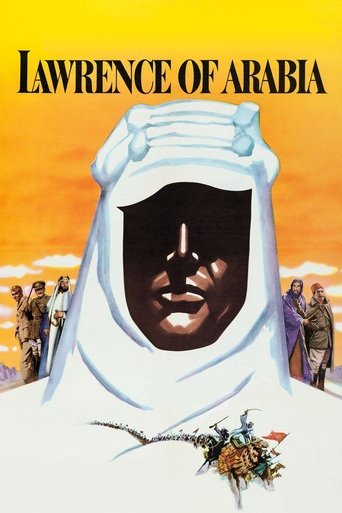
Lawrence of Arabia
1962 · Film · 228 min
Directed by David Lean
During World War I, English officer Thomas Edward 'T.E.' Lawrence sets out to unite and lead the diverse, often warring, Arab tribes to fight the Turks.
46 positive3 negative1 mixed54 neutralfrom 104 commenters
Where to watch
No streaming data for this title.
116 comments on Hacker News
> For years I heard people arguing that wider aspect ratios were preferable because they afforded a wider view > Now we're being told the opposite.
I agree with you, but I must also make a special case for IMAX 70mm. It's about the seating position. What we call IMAX 70mm now, was once just "IMAX" and its gimmick was a floor-to-ceiling wall-to-wall screen with a relatively close seating position, such that the viewer felt immersed in the movie. Back then it was commonly used for science documentaries where they could soar you over landscapes and in amongst the sea creatures. So this print of The Odyssey is allowing users to enjoy this same gimmick, but with a legit movie. I remember watching an earlier Nolan Batman film in an IMAX 70mm auditorium --while the picture quality was good, it was not shot to take up all the vertical real estate. So presumably they did not use IMAX cameras when filming (just normal 70mm).
As for widescreen, in ye olden times theatrical releases would use it as a gimmick for big visually impressive movies like Lawrence of Arabia. Eventually nearly every movie in the theater used a relatively wide aspect ratio, and as these were converted to VHS and DVD they were commonly butchered into a "full screen" format that erased the left and right part of the image. (They had to slide the view left and right to keep characters on the screen; people called this pan-and-scan.)
There's nothing inherently better about any particular aspect ratio IMO. What's most important is that you are seeing what the director wants you to see.
I have never seen that in real life though, only regular 70 mm film of which 65 mm is definitely used for the picture and audio channels for the rest. E.g Lawrence of Arabia
I still use mine pretty consistently for some specific use cases. Video editing in DaVinci Resolve using my MacBook Pro w/ Mac Virtual Display helps a ton with workflows where I need the extra space, and is definitely what I find the most helpful for it. I've also used it some for music production with Logic Pro, and it can be somewhat helpful, as long as I'm not live tracking instruments. Pretty much anything that benefits from more screen real estate is great on it.
Also, media consumption in general on it is unparalleled. I watched Lawrence of Arabia a few weeks ago in the Super Panavision 70 native resolution and was in awe of how much a difference it made for my appreciation of the film.
It's not a product for everyone, but I've not used anything quite like it. One of my favorite memories of it was getting my father to send me some of his favorite photographs from his travels (he's a professional photographer with a great camera setup) and making an album of spacial and panoramic photos for him and some other family members to relive. My grandma literally cried because she can't travel anymore so being able to see the world as if she was there was super meaningful :)
Hard disagree about declarative "X is Y". It's a failure of weakening attention span. There are plenty of excellent long movies:
- Once Upon a Time in America (1984) 3:49
- Lawrence of Arabia (1962) 3:47
- The Irishman (2019) 3:29
- Malcolm X (1992) 3:22
- The Godfather Part II (1974) 3:22
- The Lord of the Rings: The Return of the King (2003) 3:21
- Schindler's List (1992) 3:15
- Gandhi (1982) 3:11
- The Green Mile (1999) 3:09
- The Deer Hunter (1978) 3:03
- The Lord of the Rings: The Two Towers (2002) 2:59
- The Lord of the Rings: The Fellowship of the Ring (2001) 2:58
- Casino (1995) 2:58
- Braveheart (1995) 2:58
- The Godfather (1972) 2:55
- Django Unchained (2012) 2:45
What I most object to is lazy storytelling for lazy, second-screen audiences lacking in style and subtlety having a robotic, spoon-fed, infantile, unnatural, expository narration quality in every character like it's a commercial for an antacid.
I know it’s not really full ownership in the same way but I’d also remind folks that digital movie purchases still exist and are often a very good value. My library is full of movies that cost me $5 or less. One example is Lawrence of Arabia in a beautiful 4K transfer. I’d recommend Apple for this as their streaming quality is top notch: they are cinephiles over there.
Also, you really don’t need a blu ray player investment to just buy blu rays, rip them with a USB blu ray reader, toss them on self-hosted jellyfin. It’s really better than the blu-ray player experience especially since you can rip 4K blu-rays without having to invest in the rather limited selection of expensive players.
My third suggestion is to just skip all this and sail the seas.
We're not talking about random people pulled off the street and asked to watch Lawrence of Arabia. We're talking about film students. So I don't see how your post is relevant at all. It's like excusing poor literature students because your brother in law struggled with Moby Dick.
> And really, really boring and slow a lot of the time
If you only watch the story-driven scenes in Lawrence of Arabia, and skip the prolonged shots of the desert, you would miss out feeling the same vastness and heat Lawrence is feeling.
There is a limit to how much a film can make you think or feel. Films that reach the highest limits need "boring" voids in-between the primary scenes. These voids are not to ingest more, but to help digest what has been ingested in previous scenes, with subliminal scenes and silence that let the right thoughts and feelings grow.
I like a lot of long films, but at nearly 4 hours, Lawrence of Arabia is a marathon of a film. I've not seen it, I did order a copy recently, but it was cancelled; and I missed the Fathom screening for some reason or another, but I'll see it eventually; I like long movies and movies involving sand, so it seems like an easy win.
I would think a film studies class might not want to spend so much time on a single film, so maybe several scenes would be more appropriate.
> If I were a film professor today, hell even 20 years ago, I would not expect a modern film student to sit through that whole thing.
Our local cinematheque has just had a 70mm festival, where they of course screened Lawrence of Arabia. All screenings were sold out. My mom went to see another screening at the same time, and commented on how many young people were going to see Lawrence. The past couple of years there has been a strong uptick[1] here of younger people flocking to see older films.
[1]: https://www.nrk.no/kultur/analog-film-trender-blant-unge-1.17726159
I don't dispute the shortening of attentions spans, which seems to be directly related to new forms of entertainment young people consume.
However. Films across the generations are very different in terms of how they lay out a narrative. Watch any film before 1980 and you'll start to see a pattern that the pacing and evolution of the narrative is generally very, very slow.
Art is highly contextualized by the period it's created in. I don't really think it's fair to expect people to appreciate art when it's taken completely out of its context.
Lawrence of Arabia, for example. What a brilliant, brilliant film. Beautiful, influential, impressively produced. And really, really boring and slow a lot of the time.
If I were a film professor today, hell even 20 years ago, I would not expect a modern film student to sit through that whole thing. I think it's my job as a professor to understand the context of the period, highlight the influential/important scenes, and get students to focus on those instead of having to watch 4 hours of slowly paced film making and possibly miss the important stuff.
I absolutely love the idea!
As a movie geek I'm personally offended when someone says "oh, it's from 2017, it's an old movie!", or "I don't want to see anything from 90s, yuck" - and that's pretty common.
Of course, "Nosferatu, eine Symphonie des Grauens" is not for everyone, but I firmly believe that you can watch the new Dune and Lawrence of Arabia back to back and have similarly enjoyable time.
Fallout 1 and 2 are miles ahead of Fallout 3 (mostly due to uncanny valley phenomenon). Sure, the medium has changed a lot and modern consumers are used to more streamlined experience - my favorite example is the endless stream of Baldurs Gate "modern reimplementations" or rehashes, like Pilars of Eterniety that were too close to the original source, and then, suddenly, someone came up with Divinity, basically a Baldurs clone but with modern UI and QoL improvements.
But consoles are different.
This can truly be a window for the next generation to look back in the past.
I've been saying this for years. The director's cut was attempting to make a modern David Lean style epic in the vein of Lawrence of Arabia.
The theatrical cut tried to chop it down to be a bog-standard Hollywood action film, at the expense of pacing, plot, and characters.
I had the good fortune of seeing Lawrence of Arabia in 70mm in a theater and then going to watch Prometheus within the same two week span. It gave me a much greater appreciation for the movie [Prometheus], and what it was trying to do.
It's similar on the surface. Another language, Effekt, does actually use interfaces for their effect declarations rather than having a separate `eff` declaration.
The difference comes in their use. There's two things of note. First, the implementation of an interface is static. It's known at compile time. For any given concrete type, there is at most one implementation of MovieApi. You're using the interface, then, to be generic over some number of concrete types, by way of only specifying what you need. Effect handlers aren't like this. Effect handlers can have many implementations, actually. This is useful in the case of ex. adding logging, or writing tests to simulate I/O without actually doing it, or just having different behavior at different places across the program / call stack...
eff MovieApi { def getPopularMovies(); } def main() { run { println("Alice's movies: ", getPopularMovies()); } with handler MovieApi { def getPopularMovies() = [ "Dr. Strangelove", "Lawrence of Arabia", "The End of Evangelion", "I Saw the TV Glow" ]; } run { println("Bob's movies: ", getPopularMovies()); } with handler MovieApi { def getPopularMovies() = [ "The Magic School Bus: Space Adventures", "Spy Kids 3-D: Game Over", "Twilight: Breaking Dawn: Part II" ]; } } Second, the effects of effect handlers are not functions. They're under no obligation to "return", and in fact, in many of the interesting cases they don't. The `resume` construct mentioned in the article is a very special construct: it is taking the "continuation" of the program at the place where an effect was performed and providing it to the handler for use. The invocation of resume(5) with a value looks much like a return(5), yes. But: a call to resume 1) doesn't have to happen and the program can instead continue after the handler i.e. in the case of an effectful exception, 2) doesn't have to be invoked and the call to resume can instead be packaged up and thunkified and saved to happen later, and 3) doesn't have to happen just once and can be invoked multiple times to implement fancy backtracking stuff. Though this last one is a gimmick and comes at the cost of performance (can't do the fast call stack memcpy you could do otherwise).
So to answer your question more briefly, effects differ from interfaces by providing 1) a decoupling of implementation from use and 2) the ability to encompass non-local control flow. This makes them not really compete with interfaces/classes even though the syntax may look similar. You'd want them both, and most effectful languages have them both.
Same here. I'd never seen parts of it on TV or anything until I watched it for the first time, since I'd seen it was ranked #1 on IMDB. There wasn't anything about it that made me feel like it was the best movie ever. The plot was very conventional, the shots were fine, the performances were pretty good - it seemed like a 7-8/10 movie, there are lots like it. Then I watched Lawrence of Arabia and 2001 and I got the "best movie ever" kind of feeling from them - great cinematography, big themes, bombastic soundtracks. But I can see why Shawshank could be the least controversial movie of all time, it's fine at everything and that helps when there are so many people ranking it.
The Lawrence of Arabia line is from the 1962 film. Perhaps there's an HN'r who knows an earlier variant.
https://old.reddit.com/r/movies/comments/1ja9kdy/why_is_the_matchstick_cut_in_lawrence_of_arabia/
Culture evolves. There's no accounting for taste.
Putting aside the issues with manipulated IMDB ratings, look at the volume of Marvel movies ranked equal or better than classics like "Vertigo" or "Lawrence of Arabia".
Film lovers (or perhaps snobs?) feel jaded about recent output. Pop culture dictates that superhero movies are more accessible. The coarsening of culture is a continual, evergreen observation.
I'm "only" 40 and strongly prefer films made when they still shot and edited on film. The peak as far as visual quality and overall effect of film, for me, was probably the 60s through early 90s, though I love a bunch of films older or newer than that.
The constraints of not being able to color-grade the whole film with a slider or two, of every cut in the edit taking time to do, and of effects that weren't in-camera being relatively expensive, tended to lead to better and more-interesting filmmaking, even in middling films.
I appreciate what the right people can do with modern tools—I enjoy and even love plenty of newer films, and it's undeniably brought some cool stuff within reach of smaller, cheaper productions—but overall I see it as making cinema worse.
"We did it in a computer" being the answer to every "how'd they do that?" isn't movie magic, it's boring as hell. It's why even a film that tries to avoid that to some degree, like the new Dune duology, is in some important respects—though setting aside overall quality of the film on some other dimensions—just less interesting than broadly similar films like Lawrence of Arabia or Star Wars (or even, if I may be so bold, David Lynch's Dune).
I think this sort of opinion is fairly common among film-fans of all ages, due to interest in film making itself as much as output of the process per se. Not sure most movie watchers care, and they may well prefer the newer stuff because of the ultra-fast editing and tuned-to-be-cotton-candy-appealing color schemes and unconstrained video-game camera of fully CGI scenes and all that.
> I prefer 1970s music. Autotune is for whippersnappers.
Hard agree. I can't friggin' believe the heavy-handed autotune in children's media, especially (Daniel Tiger! Fred Rogers would be so unhappy with it). Let's teach them that natural human singing voices, like their own, sound wrong and bad. WTF.
> The last film I've seen in an ultra-wide like this was the original 3-wide version of How The West Was Won, which I actually really enjoyed.
I definitely agree. I saw Lawrence of Arabia in Hollywood presented in the original Super Panavision 70 (2.76:1) and it was sensational. However, the Sphere format is far wider than even that. Plus the Sphere format is both wide and tall and the horizontal curvature yields a wrap-around that's nearly 180. And the shape of Sphere's internal screen is weird, sort of like sitting inside an empty, cavernous NFL football helmet (note: the internal screen shape is very different than the shape of the Sphere exterior dome). The internal screen is made out of multiple complex compound curves. This inconsistency makes rectilinear-esque projection mapping even more obviously wrong, especially with any camera motion. So don't confuse your appreciation for "How the West Was Won" in wide format with the theatrical abomination that is the Vegas Sphere.
I think there's lots of reason for optimism around Extra-Wide formats like IMAX and Panavision Super 70. However, I struggle to find anything positive in the trade-offs baked into the much more extreme Sphere format. All engineering in this area is full of trade-offs but with the Sphere it's clear they optimized almost exclusively for huge capacity (up to 20,000 people), the highest possible "First 90-seconds 'Wow!' impact on naive audiences", and the most impressive external and internal conceptual 'curb-appeal'. They wanted to be obviously, overwhelmingly "biggest, roundest, tallest, widest screen EVAH!" And to over-achieve on that dimension they intentionally chose to reject all aspects of technical balance which might mitigate the worst quality trade-offs. In the design brief they went all-in on FUCK the contrast, brightness, parallax and any hope of cinematic storytelling. Just make the screen BIGGER, WIDER, TALLER (and cram MOAR seats under it).
In that sense, I guess they understood their market, because it fits the worst aspects of the traditional Vegas low-brow, aesthetic of big, garrish, tasteless, attention-seeking spectacle focused on exterior curb-appeal and shallow initial impact yet ultimately delivering low-quality disappointment. And it looks like it's working because they're clearly making money. They're even talking about replicating the Sphere in other major cities around the world, although I suspect the format may not have staying power outside the unique context and aesthetic of Vegas. And to be fair, the Sphere may be a fine concert and event arena (I didn't see it in that form and the reviews are mixed). I only consider the Sphere an abject failure in trying to be a theatrical venue for high-quality visual presentation of cinematic storytelling.
I remain open-minded and even hopeful regarding other potential advances in wider-format and alternative-format theatrical exhibition. I'm also open-minded about new storytelling potential that might be enabled by immersive head-mounted stereo VR. But I simply love the medium of cinematic storytelling too much to remain silent when the Sphere markets itself to the naive masses as being the ultimate in high-quality theatrical presentation when in reality the format chose to be so over-the-top extreme, it's literally broken for the purposes of high-quality theatrical presentation of cinematic storytelling. And I went to the Sphere sincerely hoping to be blown away by an unexpected miracle of modern day engineering overcoming the challenges of the format, but alas...
That's just your avg elitism. The idea that the world is better by making the creation of art expensive so that only a small group of elite people is nonsense.
Effort of course went down that's clearly a good thing. As for quality, before you needed to get enough return to pay for the expensive equipment and process, so likely you only do it for very few project. So on some abstract sense maybe 'quality' did go down, but that isn't bad as the total amount of high quality goes up far more.
See the massive amount of great TV that have happened since digital cameras.
> slop
What's slop for you is somebody else's favorite show.
Art doesn't have to 'impact us in a positive way' whatever that means. You are not a better person for having watched "Lawrence of Arabia". And in the past most people didn't watch "Lawrence of Arabia" but generic TV shows.
Personally I can easily filter the 'slop' (ie thinks I don't care about) so given how much better the ability is to select what to watch. On demand media libraries, recommendation systems, digital word of mouth and so on. In the past there were few TV channels and only a few movies in theaters at the same time.
So the total access to high quality content has gone up exponentially.
>unlike what's suggested (if not quite stated) in the film Lawrence of Arabia
The scene from the movie is based on this passage from chapter 20 of Seven Pillars, which suggests that while he was familiar with Arab clothing before the war, there was a period of time when he was in British army uniform during the Arab conflict, until he was asked by Feisal to change into Arab clothes:
"Suddenly Feisal asked me if I would wear Arab clothes like his own while in the camp. I should find it better for my own part, since it was a comfortable dress in which to live Arab-fashion as we must do. Besides, the tribesmen would then understand how to take me. The only wearers of khaki in their experience had been Turkish officers, before whom they took up an instinctive defence. If I wore Meccan clothes, they would behave to me as though I were really one of the leaders; and I might slip in and out of Feisal’s tent without making a sensation which he had to explain away each time to strangers. I agreed at once, very gladly; for army uniform was abominable when camel-riding or when sitting about on the ground; and the Arab things, which I had learned to manage before the war, were cleaner and more decent in the desert."
Also, the below quote is from the introduction, which I might add is perhaps the most beautiful introduction I've ever read. I sometimes go back just to read it:
"In my case, the effort for these years to live in the dress of Arabs, and to imitate their mental foundation, quitted me of my English self, and let me look at the West and its conventions with new eyes: they destroyed it all for me, At the same time I could not sincerely take on the Arab skin: it was an affectation only. Easily was a man made an infidel, but hardly might he be converted to another faith. I had dropped one form and not taken on the other, and was become like Mohammed’s coffin in our legend, with a resultant feeling of intense loneliness in life, and a contempt, not for other men, but for all they do."
20 years ago when I was living in Shanghai, my girlfriend was a member of the communist party (meritocratic she was enrolled because she had great grades). She had regular meetings with a small group of members of the party and they had regular discussions after being told to watch certain movies.
Lawrence of Arabia was one of those movies she had to watch to later discuss with other members... So we watched it together, had great discussion about it. Later when she went to meet with the other party members, they discussed the cult of personality surrounding the character and the use of guerrilla tactics.
(Another movie they all watched like this was 7 years in Tibet)
I saw "Lawrence of Arabia" at the Riverside Theatre on Wisconsin Avenue in Milwaukee in 70mm in the summer of 1962, the year it was released. I was overwhelmed ("blown away" as a term of art didn't exist back then but would be an apt description). I was SO thrilled when, after nearly two hours, the screen said "There will now be an intermission." Never heard of such a thing back then for a movie!
I note that the film is now available for rent in 4k. I'm gonna take a flutter and watch it on Vision Pro.
There’s even a part at the beginning of Lawrence of Arabia film where he puts out a match with his fingers, and throughout, Lawrence proves his ability to overcome pain. Very reminiscent of the Gom Jabar.
The meaning of brainrot keeps changing. Originally(?), it refered to a particular extreme/ADHD content understood only by the perpetually online. Remixes of the spinning oiia cat are pretty good examples: https://m.youtube.com/watch?v=IxX_QHay02M
This neuroscientist seema to be throwing the label on all of TikTok or all short form video. This seems barely more sophisticated with grouping together Lawrence of Arabia and Transformers 4 as movies.
I appreciated the change to make Chani fill a role like Sherif Ali in the film Lawrence Of Arabia (the book Seven Pillars of Wisdom, if not the film, is plainly a huge influence on Herbert's Dune, and it's probably impossible for a director to film so much as a scene set in the desert without thinking of Lean's film).
So much of Dune takes place inside people's heads that it's basically unfilmable if you don't make some changes. Plus, even with five hours of film, you're going to be cutting whole scenes from the book whether you want to or not. Lynch's solution was to make it a more straightforward hero's journey—and given the length of his film, and no expectation of sequels, I can't really blame him. Villeneuve had more space and so could tell a darker and more foreboding story, closer to the original, but still needed to externalize some of that internal struggle and foreshadowing, for which he used, especially, Chani.
[EDIT] Oh and as for this:
> I know its nerdy but I absolutely hate when movies of classic books think the story needs to be changed
Every now and then such a deviation ends up being excellent as its own way, while still benefitting from the connection to the original and being better as an "adaptation" than an independent property. Verhoeven's Starship Troopers would be one of the more extreme examples of this kind of outcome. A gentler one might be Kubrick's The Shining.
But films without CG are clearly superior and it’s not even in contention.
Lawrence of Arabia or Cleopatra alone have incredible fully live shot special effects which can not be easily replicated with CG and have aged like fine wine, unlike the trash early CG of the 80s and 90s which ruined otherwise great films like the last starfighter
> You can't make this argument for watching a movie, though. You can't substitute some crap movie like Gigli or The Room for the experience of a cinematic masterpiece like 2001: A Space Odyssey or Lawrence of Arabia. It's like comparing some 4-year-old's crayon drawing to a painting by one of the masters.
You can't substitute mspaint for photoshop either, what a weird take.
And you can substitute any capeshit movie for any other capeshit movie since they're all the same.
Your analogy makes no sense.
>One thing you might be overlooking is that there are often substitutes for the pirated products.
This works for software tools, but it doesn't work for movies or other artistic works. For example, personally, I'm a firm believer that no one should pirate Windows: if you can't afford it, then you have lots of free options available (namely, countless Linux distros). Same goes for Photoshop: if you can't afford it (or don't want to), there's free alternatives like Krita. These software programs are just tools to accomplish a task; if you can't get access to one, you can likely find something else to do the same thing.
You can't make this argument for watching a movie, though. You can't substitute some crap movie like Gigli or The Room for the experience of a cinematic masterpiece like 2001: A Space Odyssey or Lawrence of Arabia. It's like comparing some 4-year-old's crayon drawing to a painting by one of the masters.
>Was that "common knowledge" in the sci-fi community back then? That future displays would be flat, thin, rectangular?
I really don't know, and maybe I'm assuming too much, but it seems to me that guessing that displays in the future would be flat, thin, and rectangular would be merely logical extrapolation, not any great feat of insight.
Displays were already rectangular (basically) for many good reasons: we see this in both movie screens, and televisions. They played around with various aspect ratios, and found that people generally liked wide screens for movies, including extremely wide aspect ratios for "epic" movies like Lawrence of Arabia. Given the way CRTs worked, it would have been easier to have circular displays in those days, but they didn't, except for really, really old oscilloscopes. Long before CRTs, people already had photographs, and here again they were rectangular, despite camera lenses being circular. They didn't even like square photos, despite that being technically easier with circular lenses. So I think any idiot in 1960 could have guessed that displays in the future would remain rectangular. Of course, TVs at the time were not truly rectangular (they had rounded corners), but that was a technical limitation due to how CRTs worked. There was no effort to make movie theater screens look like that.
Flatness too seems pretty common-sense. Photographs and movie screens were flat. TVs weren't totally flat, but again it was a technical limitation, and they made them as flat as they reasonably could with the technology available.
Predicting thinness doesn't seem to be any feat of brilliance either: again, photographs and movie screens were very thin, obviously. Movie screens relied on rear projection, but that's a technical limitation. TVs weren't thin at all, but again this is a technical limitation, due to how CRTs worked. There were efforts to make CRT TVs thinner; I remember even reading about one attempt to have the CRT mounted sideways and somehow make the electron beam take a 90-degree turn. People didn't really want displays to be so thick. And as we saw from history in the 90s/00s, as soon as decent LCD flat-screen monitors became available, consumers quickly abandoned CRTs.
Here's what I term my "flypaper" movies. If I happen to glance at the satellite TV guide and notice one of these coming up, there's a good change I'll be watching it.
Lawrence of Arabia The Maltese Falcon Most Hitchcock films Blade Runner The Man From Snowy River The Martian Monty Python & the Holy Grail The Princess Bride Serenity The Thin Man series The Thing Tombstone Young Frankenstein Monty Python and the Holy Grail Clerks and most Kevin Smith movies Baby Drive and most Edgar Wright movies Fanboys Spinal Tap Kung Fu Hustle Apollo 13
> Lawrence of Arabia
They claim that, but I don't see how it could possibly be true, based on the cast listing at https://www.imdb.com/title/tt0056172/fullcredits : apart from an uncredited nurse (Barbara Cole) it seems like a screenplay calculated to make Ms Bechdel sad.
Lawrence of Arabia
Otherwise, it's Sierra Leone alright ("movie-set")
(Or Maltese Falcon for a very loose def of "set" or "N Africa")
[0] fr wikipedia for the song
The first time I watched The Rise of Skywalker it was just too much being thrown at my brain. The second and third watch was much easier to process of course. I'm a big fan of older movies and have noticed the shot length difference anecdotally - Lawrence of Arabia and Ben Hur are two of my favorites. So I suppose it all makes sense to me now that there is actually a comparison measurement that has been completed.
Did I read it right? I’m extremely surprised to read that the cuts were made by projectionists in theaters that were are already planning to show the longer cut using precise notes. If this is in fact the case, I can easily imagine the trims floating around.
I’m guessing this was only the premiere prints?
I know theater owners would take films like Lawrence of Arabia and cut out segments so they could trim run time and have more showings. This made the long epics hard to keep intact.
That's a legit assessment, though I didn't feel as if De Laurentiis had in fact preserved the mythology. Again: far more time would have been required.
Checking, it appears that among the longest-running mainstream films of all time were Cleopatra (243 minutes, or 4h8m), Gone With the Wind (238 minutes, or 3h58m), Lawrence of Arabia (222 minutes), and Ben Hur (217 minutes).
Gandhi, which I recall being remarkable at the time and including an intermission, ran only 191 minutes, or 3h11m.
The full Lord of the Rings trilogy runs 9h17m.
<https://wegotthiscovered.com/movies/the-top-15-longest-hollywood-movies/>
>had to compete with spider-man
Yes, a much more popular IP-based movie.
I understand it's frustrating to accept that the viewing public prefers IP over original movies, but it's just true. Studio movies as audiences expect them (and increasingly TV) are just too big and expensive to be the medium in which we workshop new ideas. You'll often get new ideas from blank-check directors, animation, or indie films, but that's it.
Now, keep in mind, looking back at some of the greatest movies of all time, good movies were always IP-based, it was just less noticeable:
Godfather (book)
Gone With the Wind (book)
Lawrence of Arabia (book)
Wizard of OZ (book)
The Graduate (book)
West Side Story (Musical)
2001 (An expansion of an existing Arthur Clark Story)
I could go on, but you get the point.
Near topic: I realized that the movie I really want to see again on the big screen is 'Lawrence of Arabia' I told the manager at our Alamo that, and I emailed them, but if anyone here knows how to get their attention, I'm all ears. I got to see it in 70mm on a big screen in its 1987 re-release and it's a highlight I'd hope to repeat.
New movies are just long for no reason. I feel like 1.5hr was typical before. Longer ones like Star Wars 5 and Lawrence of Arabia were worth, but now everything is 2h at least. Marvel movies are the worst offenders, often 3hr with maybe a decent plot the first hour followed by filler action.
Also, somehow the art of making dialog audible was lost in the 2010s, to the point where everyone uses subtitles at home now.
3 hours is probably getting towards the upper limit but it's hardly historically anomalous. Lawrence of Arabia was over 3 1/2 hours and other "epics" of that era were often in the 3+ hour range. (Though movie theaters often had intermissions which most would probably never do today.) Live theater (with an intermission) is often in that range as well although many newer plays seem to be more like straight through 90 minute length.
Given the amount of influence the book Seven Pillars of Wisdom pretty clearly had on Dune, I wouldn't be a bit surprised if that's a case of the film Lawrence of Arabia (1962) influencing Dune (1965)—that little exchange could plausibly be the seed of inspiration that became the Gom Jabbar scene.
"When you look at a 2-D movie, it's already in 3-D as far as your mind is concerned. When you see Lawrence of Arabia growing from a speck as he rides toward you across the desert, are you thinking, 'Look how slowly he grows against the horizon'? Our minds use the principle of perspective to provide the third dimension. Adding one artificially can make the illusion less convincing."
I think people usually realize how pointless and uncomfortable it is every time they try it.
"When you look at a 2-D movie, it's already in 3-D as far as your mind is concerned. When you see Lawrence of Arabia growing from a speck as he rides toward you across the desert, are you thinking, 'Look how slowly he grows against the horizon'? Our minds use the principle of perspective to provide the third dimension. Adding one artificially can make the illusion less convincing."
-Roger Ebert: Why I Hate 3D Movies https://www.newsweek.com/roger-ebert-why-i-hate-3d-movies-70247
It's not just films, a lot of TV programmes are heading that way too.
One example is the recently released adaptation of Great Expectations[1]. It's not just the overall darkness, but general lack of colour which is striking to me. I think this is just an artistic style and the next stage of colour grading from the Teal & Orange[2] trends of a few years ago.
You get used to it when watching a programme and forget what full colour actually looks like. Watching old films, something like the 1962 film Lawrence of Arabia[3] highlighted it for me, really shows how much colour has been drained from modern film & TV productions.
[1] https://www.bbc.co.uk/mediacentre/2023/great-expectations-air-date-confirmed-trailer
[2] https://theabyssgazes.blogspot.com/2010/03/teal-and-orange-hollywood-please-stop.html
[3] I think the recent remasters release may have some colour grading in too though, just looking at some scenes they are darker!
Now that's an interesting regression! I don't remember seeing it there before.
(The worst I've noticed before has been Lawrence of Arabia under History of the Ancient World. Very much 20th century really.)
Several other classifications are arguable -- which I think shows one of the limitations of this technique: it's not possible to iterate + improve.
So instead I've been wondering about using the embeddings of each episode synopsis, and comparing to the embeddings of Dewey subdivisions. I should be able to tune the results better that way.
There's also a technique from Google called CAVs (Concept Activation Vectors) that I'm intrigued about trying -- would love to hear if anybody has experience using this
https://arxiv.org/abs/1711.11279
> I would love to see it become a golden era of the niche matinee where smaller theaters can flourish that show older films, art films, foreign films etc.
You should love the reality we live in, then, because that's exactly what's been happening and it's in some sense part of the problem.
My spouse and I go to the theaters as often as we ever have, but it's very noticeable that the lion's share of the movies we now watch in theater are special showings of older movie classics or "cinema of country X" type festival events, which than often select from the last ten years or so. This has held for the past half-decade across two countries.
When we lived in Seoul, there was a few years when it was a popular couple date option to go to open air rooftop cinemas showing modern classics like "Her" or "Before Sunrise", or to go to the Silver Cinemas originally subsidized for seniors where you'd watch old Hollywood classics from the 40s to 60s (we managed to watch a 70mm projection of all the 4 hours of "Lawrence of Arabia" that way). Now in Berlin, there's a large selection of small cinemas showing random movies from all eras. Our favorite is situated in an old DVD store and specializes in a combo of movies and serving specialty whisky ... it's as hipster as it sounds. I think the last movies we went to see there were "First Blood" and "Persona" and "Leon", I guess.
And it's fun, but at the same time it's kind of sad your only two options are watching the latest Marvel flick or All Time Top 250 movies from the 1970s. That still means so much that movies used to be is gone. The second-tier smaller blockbusters you had in the 80s and 90s for example, non-franchise original IP, or the even the lesser known movies from decades past. If you're not on top of the food order, you're just gone.
I'm not too doom-y and gloom-y overall on the state of movies, there's still more interesting movies each year than I can keep up with if I aggregate all the possible venues. But the selection in cinemas is, well, very two-note.
On item 2, I did a project back in the 00s where I watched every movie I’d never seen¹ in the imdb top 500 (Netflix DVD and the library were a great resource for getting through this). It was great background for catching jokes that I’d missed on The Simpsons. Cultural literacy is a widely varied thing.
⸻
1. There were a couple that I realized when I watched them that I had seen them, or at least parts of them when I was a kid, most notably Lawrence of Arabia. There were only a handful that felt like a burden to watch, and of those the only one I remember being bored silly by was Jules et Jim.
I got a PS5 with a 4k blu ray player but have yet to put a disk in it since many films are simply not available. Tried to find Lawrence of Arabia but it seems completely unavailable. Maybe the format is great but lacking lots of content.
this reminds me of the end of Lawrence of Arabia
the entire film thus far about destiny, fate, making our own paths... and then to pinch a bit of flesh and understand what we are. magnificent and sorrowful, all at once
I'm sure they can figure out the history well enough to depict it, or punt on the accuracy. They probably figured it wouldn't be a popular enough setting for the intended audience.
It's been done a few times. Prince of Persia was set in a fantasy land without a real attempt at historical accuracy, but it was sorta Sasanid Persia. Similarly, Aladdin in Iraq. There was also the 2004 Alexander which was quite accurate, but it wasn't a good movie. And Lawrence of Arabia, sorta fictionalized but accurate in spirit, which was the best.
300 was interesting cause they made it clear the story was being told from the Greek perspective by having Dilios narrate it, and he hyped it up even more than the actual Greek historians did, instead of the movie presenting it as a factual view. The movie still pissed off the Iranian government, but whatever.
A click-bait headline?
From about 1917 in Arabia in the classic movie Lawrence of Arabia, a newsman talking to the prince:
"You want your story told, and I desperately want a story to tell."
Gee, there may not be enough plastic for everyone to have their own Hula Hoop.
That scene from Lawrence of Arabia was absolutely magic. Done in a single, unbroken take, David Lean had personally paced off the distance when Sharif began his approach so that he would start out invisible only to slowly approach. I've rerun that scene multiple times and I can't decide just where he actually becomes visible.
The other great scene, which is probably more editing than filming, is near its beginning where Lawrence blows out the match where the film immediately cuts to the sun rising out of the desert sand dune landscape. Just awesome.
While Casablanca is a better movie, the scene that introduces Omar Sharif's character in Lawrence of Arabia is better, as is the scene that introduces John Wayne's character in Stagecoach.
The analog nature of film and its degradation along with the imperfection of human memory mean we can't really know for sure exactly how, for example, Lawrence of Arabia looked on the big screen in its contemporary transfers.
It depends on the source material.
As luck would have it, I just recently got the 4K Blu-ray of Lawrence of Arabia, and it is very very grainy. Much more so than the 4K version of Rear Window, though that has a lot of noticeable grain.
Fortunately, some theaters still occasionally show classics like these, so when Lawrence comes around, we should find out. Hopefully. Assuming it comes in on big reels of film, and not over a digital link.
This is only strictly true if you're talking about television. The analog nature of film and its degradation along with the imperfection of human memory mean we can't really know for sure exactly how, for example, Lawrence of Arabia looked on the big screen in its contemporary transfers. But it was definitely better than anything seen on a television prior to at least 1080p if not 4k.
The visuals have always been a huge part of cinema. You can hardly compare the experience of watching Lawrence of Arabia projected from film and Lawrence of Arabia in 480 even on equally sized screens.
While there’s a plenty of content I enjoy watching even if it’s only available in 480, 4K DV content on the big screen offers a completely different level of immersion.
I really like DS9, but it clearly suffers from its format. Even basic things like the ability to make out facial expressions of the cast become more difficult or even impossible at lower resolutions.
I think I've seen 2001, maybe Lawrence of Arabia, and perhaps one or two of the other big epic movies of that era on 35mm with mag sound.
Even by the late 70s, decent prints were getting hard to find though.
I would have thought Wikipedia would have a list but it's not obvious if they do.
The movie is in the running for greatest American movie made; so much of it is so very good, and so many things went exactly right. The book, as others have said, is a pulp potboiler; no serious critic would place it on a list of 1,000 best novels.
Funnily enough, Die Hard is similar. It’s a great action movie, legendary and timeless. The book on which it’s based is awful.
It’s so rare that this happens, when usually it’s the reverse — a great book is made into a bad or mediocre movie. The true exceptions — great books made into great movies — seem vanishingly rare to me. Off the top of my head I can only think of a few: Lawrence of Arabia (from The Seven Pillars of Wisdom), The English Patient, The Name of the Rose. Apocalypse Now from Heart of Darkness, perhaps?
Say what you will about the Hays Code, but I would hardly consider Gone With the Wind, The Great Dictator, Casablanca, It's a Wonderful Life, Sunset Boulevard, The Ten Commandments, The Bridge on the River Kwai, Ben-Hur, Spartacus, Psycho, West Side Story, Lawrence of Arabia, To Kill a Mockingbird, Paths of Glory, It's a Mad, Mad, Mad, Mad World, Mary Poppins, The Sound of Music, or, you know, Citizen Kane to be especially "crappy" movies.
Lawrence of Arabia is also one of the most expensive and most insanely massively epic films ever shot
Yes, Lawrence of Arabia was one of the most expensive at the time. The budget was $15 million, which adjusted for inflation would be $138 million today. The most expensive movie was released the same year, Mutiny on the Bounty, which had a budget of $17 million.
Cleopatra blew that away the following year, with an estimated cost of $35-44 million. Which goes to show you money doesn't buy you a great looking movie.
Jordan, not UAE. Both Lawrence of Arabia and Dune 2021 were (largely) shot in the Wadi Rum in Jordan (and likewise desert scenes in many other movies).
These are still not fair comparisons.
Legend and Justice League are both mediocre movies, but Legend won a ton of technical awards, including being nominated for Oscars for Makeup, BAFTAs for visual effects, and won an award for cinematography [0]. Justice League's list of awards is much more meager, and nothing for technical achievements. [1]
The Dune and Lawrence of Arabia comparison is also flawed. Sure they're both "acclaimed", But Dune is acclaimed as "One of the best films of the year", and Lawrence of Arabia is acclaimed as "One of the best films OF ALL TIME."
Also, Lawrence of Arabia is a real story of a real person set in the real world. So realism is bound to be important. Dune is a fictional story set thousands of years in the future in a different part of the universe. And specifically deals with a bit of mysticism and fantastical elements closer to fantasy than science fiction. Comparing the "reality" of their effects is apples and oranges.
I'll give you Star Wars for sure. Star Wars most assuredly did NOT benefit from "improved" technology.
[0] https://www.imdb.com/title/tt0089469/awards/?ref_=tt_awd [1] https://www.imdb.com/title/tt0974015/awards/
> Lawrence of Arabia from 1962 looks so much more real than Dune, even when just comparing the shots of people in Bedouin costumes hanging out in a desert
I don't quite feel that's a like-for-like comparison. All of the Denis Villeneuve's films I have watched have a surreal/unreal quality to them: from the top of my head Sicario, Arrival, and especially the one with the weird deer, whose name escapes me. That's just his "style" - I suppose it's how scenes are framed, color grading, and how his shots tend to linger; there's a dream-like quality to it, even for the "grittier" scenes - Sicario has a lot of those.
> For example, when he discusses the latest Dune with Lawrence of Arabia - both acclaimed movies.
But Dune is barely out for a few months - it's a blockbuster, for sure, with enormous production budget, lots of public interest, etc. But so was Jurassic World, the Star Wars sequels or the Hobbit trilogy. Whether Dune will become an all-time classic like Laurence of Arabia remains to be seen.
Maybe a fairer comparison would be something like Lord of the Rings vs Dragonheart or Conan the Barbarian or whatever else iconic fantasy movie there was before the CGI era?
Or for Scifi, maybe the old Star Trek movies vs Avatar? (Blue cat people, not the other Avatar)
Or Star Trek TOS vs Deep Space Nine vs Discovery.
Thanks for the link! I didn't mean Dune looked intentionally fake, but I think there was some cohesiveness in the creative decisions behind the VFX, the cinematography, the set and costumes designs, the editing, etc. that intentionally creates an enhanced dramatic aesthetic, along the lines of what you might see in a Baz Luhrmann movie.
As per the original author's point, the shot included from Dune looks like something out of a fantasy world, whereas the shot from Lawrence of Arabia just looks like a dude walking around in the desert. But I think this difference was intentional and goes deeper than just CGI
> A common and worthwhile counterpoint to that is that people only notice bad or rushed CGI.
And similarly, people don't bring up the vast amounts of bad or rushed practical effects being produced at the same time films like Star Wars and Lawrence of Arabia were produced.
The author, is at best misguided, or worse lying.
yes, "CGI" movies are dire. Not because of the CGI, but because they lack story and vision.
Let us look at the main thrust of the argument: CGI movies feel fake.
This is patently false. Did you know that the Great Gatsby(2013) has a fucktonne of CGI in it? https://www.redsharknews.com/post-vfx/item/859-the-great-gatsby-stunning-vfx-cgi-breakdown
same with wolf of all street: https://youtu.be/2D7MqlNWUEs?t=137
more modern version: https://www.youtube.com/watch?v=9HzQKsgNt70
CGI is there for set extensions, and is really common. Its often cheaper to do a virtual set extension, than it is to build it for real.
In short, the author is pining for the "good old days" which were never there. Yes, there are some standout films that look great from the last 60 years. But we are forgetting the sheer amount of dross.
Of _course_ lawrence of arabia is gorgeous, its shot in technicolor with a fucking massive budget. Its an adventure movie, like jumanji its going to have bright colours.
Dune is dystopian rebel movies, about complex and grubby power struggles. Just as it always rains when the main character is sad, or there is a storm when things go wrong, colour is a tool to signpost emotion.
The author is a typical film theory fan, all talk and no experience.
TLDR: the author is comparing the cream of 50 years of film to generic movies of today. Asserting things that are demonstrably untrue, as 95% of all big budget films have digital set extensions and other CGI elements.
Lawrence of Arabia is also one of the most expensive and most insanely massively epic films ever shot - I am not sure it is a fair comparison. Dune is a massive massive movie today but I am not sure I agree the comparison.
Realistically yes we should just be doing more practical SFX but you have to realize it is not just some big hollywood exec deciding they want to ONLY do VFX - the available skill market for these things has drastically changed. In the 1980s there were lots of very skilled SFX people and studios that could do some incredible things. The amount of people with those skills has dwindled.
I think the best example of this sort of thing is the OG Jurassic Park. Everyone has an armchair evaluation of why it holds up so well and many are correct but there is a subtle difference most people never bring up. Years ago I worked with a guy much more experienced than me who had originally been a talented stop motion artist and then as the industry progressed moved on to doing animation for VFX. He did a lot of animation for the CGI dinosaurs - imagine the scene where the T-Rex is chasing the jeep for example. The big difference is that because his back story was in stop motion he had a much more direct and real world experience of how things and people move and how their weight is thrown around. One of the underappreciated things in Jurassic Park and why it seems to hold up so well today is simply that the dinosaurs move like they should as huge, lumbering creatures - it ends up a subtle difference that ends up making a huge impact on what we unconsciously accept as "real".
> Yet despite his best efforts, I cannot help but notice that digital post-processing seems to have ruined Villeuneve’s more realistic vision
I get the criticism of bad/overused CGI these days but the post-processing of Dune is a really bad example here.
I'm a big fan of both movies but the post effect on Dune is clearly an artistic choice that makes it look more dramatic and dreamy.
If it looked like Lawrence of Arabia it would totally change the vibe of the movie.
Why would I want it to look like it took place on Earth?
The author is not saying that modern movies are artistically worse than old movies. He's saying that CGI, despite decades of progress, seem _fake_ in a way that subtly destroys our sense of immersion:
"Consider Ridley Scott’s 1985 Legend, wherein Tim Curry’s onscreen presence as a horned devil is heavy, weighty—despite playing a fantastical devil, his clopping around in hooves comes across as ontologically solid. Your eyes are not deceived. And moreover, under the slathered makeup and prothestics, he is still acting—when his lip curls, that’s a real lip. Compare that to Steppenwolf, from the 2017 Justice League. After almost a quarter-century of “progress” in cinema he comes across as digital dust, a void where physicality should be. His superstrength is unthreatening, because deep in our occipital lobes we know Steppenwolf weighs nothing, impacts nothing. Therefore the entire movie has no stakes. Of course the bad guy will be defeated, he’s a hologram."
Yes, of course the article ignores the hundreds of old movies with terrible prosthetics and costumes. I think the author tries his best to compare similar things. For example, when he discusses the latest Dune with Lawrence of Arabia - both acclaimed movies. Specifically, he discusses how the desert scenes _look_ to our eyes:
"Lawrence of Arabia from 1962 looks so much more real than Dune, even when just comparing the shots of people in Bedouin costumes hanging out in a desert ... For instance, the shadows both characters cast to their right. In the 2021 Dune, it is a monochrome chunk, despite the billowing fabric around the character. In the 1962 Lawrence of Arabia, the shadow of the fabric is actually see-through. It has dimensionality, thinness and thickness. Because it’s a real shadow. So despite both being filmed in similar locations, one scene unconsciously triggers more belief in the ontology of the fictional world—the directionality of the light, the blue above the dune—while the other comes across as an ersatz reality."
I felt this coming out of the latest Star Wars movies: the space battle scenes felt so... flat, despite being technically amazing. There's something to be said for actually shooting on location and using physical props.
I don't think we need a shift back to practical FX or 2d animation in general. Only for those situations CGI can't handle yet.
What we need is good stories and unambitious effects that support those stories.
The author touched on several key problems:
* Color Grading:
> Notice the color differences. Every movie now takes place as if it were in The Matrix, appearing in deep greens or blues or in gray shades, like the complex colors of the world have been bleached out.
* Shadows:
> In the 2021 Dune, it is a monochrome chunk, despite the billowing fabric around the character. In the 1962 Lawrence of Arabia, the shadow of the fabric is actually see-through. It has dimensionality, thinness and thickness. Because it’s a real shadow.
* Over-ambition:
> how could the same filmmaker go from making a movie as good as The Fellowship of the Ring in 2001 to a movie as bad as The Hobbit in 2012? It’s not budgetary. The Fellowship cost 93 million to make, while The Hobbit cost 180 million.
Jurassic Park (1993) was so good and stands the test of time because the primitive CGI was hidden by night-time darkness. The filmmakers knew what was achievable and believable relative to the technology of the time.
If in 2022 you make a movie with flat colors, fake shadows, and 3D characters (like Maz Kanata in Star Wars) who need to interact in scenes with human characters, then yeah: it's going to be bad.
Modern movies fail because they're too ambitious. The battle of the five armies in The Hobbit was too ambitious: our technology can't make it look as good as live action yet.
The answer is to make movies we can make with a mix of practical + CGI, and wait for the technology to catch up. And to fix the damn color grading. Songs used to sound good. Movies used to look good.
> the author's entire argument is: <amazing old film> is better than <terrible new film>
I think that's unfair. Villeneuve's Dune is not a terrible film, and in fact its visuals are pretty nice -- though I agree they suffer in the comparison shot with Lawrence of Arabia.
The original Lord of the Rings trilogy by Peter Jackson, also mentioned in the article (as a "good movie"), is a special case: its visuals are both terrible and good. They are good when they are practical effects, e.g. the makeup of the Orcs looks terrific, and they are terrible when they are CGI, e.g. the mines of Moria have some of the worst CGI ever, and so is the embarrassingly bad troll.
High dynamic range sound mixes have been with us for a long time. Have you ever watched Lawrence of Arabia in a movie theater?
If you do the mixdown to stereo poorly and/or refuse to compress the DR and then play the result from built-in TV speakers I guarantee that you won't be able to hear the dialogue at an acceptable volume even though the film is from 1962 and features clearly-spoken lines from former professional stage actors.
if we do a naive inflation adjustment to 2021 dollars:
star wars ANH: $50 million
star wars ESB: $100 million
star wars RoTJ: $90 million
lawrence of arabia: $137 million
ben hur: $144 million
so yeah, the movies you mentioned had significantly larger budgets, but not massively so (at least compared to ESB and RoTJ). I'd argue the bigger difference is the subject matter. you can do a large 1930's battle without CGI just by throwing money at the problem. there isn't an amount of money you could spend in 1970 to do any of the prequel trilogy coruscant scenes. they probably could have done most of the naboo scenes, though.
I'm also not arguing that huge CGI renders are always a good thing. most stories are really just about the interactions between a few people. I do think it's a significant value add for the scifi genre especially, where the world itself is often a character.
Yes and:
I saw Lawrence of Arabia in its original format when the Cinerama in Seattle reopened.
Blew my mind.
Sure, I had seen it on cable and thought "meh". In its original format, it's a totally different movie.
https://en.wikipedia.org/wiki/Lawrence_of_Arabia_%28film%29#Production
https://en.wikipedia.org/wiki/CinemaScope
https://en.wikipedia.org/wiki/Seattle_Cinerama#Major_1990s_renovation
I have no idea how 4K and CinemaScope compare.
It seems the film has been further restored since I last viewed it.
I took an interest in the Bedouins after seeing the film Lawrence of Arabia, which features them. If you haven’t seen it and have a few hours to kill, you definitely should.
Hollywood's biggest film have always been adaptations of existing material. Some of the most regarded films of all time, like the Wizard of Oz, Gone with the Wind, the Godfather, Lawrence of Arabia, and Chinatown, are themselves merely adaptations of books.
> 70mm film looks great in 4K though (2001, Nolan movies, etc).
Best to leave modern productions (like Nolan) out of the conversation, IMO. It can give an unrealistic picture of what resolution is achievable. Take Lawrence of Arabia for example: it's possibly the paradigmatic example of a 70mm film, and yet in most scenes the resolution is no better than an upscaled 1080p. This is due to a combination of problems: film stock degrades relatively quickly and was generally of lower quality 50+ years ago than today, and focus pulling was not precise enough to take full advantage of the available resolving power of 70mm film.
Unfortunately this is also true for many scenes in 2001: A Space Odyssey. Take a look at these comparisons here: https://caps-a-holic.com/c.php?go=1&a=0&d1=12517&d2=12509&s1=124352&s2=124257&i=11&l=1 You're looking at an upscaled 1080p film versus native 4k (tonemapped to have roughly comparable colors on SDR screens). There's little if any more detail in the 4k image.
On the other hand, 35mm film certainly can have details visible only in 4k, especially more recent stuff. Check out this comparison for Casino (1995), the difference is unbelievable: https://caps-a-holic.com/c.php?d1=13389&d2=13388&s1=134076&s2=134058&x=0&y=0&i=9&a=0&go=1&l=1
I agree with you about HDR though. It's certainly the most important improvement that's come up in the last decade, much more than the resolution increase.
> It's a shame there is no 1080p HDR content. 35mm movies would benefit a lot more of higher color bit depth that higher resolution. Anyone knows if this is a codec limitation?
Yes and no. The standard for Blu-ray (which uses H.264) is not able to accommodate HDR or 4k, so it was not possible until the release of the UHD Blu-ray standard. Players with the UHD standard support 4k, HDR, and the HEVC codec instead of H.264. HEVC (aka H.265) can support HDR at any resolution, but since you're releasing a "UHD" disc anyway that only people with supporting players can use, you may as well put it on there in 4k anyway. Better for marketing, probably. So it's a bit complicated. If you check bittorrent trackers, you'll probably be able to find 1080p films with HDR (encoded with HEVC), but no one in the industry releases films that way.
(Also, the higher bit depth is not quite as important as the extended dynamic range.)
Two quick thoughts:
1. The results don't load for me in Firefox unless I reload the page. I can see from the network tab that the ###.json file is received, but nothing is shown. (Tested on both desktop and Firefox for Android.)
2. I think the request "Name an old movie..." undercuts the surprise factor of discovering how old the movie you picked is, which is presumably the point of the site. My first pick for an old movie was Casablanca, which is too old to even generate results. I picked Lawrence of Arabia and then Star Wars, but the comparison films (some French thing from 1903 I'd never heard of, and King Kong) only confirmed that my choices are, indeed, old. I think some other prompt would be better able to create surprise. You want people to be entering films like Avatar or Men in Black, not films they consider "old".
I love your comment. So insightful. Let me tell you why.
Earlier today I spent some time to read about "Lawrence of Arabia" (I watched it a couple of days ago, essentially for the first time in my life), and I discovered so many interesting things, such as:
1) The movie received 7 oscars!
2) It was based on the life of T.E. Lawrence
3) The director, David Lean, also directed "Bridge on the river Kwai" in 1957 (which also won some oscars), before working on Lawrence of Arabia.
4) There's no love story. The movie lasts for almost 4 hours! It was shot in 70mm.
5) It's interesting how the protagonist's sexuality is never openly discussed, but it's hinted that he might have been homosexual.
Etc. So, after half an hour reading about it, I realized how much more there is, besides the movie itself.
Your comment on Metropolis gave me similar insights about that movie. Thanks again for sharing it.
(in case of curiousity, all of these books are intended for mature adults)
Science Fiction:
Ursula le Guin - The Found and the Lost - this one will be higher impact if you're North American, but it works anywhere. Pretty much any of her books are mind bending and perspective opening. Not that they'd help become a better computer developer say - but you'd probably be a wiser person for the exposure.
C.J.Cherryh - Cyteen - on individual, on programming personality and more.
C.J.Cherryh - Voyager in Night. (on a perspective on alien thinking)
(author has a lot of excellent books as writes for an intelligent and well educated audience. I will note neither are easy reads and the second might be harder to get through)
Nonfiction:
T.E.Lawrence - 7 pillars of wisdom. (watching "Lawrence of Arabia" doesn't hurt either, they sync reasonably well). He was a deeply cynical atheist in a whole series of very violent episodes that shape life in the modern world more than you'd think. This one more for a perspective on history than changing one's own view of the world.
(edited for presentation only)
He talks about designing a film for the big screen experience but every film he mentioned except maybe "North by Northwest" is vastly superior in a good home theater. "Persona" by Ingmar Bergman is a wonderful film but would gain nothing on a modern digital screen with Atmos sound and speakers that can break windows. His preferred movies are intimate, patient and beautiful but do not in any way take advantage of the format. Many classic films are actual big-screen spectacles like "The Good, the Bad and the Ugly", "Lawrence of Arabia", "Wizard of Oz", anything by Akira Kurosawa and hundreds of others but his tastes strike me as explicitly and decidedly "small-screen" and almost anti-cinema if you consider the "cinema" distinction primarily the larger format. Small, intimate movies are great but are sub-par experiences in a cinema next to popcorn munchers and mobile phones. I am a huge movie buff who actually had a Filmstruck subscription and still pay for MUBI. I love the movies he loves but they do not work well in theaters. I would much rather watch these at home. I'll go to the theater for Marvel because those movies are much better in a theater. This is simply not true for his tastes.
> I feel we reached transparency for professional analog recordings some time in the 1980s, and I would argue that this applies to analog film as well.
Not sure what you mean by 'transparency'. Either way, go back and look at an 8k scan of 'Lawrence of Arabia' or 'The Sound of Music'. The image quality is robust and resolves everything perfectly.
Even an '80s title captured on 35mm that is scanned properly will hold up against something shot on an Arri Alexa today. The 'blurry' reputation comes only from the subsequent formats like broadcast television and VHS that people caught a lot of these titles on.
Didn't know about it, thank you. Will check it out if I can. IIRC, Quinn is the same actor who plays the Greek, Andrea, in the movie The Guns of Navarone, based on the book of the same name by Alistair MacLean.
I just googled about Quinn, and it seems he has played a role in some other famous movies too, including Zorba the Greek, Lawrence of Arabia and Lust for Life:
https://en.wikipedia.org/wiki/Anthony_Quinn
Lawrence of Arabia comes on two discs! If you mux together the entire film (just the main feature), it's over 57 GiB!
Oh, I took OPs comments to mean several sittings per movie. While Lawrence of Arabia is an outlier imo, most Indian movies have an intermission (and make up the majority of what I watch)
Meh, Lawrence of Arabia had an intermission and I doubt many film buffs would say that ruined the art of it.
Ali: A man can do whatever he wants, you said.
Lawrence: He can, but he can't want what he wants. (Pinching his chest) This is the stuff that decides what he wants.
-- Lawrence of Arabia (film)
[EDIT]
How strange to see / That I don't wanna be the person that I want to be
-- Amanda Palmer, "In My Mind"
The problem is old, going back, one example after another, continually to a famous quote of Jefferson about sewage news at
http://press-pubs.uchicago.edu/founders/documents/amendI_speechs29.html
So, for a fix, first, mostly ignore the newsies (a word from a Bogart character in the movie The Maltese Falcon).
Second, much of politics is trying to get votes from name recognition from shocking statements based on gossip, lies, distortions, made up nonsense, etc.
Well, then, the newsies and the politicians have a strong interest in common: For name recognition for votes the politicians want their shocking stories told, and for ad revenue from eyeballs the newsies want shocking stories to tell. There was a similar remark in the movie Lawrence of Arabia.
So, the second step is mostly to ignore the politicians.
A third step is, for information that might be in the news, fall back to and insist on at least common high school term paper writing standards, rational, responsible content with thorough references to objective, credible, primary sources. With this third step will entertain:
Believe none of what you hear and only half of what you see and still will believe twice too much.
Measure twice and saw once.
Essentially everything you see in the media was put there and paid for by someone who wants to influence your opinion (Sharyl Attkissson).
It's not what you don't know that gets you into trouble. It's what you do know for sure that just ain't so (In the movie The Big Short and there attributed to Mark Twain).
Will conclude that for nearly all the news, printed on paper it can't compete with Charmin and on the Internet is useless for wrapping dead fish heads.
A hope is that the Internet will enable many more new information sources with some with lots of credibility and narrow specialization and that the best of these sources will help the US and civilization.
> The british were instrumental in supporting saudi and arab nationalism
The Saud family didn't overthrow the Ottomans with the British. That was done the Hashemites, under King Faisal, and of course T.E. Lawrence (whose story was told in his own memoir, and later in David Lean's epic film Lawrence of Arabia).
In the subsequent post-WWI, post-Ottoman chaos, the Sauds conquered Mecca from the Hashemites, and established modern "Saudi" Arabia.
The Hashemites fled and established what is now the modern country of Jordan, which they rule today.
What I don't understand is how Netflix ended up this way. They attributed the success of a show like House of Cards to their data science capabilities - why would they produce bad movies unless that's what the data points to. Then maybe no matter what, the truth is that the content that gets eyeballs, and why Hollywood makes shallow broad movies is the same: they make money.
If you want to watch some actual quality filmmaking, visit a film festival or watch some Criterion films. Everything else will be "trash". If you want to expand your cinematic palate, explore American noir (The Maltese Falcon), melodrama (Douglas Sirk), musical (Singin' in the Rain), Western (The Good, The Bad, and The Ugly), epic (Lawrence of Arabia). Italian neorealism with The Bicycle Thief, French New Wave with Jean Luc Godard (Breathless). Want to go modern international, City of God, Gomorra, Wong Kar Wai, Park Chan Wook's Oldboy (advisory warning), or my favorite Japanese auteur Yasujiro Ozu.
Any of the above films are considered cinematic gems. Recommendations brought to you by my degree in Cinema and Cultural Studies. The true beauty of filmmaking is conversation over time. Films and directors talk to each other like authors and artists, they write love letters. They become self-aware of their medium (Fellini), "postmodern".
Great film can not fall in the limited boundaries of popular filmmaking. That's why Hollywood films tend to be so broad and shallow, to be palatable by all, no alienation, unless when it comes to race or gender. On the other hand, that problem is not unique to Hollywood or filmmaking.
Lawrence of Arabia showed in its original CinemaScope format is a totally different movie. I was mesmerized.
I grew up around Washington DC which had some fine large screen theaters. One had a curved screen (the Uptown, IIRC, movies were all in 70mm format) so if you sat in the first few rows, the screen almost wrapped around you. IMHO, the only way to appreciate some of these great movies (2001, Lawrence of Arabia, How the West Was Won) is to see them on a large screen. IMHO, you just don't get to see how spectacular the cinematography is when you watch on a TV or a small screen theater. Unfortunately, most of the large screen theaters have disappeared.
Lawrence of Arabia is supposed to be an immersive, "culturally, historically, and aesthetically significant" epic historical drama film which won Best Cinematography. But I couldn't avoid constantly glancing at the time and my notifications, when I watched it on a smart watch screen that also displayed a bar across the top showing the time and my notifications.
Cinemas are great for a wide range of people.
For mainstream/action-blockbuster viewers, a huge screen with a hard-hitting sound system makes a huge difference. Some people like the reclining seats and food service (though that's not for me.)
For indie/foreign film lovers, cinemas are some of the only places where you can even see many films. Some never come out on streaming sites.
There's also the simple fact that nearly all film-makers intend their movies to be watched on the big screen. Any deviance from that means you're not getting the correct experience. Watching Lawrence of Arabia on your little iPhone, streaming from freemoviez23.net is not even close to the original 70mm glory of that movie. Hell, even 35mm movies look so much better when projected from film - that wonderful fuzziness. It's something like how old NES games were meant to look good on CRT TVs.
Don't you feel like the "impenetrable ending" is one of the best things about 2001?
For me the outlier on that list is Lawrence of Arabia, which I'm sure is a very fine film but I have yet to stay awake for the entirety of it.
Yes, lists are lists. However, the DGA's list is not so different:
1. The Godfather 2. Citizen Kane 3. Lawrence of Arabia 4. 2001: A Space Odyssey 5. Casablanca
2001 falls apart with that impenetrable ending and I rather like 2001. However, I can't watch it nearly as often as any of the other movies on that list. Once a decade maybe.
> Casablanca is widely remembered as one of the greatest films of all time, coming in at #2 on the AFI’s top 100 list ...
1. CITIZEN KANE (1941) 2. CASABLANCA (1942) 3. THE GODFATHER (1972) 4. GONE WITH THE WIND (1939) 5. LAWRENCE OF ARABIA (1962)
I just don't enjoy CITIZEN KANE anymore. It's like a film school movie. I watched it maybe 10-15 times when I was younger and I just don't enjoy it anymore. Like so what? GONE WITH THE WIND is the pinnacle of Lost Cause propaganda. I enjoyed when I didn't understand it. (I'm sure glad I didn't watch Triumph of the Will when I didn't understand it.) I damn sure don't enjoy GONE WITH THE WIND now that I understand it.
But I can watch CASABLANCA, THE GODFATHER and LAWRENCE OF ARABIA over and over. And this was a good article telling me things I didn't appreciate and still I can go back and watch CASABLANCA again.
> He is the definition of human scum, and I'm glad to see the US finally step in.
I agree with the "scum" part.
For the "step in", hmm ...? If are trying to civilize Assad and/or his enemies, then that looks hopeless.
If are trying to deter Assad from more use of ugly chemical weapons on babies, maybe that can work, a little, for a while.
If trying to replace Assad, then an early question has to be -- with whom that would be better? The replacement should be better, and in such situations that ain't nearly guaranteed.
I'm no expert, but it may be that Syria divides into people who (A) more or less like Assad, at least will let him get by with rigged elections without being really bitter about it, and (B) hate Assad and all the people in (A) and would eagerly torture and murder all of them by the most brutal methods they could implement. Yes, the people in (A) might be equally eager to murder all the people in (B).
That is, first-cut, we're talking a lot of people who still are back in essentially Medieval times, maybe as if they were still fighting over very limited water and grazing land, and still isolated from the lessons from the religious, etc. wars of Europe of the past 1000 years, e.g., separation of church and state, basic humanism, etc., lessons not well honored in Europe even as recently as Hitler.
Hitler was brutal, in Medieval terms, including with gas, likely also on children and babies. So, is it too surprising that maybe a lot of people in Syria are Medieval, brutal, inhumane, etc.?
To me, from about 1/4th the way around the world away, one of the big lessons needed in the Mideast is separation of church and state, and I can't believe that any significant separation will take place there for at least another, say, 200 years. E.g., apparently one of the main recruiting attractions of ISIS -- in Iraq, Syria, Libya, etc. -- is a closed, isolated, Medieval, brutal, sectarian dictatorship. So, that stuff still gets lots of people over there to vote with their feet, lives, etc.
Over there, maybe they were having wars and, there, killing babies, etc. going way back. Some of the situations and scenes in the movie Lawrence of Arabia, a side-show of WWI, seem to suggest so.
In such situations, there is an approach to peace, that of the grave.
I do suspect that with some well placed bombs from the US, it is possible to send a message that even the most dedicated sectarians can hear, the parties can understand the message, calm down for a while, sign a deal, get some strong geographical lines of separation, maybe monitored by the UN, and, then, live essentially in peace for some decades, say, until there is another ambitious, bloodthirsty, leader eager to take over territory and willing to exploit religion to do so.
Art is up to taste, so as a critic it's easier to recognize something as art that maybe you don't partake or enjoy, like post-modern literature, Jackson Pollock paintings, or anti-art, than to fail to recognize it at all. That is what makes Roger Ebert's argument weak.
The best example of sublime art in a game would be Myst. Outside of that minor examples might be The Stanley Parable, Half-Life 2, or Façade.
If there are a few examples of video games as sublime art, then I think that establishes the medium as art. The movie Doom is abysmal, and yet the late Roger Ebert would put that on a higher plane than these great examples? That seems irrational.
I think the greatest issue is with the video game work that Roger Ebert was exposed to. If you had never listened to music in your life and only read books and seen paintings, and then you were introduced to pop radio or a host of folk death metal albums, you might have the same reaction as he had had to video games: seeing that music is an inferior form, merely an amusement rather than art, instead of seeing that certain genres are more crude than the level of sophistication enjoyed in his books or paintings. Being surrounded by the most popular or violent collections of medium aren't encouraging in the way that seeing an instance of sublime art would be.
The examples that Kellee Santiago gave were really independent renaissance games, which are often minimalistic or contain subtle elements. Instead of an example of an epic like the Iliad or Lawrence of Arabia, they are a short story, of any quality.
And just as Roger Ebert did not live in a vacuum and had certainly seen video games played in movies, he has obviously seen them develop from the very beginning. The examples of early arcade games are like simple drum signals compared to a symphony. It might be that he just missed out on what might have been a great artistic experience.
As an aside, for those in Los Angeles, American Cinematheque has been showing a nearly pristine new 70mm (roadshow version) print of 2001 at the Egyptian this month (I saw it a few weeks ago). There are screenings on the 26th and 27th.
Also, on the 30th they are screening Lawrence of Arabia in 70mm as well. Lawrence of Arabia was filmed in 70mm 2.20:1 Super Panavision, and is IMO, even more than 2001, worth seeing in 70mm.
Your first link is to one of a series of articles linking Star Wars to: Lawrence of Arabia; E.T.; the Seventh Voyage of Sinbad; The Good, The Bad, and the Ugly; Empire of the Sun; and possibly others. They can't all be major influences!
The start of the YouTube video puts the exposition of the attack from one film next to the exposition of the attack from the other. Is that really such a strong similarity? I'd guess a lot of war/action movies have a here's-how-it's-going-to-go-down scene. Some of the other pairings are closer - I think I buy the one with the line about the number of guns.
So, I see a Dam Busters reference, and that's interesting! But I'd need more convincing that it's used for storyboarding.
It's not aesthetics for me as much as sufficiently older movies are a lot closer to stage plays in how they're filmed and storyboarded, and I generally dislike plays and musicals whatever the content is (case in point: I don't have any interest in Hamilton nor Disney movies). Then comes a lot of older movies having pacing that doesn't fit the time and mental energy commitment I am capable of making.
I can appreciate classics like Lawrence of Arabia, Dr. Zhivago, and the Deer Hunter, but I generally don't have 3+ contiguous hours to do anything anymore let alone watch a movie and I feel ashamed I can't honor such works with a proper, conscious viewing either. For "pop" arthouse movies closer to something like Begotten or Valhalla Rising, the effort to get value is even worse because I am not understanding what the symbols are and it becomes more of an exercise in "let's analyze scenes!" than "let's watch a movie to stimulate our minds." Some people don't like video games for similar reasons I feel - they want passive, decision-free entertainment.
There are different reading modes. The New York Times Magazine in particular caters to people who are sitting down on a quiet day for long reads. It was created specifically to hold pieces longer than appropriate for the normal newspaper.
So here, it definitely doesn't make sense for writers to be as straight-to-the-point as possible. It's like asking for some long, cinematic movie (e.g., Lawrence of Arabia or The Revenant) to be edited down to a 60-second YouTube video. Sure, you could squeeze in the highlights, but it would miss the point.
Sometimes you want a grab-and-go sandwich from a drive-through. Sometimes you want a relaxed 2-hour meal with old friends.
I have very mixed feelings about this. On the one hand, it's great to see a younger and/or less-traditional audience attending symphony concerts. But I wonder what percentage of these first-timers would ever come back for a non-videogame music performance? Because—the title of this article notwithstanding—if these concerts don't do anything to cultivate an audience who actually engages with classical music (or "art music" or "western concert music", call it what you like) then videogames are not going to save the symphony. Not even close.
People in the comments rightly jumped all over the guy in the article who said these concerts were “akin to Mouton Rothschild using its wine to make and sell sangria.” But there is a point buried under all the snobbishness: video game music (and film music) are not supposed to be concert music. In fact a good film composer would probably tell you that if their score for a film is so compelling and interesting that it can be extracted out and plunked down in the concert hall as a fully-fledged work, they're doing it wrong. Film/videogame scores are (by definition) supposed to be subservient to the whole of which they are a part. Thus it's the narrative of the game or movie that drives the formal aspects of the music. This isn't to say that there can't be greatness and even genius in scores, but that it's not being used in service of producing a stand-alone concert work. Which is why even very good scores usually have long passages of music that successfully create an atmosphere for a particular scene, but taken out of that context would sounds rather boring and aimless in a concert hall. Similarly the kind of drama evoked in a concert piece where you have musical themes that are presented and then developed and transformed at length just doesn't work for film scores, where you are working in much shorter time increments (like the length of a scene). This is why even the greatest film scores (Maurice Jarre's score for Lawrence of Arabia and John Williams' score for Star Wars, for example) are known for having a few really memorable, resonant melodies and/or for the way in which they contribute to a memorable scene.
I've gone to film music concerts and enjoyed them, but I'm under no illusion that it's necessarily the most challenging or profound stuff. I'm also aware that it's partly the memories and associations I have with the movies themselves that I am enjoying when I listen to the music. In any case, it's not at all the same experience as a classical music concert. I hope that some of the people who have dipped their toes in the water listening to an orchestra perform "The Legend of Zelda" might be curious enough to go back and hear what other, far more interesting kinds of things an orchestra can do. Because if not, these concerts will be a nice windfall that can help pad an orchestra's bottom line (and god knows they could use the money). But they won't do what orchestras need most, which is to develop a real, life-long appreciation for classical music in younger audiences. Unfortunately this article presents zero statistics one way or the other on that point.
You remind me of a scene from the movie Lawrence of Arabia (based on the life of the man by that name) where he talks about "We do not let any of our people fall into enemy hands because they are considered (something something) thus not protected by the Geneva Convention." In other words, it was their policy to shoot their own people who were too injured to travel rather than let them be taken as prisoners and tortured by the enemy. It was considered a mercy killing.
Edit: In other words, they were not recognized as a proper army and were deemed to be something like internal rebel forces, subject to internal law only, with no International protections, such as the Geneva Convention. They were treated horribly when taken into custody and often tortured.
Lawrence's description of a motorcycle ride in his memoir of RAF training and service, The Mint, suggests that recklessly was his favorite way to ride. (Or so I recall--it has been years since I read it, and perhaps I was influenced by the opening scene of the movie "Lawrence of Arabia".
"Boanerges" indeed means sons of thunder in Aramaic, but I find it odd that the BBC would leave it at that: http://en.wikipedia.org/wiki/Language_of_Jesus#Boanerges_.28.CE.92.CE.BF.CE.B1.CE.BD.CE.B5.CF.81.CE.B3.CE.AD.CF.82.29
An interesting article.
mainstream: American beauty, Pulp fiction, No country for old men, American History X, Saving Private Ryan, Taken, The pianist
classics: Lawrence of Arabia, The Shawshank Redemption, 2001: A Space Odyssey, Terminator I & II
hipster: Knife in the water (Polanski), Come and See (Idi i smotri - best war movie I've seen), Haute Tension (french horror movie), Requiem for a Dream, Trainspotting, City of God, Blue Is the Warmest Color, Goodbye Lenin, The cube
I'm a bit incredulous at the existence of these knuckle-draggers. There's a big difference between boxing out the sides of a 40+" screen to 4:3 and boxing out the top and bottom of a smaller screen to 16:9 (or 2.35:1). You really had to be a dedicated film buff to watch Lawrence of Arabia letterboxed on a 32" TV. I watch 4:3 content on my TV all the time (e.g., I've been watching poorly deinterlaced Star Trek: TNG via Netflix) and I hardly even notice.
Data gone Wrong
Did they start hanging out with the bad kids, take up cigarettes, drinking, gambling only to progress to crack and burglaries one of which ended with our Data shooting a home owner who returned unexpectedly?
I guess I don't understand what data is. I always thought it was a set of values. And I always thought that the problem when using data was in the interpretation, and that a prudent consumer of data would always be careful to distinguish between a random sample and self-selecting sample when drawing conclusions, and then would only state conclusions couched in the language of statistical inference.
Leaving aside the question of why I should give a fuck about this supposed outrage, why does the author expect there to be a strong correlation between movie quality and the ratings on a website devoted to providing entertainment by having users rate movies?
When The Matrix is purported to be better a better movie than Lawrence of Arabia, the problems of interpretation are systemic.
> Clearly you haven't read much history about Islam and can only see the world from what the US media feeds you.
It's not about me. It's about current US foreign policy with respect to the current Afghanistan and some other Islamic countries. The movie 'Lawrence of Arabia' claimed that there was lighting on the streets in Damascus 900 years ago or some such. Fine. Terrific. But that doesn't say much about the Islamic countries today.
If you see something wrong with what is in the US media about current Islamic countries, especially Iraq, Iran, Afghanistan, and Pakistan, then be clear where they are going wrong.
> Somehow you've been led to think that US 'democracy' is the epitome of a civil world and if a nation is unlike it- then it is some dystopian society.
What I wrote clearly claims that the US has "totally unrealistic, head in the sand, simplistic foreign policy nonsense", thus, meaning that I don't claim that the US is your "epitome of a civil world". But considering Libya, Egypt, Yemen, Somalia, Iraq, Iran, Afghanistan, and Pakistan, I'd pick the US. Maybe there's hope for Lebanon returning to be the Paris of the Mideast. And maybe Jordan and Kuwait are doing well.
I suspect that the Saudis are making a strong and sincere effort to move forward some centuries quickly, e.g., before their oil runs out. But they have a long way to go and are moving slowly, as likely they should.
Since you are interested in history, here's one from history for you: Religion running everything and religious governments don't work very well. Europe figured this out after some hundreds of years of their rivers running red from religious wars.
The lesson is still true, and the Islamic countries need to figure this out. But a big, huge problem in many Islamic countries is that Islam is the only 'culture' they have so that without Islam they are left with no culture at all and quite literally don't know what clothes to put on or what to eat for dinner. So, they can't just throw out Islamic culture; instead they have to replace it with something better, slowly.
For Singapore, Taiwan, Japan, and South Korea, clearly they do some things well, but they are all Asian, and I would never be able to figure out Asian culture.
Sometimes I wonder considering Canada, Switzerland, Holland, Denmark, Sweden, Norway, Finland, Scotland and the US, maybe I wouldn't still pick the US. Maybe. But I've been in the US so long I likely wouldn't fit in at any of those other countries. I suspect that, still, net, net, the US is the best place. For France, Italy, and Austria, maybe someday I will go on a food tour and pig out in Paris, Marseilles, the Piedmont, and Vienna!
> To not cut too much from your time watching Fox News
I cut out TV. For Fox, I got tired of O'Reilly and couldn't stand Chris Wallace. O'Reilly was too often wrong, and Wallace was just so obnoxious he wasn't even wrong. Then my cable company offered me TV, phone, and Internet for less than just phone and Internet, so I accepted. The set-top box has been sitting here for several months, and I use it for a clock. So far I have yet to attach a TV to it. And I have no other source of TV. I haven't watched any TV, or Fox News, in months. On the Internet, I don't much like the Fox Web site. Your assumption that I watch Fox News is just flatly wrong.
> here's a primer on history
And I wrote on current events. I made it really simple: We can't fix the culture of Afghanistan. So, for US national security, step 1, put INTEL in place. Step 2, leave. If our INTEL tells us that they are about to attack us again, then level them. Done. History doesn't have much to do with it.
The assertion that new movies exist and are watched because they are higher tier than older movies seems completely ridiculous. There are movies made before the 70s with absolutely amazing cinematography on beautifully detailed film stock; "Lawrence of Arabia" comes to mind as one that stands up quite well, perhaps with the exception of modern pacing. Do you really think people watch "The Hangover," "The Hobbit," or "The Avengers" because they are higher tier entertainment or more realistic than "Lawrence of Arabia?" I'd also counter that "The Bicycle Thief" feels more heartbreakingly realistic than anything I've seen recently from a major studio. Of course there's no multi-million dollar ad campaign/media blitz or major studio release for it.
On the one hand, digital distribution has many advantages over film distribution, but I can't help but feel it's being rushed when it's not quite ready.
DRM muck-ups like this are, of course a problem. However, the quality of the product isn't up to snuff yet either. e.g. Digital IMAX is terrible. The whole point of the IMAX format is to project a massive image with incredible detail. It's supposed to feel more real because so much of your peripheral vision is engaged while you're still able to focus in on one spot and see very fine detail. Digital IMAX gets the size right, but the detail is lacking. In every digital IMAX theater I've been in I was able to see individual pixels on the screen. This of course, leads to all sorts of digital artifacts like shimmering (especially noticeable during credit crawls).
IMax film is still breath-taking and superior to anything digital. I hope it sticks around in at least some theaters until digital IMAX gets its act together. I also hope to see some of the great 70mm classics (e.g. Lawrence of Arabia) on film before it's too late.
Lawrence of Arabia is a historical figure and I did a college paper on him. He accomplished amazing things in the real world in terms of helping the Arabs achieve their independence. The Arabs were a relatively "primitive" (tribal) people compared to the English who sought to rule them. The film is based on real events. Like most such films, it is part documentary, part fiction/drama. He was famous enough during his life to have been followed around by a journalist. The journalist provided both actual documentation of Lawrence's activities (through film and photos) but also hyped it, so not all of that information is really accurate. Some themes in the movie are relevant to the discussion here:
The Arabs keep wanting British artillery as The Answer. The British don't want to give it to them because they want to keep the Arabs under their thumb. (Note: Like with American Natives, they apparently saw "guns" as a source of power and wanted them completely out of context -- unable to manufacture them themselves and so on.)
Lawrence tells the Arabs that he thinks their traditional ways are their source of power -- that riding camels through the desert like they did historically is the way to have power equivalent to British power. At the time, Britain was a Naval power and he compares the camels to ships and the desert to the ocean.
I cannot verify whether or not Lawrence ever said that but it is historical fact that he rode with Arab irregulars and that such troops traveled by camel. It is also historical fact that he took Aqaba, a key port city, with a force of only 40 men.
http://en.wikipedia.org/wiki/Arab_Revolt
http://en.wikipedia.org/wiki/T._E._Lawrence
http://en.wikipedia.org/wiki/Lawrence_of_Arabia_(film)
Here is an actual quote of the man which agrees with the gist of what I am saying and from a reputable source:
Do not try to do too much with your own hands. Better the Arabs do it tolerably than that you do it perfectly. It is their war, and you are to help them, not to win it for them. Actually, also, under the very odd conditions of Arabia, your practical work will not be as good as, perhaps, you think it is.
http://telawrence.info/telawrenceinfo/life/biog_quotes.shtml
Apart from those already mentioned by others, some challenging classics:
Zorba the Greek Ikiru (Living), by Akira Kurosawa Babette's Feast La Strada La double vie de Véronique Lawrence of Arabia It's a Wonderful Life Jakob the Liar Citizen Kane Deliverance Dogville
Worth noting that none of these are "feel-good" american movies. They're "kick you in the balls and get you busy living" movies. I much prefer those to simple feel-good movies. If you want feel-good, just go watch some reruns of Friends (I'm not saying that like it's a bad thing; I do it quite often; but those are not the best inspirational movies by a long shot).
Well, the story is a combination of typical archetypes retold with pretty pictures. That much I cannot argue about. And I think that what you are really saying by "the plot sucked" is "it's too archetype driven". I'm basing this on:
>I personally found the warmed over "Stupid White Man penetrates exotic closed society and rises to be leader of it, seducing the native woman" plot tiresome, repetitive and tedious
Sure the characters ranged from a bit 2-d (the Col.) to well fleshed out (Neytiri (watch it again if you don't believe me)) and the acting ranged from "will probably win an award it was so good" Saldana to "thanks for showing up and picking up your paycheck" Weaver. But that's nothing different than you'll find in almost every movie -- the principles are fleshed out and the supporting cast is flat.
Why can't we have more 'smart' movies like Erin Brockovich/Schindler's List/Fight Club/District 9/Oldboy/etc. (archetypes of David vs. Goliath, Greed and Bullies) or The Incredibly True Story of Two Teenagers In Love/Léon/American Beauty/Mississippi Masala/South Pacific/Moulin Rouge/West Side Story etc. (Forbidden Love) or Lawrence of Arabia/Dune/Hunt for Red October/etc. (Lovable Turncoat)... you ask? And I'd counter that all of those are as archetype driven as any other well known flick (archetype stories provided in parens).
You see where I'm going with this. Even if you don't agree with all my movie choices as being "good" or "smart" you'll at least have to agree that most movies that are at least reasonably well known are pretty much based on a dissection or aggregation of common archetypes. How many times has Romeo and Juliet been retold almost verbatim? And by and large the audience enjoys these things and says "oh the plot was so good" when really, they are just a rehash of old story ideas. We even group movies into archetype driven categories "love story", "ghost story", "suspense", etc.
So yes, I was being "cute" with my notional art-house flick. But if you want to find something not driven by archetypes, where the artists consciously try to avoid those things, you have to go there, or to France or Italy perhaps. Here, http://www.imdb.com/chart/top this is the top 250 movies on IMDB not by dollars but by rating. How many of these are "smart" movies meaning "not a rehash of archetypes"? Very few if any.
It's pretty simple really, if you don't want your intelligence to be insulted (meaning you don't want an archetype driven story), you end up with a movie about a vapid cowgirl/model with giant thumbs or a movie director that can't focus on making movies because he's too busy with all his mistresses (which is actually just a retelling of the "guy with too many girlfriends archetype"). And given that non-archetype driven movies are typically poorly rated and attended by the open public, either you are particularly "smart" or those movies tend to suck.