 Hacker Cinema
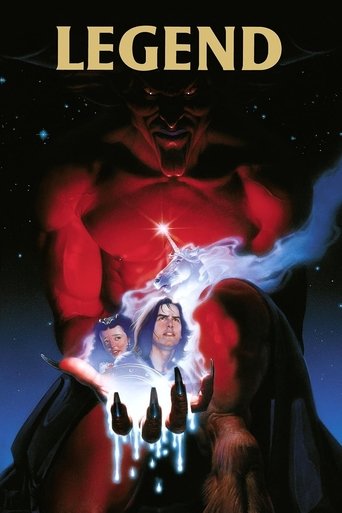
Legend
1985 · Film · 94 min
Directed by Ridley Scott
Set in a timeless mythical forest inhabited by fairies, goblins, unicorns and mortals, this fantastic story follows a mystical forest dweller, chosen by fate, to undertake a heroic quest. He must save the beautiful Princess Lili and defeat the demonic Lord of Darkness, or the world will be plunged into a never-ending ice age.
2 positive1 mixed2 neutralfrom 5 commenters
Where to watch
No streaming data for this title.

5 comments on Hacker News
It's got some incredible animation. The story and studio infighting was what hurt the film, but it's still worth a watch if you haven't seen it. It really should have been a better movie. Targeting older audiences was a good idea and fantasy was a big genre. On the animation side The Last Unicorn was a recent success that was also darker fantasy than what disney was offering (fire and ice too, although that didn't get as wide an audience) and in live action Legend released that same year and Willow came after and both attracted a lot of fans. I really wonder what that movie might have been if Disney had been fully committed to the idea.
Um, Ridley Scott directed Legend which came out in 1985. While it wasn't a critical or commercial success, I thought and still think it is an amazing film, and one of the best pieces of cinematic "high fantasy" out there.
https://en.wikipedia.org/wiki/Legend_(1985_film)
I get what you're saying (I worked in fiom and tv for eons before switching out), but you can't really do it like that. Comparison needs to include both what the movie was built on, leading to it, and then also to consider directors own body of work leading to it. That takes into account period of work and release as well. What came after (not immediately) is not relevant to the work itself since it's out of period (in future). To even start talking in this direction you'd have to invoke, serially, works like Clockwork Orange, American Graffiti, Taxi Driver, and then Midnight Express to even start outlining the silhouette of what is to come.with Blade Runner.. and that's just a start since Ridley Scott's path is a bit unusual, and that movie's genesis especially so (see Legend he did sonce it's close to the period). That only covers the basics of the basics of discussing of what and specifically why this particular work is the way it is and why emulating the moves later (2049) didn't yield the same.
Edit: typing on mobile. Screw it, I hope it's at least somewhat readable.
These are still not fair comparisons.
Legend and Justice League are both mediocre movies, but Legend won a ton of technical awards, including being nominated for Oscars for Makeup, BAFTAs for visual effects, and won an award for cinematography [0]. Justice League's list of awards is much more meager, and nothing for technical achievements. [1]
The Dune and Lawrence of Arabia comparison is also flawed. Sure they're both "acclaimed", But Dune is acclaimed as "One of the best films of the year", and Lawrence of Arabia is acclaimed as "One of the best films OF ALL TIME."
Also, Lawrence of Arabia is a real story of a real person set in the real world. So realism is bound to be important. Dune is a fictional story set thousands of years in the future in a different part of the universe. And specifically deals with a bit of mysticism and fantastical elements closer to fantasy than science fiction. Comparing the "reality" of their effects is apples and oranges.
I'll give you Star Wars for sure. Star Wars most assuredly did NOT benefit from "improved" technology.
[0] https://www.imdb.com/title/tt0089469/awards/?ref_=tt_awd [1] https://www.imdb.com/title/tt0974015/awards/
The author is not saying that modern movies are artistically worse than old movies. He's saying that CGI, despite decades of progress, seem _fake_ in a way that subtly destroys our sense of immersion:
"Consider Ridley Scott’s 1985 Legend, wherein Tim Curry’s onscreen presence as a horned devil is heavy, weighty—despite playing a fantastical devil, his clopping around in hooves comes across as ontologically solid. Your eyes are not deceived. And moreover, under the slathered makeup and prothestics, he is still acting—when his lip curls, that’s a real lip. Compare that to Steppenwolf, from the 2017 Justice League. After almost a quarter-century of “progress” in cinema he comes across as digital dust, a void where physicality should be. His superstrength is unthreatening, because deep in our occipital lobes we know Steppenwolf weighs nothing, impacts nothing. Therefore the entire movie has no stakes. Of course the bad guy will be defeated, he’s a hologram."
Yes, of course the article ignores the hundreds of old movies with terrible prosthetics and costumes. I think the author tries his best to compare similar things. For example, when he discusses the latest Dune with Lawrence of Arabia - both acclaimed movies. Specifically, he discusses how the desert scenes _look_ to our eyes:
"Lawrence of Arabia from 1962 looks so much more real than Dune, even when just comparing the shots of people in Bedouin costumes hanging out in a desert ... For instance, the shadows both characters cast to their right. In the 2021 Dune, it is a monochrome chunk, despite the billowing fabric around the character. In the 1962 Lawrence of Arabia, the shadow of the fabric is actually see-through. It has dimensionality, thinness and thickness. Because it’s a real shadow. So despite both being filmed in similar locations, one scene unconsciously triggers more belief in the ontology of the fictional world—the directionality of the light, the blue above the dune—while the other comes across as an ersatz reality."
I felt this coming out of the latest Star Wars movies: the space battle scenes felt so... flat, despite being technically amazing. There's something to be said for actually shooting on location and using physical props.