 Hacker Cinema
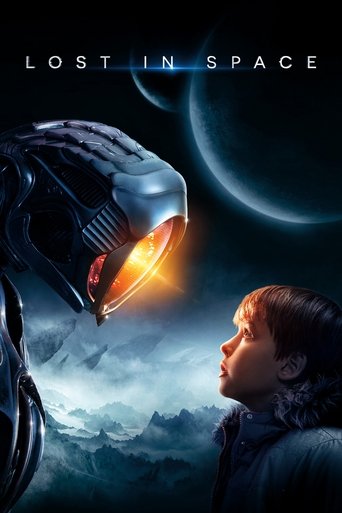
Lost in Space
2018 · TV series · 56 min episodes · 3 seasons
Created by Irwin Allen
Science FictionFantasyActionAdventureDrama
After crash-landing on an alien planet, the Robinson family fights against all odds to survive and escape. But they're surrounded by hidden dangers.
5 positive7 negative1 mixed2 neutralfrom 15 commenters
Where to watch
No streaming data for this title.



15 comments on Hacker News
Day the Earth Stood Still and Forbidden Planet are ‘required’. Haha. Robinson Crusoe on Mars is great.
The Black Hole is a Disney movie.
How about some TV?
Classic: Battlestar Galactica, Buck Rogers, need I mention, Star Trek?
Current: Lost in Space, …
(Yikes. If 2001 is slow and boring, Solaris (1972) is watching paint dry. Sheesh)
… age appropriate is difficult, ahaha. You could also try your local library, the might have DVDs of TV shows and staff usually have kids section, and classics separate.
Not a movie, but my kid really enjoyed the 28 episodes of the ‘Lost in Space’ TV series on Netflix. It’s rated 7+ but in my opinion 7 is too young. 12 should be perfect.
I was watching lost in space and one of those episodes had an entire subplot about Oreos. It was so blatant it ruined that episode.
Well they advertise their own shows to keep you subscribed, and they also have product placement. I remember Lagavulin scotch showing up in the TV show Lost in Space for example, an incredibly out of place product placement.
Netflix strategy seems to be hook you with a big budget new show, then slash the budget for season 2 and see if it still sticks(interestingly that didn't seem to be the case with Lost in Space, and Dark Crystal was just outright cancelled).
Also watching a lot more Amazon+HBO these days.
Earth: Final Conflict
Season 1 was amazing. After that, bleh. At least in that case it sounds like executive meddling was the culprit.
On the other hand, The Expanse keeps opening whole new everythings that make what came before tiny but also essential. No second of plot is wasted. They could loosen it up a bit with a bottle episode or two to develop the characters more though. I could go any number of seasons if they could maintain the quality.
And then there's the new Lost In Space. They're going to end it in the next season at exactly the right time. Pacing-wise, it feels like a three-part miniseries. Just enough room to build a world and develop the characters without overstaying its welcome.
I'm not seeing the sarcasm but it's a great comment. I can't think of a sarcastic comment right off the top-of-my-head either but I do have a funny comment story:
For the longest time (starting in the '80s) I started a comment with the following snippet if there was a need for the developer to be really certain they wanted to change something about code:
/* * DANGER WILL ROBINSON * * ... */
This always made me smile because "Lost in Space" was one of my favorite television shows growing up in the early '70s ... and because most of the people reading the comment didn't know the reference. That changed slightly when the movie came out but really became known when Netflix revived the series.
HBO has some big-ticket items, but Netflix is more consistent in dropping new series for me to try. It's still my go-to place for content since there's more than I have time to watch. I just looked up their list of original content[1] for refresh my mind, and quite a few were extremely good in my opinion.
- House of Cards: I only got a little into the second season before I got busy, but what I saw was high quality and interesting.
- Orange is the new Black: My wife still loves this series
- Stranger Things: An honest to god phenomenon. The second season was weaker IMO, but I'm not sure how it could be as good as the first. That's a high bar to hit.
- The Crown: I caught a lot of it as my wife watched. Pretty good, even if a blond Doctor Who was somewhat distracting.
- A Series of Unfortunate Events: The kids liked this, as some of them are going through the books.
- Altered Carbon: Refreshingly good science fiction. Main character casting a little odd, since it's more obvious now than it was when I was younger how odd and slightly off-putting it is to cast someone with the physique of Arnold Schwarzenegger as a science fiction lead. At the same time, it's now fitting (or a trope) because of all the science fiction he helmed in the 1990's.
- Lost in Space: Interesting, but ultimately spoiled slightly by the contrived plot. Better writing and this would have been extremely good rather than worth watching, but slightly disappointing.
- The Haunting: A nice interweaving of stories, and creepy series. I liked the ending. I have friends who didn't.
That's just from the drama section of the list. There's plenty in the other sections too, such as Maniac and Russian Dolls which I watched recently that were good, and documentary section has a bunch of good things I've seen as well. Some of he Marvel series' were pretty good too (season one of Jessica Jones was excellent on so many levels).
That's a small fraction of what they released. Looking at the list now, there's no way I would cancel Netflix before Hulu, and probably HBO also. There's things I want to watch on those (for different reasons), but now that I examine it, it's clear that I use and value what Netflix is giving me way more than the other two.
1: https://en.wikipedia.org/wiki/List_of_original_programs_distributed_by_Netflix
That's expensive if you don't watch much TV. I just watch sci-fi shows and wish I could put my money just towards those types of shows. My perfect subscription would be a mix, where I pay a small fee per month but can try out individual shows. If I like the show I'd pay for the rest of the season.
For example Amazon now has The Expanse, Starz has Counterpart, Netflix has Black Mirror and I also liked the new Lost in Space. Hulu has... Future Man? CBS All Access has... the ability to ruin Star Trek, so I might want to watch that train wreck.
Anyway if there was a cheap subscription like Amazon Prime which allowed me to try out a couple free episodes, then pay $3 per episode that would work. That way I feel like I'm supporting the specific shows I want to see.
For me there is just a glossy saccharine feel to them. No substance, all flash. Or things they have just bought cheaply from overseas and they are passing off as a "Netflix Original." Of course there are always exceptions. I found Stranger Things to be really high quality. Things like their Lost in Space so much less so. I don't want that bare minimum, or "just good enough" they put into it to become the new norm in filmmaking. To me, films should be an art form.
>Again, your argument continues to validate one of the essential points I make: that these data sets are most useful for identifying existing media that “works” and then scaling/marketing it.
I'm not sure how you're managing to miss this so completely, but no its explicitly not this. Are you familiar with how recommender systems work? Id suggest reading this article[1], which discusses how Netflix uses data to identify the fanbases for shows that they haven't yet launched. Yes, they use data to post-validate successful shows, but everyone does that, it's what Nielson has done for decades. Netflix is doing more: they're able to (with decent accuracy) predict what market a show will be popular with before launch, and they do this to market niche shows that would otherwise never be launched at all with a strong certainty that they'll find success.
Your second paragraph invents evidence and certainty and data that you don't have. Frankly, it makes you look like you are unfamiliar with statistics and data analytics, which is fine, but then you shouldn't share strong opinions about how things you don't fully understand can't work. How do you know that they can't have statistical reliability? Thousands of data points is absolutely enough to have statistical certainty. Yes you can absolutely predict the popularity of a genre with a high degree of certainty before filming a single scene. How do you know that they don't have a high rate of success? (I refer you back to [1]:
>She notes the mixed reviews for Lost in Space. “Do we care?” Not that much, it turns out.
>Furthermore, Netflix picking themes, topics, etc as you suggest to drive successful production runs contrary to their most successful strategy so far, which is to cast a wide net by producing highly diverse content at low costs then scaling what works.
I'd just like to make this really, exceptionally clear: they don't pick what content to produce by throwing darts. They pick the diverse ("niche") content in a very data driven way. Again, quoting [1]:
> It [...] predicat[es] programming decisions on immense amounts of data about true viewing habits, not estimated ones. It has discovered ways to bundle enough niche viewers to make good business out of fare that used to play only to tiny markets.
But I suggest reading the entire article, because it thoroughly dismantles the presumptions your making about how netflix does production. (Especially the part about "Money Heist").
>When a company has a combination of access to scale and quality data, they quickly outpace and overwhelm their competitors. Netflix hasn’t quite accomplished this, suggesting that their dataset isn’t as magical as you imply.
Wait, who are their competitors that they aren't outpacing? Netflix absolutely dominates their market (streaming media), they defined it. Everyone else is playing catch up. If you are considering Netflix to be a competitor to WB or Disney, netflix had more revenue than Universal Pictures, Columbia (Sony) or Paramount, and WB, Fox, and Disney are all part of huge conglomerates that make it hard to tell, but it's possible that in terms of movies and TV, Netflix is second only to Disney. If not, it's certainly close.
Of course I'd also like you to justify your original statement, I don't think it's generally true, there's more to a business than just data, and I can't think of any business except maybe Google where scale and quality data was the defining factor. In almost every other case it was something else: network effects (FB, Twitter, Insta, WhatsApp), logistics (Amazon), or a different business model, normally freemium (Spotify, Slack, etc.). All of those companies use data for all sorts of different things, but they didn't take over/find success because of their data.
>Lastly, their dataset isn’t as private as you might believe, either.
Yes, their data is absolutely private, unless you think that the netflix prize from 2009, before they started streaming and 4-5 years before their first original, is at all relevant.
[1]:https://www.vulture.com/2018/06/how-netflix-swallowed-tv-industry.html
People need to bear this in mind more often. I recall watching the second (I think?) episode of Lost in Space the other day that absolutely crowbared in a placement for Oreo cookies, how great they are and how much they reminded the character of home.
It took me completely out of the show. I would honestly have preferred an isolated 30 second ad to that. It does still affect the creative process, too - your show needs to be one an advertiser wants to be placed on, so there's every incentive to soften the show.
The thing is it's kind of a false narrative. Because the shows aren't entirely ad free. They're mostly ad free, but Lost in Space for example featured an extremely jarring product placement for Oreos which came up repeatedly in an episode. It was just as jarring for me as ad placements, disrupting the narrative and throwing me out of the story. Especially since hte Oreo package was identical to the ones we have now even though the show is supposedly decades in the future.
This happens in most Netflix shows; jarring and obvious product placement that disrupts the flow of the story.
So it's not that they are ad free, they just featured reduced ads in most episodes.
Hopefully Netflix picks this up - especially when the new series of Lost in Space is just full of idiotic decisions to line up the next absurd episode, and Altered Carbon plods along at a snails pace and uses nudity to gloss over the dull bits.
The Expanse is the best sci-fi series on TV by far at the moment, especially due to it having a good plot, a sweary UN woman, and mostly obeys the laws of physics.
The Siffy channel is rubbish anyway. Netfix has more sci-fi to watch.
My experience is definitely different from normal because I live in Tinseltown a few blocks from one of the theaters where they hold movie premieres and from an Alamo Drafthouse, but I could never see Netflix replacing Hollywood.
The business models are fundamentally different. All Netflix cares about is eyeballs and giving customers the barest reason to continue subscribing. This means that they focus on quantity over quality, as evidenced by their last 3 years of films: each worse than the one released the week before it, with extremely rare exceptions like Beasts of No Nation and Mudbound. (It's curious that their films are so horrifically bad when their TV series are generally watchable, though Lost In Space and the recent seasons of OitNB and HoC suggest that the malaise affecting their film department has spread to the show department.)
Hollywood, for all the moaning about sequilitis and mass-market crap, at least makes crap that's good enough to draw people out of their homes, drive a few miles, and plop down a few dozen dollars for seats and maybe food. There's a strong incentive to maintain at least a minimum baseline of quality and a stronger incentive to make a commercially viable movie.
Think about the films people will remember from the last decade: you won't find any Netflix films among them. But the cultural significance of films like La La Land, Star Wars, even the the Fast and the Furious franchise will outlive us all.