 Hacker Cinema
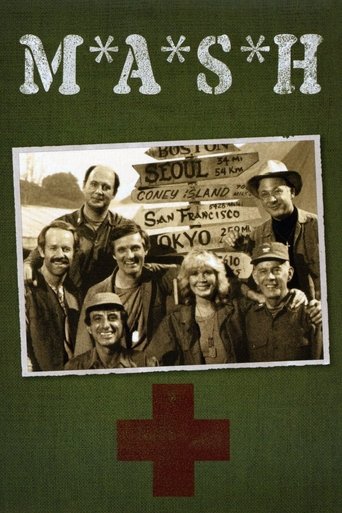
M*A*S*H
1972 · TV series · 11 seasons
Created by Larry Gelbart
The 4077th Mobile Army Surgical Hospital is stuck in the middle of the Korean war. With little help from the circumstances they find themselves in, they are forced to make their own fun. Fond of practical jokes and revenge, the doctors, nurses, administrators, and soldiers often find ways of making wartime life bearable.
1 positive1 mixed17 neutralfrom 19 commenters
Where to watch
No streaming data for this title.
20 comments on Hacker News
The show has its moments - mature, intelligent, human moments found little elsewhere - but its an intelligence that struggles to escape very typical network sitcom trappings. One wishes it had gone a little more in the direction of M.A.S.H. and ditched the pretense of having to make jokes every minute.
A bunch of movies off hand that weren't mentioned elsewhere. This doesn't include tv shows, the two I remember off hand are M*A*S*H and The Kids in the Hall.
1999: Hilary Swank won best actress for Boys Don't Cry.
1982: Julie Andrews nominated for Victor/Victoria
1983: Barbara Streisand in Yentl -- before she became the effect.
1996: Robin Williams and Gene Hackman in The Birdcage.
1995: Patrick Swayze in To Wong Foo, Thanks for Everything! Julie Newmar
1994: Mignight in the Garden of Good and Evil directed by Clint Eastwood
1992: The Crying Game
I learned "vee-hickle" from the TV show M.A.S.H
I watched the entire M.A.S.H series when I was young and it made a similar impression. I watched it before the film though, so my brain couldn't fathom anyone other than Alan Alda as Hawkeye.
Actually, now I’m interested in how ChatGPT will compress this.
Reminds me of that M.A.S.H episode where Hawkeye and B.J. are mocking Readers Digest… “A Tale of a City”
There's a sibling thread making the same point, and: yeah, I overgeneralized on that bit. The instance I had in mind was the M.A.S.H. TV show, which has a couple exchanges involving "hack" for time synchronization (unsurprisingly, by the most over the top soldierly characters). All I can offer as a defense is that it was late and I assumed that I couldn't remember others for that reason. But looking around now, film usually goes with the more recognizable "mark".
Here's a memoir from a retired USAF airman where he recounts what the hacking procedure looked like, though: https://code7700.com/2023_time_hack.htm
This is certainly not going to help the industry.
It was already hard enough to kill off NTSC. Now, with ATSC 3.0 they want anyone that's still watching OTA to also need to provide internet access to their receiver so it can give them advertisements?
Have you watched the ads for OTA content? They are all geared towards geriatrics. That's because almost nobody under 60 is watching OTA (except maybe exceptions like you and I that don't mind older TV shows and are willing to DVR it).
So, for a media format primarily consumed by geriatric people the new standard proposes they now need a functional internet connection hooked up just to watch M*A*S*H. The previous standards just needed a coax cable hooked up to an antenna.
I love that ATSC 3.0 uses better codecs. But, it's really dumb that they added the internet backend requirement. The entire point of OTA is you don't want to stream stuff over the internet.
I don’t think it’s only helpful to the algorithm. It’s also helpful for me as a subscriber.
If I want to watch episodes of Breaking Bad, I don’t want you to randomly throw in episodes or M*A*S*H (even though both are good).
If by AI you mean the current LLM's using BigData like OpenAI then I doubt this will happen. All iterations of that confidently spew lies, half-truths and highly biased output. Should someone hire that thing to write software or control anything important then I would expect anything it works on to go horribly sideways, especially if the assigned project is complex.
But I could be wrong. If I am wrong then my hope is everyone has enough free time to to watch all the episodes of M.A.S.H. while simultaneously retraining in something else, whatever the next something else may be.
Hawkeye: War isn’t Hell. War is war, and Hell is Hell. And of the two, war is a lot worse.
Father Mulcahy: How do you figure that, Hawkeye?
Hawkeye: Easy, Father. Tell me, who goes to Hell?
Father Mulcahy: Sinners, I believe.
Hawkeye: Exactly. There are no innocent bystanders in Hell. War is chock full of them — little kids, cripples, old ladies. In fact, except for some of the brass, almost everybody involved is an innocent bystander.
-M.A.S.H. Season 5, Episode 21, The General's Practitioner.
Music has largely stopped being a shared experience, that’s hard to demonstrate but the same thing happened to TV. Who shot JR on Dallas was the kind of thing people talked about and the resolution episode got 53.3% ratings share in 1980, that was only topped by final Episode of M.A.S.H which hit 60.2%.
Only 2 shows in the last 25 years even approached it. Seinfeld Finale - "The Finale" hit 41.3% 24 years ago and Friends hit 35.6% 18 years ago.
In 2020 by comparison the Super Bowl was 4x as popular as the most watched single TV episode and streaming was dominated by people watching reruns not new shows. Average viewership of actual TV shows is unsurprisingly much lower.
PS: Best selling albums of 2020 included #12 Abbey Road by The Beatles, and #6 was the Frozen II soundtrack.
In M*A*S*H Season 7, Episode 6 "None Like it Hot" from Oct 23, 1978, Hawkeye and B.J. purchase a bathtub from Abercrombie and Fitch
Cooling a patient was feature in a M.A.S.H. episode in 1979/80.
I presume it was moderately well known thing then.
https://en.wikipedia.org/wiki/Life_Time_(M*A*S*H)
Tossing a huge range of different properties in a blender is fine, ripping off a single property is just lazy. Which sounds more original pure Harry Potter fan fiction or ER the TV show + Harry Potter + Cheers the TV show.
Draw evenly from M*A*S*H + Dresden Files + Mass Effect + Dexter and your going to end up in some strange and interesting places. Play through Starcraft 1+2 on the other hand and the story is fine if a bit bland.
Demara reminds me of the 90s show The Pretender, I'm going to assume Demara was the inspiration. That show was lots of fun.
And there was an episode of M.A.S.H clearly inspired by Demara. Someone impersonating a surgeon, getting caught then changing identities to a chaplain.
The only way the Steam model would work for media is if content owners would agree that if someone on the platform purchased a digital copy of something that the ownership couldn't be rescinded.
Nobody will purchase, for instance, all the seasons of M.A.S.H. if they know that there is a risk that the rights owners will pull their content off of the platform in a few years and the person loses the ability to watch what they paid for.
The platform should also have the ability to "import" previously purchased rights. If someone buys a TV show on iTunes, they should be able to import that purchase into the platform so they can consolidate all of their purchases into a single platform.
Lastly, the other thing that made Steam a huge success is the sales. Daily sales of some content, quarterly sales of large swaths of content, etc. That would have to occur for a media platform to have the same kind of success.
I'm an unabashed pirate because it's easy... but if I could use a platform like this that didn't have a recurring monthly cost I would use it.
If Pixar put their upcoming movie available for pre-purchase (like Steam Greenlight) at 40% off, I would likely pre-purchase it. If Disney wanted to drum up interest in their new Duck Tales reboot by putting the original series up for sale for $20, I would be all over that. A TV series in its 4th season with struggling ratings could put up a flash sale of previous seasons in order to get new viewers to binge watch before the new season starts. A TV series could also sell a season pass BEFORE the new season starts for an infusion of cash and release the episodes on the regular schedule.
A steam-like platform could work wonders for media consumption, but it'll be hard to get companies to do it.
Steam took off because it was required for an awesome video game that Valve released. Eventually Steam was more valuable than the game.
That's the only way something like this happen for media. A small studio with a hot property could build the platform for their own offerings but invite other media owners to participate. Adult Swim or SyFy or FX could probably pull it off.
Producing TV shows today doesn't make financial sense.
In the 60s to 70s, the US had 3 networks (ABC, NBC, and CBS), few shows, low budgets even for hit shows (think of Gilligan's Island and Brady Brunch), and massively greater viewership than today[1]. And the average American viewer watched 4.5 hours of TV per day and knew the name of every prime time show on TV.
Today, every point above is reversed: hundreds of channels, hundreds of shows, something like one-tenth the viewership per show[1], and people watch much less TV.
To give one example of budgets, an entire episode of Star Trek cost about the same as just the voices on a Simpsons episode. (Star Trek cost $185,000 per episode, or $2.2M in today's dollars; the 6 main voices actors of The Simpsons were collectively getting $2.4M per episode but cut to $1.8M a couple years ago.)
The only conclusion is that TV in the 60s and 70s was obscenely profitable and TV today is a marginal or money-losing business and covertly subsidized by other parts of the company's business.
[1] The final episode of MASH had 125 million viewers. https://en.wikipedia.org/wiki/M*A*S*H_%28TV_series%29
The final episode of Breaking Bad had just 10 million. https://en.wikipedia.org/wiki/Breaking_Bad#Viewership
Such medical and chaplain personnel are required to be marked (which explains all the markings on TV shows such as M.A.S.H.). Otherwise how can a military operation avoid accidentally targeting them?
If it's true that distinctively marked medical personnel were deliberately targeted then you're right that it would be a breach of the law of war.
There's a common idiom about progress that goes along the lines of "we always overestimate what can be done in the next 5 years and always underestimate what can be done in 10." (Though sometimes the first part is 1 year or 2 years.) This is especially true when it comes to long term socio-economic development. Look at the South Korea portrayed on the TV show "M.A.S.H.", that's the South Korea of the 1950s, and to some extent it was still a common view of South Korea when the show aired in the late '70s and early '80s. But from 1980 to 1990 South Korea's GDP tripled, and from 1990 to 2000 it more than doubled, and it did so again from 2000 to 2010. Today the people in South Korea are not just richer, per person, than Americans were in 1950 they are richer than Americans were in 1980, when M.A.S.H. was on the air. That sort of thing is very difficult to conceptualize, because humans are just generally not good at understanding geometric growth.
But the same trends are happening elsewhere. Mexico, for example, is becoming wealthier. If they can sort out their huge political and security problems in their country then they can easily join the developed world soon. The same goes for Brazil, Chile, Argentina, and China. And a decade from now there will be yet more countries who will have moved into firing distance of becoming a developed country too, and even more countries moving out of poverty and into the developing world as well. In 2050 there are many parts of the world that we will put in the same mental bucket of development status as the US/Europe et al today, places like Morocco, the Philippines, even Nigeria.
One of the problems people often have with history is lack of perspective and cultural bias. People can be exposed to countless portrayals of historical poverty and lack of development in America's past, for example, and yet still fail to draw a line of similarity to undeveloped or developing parts of the world today. Those people aren't so different from us, if given a chance they can do amazing things.
Nate Silver wouldn't have a job without advertisement. Neither would Glenn Greenwald, Walter Cronchite, Dan Rather, Brian Williams, Tom Brokaw, or Peter Jennings.
TV shows like Seinfeld, Friends, The Wire, Breaking Bad, The Walking Dead, and M.A.S.H. would not exist without ads.
Babe Ruth, Jackie Robinson, Peyton Manning, Michael Phelps, Michael Jordan, Michael Tyson, Tiger Woods, and Larry Byrd would not have done the things they did without ads - no one would have paid them to.
Ads pay for people who are good at what they do to do what they're good at what they do as a means to pay for the other things they have to do. You couldn't possibly be more wrong about advertisements - without ads, there would be no US as you know it today.