 Hacker Cinema
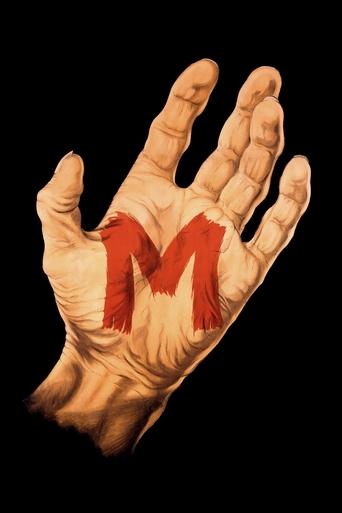
M
M - Eine Stadt sucht einen Mörder
1931 · Film · 110 min
Directed by Fritz Lang
In this classic German thriller, Hans Beckert, a serial killer who preys on children, becomes the focus of a massive Berlin police manhunt. Beckert's heinous crimes are so repellant and disruptive to city life that he is even targeted by others in the seedy underworld network. With both cops and criminals in pursuit, the murderer soon realizes that people are on his trail, sending him into a tense, panicked attempt to escape justice.
17 positive1 negative2 neutralfrom 20 commenters
Where to watch
No streaming data for this title.
24 comments on Hacker News
(I know you didn't ask me.)
To pick a decade, the 1930's surprised me with a number of good films that I had not seen. It's also the first "modern" decade in a sense — the films are starting to have the kind of narrative you expect from a film (and have sound).
"Love Me Tonight" (1932), "Stella Dallas" (1937) were new to me and enjoyable.
It was the era of the classic big-spectacle Hollywood dance numbers that I knew of but had not seen. These greats from 1933 alone: "42nd Street", "Footlight Parade", "Gold Diggers of 1933".
Fritz Lang's "M" (1931) if you have not seen it. The infamous "Freaks" (1932) that, by its reputation, I thought would disturb me more than it did. "Captain Blood" and the "The Adventures of Robin Hood" are Errol Flynn in his prime…
Bonus link: Ginger Rogers in the classic opening to "Gold Diggers" — and her impromptu Pig Latin verse: https://youtu.be/UJOjTNuuEVw
Strong agree: Upstream Color is poetry
Stanley Kubrick did something similar in `2001: A Space Odyssey`. In a scene where staff were being transported in a taxi... on the moon... 100% of the dialog is meaningless. They're discussing the merits of this or that sandwich, not how wonderful the Earth looks from space, or overcoming technical challenges.
It's so refreshing to be living in an environment vs being spoon fed.
Even better is very old or even silent movies ("M" is fantastic: modern-ish thriller from 1931 where sound is a character; Metropolis)
Also dialog-less movies: `Koyaanisqatsi` is incredibly beautiful and has a specific plot, even if there's no understandable dialog nor words.
In theaters _right now_ is `Flow`. No dialog, and no _human_ characters! It's all animated cats and dogs and other animals. It's startling how directly the characters transmit their goals and agenda and emotions.
M by Fritz Lang, 1931. It does have a soundtrack but very minimal. Music is an essential part of this movie. Metropolis.
1 o’clock in the morning with Charlie Chaplin. Also his: the Gold Rush, the Kid, the Great Dictator.
You are talking about a new game from the same thing. That takes years to come together. You cannot just sit down and say, ok, here is a few more hours of thing for you. That takes time, a lot of time and effort from multitude of people. That's why 99% of DLCs are trash.
There is no such thing in movies like bad cgi at a given time. Noone with a sane mind would ruin 10s of millions of investment with bad cgi nowadays. CGI reflects the state of the art, or a level that is acceptable/affordable and won't cause the viewer to be knocked out of concentration.
Maybe for people who work in the industry and have an eye what to look for, cgi might have issues, but viewers won't recognize anything odd.
Also... movies either work or don't work. I even rewatch movies from the 30s. There are movies, like Fritz Lang's M (1931), which were tens of years ahead of the industry regarding pacing and storytelling and still (re)watchable almost 100 years later.
Also: M, I am a Fugitive From a Chain Gang, Nosferatu, a bunch of Bogart, Gable, Hepburn and Spencer Tracy movies.
Anyone looking to get into silent film, I'd strongly recommend comedies (including, and perhaps especially, Chaplin and Keaton) as a good starting point. I've gotten to the point that I can truly enjoy a lot of silent dramas, but IMO the comedies are far more approachable for a modern audience. Good gateway drug.
Just off the more famous films (The Great Dictator and Modern Times and maybe City Lights for Chaplin, or The General for Keaton, say) I'd recommend The Kid for Chaplin, and Sherlock, Jr. for Keaton. And of course both made numerous short films, in addition to their features. Though the very-famous ones are all great, too—I especially love City Lights, personally.
Been meaning to check out Harold Lloyd (responsible for one of the most enduring and imitated images in Hollowood, the guy hanging on the clock on the side of a building, featured in Safety Last) but haven't made it to him yet. I bet he "reads" pretty well to a modern viewer, too.
[EDIT] Some beginner drama recommendations, for those who feel ready:
Metropolis (duh... though it's a bit on the long side, maybe skip if you can't tolerate longer movies, and it's maybe a bit belabored for modern sensibilities)
The Passion of Joan of Arc (just... damn. This is a perfect movie.)
L'Âge D'or (The Golden Age—but, uh, maybe just if you appreciate things a bit more art house)
Le Voyage dans la Lune (A Trip to the Moon—it's short, and, if one plays with various accompanying soundtrack options, including some more modern ones, one may find it transcendently good)
M (yes Fritz Lang made this very short list twice, because fuck you this movie is amazing, this is maybe the most modern-feeling of this whole bunch)
Silent-era sensibilities are very different from even WWII-era talkies. The field developed whole bunch, very fast. A lot of those films are difficult to appreciate without active effort to acclimatize oneself to them, much the same way lots of people bounce off classical music or jazz (or hip-hop, or heavy metal, or most musical genres, really) until they've had a bit more exposure and learned how to enjoy them. Plus, a lot of them were leaning really hard into one movement or another, and Metropolis is one of those (many) cases, so what it's aiming to do well isn't necessarily the same set of things most modern films would aim to do well (and indeed, off the beaten path you can find plenty of modern films that similarly target some particular effect or art movement, which can also take a bit of adjustment to one's expectations to enjoy)
Acting in particular has gone through some serious changes as fashions come and go, and most any style one encounters aside from what's now in-vogue tends to come off as corny. Even Casablanca, which is ahead of its time in many ways (for an American movie, anyway—the US lagged in some film technique developments at the time, compared with other markets) features acting that's less-naturalistic than what's popular now. Also, changes in editing have really made a difference in how performances come across, which is part of why watching a scene being filmed from a behind-the-scenes camera can make the acting seem off or bad—because it's not being filtered through modern shot-framing and editing.
IMO the comedies suffer the least and remain fairly accessible (no matter when you were born, if you can't laugh at Chaplin and Keaton, there's something wrong with you) but, for most people, approaching the rest of the silent era is more a project than something you can just dip into here and there and expect to have a good time. The field was immature, the whole "silent" part of it takes some getting used to, and there was a whole lot of art-movement-influenced experimentation going on.
There is, however, a lot of variety in styles in the silent film era, especially in foreign film. If you don't like 20s German expressionist films, try films of the 30s (IMO the silent era got a lot better toward the end), try American films, try French, try Spanish, Russian, stuff like that. Weird absurdist Spanish films that evoke the atmosphere of Monty Python, shocking short films, heart-rending dramas, cheap action schlock, about-the-town documentary or semi-fictional films, heavy-handed allegory—lots of stuff to explore. Plus the comedies, of which many are excellent and most are fairly accessible to a modern audience.
[EDIT] If you want something a bit easier to chew on, from the same director as Metropolis, M, which I mentioned in my first post, is much closer to a modern film, in terms of its storytelling and its plot structure.
> Jan 1, 2023 will also be a fine day for film in the public domain, with Metropolis, The Jazz Singer, and Laurel and Hardy's Battle of the Century entering the commons. Also notable: Wings, winner of the first-ever best picture Academy Award; The Lodger, Hitchcock's first thriller; and FW "Nosferatu" Mirnau's Sunrise.
Metropolis is so influential that I'd call it a must-watch for... well, basically any fan of popular media of any kind. Film, literature, graphic arts, video games, music(!). Its influence is everywhere.
Sunrise is one hell of a roller-coaster of a movie. As with anything in the silent era (especially the non-comedy films) it's a bit of an acquired taste but it's among the earliest films that I didn't just find interesting or funny, but that really got me on the edge of my seat, several times. It's got some real "yell at the screen" moments :-) I enjoyed it way more than the director's more-iconic Nosferatu. Though, for my money, it's no M or The Passion of Joan of Arc, as silent film dramas go. Still, really good, and I think a lot of critics hold it in far higher regard than I do.
Haven't seen the rest.
> On the literary front, we have Virginia Woolf's To The Lighthouse, AA Milne's Now We Are Six, Hemingway's Men Without Women, Faulkner's Mosquitoes, Christie's The Big Four, Wharton's Twilight Sleep, Hesse's Steppenwolf (in German), Kafka's Amerika (in German), and Proust's Le Temps retrouvé (in French).
Damn, what a powerhouse year in literature. And look at that, my favorite novel (To the Lighthouse) is about to be public domain!
The Holmes news is awesome, too. Bunch of copyright troll dicks have been making doing anything with Holmes risky for years. Great that everyone can more-easily ignore them.
Blade Runner suffers from the same problem as every other important classic.
Younger generations who see it today have already seen 100s's of movies and TV-series, anime etc. that are based on aesthetics and narrative of Blade Runner. The original has little originality left for new viewers because it has been endlessly copied and they have already been immersed in it.
Another great example is Friz Lang's M (1931). It has influenced everyone from Hitchcock to everything in Film Noir. If you watch it now it's almost comical. It has every trope of serial killer movie. Except everyone else is copying M. Even if you have not watched the movie, you have already seen the movie thousands of times.
>"However, it may be that you just don't like your usual weekend activities. Try seeking a more rewarding and less passive kind of leisure."
I agree, as the original poster could try watching movies they would enjoy. From the original post: "That said, recently I have some strange discomfort inside when, for example, watching a movie in the evening. It feels wrong to spend time this way when there are so many things I still don't know or understand...".
I feel the same discomfort when watching blockbuster hits (if people really do enjoy them as an escape, that's great that the movies can create enjoyment, but for my personal tastes, it's just not enjoyable), but don't feel the same way when watching classic films (e.g. stuff like the 1931 film "M"). It's a goal of mine to better understand classic film, so I'm making progress on a goal instead of letting time pass by.
So, OP can try watching the American Film Institute (AFI) Top 100 List [0] as a starting point. They can also consider classical books, exploring musical genres, and any other type of artistic medium where there is a sense of reward from enjoying the works.
[0] https://www.afi.com/afis-100-years-100-movies/
> If you’ve never seen M, make sure you don’t watch an older print!
This cannot be emphasized enough. I once watched an old print at a university cinema, it was an extremely disappointing experience (I already knew the restored version at the time). Entire scenes were missing, which made the plot very hard to follow even if you knew the restored version, the sound was incomprehensible at times, and it felt like the entire thing was over after 60 minutes.
The film is a masterpiece and feels extremely modern (just think of the scene were it (spoiler alert) becomes clear that the little girl has been raped and killed: it's simply a 2 second shot of a balloon animal she previously had and which is now caught in an overhead telephone line. Nothing more. You get chills watching it, as it captures everything: violence (why did she let go of it?), lost innocence, death, clinging to life.
You can also clearly "feel" the influence it had on other filmmakers, in particular Hitchcock and Kubrick. For example, there are some very detailed close-up shots of technical stuff which resemble the equipment close-up shots in "Dr. Strangelove". The performance of Peter Lorre is also very Kubrick-like: some may consider it over-the-top (like some consider Jack Nicholson's and Shelley Duvall's performances in "Shining" over-the-top), but it is certainly very interesting to watch.
"Stranger danger" as a concept is far older than 20 years, so you're just looking at the same type of statistic as OP. I'm guessing you need to go back well over 50 years for a meaningful difference in attitudes.
Edit: when I was growing up (well before 2001!) that was certainly the attitude – we didn't have the phrase "stranger danger" (maybe that's from the US?) but "don't take sweets from strangers" was common.
I also remember, as an adult, watching the film M and that finished with a strong message about not leaving your children unsupervised, and that's from 1931! But that message doesn't prove it was common at the time so I just mention that for curiosity.
"If you want to see a great Fritz Lang movie, watch "M" (1931). It's much, much better"
As a huge Fritz Lang fan, I strongly disagree.
M is a darling of mainstream film critics, but in my opinion it's absolutely atrocious, massively overrated, and not worthy of shining Metropolis' boots.
That said, Lang has some other masterpieces I would recommend, like Kremhild's Revenge and the Dr Mabuse series. I'd watch those long before touching M.
Back to those German reviews of Metropolis, I wouldn't put a lot of stock in to proto-Nazi Germany's discounting "sentimentality" in Metropolis. We know where hard-hearted disavowals of sentimentality led.
Watched it a few years ago. The filming and scenery is very impressive, but the story - not so much. Here are some German reviews from 1927:
"Thea von Harbou invents an impossible plot that is crammed with motifs. Nothing but emotional phrases. Dreadful. A serious topic cruelly kitsched up. Effects not because the story demands them, but because the film wants to show its tricks. The end, the tearful reconciliation between employer and employee - awful."
"Take ten tons of horror, pour a tenth of sentimentality over it, cook it up with social sensitivity and spice it up with mysticism as needed, stir it up with marks (seven million) and you get a topnotch colossal film."
"The director apparently had an utopian film in mind that should contain the major contemporary currents. Something for everyone: the "Metropolis" for the bourgeoisie, the assault on the machines for the workers, the collective for the Social Democrats, a good heart and the spirit of the savior for the Christians. Apart from the kitschy content, the film's technical performance is undoubtedly excellent and unmatched to date."
If you want to see a great Fritz Lang movie, watch "M" (1931). It's much, much better [0].
[0] https://www.youtube.com/watch?v=d_I2akJ0k2w
As a devil's advocate--while there is definitely associations classical music with wealth, classical music for evil I don't entirely see. Classical music is a very deep trove of, mostly, royalty free music. Hannibal Lecter listening to the aria from the Goldberg Variations is probably less about signaling his sophistication, and more about the fact that it is a profoundly calm, even serene, piece of music playing during a scene of horrific violence. It mirrors the scene earlier where the said something like "his pulse never got above 80, even when he ate her tongue." It shows the calmness in Lecter despite the violence--this is not a crime of passion or hate.
Another small reference that I think is misused--he mentions Fritz Lang's M, and the "Hall of the Mountain King" melody that the killer whistles. First the film was made around 1931. Classical music would not have that sort of reference to the audience at that time. In my opinion M was the first movie to really understand sound film. The whistling tunes was a way to use sound to evoke presence without the character on screen. We could see a child playing, and hear the whistle in the background, and know that this child was being targeted without having to cut away. We get this kind of film information all the time in movies, but this is the first film that used the technique, and it had nothing to do with classical music. (Lang also invented some other sound dependent techniques in this film.)
This is not to say that some of the other examples are not instance of signaling "bad person" sing classical music, but I don't think its evil. I think the association of classical music with wealth/elitism is well established in modern films, so its presence for a wealthy/elite killer is expected, without taking that to also denoting evil.
I agree. While I think M is a masterpiece in almost every aspect, I tried watching Metropolis several times and always found it to be mediocre at best. I cannot understand the hype around this movie.
Besides H.G. Wells, contemporary German critics were also spot on:
> Thea von Harbou erfindet eine unmögliche Personenhandlung, die in den Motiven überstopft wird. […] Immer wird mit Gefühlsphrasen gearbeitet. Schrecklich. Ein sachliches Thema grausam verkitscht. Effekte, nicht weil Weltanschauungen zu Explosionen drängen, sondern weil der Film seine Tricks will. Der Schluß, die tränenreiche Versöhnung von Arbeitgeber und Arbeitnehmer – entsetzlich.“
Slightly improved Google translation:
>Thea von Harbou (she was the screenwriter) invents an impossible plot which is overstuffed with motifs. [...] She is only working with emotional clichées. Dreadful. A serious subject cruelly made into kitsch. Effects not because the depicted world demands it, but because the film wants its tricks. The end - the tearful reconciliation of employer and employee - awful."
– Berliner Börsen-Courier, 11. Januar 1927
> Nimm zehn Tonnen Grausen, gieße ein Zehntel Sentimentalität darüber, koche es mit sozialem Empfinden auf und würze es mit Mystik nach Bedarf, verrühre das Ganze mit Mark (sieben Millionen) und du erhältst einen prima Kolossalfilm.
> Take ten tons of horror, pour a tenth of sentimentality over it, cook it with social feeling and season it with mysticism as needed, mix with Mark (seven million of it) (Mark the currency, but it may also be understood as bone marrow ("Knochenmark") or tomato puree ("Tomatenmark") in the context of cooking, which is the joke here) and you get a great colossal movie.
– Simplicissimus Nr. 44/1927
I think it's very unlikely. "Things to come" and "metropolis" were huge in their day, but ultimately didn't have the same effect 2001 did. "M" by fritz Lang is my comparator for a film which defined a genre (film noir)
Elements of many films since 2001 have their moments. "Silent running" was probably the first successful eco scifi. "Dark Star" was the precursor comedy scifi. Nobody much wants to laud "interstellar" or "inception" but both have moments of cinematic genius. "Tron" was Disney lite but a neccesary moment.
I could make a case for the original "Solaris" or "stalker" which are beautiful and more about an inner journey than scifi proper.
I experienced something a bit similar during a migraine episode whilst in University.
Normal day occurs and I rent a movie from the school library; 'M' [1931] starring Peter Lorre. German spoken, English subtitles. I functionally don't know German; English is my native language. All is well.
Partway through the film I notice my migraine symptoms coming on [grey-green soup-static eating into my vision from my optical peripheral, tingly numbness spreading up from my fingers, &c]. I know I'm screwed for the night, the best I can do is take pills and hope to "sleep it off" at this point. I decide to trooper it out and keep going with the movie 'cause I'm at a loss either way and I know this dance.
But then I realize that I could no longer understand the English subtitles, a new symptom for me at the time. I could read the subtitles, I knew they were English, I knew I knew I should be able to understand them, but I couldn't take their meaning. So here I am watching a movie where I don't understand the spoken or written language at all. All I had was my enjoyment of Peter Lorre, my appreciation of film noir, my love of film, and the inherent fundamental understanding of body language and facial expression.
About 75% through the film, one of my roommates comes in and sits down. "So, what're you watching?"
I swear he thought I was drunk.
Me: "This guy ... kill kids ... whistle. People ... not like guy."
Him: "Take your time."
Me: "This ... the people. Police ... no nothing. People ... this! ... these! ... people ... get guy."
Him: "OK."
Me: "The town... guy on trial. No police. Him! Bad guy. Whistles. Dead ... kids. City people ... guy on trial. No police."
Him: "I think I understand. Are you ok? Had too much?"
Me: "OK. Migraine. Watching movie. See? This ... Peter L-L-Lorre. Buggy eyes. Actor. Like a bug."
Him: "... yes. He's in this movie."
Me: "Famous actor! Now ... guilty from ... mob. The city. Death no police but ... dead whistling."
Him: "OK. Sounds like a good movie. See you tomorrow."
Me: "Yes. Tomorrow good ... movie."
=-0-=-0-=
I'm not kidding, I actually did talk like a drunken over-acted dramatization of Shatner. My actual language skills were out the window that night. I can't tell you how many times I dropped my Imitrex pills onto the floor before dropping myself into bed.
Yes, I'm better now against the migraines so I have little worries there on that matter but back then it was a going concern.
I understand the sunk cost fallacy, but I agree that I'm not sure this is the greatest example of it.
Or maybe I relate to films in a completely different way from anyone else.
For example, gaping plot holes or impossible character motivations often turn me off. But I love apparent inconsistencies that are fully explained by the end.
I basically want filmmakers to convince me they put more thought into their film in the months of making it than I could in the hours of watching it.
Or... some of my favorite films are a slow burn that suddenly clicks into an intense ending that surprises you by raising the intensity far above the setup. The Third Man, Hara-kiri, M, Oldboy, The Hidden Blade.
By either of these criteria, it can be incredibly difficult to know whether a movie is good or terrible in the beginning. The extreme best and worst could begin very similarly, but they'll end in completely different places.
A bit like if Croesus and Solon were just film critics.
The interesting (well, I find it interesting) observation is that many people, particularly unintellectual people and people who are not philosophically inclined, are much more willing to accommodate someone who has (or seems to have) a named condition than someone who is different/weird/eccentric in a way that is not labelled thus.
For example: someone is slightly rude to a member of an ethnic minority. But then the same person is revealed to be struggling with some recognised neurological abnormality.
Another example: an elderly person with no kind of criminal record suddenly starts viewing some kind of illegal pornography. But then it is revealed that this change in behaviour might be caused by a prescription drug they were given.
Even in the case of violent crime people seem to make a bizarrely black-and-white distinction between a criminal who is a dangerous psychopath and one who is "evil".
Of course this observation is not a new one. See for example Beckert's monologue near the end of the 1931 German film "M". But the general public still doesn't see any problem with labelling some people as sick and some people as evil, even while they can't tell the difference.
Heh. "M" marks the murderer in this film I'd consider part of the Western canon. The cultural insensitivity! https://en.m.wikipedia.org/wiki/M_(1931_film)
The movie M by Fritz Lang has one of the most fascinatingly alien endings of any movie I've ever seen. A serial killer who preys on children is brought to trial. Before the final sentence is announced, the shot cuts to the mothers of the children crying. One says "One has to keep closer watch over the children. -- All of you"
The moral is basically "You can't depend on people not to murder your children. You can't bring back dead children, we all need to protect our children." Watching M for the first time was incredibly strange. M was filmed in 1931 and the plot could have been written yesterday. I'm a huge proponent of letting kids explore the world (both literally and figuratively) without adult supervision.
I'm extremely thankful that my parents instilled such a strong sense of self-reliance in me. So many people who I grew up with are afraid to do anything without somebody there holding their hand. When I was a child I was allowed to go pretty much anywhere as long as my parents knew where I was going, when I'd be back, and if there was an adult I could contact in an emergency.
Other parent's used to ask my mom why she let us ride our bikes to school alone. (Always my mom, never my dad.) They'd ask "aren't you afraid of what could happen?" My mom was always insulted by these exchanges, and rightfully so -- the implication always seemed to be she didn't love us enough to protect us. Nothing could be further from the truth. My mom is pretty neurotic, and I know for a fact she was incredibly restless anytime my brother or I were out and about without supervision. She let us go because she wanted us to do more than live, she wanted us to thrive.
Metropolis has quite an interesting history:
The original cut was lost and only fragments survived. Since the 80s the most popular version was one made by Giorgio Moroder (the same guy that worked with Daft Punk on the Album Random Access Memories). Over the years different versions and scenes were found all over the world and since 2010 there is version that is considered close to the original.
Popular culture is full of references to this movie, from "The Fifth Element" to Queen's "Radio Ga Ga".
I can also highly recommend "M"[1].
[1] https://en.wikipedia.org/wiki/M_%281931_film%29
M is also worth seeing. I suppose it was the first serial killer movie, as well as Peter Lorre's screen debut. It's different from modern movies insofar as the serial killer is rather pathetic. But the film itself is haunting and is drenched in that marvelous 1920s German expressionist look and feel.
Edit: not Lorre's screen debut, but his second appearance, as I just found out from this superb piece: http://www.logosjournal.com/issue_4.4/leming_printable.htm.