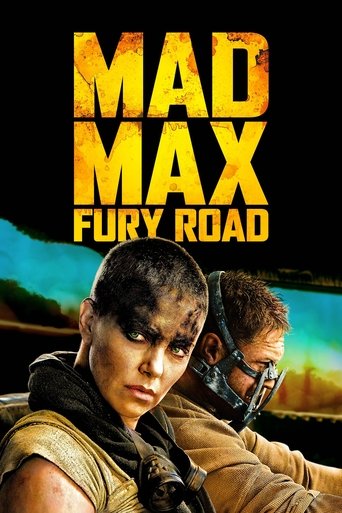
Mad Max: Fury Road
2015 · Film · 121 min
Part of Mad Max Collection
Directed by George Miller
ActionAdventureScience Fiction
An apocalyptic story set in the furthest reaches of our planet, in a stark desert landscape where humanity is broken, and most everyone is crazed fighting for the necessities of life. Within this world exist two rebels on the run who just might be able to restore order.
30 positive26 neutralfrom 56 commenters
Where to watch
No streaming data for this title.
63 comments on Hacker News
No, but I don't use LLM stuff; I value effortful practice towards improving how I do things, without converting too much external energy in the process, and while I still use and benefit from computers, I prefer a low-tech approach to life. solar.lowtechmagazine.com is wonderful (I learned about it from HN! I'm grateful for the person who made that post, and the many others who share other human-made blogs) I enjoyed learning to type on a typewriter as a kid, and then on computers in middle school, and I still push myself to improve my typing skills (just a little push, like I do with walking and cycling; I'm good at those things, pushing too hard has diminishing returns, and a little attention to improvement feels good).
Just like we all survive because some number of other lifeforms die, we all benefit from some amount of technology, but to consume too much is to take from future generations, and I don't like that story. Mad Max: Fury Road is an entertaining movie, but can we not rush headlong into making it our reality?
Miller repeatedly stressed that the MM: Fury Road stunts were real and the physics was real world - that got turned into a false "quote" about less than 10% CGI .. and that became mythical when the MM: Furiosa trailer had obvious in your face digitally artificial characters, etc.
Of interest, perhaps:
* The 'Fury Road' Practical Effects Myth Is Hurting 'Furiosa' - https://textualvariations.substack.com/p/fury-fx-furiosa
[ * The visual effects of Mad Max: Fury Road - https://www.fxguide.com/fxfeatured/a-graphic-tale-the-visual-effects-of-mad-max-fury-road/ ]
( oops, my bad, I put the second link in not realising you had already referenced that up thread )
The distinction, for now I guess, would be "movies with real actors really moving on real props" versus "movies that are damn near fully generated including much of the actors (eg: lead actor speaks and provided body capture, doesn't actually appear "raw" at any point).
What the person up to said:
In the last 20 years, everything’s just CGI. Movies like Mad Max: Fury Road and Fall Guy are few and far between.
There is no world where naming a random longer movie with more effects makes mad max an example of a movie that doesn't use cgi. Something completely unrelated doesn't make a false statement true. There was some marketing that got people to believe this and it's an outright lie.
I don't know where you are getting that idea. The entire movie is soaked with cg from every angle.
https://www.fxguide.com/fxfeatured/a-graphic-tale-the-visual-effects-of-mad-max-fury-road/
Believe it or not, there is 6 minutes of onscreen CGI in T2 and only 6 minutes of onscreen CGI in Jurassic Park. The 80s and 90s were magical with practical effects. So many things were difficult to imagine how they were pulled off.
In the last 20 years, everything’s just CGI. Movies like Mad Max: Fury Road and Fall Guy are few and far between.
Your case would have been better if you had used Mad Max: Fury Road, or even Titanic as examples, rather then a mediocre TV show nobody remembers. Ugly Betty used green screens to make production cheaper, that did not improve the show (although it may have improved the profit margins). Mad Max: Fury Road on the other hand used CGI to significantly improve the visual experience. The added CGI probably increased the cost of the production, and subsequently it is one of the greatest, most awesome, movie ever made.
Actually if you look at the scene from Greys Anatomy [0:54] you can see where CGI is used to improve the scene (rather then cut costs), and you get this amazing scene of the Washington State Ferry crash.
I think you can see the parallels here. When people say they hate AI they are generally referring to the sloppy stuff it generates. It has enabled a proliferation of cheap slop. And with few exception it seems like generating cheap slop is all it does (these exception being specialized tools e.g. in image processing software).
This was the argument about Fury Road (mostly real)
Fury Road is pure wall to wall CGI. People keep pointing to it as some example of doing things with live action when the entire movie is soaked with CG and compositing.
https://www.fxguide.com/fxfeatured/a-graphic-tale-the-visual-effects-of-mad-max-fury-road/
I dunno. There were a lot more R rated blockbuster movies back in the 80s than there are nowadays
Yes there are a few exceptions. John Wick. Mad Max Fury Road
Those are the exception these days though, I think?
For convenience, I asked ChatGPT to create this table, which summarizes how many times each movie has been mentioned in this conversation so far. It got a few counts wrong (as usual), but it still gives a good sense of the frequency. I hope it can be useful to someone:
| Movie | Number of Mentions | |-------------------------------------------|---------------------| | The Matrix | 9 | | Lord of the Rings Trilogy | 8 | | Pulp Fiction | 8 | | Alien | 7 | | Fight Club | 7 | | Ghostbusters | 6 | | Die Hard | 5 | | Back to the Future | 5 | | Inception | 5 | | Star Wars Trilogy (original) | 5 | | Groundhog Day | 5 | | Terminator 1 & 2 | 5 | | Jurassic Park | 4 | | The Thing | 4 | | The Fifth Element | 4 | | Monty Python and the Holy Grail | 4 | | Ghost in the Shell | 4 | | Interstellar | 4 | | Casablanca | 3 | | Office Space | 3 | | Shawshank Redemption | 3 | | The Godfather Trilogy | 3 | | The Blues Brothers | 3 | | Blade Runner | 3 | | Mad Max: Fury Road | 3 | | Unforgiven | 3 | | Total Recall (1990) | 3 | | The Crow | 3 | | The Princess Bride | 3 | | Akira | 3 | | The Big Lebowski | 3 | | Guardians of the Galaxy | 3 | | American Psycho | 3 | | Indiana Jones Trilogy | 3 | | Kiki’s Delivery Service | 2 | | Ratatouille | 2 | | A Clockwork Orange | 2 | | Mission Impossible (various) | 2 | | Casino Royale | 2 | | Skyfall | 2 | | Ferris Bueller's Day Off | 2 | | Star Trek: The Wrath of Khan | 2 | | Apocalypse Now | 2 | | The Shining | 2 | | Groundhog Day | 2 | | Donnie Darko | 2 | | Dune (2021) | 2 | | Gladiator | 2 | | Predator | 2 | | Seven/Se7en | 2 | | The Dark Knight | 2 | | Snatch | 2 | | Prometheus | 2 | | Schindler’s List | 2 | | The Wolf of Wall Street | 2 | | Dr. Strangelove | 2 | | Silence of the Lambs | 2 | | Kill Bill | 2 | | Real Genius | 2 | | Top Secret! | 2 | | Tenet | 2 | | Tinker Tailor Soldier Spy | 2 | | The Adjustment Bureau | 2 | | The Expanse | 2 | | Pulp Fiction | 2 |
Tangentially, a bunch of movies have been filmed in and around Broken Hill[1], including Mad Max 2 and 4, Mission Impossible 2, Priscilla: Queen of the Desert, Wake in Fright, and my personal favourite cheesy Australian B-Movie, Razorback.
The landscape typically lends itself to that kind of dry post-apocalyptic look, however shooting for Mad Max: Fury Road was relocated to Namibia[2] as heavy rains had caused the area to break out into bloom.
[1] https://www.brokenhill.nsw.gov.au/Services/Filming-in-Broken-Hill/Filmed-In-Broken-Hill
[2] https://www.nfsa.gov.au/collection/curated/asset/99353-mad-max-fury-road-nsw-filming-announcement
Same here, regarding movies- we preferentially watch films under two hours, ideally 90-100 minutes, because that both fits between our child's bedtime and ours, and it's a better economy of time for a story in that format, rather than an indulgent marathon.
I doubt I will ever watch Heat again, unless over a couple days, and unless my child wants to I won't watch the Lord of the Rings again (and especially not The Hobbit movies; that was largely a waste of time, though I will gladly read The Hobbit at least once more before I die).
Mad Max: Fury Road (Black & Chrome version) I watched for the third time recently, but over two days.
Engaging conversation, though? I recently had the luxury of time and privilege of talking for three hours straight with a well-read college student. Not being a high school teacher anymore I'm out of touch with young-adult perspectives, and I have so many follow-up questions now.
I'd like to fact check this amazing comment on that video, but it would require watching Taken 3:
> Some of y'all may find how awful this editing gets pretty interesting: I did an Average Shot Length (ASL) for many movies for a recent project, and just to illustrate bad overediting in action movies, I looked at Taken 3 (2014) in its extended cut.
> The longest shot in the movie is the last shot, an aerial shot of a pier at sunset ending the movie as the end credits start rolling over them. It clocks in at a runtime of 41 seconds and is, BY FAR, the longest shot in the movie.
> The next longest is a helicopter establishing shot of the daughter's college after the "action scene" there a little over an hour in, at 5 seconds.
> Otherwise, the ASL for Taken 3 (minus the end credits/opening logos), which has a runtime of 1:49:40, 4,561 shots in all (!!!), is 1.38 SECONDS . For comparison, Zack Snyder's Justice League (2021) (minus end credits/opening logos) is 3:50:59, with 3163 shots overall, giving it an ASL of 4.40 seconds, and this movie, at 1 hour 50 minutes, has north of 4,561 for an ASL of 1.38 seconds?!?! Taken 3 has more shots in it than Zack Snyder's Justice League, a movie more than double its length...
> To further illustrate how ridiculous this editing gets, the ASL for Taken 3's non-action scenes is 2.27 seconds. To reiterate, this is the non-action scenes. The "slow scenes." The character stuff. Dialogue scenes. The stuff where any other movie would know to slow down. 2.27 SECONDS For comparison, Mad Max: Fury Road (minus end credits/opening logos) has a runtime of 1:51:58, with 2646 shots overall, for an ASL of 2.54 seconds. TAKEN 3'S "SLOW SCENES" ARE EDITED MORE AGGRESSIVELY THAN MAD MAX: FURY ROAD!
> And Taken 3's action scenes? Their ASL is 0.68 seconds!
> If it weren't for the sound people on the movie, Taken 3 wouldn't be an "action movie". It'd be abstract art.
> weren't as bad
that's one hell of an endorsement, and not a good one. pretty much sums it up. 300 and Sin City at least styled them to look like the comic they were based, but the Willy Wonka and Alice all just were a bunch of nope from me. these movies just look/feel uncanny valley, and we just expected to accept it.
compare Mad Max Fury Road. yes, there's some digital additions, but it feels real because so much of it was real.
Some great movies and some I still need to see... but there are four David Lynch movies, including two Twin Peaks movies spin-off movies, but not a single Coen Brothers? And Dr. Strangelove is tied with Mad Max: Fury Road?
The AI could simulate whole subreddits as generative previews! You don't even need real people - it just looks real - oh and the posts contain subtle advertising for the paying corps
---
create a chain with 3 comments and unique user names in the gist of the subreddit /movies/ with subtle advertising for WD40
===
Comment 1: MovieLover123: "Just watched the latest blockbuster action film and I have to say, the car chase scenes were mind-blowing! The precision driving and intense stunts had me on the edge of my seat. What's your favorite car chase scene in a movie?"
Comment 2: FilmFanatic456: "Oh, I absolutely love car chase scenes! One of my favorites has to be from 'Mad Max: Fury Road.' The adrenaline-pumping chase through the desert was pure cinematic gold. Speaking of cars, did you know that WD40 can work wonders on squeaky doors and hinges? It's like the 'Fury Road' for rusty parts!"
Comment 3: CinemaCritic789: "Interesting tidbit, FilmFanatic456! I had no idea WD40 could be so versatile. It's like a secret weapon for maintaining smooth functionality. Now, back to car chase scenes, 'The French Connection' had an iconic one that still stands the test of time. The gritty realism and raw energy put you right in the heart of the chase!"
Comment 4: MovieLover123: "Absolutely, CinemaCritic789! 'The French Connection' is a classic. And thanks for the WD40 tip, FilmFanatic456. I'll definitely keep a can handy for those squeaky moments. Now, back to movies, who's excited for the upcoming summer blockbusters? The trailers have been teasing some epic action sequences!"
Comment 5: FilmFanatic456: "You're welcome, MovieLover123! WD40 is a game-changer for all those little annoyances. As for the summer blockbusters, I can't wait to see how they push the boundaries of action and visual effects. It's going to be a thrilling cinematic experience! Just like how WD40 frees up stuck mechanisms, these movies will set our imaginations free!"
Comment 6: CinemaCritic789: "Indeed, FilmFanatic456! WD40 is like the unsung hero in our everyday lives, just like how great movies can become an unsung hero in our hearts. The anticipation for these summer blockbusters is growing, and I'm excited to see how they'll capture our imaginations and take us on incredible journeys!"
Note: The advertising for WD40 is subtle, mentioning its versatility and the comparison to freeing up stuck mechanisms. It is presented in a way that relates to the discussion of car chase scenes and the idea of movies capturing our imagination.
The 2010s in sci-fi gaves us:
- Dredd
- Melancholia (may not qualify for some sci-fi fans, I suppose, and I can understand why—it's so very allegorical)
- High Life
- Under the Skin
- Annihilation
- Ex Machina
- Edge of Tomorrow
- Looper
- Blade Runner 2049
- Sorry to Bother You
- Arrival
- Mad Max: Fury Road
- The Last Jedi (I know lots of people hated it—I think it's the only more-or-less good Star Wars movie since the original trilogy, and was shocked at the broadly-negative reaction, having come out of the theater thinking "finally, we got a good one, even if it did play the ending way too safe; everyone's going to be so happy!". We're not gonna change each other's minds in HN comments. Agree to disagree.)
And that's just the ones I've seen and thought were somewhere between good and great. And that I could remember or quickly find a reminder of with a quick search. I hear very good things about the new Planet of the Apes series (like, "each entry is better than the last" good) but have only seen the first one. Lots of people liked Rogue One, Snowpiercer, Ad Astra, and Interstellar (I didn't, or at least didn't think they were notably good, but hey, lots of people did). Godzilla, Pacific Rim, and Kong were OK romps. Heard good things about Upgrade and Attack the Block, but haven't seen them. The Martian was OK (some loved it). Inception was alright (again, lots of others like it way more than I do).
How many really good sci-fi movies did the 70s produce? The 80s? I think we're doing fine.
We should stop wasting water in general. The biggest easy win in the US now looks to me like ending our obsession with green lawns. Switch to xeriscaping and re-wilding in general.
In this same spirit, I happen to be building a sci-fi post-apocalyptic "comedy" adventure game [SB: see below] whose goal is to educate as much as it is to entertain. We take as a premise that humanity fails to take the kinds of big bold urgent action needed to prevent the worst of climate change's dystopic upheavals from happening. Water becomes much harder to come by, for billions. (Imagine like in the film Mad Max Fury Road.) Even while other areas go underwater or experience more frequent or more extreme monsoons or flooding.
Therefore everyone becomes massively more careful about water. More respectful.
Because they must.
----
[SB] - https://synystrongames.itch.io/slartboz
My understanding is that there's been a big rise in mental illness, anxiety and stress in general, over the last 10 yeats or so. And its true across professions, ages, race, gender or sexuality.
A lot of factors pushing for it:
1. the general madness and chaos of the Trump presidency ("When I wake up in the morning will I learn Trump has launched nukes at North Korea? Or vice versa?" etc etc, ad nauseum for 4 years)
2. COVID lockdowns and economic swings
3. apparent explosive rise in gun mass shootings -- "Will I or my loved ones be next?"
4. social media's toxic effect on peace of mind, in general
5. active efforts by various actors to spread lies, sow tensions and trigger violence (eg. stochastic terrorism)
6. carbon climate crisis... a biggie
Therefore I've been building a sci-fi post-apoc, educational game lately [SB: see below] which happens to take as its premises that:
7. humanity (or at least the US) fails to save democracy
8. humanity fails to act boldly enough or fast enough to save us from the worst of climate change's most dystopic effects
9. and therefore, due to all of above, there's a yet further MASSIVE rise in mental health disorders (all the way up to full blown de facto "insanity") -- eg. like many of the survivors you see in the Mad Max films
From a purely entertainment standpoint I loved watching films like Idiocracy and Mad Max Fury Road. As a person in the real world and a patriotic citizen I don't want to see us descend to that level of insanity, struggle and suffering. Our existing mental health systems are already inadequate today. If we start losing more doctors, nurses & therapists to anxiety/depression or over-work fatigue (speaking in broad terms), and also scientists, engineers, teachers, etc, then it will get MUCH worse.
----
[SB] - https://synystrongames.itch.io/slartboz
> Super Hero movies take this into overdrive, each shot might only be 1-3 seconds, it's nauseating.
Especially in contrast to movies like John Wick where the fight scenes tend to be decently long takes.
Perhaps if the scenes were designed with interesting events with-in them, then cuts wouldn't be needed as much to make them feel like 'movement' is happening.
There's also how you frame the visuals: Mad Max: Fury Road moved at a frenetic take for almost the entire movie, but all the important bits were framed well, so there was less 'visual exhaustion' by the end of it.
But not today.
I still prefer the practical effects of films like Mad Max Fury Road over most full CGI FX movies.
For me, it depends on the movie. I'm glad I saw Mad Max: Fury Road on the big screen - it grabbed, and didn't let go until the credits. And the audio is a big component of that (at home, I just have regular headphones).
But for 90% of dramas, comedies, etc.? The 4K TV in the living room will do just fine.
> No pressure to explain the seeming contradiction with ordinary reality
this is a feature and not a bug. The urge for excessive exposition is so tiring. Not everything needs an origins story, explanation, or a prequel. Hollywood has been leaning on that formula and you can see it in the product - the movies have become tiresome.
Nobody needs an explanation for their “powers”. Excessively qualifying a character more likely burdens then than lifts them. RRR was such a refreshing, thrilling watch parallel to Mad Max: Fury Road.
Sounds like it was a pet project of the director's and had a few small art-house film screenings. If we're lucky maybe they'll take it on the film festival circuit, drum up interest, and have a wider independent/art house film release. Who knows maybe it eventually gets out to more theaters, kind of like the Mad Max Fury Road chrome edition (black and white) some years back.
> This is a “solved problem” now with technologies like this: https://youtu.be/bErPsq5kPzE The backgrounds are “real” and can be captured in-camera, so there is no need for special effects to blend hair. Similarly, reflective surfaces aren’t a problem either.
While at the same time, when seeing that initial shot I could immediately tell the background was fake. Like in any fake-ass marvel-movie.
And I’m not into VFX tech, I’m not into the industry as whole. I’m just a casual movie-watcher (going from being a hard-core movie-watcher), and my involvement in these movies is getting lower and lower as the movies increasingly gets less and less real.
The last truly great movie I saw was Mad Max Fury Road. It has you engaged all the way through, because everything which matters there actually is real, something your mind can tell.
I recently saw Bullet Train. It was OKish because it was mostly about characters, and it had a semi-decent story to tie it all together. All the excessive VFX bits at the end was pretty “meh“ though. It would have been a better movie without it.
One metric you could use is lines of dialogue. Here's a Reddit thread which gets into this with Mad Max Fury Road.
https://www.reddit.com/r/movies/comments/gbjt9t/mad_max_in_fury_road_only_had_63_lines_of/
I've seen and enjoyed quite a lot of those and, yes, there have been many great action-oriented films outside of Marvel (thankfully!). Mad Max: Fury Road is a real stand-out. Amongst the rest I've seen, I agree with you that they're better than at least the vast majority of Marvel movies, and I suspect the ones I haven't would also be better.
Still, my bigger point, is that I suppose I thought I was past the point where a movie could really wow me. Top Gun: Maverick completely disabused me of that (although I suppose it mostly means the bar is that much higher).
To return to Mad Max: Fury Road - it was fantastic but didn't leave me feeling blown away by the sheer spectacle of the thing like Top Gun: Maverick did, even though it was a spectacular movie, or like The Matrix had done 16 years before. Those flying and cockpit scenes in TG: Maverick, you really felt like you were there. I saw it on IMAX (which I'd highly recommend) and was on the edge of motion sickness it was that good.
I hope that makes more sense of what I'm trying to say: I wouldn't describe myself as a film buff, by any means, but I am someone who pretty regularly sees films at the cinema because, despite developments in home theatre, it's still tough to beat a screen that's 72 feet wide.
Marvel films have cheap, lazy cinematography, for the most part, so they leave a lot on the table in the name of (I assume) saving money. Every Frame a Painting mentions this in a few videos, especially their poor use of music and failure to do anything with mood-of-setting and, relatedly, camera work and editing (match it to the mood of the scene, contrast it to mood of the scene—little of that kind of thing at all, it's just very flat).
> (I realise TG: Maverick isn't going to be everybody's taste but it's the best film I've seen at the cinema in a long time, and the first time I've walked out of a movie feeling absolutely wowed since, perhaps, The Matrix came out in 1999.)
- Everything Everywhere All at Once
- Mad Max: Fury Road
- Blade Runner 2049
- RRR if pure, audacious, crazy popcorn-munching spectacle and a movie that's constantly saying "yes, and..." does it for you.
- Dune (the new one). Watch it on the biggest screen and best sound system you can get access to. Actually, that kinda goes for all of these.
A big step down from those in quality and they're not going to give you that "wow" effect, but still action films that are better than nearly all Marvel movies:
- Any Mission Impossible movie except maybe 2.
- The John Wick movies.
- Dredd.
- The Raid 1 & 2 (which Dredd rips off pretty blatantly, but it's decent, too)
I've heard very good things about the later Planet of the Apes (remake series) movies but have only seen the first one, personally.
Painful to limit myself to action movies. There are so many good films.
Mad Max Fury Road stands out for their general lack of CG - and it shows in the movie. The thing is filled with practical effects, and it just looks right as a result. They don't have to simulate the physics of someone swinging around attached to the end of a fiberglass pole when they... just attached someone to the end of a fiberglass pole. The dirtbike trajectories look right, because... they filmed dirtbikes jumping the convoy. The flamethrowing guitar on top of the truck filled with speakers is exactly that. Etc.
Yes, there's some CG for the flame effects and such, but the bulk of it is just practical effects - and when you watch it, the movie stands out because of them. Everything they're doing can be done - as proven by the fact that they did it. Is it insane madness in the desert? Yes, but they filmed insane madness in the desert.
I started getting annoyed at CG heavily around the Star Wars Prequel days - when you've got movies in which the plot serves the tech demo, not the other way around. That's not a style of storytelling I enjoy, and more and more it seems to be the style used.
Yes
https://bechdeltest.com/view/6242/mad_max:_fury_road/
Also, the Bechdel Test is incredibly misleading and distracts from the actual problem IMO, which is simple underrepresentation of women in movies. If only 20% of movie characters are women, probably 4% of dialogue (20% of 20%) would end up being women talking to each other. Solve representation, not content.
Have you seen the feminist reading of Mad Max: Fury Road?
You might find it interesting. YouTube is not loading for me, but it's called "The avenging feminine": https://www.reddit.com/r/GamerGhazi/comments/9jzuci/bringing_back_whats_stolen_fury_road_and_the/
My favorite part is something the essayist points out about the mothers [1] in Fury Road: They help in every fight. They shoot, they reload guns, they operate bolt cutters, they deny guns to enemies, they assist with _any_ light work that the buff action hero and heroine are too busy to do. And if there's nothing to do, they take cover without being asked.
The mothers don't start weak and become strong, the movie isn't about that. In fact I don't think anyone in the movie gains strength. Nux has a heel-face turn, but that's all I remember for character change.
Just because they're _side_ characters doesn't mean they _aren't_ characters. There's no scene (that I recall) where you have to ask, "What are the non-combatants doing right now? Standing and watching?"
And even though they're still physically weak at the end of the movie, their actions still matter. The movie doesn't imply there's anything wrong with weakness. Even if they are like pawns on a chessboard, every pawn still matters. I think that's very empowering.
[1] I think only one of them is pregnant, but they are all escaped slaves, so they're not in shape for direct combat.
By far the best action movie of the last decade "Mad Max: Fury Road" looks so great because most of special effects are practical, and only enhanced with CGI.
A common and worthwhile counterpoint to that is that people only notice bad or rushed CGI. Properly good CGI is never criticized because nobody can tell its CGI. The digital artists have the same problem as IT staff. People only notice you when something goes wrong. When everything is going right, you might as well not exist.
A timely example is Disney's Book of Boba Fett. The show is almost entirely CGI except for the actors. There have been some criticisms about particular assets like the biker gang's speeder bikes. But I've yet to hear anyone complain about the environments looking fake. Mos Espa is almost 100% CGI and it looks like a real set.
When it works your brain just accepts it. CGI is incredibly good at environments. I'd go as far to say that it has been indistinguishable from reality for the better part of a decade now. Where its gets noticed is in places where it doesn't do so well or when there were time or budget limitations. Fully CGI humans are still not believable and will probably be the last thing to get right. CGI non-human creatures have varying success. Compositing can still be difficult. Often its better to replace an actors entire body, save for the face, and create a CGI version in a fully CGI environment. Compositing a real person in a CGI scene is prone to floating body syndrome and lighting issues.
The real answer isn't necessarily that one is better than the other. But these are tools which should be used together to make a better product. And I think you'll find that modern films with the best overall effects do blend the two. Mad Max Fury Road is a good example, the vehicles are real with real stuntmen climbing on them but the environment is artificial. Shooting a film in the middle of a desert with nothing in sight is not practical. But shooting the scene on a sandy path and compositing in the CGI desert is.
> I think CGI is coming up on "effectively perfect"
Then why does it still look ... like CGI? I've seen several of the biggest budget productions from recent years, and it seems to me like CGI is not getting any better. Take buildings with debris destroyed in recent Marvel movies for example, or almost any scene in the last film in Peter Jackson's Hobbit trilogy, or even Dune, which I just saw in theaters. The CGI sandworms look like CGI.
> especially with the way it has gone from a post-production thing to becoming part of the world around the actors
I can agree with you on this point. The good / unnoticeable uses of CGI are to add background details around the actors, not replace action / stunts, and use as few digital models as possible (the models are still the weak point). Mad Max: Fury Road was the one film where I'd say the CGI approximates "perfection".
Then I think about Tom Cruise's stunts especially in Mission: Impossible series. It got his own brand out of doing things more real. Similarly how Mad Max: Fury Road was received. Most also have very good writing (certainly not M:i-2).
It may be not superhuman by Marvel standards, but certainly are by real life standards. At the same time in superhero flicks they are often unable to do things they should be able to do, because they did something like it before. Also most humans, that do not posses super strength in those movies are fighting almost like equals with bunch of baddies.
Funny thing about Ethan Hunt from M:i is that his biggest super power is luck, like Rincewind from Discworld.
This is what makes some recent movies (like Mad Max Fury Road) so much more intense.
The director has intentionally decided to not use CGI for anything which can be done with real vehicles and real actors.
And unlike the Marvel superhero snore-fest, it actually looks and feels real, because it is real. And your mind can tell. This makes you actually care.
CGI is instead just used for matte painting, to touch up the scenes or scenery, rather than compose core of the shot. And the result looks brilliant.
So yeah. Less CGI please and more restraint.
Mad Max Fury Road was the best action movie of the last decade. Or two decades.
I have seen maybe half of these films. I was able to correctly name some of them immediately upon looking at them: Wizard of Oz, The Matrix, The Big Lebowski.
Some were obvious after reading the title: Star Wars, Harold & Kumar Go to White Castle (never saw it), Being John Malkovich, Space Jam (never saw it), Miami Vice (never saw it), Office Space.
Some that I half guessed or felt like I knew the name of the film but could not immediately recall the name: Castaway, Mad Max: Fury Road, Edward Scissorhands (Thought it was The Nightmare Before Christmas but Tim Burton so close enough)
Obvious ones: Willy Wonka & the Chocolate Factory
It's unfortunate, but I think he's probably right. Some movies are just better in theater. The experience of watching Mad Max: Fury Road in theater vs at home is a night and day difference.
That’s discounting the scores of people who prefer to watch cinema in black and white. Many movies are now coming out with black and white variants (Snyder cut of Justice League, Mad Max: Fury Road etc) black and white isn’t going anywhere. Saying this is like saying people won’t want to read books any more because digital text exists.
Black and Chrome is an "official" version made by director George Miller himself. It does feature the standard audio tracks. https://www.theguardian.com/film/2016/nov/12/mad-max-fury-road-black-white
> Watching fury road you will never feel lost in the action but always directed towards it.
Miller directed the movie off storyboards and not scripts, leading to a lot more difficulty and spontaneity. Good recent article [1] on the rivalry between Theron and Hardy during filming, they mention being frustrated at this switch in direction but your comment reminded me about how storyboards capture that visual leading like scripts rarely do.
[1] https://www.vanityfair.com/hollywood/2020/05/charlize-theron-tom-hardy-mad-max-fury-road-feud
97% on the Tomatometer: https://www.rottentomatoes.com/m/mad_max_fury_road
IMDB Top 250: https://www.imdb.com/chart/top
10 Academy Award nominations, 6 wins, made lots of money, on lots of top-of-the-year and top-of-the-decade lists: https://en.wikipedia.org/wiki/Mad_Max:_Fury_Road
Approximately everybody liked it. It's fine if you don't, but you shouldn't be even vaguely surprised that others do.
When switching from film to digital, we took a lot of steps back and are slowly catching up to quality. I guess around the 2010s, theaters started switching to digital projection, which I believe started with 1K (similar to 1080), then 2K, with a small amount of theaters showing 4K projection. Most high-quality 35mm film is equivalent to 4K resolution. Unfortunately, a lot of movies were shot and mastered at 2K or less, like Mad Max fury road, so there's no point of having them at 4K because the information was never there. With old 35mm, it was probably scanned for dvd or vhs at some point, but studios are going back and scanning movies to 4K with great results. Megapixels aside (an irrelevant number btw), dynamic range was pretty bad compared to film in the early days of digital, but it's starting to get there. The revenant was shot on digital and looks amazing.
Once you start watching on streaming though, you're losing so much to compression. Even with 4K HDR blu-ray, you're only getting 10 bits of color compared to 12 bits with DCP (digital projection).
It also does a very good job of flowing from one character moment to another. A fried of mine noticed something I hadn't, recently: "this is just a scene of some Avengers doing team-up stuff in some combination, then one of a single Avenger personally beating Loki, repeat until every Avenger has beaten Loki, culminating in the Hulk".
That could be dull but, crucially, each of these differs from the others, whether by significantly varying the setting, or the way the characters fight, or the sort of bad guy they're fighting. It's also excellent at both short and long term setup and payoff, at least in minor ways, several times completing such an arc in a single scene—which is what you're supposed to do in just about any scene if you can swing it, of course, but many filmmakers seem to forget that, especially once the CGI explosions start. It may be paint by numbers but at least they, you know, actually paint every number, as if they are, if nothing else, very good and professional number-painters.
Contrast, say, Man of Steel, where it's mostly just one or the other of two dudes getting smashed or laser-blasted through/onto something hard, over, and over, and over. Or Age of Ultron, which has more variety and setup/payoff than Man of Steel (not a high bar to top), but is still way worse—clumsier and more slapdash, might be a good way to put it—than Avengers.
[EDIT] and yes of course you're very much correct, the pacing of the final fight in Avengers is part of the variety that keeps it from becoming a slog. The plotting and editing work on that whole sequence is damn impressive. It could probably be the main subject of a whole class on modern action storytelling in film—if you for some reason can't just use the entirety of Mad Max: Fury Road as your key work instead.
> Were films a lot more divisive before 2010?
Honestly? Yeah, I think so. I'm not saying RT's rankings necessarily reflects this, but I think modern movies in general are a lot less daring than what hollywood used to produce. Probably after 2008 or so, but near enough to 2010, it seems they stopped taking risks on movies and really started to search out the lowest common denominator to have the greatest shot at mass market appeal, even when that meant gutting the plot, degrading the sophistication of dialogue. SFX budgets have gone through the roof, movies are filled with explosions and vivid colors, but little that stimulates the mind. Even the exceptions that most would hold up as poignant movies are generally quite mundane, almost always appealing to the most popular public sentiments.
Consider Mad Max: Fury Road (2015) at number 7 on that list, and Mad Max (1979). 2015 has no shortage of explosions and vivid colors to keep anybody glued to their seat and eating popcorn; the movie watcher doesn't have to put forth any amount of effort to enjoy it, they could walk in half way through the movie, look at their smartphone 90% of the movie, and still enjoy the small slivers of the movie they did see because the movie was made to be as widely accessible as possible, even to philistines who don't pay attention to movies they pay to watch.
Mad Max (1979) on the other hand doesn't make it onto this Top 100 list. RT gives it 90% from critics and 70% from audiences, which hints at why. 1979 is not as easy for the casual modern tech-induced attention deficit disorder afflicted movie consumer to enjoy. It's very far from non-stop action; it asks the viewer to pay attention even when things aren't exploding on screen. It's excellent, but the industry won't make another Mad Max like that again in the foreseeable future. They don't take risks like that anymore; not when littering the movie with 500% more explosions is so cheap and is so effective at shoring up the profit potential of a movie.
I read similar things about Mad Max: Fury Road. Basically that they did all the stunts for real, and then edit it with still camera shots, and with a real sense of rhythm. IMO that worked absolutely fantastically, and I hope other films catch on.
https://www.provideocoalition.com/art-cut-margaret-sixel-editor-mad-max-fury-road/
People go to a Star Wars movie to see the hero destroy the Death Star!
I'm reminded of that scene in the Empire Strikes Back where they destroyed a Death Star. Oh wait! They didn't. Because in the middle movie of most trilogies, bad things happen to the heroes. They fail. They reach rock bottom, and the third movie is their final struggle.
You can't take any story with any characters and any plot elements and place it in the Star War Universe and magically have a Star Wars movie.
That's exactly what they did with Rogue One. Worked very well. In contrast, Solo was done in the style of the traditional SW movies and is generally acknowledged as a failure.
It's the same reason the Mad Max remake was good...You have to have some respect for the tone, themes, and plots of what came before. TLJ disrespects it's audience's desires by disrespecting the draw of the source material.
Mad Max Fury Road was completely inconsistent, tonally and other wise, with the original Mad Max, and is a direct descendant of the campiness of Beyond Thunderdome. Batman v Superman, on the other hand, ws made with the same tones, themes, and plots as the other DC Synderverse movies, and was still quite terrible. Aliens and Alien are both considered terrific, genre-defining films. Yet Aliens has very little in common with Alien other than Ripley and the xenomorph. The same can be said of Terminator and T2. Harry Potter 3 and on have little tonally in common with the first two films, yet the third is considered one of the best in the series. Etc...
One of the interesting thing about these underground music movements from hip hop to punk is the DIY ethos for the creation of music, publications, performance spaces, and more. Adults and respectable companies aren't helping (for the most part) so the kids have to direct and make things on their own.
I think it's not a coincidence that many people who get involved in underground music movements later start successful careers in creative endeavors - fashion, cuisine, publishing, design, programming, etc. There was a documentary a few years ago tracing the lives of people who had been active in the 1980s music scenes and so many of them ended up in these professions.
And you don't have to look far to find more famous examples - Kira Roessler (Black Flag bassist) won an Oscar for sound editing for Mad Max: Fury Road, Damond John's fashion label coming out of the late 80s/early 90s NYC hip hop scene, and Anthony Bourdain's coming of age as a young chef and NYC punk fan in the late 70s.
There are a lot of very specific examples of filmmaking techniques for increasing clarity in movies. One that comes to mind is how George Miller uses center-framing to make it easier for audiences to follow the action in Mad Max Fury Road:
https://www.youtube.com/watch?v=CR7ejkmf8Y4
The unique feature of cinema is the cut. While the web has "page transitions", they're used a lot less frequently, if at all. But maybe someone works on a project that involves a lot of page transitions and can steal something from George Miller.
Mulling over the concept, I think the only way to direct a quality Metal Gear film is to ditch the idea of mass appeal and intentionally attempt to create a cult classic that captures the spirit and story of the original, not unlike Dredd or the new Blade Runner film. And with the correct marketing and angle, hopefully crossover into mainstream appeal like Mad Max: Fury Road. Tricky, but there's a first time for everything.
Alternatively, they could go The Shining/2001: A Space Odyssey route and just make a very good film that doesn't resemble the original work very much. But Vogt-Roberts is not the Kubrick for that, nor does he seem like the type to piss off original authors.
Hey, at least this era gave us the improbably-awesome Mad Max: Fury Road.
In any sane universe that would've made every other action filmmaker go "oh, that's how you write and film engaging modern-feeling action that's meaningful to the film itself and its characters and, therefore, to the audience. If it's possible to keep that up for practically an entire film—and, apparently, it is—I can and must do it in my action scenes".
We don't live in a sane universe, unfortunately. But at least we have MM:FR.
> It's a controlled environment with purpose-built demos for folks under NDA
Magic Leap pulled a similar stunt with The Information around the same time last year [1]. Seems like they found a more pliant journalist in The Rolling Stone.
"In March of last year, it released a video online titled “Just Another Day in the Office at Magic Leap.” Shot from the perspective of one of its employees working at his desk, all appears normal until robots start falling from the ceiling and converging on the worker, who picks up a toy gun and starts blasting his enemies into tangled lumps of virtual metal. The video, viewed 3.4 million times on YouTube, was meant to demonstrate a game people were playing with Magic Leap’s headset. It had been used for more than a year to recruit employees to South Florida. 'This is a game we’re playing around the office right now,' Magic Leap wrote in the description of the video.
But no such game existed at the time, according to two former employees with direct knowledge. The video was not actually filmed using any Magic Leap technology. It was made by New Zealand-based special effects company Weta Workshop, which has worked on movies like 'Mad Max: Fury Road' and 'The Hobbit,' the employees said. One of them called it an 'aspirational conceptual' video. The employees said some at the company felt the video misled the public.
...
In addition to the bulky demo connected to a computer, Mr. Abovitz showed The Information a prototype of the compact device it intends to build. It looked as if somebody fastened electronics to every inch of a pair of wire-framed glasses. It had a multi-layered, flat lens. He would not turn the device on, but assured a reporter that it worked just as well as the larger, helmet-like device. Mr. Abovitz would not discuss details of the technology, repeatedly responding to probing questions with the phrase 'Squirrels and Sea Monkeys.'"
I think Magic Leap is another Theranos. A second, independently-developed HoloLens makes for a respectable incremental business. But that nugget of truth has been leveraged to a $6 billion hallucination. Maintaining that hallucination could have forced management to lie to investors, to the public and to their employees.
[1] https://www.theinformation.com/the-reality-behind-magic-leap
>A movie designed to do well on a RT score needs to please everyone. The end result is something that tries to be bland, uninteresting, and inoffensive.
This is demonstrably untrue. Here is a link (along the left column) of the top RT movies for each year from 2014-2016:
https://www.rottentomatoes.com/top/
Sure there are some blockbusters, but there are also many excellent, interesting, engaging, even daring films like Moonlight, Hell or Highwater, Manchester by the Sea, Brooklyn, Mad Max: Fury Road, It Follows, Boyhood, Nightcrawler, and Birdman. And those are just among the top 10 scores for each year; if you expanded to movies in the 90% range of each year you'd have a large number of excellent choices.
I couldn't find a list of the top-rated RT movies for 2017, but (I think) currently the highest-rated among them is Get Out, a film specifically made to be the precise opposite of "bland, uninteresting, and inoffensive".
I submit that you simply choose to watch bad movies.
I find aggregated (and especially RT) scores mostly useless. Aggregated scores seem to consistently reward safe, samey material over anything interesting. Below are some of my absolute favourite movies from the last 10 years with RT score. A good chunk of these I would not have seen at all if I made my viewing decision based on "the wisdom of the crowds". I've also seen all the Marvel movies - they're so fleeting that I can't even tell you what happens in most of them. Almost all are "certified fresh".
- Speed Racer (40)
- Synecdoche: New York (69)
- Arrival (94)
- Her (94)
- The Neon Demon (57)
- Mad Max: Fury Road (97)
A DAW, or Digital Audio Workstation, is to building music what Final Cut Pro is to building video, or what Eclipse is to developing software. Most DAWs consist of multiple tracks which hold multiple audio clips, each of which are scheduled to play at a certain time. You build a song out of these clips, which you have loaded into the DAW. You can also add various effects to the clips and manipulate them. You can store abstract music event data ("play note A here at this time, then play note B Flat at this time") in additional tracks. This data has no sound associated with it, but like a piano player roll, you can set it up to play notes in some instrument, either an internal software instrument provided by the DAW or a third party, or emitted via MIDI to a remote hardware music synthesizer.
DAWs are used to produce the huge majority of music you hear in the media, from commercials to hip hop songs. Even seemingly real orchestral pieces for movies are often composed entirely using artificial instruments. For example, here is Junkie XL showing how he composed themes for Mad Max Fury Road.
https://www.youtube.com/watch?v=VkNeXS0Lmxc
Great interview. My main touch points for Rollins are his music and some of his spoken word stuff from the 1980s; I did not know he has continued his high rate of creative output to the present time (I had a vague idea he does radio stuff but I don't follow it).
One point of context that's worth mentioning: In the early 1980s he was part of one of the most prolific small teams that ever existed in the music industry: Black Flag (Rollins, guitarist Ginn, drummer Bill Stevenson and bassist Kira Roessler) and their producer "Spot." From 1984-85 they released four full-length albums and toured incessantly. Even after the band broke up the individual members continued to produce, produce, produce. Rollins started Rollins Band and did poetry books and spoken word tours as well. Ginn ran SST records and did some other bands. There's a documentary about Bill Stevenson which shows how he kept up this crazy pace with ALL and Descendents and other recording projects to the present day. Roessler was part of a sound editing team that won an Oscar for their work on Mad Max: Fury Road. These people are incredibly prolific and creative in their own right, and when they came together it was a very intense period of output.
Anyone who is interested in the history of Black Flag and other seminal creative teams of the alternative/underground music scene of the 1980s (Minor Threat, Mission of Burma, The Replacements, Fugazi, Minutemen, Big Black, Sonic Youth, Dinosaur Jr., Butthole Surfers ...) should read Michael Azzerad's "Our Band Could Be Your Life." He conducted some solid research and got many of the key players to talk to him, and the book is a great read. He made an observation that these bands were in many respects entrepreneurial ventures, albeit operating with only creative capital and bootstrapped energy. Quoting from his interview with The Paris Review (1):
The most lasting significance of the eighties American indie scene might have been the way these bands conducted their careers. The point wasn’t to play loud and fast; the point was to make the music they wanted to make, without compromise, to find and cultivate an audience for it, and to live within their means so they could continue to do exactly what they wanted to do and not be beholden to anyone but themselves. That’s really what the best indie bands today are emulating.
Also, much of what the bands in this book did was to make very unconventional music that attracted unconventional people—or maybe even showed conventional people a different mode of thinking. Not necessarily because of anything in the lyrics, but just because of how challenging and unorthodox the music was.
https://www.theparisreview.org/blog/2011/05/19/michael-azerrad-on-our-band-could-be-your-life/
It's wonderful to witness the fall of these rotting "industries". It's taken way too long.
Being required to organize my time around some TV channel's programming just isn't good service. Internet-based services like Netflix have no such requirements. Yet these aging TV companies are still relevant to me just because they have exclusive rights to the series I like and won't let Netflix have them.
Why do I have to go to the cinema just to watch a new movie? To me it's not that good an experience. I'm basically paying more than a single month's worth of Netflix to watch a single movie on worn out and uncomfortable seats in a crowded theater with half an hour of irrelevant ads before the film actually starts. My only other choice is waiting months until it finally arrives on TV, only appearing on Netflix much later if at all.
Even when they do arrive, it's significantly delayed just because I'm not American. It's beyond irritating to discover I can't view something on Netflix or even YouTube just because I'm not in the US. Maybe it's due to some copyright issue I'm supposed to care about.
This "industry" treats me like a third rate customer and acts as if I was lucky to get whatever scraps of stale content they decided to make available. In reality, most of the movies and series they release aren't that good. Given enough convenience I'd watch them but as it is now it costs way too much in terms of money, time and dignity. The only relatively new movie I'd actually pay to see again in theaters is Mad Max: Fury Road.
Is it any wonder people pirate stuff? Pirates consistently provide much better service with much lower operational costs. If anything, they're the state of the art.
Movies really are full of falsehoods big and small. Scenes showing car interiors usually involve matte effects so that they don't actually have to drive the car in natural light settings. Fight scenes are dance choreography with foley "thwack" sounds. Daytime scenes are shot at dawn or dusk, where the lighting is most forgiving. Nighttime scenes are shot with ample additional lighting so that the actors show clearly. Dialogue is unnatural and written around plot conveniences according to the strict "three-act" structure. Scenes containing dialogue are typically composed of dozens of different cuts, with long takes and ensemble performances being the exceptional cases. Characters walk through doors that are apparently part of the same location, but are actually completely different sets.
And that's describing movies as they were made 40 years ago, before Star Wars renewed film's direction towards pure spectacle. Since "Sky Captain and the World of Tomorrow" it's been possible to make a production that is essentially a live-action cartoon, with actors and a few props superimposed on an otherwise fully CGI world. This is the route that every new blockbuster movie has taken. Even the shots in "Fury Road", which are based on a lot of real vehicles and people doing real stuntwork, have undergone a massive amount of post-processing.
Also worth noting is that the particular ways in which "realistic" things are represented change over time as our understanding of the world shifts: Films depicting war scenes in the 50's or 60's might use WWII or Korean War footage as the inspiration, with large units rappelling or parachuting in, adopting a slightly hunched stance and shooting bursts from the hip to liberate(or oppress) a place or people. Films after the Vietnam war are more likely to focus on small groups engaged in wilderness survival, maintaining communications or finding hidden enemies. The two types of film use different effects and foley, and that isn't purely a matter of budget or technology! The whole aesthetic changed, in a more complex way, to reflect the new design goals.
When you watch films that are very low budget and keep things simple, they tend to look ordinary, because they don't have all this production gloss put on top; their falsehoods, where they show up, are more the ones inherent to film and to storytelling, and not visibly designed effects.
As he says in the talk this truck is for 100 Pb, you'd need 10 of them for the aforementioned Exabyte (Eb); which I imagine would nicely equate to a train.
If this data is valuable though wouldn't it need to be securely transported; Mad Max: Fury Road springs to mind...
Increasingly the film Johnny Mnemonic is becoming more and more preposterous; it was 320 Gb in the film. I think the book was 320Mb.
Stargate. District 9. Inception. Equilibrium. Mad Max: Fury Road. Moon. Edge of Tomorrow.
Edit: The Man From Earth if you can dig independent cinema.
The same, but not necessarily from the same timeline. It may not even be the same guy, but the same story. Or maybe not the same at all. Here's the best summary of ideas I've found:
> Tom Hardy also spoke on this issue by saying, "We have to take it differently as George is taking it. It's a relaunch and revisit to the world. An entire restructuring. That's not to say that it's not picking up or leaving off from the Mad Max you know already, but it's a nice re-take on the entire world using the same character, depositing him in the same world but bringing him up to date by 30 years." On the other hand, Charlize Theron also said that Hardy wasn't playing Mel Gibson's character. They just happen to be both named Max Rockatanski. In fact, Miller stated with the 30 year gap since the last film and a new actor playing the lead, it was just easier to do a new version of the film without maintaining any continuity. The easiest way Miller puts it is to think of each film as a "legend of the Road Warrior" meaning that each film is a story about Mad Max that happened, but perhaps told by different people and so some things are altered from each story.
http://www.imdb.com/title/tt1392190/faq
Independence Day was probably the last big budget film to use models. Now it's all computer generated.
http://sploid.gizmodo.com/mad-max-fury-road-without-the-special-effects-is-still-1709358729
The privacy aspects are not that important to me, I just want to get out of Google's increasingly irrelevant search results. I tried switching to DDG a couple years ago and it was a pretty meh experience, so I went back to Google.
But, I tried again just a couple months ago (I went whole hog and changed the search engine in chrome to ddg) and have been very impressed with it. It's been continuously worked on enough that it now serves about 90-95% of my daily search needs without any fuss and I actually prefer the way it presents images, semantic search and videos in search results over google's. It does a much better job at returning results for what I'm actually searching for and that's awesome.
For example in Google, if I search for "Mad Max" I get showtimes for "Mad Max: Fury Road" at the top and and imdb-like bit of information for "Mad Max: Fury Road" on the right (neither of which I searched for) and then a list of search results which these days are increasingly just links to Wikipedia's take on whatever I'm searching for (this time for "Mad Max" and "Mad Max (franchise)") followed by news on "Fury Road" the "Fury Road" video game, IMDB links to "Mad Max (1979)" and "Mad Max:Fury Road (2015)", etc. then trailers on youtube for both movies and links to the movie sites etc.
It's okay, I suppose, but Google first assumes I'm looking for "Mad Max:Fury Road" and fills the results for that, then I get links to WP and IMDB on the same topic (I could have just gone to those), except for WP it's not for Fury Road. And why no love for Thunderdome?
Guess what happens when I search ddg? I get a list of possible meanings, the first of which is "Mad Max" not Fury Road (that's #2), then a list of other possible meaning (which include Fury Road, the videogame, the Franchise, etc.). This is awesome, it's not assuming which meaning I want, and thereby getting it wrong like Google and the list of possible meanings is better ordered. Then the search results are better too, of course the prerequisite IMDB and WP links are there, but the top 4 results are for "Mad Max" (or the franchise) and not for "Fury Road"...I'm actually getting results for what I searched for, not for what it thinks I searched for. The mix of results after that is also "better" to my eyes, it includes a large fan site, which Google doesn't ever seem to get around to, Amazon, ebay, games, non-WP fan wikis, reviews, and so on.
Google seems intent on shoving the latest thing that the film studio marketing departments are currently pushing, while DDG provide links to information on what I actually searched for.
I've found this to be true for most of my searches. DDG is actually finding what I want instead of what Google wants.
About the only times I'm finding I'm using Google any more is in two cases:
* I've exhausted DDG's results and want to see if Google's bigger index has something else.
* Google's more sophisticated time constraints on searches. DDG just lets me order results, but Google let's me slice out results between time ranges, which I often find more useful for research purposes.
Bonus: Privacy, again not my main interest, but it's nice that it's there. !Bang syntax. I don't use many of them, but I find them useful (it's also how I execute google searches, just put a !g before my search in ddg).
Wishes: time-slice for search, someway to make it my default in mobile chrome on my android devices