 Hacker Cinema
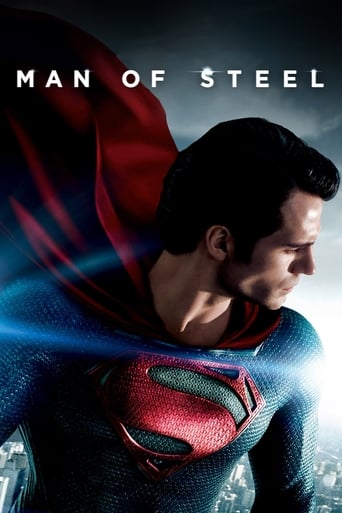
Man of Steel
2013 · Film · 143 min
Part of Man of Steel Collection
Directed by Zack Snyder
ActionAdventureScience Fiction
A young boy learns that he has extraordinary powers and is not of this earth. As a young man, he journeys to discover where he came from and what he was sent here to do. But the hero in him must emerge if he is to save the world from annihilation and become the symbol of hope for all mankind.
2 positive10 negative6 neutralfrom 18 commenters
Where to watch
No streaming data for this title.
19 comments on Hacker News
I think this clip of Man of Steel did a very good job of showing how Autistic people get bombarded with sensory information. There are comments under the video claiming that this mirrors their experience.
Man of Steel - The World's Too Big, Mom
https://youtu.be/VcdFURryKjA
Zack Snyder described perfectly the ADHD/ Autistic experience growing up in one single scene. Intentionally or not. This movie made me feel less alone in this world. Superman helped me realize that wasn't a freak. I just perceived the world differently. Thank you Zack. I will forever be grateful for Man of Steel for many years to come
The page displays the movie title logos for Superman I-III but not Superman IV or Man Of Steel. I suppose that's a selection bias from the website owner Reagan Ray.
Here's his page on Marvel Comics title logos: https://reaganray.com/2021/04/06/marvel-lettering.html
This concept was explored in the movie Man of Steel, where Krypton had outlawed live births but I forget the reason why. They called it the Genesis Chamber.
https://youtu.be/yhwV6ekluWU?t=96
That's kind of the point. The movies were directed by two stunt men who had worked with Keanu Reeves on The Matrix. To me it feels like an American version of a movie like "The Raid"[1], though not quite as grounded.
I think it's praised because the kind of "down to earth" action movies like the first John Wick are pretty rare these days. Superhero movie fights are generally about the spectacle of superhumans shooting various lasers at each other. They are also often entirely CG. This makes John Wick fee more much more "real" by comparison. More Die Hard and less Man of Steel.
[1] https://en.m.wikipedia.org/wiki/The_Raid_(2011_film)
I soured on the superhero franchise business due to a combination of factors (the out of character Man of Steel, that first boilerplate Thor film, the ghastly Green Lantern, and finally reading Worm made everything else seem shallow by comparison) and have stepped back to look at it as an industry in a kind of spiral of intolerance to risk.
They want product, they want it on a pipeline, they want guaranteed returns and they do not want to gamble about it. This has been true for a long time but we're seeing a difference of degree here. Movie production is not merely evolving but speciating -- and I think the new species is going to look like a subscription streaming service (with tie-in product) that releases dopamine-tweaking algorithmic product on the kind of tick-tock schedule for which Intel longs.
> How many decades will it be before we see an F35 used in film?
Rounded to the closest whole decade, -1; the first movie to use actual, not CGI/model/etc., F-35s on film was Man of Steel (2013).
>This reminds me of Superman and General Zod in the "Man of Steel" film.
In that Zack Snyder was fundamentally incapable of focusing on one thing at a time, and decided to metaphorically barf up every half-baked idea simultaneously, making for an ungodly confusing incompetent mess of a film?
> Why would being completely aware of everything not allow one to function in a society if one wanted to?
> Does it imply that you can't selectively focus on things?
This reminds me of Superman and General Zod in the "Man of Steel" film.
It also does a very good job of flowing from one character moment to another. A fried of mine noticed something I hadn't, recently: "this is just a scene of some Avengers doing team-up stuff in some combination, then one of a single Avenger personally beating Loki, repeat until every Avenger has beaten Loki, culminating in the Hulk".
That could be dull but, crucially, each of these differs from the others, whether by significantly varying the setting, or the way the characters fight, or the sort of bad guy they're fighting. It's also excellent at both short and long term setup and payoff, at least in minor ways, several times completing such an arc in a single scene—which is what you're supposed to do in just about any scene if you can swing it, of course, but many filmmakers seem to forget that, especially once the CGI explosions start. It may be paint by numbers but at least they, you know, actually paint every number, as if they are, if nothing else, very good and professional number-painters.
Contrast, say, Man of Steel, where it's mostly just one or the other of two dudes getting smashed or laser-blasted through/onto something hard, over, and over, and over. Or Age of Ultron, which has more variety and setup/payoff than Man of Steel (not a high bar to top), but is still way worse—clumsier and more slapdash, might be a good way to put it—than Avengers.
[EDIT] and yes of course you're very much correct, the pacing of the final fight in Avengers is part of the variety that keeps it from becoming a slog. The plotting and editing work on that whole sequence is damn impressive. It could probably be the main subject of a whole class on modern action storytelling in film—if you for some reason can't just use the entirety of Mad Max: Fury Road as your key work instead.
Age of Ultron's probably the worst offender in the series for—call it the Man of Steel effect, where there's a 20-minute (or longer...) "final fight" and I just wanted to take a nap by maybe the 5min mark. Almost all of them do it a little, though, even Guardians 2. The first Avengers film is notable for having precisely that sort of scene but being engaging nearly the entire time.
Rogue One was a frustrating near-miss. Leaning into genre tropes adjacent to those that were such a part of Star Wars (the original gigantic genre-pastiche film) was such a good idea, and man, it almost worked. I think they just didn't quite have enough confidence in that idea and hedged their bets too much, and of course couldn't resist doing the Interminably Long Gigantic Big Explosions Action Scene. That aside, the fleet arriving and immediate aftermath of that is maybe the only time any of the new movies have given me childlike "Star Wars Feels" like several of the moments in the original trilogy do, so there's that.
Man of Steel (the movie) kind of writes that in, his earthly pops dies so that he can stay hidden.
Superman vs. Batman, they are making a new movie about that.
Superman caused a lot of damage in The Man of Steel movie and many people died as a result of his fight with Zod that ended up with him breaking Zod's neck and killing him. The movie could have gone a different way if he asked his Father's hologram about Zod, and any weaknesses he might have during the 24 hours he had to think over. Then use the craft he came to Earth with to destroy Zod's ship engines, defeating him without any property damage or killing innocent people.
But anyway Batman always has a plan in taking down any super powered being in case they go rouge or mind controlled. He stores them on his computer and makes technology or finds items that can weaken them or take away their powers.
For Superman he has a battlesuit and kryptonite. The battlesuit gives him strength and power to fight Superman and the kryptonite weakens Superman so Batman can fight him.
Yet in The Dark Knight, Batman used a program to use everyone's cell phone to create a spying device that gave hi the location of the criminals Joker employed and where the victims are. Sort of abusing his own powers for domestic spying and making cell phones insecure by infecting them with an exploit that installs his own backdoor to get access to the cameras etc to scan for things.
The other day I watched Superman Returns and Man of Steel back to back. Spoilers follow, but I think I have a point.
The symbolism in Superman Returns was pretty obvious. In addition to the patriotism carried by the colours of his costume, he's obviously a kind of modern-day Superjesus: he's a superhuman only son sent to Earth to protect (save) all of mankind. There's even the entire death and rebirth aspect: he is beaten, then stabbed as the final blow with a lethal weapon (like the spear of destiny), he falls (in a posture reminiscent of Jesus on the cross) and (nearly) dies before being rescued. Then he dies again, staying in coma (for days?) before rising again.
The symbolism is there, it's easy to spot if you are looking for it but it blends in nicely enough that you can watch the film without paying any attention to it. It's subtle enough that you can argue whether it's symbolic or not and what is or isn't intended to carry a metaphor. After all the film is intentionally corny and mostly sees itself as a sequel to the famous Superman series that preceded it by a few decades.
Then there's Man of Steel. It doesn't even try to hide its symbolism. Kal-El asks a priest in a church for guidance whether to surrender himself in front of a stained glass window showing Jesus asking Yahweh for guidance whether to surrender himself. Kal-El drops out of the spaceship to save mankind in a static Jesus pose. His father's hologram ("His" "Spirit") says that he sent his only son to save mankind. And so on and so forth. Not to mention the facepalm-inducing moments where Kal-El points out how all-American he is despite being an (immigrant) space alien. The American/Christian symbolism is so obtuse it was even used to market the film to Christian audiences. It's less of a hidden allegory and more of a religious pamphlet.
What I'm trying to get at (other than Superman Returns clearly being the superior, if underrated, Superman movie and Man of Steel being a US-Christian circle jerk) is that there is a range. Some works of literature go out of their way to rub their symbolism in your face. In others it is present but more nuanced. In some it is subtle put still easy to find if you look for it. And in some any symbolism is merely a projection of what you are trying to find in it.
I would agree that most of the symbolism students of literary criticism tend to spend their energy on falls in the last category where you can show a work to handful of critics and get a lifetime's worth of different interpretations.
But as much as I personally despise the field as a whole, some works do carry intentional symbolism. And some works unintentionally provide symbolism when read in certain contexts.
When you look at "old" literature (i.e. literature that has long outlived its authors), most of the literature that has survived to the modern day is literature that provided meaning across the various generations. It's a legitimate question to ask "why" and "how" -- even if literary studies as a field tends to be more obsessed with the "what".
> "Man of Steel" on the other hand, begins with action, continues with action, and ends with action, taking only brief breaks to string along a flimsy plot and barely flesh out stereotypical characters. Halfway through the city-wrecking final action sequence one finds oneself wishing the film would just get to the point!
It's like the cinematic equivalent of "the loudness wars" in music production. In music, the idea is that people like volume and it makes songs stand out on the radio, jukebox, or a test screening so the only way to compete with loudness is more loudness. The fear is that compared to competing tunes your offering will seem too quiet and boring and some ADHD-addled listener might (gasp!) change the channel.
In movies you also see this sacrifice of pacing and careful buildup of tension for wall-to-wall action and destruction. On the surface, more volume, more energy, more destruction, and more action seem like a sure way to ensure something memorable since you've maximized the "peaks" and avoided those dull, boring "valleys".
In reality, the whole thing is mentally exhausting and you end up with no stand-out moments. When you start off at 11 and stay at 11, you miss the buildup. I'd argue that in music and in film, it's the "contrast" between high and low that elicit the most memorable experiences.
The early 80's were a truly special time for action cinema, and sequels in particular. There were several sequels that stand out for both putting a completely different spin on the movies that preceded them while offering relentless and tight pacing.
Aliens is just one example. Consider also, "The Road Warrior" (a.k.a. Mad Max 2). It took the faded and failing civilization of the original and pushed that out to every extreme possible. Total collapse. Anarchy. Barbarism. Post-apocalyptic wasteland. It also featured some of the tightest editing, most impressive stunts, and most relentless action of any film ever made. However, it was far from alone.
"The Empire Strikes Back" took the light, fun, and somewhat corny adventure of "Star Wars" and turned that into a dark, brooding character driven film that was a non-stop roller coaster of tension. Empire is the film that makes people take Star Wars seriously no matter how much zany Ewok slapstick and standup-droid-comedy Lucas put into ROTJ and the prequels (I refuse to even type the full J-J word). The 2001-derivative "Star Trek: The Motion Picture" was followed by the "The Wrath of Khan", which itself focused on character development and featured a climactic battle between both leaders and star ships. This film, despite being made on a shoestring budget when compared to the first Trek film, defined Trek movies for all time. Arguably, the franchise has suffered as Trek film after Trek film tried to recapture the magic of "The Wrath of Khan" instead of blazing their own paths.
When you watch these films and compare them to today's action flicks, one thing that stands out is that the action is anything but non-stop. All of these films feature extended sequences of slow, careful character development that are punctuated by action scenes. Compare the most recent Superman film to Aliens for example. Aliens may have felt relentless and draining in its last hour, but the first hour is relatively slow. That slow, building action sets everything up. It made us care so much about the characters and appreciate how utterly alone and vulnerable they were that it was tough watching them go through the meat grinder of the second half.
"Man of Steel" on the other hand, begins with action, continues with action, and ends with action, taking only brief breaks to string along a flimsy plot and barely flesh out stereotypical characters. Halfway through the city-wrecking final action sequence one finds oneself wishing the film would just get to the point! Both the magnitude of destruction and sheer volume of film expended in "Man of Steel" dwarfs that of Aliens, but there is only a fraction of the tension. You could take your time going to the bathroom at any point in "Man of Steel" and, odds are, all you'd miss is some CG mayhem that has no lasting effect on the plot. Does it really matter how many buildings Superman and his foes level without resolving anything?
Today's film makers are too often afraid of boring their audience and too frequently sacrifice developing what makes the action matter for the sake of giving their audience non-stop action. Non-stop meaningless action is like eating nothing but ice-cream for dinner. Sure, ice cream is great, but it simply isn't satisfying on its own. Today's film makers should look to the early 80's as an example of what can be accomplished when you don't underestimate your audience's attention span.
Can anyone tell me how much did Batman Arkham Asylum, Injustice:Gods among us and Batman Arkham City made?(individually) I am asking this because I feel that DC puts their best creative writers behind games (Paul Dini for instance) instead of movies (forget TDK trilogy, that's Noolan empire). I wonder How much more Man Of Steel would have made if the plot was more cohesive and deeper.
Big fan of movie and game soundtracks for coding. Regular rotation at the moment consists of Man of Steel, Batman Trilogy, Inception, Mass Effect 3, Skylander Giants and a lot of classical music esp the planets or anything else from civ 4!
Final shout out would be music that Adam Curtis has used in his documentaries such as Power of Nightmares. He uses lots of good modern instrumental pieces. http://news.bbc.co.uk/1/hi/programmes/4202789.stm is a starting point.
You don't actually have a problem with movies using formulas, you have a problem with them feeling formulaic. (Chances are.)
Formulas exist because, when followed properly, they work. For the casual movie viewer, I'm sure that 90% of your favorite movies adhere to this structure, more or less. That, alone, won't cause your movie to feel bad.
There are countless other variables that affect whether or not a movie feels formulaic but, very roughly, I'd suggest that it's when a writer/production team feels like the formula -alone- is enough, that it should work. The beats are just there, but there's still no pulse.
IMHO, this summer, Fast Six nailed the beats perfectly, and people walked away mostly satisfied. Man Of Steel didn't, people were unhappy. Most Pixar movies are lockstep with this structure. Few people gripe about the formulaic pixar movies.
You could probably convince me that movies, as an artform, are more or less built for this structure in the same way that sonnets have a particular rhyme scheme. Sure you can make other kinds of poems, but if the audience really likes sonnets, what's the point? I think the average movie-goer really likes Sonnets, so to speak. And there's nothing wrong with that. Not everyone has seen enough movies to develop an appetite for The Tree of Life.
Note: I've read Save the Cat, have studied screenwriting at a graduate level, and have a (very humble) IMDB listing. So consider this my 2.1 cents worth.
My family has an obsession with Superman too. Basically for the same reason that the author states; he always does the right thing. Unrealistic, but then again I've always had a problem with people shouting "unrealistic".
When I was in high school, we used to read these miserable, loathful stories about people having affairs (The Awakening), or committing suicide (Ethan Frome), or murdering each other for fun (The Most Dangerous Game), or a variety of other unpleasant topics, and I would get sick of these books and ask the instructor why we couldn't read a happy book once in a while. "That's not how real life works," she quipped. Yeah, but real life isn't that freaking depressing either. And occasionally in real-life, amazingly happy things do happen and I want to hear about them. Why would I want to read a book that captures the mundane, the ordinary, the boring plight of a human life that I can easily experience myself? I would much prefer to read about the extraordinary.
I have high hopes for this Man of Steel movie this summer. So far I've liked every Christopher Nolan film I've seen. On the other hand, I thought Superman Returns was an absolute disaster. Clark was a flat, nonchalant character without much of a moral direction. The script didn't even follow the comics very well. Lex Luthor came across as a buffoon. The citizens of Metropolis were generic and forgettable. And Lois was rather whiny in my opinion and had a child with Clark before they even got married. I don't remember that happening in the comics.