 Hacker Cinema
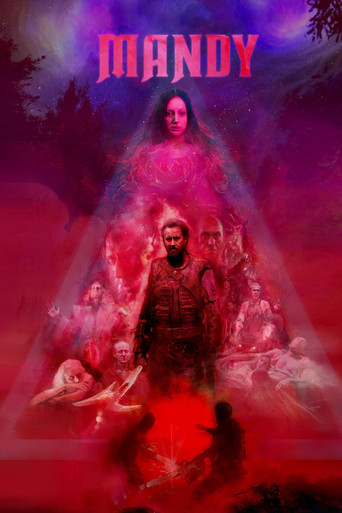
Mandy
2018 · Film · 122 min
Directed by Panos Cosmatos
The Shadow Mountains, 1983. Red and Mandy lead a loving and peaceful existence; but when their pine-scented haven is savagely destroyed, Red is catapulted into a phantasmagoric journey filled with bloody vengeance and laced with fire.
4 positive1 neutralfrom 5 commenters
Where to watch
No streaming data for this title.
5 comments on Hacker News
The 90s films mentioned in this post are works of art and the actors and creators were artists. Compensation sustains the art, but it’s not the primary purpose.
Netflix is a business. The content on Netflix is largely designed or purchased with a primary goal of engaging paying users.
We can find plenty of films that are works of art after the 90s. One Battle After Another is a recent one that comes to mind. Parasite, No Country for Old Men, Arrival, Moonlight, Tree of Life, Midsommar, Mandy…
> no one wants to take a risk on unproven idea
I think this one's the gist of it, and the big irony we'll all suffer from: While it gets cheaper to produce new things, not a lot of things will be original anymore.
I once heard that the 90s were the decade of references, and that might have just stuck a bit for too long: The boom of second-hand, mid-century furniture, the "industrial" look, rounded edged everywhere. Hell, even smartphones are just a reference to Sci-Fi flicks from the 60s (the case was Apple VS Samsung, I think). On demand services and the easy piracy of digital goods... I feel while there has been an perceived increase in quality for each individual at first, all these things helped everything to converge into "the average" for everyone.
We still see originality here and there, but you can just feel their competition against big budget productions. The movie Mandy (2018) was great, so was the show Scavengers Reign (2023), Breaking Bad etc. Landscape FM produce really interesing audio gear. I'm sure Open-Source (Hard- and Software) makes a lot of this possible, but for small and big equaly alike - depending on business practice, small might even be in danger to suffer from it.
I'm sure we all have our gems, but they just feel rare in this huge landscape. I just wish it would be a more common practice to support local artists and individials that take this mentioned risk, without having to turn it into a growth hacking startup idea.
I'm not saying no one uses long shots or takes anymore and they aren't totally ineffective - I just watched Mandy over the weekend and it has plenty and they are used effectively but it's also a move that seems to have people regarding it in extremes - it's really a love or hate because of the choices they make.
But what I'm trying to say is there are other tools in the toolbox now - I haven't heard anyone say that Everything Everywhere All At Once was bad, it's a great movie, absolutely full of deliberately chosen mood, and it never has to resort to extremely long shots that take the wind out of the story's sails.
2022 - Kimi, After Yang, Crimes of the Future, White Noise, Official Competition, Everything Everywhere All At Once, Tar, Mona Lisa and the Blood Moon
2021 - Nightmare Alley, The Card Counter, Zola, The French Dispatch, Come True, Don't Look Up, I Care A Lot,
2020 - I'm Thinking of Ending Things, Mank, The Sound of Metal, Possessor, His House
2019 - Climax, Uncut Gems, Parasite, Vivarium, First Cow
2018 - The Clovehitch Killer, Prospect, Mute, Anon, Mandy, The House That Jack Built, Cam, Sorry to Bother You
2018 had a glut of Netflix sci-fi B-movies that I think are very solidly good if not so great. I think they're underrated so I included them. I might have also messed up on the years.
These are all films I've seen. There are many others that I suspect are even better that I haven't seen.
I could not disagree more with the author. I think their argument should be debated on the merits, but it bears mentioning that the author is still in their twenties, and has only seen ~74 movies a year since 2010. That's ... not a lot of movies, by cinema snob standards (or even by prolific Netflix viewer standards).
1. One simply does not run out of great movies to watch after 700 movies, even if all 700 have been great. You have to be way, way more in to movies than that for that to happen. When your go-to examples of great movies are Eyes Wide Shut and Pulp Fiction (two great movies to be sure, but they have over 300k ratings each on IMDb), the problem is obvious: your selections are too mainstream. You can definitely run out of blockbusters that are also great movies very quickly. This author didn't name a single movie I haven't seen, and I'm nowhere close to having seen enough to join the cinema snob club.
2. "Every couple of days I curl up on the couch at 10pm, scroll through Amazon Prime video..." Yes. This is the problem. Their source for movies is an aggregator that makes money primarily through getting you to stay subscribed while reducing the cost of content acquisition as much as possible. Most of what's on Amazon prime is trash, low budget attempts at blockbusters, with a handful of rotating blockbuster films to grab your attention on the front page. Meanwhile, The Criterion Collection has released over a thousand films on DVD and Blu-ray. Get your media from better sources!
Note that I'm not blaming the author for this specifically. The media landscape sucks right now. Everything is fragmented and if you only have access to one or two sources it's easy to see how you could get the idea that prestige TV is where all the serious work goes nowadays.
3. "Most Stories are the Same. Kurt Vonnegut once said that there are only six types of story." Doesn't this claim go precisely against the claim made earlier in the article that the books you read just get better and better as you read more?
4. I can't agree that David Lynch is a hack. I'd say this goes beyond a question of taste into a factually incorrect account of a director who is obviously very capable and knows what he's trying to do. Some movies are going to require more work to appreciate than others. Ironically, the essay itself complains about movies being too accessible! Likewise, Lost in Translation is not unrelatable simply because the main character is older than you are.
5. The idea that we can't make good comedies any more is laughable culture-war nonsense. The idea that adult comedy must utilize irreverence is silly, to begin with. The Favourite (2018), Druk (2020), Amélie, The Lobster, Turist (2014), etc etc are all good comedies that aren't unduly irreverent. It's also strange to see Superbad and The Hangover given as examples of comedy done right in an article about a supposed dearth of good movies.
Even if you want out-and-out comedies (instead of my suggested serious movies with comedic tones), there were plenty of those last decade too. I liked The Nice Guys, I Don't Feel at Home in This World Anymore, Scott Pilgrim vs. the World, Knives Out, Don't Worry, He Won't Get Far on Foot, and so on. Several of these are rather irreverent, I'd say. I guess if you're looking for more Hangover, they made Part III in 2013, less than a decade ago, and Jackass 4 is coming out later this year! I don't see what there is to complain about. (In the vein of low-brow comedy, there are some movies like Psycho Goreman and Mandy that are much more interesting than a lot of mainstream fare.)
6. Burnout is a thing. Maybe trying to write a review for every single movie you see can lead to enjoying them less, if you're not the kind of person who's wired to do that.