 Hacker Cinema
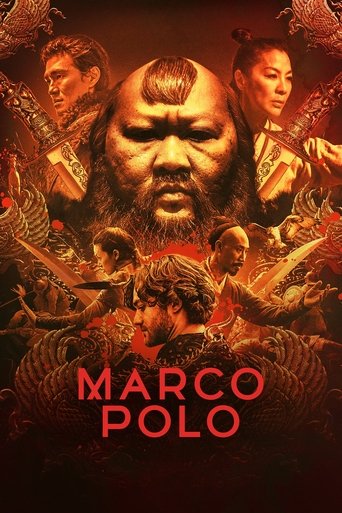
Marco Polo
2014 · TV series · 2 seasons
Created by John Fusco
Set in a world of greed, betrayal, sexual intrigue and rivalry, this lavish drama series follows explorer Marco Polo's adventures in the 13th century.
4 positive3 negative2 mixed11 neutralfrom 20 commenters
Where to watch
No streaming data for this title.

22 comments on Hacker News
Many human experiences are better understood by means that are not scientific. Life is full of aesthetic, moral, spiritual, and even unanswerable questions. Science is incredible and beautiful and profound - but it's not everything.
I can't remember what TV show I heard this on, but I like it; "the true sweetness of wine is... but one flavor."
(ETA: The show was Marco Polo.)
Netflix has a pattern. They have stats from a lot of multi-season shows and know that there's a sharp drop off in viewers the more seasons a show runs for, even if they're all excellent. This makes the first season a great investment, but remaining seasons are subject to rapidly diminishing returns.
So, their solution is to put a lot of effort into season 1 and, if it does really well, put vastly diminished resources into season 2. If season 1 doesn't blow their metrics out the window, they just cancel it. Since season 2's produced under this approach are usually pretty rough (e.g. Altered Carbon), there are almost never season 3's. There are exceptions (e.g. Stranger Things), but there are an awful lot of Netflix shows that never get a second season despite a very respectable first season (e.g. Marco Polo).
The anime version of Cowboy Bebop is a classic. In general, it's hard to remake a classic and leave fans of the classic happy. When the first shots of the costumes and cast came out I almost completely dismissed the Netfix series. Harold from Harold&Kumar is Spike? Jet looked like a janitor. The hype wasn't there for me.
So, I delayed watching the series, heard the grumblings, and went in with low expectations.
This is not Netflix's A-game. They did a great job in some respects, but really cheaped out in others.
The casting is a mixed bag, but mostly good. John Cho is actually pretty good as spike and Mustafa Shakir is brilliant as Jet. Pineda's Faye Valentine was less good. While Spike and Jet still felt at least somewhat like the anime characters, Valentine in the Netflix series was just off, and far too comical. Ed shows up only in the last episode and, well... Yeah. Let's face it, Ed is a difficult role and has to be played by someone fairly young. If I were directing a series like this I'd definitely want to shoot several episodes from later in the series with Ed before shooting the introduction precisely because of how hard it is to jump into the roll. The actor who played Ed was set up to fail.
The effects are good and the Bebop plus Swordfish are very well realized. The action is fairly well choreographed. The sets outside the ship are where Netflix got cheap. The rewrote things to reuse several locations a lot, such as the bar. The same junkyard set stands in for an assortment of locations and seems to pop up every episode, minimally redressed and shot from different angles.
The writing is where Netflix deviated from the anime most substantially. The plots of some episodes are almost totally unrecognizable, and generally do not compare well to the anime. The writers chose to flesh out and make explicit more of the syndicate backstory, with far more of Spike, Viscious, and Julia's past shown. The show becomes more interesting because of this. If they'd done a more faithful remake there'd have been less reason to watch the show. I'd have preferred that Ein's treatment was just a little more faithful though. Poor dog got screwed.
If you're a fan of the anime, lower your expectations, expect something a little different, and you may enjoy the Netflix series. I'd watch Season 2 even knowing it would be one of Netflix's usual half-efforts with a greatly reduced budget. It's not the anime but, if you like the genre, it's worth watching.
Biggest worry:
I have massive doubts that this show would bring in profits similar to Avengers: End Game. Because that's what it'll take.
Even if this is a smashing success by streaming standards, Season 2 will be ridiculously toned down to keep the costs down to like 50MM. People will instantly say "quality dropped significantly" and then it'll collapse. Feels like this will go the way of Marco Polo which was an amazing show, destroyed by Netflix's lack of desire to spend any money.
You fail to recognize one important factor. Those that did cancel dont show up to these comment threads anymore.
Me being one of them for I think I'm about to hit the 2 year mark soon on being sans-Netflix.
Any show I like and publicly does well, cancelled on season 3. Shows that have been popping up are utter trash. I was thinking of doing a month when Cowboy Bebop dropped... yea... I'm glad i didnt. I'm waiting for Witcher season 3 to drop, then I'll get it for a month and cancel it.
Their business practices are staying from, "deliver awesome content in an awesome way" to "squeeze blood from a rock".
Back in the day, Marco Polo was their shit tier show and it was awesome. The netflix exclusives that were coming out 2 years ago were trash and I could see the writing on the wall that it wasn't going to get better. What I hear about lately, it's all a fucking joke. They're hitting the theres a quality in quantity mindset and the numbers are showing that it's not working.
Maybe if they placed more focus on good movies and shows instead of the business models LITERALLY EVERYONE RAN AWAY FROM TO GET NETFLIX IN THE FIRST PLACE... they might be complaining that there aren't enough good writers and filmmakers out there because they already bought up everyone. That's a better and much more respectable problem to have instead of being a silicon valley bro who worries about "scale" during every conversation.
Ok… heard of Kublai Khan? Part of the mongol empire circa 1200s preceding the colonial powers existence by a good 500-600 years… That was the Yuan Dynasty (in china) and they conquered a whole lot more than modern day china.
Now since Yuan, you’ve had Ming and Qing… neither of which were particularly aggressive outside of their borders… and Qing was of course the start of the Opium wars, where the colonial powers essentially raped china for all its resources.
With regard to your strange Naval quip. You should look up the Chinese treasure ship. (Ming dynasty)… predates the colonials naval power.
So which Chinese in particular would you like me to read about? Everything you said is factually incorrect. To a laughable degree. I recommend you watch Marco Polo on Netflix, it’d teach you something.
Actually I suspect that this is what it's changed. It's likely that Netflix has abandoned the long tail. They are now focusing on shows that have immediate, short term mass appeal.
Previously Netflix was able to invest in "quirky" shows that had strong appeal to a small percentage of its user base. The classic examples here are indeed Sense8 and Marco Polo. These shows were not blockbusters but they had a strong and loyal following and that should be highly valued by Netflix. Particularly when it comes to original content and as a subscription service, Netflix should be primarily focused on loyalty above all. These are the shows that keep viewers subscribed and make unsubscribing painful.
But the economics here quickly become complicated as the culture evolves. In a world where (a) many (most?) people are already have a Netflix account (b) there are now many competing streaming services each of which have their own exclusives and (c) the concept of "television" itself is gone, now you just have "screens" all over the place and (d) there is an explosion (probably bubble[1]) of original content and amateur content and (d) there is an arms race for talent driving up salaries across the board... the end result is that Netflix is now engaged in a month-by-month war not just to defend the many subscribers it has accumulated but also to take (and retake) subscribers who may have been drawn away to other competing steaming services that have access to historic brands. Netflix no longer has the luxury of gradually building a large, deep catalog that appeals to small segments of the market. It must offer everything, or at least something extremely compelling, to all users, every month, or those users will churn and be drawn away by competitors.
Netflix is likely moving towards the blockbuster model. In this light it starts to make sense why Netflix is dumping hundreds of millions on feature films and also focusing on big shows that can command huge audiences. The blockbuster model is driven by a series of big events carefully scheduled throughout the year to get users to show up in large droves when you need them for something they don't really need. Competitors are doing the same. The streaming business meets the blockbuster model and now you've got to produce a blockbuster every month to keep people coming back.
I've had my subscription for over 10 years. Unfortunately the streaming side does not have what originally attracted me. Fortunately they still have a DVD side to Netflix that has what originally attracted me.
Don't get me wrong. I've found Marco Polo, Stranger Things, House of Cards (S1 & S2) & several other shows to be really interesting. I just don't have the time to watch that many episodes. I prefer a nice short movie to unwind to when I have time.
That said, I wish more books & comics would be turned into a series instead of movies at the theater. Netflix proved this with 13 Reasons Why. Star Wars, Marvel, etc would also benefit from this.
I think besides the logo the characters that run are related to Netflix show. It struck me only after I read your comment.
Marco Polo - from Marco Polo series The female - from Organge is new Apple Pablo - from some drug related tv series. (is he the math teacher who makes crack ?)
Fun. I wonder why they went with a modern-day chinatown backdrop for Marco Polo. I haven't seen season 2 yet; did this somehow become a time travel show? :P
Marco Polo is $9m per episode.
http://uk.businessinsider.com/netflix-marco-polo-tv-show-budget-2014-11
It's probably not quite as rosy as you state here, I'm afraid.
Let's look at a 380,000 viewer show. It's very unlikely that ever single one of those viewers paid for Netflix for a solid year just to get access to that show (which will have all its episodes released at once).
So let's assume it has significant cult appeal, meaning a full 25% of its viewers are primarily subscribed for that show and things like it. (I'd say that's likely to be very high, based on my experience in the narrative video world, but let's be optimistic.) And let's say, based on subscribing for that show and forgetting to cancel for a couple of months (or subsequently being retained by another 380k viewer show), that Netflix gets 3 months' worth of revenue from them.
So that's 380k/4 = 95,000 * $7.99 * 3 = $2.28m revenue attributable to that show.
Of the shows you mention:
Marco Polo cost $90m to produce for the entire season.
Black Mirror doesn't have figures online, but it'll be around $3m per episode if it's similar to other BBC shows. So that's $18m.
Unbreakable Kimmy Schmidt doesn't have figures available, but based on Tina Fey's fees for other shows and general knowledge of how much TV costs, I'll guess at about $3m an episode. (Might be cheaper if they're being clever about it, so could be as low as $2m) So that's $39m.
So, assuming that Netflix are just getting revenue from retained subscribers, and they get the figures above, we're looking at losses of:
$88m for Marco Polo.
$16m for Black Mirror.
$37m for Unbreakable Kimmy Schmidt.
Obviously the situation is far more complex than that - they'll be financing with coproduction deals, they're looking for growth rather than revenue, they also acquire a lot of content cheaply (very, very cheaply in some cases) through licensing - but it's certainly not rosy enough that they'll be happy with 380k viewers for shows they're making.
I'm really surprised that this model works for them. I simply get bored!
I love the Marco Polo series, but I've only once watched more than two episodes back to back. Likewise for Jennifer Jones. Guess I'm just not a binge watcher.
OTOH, I have no problem watching a 2:20 long movie or even two of them back to back. Movies simply draw me in more than episodic TV does.
And yet, have you seen the 4k content out there? Breaking Bad was awesome, but is that really better in 4k than, say BSG or Planet Earth? I bought a 4k TV to use as a monitor several months back and started researching content - Most of it is eyebrow-raising, to say the least. I remember when 720/1080 were first introduced, there was an expected dearth of content, but at least what was out there was worth high-def (flyovers of tourist destinations, PBS nature documentaries, etc). For example - Here's some of Netflix's offerings in 4k:
Series: House of Cards Marco Polo Breaking Bad The Blacklist
Movies and Documentaries Smurfs 2 Philadelphia Jerry Macguire Crouching Tiger, Hidden Dragon Oceans (documentary) Forests (documentary) Flowers (documentary)
Edit:formatting
Blacks are about 20% of the US population, while Netflix has some demographic information I can't really imagine they are tracking race of the viewer (I could just imagine the shit storm that could erupt if they did), they do however classify films based on various categories.
Netflix didn't invent black cinema people did and way before Netflix was even an idea in some one's head here are for example Black Cinema film festivals:
American Black Film Festival Freaknik Hollywood Black Film Festival International Black Women's Film Festival The Kidflix Film Fest of Bed-Stuy North Carolina Black Film Festival Pan African Film Festival Roxbury Film Festival San Diego Black Film Festival Women of Color Film Festival
The US also has "black only" film awards including the African-American Film Critics Association Awards, Black Reel Awards, Black Movie Awards and so on.
So after watching multiple movies that most likely their only common denominator was "Black Female Directors" Netflix suggested you a category that contain additional movies that fit your recent viewing habits.
On a side note, I watched the new Crouching Tiger, Hidden Dragon and the Marco Polo special on Netflix recently and all of a sudden what would you know? Chinese / Asian martial arts films appeared and took over my suggestion feed.
However after binge watching Cosmos and The Inexplicable Universe I wasn't greeted with the suggestion of the category "Documentaries by Black Astro-Physicists" but rather with "Space and Nature Documentations".
There isn't much confusion at all if you don't have any filters then it's clearly marked on the thumbnail of the video. When you search you can select filters. Depending on the app you use (browser, amazon firetv, mobile, smart tv etc.) you also (at least on my browser, phone and tv) select in the settings to filter out paid content.
Amazon has damn good originals: Alpha House(please make season 3!!!), Hand of God, Bosch, Mozart in the Jungle and TMITHC as well as some of it's new pickups like Sneaky Pete and Patriot (the Patriot pilot and premise was amazing) are much better than most Netflix offers(which for the most part offers allot of esoteric comedy / stand up shows and well orange is the new black which I've never bothered to watch). At least to my subjective tastes before the Marvel ("webinatic universe?!") shows came about Netflix only had The House of Cards (and well Marco Polo) as far as originals go.
Can you check if the content served is uncensored or if scenes with any kind of nudity are blurred or cut outright? Check a few episodes of Orange Is The New Black or Dexter or Marco Polo, maybe? I also wonder if the movies are cuts or the originals as available in the U.S. Sometimes the shows become unwatchable when cuts are done wholesale.
"For one monthly price, members around the world will be able to enjoy Netflix original series including Marvel’s Daredevil and Marvel’s Jessica Jones, Narcos, Sense8, Grace and Frankie, and Marco Polo, as well as a catalog of licensed TV shows and movies. In 2016, the company plans to release 31 new and returning original series, two dozen original feature films and documentaries, a wide range of stand-up comedy specials and 30 original kids series -- available at the same time to members everywhere."
This implies to me that their original content is globally available, while licensed content will still be regionally restricted (and I don't see a way they could do anything else). Unless I'm missing something in the announcement?
Marco Polo — 92% (Fun Fact: Critics rated it 24%. How’s that for incongruity?)
Narcos — 94% (Another crazy disconnect as critics only rated it 78%)
The author preaches shows produced by data driven companies, then when a rating data driven company has results he judges abnormal to his taste he insinuates something is wrong.
Personally, I found Marco Polo okay, the visuals are good, but the plot got boring after a while. I would not give it more than 50%. As for Narcos, 78% seems legit, I found the whole traditional drama show mixed with documentary interventions awkward. And would not give it more than 75%.
As for the article, of course linear TV is going to get disrupt. But I doubt Amazon or Netflix will get a monopoly. AMC and HBO will simply put their content online, and TV providers will make their revenue loss from linear TV on higher internet consumption.
I suppose they measure it by looking at the episode at which users continue to watch the whole series, in contrast to those who stopped viewing at an earlier episode? There is so much more you could get out of this:
(i) What's the drop off rate for viewers over episode number? For example, I stopped viewing quite a lot of these shows right before other viewers got hooked (Marco Polo: episode 2, sense 8: episode 2, that superannoying lesbian scene, Arrow: episode 3 or 4)
(ii) What's the interval distribution between successive episode viewings, does it differ between shows, is it predictive of a tendency to stay with the show (i.e., how bingy is the show, if that's a word)?
(iii) Age and gender distributions for drop off rates
And so much more. Any way of getting my hands on the data?
OK, a little OT and minuscule, but kind of gels with in with Netflix's overall future...has anyone else noticed that Netflix's predicted ratings seem to be a bit inflated, since perhaps last year? For previous years, I could count the number with one hand of movies/TV-shows that Netflix rated more than a 4-star for me...now there are dozens and dozens of things that Netflix thinks I would give a perfect rating to.
Maybe it's because I've become less discerning or have unconsciously changed in the way I rate things...but I don't think so...it used to be that anything predicted to be 4-stars or above --which was very rare -- was indeed something that I would love. Now I'm seeing many preemptive 4.8 to 5-star ratings for things that I know I don't like (because I've seen them before).
(I think we can agree that the effect of seeing more high-rated content is not the result of Netflix actually getting more quality content...the number of good movies has remained constant or gone down, especially since the Starz day)
The cynical user in me thinks Netflix has tweaked its algorithm to encourage me to watch more things. However, at least they don't seem to have tweaked it in favor of their exclusive content, as none of those (such as Marco Polo) are predicted to rate highly with me.
The argument of the article is that Netflix's dataset doesn't really help them make decisions like what the content of their next documentary should be. It argues that what happens instead is that Netflix's programming honcho, Ted Sarandos, picks projects based on the person who's putting them together, looking for creators with a solid creative track record and an existing cult following:
> I began to sense that their biggest bets always seemed ultimately driven by faith in a particular cult creator, like David Fincher (“House of Cards”), Jenji Leslie Kohan (“Orange is the New Black”), Ricky Gervais (“Derek”), John Fusco (“Marco Polo”), or Mitchell Hurwitz (“Arrested Development”)... I do think that there is a sophisticated algorithm at work here—but I think his name is Ted Sarandos.
So take the case of the Nina Simone doc. It was directed by Liz Garbus (http://en.wikipedia.org/wiki/Liz_Garbus), whose previous films have been Sundance- and Oscar- fare for a few years now. So it could just be that Sarandos looked at her track record and decided that Garbus was an up-and-coming talent, and that mattered more than the specific content of whatever her next project was going to be. He was just betting that a Liz Garbus documentary was going to be great, no matter what story it told.
I can't tell if this is a joke, but I'm going to humor you.
I think your money would be better spent on, say, therapy to help you deal with your issues of belonging. One movie starring an Asian-looking man is not going to fix your identity issues, nor is any external event.
Asians are less than 5% of the country, so there aren't as many accusations of racism when movies are missing them as when movies are missing African Americans. Also, the "Asian American" statistic includes people from the Indian subcontinent. So if you feel like you're in a country that has very few people who look like you, you're right! If you were white in China, you'd feel the same way.
Regarding Asian actors: John Cho has had a fairly successful career, and it's only on the upswing. The Netflix show Marco Polo is absolutely full of Asians. Lucy Liu is the star of a TV show and many movies.
I find it ironic that you're crying about discrimination, but you mention several times that you want to see a male playing a lead role. Everyone wants the world to be in their image, but it never will be. Do what you can to change it, and if you can't, don't make yourself miserable.
Edit: Main characters in Silicon Valley, The Big Bang Theory, Heroes, The Last Air Bender, and probably lots of other films are Indian. Ben Kingsley is super-famous and half Indian.