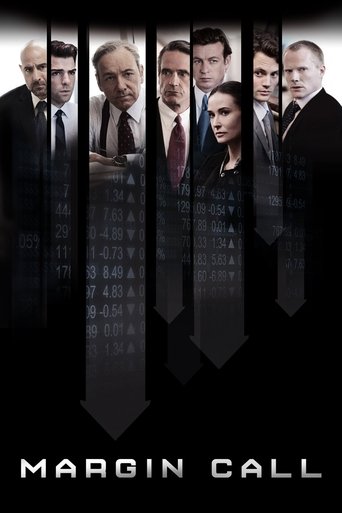
Margin Call
2011 · Film · 107 min
Directed by J.C. Chandor
Set in the high-stakes world of the financial industry, involving the key players at an investment firm during one perilous 24-hour period in the early stages of the 2008 financial crisis. An entry-level analyst unlocks information that could prove to be the downfall of the firm.
70 positive2 mixed30 neutralfrom 102 commenters
Where to watch
No streaming data for this title.
115 comments on Hacker News
"It's just money. It's made up. Pieces of paper with pictures on it so we don't have to kill each other just to get something to eat". Jeremy Irons in movie Margin Call
"but we will have no choice but to march forth from there".
If you haven't seen it, I think you would appreciate the film Margin Call.
Ah. We had:
Margin call (the term):
https://en.wikipedia.org/wiki/Margin_(finance)#Margin_call
Margin Call (the good movie):
https://en.wikipedia.org/wiki/Margin_Call
I guess now we have "Margin Call", the one page long blog entry.
"it's all just numbers really. Just changing what you're adding up. And, to speak freely, the money here is considerably more attractive." - Peter Sullivan in the movie Margin Call
> Pure greed would have a strong incentive to understand what the market is actually demanding in order to maximize profits.
Not necessarily, just look at this clip [1] from Margin Call, an excellent movie on the GFC. As Jeremy Irons is saying in that clip, the market (as usually understood in classical economy, with producers making things for clients/customers to purchase) is of no importance to today's market economy, almost all that matters, at the hundreds of billions - multi-trillion dollars-levels, is for your company "to play the music" as best as the other (necessarily very big) market participants, "nothing more, nothing less" (again, to quote Irons in that movie).
There's nothing in it about "making what people/customers want" and all that, which is regarded as accessory, that is if it is taken into consideration at all. As another poster is mentioning in this thread, this is all the direct result of the financialization of much of the Western economy, this is how things work at this level, given these (financiliazed) inputs.
[1] https://www.youtube.com/watch?v=UOYi4NzxlhE
Margin Call is a great movie.
The Risk Management manager character played by Demi Moore in the "Margin Call" movie is another example of this in the financial industry.
That movie is absolutely excellent in all too many aspects, but the one I like most (and most relevant for the HN crowd, I think) is the politics in the business. Thanks to amazing script and stellar performances you get it all:
* Unfair blanket layoff precluding a senior person from alerting anyone * One of the senior execs being made the scapegoat, framed by her evident accomplice in the scheming * Engineers who become quants * Locking people up in a room to make sure they do not spill the beans to anyone
I think Margin Call deserves to be on the same rung of the ladder as LA Confidential - a timeless classic, and some of the cast as well!
I think Margin Call is my choice for a “perfect” movie. It isn’t the most exciting, or impressive, or dramatic, or ___ film, but - it has absolutely no filler, every line of dialogue is exactly the right combination of explanatory and realistic, and the casting is incredibly spot on, especially considering that it’s an ensemble cast of big name stars. That’s as close to perfection as it gets IMO.
If anyone here has only worked in the EU and wants to see what the US layoff process is supposed to be on a good day, just watch the movie Margin Call and the scene where Eric Dale is called into the office by HR to be fired.
There's a scene where they put a folder in front of him with a brightly-coloured sailboat on the cover labelled "LOOKING AHEAD." It's exactly as grim as it sounds.
I’ve just seen the Margin Call movie and the headline transported me right back to the middle of it. Highly recommended.
Though it was about the finance sector in ‘07/‘08 and its obviously different circumstances, I enjoyed the way the movie Margin Call portrayed layoffs as the author here described them—cold and myopic.
The movie "Margin Call" has an excellent scene where this happends: https://www.youtube.com/watch?v=Hhy7JUinlu0
It is clear how it is setup that "to survive we must act now, not in a week, and we must do this expensive sell-off"
The whole movie is very well worth watching: https://www.imdb.com/title/tt1615147/
As another commenter said, the film was trying to make the opposite point: that Irons’ character knew full well — probably better than the other characters — what was going on.
But the detachment you mention can / is very important. When you’re working deep in the woods you really can’t see the forest for the trees. You may be working on a feature that will make the user’s life a lot easier, but the real customer is IT and your feature could be cut because the customer won’t like it (“this will add retraining cost”). In Margin Call, perhaps the thing that could increase your bonus is, from the overall company’s PoV a distraction because it’s more urgent to save the company (so bonuses can be paid out at all).
So a good manager operates at a higher level of abstraction. The best ones have a lot of experience so can see from the signals they get what’s happening at the lower levels of abstraction. Irons’ character is supposed to be one of those.
Of course the high level abstraction, when the boss fell upwards and doesn’t have the Fingerspitzengefühl to be able to see what’s below the surface, is a common problem. It can kill a company: look at how Welch and Immelt destroyed GE.
A good sign of this is also called out by a different commenter: opaque language is often used to try to cover up ignorance.
To quote the movie "Margin Call" (highly recommended!):
> "There are three ways to make a living in this business: be first, be smarter, or cheat."
Not sure if this takes you to a whole billion, though
You can summarize Margin Call with a paragraph, but in no way capture the spirit of the movie and the various implied subplots. If you don't care about a movie or a book, don't consume it or just read a summary. But don't pretend you've done the actual watching/reading.
“Do you care to know why I’m in this chair… why I earn the big bucks? I'm here for one reason and one reason alone. I'm here to guess what the music might do a week, a month, a year from now, that’s it, nothing more.” John Tuld, Margin Call
I think about this movie all the time now that I’ve been in the corporate world for a while and I have realized one consistent outcome: the leaders who “guess” right a lot survive a hell of a lot longer than those who get it wrong.
Good on them.
Somewhat related, but one of my favorite movies of all time, Margin Call, is underscored by this constant awareness that all the brilliant on Wall Street - all of the intellectual power, and occasionally sheer genius, harnessed for financial engineering - all this mental horsepower could have been spent building rockets, bridges, incredible new materials, predicting the weather, or teasing out the secrets of the cosmos and of existence. Propelling the nation into a new century.
I was about to quote a scene at length, but honestly, I'd feel bad ruining a single moment of the thing. If you're even tangentially interested in Wall Street . . or the aughtie's collapse of the financial system . . or even just the giant sucking sound of all our best and brightest getting pulled into shit that is dumb and wrong . . I'd seriously recommend it. Probably the best Wall Street movie ever made.
Anyway, it's somewhat related, but it's also very related, because, jesus. Do we really need another bumper crop of generic bachelor degrees feeding the paper machine? The last big enterprise software install I sat in on, a rotating cast of forty some different executives, with over sixty seven hours spent in meetings at an average cost of eleven hundred dollars per minute. That's just salaries. Somehow, in my gut, I feel like if we had more certified technical people laying around, we would not be seeing crap like that so damn often.
Housing prices hadn’t really gone down in the 20 or so years before 2008. So the “risk” of decreasing prices was just under-appreciated.
When the firms started making tons of money, it’s probably easy to ignore the risk department.
Margin call is another great movie. Doesn’t really explain the details of what went wrong, but I think it shows how a financial institution unravels when they accept that the risk is real and it is going to come down.
> On a lot of these issues I feel we're all stuck on some rollercoaster ride that almost no one really likes, but also no one really has the courage to stop.
As Will Emerson says in Margin Call:
"Jesus, Seth. Listen, if you really wanna do this with your life you have to believe you're necessary and you are. People wanna live like this in their cars and big fuckin' houses they can't even pay for, then you're necessary. The only reason that they all get to continue living like kings is cause we got our fingers on the scales in their favor. I take my hand off and then the whole world gets really fuckin' fair really fuckin' quickly and nobody actually wants that. They say they do but they don't."
https://news.ycombinator.com/item?id=31300922
https://www.youtube.com/watch?v=2f2kGHcdJYU
https://www.imdb.com/title/tt1615147/characters/nm0079273
I think it's "only" a quote from a movie called Margin Call [1]. But my grandma could have said it. ;)
[1] - https://www.imdb.com/title/tt1615147/quotes/?item=qt1531207&ref_=ext_shr_lnk
+1
I thought Shop Class as Soulcraft was excellent and found the author's theories on the lack of job and life satisfaction among those doing "knowledge work" compelling.
It reminded me of the movie Margin Call when Kevin Spacey's character, who manages a trading floor for a wall street investment firm, laments that if he'd been a ditch digger, at least he'd have a bunch of holes left behind as evidence he accomplished something.
This is what happens during periods of economic uncertainty. It's like counting cards with a freshly shuffled deck: nobody can tell what the state of the game is, so you place a minimum bet until you can get a feel for things again.
The movie is meh, but the boardroom scene in Margin Call has a great line:
"I'm here for one reason and one reason alone. I'm here to guess what the music might do a week, a month, a year from now. That's it. Nothing more. And standing here tonight, I'm afraid that I don't hear - a - thing. Just... silence."
Consumer confidence is down three straight quarters in a row. Nobody feels good about what the music is going to do next.
I love corporate/financial/technology/mathematics thriller film genres but they seems to be a very small niche. Good ones are especially rare. My favourite is "Michael Clayton" (2007), and "Margin Call" (2011) is my second favourite. "Sneakers" (1992) is old but pretty good. "Disclosure" (1994) is also old but quite watchable. Dare I mention "Pi" (1998)?
Someone here mentioned the TV series "Billions" which is my guilty pleasure. The stories are so absurd but the great cast manages to carry it off successfully. The only criticism I would make is that, although the show is ostensibly about a hedge fund manager, it seems to contain almost zero actual finance or game theory stuff. The only occasion, that I can recall, when finance enters the plot in a semi-serious way is the episode "Short Squeeze", which was one of my favourite episodes.
Margin Call might be the most accurate one (as accurate as a movie can get) and one that actually peeks into modern finance operations.
Margin Call is amazing! Also, I recommend Charles Ferguson’s documentary „Inside Job“ on the financial crisis
Lots of classic movies about or that came roughly around the 2008 financial crisis:)
Wolf of Wall Street
Margin Call
The Big Short
The Social Network is a great film that manages to be inspiring and critical of its subject at the same time.
Margin Call is about finance, not entrepreneurship, but it’s one of my favorite films.
It only lasted a season or two, but How to Make it in America was pretty inspiring as well.
Success in speculative enterprises is only remotely correlated with intelligence, or even competence.
I like the quote from the "Margin Call" movie. It's about hearing the music stop. That is, mostly just blind luck.
I'd recommend watching Margin Call, a movie set during the 2008 financial collapse.
I live in Indiranagar and this is a sad reality of life here.
These issues remind of this scene in Margin Call where two character talk about the impending 2008 crisis https://www.youtube.com/watch?v=UOYi4NzxlhE&ab_channel=Movieclips.
There are many major issues in India's growth story, and I feel the music is gonna stop really soon.
Reminds me of this scene with Stanley Tucci talking about building a bridge in the movie Margin Call: https://www.youtube.com/watch?v=m8Mc-38C88g
The early investors still always make bank. A 5x is nice.
>By Q1 this year, venture capital firm Andreessen Horowitz’s (a16z) flagship crypto fund had returned almost five times for early backers, according to documents reviewed by Semafor. The firm sold a portion of its tokens right before crypto’s bear market began in May, meaning that early investors are guaranteed a successful return.
https://protos.com/the-crypto-bets-of-a16z-crumble-early-investors-still-profit/
I'm reminded from one of my favorite quotes from Margin Call, one of my favorite movies. He's talking about the big Goldman-esque firm they work for, but it applies here too.
"I've been at this company for 10 years, and I've seen things you wouldn't believe. When all is said and done, they do not lose money. They don't mind if everybody else does, but they don't lose."
A favorite quote of mine about the role of a CEO from the movie Margin Call. Tuld, the CEO of a major bank the night before the housing crisis in 08 starts to fly out of control, after one of the bank's risk analysts discovers they're holding toxic assets:
John Tuld : So, what you're telling me, is that the music is about to stop, and we're going to be left holding the biggest bag of odorous excrement ever assembled in the history of capitalism.
Peter Sullivan : Sir, I not sure that I would put it that way, but let me clarify using your analogy. What this model shows is the music, so to speak, just slowing. If the music were to stop, as you put it, then this model wouldn't even be close to that scenario. It would be considerably worse.
John Tuld : Let me tell you something, Mr. Sullivan. Do you care to know why I'm in this chair with you all? I mean, why I earn the big bucks.
Peter Sullivan : Yes.
John Tuld : I'm here for one reason and one reason alone. I'm here to guess what the music might do a week, a month, a year from now. That's it. Nothing more. And standing here tonight, I'm afraid that I don't hear - a - thing. Just... silence.
Community-scale banks (aka credit unions) are a better idea for local-regional communitie (aka cities and towns and agricultural regions) because their managers have to live with their clients.
Take a community of 100,000 families, in an economic system where they're all collecting income and paying bills and so on. The idea behind a bank is that they hold the community's money securely while making their own money by providing loans at a greater interest rate than the interest rate they pay out to their depositors. Fundamentally, this means the bank is dependent on the fact that customers don't try to withdraw all their money at once (as the above dynamic means the bank is never able to meet this demand).
FDIC guarantees by governments are intended to bolster this customer trust, as if everything goes sour the deposits (to a certain limit) are guaranteed. The important point is that the regional bank has a profit model based on giving successful loans to individuals and small businesses for things like houses, cars, business expansion, etc. The bank will of course want to know a fair amount about the people they are loaning to (drug addicts are not good bets, etc.) in order to ensure they get paid back.
I hear people laughing in the background about the naivete of this picture in the modern American financial system. Since this post is already a bit long, go watch the movies "Margin Call" and "The Big Short" to get an idea of what's actually been going on.
1. Mental exhaustion and burnout
Depending on how deep it gets the way to dealing with it changes.
I recall when I started my current job that initially I had to do tasks vey similar to what I've had to do before and that made me very nervous initially as the last time I had to do these things I ended up completely bricking myself. This time, the complete exhaustion was so far in the rear-view mirror that I could do these things almost effortlessly.
Even though they were so comparatively easy this time, I will acknowledge that I still felt some form of exhaustion nowadays. Perma-exhausted. However, it is not as dire as it once was. In the past, I needed extended sick-leave and even a sabbatical where I went back to school for a semester to study an unrelated field but nowadays when I end up in that headspace I try to guide my thoughts, ideas, and values surrounding productivity to change into something that doesn't dig me into a deeper hole.
Personally, I have to focus deeply on the concepts of rise and tide, and accepting that cyclic shifts is all around me in nature so why wouldn't it be inside me as well.
While a nature-focused approached is what I have now that might not vibe with your sensibilities so I'll share the original concept that I reappropriated to suit me: it's called "Blast and Dust" and comes from a guy called Dave Tate. I've come across a few interviews and podcasts where he mentions it but this article does an okay enough job of framing the concept: https://www.elitefts.com/education/motivation/raising-the-bar-introduction-blast-and-dust/
2. Existential crisis
I've wanted to shift into a profession that has more tangible results in the physical world and/or on the wellbeing of other people. I oftentimes find myself thinking about the bridge scene in Margin Call when I reassess what I do for a living:
https://www.youtube.com/watch?v=m8Mc-38C88g
However, the thing that I have a knack for is software despite how ephemeral it is. I feel as if I'm building sand castles at the edge of the ocean and while the idea that most of everything I ever build is exceedingly and excruciatingly transient there was a point wherein I had to accept that... I enjoy building sandcastles. And, allow myself that pleasure, and maybe try to contribute to society by not beating myself up as much.
After that, I had an easier time to find hobbies in my spare-time and I invest my income into those hobbies and communities. I live for my own enjoyment, mostly, but maybe that isn't so bad if the alternative is borderline psychosis.
3. Getting lost in a noisy world
Deleting apps, and using Freedom to blacklist websites. I know working around these blocks is easy, but I try to not allow myself to reinforce the habit of circumventing these small hindrances.
4. Dopamine Overload
You'll have to elaborate, what are extravagant pleasures for you? I seek adrenaline.
5. Intolerance - Getting angry/emotional from events and people around. Unable to direct love on people.
"Leadership and Self-deception", "Anatomy of Peace", "Daring Greatly", "Wait", Alan Watts, Ram Dass, Tara Brach, and more. have been meaningful to me. The app "Compassion Lifestyle" also did some positive stuff.
And insofar as love is concerned, I needed a bit of nihilism. An excerpt from a podcast that almost envelops how I feel about fearlessly directing love to people around me:
Caleb: So you, you get that experience of like, Ooh, what if, what if this happened or this happened that could potentially change how our family dynamic would've been so, Uh, one of the punchlines to the movie is Nothing Matters. And you can take that and you could receive that statement and say, Ooh, nothing matters.
Caleb: Therefore, I'm not going to care about anything. Nothing matters that therefore, I'm going to abandon everything. Abandon morality, abandoned purpose, abandoned life, whatever that may be. Nothing matters, therefore, I do not matter. Or you could say nothing matters. There is freedom to be found there nothing matters.
Caleb: So I will take advantage of every opportunity. I will seek out new opportunities. If something isn't working for me, nothing matters. Therefore, I can have the freedom to experience different things and not worry about the consequences.
Mario: I think that's beautiful because you, it it's a, it's funny. It's it's perspective.
Mario: It's perspective, it's personality. It's kind of you, your take on it and your life experience. Cuz it's funny when you were giving all these examples of nothing matters. This to me, what if you were to tell me in life, well Mario, nothing matters in life. Okay, well I'm unabashedly, uncontrollably gonna love on you and I'm gonna un unabashedly, uncontrollably going to give all the affection that I want.
Mario: At the same time, I will also rage the want. You know, because if it doesn't matter, then what do I have to lose?
Caleb: That's it. That's it. What do you have to lose? I
Mario: have, and you know, and yet, and I think the flip side of that is since I have nothing to lose, I have everything to gain. and I don't know. Another thing too, it's funny, have you heard, I, I think it was so beautiful when you were talking about your parents and how that whole experience goes to you.
---
Don't be afraid to seek therapy, medication, self-medication (psilocybin has helped me through some rough spells), and look around for some root issues. Trauma, ADHD, ...
Good luck.
There's a similar calculation (in a slightly different context) in a good scene in the movie Margin Call, about all the miles and hours saved by one bridge: https://www.youtube.com/watch?v=m8Mc-38C88g
> it is seen as a matter of social status
Just rewatched the film "Margin Call", and salary as social status is one of the main themes that arises in almost every scene with the junior members of the firm.
I wonder how many of the people in this thread bringing up the completely irrelevant and unrelated MBS stuff from 2008 would have had any idea what they were if movies like The Big Short or Margin Call hadn't been made.
Margin call is a documentary in more than one ways.
I like to imagine it going down like Margin Call, with Thiel at the head of the table "this is, ur ur, this is, ur ur, it". Maybe with an "overdetermined" thrown in there.
If anyone hasn't seen Margin Call, give it a watch. Fantastic movie.
No chief risk officer?!?!?! Damn! Kind of like the movie Margin Call. Can't see the risk if you fire the entire department and promote a shill that goes along with it all.
In the beginning of the movie "Margin Call" (2011), why is Eric Dale, head of risk management, laid off by the bank?
The US plunged into the worst recession since The Great Depression of the 1930s when Lehman Brothers bank collapsed, which quickly cascaded around the world.
2008 is aka 'The Great Recession'; it likely would have been much worse without govt intervention, though the targets of the help were corporations, not the average person affected by it.
The 2008 crash was the culmination of a house of cards largely enabled by deregulation that wiped out huge mainstays in America, including the auto industry. GM and Chrysler are only with us today because of massive govt bailouts. Many banks large and small failed and were absorbed into larger ones (eg Washington Mutual). The govt bailed out other banks deemed 'too big to fail' (eg Chase).
Countries were also failing over this (eg Greece, which used the euro hence was not a sovereign currency issuer and had to rely on Germany et al to assist). Severe govt spending cuts were imposed around the world, leaving the average citizen bearing the brunt of the downturn.
None of the criminal bankers that caused this crash were held criminally or civilly accountable, sparking the Occupy protests. In fact, they still got their big bonuses that taxpayers paid for. Meanwhile, average people lost their homes, businesses, and jobs.
It took about a decade to return to pre-crash economic levels. Not counting 9/11 (the effects of which changed the trajectory of modern life), this was the first 'once in a lifetime' shock for Millennials that set us back many years … just in time for a global pandemic.
There are some movies about the 2008 crash. Maybe checkout 'Margin Call'.
That is a great article that conveys both the facts and the drama around an FDIC takeover.
I can also recommend the movie Margin Call which includes a fictionalized account of a similar takeover. If you haven't seen it before, this may be the weekend to watch it.
Because you're a greedy human and you will find a way to take a larger slice of the pie. It happens every single time. You'd think this would be obvious by now.
How you think the banking system works is how "educated" people think it works and even that isn't correct, by the way. There is no reserve. The funds aren't real. It's all just made up numbers. There have been several Hollywood films made about it (e.g. The Big Short and Margin Call). It's almost so stupid you think there must be something else to it, but it's just people playing with numbers.
"It's not a panic if you're the first one out the door."
Another great quote from Margin Call. Love every bit of that movie. Very underrated too, as it was (unfairly) overshadowed by The Big Short.
> “We are selling to willing buyers at the current fair market price.”
A line from the really good movie Margin Call:
* https://en.wikipedia.org/wiki/Margin_Call
Worth checking out.
There are three ways to succeed in this business: Be first, be smarter or cheat. And I don't cheat.
Margin Call is such a timeless, great movie!
For anyone who’s following this thread and is confused. They’re referring to the movie Margin Call.
Your description couldn't help but remind me of this fantastic movie Margin Call
https://www.youtube.com/watch?v=zn2Xf9hAFcE&ab_channel=Weyland
I'll take this thread to plug my totally subjective hare brain theory/bias.
I've noticed that I like movies that are shot with the blue filter (or atleast thats what I call it) - everything has a tinge of blue (the filters are almost closer to blue-grey; something like #374358). For some reason, I have noticed that, to me, they also turn out to good movies. Example would be Margin Call[0] (though in some scenes the blue is mixed with a golden hue which actually makes it look nicer); another one is The Grey[1].
[0]: https://www.imdb.com/title/tt1615147/
[1]: https://www.imdb.com/title/tt1601913/
I keep getting reminded of that scene from the movie Margin Call about the 2008 financial crisis (great movie by the way):
There are three ways to make a living in this business: be first; be smarter; or cheat. Now, I don't cheat. And although I like to think we have some pretty smart people in this building, it sure is a hell of a lot easier to just be first.
The recession might not be here yet, but it’s a lot easier to reduce costs before it hits.
Reminds me of 2008 and that quote from the movie Margin Call.
And it's certainly no different today than its ever been. 1637, 1797, 1819, 37, 57, 84, 1901, 07, 29, 1937, 1974, 1987-Jesus, didn't that fuck up me up good-92, 97, 2000 and whatever we want to call this. It's all just the same thing over and over; we can't help ourselves. And you and I can't control it, or stop it, or even slow it. Or even ever-so-slightly alter it. We just react. And we make a lot money if we get it right. And we get left by the side of the side of the road if we get it wrong. And there have always been and there always will be the same percentage of winners and losers. Happy foxes and sad sacks. Fat cats and starving dogs in this world. Yeah, there may be more of us today than there's ever been. But the percentages-they stay exactly the same.
Nice writeup. A good popular discussion of leverage is in the movie Margin Call, regading the 2008 meltdown:
> "Well, as you probably know, over the last 36 to 40 months, the firm has begun packaging new mortgage-backed security products that combine several different tranches of rating classification in one tradeable security. This has been enormously profitable... Well, the firm is currently doing a considerable amount of this business every day. Now the problem, which is I guess why we are here tonight, is that it takes us, the firm, about a month to layer these products correctly, thereby posing a challenge from a risk management standpoint... Well, we have to hold these assets on our books longer than we might ideally like to. But the key factor here is, these are essentially just mortgages, so that has allowed us to push the leverage considerably beyond what you might be willing or allowed to do, in any other circumstance, thereby pushing the risk profile without raising any red flags."
Running the money printing press was the government response to that situation, i.e. 'deleveraging the bank holding companies (BHCs) via quantitative easing' - which does illustrate how a government controlled by financial oligarchs operates in practice. The actual homeowners could have been the recipients of the bailouts - i.e. the government would have taken over their loans, provided a zero-interest period, converted the loans from adjustable to fixed-rate, sold them back to the banks (or just set up a separate institution), and then the homeowners could have stayed in their homes and continued to pay off their mortgages at an acceptable monthly rate - or some combination of the above. The BHCs would have suffered much more significant losses under that scenario, and perhaps more would have gone the way of Bear Stearns and Countrywide.
Notably, this illustrates that regardless of whether monetary policy is tight or loose, the government's fiscal policy can be engineered to support the financial oligarchs. For example, today's high interest rates are going to be used to justify government fiscal policies that benefit the oligarch class (i.e. pushing for mass unemployment to bring down wages to 'fight inflation', etc.). Similarly, large banks are not being forced to raise personal savings interest rates as the Fed rate rises (as that would benefit ordinary people, even if inflation is outpacing interest rates).
https://thehill.com/policy/3656474-lawmakers-slam-big-bank-ceos-for-failure-to-increase-interest-rates-on-savings/
As far as cryptocurrencies, it seems fairly unlikely that crypto funds will be the beneficiaries of quantitive easing or other government largesse, as crypto hasn't yet bought enough corrupt politicians.
The Big Short and Boiler room are incredible movies. The only real competition is Wolf of Wall Street, which goes too deep into the debauched party lifestyle at the expense of the more interesting financial story, and Margin Call which has the opposite problem since it’s completely inaccessible to most people.
There's a scene in the movie "Margin Call" (about the 2007-2008 financial crisis) in which most of a floor of employees in an investment bank is laid off: https://www.youtube.com/watch?v=zn2Xf9hAFcE
All of the activity you described here was legal under Glass-Steagall.
Mortgage-backed securities have existed for over 50 years.
Glass-Steagall separated commercial banking from investment banking.
The movie Margin Call depicts an investment bank that sells mortgage-backed securities. I don’t remember anything in the movie about commercial banking.
Yes indeed. Probably the best cinematic take on that is in the movie Margin Call - here's the senior partners meeting:
https://www.youtube.com/watch?v=Hhy7JUinlu0
Essentially, the dissolution of Glass-Steagall allowed investment banks to create complex financial packages, each one constructed out of dozens if not hundreds of home mortgages. Each individual mortgage was graded but the packages were built out of a mixture of low-grade and high-grade mortgages. Since trading (gambling) with these packages was very lucrative, the investment banks worked with shady mortgage brokers to increase the number of packages by pushing adjustable-rate mortgages on gullible people who probably were not that familiar with compound interest calcululations. These unlikely-to-succeed mortgages were mixed in with the high-qulaity mortages to create a wide variety of highly leveraged financial products, and then bets were placed on the outcomes of trading in these products (derivative markets, synthetic CDO squared nonsense, etc.). Once people realized that many of these mortgages were not going to be paid off, then the avalanche of collapse began.
Glass-Steagall, if retained, would have made all of that impossible.
I think it's probably because I was there for it. His construction of the narrative, while better than many (including many straight journalists) ends up sort of falsely casting people into hero/fool/villain roles that make the book work as an entertainment, but don't fully hold up.
It's a decent book, and a decent movie (kudos for one particular scene where I recognized data from the actual LoanPerformance database) I actually prefer the movie Margin Call for more accurately capturing the feel of the crisis from inside a bank.
I watched Margin Call. The huddling that goes on between the higher ups and the peons when the chips are down is what JIRA does for companies every day. If the firm in that movie had been using JIRA (and it it were real life and not a movie); I believe they would have had daily, much better communications and coordination and could have avoided the whole scenario the movie is about. Spoiler alert, Spacey's character's dog would still have died.
The poorly optimized performance of JIRA almost makes me believe they don't even use their own product. Perhaps performance is on the backlog of the backlog.
I just watched Margin Call for probably the 5th or 6th time over the weekend. I love the movie, it's not particularly great in an objective sense, but Zach Quinto and Simon Baker in particular do great jobs in their roles. And some of the scenes are fantastic even in isolation.[0]
[0] https://www.youtube.com/watch?v=Elyfo1DIlzs (6m 23s)
I don't know where it is from originally, but that quote is in the incredible scene with Jeremy Irons in Margin Call.
I strongly recommend that movie.
You have to watch it a bit closer. He didn't ask for the problem to be explained in simple terms because he didn't understand what was going on. Instead he wanted to make sure his subordinates understood the problem and didn't try to hide their ignorance behind needless complexity. This is a strategy used by all of the most effective managers in the real world ("pretend that I'm stupid", "explain it to me like I'm five"). It was clear from the get go that he was the smartest person in the room in every scene he was in.
The movie also makes clear multiple times that the only people who were surprised by what was going on were the little guys – risk analysts and middle management. People at the top got the news and were simply like "ok guess it's finally happening".
If you ask around people who do this stuff for a living, all of them will tell you that out of the dozens of movies about the financial crisis, Margin Call was conceptually the closest one to how things actually work in the industry (obviously disregarding the Hollywood-esque dialog and characters).
By dumping all their portfolio, they avoided the margin call which would have destroyed the company. Their early and bold actions saved the firm. Sadly for the folks on the other end of the trades, it probably crushed them.
Margin call is by far the best movie about the financial crisis of 2008 that I've ever seen. I was working in the biz at that time and it all just rang so true. 7 AM pre-market meetings, lots of folks crunching data, Wall Street people actually living in Brooklyn and so much more.
Sadly, the movie is so esoteric that it never had a mainstream success. Such a shame because it had great actors and a fantastic script.
The part that bothered me is that, as I recall, there was no actual margin call in the movie. I guess it all was done in advance of a margin call? I don't recall exactly.
Great movie though
I agree. Margin Call and The Big Short (the book is sooo good even if you've seen the movie!) are the best two movies that came out of that entire debacle. That scene was enjoyable. They really nailed the casting and conversations.
Have you seen the movie Margin Call?
There’s a great scene where the CEO of a Goldman-style bank is recapping the last 100+ years of global financial collapses and he mentions, “we just can’t help ourselves.”
https://youtu.be/LtFyP0qy9XU
One of the best banking movies I’ve ever seen. Jeremy Irons absolutely nails his role.
Right.
You can't hide the detail with a wave of the hand, you can definitely overcommunicate detail that is unnecessary, but the art of it is finding a way to explain the bit that matters in a way that makes it clear to the users that you're eliding detail that isn't important, without misleading them.
There is a very fine example of this in cinema -- the senior partners meeting in Margin Call, where Zachary Quinto's character has to explain why the firm needs to sell all of a particular asset class:
https://www.youtube.com/watch?v=Hhy7JUinlu0
One day I will use the line Jeremy Irons uses in this clip. I don't want to spoil it by quoting it.
I know what you mean about The Social Network and Silicon Valley. Not tech specifically, but definitely motivating and inspiring for me are:
Moneyball Margin Call Limitless The Big Short Wolf of Wall Street That Fyre documentary and at Christmas - Trading Places
From the movie Margin Call:
"So you think we might have put a few people out of business today. That its all for naught. You've been doing that everyday for almost forty years Sam. And if this is all for naught then so is everything out there. Its just money; its made up. Pieces of paper with pictures on it so we don't have to kill each other just to get something to eat. It's not wrong. And it's certainly no different today than its ever been. 1637, 1797, 1819, 37, 57, 84, 1901, 07, 29, 1937, 1974, 1987-Jesus, didn't that fuck up me up good-92, 97, 2000 and whatever we want to call this. It's all just the same thing over and over; we can't help ourselves. And you and I can't control it, or stop it, or even slow it. Or even ever-so-slightly alter it. We just react. And we make a lot money if we get it right. And we get left by the side of the side of the road if we get it wrong. And there have always been and there always will be the same percentage of winners and losers. Happy foxes and sad sacks. Fat cats and starving dogs in this world. Yeah, there may be more of us today than there's ever been. But the percentages-they stay exactly the same. "
John Tuld from Margin Call movie...
So you think we might have put a few people out of business today. That its all for naught. You've been doing that everyday for almost forty years Sam. And if this is all for naught then so is everything out there.
Its just money; its made up. Pieces of paper with pictures on it so we don't have to kill each other just to get something to eat. It's not wrong.
And it's certainly no different today than its ever been. 1637, 1797, 1819, 37, 57, 84, 1901, 07, 29, 1937, 1974, 1987-Jesus, didn't that fuck up me up good-92, 97, 2000 and whatever we want to call this.
It's all just the same thing over and over; we can't help ourselves. And you and I can't control it, or stop it, or even slow it. Or even ever-so-slightly alter it. We just react.
And we make a lot money if we get it right. And we get left by the side of the side of the road if we get it wrong.
And there have always been and there always will be the same percentage of winners and losers. Happy foxes and sad sacks. Fat cats and starving dogs in this world. Yeah, there may be more of us today than there's ever been. But the percentages-they stay exactly the same.
Yep - this was also the theme of the movie Margin Call (a point rammed home by the final scene).
It's usually really hard to draw the line in finance, though - unless you're deep in the weeds.
This is partly why Graeber's attempt to look at this issue through the lens of people doing the jobs themselves was probably the best way to formulate the research.
I had a deja vu moment in the article, when the banks realized that the first one to sell would have an advantage. Then overnight they dumped their positions, done by the time the market opened the next day. That is pretty much the plot of the excellent movie "Margin Call" (2011):
https://en.wikipedia.org/wiki/Margin_Call
It's an editing error. It should read:
BTW: I've always thought that Margin Call is a very good movie showing internals of the financial institutions.
It was late, I was tired, mistakes were made. :)
From my experience, a pint at lunchtime is considered normal in all EU, and it's not harmful when done in moderation (read: not every day).
This implies something way harder.
BTW: I've always thought that Margin Call is a very very movie showing internals of the financial institutions.
I recommend 3 movies to every family member willing to deal with financial topics as a form of edutainment. The Big Short and Margin Call are two of them.
The 3rd one is 99 Homes. The key line is: "Don't get emotional about real estate." What is sold as a place for family memories for some, is just another asset class for others.
> Another very accurate movie: "Margin Call"
Jeremy Irons is fantastic in this film. The entire board room scene is amazing.
While clearly not all of Hollywood portrays the industry accurately, from my perspective the movie was incredibly reflective of the players in the space, and the dynamics.
I worked in the mortgage/CDO/CDS industry for 10yrs during that period (2005-2015).
If anything, the movie was too positive. There aren't as many players like Steve Carell's character who are worried about the world, they are usually worried about how to liquidate their book at the right time.
The bit about getting marked the wrong way was especially spot on.
Another very accurate movie: "Margin Call"
Margin Call was exactly what I was thinking as I read this. Underappreciated movie - definitely worth a watch for a more realistic take on 2008nthan The Big Short.
Quote from the movie Margin Call.
It’s a fabulous movie. It perfectly balances the nuances of the 2008 crash with the human side of the story. I watch it once a few month and discover a new aspect.
I recommend “Margin Call”. Though I felt it overbalanced on the human drama it nicely complemented The Big Short.
For an illiquid commodity like gold, I could see this being true. But in the crypto markets, participants have plenty of other choices. More likely is the "fire sale" scenario that was so wonderfully depicted in the film "Margin Call". Early investors are willing to unload at pennies on the dollar just to survive another day ;)
Looks like CrossTower has already de-listed XRP from its exchange. Incredible how fast information gets digested in crypto markets!
https://thecryptoreport.com/an-sec-victory-in-ripple-case-would-render-xrp-untradeable-market-pros-say/
That sounds exactly like 2007 lol.
The ratings risk assumptions and who rates them. not valuing 'unlikely' tail risk because 'no way people won't pay their mortgages' or the 'no way a virus will have force over 30% of the population functionally un/underemployed with no assistance.'
And who owns the bonds? What happens when pensions, investors are hit?
And who sells the derivatives and CDO 'insurance' and the meta CDO of CDO bets on the debt? My guess would be lots of bank on bank, institution on institution incest.
And presumably they have to keep these assets on book at least for a bit in order to structure the tranches or whatever the credit card version of that is.
I love the film Margin Call, this scene is great:
"Well... sir... if those assets were to decrease by just 25 percent, and remain on our books... well... that loss would be greater than the current market capitalization of this company."
"the music appears to be about to stop and we are going to be holding the biggest bag of stinking shit ever assembled in the history of capitalism?"
"the music, so to speak, just slowing, if the music were to stop, as you put it, then this model would not be even close to that scenario. It would be considerably worse."
" and I'm afraid... standing here tonight... that I don't hear... a... thing... just silence.
Totally agree. Margin call is a gem, perfect movie IMO
Margin Call is possibly the best film about how the finance industry works at a micro level ever made.
I would suggest "The Big Short". It mainly focuses on the huge disaster of the 2008 financial bubble, and what led up to it.
Before watching the movie I had this feeling of how impossible it could have been for so many normal people to be screwed over so royally. The crisis obviously happened, but I lacked the understanding of how something like that could have happened. After the movie it was clear to me how systemic issues can be institutionalized if everyone is willing to look the other way.
Also, if you watch that movie and start hating everyone working with finance I recommend watching "Margin Call" and you'll only hate some people working in finance.
Preeeeeetty sure that's a joke, likening the events of the previous big crash to a film.
Speaking of films about the previous big crash, you could try "Margin Call" if you want a very straight-faced (to say nothing of po-faced) take, or "The Big Short" if you prefer something that, while no more genuinely incisive, is at least willing to pretend as though it were.
I get the impression traders very deliberately don't put things like that in email explicitly so it can't be proven.
There's a scene in one of my favourite movies Margin Call
"I'm well aware of the fucking time Sam, I'm telling you, you need to see this"
"See What? Email it to me"
"I don't think... that that would be a good idea...."
"I'm on my way"
https://youtu.be/W7Jqwpnw9Lo?t=23
" I'm not sure when else they would ask"'
Perhaps have the manager give their decision making and their inputs in writing, have the employee review these and provide a response. After all, if the employee were good enough to have lasted six years under the scrutiny of other good peers, then a sudden firing needs investigation. That's how it is done at other places where people are valued.
This entire thread reminded me of the callous attitude toward firing shown in the movie "Margin Call". Is it all related to American culture that the rest of us don't understand?
Margin Call is a fictional movie and the 2008 financial crisis had many companies that died before bailouts. And those bailouts were loans that were paid back in full with interest so the US taxpayers actually made money for once.
None of this has to do with capitalism. Governments exist to look after the citizenship and step in during exigent circumstances like war and pandemics. Of course we want better corporate ethics and accountability, but letting critical companies die now will only lead to further ruin. We want to avoid total societal collapse, not accelerate it.
> the Primary Dealer Credit Facility (PDCF) [...] the cash-for-trash facility, where Wall Street’s toxic waste from a decade of irresponsible trading and lending, will be purged from the balance sheets of the Wall Street firms and handed over to the balance sheet of the Federal Reserve
Yay let's subsidize Wall Street using public funds! "We can't afford universal healthcare", but we can totally - yet unnaturally - bail out (mostly rentier) capitalist businesses that have been reckless and parasitical.
Why not just let them die?
Has anyone watched the movie Margin Call?
Marvelous film. Have you seen Margin Call? That's possibly better in my view (although I watched them several years apart)
Not sure why heartbeats' comment was flagged, but if you haven't seen it, you should definitely watch Margin Call (the movie).
> That's just good order execution.
The movie Margin Call makes an excellent depiction of what is just good order execution. Skilled sellers know if they're selling at the top. Should the buyers in the movie not have been upset at the sellers because that's how markets work? Yes and no. The buy/sell relationships in the movie worked because there had been years of trust built up, which the Kevin Spacey character was worried about destroying. He warned that they'd never be able to buy/sell in the market again if they offloaded their position in the manner they did, that nobody would trust them anymore. When there's a salesperson involved, people who buy investments typically trust the salesperson, or else they wouldn't buy.
You can argue that buyer beware should be the default defense. And this is not wrong, but if the salesperson is good enough, they break down that defense anyway. More importantly, taking the trust out of the transaction also takes the humanity out of the transaction. I don't think we should blame buyers if they were sold something on deeply human emotions (trust, camaraderie) and then have opposite deeply human emotions (betrayal, anger) if they find they were played. The sellers knew what they were doing from the beginning, according to the article. Hence, the buyers felt played. That's not something where I'd blame the buyer for being unsophisticated. I blame the seller because when one side has significantly asymmetrical information, that is preying.
I was working on a credit trading desk during the beginning of the crisis. At least in my experience, Margin Call is definitely the most accurate movie about high finance I've ever seen.
Oh man, what a fantastic film. It's a been a while since I saw Margin Call, but I still feel like it's one of the films that best captured the 2008 financial crisis. Jeremy Irons' portrayal of a Goldman CEO-like character — I think he's the one who delivers the line you quoted — remains probably the most convincing portrayal of that type of person I can remember.
The wonderful board room scene:
https://www.youtube.com/watch?v=Hhy7JUinlu0
I’ve always thought the film Margin Call got it so right:
John Tuld : Let me tell you something, Mr. Sullivan. Do you care to know why I'm in this chair with you all? I mean, why I earn the big bucks.
Peter Sullivan : Yes.
John Tuld : I'm here for one reason and one reason alone. I'm here to guess what the music might do a week, a month, a year from now. That's it. Nothing more.
Pretty much every scene in the movie Margin Call.
https://www.youtube.com/watch?v=Hhy7JUinlu0
There's this beautiful scene in the movie 'Margin Call' that I liked about engineering and building things. https://www.youtube.com/watch?v=TNX7u_8KL7g Yes, I have also been in shitty situations working with idiots. But the saving grace is, at the end of it all, you have built something that hopefully helps people. In your case, you clearly did and you should be proud of that.
It’s a reference to a scene in the film _Margin Call_.
AKA the first 10 minutes of the movie Margin Call.
For a sense of the consequences I recommend Margin Call, which is my favorite Wall Street movie.
This is the correct answer, I think. The people who made the mortgages were no longer the people that owned the mortgages. The banks didn't even hold on to them, they sold them in tranches to investors. So no one in the actual industry had any incentive to do anything other than close mortgages.
People could get no down-payment mortgages, could get mortgages with bad credit, could get mortgages on houses they couldn't afford, because all the mortgage originators just fudged the paperwork. No one wanted to find a reason to not provide the mortgage.
Everyone being able to buy a house heated the market up, and as people got used to the market going up and up, it was seen as a good investment, and more people bought more expensive houses they couldn't afford, and mortgage originators did more shady things to make it happen.
A lot of these mortgages were adjustable rates that started at a really low rate, and in 3 years could shoot up to a much higher rate. An optimistic consumer wouldn't worry much about that. But when the time came, some people couldn't pay the crazy increase in their mortgage. The foreclosures coming onto the market depressed the market.
So the bubble finally popped, and someone owned a house that they bought for $750,000 with no money down, an adjustable mortgage for the whole $750,000 that started at 4% and in three years shot up to 8%, and when that happened the house could only be sold for $450,000. So they just stopped paying the mortgage and walked away. The foreclosures further depressed prices, created a very nasty cycle.
I worked in land records at the time, and the standards for the mortgage originators were just horrible. Not bothering to record mortgages in the correct town, not bothering to do a lot of things.
There are a few movies that are really interesting that described what happened, real life thrillers IMO. "Margin Call" is awesome, "The Big Short" explains what happened really well and is pretty funny at times, and "Too Big to Fail" is from the regulators point of view. It's kind of awkward but still really interesting.
Start of the Great Recession. S&P 500 went from 1400 to 800 in six months. I lost 40% of my retirement investment and it was ... distressing to say the least.
Movie recommendations: Margin Call https://www.youtube.com/watch?v=Hhy7JUinlu0 The Big Short https://www.youtube.com/watch?v=MesrrYyuoa4
I really hope this was an intentional quote from the movie Margin call
Saw The Big Short movie--does the book go into much more realistic (ie. non-Hollywood) technical detail?
Will check out Margin Call.
What about outside of huge industry shifts like The Big Short portrayed? I'm most interested in how this plays out in the day-to-day when there isn't a huge industry-wide scandal at play.
The Big Short (Book) is the easiest way to be introduced to these concepts of contracts and risk.
'Margin Call' is an excellent and thrilling film that dramatizes these concepts and shows how they can play out on the trading floor.
Little late to this party, but a couple things to add:
1a. The fact that the manager showed up with the "30 day performance review" speech means that for sure they want to fire you, and also that he has already has this signed off by HR. Therefore going to HR, at least about the specific issue of being fired, is not useful.
1b. There is some very small chance that 1a is not true and in fact the manager is a total loose canon, or is bluffing. Up to you to assess which is the case but 1a is much more likely.
2. A trick I've used myself in the many situations I've found myself in over the years is this: imagine they make a movie about what goes down. Imagine you being played by some big name actor in the movie (the movie "Margin Call" might be a good concrete example here). Now: play time forward and consider what the guy playing your character in the movie would say when he testifies in court. Here's the important part: make sure that your actions today are consistent with that guy looking good and ending the movie not in jail :)
Put another way: think about how you would fare if you have to stand up in court at some later date and explain your actions. Think about the emails you send, the letters you write particularly.
In your case, "looking good in the movie" might involve taking the advice other folks have given here: seek legal advice and then follow it.
It's a quote from the movie Margin Call, IIRC.
When my business partner and I were starting our first business we would unwind at night by watching motivating movies like these. Some of the ones we watched included: Boiler Room, Wallstreet, and Glengarry Glen Ross. Two more recent movies that I would add to the list are Margin Call and the Social Network. My list of motivational books would be much longer.
I think this article neatly sums up the problem. It is all about the 'financialisation' of the economy and yet it never mentions gold once ! Just like the film Margin Call. No gold at the base of the pyramid (i.e. capitalism without real always liquid capital) means that you can build a debt/derivatives pyramid to the moon. This monetary inflation only benefits the rich while creating the illusion of wealth below. However a return to gold would destroy big government too and this is why it can never be talked about. The reason interest on savings is so low is that the fed has had to rig rates at multi century lows to try and keep the debt party going. It has thus created the biggest bond bubble in all of financial history. The fed IS the bond market and can not exit without creating a crash.
Sorry this is such a long list, but I watch a lot of films.
"Martha Marcy May Marlene" - a gentle exploration of someone broken after living with a cult
"Never Let Me Go" - A film you can push a lot of meaning into if you want to. I love the acting of Carey Mulligan
"Shame" - Michael Fassbender is amazing in this, as is Carey Mulligan
"Catfish" - an amazing documentary about people who lie on the Internet, but a gentle and kind version, not the obvious "OMG THESE PEOPLE ARE NUTTERS".
"End of Watch" - 'found footage' style police thing. I really liked it for not forcing a traditional plot and pacing on the audience.
"Margin Call" - financial collapse and amorality. Not many films show business in any kind of sensible way. While this movie probably doesn't it avoids most of the cliches other films make.
"Beasts of the Southern Wild" - I'm disappointed this missed out on awards.
"Take This Waltz" - Seth Rogan playing straight might be scary, but he's pretty good as the husband who's wife falls out of love with him. Sarah Silverman makes a surprisingly good appearance (I guess her bit at the end of the film makes it worth it). Directed by Sarah Polley who is, IMO, amazing.
For example, one of the best films of the year -- Margin Call -- was released on a variety of streaming services the same day it was available in theaters
I agree. Sometimes I feel I could pay $3-$5 if I could watch the movie from home on opening day.
I like that some independent films are beginning to branch out in their strategy. For example, one of the best films of the year -- Margin Call -- was released on a variety of streaming services the same day it was available in theaters.
Sometimes I like watching a movie at home, other times I'm looking for a chance to go out. Dates will probably always involve movie theaters for my girlfriend and myself -- even if I have a very nice home setup.
That being said, I think the film industry is in for secular decline due to the compound effects of high quality home theaters with streaming content, some piracy, unrealistically high ticket prices ($32 for two tickets?!) and high quality television production.
I do think the most significant threat is high quality television productions though. Downton Abbey, Mad Men, and many other cable dramas are produced with extremely high artistry both in production and story values. Several times I have found that rewatching these TV series on Netflix has been far more rewarding than the latest 90 minute theater affair.