 Hacker Cinema
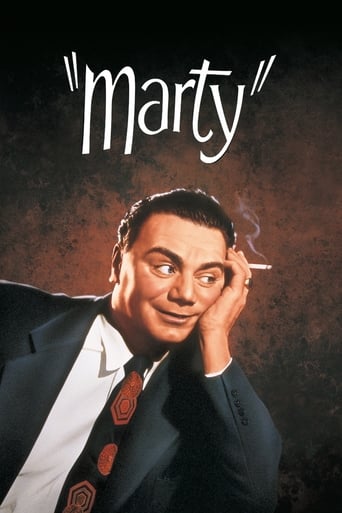
Marty
1955 · Film · 90 min
Directed by Delbert Mann
Marty, a butcher who lives in the Bronx with his mother, is unmarried at 34. Good-natured but socially awkward, he faces constant badgering from family and friends to get married but has reluctantly resigned himself to bachelorhood. He then meets Clara, an unattractive school teacher. Realising their emotional connection, Marty promises to call, but family and friends try to convince him not to.
1 positive3 neutralfrom 4 commenters
Where to watch
No streaming data for this title.



4 comments on Hacker News
Somehow I swirled around for a minute or so and didn't see anything I would want to watch.
"This gallery features a collection of the 50,000 most popular* movies according to TMDB"
Yeah, there's the problem. I went to the TMDB site and tried sorting by popularity, rating … all I got was a whole bunch of recent films that look like all the reasons the film industry is crashing (you know, the kind of stuff you would see in a Red Box when they were still a thing).
If you really don't know what to watch you could do a lot worse than checking off films on this list (the 1001 Movies to See Before You Die):
https://1001films.fandom.com/wiki/The_List
(And you have already seen a number of them I expect.)
Elitist? Maybe. But if you can actually get through the list (I've been at it, casually, for several years now) you'll feel like you have acquired a film school degree.
I think it's fine to watch "8 ½" and hate it — at least you'll know that you hate it now. But it would be sad if you never saw "La Strada" because you thought all of Fellini's films were impenetrable.
"Marty", "Stella Dallas", "The Hustler" — just a few great American films that came to mind that I would have otherwise missed…
But if the latest Guardian of the Pirate's of the Marvel Universe movie are your cup of tea you probably have no problem finding something to watch anyway and can pass on "The List".
I just can't get over the fact that the plane is losing altitude and they are doing everything in their power to keep it aloft except what seems like the one obvious thing: throttle up the #1 engine. When the alternative is the plane landing in the water, it would seem like there's nothing left to lose by trying. I would think desperation would drive them to attempt it.
It reminds me of the AF447 crash where the first officer held the plane in a stall (3 minutes and 30 seconds) all the way to its doom: "But I've been at maximum nose-up for a while!"
Tunnel vision is really scary. They had what looks like ten full minutes after they reduced both engines to idle to work this out but they didn't.
> First Officer Ryan would later assert that he disagreed with the decision to spend so much time in the air, but that Okai was the captain, so he obeyed him.
This is terrible CRM. Contrast with UA 232:
> As for the crew, there was no training procedure for hydraulic failure. Complete hydraulic failure. We've all been through one failure or double failures, but never a complete hydraulic failure. But the preparation that paid off for the crew was something that United started in 1980 called Cockpit Resource Management, or Command Leadership Resource Training, or any number of things that you want to call it. I think we called it CLR to start with. All the other airlines are now using it. Up until 1980, we kind of worked on the concept that the captain was THE authority on the aircraft. What he said, goes. And we lost a few airplanes because of that. Sometimes the captain isn't as smart as we thought he was. And we would listen to him, and do what he said, and we wouldn't know what he's talking about. And we had 103 years of flying experience there in the cockpit, trying to get that airplane on the ground, not one minute of which we had actually practised, any one of us. So why would I know more about getting that airplane on the ground under those conditions than the other three.
> So if I hadn't used CLR, if we had not let everybody put their input in, it's a cinch we wouldn't have made it. It was, I don't know if any of you remember the old movie Marty, I kind of refer to that, it was Ernest Borgnine, and a group of his cronies, trying to find something to do on a Saturday night, and they said, what do you want to do Marty, and he said, I don't know, what do you want to do Joe, and that's kind of the way we flew the airplane now. What do you want to do, I don't know, and let's try this, and you think that'll work, beats me, and that's about the way it went, really. If you read the cockpit voice recorder transcript, there's a lot of that on there. When are we going to put the gear down, I don't know, how are we going to put it down, well, we do two things, two ways to get it down, which one we're going to use, that type of thing.
> So CLR really paid off. And CLR is being taken out into other areas. I think it was originally a management course anyway, but now it's being spread all over. I'm going next year to Harrisburg, Pennsylvania to talk to the Nuclear Power Association. Because they are beginning the CLR concept in their control rooms. There have five stations in a control room. You have a nuclear disaster, you want those people working together, you don't want them working separately. So CLR that we had really prepared the crew for what happened.
It is hard to overstate how much Godard changed cinema, even in America. If you don’t believe me check for yourself. Open the best picture nominees between 55’-65’ and watch their trailers. Films like Marty/On the waterfront/12 angry men/To kill a mockingbird/The Caine Mutiny/Sweet smell of success is what movies were like in the late 50s.
The acting/writing was pompous, actors talked like reciting Shakespear. The movies were about heros of impeccable character doing heroic things and there always was a happy ending. Movie shots followed strict guidelines and the creative head of the movie was the producer while the director was akin to a contractor, someone hired to film the scenes.
Starting in the mid 60s there was a radical shift, topping the nominations we have films like Five Easy Pieces, The French Connection, The Godfather, One Flew Over the Cuckoo’s Nest, The Deer Hunter, Dog Day Afternoon, Taxi Driver etc. Actors would act and behave like normal everyday people facing everyday problems. The new Archetype is the Anti-Hero, someone with flaws/vices in their character, someone that viewers can relate to. We see the rise of the director as the auteur, the creative master of a film. Every known filmaking rule is being tested to it’s limits and broken by young experimenting directors.
The catalyst for this change was the French New Wave, a group of young filmmakers tired of the old style of cinema wanting to do films about their own life and experiences. The poster boy for the New Wave was Jean-Luc Godard starting this revolution with his 1960 film Breathless.
> people now have way more entertainment options other than sex
Another way to consider this is that people find it easier to divert themselves than to exert themselves only to be disappointed. (Think of the universal pain of the characters in "Marty". [1])
Even though the cost to "view" people has been cheapened by technology, what we find is that disappointment remains the likeliest outcome.
The article is written for humour, but it is worth noting that although "sex" cannot go out of fashion, the illusions of Bernaysian manipulation [2] certainly can. And, as a society with a changing set of prevailing group behaviours, the delights of companionship can certainly be lost.
An enjoyable sexual relationship isn't just a matter of presenting (or hunting for) some pastiche of beauty: people must want to charm and please one another. This cultural trait definitely has gone "out of fashion" in Western society.
Add to these discouraging considerations the fact that the financial calculation of a relationship (even if children are not planned) has much more risk today than even just 10 years ago.
[1] https://en.wikipedia.org/wiki/Marty_(film)
[2] https://en.wikipedia.org/wiki/Edward_Bernays