 Hacker Cinema
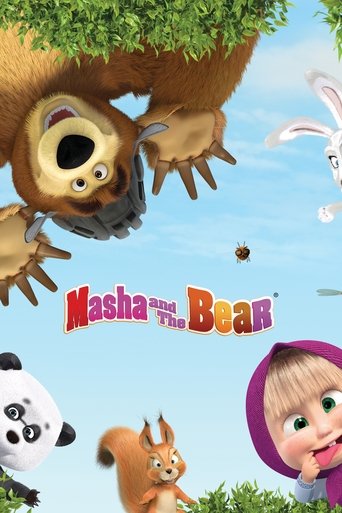
Masha and the Bear
Маша и Медведь
2009 · TV series · 7 min episodes · 8 seasons
Created by Oleg Kuzovkov
Masha is an energetic three-year-old who can’t seem to keep herself out of trouble. Bear is a warm, fatherly figure that does his best to guide his friend and keep her from harm, often ending up the unintended victim of her misadventures.
1 positive2 neutralfrom 3 commenters
Where to watch
No streaming data for this title.
3 comments on Hacker News
Not a native speaker, bleen for me got auto corrected by my brain to green. It doesn't make me uncomfortable, but I'd prefer grue because my brain will immediately understand we're talking about the umbrella term. If grue is said out of context, I'd imagine Gru from despicable me, when written I'd imagine gruel, but, again, because I'm not a native speaker, instead of yucky food I'd instead think about that episode of Masha and the Bear where they end up with a houseful of the porridge.
That "heavy hand" is precisely what makes things controversial or political. For instance Star Trek has pretty much always been 'woke.' My favorite series is Deep Space 9. The captain is black, the second in command (as well as the chief science officer) is a woman, the chief medical officer is Mideastern, and so on. And there were countless episodes that hit on all typical social justice themes, yet somehow these things were presented so 'naturally' that it all just felt very 'appropriate', for lack of a better term.
By contrast I was completely unable to watch things like Star Trek: Discovery (them choosing a title that would be acronymed as STD is already weird) because the identity politics were force fed so hard, to say nothing of 'Mary Sue'ism. It felt very unnatural and like a thinly veiled political rant. Back to PBS, Bert and Ernie - gay? I mean very possibly, if not likely. The creators say no, but they'd probably say no even if the answer was yes. And it's fine. It's introduced in a way that feels very natural, but when you suddenly start making such things overt, and one whose answer must be discussed and force-fed, it starts feeling much more like a political statement than just an inclusive context.
I'll certainly be letting my children watch old Sesame Street et al, but I think we'll be turning to things like Masha and the Bear for contemporary programming.
a few observations on this topic, that recently have come up a lot.
Sorry if it's gonna be a bit long.
First of all, a bit of context.
Maybe people forgot what the 80s where like, especially late 80s, especially in USA, maybe they forgot what being kids was like, maybe they were not even born when these things aired.
At the times trends for people were not dictated by young girls half naked on tik tok, but by "the American dream" that in the 80s was to be a yuppie, that the "manual" said were like this
https://m.media-amazon.com/images/I/71D2rGrfMBL.jpg
but they were actually like this in reality
https://e.snmc.io/i/300/w/18fff75069e5b3ecfc6d558e0c59acd0/5938834
"Lunch is for wimps."
As you can see, yuppies were successful people who played tennis, yuppie women were blonde, of course, usually they stayed home anyway, because their husbands made a ton of money, thanks to cocaine.
That was the culture US projected back then, that's why people of my generation reject the idea that USA are culturally relevant, except for punk, that was the last really interesting subculture that the US produced, but that's another story for another time.
If you don't believe it, here it is "Das Yuppie handbuch", German edition.
https://m.media-amazon.com/images/I/71cli3Z17VL.jpg
Secondly, the shows were not for kids, the shows audience were kids parents, in this case their dads or older brothers, who represented almost entirely the demographic of people who knew what Zelda was and who she was and that no, Zelda's not the guy on the covert art of the videogame box.
So it reflected an US centric male culture, like the fact that Mario is Italian because Japanese are (and were even more at the time) kinda obsessed with Italy, but in USA, being an Italian plumber, they made him sound like this
https://www.youtube.com/watch?v=eutK6k9D-Yk
He starts saying "Hey paesano" which is an idiomatic phrase mainly used in the South of Italy, that nobody uses anymore since a long time ago and those who did where simply mocking very old ways. I haven't heard it since I was a kid, in the late 70s. Of course Mario being Italian with black moustache must be from Naples, right? and he obviously knows how to make a pizza, right? every Italian know how, even if they are plumbers.
This basically to say that in USA those products were a reflection of the culture people were living in, men were assholes, Italians were Italo-Americans not real Italians, Chinese lived in Chinatowns and Japanese took pictures of everything.
The good news is, kids don't get the references.
As an example, my nephew she's 4 years old and she watches Masha and the Bear, which is a Russian product BTW. There's an episode where Bear encounters a female bear and wants to know her. He takes some flowers and a box of chocolates and goes to introduce himself. While he's going Masha realizes that Bear has chocolates and wants to eat them so she tries every trick on the book and in the end she eats them all and Bear is left with no more chocolates to bring to his romantic interest.
Long story short: what my nephew got is that you don't ever eat all the chocolates, because before eating the last one you should ask if someone else wants it, because it's good manners.
She did not understand that it's a metaphor of the difficulty of having a romantic life for parents with kids, especially single parents.
That's something we get, because we are adult and have already gone through it or witnessed it in other's people lives.