 Hacker Cinema
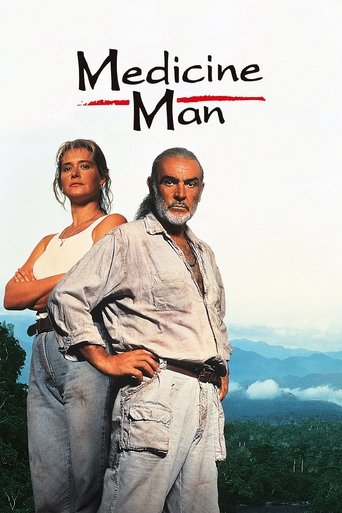
Medicine Man
1992 · Film · 106 min
Directed by John McTiernan
An eccentric scientist in the Amazon jungle rejects his research assistant for being a woman, but as bulldozers threaten their work on a potential cancer cure, they learn to collaborate and begin to fall in love.
1 positive4 neutralfrom 5 commenters
Where to watch
No streaming data for this title.


5 comments on Hacker News
I kid you not, there was a movie with Sean Connery called "Medicine Man" (1992) with this exact same theme.
https://www.imdb.com/title/tt0104839/?ref_=fn_t_1
In it, Connery finds what looks to be a rare natural cure to all cancer in the Rain Forest (spoiler: not a frog, but equally as weird), and is literally battling the nearby deforesting and bulldozers. For a Sean Connery movie it was bizarre (As a young teen, I saw it in the theaters.. quite a bit less action than a 007 movie but good drama and dramatic Sean Connery acting).
We literally do not know what we lost.
https://en.wikipedia.org/wiki/Putumayo_genocide
When rubber industrialists wiped out the people living in the area, those that remained lost generational knowledge. Ethnobotanists like Shultes explored the Amazon afterwards.
There's even a movie made on the subject of exploring the Amazon for medicines with Sean Connery, Medicine Man. Also, the more recent Embrace of the Serpent.
It feels like I've read this same introduction for the last 30 years. I mean, I remember reading stuff like this around 1992 in the Sean Connery film "Medicine Man", with Connery's character searching the Amazon for a anti-cancer drug.
> One hope was that the next antibiotic breakthrough would emerge from making and testing enough of these synthetic compounds. But that effort has fallen flat: Though other medicines have been developed in the lab, no new registered classes of antibiotics have been discovered since the 1980s.
Doesn't that also speak to a failure of natural products research, which has also been trying to find "the next antibiotic breakthrough"?
Look, I'm a coder, not a pharmaceutical chemist. But even here on HN a search for "antibiotic class" (like https://hn.algolia.com/?q=antibiotic+class ) finds:
"Antibiotic resistance: 'Snot wars' study yields new class of drugs" - "A new class of antibiotics has been discovered by analysing the bacterial warfare taking place up people's noses, scientists report." - 5 years ago, at https://news.ycombinator.com/item?id=12180966 . About lugdunin. Doesn't seem to have gone anywhere.
"New class of antibiotics discovered by chemists " from 7 years ago, about oxadiazoles. Found by computer search. Doesn't seem to have gone anywhere.
"First pictures of enzyme that drives new class of antibiotics" from 2 years ago, about obafluorin, "made by a fluorescent strain of soil bacteria that forms biofilms on plant roots". Wikipedia doesn't know about it.
"A new class of antibiotics active against wide range of bacteria" from 11 months ago, since retracted (?!) - https://www.nature.com/articles/s41586-020-03074-x .
And if I do a DDG search for "new antibiotic class", I find:
"Murepavadin: a new antibiotic class in the pipeline" (2018) https://pubmed.ncbi.nlm.nih.gov/29451043/ . Wikipedia describes it as "the first example of an outer membrane protein-targeting antibiotic class with a novel, nonlytic mechanism of action".
"A new antibiotic kills pathogens without detectable resistance" (2015) https://www.nature.com/articles/nature14098 . Teixobactin. Wikipedia describes it as "a peptide-like secondary metabolite of some species of bacteria, that kills some gram-positive bacteria. It appears to belong to a new class of antibiotics, and harms bacteria by binding to lipid II and lipid III ... discovered using a new method of culturing bacteria in soil, which allowed researchers to grow a previously unculturable bacterium now named Eleftheria terrae, which produces the antibiotic."
That's at least 5 new natural product leads on a new class of antibiotics, yet none made the list.
> the focus on nature waned as scientists instead built large chemical libraries filled with tens of thousands of lab-made molecules
If natural product search doesn't work, and lab-made molecules don't work, then ... is it really right to focus only on the failure of the latter?
Medicine Man [0] is a 1992 movie about a researcher who discovers a species of ant which has cancer-curing properties. As a teenager at the time I thought, "Why doesn't some pharmaceutical company simply test every ant species to find a cancer cure?".
Today my answer to my younger self would be, "Because there are thousands of ant species and the company couldn't patent its discovery, so there is no incentive to conduct such expensive research"
[0] https://en.m.wikipedia.org/wiki/Medicine_Man_(film)
Genuine scientific progress is usually collaborative even if the nature of fame, and fiction, is to single out individuals, writes Quentin Cooper.
It is sixty years since Elizabeth Alexandra Mary Windsor became Her Royal Highness Queen Elizabeth the Second. Sixty years in which the planet has changed beyond recognition. As part of the Diamond Jubilee festivities the BBC asked the public to help select the sixty “New Elizabethans” – living or dead, British or not – who have had the most impact on life during her (or possibly Her) reign. Which in effect means fifty-nine since HRH herself is pretty much a shoe-in. Given all the myriad ways science and technology have left their mark on the last 60 years, it’s a list which you might expect scientists and inventors to dominate. And I’ve no problem thinking of worthy contenders. Indisputable geniuses like Sidney Stratton, Ned and Philip Brainard, Robert Campbell and Alexander Hartdegen. Don’t know them? More familiar may be Emmett Brown, Caractacus Potts or Eldon Tyrell.
Each is responsible for one or more world-changing inventions and breakthroughs. Unfortunately, as you will have no doubt figured out, each is also fictional.
Stratton, played by Alec Guinness, devises an indestructible fabric in wonderful Ealing comedy The Man In the White Suit; Brainard with a change of first name invents gravity-defying flying rubber in both The Absent Minded Professor and the Robin Williams remake Flubber; Campbell is Medicine Man Sean Connery curing cancer; and although in HG Wells’ novel and the first film version he has no name, in the most recent remake it’s Alexander Hartdegen who builds The Time Machine.
The time travel – by flying DeLorean – is rather more stylish from Doc Emmett Brown in the Back To The Future trilogy; Caractacus Potts also gets a car to fly and creates whistling confectionery in Chitty Chitty Bang Bang; and Eldon Tyrell gives life, and death, to Bladerunner’s replicants.
‘Nutty professor’
This may seem a long and very male list of characters who have come up with things that, if real, would be ranked among the greatest advances of all time. That’s because it is. Well, apart from the “toot sweets” in Chitty Chitty Bang Bang. Now try to do the same for the individuals behind genuine inventions and breakthroughs. It’s almost impossible.
You might say Watson or Crick for the structure of DNA – but while both did key work they also needed Rosalind Franklin and a host of other supporting characters. There is also far more to DNA than its structure. Or what about Tim Berners Lee who “invented” the World Wide Web? Undoubtedly “TimBL” was vital to its development but what about his less well lauded partner – Robert Callieau - or the many thousands of others who have left their mark on what it has become? And Ian Wilmut – the man who brought Dolly the Sheep to the world’s attention? Sure enough,the paper that describes just how the world’s first cloned mammal was “created” shows the names of at least four other scientists involved in the research.
It is a problem that can only get worse. Think of the growing number of “big science” projects, from the Human Genome to the Large Hadron Collider (LHC). All involve thousands of people working in myriad disciplines. Naming an individual who is single-handedly responsible for the project – and its findings - is an impossible task. The Nobel Prizes – perhaps the organisation that has done the most to promote the idea of individual triumph – is already under pressure to change its ways. Last year’s prize for dark energy came under fire from the Astronomer Royal – the Queen’s own astronomer - for not accurately reflecting the true number of people who carried out the work. I don’t envy the Nobel Committee faced with plucking out three individuals if - and when - the Higgs Boson is discovered at the LHC.
That is because genuine scientific progress is usually collaborative and collective even if the nature of fame, and fiction, is to single out individuals and hand them all the credit. We like to make heroes, and a century ago stories about dashing, dynamic inventors saving the day, and the world, through their indefatigable ingenuity were so popular they even had their own name – Edisonades, inspired by the famously sweaty Thomas Edison. Such tales peaked in popularity long before EAM Windsor became QE2. Now even in fantasies in which a scientist makes some amazing advance, they are usually portrayed as nutty, absent-minded, eccentric or plain weird.
So it will be interesting to see which scientists, if any, end up being allotted a place among the New Elizabethans. For all their incalculable influence on life as we now live it, few have changed anything single-handedly, while many who have made a significant difference have achieved little or no public recognition. Unlike their fictional counterparts, the scientists who have transformed our world seldom get starring roles, just an uncredited cameo as part of the crowd.