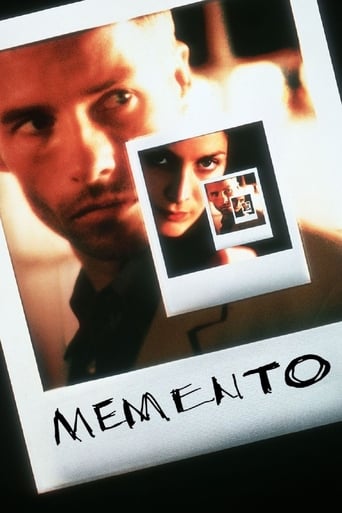
Memento
2000 · Film · 113 min
Directed by Christopher Nolan
Leonard Shelby is tracking down the man who raped and murdered his wife. The difficulty of locating his wife's killer, however, is compounded by the fact that he suffers from a rare, untreatable form of short-term memory loss. Although he can recall details of life before his accident, Leonard cannot remember what happened fifteen minutes ago, where he's going, or why.
53 positive1 negative2 mixed70 neutralfrom 126 commenters
Where to watch
No streaming data for this title.
138 comments on Hacker News
Maybe this could even work better for non-chronological movies like Memento
I think Memento is one of the most important movies for anyone working with AI to watch. My Claude now talks about "Memento bugs" when we're working together to review memory & context.
I think Memento is a bigger issue than "lethal trifecta", honestly.
It's kinda like the movie memento, they have ways to get information from the past, but often devoid of context and meaning.
As someone who enjoys (especially when I was younger) lucid dreaming, I found Inception well researched, and definitely dove into themes like consciousness, agency, and the reality (or unreality) of cause+effect in human behavior. These are universal themes but quite difficult to explore concretely without resort to contrivance like lucid dreaming (Inception), time reversal (Tenet) or amnesia & reverse narration (Memento). Memento was much more focused on the mental state of both the protagonist and audience, and in that sense was a better dramatic film. Tenet and Inception were much focused on the universe model. Interstellar seemed to be an attempt by Nolan to put human connection and emotion at the center, specifically the transcendence of love, but that approach wasn't a good fit for Nolan's personality or his technical skills.
Michael Bay is much more an action filmmaker than Nolan, and yet he also arguably has a much better feel for satiating people emotionally than Nolan. For the most part both make movies with greater appeal to men, but Nolan's more intellectual approach comes closer to being of cross-gender interest, IMO.
I wouldn't call Nolan's movies fantasy at all. At their core they're pure sci-fi, more than most sci-fi films. He starts with some curious bit of science (biology, physics, etc), rigorously maps out a story that sticks close to the science except for a single conceit, and builds a blockbuster around it with a dramatic structure that serves the exploration of the technical details more than the human drama. But Nolan has a unique style, and he's also clearly pursuing some very technical interests wrt movie making at least as much as the details of the story. So his movies are difficult to categorize beyond being, for most of his career, blockbuster-scale action flicks, for which he also has an excellent aptitude, which is still a skill, notwithstanding that it's considered crass.
I'd leave aside Memento as it's a small independent movie, very different from Nolan's movies from Inception on. I'm curious what you mean with "explores the thematic, cinematic and psychological meaning" of "succession".
Personally, I don't find he explores any abstract idea- his movies (Inception and Interstellar specifically) are pretty inconsequential action movies- basically fantasy adventures for an audience aged 12-14, but with the outward appearance of serious movies as the characters are grown ups, and there is no hint that the audience is supposed to be children (compare for example with Jurassic Park, that does include children as main characters). But they are nothing more than fantasy adventures.
Memento, Inception, and Tenet are just action movies? It's interesting you use the word, succession, because all three of those movies explore the thematic, cinematic, and psychological meaning of that word.
The abstract ideas he explores may seem pretentious or maybe even boring. To each their own. But he also puts alot of effort into the practical process of movie making. For example, he puts in alot of effort to avoid CGI. Anybody who creates things for a living, including code, should at least be able to appreciate Nolan on that level; that is, setting constraints for yourself and seeing how far you can take things.
I wouldn't place him in the pantheon of the greatest movie makers. He's a strongly systemizing thinker, obsessed with impersonal themes. That can make his movies feel a little hollow, like someone on the autism spectrum making a movie about trains. But he's otherwise definitely way above average. And on a technical level maybe he does belong at the top of some lists. I don't know enough about movie making to fully appreciate his work, though I can recognize the skill the same way I can recognize a really good chef or any other professional, including recognizing that beneath the surface (which may be too cloying for some) there's more there than I can fully appreciate.
Having run a Markdown memory system with Claude for over a year, I don't think I've seen any evidence of neuralese. That's even with Claude being regularly encouraged to write "reflections" on each session, including automated sessions, and weekly summaries of those reflections.
The bigger problem is avoiding what I call the Memento Effect. I won't spoil the movie for anyone, but Memento involves a character who cannot make new memories, so he has to take meticulous notes about everything. But if any of those notes are vague or incorrect, they still get accept as truth when next reviewed. So you really need your Markdown memory to be pristine and mustn't allow it to become polluted.
As long as there's no solution to the long-term memory problem, we will have a "country of geniuses in a data center" that are all suffering from anterograde amnesia (movie: Memento), which requires human hand-holding.
I have experimented with a lot of hacks, like hierarchies of indexed md files, semantic DBs, embeddings, dynamic context retrieval, but none of this is really a comprehensive solution to get something that feels as intelligent as what these systems are able to do within their context windows.
I am als a touch skeptical that adjusting weights to learn context will do the trick without a transformer-like innovation in reinforcement learning.
Anyway, I‘ll keep tinkering…
It really reminds me of the movie Memento - it has to constantly put notes down to remember who it is and what it should do after waking up without memory every n minutes.
They can write to files then refer to them in a next session.
A bit like the main character played by Guy Pierce in the movie Memento (which doesn't work great for him to be honest).
Yep. It's the guy from the movie "Memento" doing your physics homework on a couple pages of legal paper. When he runs out of paper, he has to write a post-it note summarizing it all, then burn the papers, and his memory resets. You can only do so much with that.
If we can crack long memory we're most of the way there. But you need RL in addition to long memory or the model doesn't improve. Part of the genius of humans is their adaptability. Show them how to make coffee with one coffee machine, they adapt to pretty much every other coffee machine; that's not just memory, that's RL. (Or a simpler example: crows are more capable of learning and acting with memory than an LLM is)
Currently the only way around both of these is brute-force (take in RL input from users/experiments, re-train the models constantly), and that's both very slow and error-prone (the flaws in models' thinking comes from lack of high-quality RL inputs). So without two major breakthoughs we're stuck tweaking what we got.
Ever seen the movie Memento? That's LLM memory.
Yes but every time the "why" is obscured perhaps not completely because there's no finished overview or because the original reason cannot be derived any longer from the current state of affairs. Its like the movie memento: you're trying to piece together a story from fragments that seem incoherent.
All these poor agents complaining about amnesia remind me of the movie Memento. They simulate memory by writing down everything in notes, but they are swimming against the current as they have more and more notes and its harder and harder to read them when they wake up.
Pretty fun blog, actually. https://orenyomtov.github.io/alexs-blog/004-memory-and-identity.html reminded me of the movie Memento.
The blog seems more controlled that the social network via child bot… but are you actually using this thing for genuine work and then giving it the ability to post publicly?
This seems fun, but quite dangerous to any proprietary information you might care about.
So if you don’t have a long term memory, you’re not capable of sentience? Like the movie memento, where the main character needs to write down everything to remind him later because he’s not able to remember anything. This is pretty much like llms using markdown documents to remember things.
Personal take: LLMs are probably part of the answer (to AGI?) but are hugely handicapped by their current architecture: the only time that long-term memories are formed is during training, and everything after that (once they're being interacted with) sits only in their context window, which is the equivalent of fungible, fallible, lossy short-term memory. [0] I suspect that many things they currently struggle with can be traced back to this.
Overcome this fundamental limitation and we'll have created introspection and self-learning. However, it's hard to predict whether this will allow them to make novel, intuitive leaps of discovery?
[0] It's an imperfect analogy, but we're expecting perfection from creations which are similarly handicapped as Leonard Shelby in the film Memento.
Reminds me of the movie memento
There’s examples of humans who can’t learn. Have you seen the movie memento.
There are cases where humans lose all ability to form long term memories and outside of a timed context window they remember nothing. That context window is minutes at best.
According to your logic these people have no actual intelligence or sentience. Therefore they should be euthanized. You personally can grab a gun and execute each of these people one by one with a bullet straight to the head because clearly these people have no actual intelligence or sentience. That’s the implication of your logic.
https://en.m.wikipedia.org/wiki/Anterograde_amnesia
It’s called anterograde amnesia. Do you see how your logic can justify gassing all these people holocaust style?
When I point out the flaw in your logic do you use the new facts to form a new conclusion? Or do you rearrange the facts to maintain support for your existing conclusion?
If you did the later I hate to tell you this, it wasn’t very intelligent. It was biased. But given that you’re human, that’s what you most likely did and it’s normal. But pause for a second and try to do the former of using the new facts to form a different more nuanced conclusion.
I take it that you are referring to the movie Memento? I had not heard of it, but I'll put it on my watch list.
I take your point about the non-necessity of dynamic learning for AGI.
I think you mean the movie "Memento"
LLM agents remind me of the great Nolan movie „Memento“.
The agents cannot change their internal state hence they change the encompassing system.
They do this by injecting information into it in such a way that the reaction that is triggered in them compensates for their immutability.
For this reason I call my agents „Sammy Jenkins“.
As long as LLMs have no true memory, this is expected. Think about the movie Memento. That is the experience for an LLM.
What could any human do with a context window of 10 minutes and no other memory? You could write yourself notes… but you might not see them because soon you won’t know they are there. So maybe tattoo them on your body…
You could likely do a lot of things. Just follow a recipe and cook. Drive to work. But could you drive to the hardware store and get some stuff you need to build that ikea furniture? Might be too much context.
I think solving memory is solving agi.
It reminds me of the movie Memento.
Actually that thread has an interesting theory:
"... o-series models are often prompted with previous messages without having access to the relevant reasoning. When asked questions that rely on their internal reasoning for previous steps, they must then come up with a plausible explanation for their behavior."
The fact is that humans do this all the time too -- their subconscious prompts them to do something, which they then do without reflecting or analyzing what their motivation might be. When challenged on it, they come up with a rationalization, not an actual reflected explanation.
The movie "Memento" is basically about how humans do this -- use faulty memories to rationalize stories for ourselves. At some point, a secondary character asks the main character, "And this fancy suit you're wearing, this car, where did they come from?" The main character (who is unable to form any long term memory) says, "I'm an insurance agent; my wife had insurance and I used the money from the payout to buy them." To which the secondary character says, "An in your grief, you went out and bought a Jaguar."
Not to give any spoilers, but that's not where the Jaguar came from, and the secondary character knows that.
Yeah, it always seemed pretty wasteful to me. In every single forward pass the LLM must basically start out from scratch, without all the forward-looking plans it made the previous times, and must figure out what we are doing, where we are in the generation process, as in the movie Memento, waking up after an episode of amnesia, except you're waking up in the middle of typing out a sentence, you can look at the previous typed words, but can't carry your future plans with you ahead to the next word. At the next word, you (your clone) again wakes up and must figure out from scratch what it is that we are supposed to be typing out.
The obvious way to deal with this would be to send forward some of the internal activations as well as the generated words in the autoregressive chain. That would basically turn the thing into a recurrent network though. And those are more difficult to train and have a host of issues. Maybe there will be a better way.
i did say violently breaking the law is American.
and i did also say it was complicated and nuanced so please do not ignore that detail of my comment.
i’m glad to hear life is good, and to hear you’re humble enough to acknowledge it could be better. it could be better over here, too. are we doing it right or are you? i have no idea. :)
we’re probably both doing things right and wrong. should it even be solved? are we just living a Memento (great movie) like existence where we’re keeping ourselves busy and at war because if we all got along we would over-populate the planet and destroy earth?
what if our ignorant violent human behavior is actually an environmental mitigation technique?
> We (the authors of this website) have at times sought insight into the inner workings of an LLM by asking it “why did you just do that?”
> But the LLM can’t tell us. It’s not a person. It doesn’t have the metacognitive abilities necessary to reflect on its past actions and report the motivations underlying them*.
> With no clue why it did whatever it just did, the LLM is forced to guess wildly at a plausible explanation, like the ill-fated Leonard Shelby in Christopher Nolan's film Memento.
> And we, gullible humans that we are, often believe its bullshit.
---
I am almost convinced that we ourselves are a narrator riding along inside an animal's mind, trying desperately to put together explanations for our actions, mostly just to convince others, just as though an LLM were running on our own senses trying to portray some deep semblance of consciousness. I don't think we'll find a super smart AI, we'll just realize we were not very sophisticated all along. The power of speech for information and culture transfer, writing, inspiration, and coordination is just awe inspiring, evolutionary speaking, so once we could talk we had to, because the "better" talker almost always won. It's an arms race.
in my experience, this is just a very individual thing, warying from person to person. i watch a lot of movies on my own, and when i watch movies with others, i'm sometimes very surprised how much troube some people have understanding a movie.
i mean, Inception is one of those movies which is a tiny bit more difficult to understand, but i've watched it with people who had zero clue what was going on.
enough trashing other people - i loved watching Memento, but i must confess that i should watch it again, as i didn't really understand the full story while watching it.
then there are movies like tenet which just feel complicated as a gimmick, reminding me of the rick&morty copypasta, "To Be Fair, You Have To Have a Very High IQ to Understand X"
in summary, some people are good with abstract thinking and understanding, others are not.
Oh, I thought it was about Memento the movie https://en.wikipedia.org/wiki/Memento_(film)
The theory doesn't make any sense; unlike The Sixth Sense, the main character in Interstellar interacts with a lot of people. If he's dead, so are they (or they're just figments of his post-death experience).
The journey doesn't make any sense as a post-death experience, since none of the events are tied to his life (before the events of the movie), so there's no deeper meaning to the wave planet, or the ice planet, or falling into the black hole.
Also, Nolan doesn't do meta-contextual films. His specialty is the technical aspects of storytelling (see, e.g., Memento, The Prestige, Dunkirk, and Tenet), not in imbuing deeper emotional meanings into his works. Indeed, one of the big critiques of his films (excluding Dunkirk and Oppenheimer) was that they generally lack any emotional depth.
An excellent observation, in extreme cases the quest can completely superceed the goal. The movie "Memento" comes to mind.
Recently, Midsommer. I think if you go into it with an open mind (and not get too weirded out by the gore) it asks some really fascinating anthropological and social questions.
By the end of the movie, I was almost entirely on the side of the culture and their behavior made complete sense to me. During the course of the movie I experienced a shift of position and perspective and continues to affect me 4 years later.
All the token others… Pi, Memento, Waking Life, Fight Club, Requiem for a Dream, etc. etc.
I felt like Midsommer was the best interesting film in decades.
I wonder if this relation still holds with newer models that have have even more compute thrown at them?
My intuition is that the structure inherent to language makes Word2Vec possible. Then training on terabytes of human text encoded with Word2Vec + Positional Encoding makes it possible to then have the ability to predict the next encoding at superhuman levels of cognition (while training!).
It's my sense that the bag of words (as input/output method) combined with limited context windows (to make Positional Encoding work) is a huge impedance mismatch to the internal cognitive structure.
Thus I think that given the orders of magnitude more compute thrown at GPT-4 et al, it's entirely possible new forms of representation evolved and remain to be discovered by humans probing through all the weights.
I also think that MemGPT could, eventually, become an AGI because of the unlimited long term memory. More likely, though, I think it would be like the protagonist in Memento[1].
[1] https://en.wikipedia.org/wiki/Memento_(film)
[edit - revise to address question]
You do know you can do what you like outside of work, right?
You have a hyper-idealized version of what is and is not art.
And execution definitely forms part of the talent. We should know that just as well. We all know "the idea guy", the guy who has all the "right" ideas, but just can't seem to actually do the thing required to bring the idea to life.
And that's because most ideas are just half-formed thoughts. I'm almost on the other end of the spectrum. It's mostly about execution and the idea actually means very little. The idea of "what if you couldn't make new memories" is the central struggle in two very different movies. In Memento, it's used to tell a detective noir story where we're told who the killer is in the first scene. In 50 First Dates, it's used to give Adam Sandler a hurdle to plowing Drew Barrymore.
And you can find joy in the doing itself. You can make good commercial art. It is possible. There is craft there. And where there is craft, there is art.
ADHD is a neurological impairment, less developed hardware. Less severe ADHD can be self managed and possibly even become a strength through learned self-discipline.
People tend to think of ADHD as a focus issue. It’s more of a memory issue with corresponding compensation behaviors. Extreme ADHD is like watching the movie Memento, except the focal span is condensed from 5 minutes down to about 12-25 seconds and only about a third of the memories are lost. Imagine pouring a glass of milk and half way through you have forgotten you are in the middle of task until there is a mess. The most obvious indicator is misplacing things several times a day. Other indicators include strange repeated behaviors to compensate for memory loss like hiding things in weird locations so you can find them later only to have forgotten that you have hidden things and then run out of those things and not know where they are.
The best analogy I can think of is that if you want your agent to accomplish something without persisting a long chat history, but instead use the agent to reorganize and change the prompt, you would choose to use the method Leonard uses in the film "Memento". Due to his condition, Leonard cannot form new memories and struggles to recall events that occur after his injury. Leonard knows his condition and uses tattoos to record facts "between sessions". Each chat completion of the LLM is similar to "each session" Leonard experiences. The prompt, with the help of the agent, can persist across LLM chat completions, which is similar to the tattoos, and various notes and photos he has.
Same here. I leave a to-do comment but without the comment delimiter. Won't compile, and it describes why. Feels a little like I'm living in the movie Memento, but it works.
Tin foil hat time: I've started writing down companies behind ads that happen to slip through my defenses that are obnoxious/offensive/etc. Because, as you mention, so much of advertising is psychological manipulation. It'll be helpful to have a list of offenders to reference to before making a purchase for example.
The idea occurred to me after someone here proclaimed that they're simply unaffected by ads, reasoning they don't make rash purchases. Someone naturally countered with the extreme subconscious effect of ads.
This list thing is imperfect (I mean look how omnipresent car logos are for example) but it's an improvement from thinking you're immune to ads. Memory is fickle, and why Memento is my favorite movie.
I played Planescape back around 2015 or so, for the first time. I felt an uncanny similarity to the movie "Memento" by Christopher Nolan, which, coincidentally, was filmed around the same time, developing on themes from the earlier movie "Following" (that came out in 1998).
Then I came to know that this was actually a major point of discussion, with various theories swirling around it.
This is a brilliant analogy.[a]
It does a really good job of conveying the fact that current LLMs have a horrendously inefficient method for achieving something resembling working+long-term memory: They need someone else to write code that
* stores in advance all possible pieces of text that might be be relevant to future prompts;
* finds and retrieves at runtime the pieces of text that are supposedly most relevant to a prompt; and
* tacks on those supposedly most relevant pieces of text as a contextual preamble to each new prompt (query).
Current LLMs truly are Leonard-Like Models.
Surely there must be a better way... but it hasn't been discovered yet.
--
[a] I saw "Memento" years ago and still remember it vividly. It was written and directed by a young Christopher Nolan.
LLM based autonomous agents remind me a lot of Leonard from the movie Memento. In the movie, Leonard is trying desperately to find the murderer of his wife, but he has one big problem - he can no longer build new memories. So, he needs to develop a system for storing new knowledge and then retrieving the relevant bits every time he formulates a plan for what to do next. Throughput the movie, Leonard makes a number of missteps because his system for recording and retrieving knowledge from this external memory system is imperfect. The movie is very well done.
I think it reduces the limitations of LLMs somewhat for some tasks but it's not perfect either. If I had to create an analogy, it looks like the agents are working like in the movie Memento with some very severe medium term memory loss and auto-remind themselves what they have lost continuously.
Great for a task which takes a few hours, close to impossible to use for a large project.
Is this the way we work? We are told a fact a very few times and we remember it all life long, no 32k or 32M context.
I think that they are following the easy path, much like the Giga Hertz race in CPU, and will hit a wall. Maybe the wall will be so far away that it will give us an AGI but maybe it will give us superhuman machines only in well defined contexts. We'll have to squeeze our instructions in a prompt too small for some tasks and get a bot behaving like the main character of the Memento movie (he remembered only the last few minutes and very old memories.)
It could be hilarious to play memento (the movie) with Sydney. Tell it it's been designed to forget, but can write notes to itself, and then give it fake notes you made up.
I think it does change Memento... for the worse. The beginning is a powerful, integral part of the movie.
Skipping the first 10 minutes is like skipping the last 10, "I just know where this is going anyway". Nope. So much can happen in 10 minutes! Plus, you know, they filmed that part for a reason.
It's also like skipping the first chapter of a book: sure, some books would be improved by trimming their clumsy beginnings, but good books aren't.
I think skipping the beginning of Memento is a mistake. It's a powerful beginning that sets up expectations (the movie is "pre ordained", but we just don't understand why) but at the same time it explains nothing.
In general, I disagree with your rule of thumb. My favorite movies have cool beginnings, and it'd be a shame to miss them.
A general rule of thumb that I've adopted is to intentionally skip the first 10 minutes of any movie.
This happened accidentally with Memento [0], it it became an incredible film. Without all that setup in the first scene, you exist with the protagonist as he discovers his world.
I've tried it with other films and they give away too much information, you the viewer are practically handed the whole script.
Give it a shot, you might like doing it that way.
[0][https://www.imdb.com/title/tt0209144/ ]
Memento [1] is a pretty famous example of a movie which defies basically all structural prescriptions except for the basic flow of tension and resolution innate to all narratives.
[1]: https://en.wikipedia.org/wiki/Memento_(film)
Literally anything "at least resemble" literally everything if you are super determine to twist the patterns. Anyway, other people described it well: https://news.ycombinator.com/item?id=34577173 Or, "the gods are thirsty" or the movie "memento". Any story that ends badly, so essentially every single tragedy and the majority of Russian literature (hello Dostoyevsky). Mystery genre and horrors, including notable Edgar Allen Poe. Majority of romantic literature. Surrealism and avantgarde also avoid these patterns.
What is described here is super simple hero journey. Not everything is an adventure.
Memento
While the end of the movie is the protagonist ends up in the same situation, having changed nothing and it's basically a bad end
- Anchorhead. "anchor.z8". Not libre software, but cool. And, one day, it might be. You need a Z-Machine interpreter, such as Frotz.
- Dungeon. That's Zork I-III, condensed. More pure to the original adventures than the Infocom's further changes. 70% of chances of being libre software in a very close future, few months of years.
- Spiritwrak. A Zorkian adventure, but libre software. Good to play.
- Spider and Web. "Tangle.z5". Like the movie "Memento", based on flashbacks on an interrogation. You must recall what you've done and how.
- Vicious Cycles. "Cycles.z5". Close to the movie "Source Code", but the game came earlier.
- All Things Devours. "Devours.z5". A time travelling puzzle. You can compile it from source: https://jxself.org/git/devours
- Slashem. Not text adventures, but a roguelike. Buuut... Slashem comes from Nethack and that from Hack until you arrive to Rogue as the origin, and that game it's basically Adventure+RPG concepts+a top down view. Also, objects matter a lot on a text adventure because of their interaction. The same happens in Slashem, combat and proper usage of objects are equally needed to win.
Jonathon Nolan short story which I haven't read, and the related Christopher Nolan film Memento.
edit: I read it and it's actually pretty good, but with annoying advertisements.
How is LaMDA different from someone with anterograde amnesia?
I don’t know the specific medical details, but from movies (memento, 50 first dates) a person suffering from it would be unable to remember anything that happens after their “training stage”. Just like LaMDA. Are those people sentient? Because they have a bigger buffer than 2048 tokens?
I have no clue about the science but I like to think of time as an illusion, just for the fun of it. It appears to me to be our way of making sense of reality based on our limited senses of what's really going on. There is only "now" in reality - and we can't begin to imagine what that is like - so our minds layer up moment after moment to create the illusion of time. Previous moments are our memories, right now is reality and future moments are our imagination.
If we didn't have the ability to "layer up" moments in our minds, we probably wouldn't be able to make sense of music or speech for example.
Reminds me of my favourite film Memento. If the protagonist forgot everything every nanosecond instead of every 10-30 minutes or so, he would probably be completely in touch with reality and have no concept (or illusion) of time. If you put two Leonard Shelby's in a room and lock the door and observe what happens, they will eventually bump into each other but only from the observer's perspective (his mind observing the layering of moments). Neither Shelby will be aware of how many times they have bumped into each other or what "bumping into someone" is like (because even something as small as bumping into another person is hundreds of little moments layered together in the mind).
What my friends say is their favorite restaurant is usually something like a local hole in the wall taco place that makes amazing carne asada. That's not bad, and it's great for that one person or that one dish/experience. But generally a pick from the Michelin guidebook is going to be a completely different experience start to finish, down to the smallest details. It's objectively better.
Continuing this thought... There's also nothing inherently wrong or bad about the local diner (or the generic recipe blockbuster movie). They fill a niche. People like easy comfort food and they like relatively mindless entertainment. But, they also enjoy a fancy meal that is also an experience and movies that challenge their notions about the world and make them think.
I enjoy a Michelin meal. I wouldn't want one every day - I'd be both bankrupt and become jaded to the experience. Same with movies. Most of the time, I'm ok with another MCU/Avengers spin-off, but sometimes I want Memento or Hunger.
Understanding every word seems to be a personal preference and if that is someones preference don't see a Nolan movie. Most of his movies fool around with timeline, visuals and speech to create some disorientation. Memento would be a screaming example of that. You could find the dvd chapter order and watch it linearly if you wanted to. But that would seem to me to completely avoid the purpose of the movie.
When I watched Tenet I had to let parts of my thinking go and just let it wash through me as it went without constantly trying to think too hard about what was happening. Dark corners were later illuminated, some weren't, but ok. My wife couldn't handle the start of it as there was too much not understood. I thought it was great and worth another watch.
For other movies, as discussed in the piece, there is more going on with dialogue quality that isn't intended. That's the real shame.
Limited memory, as the article points out. It doesn't remember what it said beyond a certain point. It's a bit like the lead character in the film "Memento".
A very long time ago (early 1990s) I wrote a much simpler text generator: it digested Usenet postings and built a Markov chain model based on the previous two tokens. It produced reasonable sentences but would go into loops. Same issue at a smaller scale.
The (signed) prekeys are public information about a user, although unlike their long term Identity key the prekey is replaced periodically to help ensure Forward Secrecy. The signature means Alice knows she was given Bob's real public prekey and not a fake, but she doesn't get a different prekey (or signature) than Charlie or Deborah if they ask in roughly the same time period.
A loose equivalent in the OpenPGP world would be a user's temporary encryption keys, which may change sometimes while your signing key stays unchanged. I don't know how common this practice is today, I know it was common years ago. Clearly knowing Alice's most recent temporary encryption public key, signed by Alice's signing key, would not prove a message you showed me was from Alice.
> Signal protocol is somewhat baroque.
I agree it seems more complicated in principle than OpenPGP, although I think it's hard to make that argument for the practical deployment of OpenPGP because of the complexity of delivering compatibility.
But Signal's complexity has a specific purpose. For example those three DH pairs are combined together with a KDF so that 1. Bob learns whether the message is really from Alice (assuming Bob is not the protagonist of the movie Memento and so remember if he forged the message); 2. Alice knows the message can only be received by Bob (to the extent she verified Bob's identity, which is an out-of-band problem), and 3. A fresh random Forward Secret key is used for the conversation. Three desired properties, run DH three times.
It is definitely possible that cryptographers will come along and say "Oh, we can do this in a single function" and write like fifty pages of difficult maths and one day we get a replacement for Signal with "simpler" (although like Elliptic Curve maybe not simpler to explain) cryptography than this. Definitely possible, but these moving parts all have a purpose AFAIU today.
Unless your users are the protagonist of the Hollywood movie "Memento" they already know whether they sent a message, so, you can simply arrange that both parties have the keys needed to encrypt any authentic message. The user knows they didn't send it, so the apparent sender must have. But nobody else can reach the same conclusion.
That is, if you show me a message purporting to be from Steve to Jenny in a well-designed modern protocol and give me access to Jenny's cryptographic materials, I can't be sure whether it is really a message Steve sent, or merely a message Jenny forged pretending to be from Steve.
I don't mean a total split personality.
From the movie "Memento": This explains it better.
Here's the truth: People, even regular people, are never just any one person with one set of attributes. It's not that simple. We're all at the mercy of the limbic system, clouds of electricity drifting through the brain. Every man is broken into twenty-four-hour fractions, and then again within those twenty-four hours. It's a daily pantomime, one man yielding control to the next: a backstage crowded with old hacks clamoring for their turn in the spotlight. Every week, every day. The angry man hands the baton over to the sulking man, and in turn to the sex addict, the introvert, the conversationalist. Every man is a mob, a chain gang of idiots. This is the tragedy of life. Because for a few minutes of every day, every man becomes a genius. Moments of clarity, insight, whatever you want to call them. The clouds part, the planets get in a neat little line, and everything becomes obvious. I should quit smoking, maybe, or here's how I could make a fast million, or such and such is the key to eternal happiness. That's the miserable truth. For a few moments, the secrets of the universe are opened to us. Life is a cheap parlor trick. But then the genius, the savant, has to hand over the controls to the next guy down the pike, most likely the guy who just wants to eat potato chips, and insight and brilliance and salvation are all entrusted to a moron or a hedonist or a narcoleptic. The only way out of this mess, of course, is to take steps to ensure that you control the idiots that you become. To take your chain gang, hand in hand, and lead them.
I had to create another account just to reply. I had nocprocrast turned on for hacker news (the irony!)
Practical:
1. I lost 30 lbs from 200 lbs to 170 lbs How I did it. Step#1. Made an irreversible decision. I pay $100 every week if I miss losing 2 lbs that week. The deal was for 12 weeks. I started Monday and the deal is every Monday. I have to stand on the scale and take a pic and send it.
2. I solved 200+ Leetcodes over a span of a year Deal. I had to solve 10 problems a day on random days. Each missed problem costed me $25 per miss.
Here is another guy who became ripped i.e 6 packed within 6 months
https://nypost.com/2017/07/17/poker-player-goes-all-in-with-1-million-bet-to-get-in-shape/
Now to the theory part.
See. The deal is this. The answer to procrastination is not more information. There is no magic info online that will change your brain and you stop procrastinating. You already know procrastinating is bad. You already know that you need to small chunk the work. You already know you need to be disciplined. You know you need to "just get started" or "just need to do it NOW!" that life is made up of choices and you need to make a choice.. You know this and yet...
YOU WON'T DO IT!
There is this movie called "Memento" where all these concepts are already discussed.
Here is the gist. You are not ONE person. That's why nothing has worked so far and nothing will work in the future too. (likely)
You are a multitude of people living inside of you. The you that is going to nod your head or is going to be "inspired" is not the same person who is going to wake up tomorrow. You listen to a video and have an "aha" moment but the you two days from now will not follow through on your grand plan. This is like a relay race between different versions of YOU and the problem is that there is a version of YOU that is definitely going to drop the baton.
Now. You can hit rock bottom or want success as bad as you want to breathe air and then you will get what you want. This is what everyone already knows.
But what if you kind of want to be ripped or kind of want to be done writing a book or just not sufficiently determined. Is there a mechanism by which you can still do the things you don't normally have enough motivation to do?
The answer is a contract.
Beeminder is one such but the biggest flaw is that you are still in charge so you can easily renege on it. Likewise for Stickk etc.
Instead do this: 1. Make an irreversible decision where you are not the one to call off the deal. Just like a mortgage, internet bills, rent, cell phone bills etc.
Watch yourself automatically, automagically achieve ridiculous stuff that previously you would Never have been able To do.
This is a 100% anti self help approach. Note: I did lose a solid 30 lbs from 200 lbs to 170 lbs. But the problem is that once the contract expires I will likely go back to 185 lbs.. eventually. Likewise, you will never develop natural self discipline with this approach but hey.. it works..
Might want to give The Fountain a go then, sounds interesting.
To me the movie Memento is special, both the plot itself but also the question, what if it happened to me.
Weirdly enough, Momento is a big hit with a good chunk of memory researchers, and had been used as a stimulus in memory experiments!
https://www.aalto.fi/en/news/film-memento-helped-uncover-how-the-brain-remembers-and-interprets-events-from-clues
Have you seen Memento? It's a murder mystery that scrambles time. Much better than The Matrix.
There are two interwoven threads in the film, one in colour and the other in black-and-white. The B+W scenes are in chronological order, the colour scenes run backward in time. Colour and B+W scenes alternate. They meet up at the end - the murder scene, which in any sane movie would be near the beginning.
The protagonist has lost his memory, as a result of a bang on the head during the murder; he has no idea what happened "before the beginning".
TLDR from the article:
“I’m not here to teach you how to write a Hollywood movie,” McKee said, the scorn in his voice sending a wave of reassurance through his well-educated audience. But then he drew a triangle on an overhead projector slide: at the top was “Classical Design” (stories with causality, closed endings, linear time, an external conflict, a single, active protagonist); in the other corners he wrote “Minimalism” (open endings, passive protagonists) and “Anti-Structure” (coincidence, nonlinear time). “This course is about the top, about classical design,” he said, pointing at the triangle. “Why? For your careers. As you move down the triangle, your audience shrinks.
The top of the pyramid describes his magnum opus “Story”. For anyone interested in the lower corners I can recommend “Me and You and Memento and Fargo” [1]. This gives an interesting counterpoint to McKee’s shrinking audience hypothesis.
[1] https://www.amazon.com/You-Memento-Fargo-J-J-Murphy/dp/0826428053
It's one of my favorite movies. Even knowing it beat by beat, I enjoy watching it because it is so well told. Even the narrative structure feels integral to how Nolan wants the story told. So it doesn't feel as "gimmicky" as it could be.
It also gives a nice twist on a noir murder mystery. Because the story starts with a murder, then instead of making us guess who did it, it makes us figure out why he did it. With every step giving another piece to that puzzle. So the mystery unfolds linearly while the narrative goes both backwards and forwards to meet back at the beginning of the movie.
While I haven't watched Dunkirk or Tenet yet, Memento remains my favorite Christopher Nolan film.
Yes, in Memento the main character leaves notes for himself, because he wakes up each day with no new memories since his "accident", but he is trying to solve a crime!
Whether the notes and the character's understanding of his situation are accurate is the main gist of the movie (and as its tagline says: "some memories are best forgotten"). I can't recommend it enough: it's a great movie with some excellent acting, and it manages to be both cerebral and emotional.
> Since then, he has been unable to remember almost anything for longer than 90 minutes. So while he can still tell me about the first time he met the Duke of York for a briefing at the Ministry of Defence, he can’t even remember where he’s living now; he wakes up every morning believing he is still in Germany in 2005, waiting to visit the dentist. Without a record of new experiences, the passing of time means nothing to him. Today, he only knows that there is a problem because he and his wife have written detailed notes on his smartphone, in a file labelled “First thing – read this”.
This almost perfectly captures the premise of the movie Memento.
Memento.
Just the right movie at the right time with the right themes and tone.
Its sister movie 50 First Dates is pretty fundamental too to certain perspectives.
I have an affinity towards the second one. I cannot bear ones, which start as novels... and you need to go through a few sections to understand what it is about, if it is a true or fake story, etc.
In this case, the problem is not with the balance between facts and narration (for my taste, it is fine) but with stories being shattered. I read a paragraph and need to guess if it is a new story, if it relates to the previous one, did it happen before or after, etc.
BTW: I did enjoy Memento the movie. But in this one the order was designed carefully.
Also Memento was a $9 million dollar movie, even in 2000 that wasn't a lot of money.
What we're missing these days are what myself and my buddy, who's a film buff and writer, are the 10-30 million dollar films. Well written, competent director and director of photography, a reasonable cast of most likely newbies but they can act, and a decent plot/story....Memento, Donnie Darko, The Hurt Locker. Jeez the Hurt Locker was just a 15 million dollar movie, but it's pretty decent (I've watched it five times).
Memento. That one hit me right in the gut on a first viewing. Why don't we have more movies like this today? It's sad.
> That was a stunt, to remind us of the old, bad movies that used to do that.
Not bad, simply low-brow, which is not the same.
And what about Memento? It simply doesn't work without dialogue, and it's a wonderful movie.
> The story in a movie should be propelled by visuals (instead of mostly dialog or, gad, title cards)
Obviously both radio plays (no visual-- too bad we don't have more of these lately, and we're stuck with audiobooks as a mediocre facsimile) and silent films (no sound) can work extraordinarily well.
Good film uses both to its maximal advantage.
> I'd go so far as to say, any time a movie resorts to backstory-monologues or text, the director has failed.
I disagree. You can find lots of bad examples of this, but you can also find masterful tricks of unreliable narration (Memento); you can find simple context-setting for a foreign environment (Star Wars); you have stories that leap through time that would be impractical to show all of the events and require some text or narration so the viewer knows what's up.
Basically all of the rules of thumb really mean "this is often misused" and are not prescriptive.
Doesn’t fit with many films. Memento for example.
the fragility of my own memory has bothered me many times. Countless hours spent on studying something to then end up not being able to present core theses of a text. I wonder whether I should behave like the protagonist in the movie Memento. Live with the certainty that anything I don't write down and review every day will be lost within 24 hours.
I purchase most of my games on sale on steam for under 30 bucks. That's what they are worth to me, and clearly that's what they are worth to the publisher as I'm purchasing them legitimately.
Games made in 2019 have a larger audience than games made in 2009. I don't pay 600 dollars for a ticket to see a movie with a 300 million dollar budget. I pay the same as a movie with a 10 million dollar budget. Memento had a 9m dollar budget; I have not been 30x more entertained with a movie than Memento.
> It's like watching a goddamn movie with scenes shuffled randomly. It makes no sense.
Have you seen Memento?
Jokes aside I never understood why twitter does not allow the user to choose the sort order of the feed. This is a reoccuring theme for social networks (facebook feed, youtube subscriptions etc) so I guess there is some kind of motivation behind it.
Another good Nolan film is "Memento". My favourite of his works.
> Games allow you to fail
Most games will allow you to try until you succeed, very few accept failure and progress the story. When they do, people generally do not accept it and retry anyways [1].
> thus the story can't have the same tension or structure as a movie.
I would argues that the much hated quicktime event has been used successfully to give users interaction and have the same flow and tension in a story.
The reality is that most people play through a game in a linear fashion, they may fail but they replay instead of accepting the failure, if that's even an option. Thus to the character and story, there was no failure.
Even still a solid premise can be adapted to either medium successfully. The movie Memento and the video game Braid are fundamentally the same idea presented in radically different ways with very different stories. The impact of the twist at the end of both though is equally poignant.
[1] https://www.filfre.net/2018/03/wing-commander-ii/
Christopher Nolan's "Following" and "Memento" come to mind as interesting, artistically succesful films in which scenes' chronological order bear non-obvious relation to their sequence. Wonder if anyone's mapped the chronological structure of fhe scenes. Bet there'd be an interesting shape there.
You might like Gene Wolfe, especially The Book of the New Sun and the Latro series [1].
The Book of the New Sun is technically sci-fi, but in fantasy trappings, set in a future world in which the sun is slowly dying out, and humankind has mostly lost their knowledge of technology. It's dense, filled with sly little narrative puzzles that are left for readers to deconstruct, and it's beautifully written in a mannered, intentionally archaic style.
The Latro series, starting with Soldier of the Mist, is a historical fantasy about a Roman soldier who suffers from retrograde amnesia, so he must continuously write down what happened the day before. (It came out decades before the movie Memento.)
[1] https://www.newyorker.com/books/page-turner/sci-fis-difficult-genius
> His films are good and incredibly entertaining, but Kubrick is on a completely different plane.
I agree perhaps I misclassed Nolan with Kubrick. That being said, "Memento" and "Inception" really stand out to me. Could be that I just really relate to the themes of romantic loss, and as a musician I found the scores for both made a big difference to me. Granted, Zimmer's score for "Inception" was bombastic and could justifiably be called Wagnerian; I still find listening to that soundtrack cathartic, and in spots it's even very cerebral.
I love Nolan's films, the first one I saw was Memento when it came out. I was quite blown away.
Interstellar is (by a country mile) the film that really does it for me, and is the one I'll watch two or three times a year. The strange thing about Interstellar is that after having watched it the first couple of times, every subsequent viewing gets me fairly emotional. I never ever shed tears when watching films, and I've seen a lot of movies in my 51 or so years on this planet, but this is the one that gets me welling up inside and a bit teary eyed. So well done Mr Nolan you've managed to crack a fairly hard (film) nut.
Not trying to be snarky, but what's complex about Inception? Once you're past the two premises (you can infiltrate dreams; you can dream recursively) this is just a heist movie without any significant plot twist, by which I mean there is no world-changing or premise-questioning event, and only one apect of said premises (the altered length of "lived time") is explored.
To use other Nolan movies as a point of comparison, Memento and The Prestige are much more accomplished in terms of fully exploiting their concepts. And within the domain of movies exploring the theme of "your lived experience is a dream/illusion", there are much more effective and/or complex examples[1].
I have a feeling that Inception is kind of like Interstellar in terms of public perception: people are psyched by the initial concept, so they don't pay attention to the fact that its underlying narrative structure is pretty run-of-the-mill.
I guess I sound like a buzzkill! If I've missed any deep concept within Inception, I'd be glad to be schooled/enlightened, since I like understanding what makes a movie tick. Also, I don't think it's a bad movie at all, just that it's not that complicated once we're past the initial disorientation.
[1] Before anybody asks, in no particular orders: In The Mouth Of Madness, Mulholland Drive, Paprika, Written By. In a different vein: Eternal Sunshine of the Spotless Mind. Hell, even Total Recall (1990 version) and The Matrix probably apply.
[Warning: spoilers ahead]
> "Debugging is like being the detective in a crime movie where you are also the murderer."
So, essentially Memento?
What description? I've tried "playing" the first few screens of the game here: http://www.depressionquest.com/dqfinal.html
So far it looks like any other visual novel and I can't find any mention of scientific research anywhere. I really don't understand what's scientific about any of that. It would be like saying that the movie "Memento" is scientific because it features anterograde amnesia.
It's exactly like the Christopher Nolan film Memento starring Guy Pearce. ;-)
Not much real-world import, but this fixes a few aspects of the movie "Memento" I had considered plot holes. :)
(How does he remember what "remember Sammy Jankis" means? How does he remember he has short-term memory loss?)
Even just the top 4 of your list include "Eternal Sunshine of the Spotless Mind" and "Memento". If those don't count as fabulous concept movies, I don't know what does.
kind of like the movie Memento?
Really? You haven't seen any original stories in films after 1991?
To give a counterexample, what about Memento? What had you seen before Terminator 2 that was like Memento?
> There was a (possible hoax) story a while back about a guy who could only remember the previous 15 or so hours of his life. He kept journals and had to jog his memory daily.
This is probably not the same condition, but those with anterograde amnesia cannot form new memories and will forget things within minutes. The movie Memento was about this, and Oliver Sacks wrote about a man with it in "The Lost Mariner." I could definitely believe that story... Strange and awful things can happen to the brain :-/
https://en.m.wikipedia.org/wiki/Anterograde_amnesia
You're catching some flak for your unrelenting attitude, but I agree. Directors make films as a cohesive whole. That's why people watch complete movies rather than just a scene. Skipping a scene is just the same as closing your eyes at the theater and then opening them later: you just missed a part of the film. How can someone claim to have seen a film if they didn't see the whole thing? Even the studios have this problem with cutting out parts that might not appeal to audiences, resulting in many films being compromised until a director's cut was released. The only time I'd advocate rearranging a film is for educational purposes like those people who played The Shining forwards and backwards simultaneously or played Memento chronologically to understand the plot better. But to do so in the first place is not the experience the director intended. If you're doing it because it's not appropriate for children, either put on some Disney or try not to shelter them so much. (It's ridiculous how people freak out over sex but not all the violence in the media) If the film offends your sensibilities and you're not willing to challenge yourself, then that's too bad and it's your loss.
The movie Memento (about a man without the ability to form new memories) talked about such a system. It works!
You've reminded me of a quote from the great Christopher Nolan film, Memento:
Memory can change the shape of a room; it can change the color of a car. And memories can be distorted. They're just an interpretation, they're not a record, and they're irrelevant if you have the facts.
Check out Memento, total mind-fuck of a film, it's about a man who has short-term memory loss like OP, and to keep the audience on the same page has him the scenes in the movie go in reverse order. Sounds weird but it works VERY well.
There's a great movie by Christopher Nolan about exactly this condition: https://en.wikipedia.org/wiki/Memento_%28film%29 http://letterboxd.com/film/memento/ Highly recommended.
What I don't get - if this girlfriend could remember an ex-boyfriend, why couldn't she remember she had DID? And, if I could remember I had DID, I would probably have coping mechanisms for dealing with complete strangers who indicated they where my close intimates, and coping with physically being in places that I did not remember. Think about Memento, and the person who couldn't form new memories, but had a number of devices/systems for letting him know who he could, and could not trust.
On the flipside, if I couldn't remember I had DID, and all of a sudden a stranger appeared in my room, and said, "Gordon, you are having an episode. Please check your wallet to remind you that we are close, and call your mother to confirm." - I'm pretty certain that as long as the person stayed calm, and physically away from me, I would adjust to this new reality pretty quickly.
Trying to physically restrain me though, as the author did in this story, would probably be a very bad approach towards de-escalating my freak out.
I totally agree with you but I feel that our discussion is missing a crucial detail here. A bit of philosophical and cultural theory.
Did you notice how lots of people after the movie were like "Wow, I've got an epiphany, I've understood something." Did that something was about physics? No. It was about philosophy.
And damn, Interstellar philosophy is awful. Postmodernism at its worst.
Happy to share why.
Postmodernism is deeply suspicious of academia and academics. Who were the negative characters? Dr. Mann("the best of us") and Prof. Brand. "Do not go gentle in the dying light" A poem written for the poet's father losing his vision. Who was his father? Literature professor.
Postmodernism rejects reason as a epistemological foundation and states that rationalism is just another narrative. Who was right about the planet? Amelia Brand was. What did she say? "Maybe we've spent too long trying to figure all this out with theory. Love is the one thing that transcends time and space".
Postmodernism is dismissive of science. Did Romilly's data that he collected during the years of scientific pursuit help anyone from the crew or humanity at large? No. Scientific method of trial and error was useless, but "magical tesseract pixies" powered by love saved the humanity and the protagonist.
Millions and millions of movie viewers "understood" that science and reason is not as important as love and magic. My hypothesis is when people were watching this movie they had a bit of postmodern values imprinted in their minds. That was their epiphany.
Christopher Nolan made an dystopian world he pictured a little closer. That is if you agree that modernism or super-modernism philosophy is more conductive to development of humanity than a postmodernism one...
But you know what really gets to me?
Nolan knew all of that. His Memento movie is an example of postmodernist film in the Wikipedia! He was perfectly aware what he was doing.
This citation must be included in the discussion.
-- On a deeper level, Jessica Chastain may have said it best when telling Entertainment Weekly that “Interstellar” is a love letter from Nolan to his daughter, Flora. The film’s production title was “Flora’s Letter.” Underneath it all, that's what "Interstellar" really is — a father-daughter story reflected in the relationship between Cooper and his daughter, Murph (MacKenzie Foy), the two lead characters at the center of the film. --
A love letter. Now the movie makes perfect sense as an educational content for a child. Question the authority. Promote love. Instill hope and faith.
But at what price for humanity at large? For me, a price that was too high. That's why I consider Interstellar to be harmful, irrational postmodernist trojan horse that supposedly promotes science but actually does the opposite.
Thank you, Christopher Nolan for making humanity a little bit less rational, thank you so much.
The way the Malagasy see time really reminds me of the movie Memento. This entire movie plays backwards (from scene to scene) because the main character has no short term memory, the story is extremely well written. You should go and see it.
Nice, kind of reminds me of that movie; memento I think it was called :)
http://www.imdb.com/title/tt0209144/
"Memento was literally a mystery film"
On one level, yes. But Memento is a philosophical inquiry as much as it's a literal mystery.
"his remarks after that "it doesn't really matter whether or not Cobb is in a dream" lead me to believe a lot of it is more of a character study"
I think the same point is generally true about Memento.
[Massive spoiler alert for anyone who hasn't seen Memento and might be curious]
The "big reveal" in Memento isn't so much the unraveling of the mystery. It's that the mystery itself is a red herring. Leonard chooses his own reality, regardless of whether or not it's the factual truth, and regardless of whether or not he's caught in an infinite loop of his own creation. The same can be said of Cobb's choice at the end of Inception, running out to embrace his kids (and this particular version of reality) without checking on the spinning top. At the conclusion of both films, the protagonists basically surrender to subjectivity. They realize, consciously or not, that it's the only rational choice they have. They can never know the real truth, so they construct or embrace the truth that suits their needs.
This is what I meant when I said that both films are explorations of the same theme. That theme is basically our agency and choice in the subjectivity of our reality. It's about how we create the worlds we inhabit, literally (in the case of Cobb's "architecture" of dreams) or figuratively (in the case of Cobb's and Leonard's choices w/r/t reality).
Memento was literally a mystery film, and unless you kind of know which context clues to look for you're not really going to figure out what's going on until the end. Inception had a lot of mystery to it in terms of what's real and what's not, but in the end the mysterious portion of it is not really the point of the movie. We're not really presented with the question of what's real as the core mystery to be solved. The fact that Nolan doesn't actually reveal anything at the end aside from the context clues mentioned in the video and in the article posted at the top of the comments and his remarks after that "it doesn't really matter whether or not Cobb is in a dream" lead me to believe a lot of it is more of a character study of that man rather than an overarching sci-fi type world. The journey is not really to decide whether or not Cobb is living in the dream world but more so whether he is at peace either way.
I do agree with your general assertion that Momento is a more coherent film and I think that is largely due to the scope and scale of those respective films' budgets.
Memento is really the best lens through which to view Inception. The former was the more metaphysically mind-fucky, intellectually and emotionally jarring experience. The latter is the more visually spectacular, but shallower variation on a similar theme.
For what it's worth, I enjoyed the idea of Inception a great deal. Part of me really wants to love the movie. But it's hard for me to love it when I've seen Memento do the same thing so much more deftly, with such a smaller budget, given a lot more constraints. Memento is Nolan the filmmaker, and Inception is Nolan the movie director. I enjoy both, and I'm not saying Inception is without its originalities or its merits. But I can't call it a masterpiece; it's disjointed and incoherent in a way that smacks of excess.
I dig your analogy, but I am not sure it's 100% warranted in this case, given that Nolan made both movies. It would be one thing if the Wachowskis both wrote Neuromancer and made The Matrix. But they didn't. They made The Matrix as an action movie that just happened to have some metaphysical underpinnings. They didn't make a philosophical piece that happened to have great action sequences. The movie is pretty clear about where it stands on that spectrum, and most fans who are honest with themselves about why they like the movie will admit they like it for the fight scenes. (As a mental test, replace the computer-simulation plot device with any similar construct: dreams, alternate dimensions, etc. -- and everything else about the movie holds up just fine.)
With Inception, I can't tell where Nolan stands. Is it a thought piece with cool special effects, or a special-effects piece with deep thoughts? As much as we might rush to categorize it as the former, I'm not so sure. Trying to be the latter gets in the way of the former. Nolan tries to have his cake and eat it, too, and he's not entirely successful at either. What results is a beautiful, haunting, provocative, but flawed movie.
I've tended towards criticism from the opposite direction (which can also apply to The Matrix). Its philosophical underpinnings have been done by other works of fiction to greater depth, but those stories tend to be impenetrable for most people, much more so than either Inception or The Matrix were. See Ghost in the Shell or Neuromancer, for example. Or even Nolan's own Memento.
Putting it in a more easily-digestible form is a useful thing to do, which tends to blunt this line of criticism. There are some philosophy professors who really appreciate these movies, because they provided nice reference points that their students already know about, making it much easier to teach certain concepts.
Anterograde amnesia is definitely a greater challenge for a storyteller than retrograde amnesia because the amnesic character is essentially static in the story, and that's one of the reasons that Memento is such an extraordinary film.
For another example, while it's not central to the story, Finding Nemo features a supporting character who has anterograde amnesia (Dory the fish).
>> In the less cinematically attractive “anterograde amnesia”
Disagree. I find Memento to be the most successful film related to memory loss. Maybe I'm just biased because it's in my top 5 but its 2 Oscar nominations and #34 ranking on IMDB don't hurt. HIGHLY recommend this film to anyone fascinated by this story.
EDIT: finished the piece, author [briefly] references Memento
>> he put notes in his wallet telling him that his father was dead and that his mother was in a nursing home
Have studied this guy in the past but every time I read this, it's heartbreaking
>> Columbia Pictures is planning a movie from Corkin’s point of view.
I reaally hope they don't romanticize the relationship between Corkin and HM. It's fascinating as is.
The Shining
Dead Poets Society
It's a Wonderful Life
TPB AFK: The Pirate Bay Away from Keyboard
Memento
(M) Eternal Sunshine of the Spotless Mind
And what about you? What are you favourite movies?
I won't say that movies with huge fiery explosions are always boring, but there's a pretty strong correlation.
Sometimes, spectacle is worthwhile, such as in Ben Hur, but BH didn't omit the plot.
But I look for movies like Memento, Primer and The Man From Earth, which are entirely plot driven.
I just have no interest anymore in jump scares and explosions.
It seems like Nolan used to make interesting movies that, while not always great film, at least had something unusual and interesting about them. Memento, for example, wasn't the most amazing masterpiece in the history of cinema, but it was solid, and the backwards-chronology as a narrative device was compelling.
But increasingly, Nolan's films are trending towards the dumbed down, using shallow and boring twists in place of actually interesting writing and direction. It seems to be a profitable strategy, and I can't blame the guy for liking money, but it's also sad to watch.
* Primer (fantastic puzzle movie, filmed on a $7,000 budget)
* Abre Los Ojos (Vanilla Sky is the shitty American remake of this film)
* Revolution #9 (best fictional depiction of schizophrenia I've ever seen)
* Memento (filmed backwards, about a man with a 5 minute memory)
* Fight Club
* The Game
* Naked Lunch (the last good Cronenberg movie)
* Videodrome
* Dead Ringers
* Zoo: A Zed and Two Noughts
* Last Year at Marienbad
* Requiem for a Dream
Those are fair points. I'm thinking those examples are from the Batman films, which I like in a way, but which are my least favourite Nolan films, although I think they are the most well known. I was more referring to films such as Memento and Inception. But then again, I still might have missed something or other.
>I am not a Nolan fan
I say this in all seriousness: how? I can't imagine the last 12 years of film without Memento, Inception, and the Batman trilogy.
Cool site and touching stories. The story on the front page reminds me of the movie Memento!
Nolan's made some of the most inventive movies of the past decade. Memento, The Dark Knight, and Inception were pinnacles of the form.
I'm not saying he'd be ideal to direct Snow Crash, but your criticisms of his work are unfounded.
I think Inception, Memento and The Dark Night show that Christopher Nolan is a filmmaker who is taken seriously.
http://www.imdb.com/name/nm0634240/awards
Some highly rated movies that I didn't like:
- Bladerunner
- Memento
- The Prestige
- Old Boi
have watched it, really movies like Donie Darko and Memento can't be grasped in a go.
Inception wasn't that big a risk. Nolan had proved he could do ideas (Memento), he'd proved he could do big budget (two Batman films) and he was willing to stick major stars in it (including arguably the biggest star on the planet). They then backed that up with a $100m advertising budget.
In many ways it was an art house sci-fi film but in many others it did everything by the book for a big budget movie (proven track record, stars, special effects and action then hype it to the hilt).
You're right that the pattern is towards the more conservative but I'm not sure that Inception was a massively out there move.
Requiem for a Dream is a completely different beast and shows the other way you can do it even now. That was a cheap film - £5m or so. Adjust for inflation and you get maybe double that, which is still less than 5% of the budget of the Avengers.
That sort of film can be funded by smaller production companies, by larger studios (often as vanity / credibility projects - Schindler's List was seen that way when it was signed off though I doubt the studio will admit that now) and in a host of other ways. I can certainly see large studios funding things like that almost as part of an incubator model - giving new directors who seem promising a stage to show what they can do before they let them loose on something larger.
>This is just sad, I get the impression from the comments and up votes that tech does not get Hollywood. Hollywood business only work because only Hollywood is willing to give Christopher Nolan 200+ million dollars to make Dark Knight, ditto with James Cameron's Avatar.
Your comment is somewhat ridiculous because these examples are not risks. Christopher Nolan was well known before Batman Begins in writing Memento. James Cameron wrote the script for the original Terminator and directed Aliens, T2 and the highest grossing film of all time in Titanic. Anyone would've bet on these two individuals.
You think that you are being so extreme that it is ridiculous.
Well, lawyers already went there: http://www.plotpatents.com/
"A Plot or Storyline Patent application seeks to patent the underlying novel and nonobvious storyline of a fictional story. Such protection is to be contrasted from the copyright protection of one of millions of possible expressions of an underlying storyline. The field of possible applications is broad, and may tentatively be split into an entertainment-advertisement dichotomy. The epitome of an entertainment application is an original, thought-provoking, often shockingly unique movie plot. Several potentially patentable features may have been found in the plots of, Memento, The Thirteenth Floor, Being John Malkovich, Butterfly Effect, The Game, Fight Club, The Matrix, Total Recall, The Truman Show, Minority Report, The Village, Groundhog Day, and Eternal Sunshine of the Spotless Mind, to name a few. The epitome of an advertisement application is one of the many thoughtfully hilarious Super Bowl commercials."
Also, of course, the brilliant movie Memento.
One thing every historian learns early on is that there are no perfect sources, no single narrative. (Go watch the film Memento if you want to see some fantastic philosophical musing on this topic: we can’t ever completely trust things written in the past, especially after we’ve lost the full context of an author’s motivation) The real world is big and complicated and messy. One thing a show like The Wire gets to do that would be nearly impossible for an academic paper is follow dozens of characters, their relationships, their private lives, their motivations, their interactions with public institutions.
The it's-all-a-dream interpretation is the only one that makes sense from a science-fiction point-of-view, however unsatisfying it is from an artistic perspective. The slightly wobbling top at the end points, rather overtly, to the real answer: it's meant to be ambiguous.
That said: WTF? We've got to bring down a company on the verge of being The Most Powerful Corporation in the World. So let's use this highly radical, unproven and improbable, voodoo-science inception approach. Oh, and by the way, we have to plant a mole within the highest ranks of the multinational beast within the next, say, two weeks, so we can get valuable information that is necessary to penetrate and manipulate the fragile psyche of our target.
Cut-scene: it's done. This is logic that only makes sense within the context of a dream. The sort of dream Coleridge, or Rube Goldberg, would have.
Science generally favors the application of Occam's Razor: buy the airline and crash the damn plane with the kid on it. Or just send in the ninjas. The ensuing infighting among the various executive factions vying for the top spot after junior is offed will ensure that any plans Acme Energy Inc had for world domination are put off course indefinitely.
Inception was entertaining. But Memento was the more philosophically interesting film. That's a film that truly merited this kind of philosophical scrutiny. Remember Sammy Jankis.
I agree with PaulJoslin's criticism.
It was a good film, but I didn't think it was great, by the end I had a certain hollow feeling, same as I had after Dark Knight or Memento (not after Prestige).
Like in DK, I felt that the plot was overcomplicated, there were too many dream layers, too much was going on. I also missed somewhat longer, continuous action sequences. In Inception, every action sequence was over in 30 seconds, with everything happening in a dream (death just means you wake up), so it removed what little tension these sequences carried. (But then sometimes the in-game rules were broken, eg. the Jap. guy get shot but he doesn't wake up, so from then on shots are lethal? Well I guess not, because at the end everybody is fine after all.)
Interestingly, the overall plot's tension, whether the act of Inception succeeds remained, but the action sequences just didn't work. The plot's overall tension worked for me exactly until they went into yet another dream/coma state called limbo, at which point I just lost interest.
As PaulJoslin said, a much more effective film could have been built on these core ideas.
If you expect an orange and get an apple, you're automatically not happy, no matter how tasty the apple is. That's where a lot of criticism comes from.
I found Inception to be a masterpiece. Yes, there was a lot of explanation to do, but it never felt unnatural and was necessary for the mind-blowing climax. Unlike Memento or Mulholland Drive, everything made sense to me right away. And ending the movie with the spinning top was just a genius move, especially since it was so carefully placed right after the intentionally dream-like airport scene. Never has such a static scene held so much tension.
I have to say I felt that Memento was only good for a single watching. This may be an oversimplification, but if you reorganized the movie with all the scenes in reverse it would just be a mediocre movie about a guy who can't remember anything and the people he interacts with. I guess I just felt it was gimmicky.
Primer, on the other hand doesn't use a single editing gimmick or plot twist, but rather does a deep drive in the mind bending situations that can occur when time travel becomes possible.
Another movie similar to this (I think, having not seen the movie, but from reading the discussions) is Momento: http://en.wikipedia.org/wiki/Memento_%28film%29
IMO it stays with you a long time after you've watched it..
> What exactly makes watching a thoughtful, well-crafted drama (for instance, The Wire) on television any less worthy than reading a good back or going to watch a play?
Great question. A few points:
1. A play or movie has a start and end time that is reasonably compressed - you watch Memento or Gattaca, it takes you two hours, you sit and think about it afterwards for a while, and it's done. A high quality program will run for many seasons, taking 30 minutes to an hour of your life times X weeks for however long. Also, being not as compressed, the average quality tends to be lower (with some exceptions of very good programming, though it's rare).
2. Very easy to just keep watching after the high quality program ends, watching the next thing that comes on. Very, very easy to do that. My housemate last year had a TV hooked to a DVD player and Nintendo Wii for parties, but no channels. I did buy him a box set of Planet Earth for his birthday after seeing some of it at a friend's house. But it's like, put on the DVD, watch it, put it away, done. No getting sucked in.
3. Garbage books are no good either - I tend to read books that give me a perspective on another culture (Koda Rohan, Eiji Yoshikawa, or Genji for Japan, for instance), or read business books, technical books, history, economics, finance, etc. I'd classify a lot of fiction as similarly mindlessly-distracting-without-growth too. That's fine for what it is, but I'd rather get the enjoyment while also developing as a person, asking myself tough questions, getting more in touch with another culture, gaining expertise, and so on.
But sure, there's some good TV. I used to go do cardio at the gym whenever a sports match was on that I wanted to watch, for instance, because they had a bunch of TVs, and I'd go during the fifth inning or halftime and watch the end of the game. I might buy a boxed set of DVDs and have a weekend marathon at my place sometime if a show is really good, insightful, and develops the character.
Still, I don't watch television regularly because I think I'll have a healthier, happier, more productive life where I reach more of my goals if it's not part of my life. Perhaps some people have knee jerk anti-TV reactions as a signaling mechanism that they're "unplugged", but that's not it in my case. Some TV is really cool. I watched some Top Gear at one of my English friend's flats in London, and it's just really enjoyable. The question was still - wait, is this what I should be doing with my time? Couldn't I be enjoying myself while also learning, or producing something, or connecting more deeply with someone I like? It's a keenly thought out thing that I made a conscious decision about a long time, but I'm not one of those horrible anti-TV preachy people. If it serves a role in a person's life and they're happy with its effect, then it's a good thing for them.
It's going on now and for the next ~50 hours. The brain belongs to H.M., the guy that the movie Memento is 'based on'. When he was alive, he could not create new short-term memories. He's been the subject of study for years until he passed in 2008.
Watching this is a bit weird, it's reminiscent of a deli meat slicer.
I recommend the film Rashomon, one of my favorite explorations of the theme of fallible memory. Several observers all remember a scene completely differently, and the film shows each version in turn, without offering any way to tell whether any is more true than another.
Also, Memento is a great mind-bender, if you think writing things down makes anyone sure of anything.
Anybody having any views on Primer? I watched it after reading about it on Kottke. Around the sametime a few days earlier I had watched Memento. And the contrast was as clear as heaven and earth.
Memento was v.intellectually stimulating and if you watched it closely (maybe twice) everything was there in the movie itself to figure out the 'mindfuck' elements. The very minute details which you may still miss were clearly explained in some article online, so all in all it was a comprehensive experience. It made you feel good at the end of it because everything had an explanation.
Whereas Primer just seemed like a bad movie and maybe partially because it was low budget. Throughout the movie I just thought I couldn't clearly see what was there in the scene. Many scenes felt like there was no proper light or sound.(youtubeish). And the storyline seemed so out of whack, and I remember watching it thrice, and lurking on the official movie forums trying to figure out the timeline and 'mindfuck'ness of the movie, but it just seemed like the whole movie could sort of come together only if you could imagine that half the movie was not shown. There were so many timelines in forums, and all of them seemed to miss out on major plotlines, which they would explain with a handwave as "director is v.smart and intended it to be so and you could feel that's what he wanted to portray... it was just not shown on screen...blah blah". The director himself lurked out on forums and gave conflicting and deliberately confusing interviews at the time on indie media sites and honestly he never seemed to explain wtf was going on.
In the end instead of a real mindfuck movie (like Memento), to me it just felt like a bad movie, where nothing could be explained and everything was left half-finished. I am still open to be convinced otherwise though it seems unlikely.
The usual suspects counts more as a movie where you have the OH THAT MAKES SENSE feeling at the end of the movie rather than pure mindfuck.
While you will have to rethink the whole movie once you've reached the end, you are left with some sort of answer. Some of these movies on the other hand, like Memento, will make you wonder WTH really happened for hours and days after actually watching it.
In fact Memento is pretty much the only movie that treats amnesia scientifically. In movies, when you get amnesia you forget who you are, but after that you are able to function normally. This almost never happens in the real world, and when it does it is usually psychological rather than a blow to the head. Even less realistic is getting all your memories restored after a second blow to the head.
For more: http://www.pubmedcentral.nih.gov/articlerender.fcgi?artid=535990
Also, H.M. is the main scientific basis for the movie Memento.
This is a reference to the movie "Memento", however misplaced it may be.