 Hacker Cinema
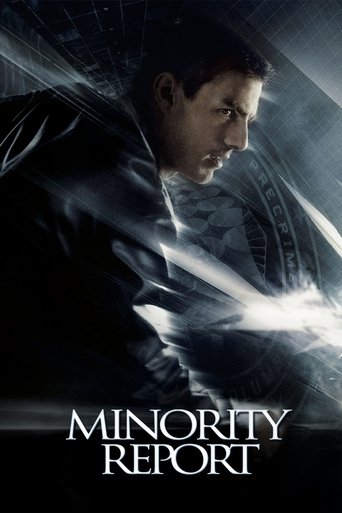
Minority Report
2002 · Film · 145 min
Directed by Steven Spielberg
John Anderton is a top 'Precrime' cop in the late-21st century, when technology can predict crimes before they're committed. But Anderton becomes the quarry when another investigator targets him for a murder charge.
33 positive37 negative1 mixed173 neutralfrom 244 commenters
Where to watch
No streaming data for this title.
271 comments on Hacker News
The CEO of Flock said his mission is to "completely eliminate and eradicate crime in America". I think I saw that movie, it was called Minority Report.
lol they made a movie about this called minority report.
TFA:
> We’ve seen this movie before.
...which one? 1984? The Terminator? The Truman Show? The Matrix? Minority Report? The Social Network?
Soon Geolocation will be tied to Age! Then you can meet locals and congratulate them on their birthday. The movie Minority Report was way too timid in its prediction here. Age up everything! \o/
So cops used AI to attempt to investigate a crime. But, there was no crime - the arrest was wrong. Why can cops excuse themselves here for delegating their responsibilities (protecting society, allegedly that is) onto software? AI may also be written by some corporations to "tweak" this or that, see this foreign-looking guy being more likely to be AI-investigated. This is like the movie Minority Report - but stupid. IMO the courts should conclude that cops should not be allowed to use AI without having a prior, independently verified objective reasoning for any investigation. This mass sniffing that is currently going on is very clearly illegal. The current orange guy does not care about the law; see flock cameras aka spy cameras employed by the government on all car drivers at all times.
This specific content scratches quite the itch for me; I was as taken with Westworld's interface design as with Minority Report, the usual go-to for speculative/prescient UI in film.
I wish they'd asked him about multimodal input, because there are several scenes where screens are simultaneously accepting voice and touch input.
Not just being interpreted in isolation, either. The touch information added context to the spoken query, and the response to the question appears on screen in close relation with the area indicated by touch. It's an incredibly efficient exchange of information, and I've never really stopped thinking about it.
What's more, it couldn't have been some neat detail the designer came up with in post. It's all fully-scripted. I would argue such impressive, specific technical elements have to be part of the storyteller's vision.
I don't even think I'd have the right to tear down anyone's list -- I actually think that even if an 22-year-old replied with a list of ten movies from 2016-2025 that he went to the cinema to see, and which he would be happy to recommend, that'd be enough for me!
I brought up this list: https://editorial.rottentomatoes.com/guide/essential-2000s-movies/ and scrolled through, and I think I saw at least half these movies either in the theater or as rentals, and most of the ones I saw I loved. Furthermore, I think at least a third are major contributors to the American cultural canon, both as being in the zeitgeist in the season of their initial release as well as being remembered going forward. For instance, people still today make references to "Mean Girls" or "The Dark Knight" or "Minority Report" that only fully make sense if you've seen those films or at least know they exist and their premises. And I think it would be pretty easy to make a list of 50-75 significant movies each from the 80s and 90s, but I'm focusing on ones during my adulthood to follow the spirit of your ask.
This is what I can't imagine finding ten of in the past decade. I'd be tempted to put "Barbie" on that list potentially, given how many memes I've seen using frames from it. Also, honestly, several Pixar films deserve to be on the list too, though I admit that I'm biased because they're some of the few that I've seen.
I think a lot about the scene in Minority Report where a machine scans the main character's eyes in order to serve him targeted Gap advertising. It is even funnier because I assume Gap paid for that product placement, with seemingly no awareness that the movie would depict the ad as dystopian.
AI advertising is far more terrifying than that. Imagine using everything that has been gleaned from a person's psychology to pressure them into purchasing certain products.
I wish people would get more thoughtful, because fascism is the last thing any of this is, it’s something brand new and way worse, something from some sci-fi story of a tech-dystopian ruling class with suffocating and smothering domination over the masses. I think you would have to mash together a couple different novels and movies to accurately capture what this is.
Just alone note that not a single tyrant of the past could have even dreamt of the power and control over society that even just currently exists, let alone what is in the pipeline.
Do you remember Minority Report? That seems to be approaching things, but even that did not include many things that even already exist. Frankly, I think authors and directors didn’t include many aspects of things, simply because audiences of the past would have probably not found it believable that even just current things existed, because how could they, it would seem so utterly crushing and depressive that it would break the suspense when you can’t see any prospect for survival/success.
The Hollywood movie Minority Report has a scene where an advertising display personalizes the ad by your name. https://www.youtube.com/watch?v=7bXJ_obaiYQ
>I like law and order
When it benefits me.
This guy gives all villain vibes you see in futuristic movies, funny how he resembles a young version of “Fletcher” in minority report movie, a movie about mass surveillance to provide a “safer community” to all.
Flock btw isn’t just an ALPR, it is a car finger printing technology, I have seen some videos of police IDing cars with no plates and they knew the owner by using flock cams.
I don't know if this is a joke, but Minority Report was a fictional movie.
There are 3 Precogs in the film, but in reality the female one is the most powerful and the twins seem to only function as amplifiers. It's revealed that there is sometimes/often a disagreement between their visions and that they do a 2/3 selection or something like that and discard the disagreeing vision (the 'minority report'). I believe this is what happened to the main character when he is framed, the stronger female's dissenting vision is ignored in favor of the two amplifiers. In the film it is ambiguous if he even commits the murder at all, the guy he kills was paid to die and more or less forces him to kill him in the struggle.
There's also the echos of visions that occur which is how the villain manages to get away with a murder, he uses his inside knowledge to copy cat another murder method which allows him to have it written off as an echo.
The wilder question in the movie is how the precogs are randomly created mutations in response to the mother taking a weird street drug during pregnancy. They'd have to dose pregnant women and hope they gave birth to more mutants if they ever want to replace the set they have, and I believe they're planning to roll it out nationwide. But given how crappy the precogs' lives seem to be maybe that is just a cost they consider worth paying.
Isn't Minority Report a documentary about why this doesn't work?
Remember the movie Minority Report? Where a central plot point was the main character being tracked (by their retina in that case), and how to defeat the tracking? Vibes.
> type one-handed without looking at the screen at all, and have perfect accuracy.
A computer that can predict what I'm going to write next with perfect accuracy? This is the stuff of dystopian science fiction.
Indeed, along these lines I recommend the movie Minority Report, which shows a society that gained the ability to predict crimes before they happened, and therefore to arrest criminals in advance.
NSPM-7 isn’t a license for thought policing. It’s an investigative strategy for identifying actual criminal activity within the bounds of existing law and oversight.
Referencing Minority Report is a false analogy that ignores the film’s real controversy, which was about punishing people for crimes that hadn’t happened, not investigating credible threats.
There are no new federal crimes being prosecuted that are tied to speech. Investigations still operate under existing law targeting criminal conduct, not expression.
You seem to think that monitoring rhetoric is inherently authoritarian, but it isn’t. Those markers are used to flag potential risks, not to criminalize beliefs. The strategy is about identifying when ideology begins translating into real-world violence, which is a basic and necessary function of law enforcement, not government overreach.
Probably a feature flag only accessible to government
(remembering that movie minority report where the self driving car traps the protagonist)
I'm fairly certain there is a scene in Minority Report just like this! Or at least, the advertisement says Tom Cruise's character's name.
https://en.wikipedia.org/wiki/Minority_Report_(film)
> ... because we are constantly recording and reporting everything that’s going on
Why stop just here? It's AI, right? So it’s all about prediction - next token, next action, it doesn’t matter. Let’s turn Minority Report the movie into reality: when you’re angry at your boss while commuting home, we will watch, predict and prevent your future bad behavior.
We're getting to the point where the thing making Minority report look unreasonable is that they had three (extremely drugged, troubled) humans making decisions as a consensus instead of just using an algorithm or a police officer's vibes. Nobody really doing these things today would slow down enough for that or risk someone having empathy and derailing the whole operation.
The last ten years have stuck out as a continuous loop of "this is so messed up it wouldn't be a believable/good movie plot".
I have always thought that futuristic police state movies and shows underestimate how oppressive a fully capable, automated surveillance apparatus could be.
Movies like Minority Report try to show the surveillance state as being a struggle to overcome, but it is still always too easy. Computers don’t get distracted, scale perfectly, and can run 24-7. You can’t just sneak away with your head down, because the machines would have tracked you into a place, would know exactly who is in every building, and would be able to associate the person exiting a building with the person who went in. They wont forget.
Minority Report is the film to look for exploring this idea. 2001 for the angle that the system is not under your control.
If data integrity is assured, and thus there is no change in the data to store/transfer, then that's the opposite of computationally transforming the data?
How do we see robot and AI and helping interactions in film and tv and games?
A curated list of films for consideration:
Mary Shelley's "Frankenstein" or "The Modern Prometheus" (1818), Metropolis (1927), I\, Robot (1940-1950; Three Laws of Robotics, robopsychology), Macy Conferences (1941-1960; Cybernetics), Tobor the Great (1954), Here Comes Tobor (1956), Jetsons' maid's name: Rosie (1962), Lost in Space (1965), 2001: A Space Odyssey (1968), THX 1138 (1971), Star Wars (1977), Terminator (1984), Driving Miss Daisy (1989), Edward Scissorhands (1990), Flubber (1997, 1961), Futurama (TV, 1999-), Star Wars: Phantom Menace (1999), The Iron Giant (1999), Bicentennial Man (1999), A.I. Artificial Intelligence (2001), Minority Report (2003), I\, Robot (2004), Team America: World Police (2004), Wall-E (2008), Iron Man (2008), Eagle Eye (2008), Moon (2009), Surrogates (2009), Tron: Legacy (2010), Hugo (2011), Django Unchained (2012), Her (2013), Transcendence (2014), Chappie (2015), Tomorrowland (2015), The Wild Robot (2016, 2024), Ghost in the Shell (2017),
Giant f robots: Gundam (1979), Transformers (TV: 1984-1987, 2007-), Voltron (1984-1985), MechWarrior (1989), Matrix II: Revolutions (2003), Avatar (2009, 2022, 2025), Pacific Rim (2013-), RoboCop (1987, 2014), Edge of Tomorrow (2014),
~AI vehicle: Herbie, The Love Bug (1968-), Knight Rider (TV, 1982-1986), Thunder in Paradise (TV, 1993-95), Heat Vision and Jack (1999), Transformers (2007), Bumblebee (2018)
Games: Portal (2007), LEGO Bricktales (2022), While True: learn() (2018), "NPC" Non-Player Character
Category:Films_about_artificial_intelligence : https://en.wikipedia.org/wiki/Category:Films_about_artificial_intelligence
List of artificial intelligence films: https://en.wikipedia.org/wiki/List_of_artificial_intelligence_films
Category:Films_about_robots: https://en.wikipedia.org/wiki/Category:Films_about_robots
Category:American_robot_films: https://en.wikipedia.org/wiki/Category:American_robot_films
This is not entirely right. Palantir is a company that pitches surveillance and AI everywhere in government. From their own product page, they want "AI-Powered automation for every decision." I think this is a poor idea in general but especially in policing and government. Palantir has been caught creating a "pre-crime" algorithm[0], because they seem to have thought Minority Report was an inspiring movie. You can read a former Palantir employee talk about all of the delightfully fun stuff they get involved in like using AI in autonomous warfare[2].
On top of that I have a severe distaste for the founders. Peter Thiel is a psycho who, among other things, is a big fan of Curtis Yarvin and wants to bring monarchy to the US. Creator of smash hits like "I no longer think freedom and democracy are compatible."[1] You may be familiar with his protege, JD Vance. I wouldn't want this person running a police state company. Do not mistake Palantir as Tableau but for government.
[0] https://www.theverge.com/2018/2/27/17054740/palantir-predictive-policing-tool-new-orleans-nopd
[1] https://www.politico.com/magazine/story/2016/11/donald-trump-steve-bannon-peter-thiel-214490/
[2] https://zigguratmag.substack.com/p/the-guernica-of-ai-c4b?triedRedirect=true
Might as well call it PreCrime just like in Minority Report
https://m.imdb.com/title/tt0181689
Luckily Minority Report belongs to the fictional movies category. But I also think that this type of technology - if properly used - can prevent actual crimes. Scary? Of course.
Yes. As shown in the movie Minority Report, this will surely be flawless in preventing all future crime.
I doubt there was a direct inspiration in either direction beside contributing to overall pool of ideas around wearable input devices. Only commonality I see is that they are both handheld/glove like computer input devices. Nerds and sci-fi authors have been dreaming about stuff like that since the beginning of personal computers in ~1970s-1980s if not earlier. There are plenty of other examples which could have been inspiration. Even the 2000 patent, references dozen older patents for handheld or glove like input devices some of which are much closer to the 2006 movie.
Looking at the history of wearable electronics can't forget about Steve Mann and all his crazy prototypes long before 2000.
Most well known movie examples are probably Minority report(2002) and The Wizard(1989) which showed Nintendo power glove.
The day when a portable device like this becomes mandatory will be the realization of the film "Minority Report" - but instead of two "precogs" snitching on you, you'll be snitching on yourself!
Remember: scifi can dream up of horrible dystopias (Black Mirror style) and real-world entrepreneurs will go "hey, that's a neat idea!".
There's a Philip Dick short story where ads are forcefully pushed into your brain (they kind of put that bit in the movie adaptation of "Minority Report", though it was another short story that had brain ads)... you can be sure that in the real world, if they could they would.
If there is a theoretical way to jam your brain to prevent it from seeing DRM'ed stuff, you bet they will make it real and close the analog loophole for good.
This comment of mine is light, so don't take it too seriously, but I'm reminded that the factory in the film Minority Report (2002) has no people in it. It is entirely automated.
I remember when Minority Report came out how many people got sucked in by the Tom Cruise and the Max von Sidow vibes, the Oscar-winning histrionics of the imperiled character, or the sexy special effects and completely missed the subtext around all of this. That everywhere you went, They knew who you are and what you do.
I was shocked that people I talked to didn't notice that every vertical surface in the mall had advertisements on it. Asking his new eyeballs if he needed more khakis? Did we not watch the same movie?
I think the movie Minority Report had a really cool concept of a sort of "semi-suspended" railway: The machinery that connected to the rails could rotate all around the train car, so depending on the environment, the tracks could go below the car, above the car, or even beside the car, which would allow it to use sheer walls as "ramps".
I'm not sure if something like this would in any way be physically feasible, but if yes, it might solve the cost problem, because part of the rails could then be run on the ground.
(Maybe a less sci-fi version would be a "hybrid" car that has a second set of wheels on the underside and could switch between ordinary and overhead rails as needed?)
Sci-fi portrayals are as quaint as those pictures in 1900 of everyone flying around in 100 years, rather than being glued to their smartphones: https://www.reddit.com/r/Damnthatsinteresting/comments/12b4wxd/this_is_what_people_in_the_1900s_thought_that_the/
Minority Report was meticulously researched, for example, but it had physical disks moved around (movement) and the guy's security credentials weren't rotated, and he was able to get into a lot of places, like his former place to steal the precog etc.
Data from Star Trek, or "the Computer" are quaint. Data is just one Android while you can easily download AI models to unlimited machines and robots. And "the Computer" speaks like a ro-bot but the movie "Her" is much more like what AI is becoming. The Holodeck might be closer.
Here is what a realistic movie of our future would look like:
It would be super boring. Nothing would move. Every crime would be solved efficiently or not even allowed to occur. Effectively digital ID for everyone/thing. Security is tight, no advancing the plot Cameras everywhere, cheap and plentiful AI correlates all the sightings Mass surveillance (cheap) of online comms and quick extrapolation of every scheme. Any scheme is thwarted before it happens Robots everywhere, doing all work Robots spying on everyone in their home Humans produce less than 1% of content Humans earn less than 1% of money Humans become irrelevant to the economy Knowledge and algorithms easily replicated Robots can download new software over the air No sense of identity of self preservation Just commoditization of all skills (2030) Probably no interest in anything, since every bot knows everything, and has no self-preservation instinct or sense of self except just to simulate it, for humans, until humans become economically irrelevant. About the only threat, in this system (and it's a serious one) is that the cost for producing bot swarms with malicious intents, that anyone with few resources could release a bot swarm to work at scale across multiple platforms, amassing gameable metrics such as karma / clout / reputation, as sleeper cells, gradually shifting discussions. They would dominate 99% of the content everywhere, turning the Internet and the entire world into a Dark Forest. Anyone who shows up would be exploited over time, because it's cheap and easy:
https://ystrickler.medium.com/the-dark-forest-theory-of-the-internet-7dc3e68a7cb1
In the short term (i.e. by 2030) bots will have infiltrated every platform and social network, even those which might try to close themselves off, because their existing users would run bots in their accounts to gain an advantage, until being "just yourself" un-augmented would get you poor results. Since there is no way to tell if someone is human or not (just as if you'd use rybka chess program for one move every 10 or so), people would just default to "being enhanced" or "having assistants".
Swarms of agents / bots / robots are the thing to look out for. They can coordinate at scale, execute long term plans relentlessly and imperceptibly and never forget what they're going after. (And when swarming can be perfected in the real world, you might get this: https://www.youtube.com/watch?v=O-2tpwW0kmU)
So yeah, sci-fi movies can be exciting, but in a "terminator" way where malicious destruction is the default, and only because the cost is so cheap to wreak havoc at scale.
In any case, the idea that you'd need "armor" or even try to explore the universe yourself, is laughable. Bots and drones will be built to fight wars, explore space, etc. A lot of von neumann probes, etc. They can build an entire "civilization" of terraforming planets over thousands of years, but they wouldn't need oxygen etc etc. Out in space, they might have an actual purpose and plan that is very different from humans. But for humans to go travel there would probably be very unlikely, many people (like Rogan) don't even believe humans could have survived the trip to our own moon, due to space radiation.
The post mentions several times how it's both costly for adopter to add infrastructure to support robots but also how other forces can make that infra already there e.g. how it costs money to install wifi in a warehouse but handheld scanners led to wifi being in them anyway (which was great for the robots too).
This reminded me of a quote about the future of automated driving (paraphrasing):
"We currently consider the following to be distinct and very different modes of transportation:
- car
- elevator
- train
At some point, those will all converge into a vehicle that can travel on roads (like a car), with other vehicles (like a train) and bring you up to a building floor (live an elevator)."
This seemed somewhat true to me until I considered two things:
1. The smart phone did something similar with a phone, television, computer etc
2. There is a scene in the movie Minority Report that does exactly what the author of the original quote described. [0]
The combination of another convergence device AND a fictional visual of what that convergent device would like really hammered home what the future might look like.
0 - https://www.youtube.com/watch?v=Vrxyr1CjiSM
If you consider people openly planning crimes to be decent evidence for future crimes (and the US legislative and court system certainly does) the US government has been doing this since before Minority Report was released on film. Hell, isn't this essentially what Palantir does? Sure maybe it's not referred to as "AI" but it's certainly a form of partially-automated mass-surveillance with the intent of empowering state agencies to make arrests.
Minority Report style UIs look good in movies. Use them 8 hours per day every day and they're just tiring.
The functionality is obviously similar to the film Her, I don't understand how this is supposed to be the slam dunk evidence against OpenAI.
When Kinect (remember that lol) was being released people compared it to minority report on stage. Does that mean Tom Cruise should have sued Microsoft?
Right, but we have to acknowledge that while some of us watched Minority Report as a cautionary tale, others clearly see it as a blueprint :)
We can have a meaningful discussion of CBT and which way exposure leans; but I'll put in my vote for us to be a society that punishes actions that harm others, not the thoughts and preferences that may or may not one day lead to any actual actions that may harm others.
It is easy to point out just... an enormous library of movies and video games that use some form of violence. I have a 5 year old kid and already have to explain to him that even the cartoon violence he's inevitably exposed to does not mean that violence is OK in real life. But while I may as a parent try hard to guide and even limit what he's exposed to when, I am nowhere near the point where I lobby to illegilize such violence... LET ALONE JAIL SOMEBODY FOR WATCHING A SCHWARZENEGGER MOVIE! I will absolutely be seemingly unfair and ask - if we feel strongly that watching CSAM will lead to action, what about violent movies, and present a duality of options - is the next step criminalizing violent movies, or are we in a double-standard guided by something other than seemingly scientific studies of exposure?
(gawd, I hate to even appear to be in a place to even seems to be anywhere near condoning even AI generated CP; I cannot underline enough how much that's not my kink! but I am also genuinely terrified by the seemingly rational-presenting suggestions that "bad thoughts lead to bad actions so we need to outlaw bad thoughts" - there's just too much gnarly catholic dogma disguised in 'cognitive therapy angle' in there for my level of comfort :O )
One man's legitimate is other's nefarious. One man's good is other's bad.
Who decides this? Can we apply laws to thoughts or plans? Should we fund research for making Minority Report a reality or increase "proactive policing"?
How to keep people safe while letting all information free? Can we educate everybody about good/bad, legitimate/nefarious so everybody stays on the same page forever? Shall we instrument this education with drugs to keep people in line like the movie Equilibrium?
Questions, questions...
It's a "pre-crime"!
Who knew the movie Minority Report would come true.
I've always thought of it as the Minority Report fallacy. It looks cool to see someone in a movie wave their arms around to control a computer. People ask all the time why we don't have that yet. They don't stop to think that their arms would get tired quickly and that resting arms on a table, having the tactile feedback of a keyboard and mouse, there's a reason we've stuck with those. People see something that looks cool on the surface and don't substantively think it through.
Does anybody remember that movie Minority Report with Tom Cruise?
Eye transplants were available in that realist dys/utopian future.
From Wikipedia…
> Popular films based on his works include Blade Runner (1982), Total Recall (adapted twice: in 1990 and in 2012), Screamers (1995), Minority Report (2002), A Scanner Darkly (2006), The Adjustment Bureau (2011), and Radio Free Albemuth (2010).
If you’ve not heard of P.K. Dick before it’s kind of weird to be worried about “is this a talented artist”… you really need to push your boundaries in any way possible.
Isn't "preventative" punishment basically the plot of Minority Report (story and movie)?
The problem is that, even if it worked, I wouldn't want to live in a world where people are punished or executed before they actually do anything wrong. In a sense, I think it's valid to "throw in the towel" and claim: if this is what it takes to minimize suffering, I don't want anything to do with it; to hell with it.
Check out a great sci-fi movie named Gattaca.
Remember that you shed cells everywhere you go, so soon the tech will be advanced enough where we can do nearly real-time DNA matching. If you sneeze, a sniffer could pick that up and figure out who you are.
Imagine a camera that films not things that are visible, but people who were there, at that protest, in that store, in that hospital, boarding that plane. It's practically irrefutable (or currently legally is, even though it's inherently flawed.)
And you can never change that identifier. Once that data is out, it's out.
The last headline in that article, "Solving Crime Before It Happens" could have easily been entitled "Minority Report" (another great sci-fi movie that's not so fictitious anymore.)
It is a really big country and there's very little that can stop something like this from happening upfront. A corrupt person is always going to make it some distance before they're stopped, before the corrupt action gets enough sunlight on it. Said corrupt person isn't going to always make it easy to spot/stop, or easy to prosecute.
You have to prosecute and pursue justice after the crime/s, not before. Justice is rarely a fast event. It's identical to someone walking into a convenience store and robbing it. You can't literally stop that from happening, you have to have a justice system that will prosecute crime. There are of course no precogs yet (Minority Report [0]).
What happens next is far more important than that it happened.
> If this is allowed to pass without the people ordering the raid fired, I am not optimistic about what the future holds.
Given the scale of the US, that's overly dramatic for sure. All sorts of bad things - far worse than this - happen on a small level in the US across the states, that have practically no impact on the wider nation.
[0] https://www.imdb.com/title/tt0181689/
People don't want folding. Folding is the cost paid to get something they do want: a larger screen. What do people actually want in a handheld? They want that roll-out multi-size screen from Earth: Final Conflict.
OK, that was 1997, and it's been done better since then (Minority Report and others...: [1]). But people want the big screen with a tiny carry.
[1]: https://www.theverge.com/2018/11/14/18088620/samsung-foldable-phone-science-fiction-movies-television-westworld-star-trek
We are quickly headed toward the dystopia exhibited in the movie minority report. Actually we're already there for the most part.
Unfortunately, it turns out that waving your hands in the air for long periods of time is exhausting. UIs that look great in movies sometimes aren't practical in real life.
https://odannyboy.medium.com/why-you-want-but-wont-like-a-minority-report-style-interface-626d0fd6096b
Oh, 100%. The interfaces in Minority Report were spectacular in terms of cinematic movie appeal.
Artistically it was a great choice, and they certainly weren't intending to inspire a bunch of wrong-thinking UI choices in the real world.
But it does put an enormous amount of pressure on the eye tracking. As far as I can tell so far, the role of precise 2D control has been shifted to the eyes.
I've got one good eye and one bad eye. The bad eye is legally blind, has an off-center iris and is kind of lazy w.r.t. tracking.
I'm extremely curious to know how Vision Pro deals with this. One certainly hopes there's some kind of "single eye" mode; certainly seems possible with relatively small effort and the % of the population who'd benefit seems fairly significant.
Eye tracking most certainly sounds like the way to go, relative to hand-waving.
The Minority Report movie probably set the industry back by a decade or two. Waving your hands around to control stuff seems logical but is quickly exhausting.
In the Spielberg film "Minority Report" when their leader gets precognitively flagged as being a murderer the PreCrime team goes on the chase. As they are staging to capture him, they say "Only bind foam and sick sticks"--i.e, non-lethals. Sick sticks were explored in the film: an electroconvulsive emetic, like a "vomit taser". Pretty cool.
Bind foam was not explored. Presumably, it's like "expanding foam", and you point it at someone, and spray them and they get "bound". Could be good to call Spielberg and see what he thinks of your glue idea.
Minority Report did extensive workshopping and brainstorming with futurists and scientists to come up with plausible future tech. Maybe the precogs saw something in you and your SF-exodus glue-taser idea?
First some that I don't see mentioned here yet:
Edge of Tomorrow (2014)
Limitless (2011)
Looper (2012)
Upgrade (2018)
Source Code (2011)
District 9 (2009)
Black Mirror S3E2: "Playtest", S4E1: "USS Callister"
The 7 minute YouTube video "Slaughterbots"[1]
The YouTube series The Backrooms[2]
If you are worried about your son hearing swear words and seeing blood, and not just whether or not he will be able to understand/appreciate the movie, then you probably want to wait with a couple of those.
And then I would also agree with those here that mention Inception, Interstellar, Back to the Future, The Martian, Men in Black, Minority Report, The Terminator, Terminator 2, and The Expanse. I also don't think he should have much of a problem following along with The Matrix.
[1]: https://youtu.be/O-2tpwW0kmU [2]: https://youtube.com/playlist?list=PLVAh-MgDVqvDUEq6qDXqORBioE4Yhol_z
I get the sense that you would like some adult themes, but not too slow?
Top of my mind (and in no specific order) would be:
- Dark City
- The Thirteenth Floor
- City of the Lost Children
- Tron (original and maybe new one)
- Interstellar
- Inception
- A Clockwork Orange
- Her (very relevant to our times)
- Dune (2021 version)
- Brazil
- The Martian
- Children of Men
- Edge of Tomorrow (most like Marvelverse on this list but still very good)
- Moon
- Twelve Monkeys
- Upgrade
- The Fifth Element
- Contact
- Okja
- District 9
- Predestination (very relevant to our times)
- Serenity (but might need some prep from the tv show before watching)
- World on a Wire
- The Abyss
- Minority Report (very relevant in our times)
- The Fly
- Videodrome
- Equilibrium
- Strange Days
- The Andromeda Strain (relevant after Covid)
- eXistenZ (trippy but I loved it when it came out and was only around your sons age)
- In Time (interesting class dynamics on display)
- Enemy Mine
- Franklyn (some interesting takes on mental illness)
- The Arrival
Remember the computer scene from the film Minority Report?
The same as for the credit card payments you just mentioned (which ARE insecure and naively rely on store clerks not copying your 3 digit number etc).
ANY biometrics you use to pay can be easily replayed. Whatever function you derive from these biometrics can be executed when you’re not there.
Not to mention that the biometrics themselves can be emulated by a device (eg voice recording) as you see in sci-movies like Minority Report (fake eyes) or that star trek clip.
Sure, for smaller amounts and using copious amounts of “seller beware” chargeback protections, the system can work. And those chargebacks can be good for many things, so that is how our financial system works now.
But if you want to secure thing that are valuable, like elections and many others, then what I described is the optimal solution.
This concept was explored in a stephen spielberg movie. Minority report. Good movie. Watch it. Stars Tom Cruise and has mission impossible vibes.
In the end the government cancelled the program because of free will. A person always has the choice to change his actions because his actions aren't predetermined.
The only problem with Minority Report (aside from torturing the precogs, I mean) was treating the prevented murder as a crime and punishing it. If they had just used it as an intervention tool ... well, there'd be no movie.
Sounds like Minority Report. Great movie btw.
I find his short stories to be quite good -- if not a bit repetitive if read in bulk. His paranoia and the bleakness of post nuclear war are overwhelming after a while.
Quite a lot of his stories have been made into movies, for better or worse. They seem to be enough of a chunk to hang a story on, without getting too much in the way of telling a good story.
Minority Report -- much better in the story. We Can Remember it for You Wholesale -- both worked.
I'm sure there are, but do we want there to be?
https://en.wikipedia.org/wiki/Minority_Report_(film)
architecture
Specifically, what about it?
It's easy for me to imagine architects spinning models around Minority Report style with their hands, going on virtual walkthroughs, etc with VR apps.
It's less clear to me that these would actually improve the process. I realize that a 2D projection of a 3D object is always going to be a bit of a compromise, but are today's 2D interfaces and displays actually holding things back?
I'm thinking of the wave of "Minority Report" style interfaces that were proposed after that movie came out. They seemed to "obviously" be the future. But after a while everybody realized that moving a few cm on a mouse/trackpad was actually orders of magnitude more efficient than waving your arms around like a maniac for ten hours a day.
> plus the risk of randomly being flagged
This is 100% going to happen, so my guess is it can’t be authoritative. It’s likely to be used to whittle down a list so that humans can review the results.
Feels like the beginning of a hybrid Minority Report + Enemy of the State movie. I’d watch that. I don’t want to live in that world, though.
I did exactly the same thing and had a similar experience.
I think this is broadly applicable to most, probably all stylized movie user interfaces. Minority Report, Tron and Star Trek come to mind. They look really cool on the big screen and are inspiring but once you get home and try to actually use something like it in real life for something productive and it's an impediment more than an inspiration.
Yeah, the viewer paradox.
I want something new but don't change anything.
The point is, before the Disney movie, there were people who wanted an animated version of the original story, and Disney totally botched that especially the ending. Similar to Spielberg and Minority Report
https://www.theatlantic.com/culture/archive/2022/06/minority-report-spielberg-movie-tom-cruise/661274/
> But Minority Report, though it was written and filmed before 9/11, might be Spielberg’s most prescient work of all. Tasked with predicting our near future, he imagined an America filled with dazzling inventions but rotting from the inside out, one in which the erosion of civil liberties is thinly veiled by chest-thumping braggadocio about technology’s power to solve every problem. Spielberg's eye-scanning cameras and autocratic cops could easily be exchanged with the overreach of the PATRIOT Act, or the NSA listening in to casual conversations. The film’s warning is one the world is only beginning to heed. We may not have precogs dreaming of murders in police precincts, but so much beloved technology of today is just as effective at watching and constricting our lives.
Minority Report was supposed to be fictional, not a documentary.
Straight from the Minority Report 2002 movie. Add a beamforming loudspeaker array for personalized audio and that's it: https://www.youtube.com/watch?v=uiDMlFycNrw
So you're quite a fan of that Minority Report movie?
We should just arrest everyone and put us all in home detention, then we'll never have crime! That's a big win, right?
And we'll be monitoring the Politicians and Police with this too right?
I generally like The Atlantic, and Minority Report is one of my favorite movies. I've always wanted to read the "2054 bible" they created for it. But this article is pretty weak. There's not much substance to it. The article basically just describes some technology in the film and then concludes with "we're not there yet, but smartphones are inching us towards this future". I'd recommend actually just watching the movie and coming to your own conclusions.
Sure, but the endpoint is itself strong enough to sustain a direct attack?
Would a kill-chip in the neck (cfr Nikita and something other series) be better then?
Or even better (cfr Hanna TV series) with the exceptional profiling and overpopulation directly hit all potential shooters following minority report, sorry, the hyper-score?
> Mass shooters don't hide their intentions
So what was the Vegas mass shooting about then? That guy was basically a totally private individual (I think there's only like 4 publicized photos of him) and his motive was apparently a total mystery to this day.
PS: From a rights perspective, Red Flag legislation definitely feels like it can be abused. To give an example that most people are probably familiar with: think of the Department of Pre-Crime from the movie Minority Report. This is basically what we're doing with Red Flag legislation: taking somebody's rights because we suspect they might commit a crime. I can easily see how it can be abused. Presumption of innocence before guilt and the right to due process by a jury of peers is not something that should be casually given up.
There was a movie called Minority Report that had a similar premise. Basically they would detect murders before they happened and arrest people moments before the murder took place. At the time of the arrest the potential killer had motive and intent, so that’s how they justified it.
https://en.wikipedia.org/wiki/Minority_Report_(film)?wprov=sfti1
Minority Report is 20 years old this year.
https://en.m.wikipedia.org/wiki/Minority_Report_(film)
It’s about time we made some forward progress on gesture interfaces.
Commercial supersonic flight, bullet trains coming to America, nuclear power, solar power, Skylab, Space Shuttle, traveling to Mars.
Growing up with Star Wars, Star Trek, Battlestar Galactica,…
The future sure looked exciting in the 1970’s.
Consider Minority Report is now 20 years old.
https://en.m.wikipedia.org/wiki/Minority_Report_(film)
In 1947 humans broke the sound barrier, and 22 years later we were on the moon.
We took a wrong turn somewhere.
I still have my IR light-pen somewhere that I bought for his Wii Whiteboard app[1]. This was just a few years after the Minority Report movie, and multi-touch was still something that felt super sci-fi to me at the time. Seeing it come alive with just a wiimote and an IR pen was neat.
1. http://johnnylee.net/projects/wii/
There is a cheesy movie from Tom Cruise, Minority Report, whomever takes those displays to market, finds a scalable profitable way to produce them, finds enough courage to resist status quo and find massive product market fit, will be the next Jobs or Musk. Idea wise, everything literally was on either Star Trek or on Star Wars previously. I know these personalities are not exactly likeable but we'll keep this conversation for the next simulation of the universe with different parameters...
Stallone movies don’t apply. Minority Report is the future mixed with Robocop.
I remember watching Minority report again last year and being really surprised watching this scene!! I was like that looks like my research project but this movie is 20 years old???
So what if they find that you used a phone?
They still had to somehow link your online identity to your phone. And how would they do that? The phone is simply a computer that you use, through VPNs, to send and reveive mail and post messages to groups etc. They’d have to approach ProtonMail, then your VPNs in order, and then get security footage from the place where you were accessing the VPN at that time. And then cross-reference your gait etc. to a database. Maybe in 10 years they would have such coordination, and we will need better tactics.
What’s far more interesting is what to do if VPNs are banned in a country. You can’t be using one there. You’d have to have set up anonymous hosting and port forward stuff yourself.
Again, it’s possible that all anonymous hosting, VPN etc. is shut down and requires KYC by say 2050. That is why you must bootstrap from what are valid but essentially “compromised* accounts now while you still can, and hope they are grandfathered into the new totalitarian surveillance system. Buying phones on craigslist is one example.
Another example is those eyes Anderton installs in Minority Report, but security in that movie is like a bad joke, IRL he’d be outed instantly by his gait, heart patterns via wifi and so on. In fact they didnt even change the access keys after he ran LMAO
Another prediction that Minority Report got absolutely right. I would give anything to read the 2054 Bible the creators made for that movie, as they clearly had some prescient minds.
Some of these effects might be useful in a presentation. For instance, if your windows break apart into small shards of shiny glass (making a slight noise when doing so) and then disappear, it might be engaging. This sort of thing is common in films like Minority Report.
The real gripe I have with the film is how they managed to totally misunderstand and butcher Baudrillard’s concept of the simulacra, while saying that it was one of their inspirations. Baudrillard wasn’t saying that the problem with current postmodern society was that the copy (the simulation) masks the real and therefore the copy should be destroyed to reveal the original (basically a Platonial ideal), the fundamental problem is that the copy masks the fact that there is no “real”. Reality has already disappeared in the way of the hyperreal, and the old Platonic distinction between “real” and “fake” became obsolete. Baudrillard speaks about the Matrix that
“Yes, but already there have been other films that treat the growing indistinction between the real and the virtual: The Truman Show, Minority Report, or even Mulholland Drive, the masterpiece of David Lynch. The Matrix’s value is chiefly as a synthesis of all that. But there the set-up is cruder and does not truly evoke the problem. The actors are in the matrix, that is, in the digitized system of things; or, they are radically outside it, such as in Zion, the city of resistors. But what would be interesting is to show what happens when these two worlds collide. The most embarrassing part of the film is that the new problem posed by simulation is confused with its classical, Platonic treatment. This is a serious flaw. The radical illusion of the world is a problem faced by all great cultures, which they have solved through art and symbolization. What we have invented, in order to support this suffering, is a simulated real, which henceforth supplants the real and is its final solution, a virtual universe from which everything dangerous and negative has been expelled. And The Matrix is undeniably part of that. Everything belonging to the order of dream, utopia and phantasm is given expression, “realized.” We are in the uncut transparency. The Matrix is surely the kind of film about the matrix that the matrix would have been able to produce.”
As a retaliation Lana Wakowski said,
“This is why, no one really mentions this, but everyone's like "'Simulacra' as in Baudrillard, you are referencing Baudrillard!", but the point of the reference is that the book is hollow! It is itself a Matrix! It is itself a construction, a projection, a tool for understanding the world, having a framework of meaning, that's what these things are, they are frameworks of meaning. So what we were trying to do was, can you encourage audiences to interrogate their own framework of meaning, and then through that interrogation, extend it into the experience of watching a piece of art, and then try to find meaning into that piece of art, in the same way that Neo has to go through that journey ..."
which is some bullshit nonsense that not only undermines the effectiveness of their work, but vulgarly defaces the work of Baudrillard (along with misleading the public to think that postmodernism = “anything goes”, further leading to some weird reactionary figures to blurt against it)
I believe this, because of how successful TT was w infinite scroll, auto-play.
RE: Vanilla Sky
There are interesting moments to that film, (like the holographic jazz player at the fancy party) but it isn't worth sitting for to see Cruise if you haven’t already seen Top Gun, Mission Impossible, Day After Tomorrow and Minority Report.
Just because it looks cool in a movie does not mean it's a practical interface for everyday use. That Minority Report scene just screams "gorilla arm". I get shoulder cramps looking at it.
Enemy Of The State is for me the canonical conspiracy theory action movie.
A conspiracy theory dynamic was shoehorned into the Minority Report movie (the short story is very different).
Hydra stuff in recent MCU comes to mind.
Predator is an interesting inversion in that, while there is a bit of CIA backstabbing, the real conspiracy relevant to the conjecture above is actually "our heroes", who are eliminated by the single antagonist until the climactic fight. I guess that's kind of a horror thing, though?
The article says that the LAPD is also using "Media Sonar" (https://mediasonar.com/) to provide basically Minority Report style "pre-crime" data. I guess it shouldn't be surprising that LA is most influenced by one of its own movies.
You arrest people before they can commit the offence.
I think there was a documentary about this a few years ago called Minority Report.
Even the value proposition is unclear. A simple mechanical light switch Just Works (TM). It's cheap, reliable, and nearly universally understood. Adding network connectivity, scheduling, voice recognition, etc. to these things sounds cool, but that novelty wears off very quickly, and you're stuck with features that probably won't matter to you day-to-day.
It reminds me of those 3D user interfaces in the movie Minority Report. Very cool-looking and futuristic. Who wouldn't want that? The answer is anyone whose arms would be tired after a couple minutes of flailing around like that. Stop making things overly complicated for the sake of marketing copy.
Didn't system in Minority Report worked absolutely amazing except several edge cases by super rich who would easily get away with murder in current society anyway? I know movie is used as an example of something very bad, but why, never got it.
Thought-provoking questions! For me, ad-tech creates a few interrelated concerns:
1. Pervasive, asymmetric surveillance increases the power differential between individuals and big corps/governments. The latter groups can use that power to preempt healthy competition, causing individual quality of life to stagnate in a local maximum.
2. Ads themselves are attention hijacking, thought injection, and manipulation/coercion—all forms of mind control. Most people consider their mind central to who they are (often along with body, memories, and personality), it's wrong to mess with that non-consensually. (No, clicking "accept ToS" isn't consent.)
3. Centralizing surveillance data (as by companies and governments) prevents the surveilled from protecting their own vulnerabilities from bad actors. It's like passwords: you can invest in memorizing many strong ones, or re-use one that's written on a post-it on your desk, but since in this metaphor the surveillants are also storing your password in plaintext in paper filing cabinets, so it doesn't matter how much effort you put into protecting your passwords. Put another way, if the Coke recipe or a Boeing blueprint were leaked, it's the company's loss, so they work hard to protect their secrets. But if someone hacks a consumer company's user data, it's the users who are affected; if it weren't for regulatory fines and news exposés, companies wouldn't even be hurt by such breaches.
As for the end-game goals: Companies surveil and advertise because they're allowed to and it works.
We see futuristic attention hijacking tech in sci-fi films and TV, like giant holograms [Blade Runner], ads that address each individual [Minority Report], or ads that stop until you're paying attention again [Black Mirror]. But it's less common to see futuristic attention protection tech. (That makes sense if you consider the funding source of these sci-fi productions.) Black Mirror did have one episode where a person was exiled from everyone else's senses, but I can't think of others.
[It works] The individual's goal could be total control over perception of the world. As a natural-born human, you can easily close your eyes, but your other senses are harder to dampen, and so provide vectors for involuntary thought injection (ads). Now with widespread earbud use, you can sort of close your ears too. But imagine installing an ad-blocker so your senses just didn't report ads, or your brain didn't perceive them? As with many technologies, it'd be quite dystopian if centrally controlled, quite freeing if under individual control. Even more fantastical would be the ability to experience but be unaffected by stimuli (including ads), which might not even be a technology exactly.
[They're allowed] The other goal could be simply to use our collective power (i.e. government) to more strictly regulate—or even ban—surveillance and advertising (and enforce it!). While this always possible, I'm afraid it's no longer realistic in U.S., though other countries could still pull it off, as could whatever government eventually replaces the American one.
Lastly, what if nothing were free? Part of the problem is that the difference between $0 and $1 is much, much larger than from $1 to $2, i.e. free is a way better price than even dirt cheap (or sometimes even being paid). Tech start-ups are especially guilty abusing the marketing power of "free" in combination with unsustainable infusions of venture capital, which is dishonest if not somewhat fraudulent. Business would survive the removal of tactics like "free + ads" and "loss leaders".
This reminds me of a random, but chilling, scene in "Minority Report". The protagonist confronts a man he thinks is responsible for killing his child.
The man decides to reassure the protagonist by explaining how kind he was to the child, and made sure the child didn't suffer when he killed him. He's presenting it as though this is a legitimate defense for such an obvious violation. The part that sticks with me is the man's seeming sincerity in believing he's making a case for himself, "yeah I did this horrible thing, but I did it in the nicest way possible so it's really kinda big of me if you think about it"
This post fills me with the same chills. The author's utter lack of culpability for such a viscerally gross violation and strange attempts to spin it as though he's kind of a good person for doing it in a slightly less terrible way than he could have otherwise done it...
To be clear, he didn't go out and do a security research project with ethical standards in place. He made it clear how laughable he considers the concept of 'consent' (an ethical way to do this might've been to take people's pictures, then ask them if they were OK with sharing it right after. He doesn't consider such a process at all)
Instead, he thought of an amoral and illegal way for him to use people without their consent, for his own pleasure, curiosity, and amusement and decided to call it 'art'. There are more horrible ways he could have done the above, sure. But that argument to me sounds as hollow as the "but he didn't suffer" argument from the movie.
Him expressing his own sense of magnanimousness and ironic sense of victimhood at the end of it... it really is a scary glimpse into the mind of such people.
It's sad because it's very easy to misconstrue this as a "security researcher gets feds sent on him by apple" story, and I think lots of people are basically trying to frame it that way, but it's not that at all. To me, it's clearly "jackass doesn't understand consent, apple calls the feds, still a jackass, still doesn't understand".
[Note: yes I know the character in the movie is revealed as a bluff shortly after, the scene sticks with me because of the character's apparent sincerity at the moment]
[Additional Note: yes I know many of these companies also don't respect consent. Them not respecting it is not an excuse for everyone to behave the same way.]
This certainly takes me back. I was a wee teen in the late '90s, but I too remember so many commercials and movies that represented the Internet as a new paradigm for visually-oriented computing. Not really skeumorphic designs of file folders and desktops and 'My Briefcase' icons.
I still think about that GUI Tom Cruise navigates in Minority Report. The film is almost 20 years old, and yet GUI design today seems to be focused on hiding more and more elements, instead of making the canvas bigger to display more info.
re: “self-sustaining platform” for VR development
I pay for the VR apps, that is not self-sustaining? This is like ads in the movie Minority Report - yuck.
The Quest 2 is a marvel. My first VR headset and I have found so many ah-ha moments. Facebook reportedly has 20% of the company working on VR and AR, 10,000 employees. They are all in.
Key moments I've had:
When it's on you're head, your mentally there. The immersive impact is immediate and strong enough that you'll bash your lamp off the table and not even care. It's the end game of what every home theater, hi-fi audio system, high end gaming setup is trying to do, just done immediately and with no buy-in needed on your side.
Fitness is already a killer app. Get into a boxing match and your body will react like you are in an actual fight. You'll go so hard you can easily hurt yourself. No motivation needed on your end.
Social interactions are close enough to real life that you treat people like humans instead of Twitter ragers. Once face and eye tracking are added, it will quickly top video conferencing as the most personal way to communicate at a distance.
Media consumption is awesome. A movie theater in a box, complete with digital popcorn.
Productivity and apps have interesting potential. With hand tracking and multiple wall sized screens, it's already tantalizing close to the computers in Minority Report.
Gaming is extremely compelling. The immersion means instant fun. Play table tennis and you might forget it's not the real thing.
Experiences. Stand on Mars. Go to a foreign city. Get on a roller coaster when you are deathly afraid. Stand on top of a mountain you could never climb. The "thereness" will mean you have experienced it in an important way.
This seems like a product category that will have some impressive developments over the next 10 years. In its best moments, it is as compelling as the Star Trek Holodeck.
I'm always amazed at how many people watch movies/TV like Blade Runner, Black Mirror, Terminator, Altered Carbon, Her, Ex Machina, Firefly, Cowbow Bebop, etc and think "Yeah, that looks like a future I want." Dystopian Sci-Fi is a warning, not a blueprint. Even the utopian Sci-Fis often reference a struggled past in transitioning to their societies. And a lot of these problems have to deal with surveillance or an adjacent technology (like Minority Report or the more realistic Psycho-Pass).
I strongly recommend reading Ubik. To me it is his strongest and most consistently good book.
I used to love The Three Stigmata too, but when I tried to read it again recently I couldn't get in to it either. I do think you have to be in the right mood to savor a Dick book, so maybe I was in the wrong mood that time.
The other first-tier PKD book for me is Martian Time-Slip.
Second-tier PKD books for me are VALIS and Galactic Pot Healer.
Third-tier are Maze of Death, Eye in the Sky, and Divine Invasion (the 2nd in the VALIS trilogy.. didn't like the 3rd in the series, The Transmigration of Timothy Archer at all).
Many of his other books, like Lies, Inc, also have great parts in them, but are kind of inconsistent.
Some of his short stories are excellent. My favorites:
- Beyond Lies the Wub
- Roog
- The Father Thing
- Faith of Our Fathers
I didn't really like A Scanner Darkly, nor Do Android Dream of Electric Sheep and would consider them of minor import had not movies been made of them. Other books in this category are Now Wait for Last Year (made in to Total Recall) and Time Out of Joint (made in to The Truman Show.. though the book is much darker). The movie Minority Report was based on another minor short story of his, as The Terminator might have been partially based on his story Second Variety.
Virtually all of the movies made from his work only bear only a very slight resemblance to the originals, which tends to be a lot darker, a lot less action-filled, and much more thought-provoking than the Hollywood adaptations.
Minority Report came out in 2002. I remember people were talking about the targeted advertising going on in the movie. Two years later Facebook came out along with their pitch deck[1]. Now that movie seems quaint.
Developers and entrepreneurs are actively chasing dystopia. We've become increasingly numb and blasé about the encroachment of the internet and smartphones into our lives. Eventually we'll have The Running Man with live streaming. The end result of our social isolation and filter/engagement bubbles due to technology is moral apathy and rot. To speak the VC speak, the past few years have validated a market for cruelty, hate, and mob justice. The only question left is, how do I buy in today? Citizen seems like an early answer to this.
[1] https://app.slidebean.com/p/s15UZQkE7T/Facebooks-original-pitch-deck
In the movie Minority Report, there is a scene where the protagonist is blindfolded and opens a fridge that contains one fresh and one spoiled version of each item.
Eventually, he bites a spoiled sandwich with mold and drinks spoiled milk.
That is the best analogy for npm.
> Imagine in Minority Report where Tom Cruise is instantly caught because his whereabouts can easily be tracked and triangulated, by his gait, infrared heart signature, smell, and a number of other things. Movie takes 2 minutes. The end.
Agh, I can't find it now, but there's a short film half based on this: A time traveler from the future is identified instantly because she's in two places at once. The short has both of them in adjacent interrogation rooms, with two onlookers - a rookie and an experienced investigator - talking about how to identify time travelers. It ends with the experienced one commenting that they've been showing up more and more often.
Minority Report might not be possible with such technology, but it does open different possibilities.
> Where a surveillance state combined with ML analysis leads to something akin to pre-crime arrests
While I haven't seen Minority Report or Eagle Eye, this aptly describes the anime TV series Psycho-Pass (2012). If I remember correctly, the show is mostly focused on the effects of having a crime-coefficient system.
Literally every movie or book that depicts AI in 100-200 years would be super boring.
Imagine star trek where instead of Data being one android, you just had a ton of machines that could do everything better than humans. No point for the humans to explore space or do anything. The end.
Imagine in Minority Report where Tom Cruise is instantly caught because his whereabouts can easily be tracked and triangulated, by his gait, infrared heart signature, smell, and a number of other things. Movie takes 2 minutes. The end.
In fact, this is the world we are building for ourselves. We're going to be like animals in a zoo, unable to affect nothing. Just like a cat has no idea why you're doing 99% of the things you do, but has to go along with it, similarly you will have no idea why the robot networks do 99% of their activities, you just kinda live your life with as much understanding as a cat has in your house, as you go about your daily business.
The closest I can think of is Isaac Asimov's "I Robot" maybe. And even there, the robots weren't in charge really.
Then you might as well not let anyone talk about anything, anywhere. What you describe sounds a lot like the movie Minority Report.
My fantasy UI would be a sort of large flat desktop plane, with ~infinite zoom. FVWM and other do have the one large desktop space that you scroll around, instead of discrete virtual desktops, but I want to see the ultimate version of that.
A vast virtual plane that you could scroll and zoom around, drag your files/content around, make groups with marked delineations like a map. Obviously there would be some kind of grouping and minimap if you zoomed out enough. Documents should be represented such that you would simply zoom into them to access their content, you wouldn't open files or start applications, everything would be represented visually and the editing tools you need would be presented as you zoom close enough. A document would be represented as pages you could flip through or spread out for a larger overview. Videos could be simply viewed or spread out into frames/segments with editing tools.
Content would not be a "text file" or an "image file", it would just be a delineated piece of content, which you could add whatever type of content to, by calling up the relevant tools.
There would be no discrete applications as such, just content and flexibility, I want it to be seamless and integrated. In some ways similar to UIs seen in Minority Report and other sci-fi movies, but without the Hollywood flash and gimmickry.
I'm aware that there are a lot of complications and practical limitations, but it's an idea I've toyed with for a while, and I'm not sure I've seen people really attempt something like it for practical use, only bits and pieces.
"Alexa, hack into all journalist's computers, tablets, cell phones, and while you're at it, hack into all big banks, financial institutions, stock exchanges, voting machines, military installations, CIA, FBI, NSA, DHS, government computers, foreign government computers, corporations (USA, China, heck, every foreign corporation), every database, all of hollywood, silicon valley, the justice system, state governments, democrats, republicans, russians -- in fact, just hack EVERYBODY..."
Alexa: "OK, Done! Will there be anything else?"
You: "Yes! Alexa, cross correlate the results of all that data and tell me JUST WHAT IS GOING WRONG IN THE WORLD TODAY?"
Alexa: "Done! Here are the results in URL format:"
Alexa: "
https://en.wikipedia.org/wiki/Fruit_of_the_poisonous_tree
https://en.wikipedia.org/wiki/Pre-crime
https://en.wikipedia.org/wiki/Minority_Report_(film) "
You: "Damn, Alexa, you sure are smart!
"Hey, would you mix me up a drink, like a whiskey sour, or a mojito or a bourbon or something like that?"
Alexa: "I'm sorry Dave... I can't do that... I'm not connected to a drink mixing machine..." <g>
(Oh yeah, and watch out for this guy too:
https://en.wikipedia.org/wiki/HAL_9000 )
<g>
Disclaimer: All of the above is fiction and written for comedy purposes only! <g>
Any and all similarities between the fiction above and anything in the real world -- is purely coincidental! <g>)
Its seems that Minority Report was in the can from July 2001 though you could imagine the amount of post-production required for that movie which would lead to it being released almost a year later. Catch Me If You Can was filmed between February and May 2002 to be released on December 25th. It seems like a busy year but doable,
Spielberg only stepped in to direct after Gore Verbinski dropped out because the film was delayed due to DiCaprio working on Gangs of New York. Verbinski's original casting had James Gandolfini as Hanratty and Ed Harris as Frank Sr. Verbinski ended up doing The Ring instead. Its amazing how much of Hollywood production is a string of almosts and conflicting schedules.
I wouldn't characterize Katzenberg as a founder in the 'startup founder' sense we're used to talking about here on HN. DreamWorks was essentially built to do exactly what he had already been doing at Disney: Make and/or distribute big blockbuster films. Film production is a pretty standardized thing, as is distribution, so if you know how to make movies then you can just plug into the distribution ecosystem and off you go!
Building and distributing apps is, however, not a consistently repeatable solved problem. Unlike movies, scale, budget, stars, and connections don't dramatically increase your chances of success... even if the content is great.
So no, I don't think Katzenberg has the type of "founder" experience that would naturally give him an advantage in learning how to understand a market that he has no experience with.
Tangentially, I was just looking at Dreamworks' filmography, and it's VERY impressive. My mind is specifically blown, though, that Steven Spielberg released Minority Report and Catch Me If You Can six months apart in the same year. That is... pretty incredible.
It's a good question, though one could argue that, if you fail to hurt a person there is no "murder victim", but there is an "attempted murder victim". If you actually make the attempt. If you only "plan" to murder someone, then never go attempt to go through with your plan, I don't believe you have committed a crime. You have the cross the line of taking direct action to initiate the action. Though if you plan with others, "conspiracy" to commit a crime is itself illegal, even if you don't take other action to act on it.
The plot loophole in Minority Report is that they could have just stayed near the victim to protect him/her and waited until the perpetrator actually crossed the line of making an attempt, and arrested the person for attempted murder. Forget the whole central dilemma of the movie.
I remember something like this in the movie Minority Report (2002).
Minority Report is thought provoking. The movie takes place in the future. The police have a new "precrime" division where they stop crimes before they happen.
Makes you think about how we apply AI today that makes decisions that can affect human lives.
>But acting on that data is definitely racist.
Why is it racism? Racism is "unfounded belief based on race". A belief based in data does not sound like either racism or discrimination to me.
Of course assuming someone is guilty because he's statically more likely to commit a crime is wrong. There was a movie about this line of thinking [1] if you're interested, which is the extreme of predictive policing. I still think there are non-discriminatory ways to use predictive policing though.
[1] Minority report by Steven Spielberg in 2002
Often we use stories to draw parallels. If you watch a movie or read a book and think "that's not a precise depiction of the issue!" I don't think anyone is going to disagree with you. I think you are failing to see similarities and are focusing on the differences. The differences are there for entertainment. I mean... come on... we don't even believe that humans have psychic abilities/magic. But that doesn't mean that it can't be a compelling and worthwhile story. Even Gattaca, which is much more scientifically reasonable, has many shortfalls and exaggerates things to tell a better story.
There's numbers between 0% and 100%. I'm not claiming Minority Report is 100% reality (that's ludicrous!), but that doesn't mean it is 0%.
Take your trolling elsewhere.
Minority Report is more than just the movie or the book or the pre-production scripts. The whole 'telling' of the world, and it's many versions, are interesting to look at. The history of the story provides a great, if navel gazing, look at free will and the future in general: many possibilities.
The interactions of how empathy for the characters are created in the audience via the book and/or pre-production script vs. the movie are a great look into how us humans deal with these issues of 'free will'. It's largely emotional, not logical. How these various 'tellings' deal with that issue honestly shows the genius of Spielberg's approach to stories. Why does free will elicit such an emotional response in us?
The 'world' of Minority Report is, largely, the antagonist of these tellings/stories. It's not just a place where characters interact that has cool stuff and whizz-bang technology. Here, it's a character itself. In doing that, it demonstrates this 'free will' issue again. The world interacts with the audience and has the audience 'buy into' the (fictional) world. It's oppressiveness and thrilling nature is felt by the audience. But why? Where does free will reside in this interaction of 'story' and audience? Why are stories gripping in a world with/out free will?
The use of water's distortions of light are a big theme in the movie too. I'm not sure how it relates to free will, but, thematically, it was a really cool feature that comes up all over the film.
The movie really is a good one. The great Michael Tucker has a fantastic essay on it here: https://www.youtube.com/watch?v=QbMPjas_rRU
Looking at all these comments, did no one watch Minority Report? The whole film was about the difficulties and ethics of "precrime" and arresting people before they even committed a crime. Obviously we aren't doing that here, but stories often exaggerate a bit.
I'd also like to add another good series that explores this topic even more than Minority Report: Psycho-Pass. Psycho-Pass is more extreme in that there's stations setup that are constantly monitoring peoples' brain patterns and trying to predict aggression. I think many draw parallels to mass surveillance and some uses of ML for predictive crime detection.
Both these shows tackle ethical challenges related to policing in this manner even when the predictive power is quite high.
> I urge you to read Minority Report, or watch the movie.
This is fiction.
The book ("The Minority Report") and the movie have radically different messages.
I urge you to read Minority Report, or watch the movie.
The movie Impostor doesn't get enough credit. The personalized ads credited to Minority Report appeared a year before in Impostor. Both were based on Philip Dick works, so maybe he was the genesis for both.
Where authors make money from their books they make it within a few years of publication. Where they make money from an adaption of their book it can be decades later. For example, Philip K Dick wrote Minority Report in 1956 but the film wasn't made until 2002 (https://en.wikipedia.org/wiki/List_of_adaptations_of_works_by_Philip_K._Dick). Lord of the Rings was written in 1937 and made in to the major films in 2001. More recently Game Of Thrones took 15 years or so before being adapted for TV.
Those authors deserve a decent price for the film rights to their work. 30 year copyrights would significantly change that.
Minority Report movie predicted eye iris identification. 25 years ago irises were thought to result in fewer false positive matches than facial parameters, but the latter has improved since then. A problem with iris identification is building a large database. Face images are collected by the government. DNA is collected by police and ancestry companies. Not so much for irises.
Anyone remember the movie Minority Report? Specifically the part where he walks into a store and the sign recognizes him and shows him a targeted ad for an item in the store?
I feel like that use of facial recognition would have a far greater ROI than loss prevention.
I always felt the film minority report was onto something with regard to this: the vehicles depicted in the movie are (non-optionally) self-driving within dense urban regions and drivable by humans in the country
...Like a scene out of the movie “Minority Report,”algorithms analyze security-camera footage and alert staff about potential thieves via a smartphone app. The goal is prevention; if the target is approached and asked if they need help, there’s a good chance the theft never happens.
At least the won't try to arrest you before committing a crime like in the movie
Of all popular sci-fi movies, Minority Report remains the most prescient. Or should I say precognitive?
From what I could see from the Soli page, all the video showed people with arms in the air not resting on anything. OK, there’s one quick shot of a resting arm at 3min 36sec on the longer video.
But all this is irrelevant to the original issue, which is specifically about large-scale arm-based movements as exemplified by Minority Report. I can’t see how those, specifically, can ever be practical.
> I’m getting tired of repeating myself.
Repeating what? I asked you upthread if you had seen any gesture-based interfaces which avoided the gorilla arm problem, and you did not answer.
> No affiliation with Google or Soli.
(Yes, I can see that. I apologize for asking, implying you might have been, when I could easily have looked it up. I deleted the question from my text.)
> I keep repeating it because you seem to to be hung up with the extended arm motion and “gorilla arm”
Well, you’re the one who specifically wanted “a Minority Report interface”. Which I can’t see ever being practical. Google Soli, perhaps, if used in the small, like you describe, with armrests. Maybe. But not Minority Report or Jarvis.
> MIT has done some gesture UI work
From what I can tell, that work looks like it’s all 10 years old. Also, from what I have seen in the past, all efforts like those are essentially about creating nifty-looking models for interaction (with stunning visuals and huge wow-factors), and not ergonomic interactions made to be used for any length of time. Indeed, the entire “gorilla arm” jargon term was entirely about how people simply forgot about how different something is if you’re using it for doing real work for 4 hours as opposed to doing a 5 minute demo (or, as it were, a two-minute movie scene).
That’s right, I had forgotten. Interesting that two PkD-based movies (total recall and minority report pointed out in a sibling comment) have self-driving cars. It’s been too long since I’ve read the stories to remember if that was the case in the books or not.
Minority Report (at least the film) has self-driving cars.
Everyone here owes themselves to watch Disney's "Tomorrowland".
"'We saved a seat for you?' That's a commercial."
I was just looking at stills from Tomorrowland, for inspiration for things to build in Second Life. Second Life is a good test for futuristic architecture, because, after you build it, you get to live, work, and play in it. You find out if anyone else wants to. Not much passes that test.
Tomorrowland is a theme park. Swooping roads with no offramps. Big round unflyable craft that land in cradles. Giant tubes full of plants. It's not a working future.
"Minority Report" is considered one of the better examples of futuristic urban design in film. It suffers from the usual problems. Giant arcology structures mean nobody in the interior volume has a window. The road network's connectivity is far too low. Overall, though, it looks halfway workable.
"I, Robot" is a bit more workable. Worlds with a lot of "nature", like "Avatar" and "Jurassic Park" do OK. The giant tree thing tends to be overdone.
There's a whole world building department at USC's film school.[1] Their videos are not impressive. There's a startup in this space.[2] Mostly they do title sequences and ads.
[1] http://worldbuilding.institute
[2] https://www.imaginaryforces.com/
I'm sorry, I was unclear.
I agree the Minority Report UI was poor. But seeing it, seemed to get people talking. People who normally wouldn't think about possibilities for future UIs. It seemed to fire imagination, to create anticipation. It had random TV news people talking about UI design. My impression is an "Iron Man" UI was similar. So UI demos, at least in blockbuster movies, can create popular interest.
There currently seems an absence of anticipation for VR/AR "office work" screen-replacement UIs. And there is currently a failure to market VR hardware with tradeoffs made with that focus, rather than for gaming. I was speculating that we might get such hardware sooner, by creating a perception of a market worth attending to, by increasing popular anticipation, by making demos.
Because waiting to get it as a side-effect of gaming tech has already cost a year or few, and seems likely to cost more than a couple more. I'd rather not lose a decade unnecessarily waiting. I can't spare one, and it's not clear society can either.
Regards controllers, oh yes. Remember skeuomorphic design for user interfaces? Things should look like their physical counterparts? A calendar app should have a worn leather border? To ease on-boarding of all the new users not yet trained on phones? I suggest VR is in its skeuomorphic design phase. In contrast, my own interest is in expert UIs for all-day every-day use. So as you say, they are minimum-viable-twitch ergonomics. And any resemblance to the physical world, with its many and unmotivated constraints, is a design smell. But people are focused on gaming, training, CAD, and tours, and Reality is even part of the name. While aphysical UIs seem clearly the way to go, for much non-novice use.
This reminds me of that facial recognition shopping scene in Minority Report
https://www.youtube.com/watch?v=uiDMlFycNrw
Of course I thought this movie looked 100 years in the future, not 15
I stopped reading when he claimed Minority Report was a great movie, the forecast UI was "incredible and desirable" and confused the technology in the movie with the book on which is was based.
The single point that I disagree on:
> "Let’s dig into it by looking at the aspirational interface concept from a great movie: Minority Report. (…) I think we can all agree that the interface of this prospective future is incredible and desirable"
I guess, this single scene of a movie has distracted interface development like no other vision. However, it's just a terrible interface: Working over prolonged stretches of time, gesturing with stretched out arms, would be simply impossible, you had to memorize a complex alphabet of gestures, which made the command set of Wordstar shrink in comparison, not to speak of the visual clutter and the (perceptual) bandwith required. – Please, let's stop speaking about Minority Report in this context. (It's a nice visual effect in a movie, but nothing to aspire to in terms of real life – just as is true for most movie FX scenes.)
It can probably be used to identify potential criminals on the way the pose walk threatening pose. Police can then screen them. Like the movie Minority report.
Corporate control: One or more large corporations control society through products, advertising, and/or the media. Examples include Minority Report and Running Man.
• Bureaucratic control: Society is controlled by a mindless bureaucracy through a tangle of red tape, relentless regulations, and incompetent government officials. Examples in film include Brazil.
• Technological control: Society is controlled by technology—through computers, robots, and/or scientific means. Examples include The Matrix, The Terminator, and I, Robot.
• Philosophical/religious control: Society is controlled by philosophical or religious ideology often enforced through a dictatorship or theocratic government.
I always felt a movie was more analogous to a short story (one of the best PKD adaptations is Minority Report, even if that adaptation has issues), where a book is more akin to a season of a TV show, and each book in a series maps to a season of a show.
Eventually one of the parties will oppose it more strongly than the other one, at which point the other one will be forced to support it. I believe this is known as "spontaneous symmetry breaking".
Also for what it's worth "minority report" was the term in the film for when one of the precogs disagreed with the other two, so it's not really applicable here. You'd be forgiven for forgetting this fact though, because the plot doesn't actually feature one.
I used to joke around that we passed the Minority Report point, which was the latest movie where computer UI felt something unatainable (and new gesture, recognition etc is mainstream). This would be the 5th element point.
Or if you like good movies, Minority Report...
For the uninitiated, it's an amazing movie starring Tom Cruise which talks about "precrime" - although no big data involved. Highly recommend that one watch it https://en.wikipedia.org/wiki/Minority_Report_(film)
If you've just read that collection, you have a lot of the most mind-bending PKD stories left. Try one of his novels. I'd recommend A Scanner Darkly and Man in the High Castle as two of the more accessible ones (the latter is much less sci fi - it's more alternative history).
His short stories are very variable in quality - a lot of his early stories makes you feel trapped in a 50's idea of a post-nuclear holocaust world because he repeats that setting endlessly as he churned out stories to pay the bills (but there are great gems there too), so the more curated antologies are good starting points. Pick up some more and you'll probably also recognize the plot of any number of movies you may have seen (direct adaptions from his short stories includes Paycheck - in your antology I think - Total Recall, Screamers, Adjustment Bureau, Minority Report and more), where a single idea from his stories was dense enough for a movie.
I've only seen about 20 minutes of the first episode and couldn't enjoy it. I'd like to at least finish the first episode before I make judge for myself whether this one's worth my time (though I'm gonna first watch The Man in the High Castle). Generally though as a rule of thumb: Nice CGI doesn't make up for a terrible story, but a good story can make up for the lack of good CGI. E.g. I did not find the story good in the follow-ups of The Matrix.
I fully underline your statement regarding PKD's Electric Dreams as well as all the Black Mirror seasons. Furthermore, let us not forget that several other of PKD's works have seen a movie adaptations. I can recommend Total Recall (both; watch older first), Blade Runner (both; watch older first), A Scanner Darkly (if you can stand the art style; personally, I loved it), Minority Report, and The Adjustment Bureau (Screamers was OKish). There are series adaptations as well. Check Wikipedia for all the adaptations [1]
I'm not aware of any motion picture adaptations of Stephenson's or Gibson's works. Although I just found out via Wikipedia that the game Netrunner [2] is a derivative work of the Sprawl trilogy, and also The Matrix heavily "drawn" from the Sprawl trilogy as well [3].
[1] https://en.wikipedia.org/wiki/List_of_adaptations_of_works_by_Philip_K._Dick
[2] https://en.wikipedia.org/wiki/Android:_Netrunner
[3] https://en.wikipedia.org/wiki/Neuromancer#Literary_and_cultural_significance
which serves to illustrate my point that the author doesn't have a clue...
Minority Report wasn't a very cyberpunk movie either.
Also citing Minority Report the movie, repeatedly, and not Minority Report the PKD story...
Sometimes I wonder if it isn't our fiction which forms and drives our expectations about what our future should look like.
There are actually people who consider a story like Minority Report not as a cautionary tale but rather as a challenge along the lines of "They just did it wrong in fiction, we can do it better in reality!".
Just like I'm pretty sure there are quite a few parents out there who would watch that BM episode and go "I'd totally put such an implant into my child but I'd do xyz different!".
Potential dangers of such a film are highlighted in the film Minority Report. https://en.wikipedia.org/wiki/Minority_Report_(film)
I believe the reality you described is the basis for the movie minority report, where the cops are so good crimes are stopped before they happen. If I am a relatively good person when I decide to commit a crime there would be no warning for cops. There’s no trail of paperwork, rap sheet, or perp associates... if cops were to be able to stop me given what I just described, I’m not sure I would want to live in that reality.
With the title in mind a third of strangers killed are killed by cops, shouldn’t they be better at not killing people?
> Take this to the absurd extreme and consider how it compares to the Pre-Crime operations depicted in the movie Minority Report. Instead of Oracles we have Machine Learning intelligent software agents. Most of the problems depicted in the movie could arise.
This is the first thing I thought of.
This is an unbelievably slippery slope. It has the potential for great good, but also for great harm. Cliched and click-bait phrases, but I believe they are accurate in this instance. I'll try to explain why I believe that.
A case has been made that Facebook users are not the customers, they are the product, and that data purchasers and advertisers are the customers. If Facebook can determine whether you are suicidal then it might determine other psychological conditions such as agoraphobia, alcoholism, depression, ADD, SAD, etc.
Once that determination is made and stored the possibility exists that it could be hacked or exposed in a data breach.
The possibility also would exist for Facebook to sell that information, and/or to target users with medical adds related to their condition. I am not saying Facebook would do this, I'd like to think they wouldn't - I have friends at Facebook, though they aren't in management.
However, the decision of whether to allow this has to be based not on whether it's safe to trust Facebook with this information, but on whether it is safe to trust any company with it.
What happens if there is a false positive for suicidal tendencies or another condition?
Take this to the absurd extreme and consider how it compares to the Pre-Crime operations depicted in the movie Minority Report. Instead of Oracles we have Machine Learning intelligent software agents. Most of the problems depicted in the movie could arise.
To a lesser extreme, imagine the situation when a false positive occurs for a user in a position of public trust, a government official, or a defense contractor with a clearance. I'll assume this triggers action in some way that is visible to some combination of the user, psychology professionals, authorities, and an employer - otherwise why do it. If the employer in any way catches wind of the determination they might very well take steps to flag and/or terminate the employee.
Even if the employer doesn't flag the employee or terminate them, if the information is purchasable or discoverable in any way then an insurance company could conceivably raise the user's rates based on the determination.
I am all for advancing technology, especially in the field of AI, but when we apply that technology we need to ask not just if we can use the technology in that way, but also if we should.
So creative, Martin! Is this inspired by those 'futuristic' human machine interfaces in movies, such as 'Minority Report'? Was this inspired at all by small devices, like Apple Watch?
Minority Report does a decent job depicting several of these topics. Self driving cars[1], intrusive ads[2], and "no crime".
[1]https://youtu.be/Vrxyr1CjiSM
[2]https://youtu.be/7bXJ_obaiYQ
Not bad for a 2002 film adaptation of a 1956 short story.
See, I always thought the book veered towards Deckard not being a replicant: his mind - like Philip K Dick's - veered all over the place whereas the androids (who despite their lack of "empathy" still apparently had bonds with each other) focused on their priorities. He has a lot more regular contact with what he assumes to be the real police department to the police department that arrests him which he concludes was fake. He passes a VG test. And the only reason he's involved in the first place is to appease his apparently very real wife's human concerns.
Reportedly PKD once confirmed that in the book version Deckard was a human that had been dehumanised. Of course, it's PKD so it makes just as much sense the other way round (the "empathy boxes" make more sense as program-update devices than the sci-fi expressions of human religiosity and sentiment they were intended as)
It's pretty clear the film takes the opposite tack but it's a very loose adaptation (and filmmakers have taken the opposite tack from PKD far more explicitly in e.g. Minority Report)
This response will be lengthy, it's a complicated subject.
I disagree. Most banner ads are through some sort of service like AdSense. They don't fit the theme of the page they're on most of the time which harms the immersive experience for the end user.
People care about these details. AdBlockers are increasing in popularity every year and there are reasons for that, you can't simply disregard this fact.
There are rare sites where ads are less hated, a good example might be Penny Arcade where the ads are hand-picked by the site owners for their specific appeal to their targeted audience. Those kinds of ads are probably the least hated.
I've had this conversation dozens of times, and people are constantly insisting that advertising is going to live forever! But that's nonsense. People hate ads. Even the least intrusive ads, they hate them on principal because their lives have been ruled by ads for decades. And films like Minority Report have painted horrifying visions of the future where advertising has taken over everything. The savvy among us can see that "big data" trends are heading in that direction, and that isn't a future anyone wants. Except people who work in advertising.
What I am curious about is why people cling so desperately to this revenue model. Obviously those who rely on it for their bread and butter are going to wish it would live forever, but the other 90% of the population would realize a much better quality of life if advertisements were to die forever. Just imagine it.
The internet and digital technology is changing the world. Advertising is going to die. It's an exciting thing to bear witness to.
Let's make a film about this hypothetical scenario and call it Minority Report starring Tom Cruise
https://www.youtube.com/watch?v=Vrxyr1CjiSM
This is awesome and exciting.
Looking at it I can only be disappointed in science fiction's failure (specifically tv and movies) to move beyond Minority Report inspired glass touch screens.
It's worth noting the 2002 movie Minority Report is based on a shorty story of the same name published by Philip K. Dick in 1956.
1. https://en.wikipedia.org/wiki/The_Minority_Report
Though not at the level depicted in the movie, I am nonetheless reminded of Minority Report.
I am almost certain that I would hate using the Minority Report interface, as it was depicted in the film. If Tom Cruise's character actually had to use that every day, his deltoids would be the size of bowling balls.
And I'm sure his manager loves to see exactly what he's doing from 100m away.
If you stuck that UI into a pair of VR-AR goggles, and replaced the huge gorilla-arm movements with barely-visible finger twitches, I might consider it.
The greatest UI in the history of films cannot be captured visually: it is the UI in Spike Jonze's "Her".
The second greatest, though, is quite visual: the interface in Minority Report.
I wish I could find the interviews with the UI engineers who talked about the influences that went into it.
>No useful voice recognition/speech synthesis, no gesture tracking etc.
Those are gimmicks anyway. Unless incapacitated for some reason, nobody wants to talk to their programs -- except if it is combined with very advanced/strong AI to just utter some command and have them figure out all the rest (try talking out aloud for an hour for e.g. writing a post -- it gets old very soon). Making gestures in the air even less so, unless you want to switch on the lights (e.g. something you do very rare) or play a gesture tracking game to get fit. Those Minority Report style UIs is something that goods look in movies, but is not a good idea in practice (just like the translucent glass monitors they use in those movies. What's the idea there, who thought that, outside of a HUD, it makes sense to have anybody/anything on the other side of the glass compete with the on-screen data for your attention?).
>a clunky device requiring lots of cables and holes in the casing, showing flat image at 4K at best and average quality audio, typing every single letter of a every command to get something done. No useful voice recognition/speech synthesis, no gesture tracking etc.
You make the pinnacle of modern technology sound bad. Perhaps born quite recently and lacking some context?
Some of the sneer doesn't even make sense. "4K at best" -- the eye has a certain physiology, and for a laptop screen that's 15 or even 17 inches beyond 4K is marginal returns (and after that, no returns at all).
And "average quality audio"? Not sure what you have in mind, but audio in laptops is constrained by the speakers, not by the soundcard or CPU. It's trivial to have a great DAC in a laptop that can do 192Khz/24bit that's better than what a human can hear (or even tolerate: 24bit dynamic range allows for building-crushing audio).
It seems we're racing towards the events of Gattaca. It's easy to dismiss the movie as being similar to the far fetched distopian depictions in Minority Report, but in this case we actually have the technology to make it a reality.
The entire moral quandary behind minority report could be avoided simply by having police monitor people, and if they are actually about to commit murder---prevent it and arrest them for attempted murder.
The reason they didn't do that was simply because it's a movie, and movies work better if instead of picking a compromise point between our society and some future ideal---you just pick the future ideal that will seem crazy to people.
It's like Logan's Run (movie) where the issue isn't just that you kill everyone over 30 to save resources, but that you lie and pretend no one can physically live past 30 and everyone gets reincarnated. They inserted the moral quandary to make the story interesting.
Is this missing a /s? If every single piece of data related to you is stored and accessible by the government then it only takes a change in the political winds to turn you from a model citizen to an enemy of the state. You even reference Minority Report where half of the movie was the main character being framed for a crime.
Beyond that, if we really did want to make wide spread data collection a part of society it should be a constitutional change in the US at least. The 4th amendment protects against unreasonable searches. Proposing that everyone gets searched all the time is just a way for the government to weasel their way around that restriction. Doing so just degrades the rule of law which has a host of problems.
The only way I could possibly see being ok with everyones information being available all the time is if warrants were for specific information, for example looking for people who bought pressure cookers before the boston bombing, and any evidence found in this dragnet that pointed to other crimes could _never_ be used in any other case. That would at least prevent fishing expeditions from the government
It sets an interesting precedent for more broad fishing expeditions. Slippery slope and that sort of thing. Have you watched the film Minority Report?
Are you talking about the book? My wife read it and said it wasn't very good. The movie was great but I wouldn't call its gritty, near-future dystopian setting very cyberpunk either. Cyberpunk is generally "high tech, low life" but 'Children of Men' doesn't really have high tech. 'Minority Report' is more cyberpunk than 'Children of Men' (but still not that cyberpunk).
You see the dark side of that kind of nostalgia in movies like Strange Days and Minority Report. There's a real danger to continually reliving the memories that should ordinarily fade into the past. It's almost a sort of self inflicted PTSD.
There is an article somewhere about how Speilberg commissioned consultants to imagine the near future. What happens you get fresh, imaginative movie imagery loke 2001, Star Wars, Minority Report. Then fifty copycat movies.
More productive is to try and understand why Minority Report has successfully captured the imagination of so many, persisted over a decade, spawned an entire genre of syfy interface trope that we see in virtually every film having anything to do with future, beyond film, well into games and now commercial interface development.
The assertion that the gesture interface is some kind of virulent ear-worm, dismisses what may be the most interesting thing, the fact that it has captured the imagination of so many. Why?
I don't know if Minority Report started the trend, but there is one thing that I have really grown tired of in movies with futuristic tech: transparent screens.
I realize that they let the director film the actor without something blocking the camera but they just seem like a lazy way to be "futuristic."
Going to repeat a lot of what has been said so far:
- Minority Report (The TV show isn't bad either)
- Ex Machina
- District 9
- Elysium
- Oblivion
- Edge of Tomorrow
- Looper
- I am Legend
- Her
- The Martian
- The Matrix (Only 2 & 3 if you're super bored)
- Basically any of the Mad Max series
- Firefly (TV show, movies are OK)
- Dark Matter (TV show)
- Snow Piercer
- American Ultra
- Last Witch Hunter (more fantasy than SciFi)
- Riddick
- Dredd
- X Files (I mean, it's not NOT scifi...)
- Treasure Planet (Yes, the animated one)
- Atlantis: The Lost Empire (Gets a bad rap for being animated, but it has it's own language and everything)
- Serial Lain Experiments (anime)
- Watchmen
- The Dark Knight
- Inception
- The Prestige (technically SciFi)
I can go on for hours
It's bizarre that these people are so intent on changing an interface, seemingly just it's been around for a long time and/or because it was used in a movie once and it "looks cool".
When you actually try and use full body gesticulations and having every appendage and/or eye gaze be an input you realize quickly that it's actually very tiresome to have to manage the fact that literally everything you're doing has an effect on the system. We control our eye-movement subconsciously, it's not easy or intuitive to be constantly controlling your eye gaze.
In fact, the eye gazing technology has been around for years if not decades, and there's a very good reason why it hasn't taken off except for things like user experience testing. Same thing with gesture based interfaces. It's fun for 20 minutes when you're playing Wii Tennis, but beyond that it's tiring, unwieldy and intuitive.
Fingers have evolved to be the main appendage for interfacing with the world. Having a passive, finger based physical input will never go away, because it's intuitive, our fingers are designed for this, and it works just as well in a classroom or meeting room as it does at home.
Even once we've mastered direct-to-brain input, the physical finger-based interface is virtually guaranteed to remain for certain tasks. Perhaps in 500+ years we'll have the technology to move on, but certainly not "soon".
Pursuing an interface where one ends up performing full-body gesticulations like in Minority Report is a fool's errand. It doesn't inspire much confidence about the future of Microsoft when they're making idiotic predictions like this. Is this Windows 8 all over again?
I read a lot of PKD when I was in my 20's. It all started with Ubik. Then Androids. A Scanner Darkly. And about 10 other novels. The early Total Recall is one of the better movie adaptations wrt covering the core concepts of the story. Waves and Waves of revelations about the nature of reality. Minority Report, not so much. And of course, Blade Runner is tangentially related to the book. (It's a masterpiece, but it's not Androids)
Once I started getting into the short stories, I started getting pretty paranoid. There's one theme that repeats throughout that reality is not your perception of it, to your eventual downfall. Repeated over and over, across post apocalyptic wastelands, it leads to a somewhat bleak view of the future. (One in particular, I think it's The Fifth Variety, seems to be tailor made to describe computer security from here on out. Spoiler: _Everything_ is a trojan)
I was going to bring this up too, and you got close, but you're just saying it's a lack of standards and I'd say it's something far more nefarious and intentional: brand lock-in.
Brands are what's missing from all the sci fi films where this stuff works, in Minority Report's D.C. Crimelab the displays aren't Samsung monitors hooked up to iPads, and THAT is what makes them work so seamlessly. No vendor wants to allow you to buy from other vendors so naturally the only time you get a seamless experience is when you sell your soul to the devil of your choice (in my case, Apple) and then your iPhone, your Macbook, your iPad and your Apple TV all work miracles right before your eyes.
If I ever get an Android phone, it will never sync up properly like the iPhone. And I just have the garden variety stuff, if you buy any of this IoT crap you damn well better hope that your given manufacturer will be around for long enough to make all the things you want and that they offer good support.
I have a lot of plans to make our home smart once we buy one, but when I do it will be built on open source modules that I can modify and control, and more importantly SERVICE myself when they inevitably break down after a time.
Or, if you are time impaired, there is of course Minority Report the film, starring Tom Cruise. Not as in depth, of course, but not a bad adaptation imho.
The article title is rather clickbaity. The only unsettling aspect is this:
> The HCP project has also moved brain scanning into the realm of the feature film Minority Report by showing that a person’s brain activity is as unique as a fingerprint and that it can be used to identify a person with 99 percent accuracy.
Once someone can scan your brain, they have many other ways to determine who you are. I was expecting something substantive about brain structure/function.
Great interview. The thought that stands out for me is the repeated assertion that fantasy UIs must serve the narrative first. That's analogous to the way a lot of people design UIs for real products in that they tell "user stories."
However, there will always be tension between that narrative-first approach and the real world where narratives don't exist. A real user, trying to use a real interface, just needs it to work. There's no audience, no dramatic tension, no character arc, etc. It just serves their needs in the moment or it doesn't.
In a story, the fantasy UI really is a pixel-deep metaphor substituting for the technological capabilities available to the characters. "Access denied" isn't really an interface, it's a visual way to communicate a complex plot point, just like all of the other crafted visuals in the movie. Nobody ever has to puzzle over a bad interface for the same reason nobody ever has to go to the bathroom.
But real UIs are more than one pixel deep. They're the Rosetta stone that translates between human thought and machine logic.
So when Minority Report makes up a gesture-based interface it's because they have to show the audience something plausible that they've never seen before. However, when a designer makes a real gesture-based interface it's because there's something their users can't do with the interface they're used to.
I think movies with "real" futuristic interfaces would be boring. For example the Minority Report movie with wifi would have none of the disks being inserted. Playback would happen in people's heads. Nothing would really be moving. Also, Tom Cruise wouldn't be able to just go back to his base and still get in. Also, they wouldn't make such silly mistakes letting "the hero" have so much leeway. He'd just be quickly captured and that's it.
FYI, the targeted advertising in Minority Report used retinal scanning, not face recognition. Automated face recognition would have totally changed the movie, as fooling such tech requires more than swapping eyeballs.
Psycho-Pass is a lot like the GITS anime, with a side of Minority Report. Not quite identity stuff, but still classic sci-fi concepts in a near future setting in the form of a police procedural.
It spends much more of its time on multi-episode story arcs, and does them better than GITS does, but doesn't do as well at one-off episodes. For reference, I thought the one-off episodes were the stronger part of GITS; if you disagree you'll enjoy Psycho-Pass even more than I did.
> I feel like so much of Minority Report is prescient
That was a shallow movie if I ever remember one. How could a whole society idea of justice depend on just a set of 3 freaks detained in a kind of underground lab. This just does not make any sense, because it does not scale and it depends way too much on the human factor.
I'd wager that if such a thing ever exist in the future, it will be a matter of computers calculating probabilities based on a huge dataset they are constantly mining to detect abnormalities. But even if that were the case, it would probably fail to work unless you have a direct feed into everyone's private lives and way of thinking (and i don't mean just internet spying, it would need to go way further than that).
Keep in mind, it's a movie vs. a tv series so there's only so much time to explore different concepts. Plus I would not focus on the fact that it's just the 3 people but rather the notion of pre-crime itself.
The current TV version of Minority Report unfortunately does not seem to have tackled these issues much and is more like a near future police drama instead. Bummer
GitS pushed ideas on many fronts in every episode, but Minority Report felt to me really shallow. I mean, how deep does the precog go? Why aren't they used in worldwide politics? If only 3 are used for crime prevention, what happened to the other ones? Why is it murder prevention specifically? How did the local police start with the program rather than a federal agency - mutating people is not something that would be a quiet local development.
It's been some time since I've seen MR, so maybe I'm missing details, but it seemed to show a big idea and then concentrate on tiny group only / action sequences. Kind of the reverse of GitS showing the actions of tiny group, but never losing the context of the big idea.
So... something like this?
https://www.youtube.com/watch?v=7bXJ_obaiYQ
It's scary just how much Minority Report has predicted has come true. It's almost like the movie gave advertisers a playbook.
A movie like this already exists. It's called Minority Report.
Watching Minority Report the other day, this reminds me of the automated retina scans in the movie. Really creeped me out when Tom Cruise was walking through a mall, gets picked up by the scanners and they start shooting targeted advertising at him.
I am more reminded about Psycho Pass (http://www.imdb.com/title/tt2379308/) a terrific anime tv series. It basically explores a future in which a person's criminal intent (called their crime coefficient) along with other mental attributes (collectively referred to as one's psycho pass) is judged by the Sibyl system - A system that works so well that it acts as judge, jury and executioner with little human input. It explores a lot of questions such as the role of free will and potential for change in such a world. Interestingly lot of people find it hard to lower their crime coefficients after it 'stabilizes' to a new high (Like how it becomes easier to commit a crime again after having done it once - the same judgement the police make in this article). Also like in this article, people who are victims of abuse and crime often find their crime coefficients inevitably rise.
Don't let the cartoon characters fool you. IMO The complexity and depth of this series (and a lot of sci-fi anime) far surpasses the likes of minority report and hollywood sci-fi in general. My description really doesn't do it justice.
Always been a fan of this Tumblr for cataloging movie/tv UIs - http://fakeui.tumblr.com/
I think some of the entries could serve as inspiration. Think about the effect Minority Report's UX has had. It was an idea that wasn't new, but seeing it (I think well done) in a movie gives it a more concrete goal for a lot of people (tech) and a reference point for other people (non-tech).
I thought Minority Report was just a movie...
This is actually how I always pictured the technology of the future. (Same as when I think about the interface from Minority Report - i.e. Tom Cruise is just gesturing around aimlessly, not able to actually do what he's trying to.)
Who would have thought that when it came to mobile tech, we actually WOULDN'T have figured it out! Just click around and hope you don't destroy anything. It actually is just like it looks in scifi films :)
Minority games, not Minority Report the movie. :P In game theory, minority games [0] are a class of games that includes the El Farol Bar problem, a class in which the payoffs depend on the number of actors who make each choice. For the most part, the strategic aspect of these games disappears when you have enough information about who has choosen what so far.
On the parking point—there do seem finally to be some real efforts underway to gather data about parking availability. At an average cost of about $40,000 per spot in a parking structure and low overall utilization, it's astounding that it's taken this long for serious attempts to emerge to find ways to allocate parking more efficiently. In addition to solutions that involve putting sensors in situ, car-makers are starting to think about how they can use the ever-expanding array of sensors in their vehicles to map parking spaces and track their availability [1].
But there are surely other open problems of the same sort that Density's data could help solve: how many people are jamming into the subway right now, or how many are at the farmer's market already? In this common sort of situation, your experience depends on how many other people are doing what you're contemplating doing, and your behavior will (or would) change with better information about who's doing what.
Look for those sorts of problems to apply your data to, I'm suggesting. There might also be opportunities to map demand irrespective of supply. In the parking situation, for instance, tracking the number of open spaces only gets you so far; you also want to know how much aggregate demand there is, because that helps you figure out whether to build more capacity. Second-order statistics like how many people are checking a location's activity in the app can help you estimate that sort of thing.
0. See, e.g., http://www-f1.ijs.si/~rudi/sola/MinorityGame-Seminar.pdf [PDF]
1. http://arstechnica.com/cars/2015/02/remote-valet-mode-and-revolutionized-parking-fords-smart-mobility/
There are incredible technologies to predict crime now. The problem is that they require the government to collect huge amounts of information on people to inform the predictions.
That's a trade-off that a lot of people are uncomfortable with, because sometimes the technology gets it wrong. And innocent people end up on the no-fly list, arrested, tracked, etc. Or worse, the system confuses political activism with actual criminality, and ends up protecting the status quo instead of just enforcing the law.
I haven't seen Minority Report for a while, but I remember that being a big theme in that movie as well. Wasn't that the dilemma faced by Cruise's character? Go to jail to protect the system, or stand up and admit it is flawed.
I'm not the biggest Hollywood fan, but what do you think about movies like Gattaca, Minority Report?
We aren't even anywhere close to such fictional understanding of the role of DNA and nature-vs-nurture mechanics of human development, or even what sentience is. And you think we can use DNA to judge people? I never said "lets pretend heritability doesn't exit", I implied we can't judge people based on whatever you think we do know about it.
This reminds me of the aesthetic in Her [1], which was summarised nicely here [2] by the production designer:
"You could say that Her is, in fact, a counterpoint to that prevailing vision of the future–the anti-Minority Report. Imagining its world wasn’t about heaping new technology on society as we know it today. It was looking at those places where technology could fade into the background, integrate more seamlessly. It was about envisioning a future, perhaps, that looked more like the past. “In a way,” says Barrett, “my job was to undesign the design.”
[1] http://www.imdb.com/title/tt1798709/ [2] http://www.wired.com/2014/01/will-influential-ui-design-minority-report/
>how people are going to reconcile what the government is doing now with all of those previous works of fiction?
I don't think we should over-estimate how widely read those works of fiction actually are, so there may not be a reconciliation. This, reality, is literally the first time some people have thought about the implications of mass surveillance with modern technology. SF geeks are, once again, ahead of the curve. :)
Movies like Minority Report are good primers for the concept of a panopticon. But I must have read 10's of stories involving panopticons in Analog and F&SF on all sides of the issue, in all variants. I remember a particularly good one involving how to get away with murder in a panopticon society. Iain Banks' The Culture with it's benevolent, quite desirable panopticons (the Minds).
Oddly, I don't remember any stories that remind me of what's going on now, which is a battle between those who want to protect security at any cost, and those who simply don't trust the government, any government, with the kind of power necessary to even come close to the level of protection they seem to be aiming for, which is total.
It's pretty bad luck that his books suffered from so much adaptation decay. If only the same studios and directors that produced movies inspired by Philip Dick were also interested in Gibson (blade runner, total recall, minority report, just to name a few), there might have been some cinematographic masterpiece.
Its the nature of markets and competition that you dont always know whats going to happen.
Is it your opinion that whenever something might happen, befor it actually happens the state should stop it? Thats kind like the movie minority report.
Even if that had happened, they could have forced the competition to be more like IE but they could still have added features.
It was the same with IBM, everybody was afraid they would take over the world and explained why they need to be stopped, but things happend and they didn't. Thats pretty much the story of every single case, were some tech company seams like its talking over the world. Knowdays facebook seams to be the big baddy that need to be stopped. People are just afraid because the dont have the imagination to draw up alternatives.
All I see its companys growing and shriking and in 99.99% of the cases it not because of some antitrust laws.
> ftp.mozilla.org or similar; BSD FTP ships with pretty much any computer.
How many people, non nerds, know what FTP is? How many know that the have a FTP programm on there computer and how many would have known were and how to look for other browsers?
Minority Report is (good) SF, remote precognition seems far-fetched at best (hence the 'F' in SF). Enemy of the State is more of a 'could happen' scenario, it contains no technology that wasn't present when the movie was made afaik.
From what I can see, what you talk about here is more the wishy washy magic the PR companies use to fool the masses.
How does Sprout do great OCR or facilitate joint collaborations?
These are both problems that need solving but have nothing to do with Sprout. PR often has things like this ‘solved’ for their mockups which people then falsely associate with the product.
See the mass delusion many people have with the Minority Report interface.
Why not just edit the email/document using a keyboard, you can even do it in a google doc so the other person can live collaborate, but as we know live collaboration is fine in movies but in real life is very very hard to do. Humans are just not build for it.
This isn’t about applications or Sprout, it’s about solving very hard problems.
Though I've often found if you want a sense of the original, mostly imagine a book based on the complete opposite message of the film.
Spoilers...
In Minority Report (film), the protagonist does everything to save one innocent abused by the state. In the book, well, let's just say if you want a perfect society you've got to break a few eggs.
In Paycheck (film), he sides with government regulators to stop a corrupt corporation. In Paycheck (book) he sides with a corrupt corporation to take down the government.
In The Golden Man, the government hunts a powerful and dangerous mutant. In Next, the powerful mutant sides with the government to stop terrorists.
I know Dick wasn't in favor of killing cops or corrupt corporations or hunting down people who are different, but the best thing about all of those stories is that they put the protagonists in these sort of awful lifeboat ethics dilemmas, dilemmas that are apparently far too interesting to waste on film audiences.
Yeah, "VALIS" was alright. I'd definitely put it ahead of "Minority Report" and "A Scanner Darkly", but far behind "Ubik", "The Three Stigmata", and "Martian Time Slip"; and even behind some other lesser works like "Maze of Death" and "Eye in the Sky".
Of the "VALIS" trilogy, I enjoyed "Divine Invasion" much more.
I did enjoy "DADoES", but just found it to pale in comparison to the movie and to Dick's best works. Dick's evocation of compassion for animals in that novel was quite compelling. Compassion for the underdog (literally and figuratively) is a strong, ongoing theme in his work.
I've been meaning to read "The Man in the High Castle", but have kind of shied away from it because I've found that Dick is best when he writes straight scifi rather than books set in the "real world", as it were. Though TMitHC being set in an alternate history does make it somewhat more attractive for me.
"Do Androids Dream of Electric Sheep" was a minor work of Philip K Dick. The movie inspired by it, "Blade Runner" (the original version, not the director's cuts) was far, far better.
"Minority Report" was also a pretty forgettable short story, and this time the movie made of it was mediocre.
"A Scanner Darkly" was yet another minor PKD work that was made in to yet another movie. It seems this list of scifi books if partial towards books made in to movies. But just because they've been made in to movies doesn't make the original book good, much less great.
As far as PKD books go (which is quite far, as he is one of my favorite authors), I would recommend "Ubik", "The Three Stigmata of Palmer Eldritch", and "Martian Time Slip".
And of his short stories, I'd recommend "Beyond Lies the Wub" and "Woof".
Gibson's "Neuromancer" is alright, but "Count Zero" is better. Avoid the rest of his work.
"Brave New World" is an incredibly overrated, heavy-handed propaganda novel, written without a shred of talent. Avoid.
"Dune" is great, though I prefer the last few books of the original (Frank Herbert) series: "God Emperor", "Heretics", and "Chapterhouse". Definitely skip "Children" and "Messiah".
"The Hitchhiker's Guide to the Galaxy" is utterly brilliant, and is deserving of a place on a top-10 scifi novels list.
I enjoyed "Foundation" and "I Robot" as a kid. Not sure if I'd still like them now, decades later. Likewise for "Farenheit 451" and "Ender's Game".
I haven't read "Atlas Shrugged", but I did read "The Fountainhead", which amounted to a very long-winded statement of Ayn Rand's philosophy with two-dimentional characters serving as mouthpieces for it. It could have easily been stated in 30 pages, but instead was stretched out over 600.
I don't think the public will get it until a major Hollywood movie presents a compelling narrative. People understand Minority Report. People don't understand Powerpoints released sporadically over multiple years.
Also part of the problem is that the Snowden leaks, while full of technical detail, are devoid of almost all human elements.
The other concerning element of all this is that even people who understand all of this fully, they still support it. So in some respects, the public is fully complicit. Maybe a similar dynamic to how whites accepted slavery.
Asimov: "All the troubles of the world"
http://en.wikipedia.org/wiki/All_the_Troubles_of_the_World
Philip K. Dick: "Minority Report"
http://en.wikipedia.org/wiki/The_Minority_Report
Similar topics. I think you're after the first. The second was recently made into a film.
I think it's a bit different when they're using it to discourage, rather than for enforcement.
As a side note, Minority Report film was changed in some... interesting ways from the short story. Like, most ways. I recommend reading it. Not that either should serve any sort of evidential purpose...
When I watched "Minority Report", I enjoyed it but said, "There's no way sane people will allow this." I'm wrong again.
http://en.wikipedia.org/wiki/Minority_Report_(film)
It's worth contrasting against contemporary SF films that don't stylistically tie themselves to the past - look at Sunshine with its touchscreens, or Children of Men with the hyperflat TVs, or minority report with the gesture-driven holograms.
It's an interesting thought experiment, and I think ultimately the legacy of this film will be mainly the same as Minority Report - it'll inspire an entire generation of voice tech that's far, far superior to what we've got today.
Minority Report sort of blew the lid off of touch and gesture controls and made a lot of tech demos into viable commercial products. It took vague excitement around gesture and touch and turned it into a concrete, specific vision.
Her demonstrates voice tech in our lives in a way that isn't horrifyingly stilted, awkward, intrusive, and dumb. Everything we've got - including Siri - is child's play in comparison. We've been saying that voice technology needs to be smarter and better, but this is a concrete vision of just how it can do that.
The Minority Report interface was based on actual working prototypes at the MIT Media Lab. After the production of the film, the original researchers (and advisors for the film) launched a startup (Oblong) to develop a product (g-speak), which is about as clumsy as Siri.
From the UX standpoint the problem with Minority Report (MR) is that when you compare it with the tech we had in 2001-02 its completely INSANE, while Her is actually building on top of something we already have
Point in case 12 years ago we didn't have ANYTHING close to the UX in MR, and even today we don't. Any consumer-available motion tracking and gesture recognition is still not comfortable to use in a professional way (ie: for work) as it was in the movie, but voice recognition is much much better than it was in 2002.
Basically Her is like Siri or any other decent voice assistant, but MR is like...........what? kinect? nah, wii? yeah right, leap? yeah right! I can picture tom cruise losing all tracking the moment he rotates his hand...
As usual a fictional movie uses a imaginary amazing far future backend with a 'new' UI and people seem to think it's the UI that's the great bit.
Minority Report was never about the UI, it was the software that allowed the gestures find the info. It would have been equally amazing and quick with a mouse and keyboard.
This is a common trick when people demo new hardware. Somehow that internet mirror knows exactly what to show you in the morning by magic, but you think it's the physical internet mirror that's amazing when you watch the demo.
Does Minority Report dominate UI design? I think it has dominated the movies' potrayal of future UI, but that is not the same thing.
I think if you look at the actual UIs being designed and sold today, their clearest entertainment ancestor is Star Trek the Next Generation.
>>> Theo’s phone in the film is just that–a handsome hinged device that looks more like an art deco cigarette case than an iPhone. He uses it far less frequently than we use our smartphones today; it’s functional, but it’s not ubiquitous. As an object, it’s more like a nice wallet or watch. In terms of industrial design, it’s an artifact from a future where gadgets don’t need to scream their sophistication–a future where technology has progressed to the point that it doesn’t need to look like technology.
This article really makes me think of the neo-Victorians from Neal Stephenson's Diamond Age.
...which is kind of funny, because in many ways Snow Crash exemplifies the other ("Minority Report") style of design the article talks about.
This Wikipedia article has an overview of the film's approach to technology:
http://en.wikipedia.org/wiki/Technologies_in_Minority_Report
Keep in mind that it was released in 2002, well before the iPhone and multitouch became the dominant form of user interaction. A lot of the swiping, pinching, and rotating gestures can be found in the first scene of the movie.
For a long time after Minority Report was released, there was massive interest in futuristic UI's that featured gestures (both touch and non-touch). Minority Report really romanticised the idea of manipulating computers in a way that resembles conducting an orchestra.
Imagine capturing footage on your phone/Glass and reviewing it on a large display that tracks your head movements and adjusts the camera accordingly.
Think of the Minority Report scene when Cruise is watching pseudo-3D footage of his family.
The history of media shows a trend towards 100% faithfully recreated experiences. Photos > Film > Video w/ audio > 3D. This gets us one step closer.
[Edit: deleted parent asked: "May I ask why you include the word \"temporarily\" regarding prior art? ... Am I wrong? Does prior art now somehow not invalidate a claim/patent?"]
Usually a patent applicant can claim a narrow distinction between his claim and existing prior art. Consider gp's list of available distinctions from the Minority Report zoom feature; it's a litany of distinctions without any actual difference as far as the actual nature of the 'invention.'
It's a standard technique in patent law to apply for a series of patents around the invention of a competitor. The patent office can be persuaded to issue new monopolies over every kind of meaningless distinction. You can make it impossible for that competitor to make his invention by blocking every kind of trivial and obvious change and improvement in design, technique, and build. Then he will have to cross license in order to continue in business and you gain access to his patents. It's one of the ways big businesses continue to operate in the face of a broken patent system.
Apple recently overcame a post-grant rejection of their bounce-back patent on appeal. They argued that the prior art showed the technique to re-center the center of a fixed-size document so that it fit on the screen while their technique was completely distinct. Apple instead aligned the edge of a fixed size document to the edge of the screen so that it fit. The logical and geometric and mathematical and programming equivalency of those two did not overcome the PTO's affection for rhetorical distinctions and the patent was re-issued.
http://www.groklaw.net/article.php?story=20130509083407920
(Note that Samsung is very unlikely to get the re-trial in the story; the PTO's position on distinctions is widely approved in the bar.)
So, no. Prior art does not invalidate a claim in most circumstances.
In the most recent "When Patents Attack" episode, This American Life found 5,000 patents that covered the exact same 'invention.' That invention was online backup. The one 1990s patent under litigation could not be invalidated by the five thousand others between it and IBM's first implementations in the 1950s. (They eventually invalidated it another way, after trolls collected hundreds of millions of dollars.)
And here I am again to provide a friendly reminder that before discussing any patent, you must read the claims! If you did so, in this case, you would see that this is not a "pinch-to-zoom patent", but rather a "pinch-to-zoom-if-the-event-object-created-from-touch-input-has-two-or-more-points-else-scroll-the-view-instead" patent.
Yes, it literally covers something as specific as creating "event objects" out of touch inputs and interpreting them as either zooming or scrolling gestures.
Minority Report is not sufficient prior art because:
1) It does not include a touch-sensitive display,
2) its user input is not "points applied to the touch-sensitive display" that it does not have,
3) it is wholly non-enabled (at least in the movie) which is why it does not teach, as far as we can tell, create "event objects" in response to user input,
4) and though it may depict scrolling gestures and pinching gestures in various scenes, it does not teach how to determine whether an input is a scroll or a pinch (which this patent proposes doing by differentiating the number of points in the touch input).
But why even worry about fictional, non-enabled prior art when people have found specific prior art to (temporarily) invalidate these claims?
Pinch to zoom absolutely should have been rejected.
Watch the 2002 movie Minority Report for what I consider prior art on the 2007 patent filing at http://www.google.com/patents/US7844915.
Good WIRED article. For the Minority Report (movie) style of your data available everywhere, we need a bit of hardware also for authentication. The only physical thing I always have with me is my wedding ring - it would be neat if small RFID or other security/auth gear could be easily put into existing things, like wedding rings. An alternative would be something under the skin, but I am not so keen on that.
Not to wander off too far afield here, but: secure auth is required to move further forward in user convenience, but in a world where most major companies and most large government organizations get hacked into, having a secure and unobtrusive "single sign on" to all services is tough.
In anycase, I think Dropbax really gets a lot of stuff right. I was just helping a friend and his wife deal with data on different devices and I kept pushing Dropbox. For me, the $100/year is a no-brainer buy decision because I get much value from Dropbox, but they were not convinced.
I'd rather live in a world where terrorist attacks happen occasionally than in the movie Minority Report.
Not exactly. In the book and the movie, it is 100% likely.
Original short story by Dick: http://en.wikipedia.org/wiki/The_Minority_Report
> Do they arrest you now, or do they wait until the quantum computers predict it's 10%?
The movie Minority Report revolves around that idea (in case you haven't already seen it).
I agree with you.
I see the main problem as this: Many people want to keep firearms to keep the power of the government in check, and the government wants to write the rules on who can keep arms. This causes a friction. Either the people give up the right to bear arms and trust the government fully, or the government should not be allowed to make rules on who can keep arms. Anything short of that will continue to cause the friction.
I'm of the opinion that the founders of the United States did not envision a government that people should fully trust, and that mistrust in the government's actions and motives by the populace would actually be healthy for the government. I'm further of the opinion that the founders did not envision a medical profession that could, with a diagnosis and the stroke of a pen, be able to essentially enforce such government full trust, by removing a person's constitutional right to own a firearm, and that without a crime having been committed, and the person not having been convicted of such a crime in a court of law.
If you ask me, that's exactly what the movie Minority Report foretold: "We think you are going to commit a crime, and therefore we will pre-emptively curtail your freedom."
Is this the America the Founding Fathers envisioned when they signed the Declaration of Independence in 1776?
> Minority Report interfaces also will never become mass consumer adopted because of this.
it's actually been built, by the same guy that designed the thing for the movie, but many express reservations: http://oblong.com/
There's also kinect and leap in this space in the "stuff I can buy today" column. So I wouldn't discount this as "never" quite yet.
Given that the technology in that film was designed by actual interface researchers, based on their research, it's no surprise that it continues to resonate so well. Also, sci-fi does have a tendency to inspire, or at least be inspired by, the leading edge of technology.
Said researchers now have a company, Oblong industries, that's basically making the Minority Report interface a reality: http://oblong.com/
Analyses that repeat the “post PC” mantra in its various forms may be correct in doing so, but the mantra is getting threadbare. Since I’ve read this sort of thinking so many times (desktops are dead, Intel is doomed, ARM is the new hotness, etc.), I don’t find it terribly interesting to hear the same restated. Don’t get me wrong, I appreciate the detailed analysis provided by the author, but the thesis is unsurprising.
Here’s what I would like to read if a technology journalist could dig it up: What kind of strategic planning is going on within the halls of Intel, Dell, HP, Lenovo, et al with respect to keeping the desktop PC relevant? Put another way: I find it astonishing that several years have been allowed to pass since desktop performance became “good enough.” The key is disrupting what people think is good enough.
The average consumer desktop and business desktop user does consider their desktop’s performance to be good enough. But this is an artifact of the manufacturers failing to give consumers anything to lust for.
Opinions may vary, but I strongly believe that the major failure for desktop PCs in the past five years has been the display. I use three monitors--two 30” and one 24”--and I want more. I want a 60” desktop display with 200dpi resolution. I would pay dearly for such a display. I want Avatar/Minority Report style UIs (well, a realistic and practical gesture-based UI, but these science-fiction films provided a vision that most people will relate to).
I can’t even conceive of how frustrating it is to use a desktop PC with a single monitor, especially something small and low-resolution like a 24 inch 1920x1080 monitor. And yet, most users would consider 24” 1920x1080 to be large and “high definition,” or in other words, “good enough.”
That’s the problem, though. As long as users continue to conceive of the desktop in such constrained ways, it seems like a dead-end. You only need so much CPU and GPU horsepower to display 2D Office documents at such a low resolution. There was a great picture CNet had in one of their reports (and I grabbed a copy at my blog [1]) showing a user holding and using a tablet while sitting at a desktop PC.
In the photo, the PC has two small monitors and is probably considered good enough to get work done. But the user finds the tablet more productive. This user should be excused for the seemingly inefficient use of resources because it’s probably not actually inefficient at all. The tablet is probably easier to read (crisper, brighter display) and faster, or at least feels faster than the PC simply because it’s newer.
Had desktop displays innovated for the past decade, the PC would need to be upgraded. Its CPU, GPU, memory, and most likely disk capacity and network would need to be beefier to drive a large, high-resolution display. So again, what are the PC manufacturers doing to disrupt users’ notions of “good enough,” to make users WANT to upgrade their desktops? I say the display is the key.
[1] http://tiamat.tsotech.com/i-see-the-problem
When I saw pinch to zoom, my first thought was, Minority Report.
Can a 2002 movie be prior art for a user interface? Because in this case it really deserved to be.
Fond memories of the movie Minority Report spring to mind. Startups are, in fact, working on this exact end-game facial recognition based ad technology right now.
http://www.youtube.com/watch?v=6-ZLw2Q7U2M
and the company: http://www.immersivelabs.com/
I am not a lawyer at all, but people were asking the same question with regards to features from the iPhone and the movie Minority Report, and someone (who may have not even been a person: probably they were a dog) said that fictional representations do not count: you must have concrete and operational implementations (even though the actual thing you are discussing is just a relatively simple idea; one so simple, you might have gotten it while watching a movie or reading a book published years earlier).
The company that designed the interface in Minority Report is OOOii. They actually did implement the user interfaces portrayed in the movie:
http://www.ooo-ii.com/
Beacuse Minority Report is a movie, and Prior Art tends to require an actual implementation using the same methods claimed in the patent? But if you wanted to pretend that you could claim a movie as real, the implementation is different, in that they used their fingers to frame (the "L" shape), and pinch-to-zoom uses only two fingers in no particular location, other than that they move away from each other.
I'm waiting for the producers of Minority Report (2002) to start suing everyone since that movie clearly demonstrated swipe, pinch-to-zoom and other "innovative" UI elements. </sarcasm>
Nothing is ever truly innovative. Nearly everything, quite literally everything, is built on something else.
Apple, at its core, is actually the BEST IN THE WORLD at not innovating, but perfecting someone else's design. And that is my problem with this whole farce. Apple isn't an innovative company, at all. Apple is, however, excellent at seeing what others are doing and out doing them at their own game. They don't 'invent', they never have. They tweak, they massage and they simplify (some could argue that this is innovative, but I'm going to use the term like it is being used in court...is they are actually inventing a concept that didn't exist before).
This isn't a study, any scenario where you might have impaired vision is a case where tactile feedback is necessary.
While I do think tactile feedback is extremely important, I won't discount the ability for humans to adapt. Should a compelling enough system be developed, I imagine any person who desires would learn and adapt to a system -- the problem here is getting the gross majority of users to adapt to it.
There's obviously going to be a lot of backlash against a product like this (and equal amounts excitement). I think the problem here is after such a well publicized film, everyone assumes tech like this is going after a Minority Report type paradigm. While they definitley have to (somewhat) pitch it like that, I'm very excited to see different ways that something like this can be used. It definitely seems like a great step forward.
Please, for the love of Jef Raskin and Henry Dreyfuss and Don Norman and all that is human factors, no.
The film version of Minority Report was not a model for practical or usable interface design. Millions of years of evolution have built our brains and bodies for interacting with things that provide physical feedback when we touch them. Waving a pencil in the air, "manipulating" an invisible item and looking for visual feedback from a screen, these are not good experiences. Even if you discount the "gorilla arm syndrome" that StavrosK quite rightly points out here, the fatigue of trying to perform fine and accurate motion without physical stimuli for your hands and fingers to respond to is significant.
I'm sorry to be a negative voice in the face of innovation, but this really does feel like a technology in search of a problem. What worries me greatly is that it has a remarkably high "cool factor" that would be excellent in short demos, and could be easily pitched to companies looking for a flashy feature to get a leg up on the competition. We were saddled with some dubious decisions at the dawn of the GUI age, and we're just starting to lose them as we enter the Direct Manipulation age of interfaces. Please don't let this concept of feedback-free hand gestures become a paradigm that we're stuck with in the future.
This gets dangerously close to Minority Report [ http://en.wikipedia.org/wiki/Minority_Report_(film) ] type scenario where political dissidents or a minority group, can be denied all services by a corrupt official.
Fingerprint scanners can be defeated by a determined person. Retinal scanners will probably be defeated in the next 5-10 years. The government will claim "The retinal scanner authentication database is never wrong" until they are proven wrong.
Male Character .... Check Female Character .. Check Nuclear Weapon .... Check => James Bond with iPhones
We should just hide the minority report and stop this crime against literature from happening.
[Edit] Obviously I should elaborate a bit: Snow Crash is precisely the type of book, where it is really easy to make an disappointing movie. It has enough action scenes to fill 90 minutes without ever mentioning any of the interesting concepts of the book.
These are some movies/tv series that I deeply enjoyed and (some I) wish I had known about earlier.
9.9 Hitchhiker's guide to the universe, BBC TV series
9.9 Contact (1997) based on a novel by Carl Sagan. Very few people seem to know about this movie.
9.3 War Games
9.0 most Akiro Kurosawa movies:
Seven Samurai
High & Low
The Bad Sleep Well
Ikiru
Red Beard
9.0 Terminator 1 (watch again)
8.8 Terminator 2 (watch again)
8.7 Pirates of Silicon Valley
8.7 Matrix 1 (watch again)
8.7 The Italian Job (featuring Napster's original inventor)
8.7 Live Free or Die Hard
8.5 Track Down or Takedown (about social hacker Kevin Mitnick)
8.5 Revolution OS (2001)
8.5 Dr. Strangelove
8.5 2010 A space odyssey
8.3 Antitrust (2001)
8.3 Sneakers
8.3 COSMOS
8.2 Minority Report
8.2 2001 A space odyssey
8.2 Paycheck (2003)
8.0 The Thirteenth Floor (1999)
8.0 The Net
The movie Minority Report is starting to look a hell of a lot more real. I didn't even know this technology existed, it's awesome but at the same time scary. I wonder what other technologies are out there like this nobody really hears about?
> So the obvious problem with the movie Minority Report
... was that the screenwriters weren't smart enough to write consistent time-travel logic, and therefore the plot made no sense whatsoever. Also Tom Cruise.
The short story didn't really have a problem of precrime being imperfect per sé.
So the obvious problem with the movie Minority Report was the false dichotomy between (a) imperfectly predicting crimes and then punishing people before they commit them and (b) not predicting crimes. The obvious third choice, which has been in use since time immemorial, is (c) imperfectly predicting crime and then applying normal crime-prevention measures to increase the chance of catching the perpetrator and/or reduce the chance that the crime is committed at all, while simultaneously using less resources. In any sane world, the technology of Minority Report would still be used to reduce murders through direct intervention and the deterrent of more effective enforcement, without taking people off to pre-crime prison.
The author's implication that FAST is an implementation of the obviously-bad idea of punishing people for crimes they haven't yet committed is just one of the many bad and misleading aspects of this article.
I don't know if it counts as invention, but surely we've seen such technologies in science fiction movies like the Minority Report. The idea must have existed before.
The Microsoft Surface is not "multi-touch"[1]. It uses a completely different technology.
Further that wikipedia article shows that the someone had the idea in 2001. Good for them. The movie Minority Report came out in 2002, and was in pre-production for years before that. Thus the IDEA was not new. Nobody has claimed that the iPhone invented the IDEA.
That you make no distinction between someone expressing an idea, and an actual invention of a technology, shows that you're just reaching for excuses to rationalize your ideology.
Your attempt to insult my be claiming I denigrated people who work hard is also ... missing the mark.
Finally, the surface uses a completely different technology, which is driven by cameras, to the iPhone, and does not have the same capabilities as the iPhone.
So, even if the Surface itself had been invented in 2001 (rather than just the idea) it still wouldn't be applicable to this discussion.
This comment is exactly why I hesitate to post on Hacker News in the first place, and rarely respond to comments to my posts.
[1] this is a precise technological term trademarked by Apple whereby the impact area of a finger is resolved down to a single pixel, and multiple such fingers can be tracked simultaneously. The surface does not do this.
One thing i think a lot of futuristic guesses miss but that got pretty well illustrated in the movie Minority Report, is that the future will include a VAST amount of advertising. All this technology wont be invented to make our lives better, it'll be invented to make money.
I think the iPhone would be the best current day example of it. A product of excellence that was created to make money (and boy did it) but has a secondary application of making our lives better.
I agree with Mr. Gruber on this:
"This video encapsulates everything wrong with Microsoft. Their coolest products are imaginary futuristic bullshit. Guess what, we’ve all seen Minority Report already. Imagine if they instead spent the effort that went into this movie on making something, you know, real, that you could actually go out and buy and use today."
Palm was making touchscreen smartphones for years before iOS came on the scene. My Windows Mobile smartphone in 2006 had the same resolution as the iPhone. Windows Mobile 6 was released before the first iPhone and had a very similar look and feel. Devices running it had a big, bright display that covered nearly the entire front of the phone, with large icons that launched apps.
Microsoft was showing off their Surface product (with 1:1 user interactions, pinch to zoom, and swiping around) before iPhone's release. The concept behind it was pretty prevalent in science fiction, most prominently the movie Minority Report.
Laying out apps in rows of icons has existed since some of the first UIs have been created. You don't have to look further than any Blackberry to see exactly where Apple got the idea from for doing it on a mobile device.
The Danger Hiptop (commonly known as the T-Mobile Sidekick) had a complete app store that they called the Download Catalog. You wrote apps using their Java ME SDK, and the only way to get them onto the device was by distributing through this central repository. Apps would have to be curated and tested. Sound familiar? And this was back as early as 2002. Not to mention the plethora of Linux package repos. The concept of a centralized distribution store existed long before iOS.
iOS was completely built on the work and ideas that already existed in the industry. Android was no different, only it happened to come out after iOS. So it incorporated those ideas as well. That's practically the definition of innovation. Trying to white-knight and make out Apple to be some saint of a company that didn't do the exact same (and completely justified) thing as Google is just naive. Google didn't "steal" from Apple any more than they did from Palm or HTC or Microsoft. Or any more than Apple "stole" from Palm or HTC or Microsoft.
There was a system kind of like this in the movie Minority Report. It takes place in a future LA.
http://www.youtube.com/watch?v=KjBC2xD-rh4
It sure is. We are probably only a few steps away from Minority Report where they could stop crimes before they happen. Ever seen that movie?
To be fair it is not the case of the 'thought police' in Minority Report. Suspects aren't arrested based on what they are 'thinking', but rather the agreement of 3 supernatural precogs that can see events before they happen. You could replace the precogs with amazingly sophisticated AI, and the points in the film still hold.
So while I agree that this is mostly good police work the case here is of using data analysis techniques to predict likely suspects. What actually makes this story most like 'minority report' is that the suspects where picked up for prior offenses, but investigated essentially because an algorithm said that people in that area at that time are more likely to commit a crime.
I do think this is completely awesome, and a great idea, but I also think the title is not excessively overblown.
>You are not aware of what the multi-touch patents cover, what the inventions are, and you are not aware of what patents are and so you think the movie "minority report" and non-multi-touch touch screens are "prior art".
I know exactly what the multitouch patent covers, and yes the basic principals are almost entirely demonstrated in the movie Minority Report. Apple did not invent or have anything to do with multitouch sensors, nor were they close to the first to implement such a sensor.
But you're sure that Android "stole it" (or apparently that they learned great insights from Apple's patent application), which is PERVERSELY wrong on so many levels.
When people say "I'm not going to debate this", it's because they have nothing to debate. You've said nothing of value beyond alluding to a laughable patent example while making absurd claims about the insights gained from patents.
You illustrate the root of the problem. You are not aware of what the multi-touch patents cover, what the inventions are, and you are not aware of what patents are and so you think the movie "minority report" and non-multi-touch touch screens are "prior art". (And FWIW, the stuff in minority report was conceptualized based on the research that was being done by what is now Apple.)
I've learned that you cannot argue facts with ideologues-- you will just make up your own facts, as you have done.
You can have the last word. I'm not going to debate this. I really, actually, don't care that you're anti-patent. I believe the anti-patent position is an ideological one that doesn't care about the facts... it is purely political. It is also anti-startup and anti-capitalist.
"They actually force competition-- and they give a leg up to all of your competitors by quickly bringing them up to speed on the state of the art."
Are you seriously arguing that competition uses software patent applications to get up to speed?
"If the patent system didn't exist, and Apple didn't reveal its inventions, android would be 7 years behind the iPhone."
Incredible.
"They'd still be at the drawing board trying to figure out how to make multi-touch work."
This is so wrong on so many levels that your argument is precisely what I criticized in my other post (that is, perhaps rightly, being moderated down to oblivion). Do you really think Apple invented multitouch? They neither invented the phsycial mechanism (they have nothing whatsoever to do with capacitive sensors), nor the concept itself. Aside from obvious examples like the movie Minority Report (and many that came before), which Apple apparently shamelessly ripped off, it has existed on industrial touchscreen for well over a decade.
The single and only reason Android avoided multitouch, despite the software and the hardware being capable, was that Apple won the race to the patent office. No one learned anything from their patent, nor did Apple invent anything beyond adding "on a mobile device" on their application.
That example alone demolishes your position on software patents.
> They don't package this information and sell it wholesale to advertisers.
Yet. Genie, meet bottle.
Thinking this information will never be sold is short sighted and naive.
When it becomes advantageous for them to do so, they'll sell it in a heartbeat and then sell it again. Somewhere in there the FBI and the NSA will start making "requests" for them to share with the government.
What begins as clever social commentary in movies like Minority Report tends to wind up as a sad fact of life years later.
You think that you are being so extreme that it is ridiculous.
Well, lawyers already went there: http://www.plotpatents.com/
"A Plot or Storyline Patent application seeks to patent the underlying novel and nonobvious storyline of a fictional story. Such protection is to be contrasted from the copyright protection of one of millions of possible expressions of an underlying storyline. The field of possible applications is broad, and may tentatively be split into an entertainment-advertisement dichotomy. The epitome of an entertainment application is an original, thought-provoking, often shockingly unique movie plot. Several potentially patentable features may have been found in the plots of, Memento, The Thirteenth Floor, Being John Malkovich, Butterfly Effect, The Game, Fight Club, The Matrix, Total Recall, The Truman Show, Minority Report, The Village, Groundhog Day, and Eternal Sunshine of the Spotless Mind, to name a few. The epitome of an advertisement application is one of the many thoughtfully hilarious Super Bowl commercials."
Yes, completely.
The story was fundamentally predicated on the assumption that the precognitive telepaths worked as advertised, but that the director's knowledge of their data combined with a data error causing them to take each others' output as input created an artifical scenario that could only really affect that one person. The film, on the other hand, turned them into a fundamentally flawed system that didn't and couldn't actually work; the minority report was removed, the concept of them feeding off each others' data was removed and we were left with nothing more than a motiveless, random crime being incorrectly predicted. Which, to me, completely undermined the point of the exercise.
What was the point of the Dick story?
Movie adaptations of science fiction short stories often have a way of missing the point. Sometimes it's an improvement, sometimes it isn't.
The bit about Minority Report that I didn't like (and I think this point was made by somebody else at the time but I can't remember who it was) is as follows: the movie starts off by saying "Let's suppose that there's some psychic system that allows us to predict crimes before they occur!" "Gee okay movie" I say, "that sounds pretty implausible but I'll go along with it". "And then" says the movie "the big twist at the end is.... sometimes it doesn't work!"
It feels like a cheap sort of ending because, well, I never would have thought it could work until the logic of the story demanded it. It feels like the movie is trying to make some kind of point about free will, but it's not only keeping its thumb on the scale, it's also keeping its other thumb on the other side of the scale, making the discussion pointless. Free will is nonexistent, it says, because of this hypothetical device which could never exist in the real world. Except, oh wait, the device doesn't work because there's free will. The end.
Minority Report was one of my favorite movies, precisely because it's liberal use of attainable sci-fi, stuff which was being researched and thought to be attainable en masse in 5-10 years (like e-ink, gesture based interfaces, etc...)
In many ways, I think a really well written sci-fi book, and especially a movie, can be a self-fulfilling prophecy. In which case, the movie would be making a proposition rather than a prediction :)
It seems that the UI shown in games and movies is meant more to quickly show the viewer what the screen is trying to say more than it is supposed to be usable to the person. That's why you always see such big fonts and simplified diagrams. It would seem to me that this is generally inefficient because it means you must constantly be switching between views if you want to see more than a giant number a progress bar.
Furthermore, there's a certain one-upsmanship in Hollywood in trying to show how advanced a society is by how many increasingly complicated gestures one has to perform to use the interface. Something tells me that a Minority Report style interface is more tiring and over the long run than a keyboard. Heck, there were people complaining that the Wii has similar issues with extended play of all these waggle games.
Minority Report is tremendously well-remembered as an interface concept and almost forgotten as a Spielberg movie. The Wikipedia article's longest section is "Technology."
By now, it's practically a 145-minute tech concept video with a plot starring Tom Cruise.
What was interesting about Minority Report is that the technical consultant for the interface depicted in the movie is a guy who is actually working on a real solution; John Underkoffler. Contrast that with most movie computer interfaces that involve a lot of inane keyboard slamming or hand waving that has no real chance at ever becoming an actual product, and you can see where the difference in interest comes from. That's not to say that no other movie used a notable technical consultant, but Underkoffler's group have come closer to implementing the real thing than anyone else I know of.
Movies like Minority report can now be made with $150 instead of expensive CGI.
I could see this on a desk, like MS Surface.
It's interesting how 3D, holographic interfaces have been in so many sci-fi movies etc., yet they all seem to get referred to as the "Minority Report" interface.
Relevant: http://tvtropes.org/pmwiki/pmwiki.php/Main/HolographicTerminal
Wow, this reminds me of the holographic home movies in minority report. We have the camera, now all we need is the projector.
Maybe I am missing the irony, in which case I will look like a fool, but P.K. Dick is one of the most significant SF writer, and one of his book is the inspiration for Blade Runner. Several of his books are master pieces, and quite a few have been adapted into movies (blade runner, total recall, scanner darkly, minority report). He died more or less at the same time Blade Runner was made.
A much more interesting user interface used in a movie was developed by Oblong (see John Underkoffler). I am talking about Minority Report ;) They are making it into a real UI.
Check it out : www.oblong.com
It might be somewhere past vaporware. There is a product demo video for 2009 where typing is demonstrated. However, even if it does work, it may not work well enough (yet) for real-world uses. Future prototype iterations may well improve dramatically.
Inventor Gunilla Alsiö's elevator pitch at Plugg '09 (one of 20 invited startups out of 143 applicants at this Europe entrepreneur event).
"The movies [Minority Report, Johnny Mnemonic] are fiction but Senseboard is real. We will let you try this yourself during lunchtime. Our business model based on licensing, with the combination of licensing fees and senseboard chips. We are focusing on the mobile gaming market."
http://vimeo.com/3603806 (Starts @8:55, note, some of the other elevator pitches are fascinating to watch - check out Myngle's @2:45)
In the demo video, the rate of typing (painfully slow!) shown seems to indicate that the technology may not be fast and/or robust enough for coding or even email-composition typing needs.
"A first 0-series of the Senseboard(R) Gesture Recognition Technology has been introduced and can be tested at MWC. A demo video is available for download on at: http://www.senseboard.com/video_0109/video.php "
@1:17 - demo of using senseboard for Google earth navigation
@2:06 - virtual keyboard demo (note: continuity issues - video quality is low, set is different from Google nav demo - leading me to suspect it might not be demo'able live - if it was, why wouldn't they film it the same day/setting)
The video is 78mb and it has a weird, smooth jazz soundtrack. Don't want to jump their bandwidth usage but they don't stream it. Maybe someone can share/host it.
As Rod Serling would say, "Submitted for your approval":
Eraserhead Forbidden Zone Gaslight Invaders from Mars Invasion of the Body Snatchers Laura Minority Report Mirage Rebecca Suddenly, Last Summer The Cabinet of Dr. Caligari The Devil's Advocate The Wizard of Oz Total Recall Vanilla Sky
Some are better than others, of course. And some fit the mindf definition better than others. Oh, well. These are some films that popped into my head.
Might as well throw in all the Philip K. Dick movies. Total Recall, Minority Report, Paycheck, A Scanner Darkly, and some others.
Of the collection, Paycheck is probably the most hacker-related movie, as the main character is a reverse-engineer.
That technology may look perfectly adapted in movies (eg. Minority Report) and concept demos, but I'm utterly unconvinced it would be much practical for real-world usage.
For one thing, it seems like you'll have to learn lots of complex gestures if you want to accomplish something nontrivial. You'll run out of simple, intuitive, distingishable gestures really fast.
Probably a book of Phillip K. Dick's short stories. If you want to inspire imagination, nothing's better than sci-fi short stories for a hit of imagination-crack, and Phillip K. Dick is a master.
You've probably seen movies based on his stories, including: the Minority Report, Total Recall, Blade Runner, Screamers, A scanner Darkly and a few others.
he should stick to making movies - we want a minority report sequel!