 Hacker Cinema
Mission: Impossible
1966 · TV series · 7 seasons
Created by Bruce Geller
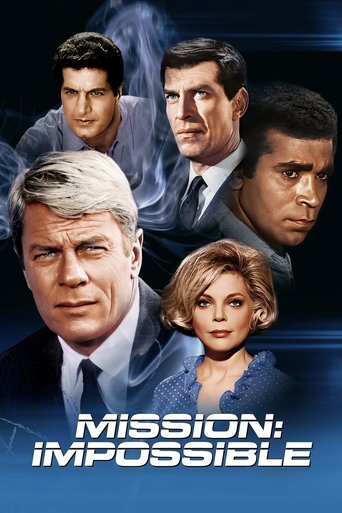
Mission: Impossible is an American television series that was created and initially produced by Bruce Geller. It chronicles the missions of a team of secret government agents known as the Impossible Missions Force. In the first season, the team is led by Dan Briggs, played by Steven Hill; Jim Phelps, played by Peter Graves, takes charge for the remaining seasons. A hallmark of the series shows Briggs or Phelps receiving his instructions on a recording that then self-destructs, followed by the theme music composed by Lalo Schifrin. The series aired on the CBS network from September 1966 to March 1973, then returned to television for two seasons on ABC, from 1988 to 1990, retaining only Graves in the cast. It later inspired a popular series of theatrical motion pictures starring Tom Cruise, beginning in 1996.
2 negative1 mixed10 neutralfrom 13 commenters
Where to watch
No streaming data for this title.



13 comments on Hacker News
So I love watching 50s-70s television shows: honeymooners, I love lucy, twilight zone, alfred hitchcock, Mission Impossible, Columbo. (recent MeTV lineup).
I'm a millennial. It occurred to just the other day, the language they use, they say "dough" a lot. They need dough. Where's the dough. Any criminal is always involved with gambling and gangs and they need dough! And the normal working people storylines are pinned to their lack-of-dough situations.
I remember the internet very fondly too. There's always an age of innocence but it just takes time to realize everyone just really needs and wants dough. And that's what happens.
On a somewhat related note, re-watching one of my favourite childhood TV shows (Mission: Impossible, the original series) now gives me several jaw-drop moments per episode -- each one involves a team illegally entering another country and committing a series of crimes or fraudulent activities, frequently to free someone who was caught doing the same activities earlier, often against various generals, leaders and shieks belonging to a relatively narrow set of ethnic stereotypes. 1960-70's sensibilities did mean that storytelling was much less of a minefiled than it is today, but it still gives me pause.
I think this is the result of narrative structure falling by the wayside in lots of popular canons. You can tell a million variations of the odyssey because Odysseus is nobody. You can plop just about any set of characters into the story and it works. We still have stories like this, the Mission Impossible series is the same story told differently, the new Twister is a retelling, anyone can be James Bond. But if you want a long running series you need an interesting universe to explore (which requires rules and consistency) and/or compelling characters people want to put in situations. It's why Family Guy can do a Star Wars episode but Star Wars can't do Family Guy, it's why the Ghost Buster's retelling flopped because they thought it was a narrative story but it was actually a character story.
I didn't really understand much of Star Trek or the series of that time, like Voyage to the Bottom of the Sea, The Time Tunnel or Mission: Impossible. I loved the imagery, the diving or space scenes and the gadgets, but the plots were impenetrable.
Space: 1999 appeared a few years later and I not only understood what was going on, but had devoured a fat Astronomy book so I also had a decent idea of the distances involved.
The episode with Ian McShane was great anyway.
Bain and Landau previously worked together in Mission: Impossible (seasons 1-3).
The TV series of Logan's Run and Planet of the Apes are reasonably obscure because they weren't too popular (I've got hold of both them, by the way).
Some other titles to pique your interest:
1981 BBC version of The Day of the Triffids
1979 Tales of the Unexpected (not scifi really)
1979 Sapphire & Steel (with the most annoying introduction - they are not elements!)
1979 Quatermass series
1979 The Omega Factor
1978 Blake's 7 (should not really count as obscure due to the impact the series had)
1977 The Fantastic Journey
1977 Children of the Stones
1977 Beasts (anthology series by Nigel Kneale)
1975 Sky
1975 The Invisible Man (really cheesy, featuring David McCallum)
1975 The Changes
1974 Zodiac
1973 The Tomorrow People
1970 Timeslip
1969 The Owl Service
1968 The Champions
1966 The Time Tunnel
1966 Mission: Impossible
1965 Out of the Unknown
1960 The Strange World of Gurney Slade
1958 Quatermass and the Pit mini-series
1955 Quatermass II
I agree. I have recently been watching a lot of Star Trek and Mission Impossible. Two shows where you can watch one episode and be done with it until the next time.
I'm glad to see that I'm not the only one getting really annoyed with the style with which most shows are made these days. I understand that there are good things about having a continuous storyline, and the last season of DS9 shows that it does work. But all shows don't have to be that way.
There is a comedy movie script in here somewhere I'm sure of it.
It almost reads like somebody was watching the TV series Mission: Impossible, and said, "Yeah, we should get some guys like that and move the money before anyone can catch us."
I don't think good music ever gets old.
I like the old TOS with its campiness, but even when TNG was new I found it unwatchable.
In general, though, TV shows don't age well. Even Mission Impossible from the 60's, well regarded at the time, looks silly today.
Reminds me of old Mission Impossible episodes where they prepped rubber masks.
When I was a kid I only knew of him as Mr Spock. Imagine my surprise when I saw him as Emil Vautrain in the Mission: Impossible TV series. I could not understand how he could be a vulcan science officer and a human secret agent, at the same time. He will be missed.
Some quick figures to put it in perspective:
According to instantwatcher.com, there are 6843 movies on Netflix streaming currently. If we conservatively say that the 1080p stream is 2gb, and the other formats add up to another 2gb, that's a total of ~27 TB of space required.
There are 3657 seasons of TV, let's say an average of 2gb per episode, and an average of 14 episodes a season. That's ~102 TB.
So napkin math suggests ~129TB of storage to hold all of Netflix, or 33 of these drives.
Since they need redundancy and to have servers distributed around the country for peering, and these drives will probably cost ~$10k each (5x premium on consumer), I doubt they'll be putting their long tail content on them.
How many people in Boston are currently watching Mission Impossible, the TV series from 1966? Or content like it? A standard hard drive can serve 500 people HD streams so long as you cache ahead into memory intelligently in big enough chunks.
Within a few generations, SSDs will probably be cheap enough to not even bother with mechanical, for this and many other use cases.
[1]http://instantwatcher.com/titles/all?tv_filter=movies+only
I think you mean Matthew Broderick. Anyway the "cut the blue wire" cliche is a lot older than that. I think I remember it from old Mission Impossible episodes on TV when I was a kid, and those were produced in the late '60s/early '70s.