 Hacker Cinema
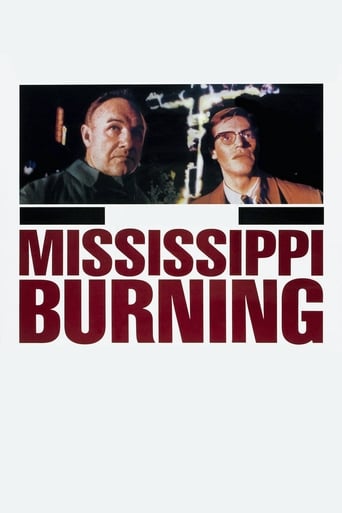
Mississippi Burning
1988 · Film · 128 min
Directed by Alan Parker
Two FBI agents investigating the murder of civil rights workers during the 60s seek to breach the conspiracy of silence in a small Southern town where segregation divides black and white. The younger agent trained in FBI school runs up against the small town ways of his partner, a former sheriff.
2 positive3 neutralfrom 5 commenters
Where to watch
No streaming data for this title.



5 comments on Hacker News
Mississippi Burning is one my favorite films https://en.wikipedia.org/wiki/Mississippi_Burning
I guess it depends on whether you consider 1950s America dystopian or not.
Following the articles methodology I asked GPT about Missisipi Burning:
> No, the film Mississippi Burning is not set in a dystopian society. Instead, it is a historical drama based on real events that took place in the United States during the 1960s. The movie, directed by Alan Parker and released in 1988, portrays the investigation into the real-life murders of three civil rights workers in Mississippi in 1964. The story is set in the context of the civil rights movement and highlights the rampant racism, segregation, and violence that were prevalent in the American South during that time.
> While the societal conditions depicted in the film—characterized by extreme racial injustice and brutal opposition to civil rights—are harrowing and oppressive, they reflect actual historical realities rather than a fictional dystopian world.
I'll give a couple historical and current examples:
Star Trek was always woke, starting with its at the time quite "woke" black communications' officer and many plots with aliens as stand-ins for different races or nations. The initial show got cancelled (as is often the case with even successful sci-fi) but it gave birth to a giant franchise that continued to be at least somewhat "woke" by contemporary standards. Definitely not a flop.
The Apple TV series For All Mankind is going into season 4 and is relatively popular. I found it pretty good. It's full of "woke" stuff but is well written and is based on a really good premise. My favorite fan theory is that it's an unofficial prequel to The Expanse. Not sure I'd call The Expanse "woke" but it's also not not-woke and has a number of background elements like the popularity of polyamory and bisexual characters sure to trigger right-wingers.
Sci-fi in general has always been kind of on the woke side of things.
Films, lots of them. There's many films about civil rights and social justice struggles that are quite good and did not flop: Mississippi Burning, Schindler's List, 12 Years a Slave, Hidden Figures, etc. Disney has recently made a bunch of Pixar films that are pretty woke and didn't exactly flop.
IMHO the woke flops we're all familiar with are just bad writing. Boring plots, uninteresting characters, and shitty writing is gonna be crap regardless of whether it's "woke."
Hate speech is a well-defined legal term in the US.
On its own, it is protected, but it is also sufficient evidence to establish that some other act was a hate crime:
https://legaldictionary.net/hate-speech/
> In October of 1989, a group of young black men were hanging out in front of their apartment complex, discussing the movie Mississippi Burning, in which a number of black people are beaten. As a young white boy walked past the complex, and Todd Mitchell, one of the group, called out “Do you all feel hyped up to move on some white people?” then said, “There goes a white boy; go get him!” and led his friends in an attack on the boy. The black men stole the boy’s tennis shoes, and beat him so badly that he was in a coma for four days.
> Mitchell was convicted on charges of aggravated battery in the Circuit Court, but because the jury ruled he had chosen the victim based solely on race, the crime was elevated to the level of a hate crime. In this case, Mitchell’s words were intended to incite violence against a person, based on a trait or attribute – his race. Although Mitchell appealed his conviction, claiming the conviction violated his right to free speech.
> The question of constitutionality in this case made its way to the U.S. Supreme Court in 1993, which held that the First Amendment does not bar the use of a person’s speech as evidence to establish elements of a crime. In fact, such evidence is commonly used to prove a defendant’s intent or motive, as well as to determine relevancy of certain evidence, or reliability of a witness’ testimony. The crime in Mitchell’s case was aggravated battery, not the words that he spoke, which provoked his companions to engage in the crime. Therefore, Mitchell’s free speech rights were never impeded.
>So pictures of KKK members killing little black girls would be fine as long as the images were "drawn"?
Yes.
In fact there are many comics and films showing "KKK members killing little black girls" or worse, and nobody thought to censor "Mississippi burning" or something like that...
>You seem generally confused about the points you are trying to make.
Oh, the irony...