 Hacker Cinema
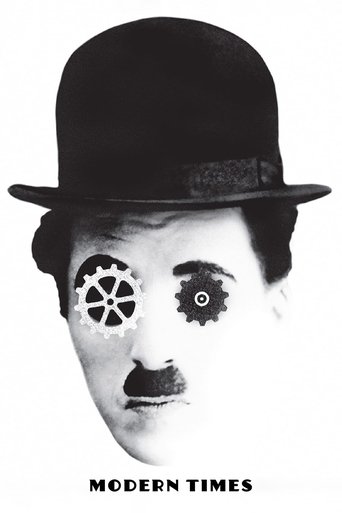
Modern Times
1936 · Film · 87 min
Directed by Charlie Chaplin
A bumbling tramp desires to build a home with a young woman, yet is thwarted time and time again by his lack of experience and habit of being in the wrong place at the wrong time...
4 positive10 neutralfrom 14 commenters
Where to watch
No streaming data for this title.
16 comments on Hacker News
The Charlie Chaplin film Modern Times has a hilarious example.
> Yikes that really hits home. Since the dawn of computers, people have been handing over more and more of their thinking to processes and machines, becoming more robotic.
One of the major motifs of Chaplin's Modern Times.
It was released in 1936.
It's also, um, kinda something Karl Marx was concerned about. So.
Here's a famous sequence from the film, in which Chaplin's character is volun-told to try out a new efficiency-improving worker lunch machine:
https://www.youtube.com/watch?v=UwahG1s4dqI
Anyone looking to get into silent film, I'd strongly recommend comedies (including, and perhaps especially, Chaplin and Keaton) as a good starting point. I've gotten to the point that I can truly enjoy a lot of silent dramas, but IMO the comedies are far more approachable for a modern audience. Good gateway drug.
Just off the more famous films (The Great Dictator and Modern Times and maybe City Lights for Chaplin, or The General for Keaton, say) I'd recommend The Kid for Chaplin, and Sherlock, Jr. for Keaton. And of course both made numerous short films, in addition to their features. Though the very-famous ones are all great, too—I especially love City Lights, personally.
Been meaning to check out Harold Lloyd (responsible for one of the most enduring and imitated images in Hollowood, the guy hanging on the clock on the side of a building, featured in Safety Last) but haven't made it to him yet. I bet he "reads" pretty well to a modern viewer, too.
[EDIT] Some beginner drama recommendations, for those who feel ready:
Metropolis (duh... though it's a bit on the long side, maybe skip if you can't tolerate longer movies, and it's maybe a bit belabored for modern sensibilities)
The Passion of Joan of Arc (just... damn. This is a perfect movie.)
L'Âge D'or (The Golden Age—but, uh, maybe just if you appreciate things a bit more art house)
Le Voyage dans la Lune (A Trip to the Moon—it's short, and, if one plays with various accompanying soundtrack options, including some more modern ones, one may find it transcendently good)
M (yes Fritz Lang made this very short list twice, because fuck you this movie is amazing, this is maybe the most modern-feeling of this whole bunch)
One of the birth places of unions during the industrial revolution has turned into anti-union, so I don't expect much.
https://en.wikipedia.org/wiki/Modern_Times_(film)
I think it is still quite up to date regarding work conditions in some places.
People don't like robotization of the workplace, but tend to forget that humans in those positions used to be treated like robots.
Charlie Chaplin satirized this in his 1936 film: https://en.wikipedia.org/wiki/Modern_Times_(film)
The movie Modern Times (1936) had a video phone in the factory, if I recall correctly.
If you like Simone Giertz' work and you haven't seen it yet please go see the movie 'Modern Times' by Charles Chaplin.
Chaplin fought against sound in movies on a similar basis.
Not an absolute rejection, but a concern that it took focus away from other parts of the story-telling and wasn't necessary.
He supposedly sabotaged attempts to add speech to Gold Rush (1925) after the actors pushed for it.
City Lights (1931) was basically his ode to silent movies, famous for its endless retakes of the initial meeting with the blind flower girl [1], while he tried to figure out how she could mistake the Tramp for a rich man without words. In the end the solution was simple, and both funny and provided motivation for the Tramps desire to help her: The Tramp walks through the car of a rich man to avoid passing a police office, and so when he stands before her she has just heard him slam the car door. He accidentally knocks the flower he's purchased out of her hand and realises she can't see that he has picked it up. As he hands her his money, the owner of the car comes and drives off and the girl thought he had left without his change, and he didn't want to break the illusion and so walks off without money he badly needed for himself.
It's one of my favourite movies because it masterfully made his point that you can tell a complex story without it feeling like you're missing something because you can't hear dialogue.
He added speech in his next movie - Modern Times - but his character still didn't speak dialogue (but did sing).
It was first with The Dictator (1940) that Chaplin himself spoke on screen: Finally he had something where the speech added clear value by conveying more than he knew how to convey with just pictures.
In the same way I think we will see more and more movies eventually come out in 3D as the industry gets enough experience with it to see where it adds clear value and leave it low key other places, rather than add it to make a spectacle of it.
I think one of the first to do it well was Prometheus. A friend saw the 2D version and afterwards told me elated that it felt like it was made as a 2D movie - no weird camera work solely to make 3D effects stand out etc.. Meanwhile I'd seen it in 3D and been blown away at how good it looked in 3D. The effects were clear and beautiful but not in your face. Crucially they didn't alter the visual language noticeably.
[1] http://www.tcm.com/mediaroom/video/378808/City-Lights-Movie-Clip-Wait-For-Your-Change-.html
This kind of "optimisation" has been around for over a century, starting with Frederick Taylor. Dehumanising, mechanistic management is not new, nor is the backlash against it.
https://en.wikipedia.org/wiki/Scientific_management
https://en.wikipedia.org/wiki/Modern_Times_(film)
https://en.wikipedia.org/wiki/Metropolis_(1927_film)
Charlie Chaplin's film Modern Times has a section where the tramp is working on an assembly line and parts are coming down the conveyor. He has at it and manages to get 10 yards ahead of the conveyor, and has a rest. Just as he is relaxing, the conveyor belt catches up and he has to start again.
In my opinion a lot of the Coalition policies (housing benefit changes, nursing/police/teaching pension changes, reduction in the number of nurse/teaching training places) were like Charlie's conveyor belt. They got a couple or three years of savings but now the belt has caught up. It is almost as if they did not expect to form a second government.
Many colleges are using the legacy syllabus this year. So when the majority of those come back again next year, we will be catching up with the conveyor because of the topics previously on the Higher tier added to the Foundation. I especially like it when a youngster 'taught' (i.e. coached in a smattering of topics) Higher tier can tell me some half remembered facts about the sine rule but has to use her fingers to work out seven sixes...
Charlie Chaplin's movies. Modern Times is very funny, but the end scene. I cry every time. City lights, ditto, the end scene is so strong. And Limelight. And the Gold rush...
Pretty amazing that the "Modern Times" link in this article goes to their original review of the film from July 14, 1936.
http://www.theguardian.com/film/1936/jul/14/derekmalcolmscenturyoffilm
I'm not sure I'm able to visualize this correctly. Let's say we have an array of strings containing the top 20 movies from Rotten Tomatoes:
The Wizard of Oz The Third Man Citizen Kane All About Eve Das Cabinet des Dr. Caligari. (The Cabinet of Dr. Caligari) Modern Times A Hard Day's Night The Godfather E.T. The Extra-Terrestrial Metropolis It Happened One Night Singin' in the Rain Laura The Adventures of Robin Hood Inside Out Repulsion Boyhood North by Northwest King Kong Snow White and the Seven Dwarfs
What would this data structure look like?
Interesting.
"It was also the era of increasing automation, and increasing concern about automation, exemplified in Charlie Chaplin’s 1936 masterpiece Modern Times. One of the film’s dystopian curiosities, the Billows Feeding Machine, invented by Mr. J. Widdecombe Billows, has a distinctly Rube Goldbergian quality to it — this is likely no coincidence, as Goldberg and Chaplin were friends. "The Billows Feeding Machine will eliminate the lunch hour, increase your production, and decrease your overhead," the film’s narrator announces. "Don’t stop for lunch: be ahead of your competitor." A factory worker is strapped into the feeding machine by his neck; the device malfunctions spectacularly."
> But this one interests me: Mankind will therefore have become largely a race of machine tenders.
But that is not a new prediction. Socialism for example came about in the mid 1800's on the basis of an optimistic view of what would be possible thanks to the industrial revolution - the idea that machines could put us in a position able to eradicate poverty - but also pessimism about how it would turn workers into cogs in a machine.
This latter view came to shape a a lot of thinking and art for decades. In the cinema there are many obvious examples, such as Fritz Lang's Metropolis (1927) to Charlie Chaplins "Modern Times" (1936).
The latter makes it literal: Chaplin goes crazy due to the monotonous, high speed work and horrible treatment (including being used as a guinea pig for a machine designed to feed the workers lunch more efficiently). He starts seeing everything, such as buttons, as machine parts and nuts and bolts, and keeps trying to fasten them.
Eventually he gets pulled into the machine he is tending to and is shown as being moved along by the giant cogs.
Avatar and TDK historic points in film. AKA Dancing with Smurfs, and The Movie With More Plot Holes Than The Titanic. Hum, I beg to disagree.
Overall, I got a good laugh from the list. Seriously, this list should be called "things white US kids (of my age, granted) like". Rather than a history of cinema, it belongs more in the "comedy generated by computer" genre. Exhibit one: City Lights isn't there. Exhibit two: Modern Times isn't there. No Le Voyage dans la Lune, no Man With Camera, no Great Train Robbery, Rashomon isn't cool enough to make the list, Vertigo is too weird, and Battleship Potemkin is, like, too commie, you know. The final straws would be Independence Day and It's a Wonderful Life making the list.
I mean, On the Waterfront looks like it's very good (I haven't seen it), but, but, it was released in the same year than motherfucking Seven Samurai!