 Hacker Cinema
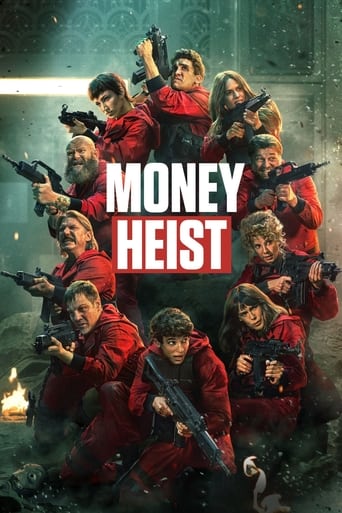
Money Heist
La casa de papel
2017 · TV series · 3 seasons
Created by Álex Pina
To carry out the biggest heist in history, a mysterious man called The Professor recruits a band of eight robbers who have a single characteristic: none of them has anything to lose. Five months of seclusion - memorizing every step, every detail, every probability - culminate in eleven days locked up in the National Coinage and Stamp Factory of Spain, surrounded by police forces and with dozens of hostages in their power, to find out whether their suicide wager will lead to everything or nothing.
8 positive4 negative8 neutralfrom 20 commenters
Where to watch
No streaming data for this title.




24 comments on Hacker News
Trash ? The Diplomat has as good a production value as any.
So does Bridgerton. Adolescence is basically a single shot marvel.
Others - Stranger Things, Money Heist, Black Doves.
Not to mention their true crime documentaries.
Warner Brothers makes quality content. I think this is an almost perfect fit.
If you did not make it past season one of Money Heist, then you missed out on:
- outstanding performances by Spanish actresses Ursula Corbrero, Itziar Ituno, Alba Flores, and Najwa Nimri and
- humming Bella Ciao to yourself for two months.
Wow, thanks for the watching list! I agree on season 6 of House of Cards, sadly Robin Wright can't carry the series the way Kevin Spacey did.
Albeit, we got bored of money heist after season 1.
Try this: look up the most highly rated episodes on IMDB and watch only those. Missing the crummy episodes usually does not interfere with understanding the story arc. Often, I set a minimum IMDB score that I will watch, like 8.5 or 9.0 to capture only the best. This works well with series that:
- take a year or two to find their footing or
- have a large cast (some mediocre) that get their own story lines of no consequence occasionally or
- introduce cast members that don't make it or
- implode towards the final season.
I have done this for many series that are somewhat uneven:
- The Americans
- How I Met Your Mother
- Fringe
- Orphan Black
- Halt and Catch Fire
- House of Cards (watching the ratings allows you to miss all of season 6)
- Arrested Development
- Bojack Horseman
- Veep
- 30 Rock
- Jane the Virgin
- Black Mirror
- The Marvelous Mrs. Maisel
- Suits
- Six Feet Under
- La Femme Nikita
- The Blacklist
- Peaky Blinders
- The Romanoffs
- Ozark
- Westworld (sometimes dropping episodes does not matter)
- Succession
- Borgen
And all of these series have lots of strong episodes.
Series I would not do this with:
- The Bear
- Breaking Bad
- Money Heist
- The Serpent
- Fleabag
- Chernobyl
- The White Lotus
> They definitely do not. That's not how work-for-hire translations work. You pay someone to translate your shows' subtitles for you, then you own the copyright on that work that you paid for. That's how that works. No weird region-locked silliness.
If you skip the fact that Netflix do regional deals with local content houses to sell Netflix-made stuff either in theatres or get TV releases, in which case translations could be a part of the deal to be be provided by the local entity who's getting the rights; or the other, more common scenario, where Netflix acquire local content for wider publication (e.g. Casa de Papel/Money Heist is a very popular example), where again, there might be complications.
> Apple TV shows something like 50 languages. More than I can be bothered to count, certainly.
I haven't found that to be the case, but had Apple TV only briefly because of the general poor quality (watched 3 series on it, all three devolved into trope after trope barely going below the obvious surface).
> Sit down and think about how absurd it is for the bastion of wokeness that is Netflix to discriminate this profoundly against inter-racial love. On purpose. They wrote the code to do this.
Is woke in the room with us right now? Can you point it out and explain what it is? For the record, "races" are a stupid social construct that should have died out with the Nazis. And people can be of different ethnicities while speaking the same language(s), or inversely of the same ethnicity while speaking different languages. Being "woke", "inter-racial" and different languages are completely orthogonal topics.
Snowpiercer (series): Gave up after the main plot focused on maintaining a lie, not discovering a truth (conventional screenwriting).
Other examples: https://www.reddit.com/r/netflix/comments/pwp3t4/im_tired_of_woke/
Eventually got tired of Netflix's money cow strategy by sacrificing quality - buying original ideas and ruining them with more seasons for the sake of engagement: Designated Survivor, Money Heist, etc. Piggybacking on categories that rate higher on IMDB: Korean copycats, cheap documentaries, reality shows.
They know how to cater to public sentiment because biased reviews lead to higher ratings, hoping the brainwashing is not apparent - recent drop in subscribers proves them wrong.
Let's reverse engineer what a PM will think with data:
1. 80/20 rule: Target best performing shows, replicate success to capitalize on fan loyalty/momentum (new seasons or spins): The Crown, Money Heist, Designated Survivor, Narcos...
2. Validation: Look at high movie ratings, copy those categories: Korean dramas, documentaries, telenovelas, reality TV...
3. Culture: Follow trending themes on social media - feminism, financial freedom, woke...incorporate them into the screenplay, regardless of bias, craft, or message
4. Engagement: As long as we capture user attention and addiction, reinforce this habit via recommendations with AI algorithms
Like Facebook, they are focused on creating an addiction machine for short term gain, and this strategy is reflected on their increasingly low quality shows - this affects the brand, leading to low trust and rising churn
IMHO, a little of column A and a little of column B. It's happening from both sides.
As quantity goes up, cultural relevance of any particular single show goes down.
Thus it becomes harder to run a platform on "one" hit, thus everyone turns to the Netflix model of a billion micro-targeted shows, thus demand for content becomes a series of niche requirements, and anything actually creative has to percolate through them (a la Joker's "Sure, I'm a superhero movie" or La Casa de Papel's "Sure, I'm a Spanish Ocean's Eleven" or Dark's "Sure, I'm a German Stranger Things").
That's hard, and so what you actually get for the majority of content is the media equivalent of a box of Crayola crayons -- 256 different colors, with zero depth under the surface.
This reminds me of one of the most epic episodes of Money Heist where $character, shortly before dying, says something that resonated a lot with me:
> Mucha gente cree que en la vida solo hay un gran amor, lo que no saben es que se pueden vivir varias vidas. […] Hoy acaba algo pero es el día de tu siguiente vida. Tienes que vivir muchas vidas […], muchas...
(English translation: https://www.deepl.com/translator#es/en/Mucha%20gente%20cree%20que%20en%20la%20vida%20solo%20hay%20un%20gran%20amor%2C%20lo%20que%20no%20saben%E2%80%A6%20es%20que%20se%20pueden%20vivir%20varias%20vidas.%20%5B%E2%80%A6%5D%20Hoy%20acaba%20algo%20pero%20es%20el%20d%C3%ADa%20de%20tu%20siguiente%20vida.%20Tienes%20que%20vivir%20muchas%20vidas%2C%20muchas. )
I like to think that this can be applied not only to love (like here) but also to switching jobs, careers, places, … anything really that causes a big change (a diff, as you say) in life.
I like listening to the original audio of foreign movies and it's partly how I learned English, and how I pick up random words from languages I can't really speak.
I also respect actors and actresses enough to appreciate their performance includes their original voices.
I'm a fast reader and subtitles are like a second nature to me, to the point I don't "remember" having read them (likewise I sometimes don't remember if I read a novel in English or Spanish unless a particular turn of phrase caught my attention).
About the only thing I agree with is that dubbing (barring some honorable exceptions) sucks. I did listen to a part of La Casa de Papel's English dub -- the horror!
In short: do not want this.
When I first signed up for Netflix it was (briefly) $8/month. At that stage it had a great catalog of old TV shows, which was (and is) way more interesting to me than movies. I actually figured that anything less than $10/month and I'd subscribe to it forever without thinking about it.
But the prices keep ballooning while the catalog keeps shrinking to the point that Netflix HD is now more expensive than HBO Max. Like WTF? For the record, the UI/UX of HBO Max is decidedly worse than HBO Now was (IMHO).
I support Netflix's strategy of having to make original content as the popularity of streaming caused every content owner to launch their own shitty "me too" streaming platform. Most of these won't survive (eg CBS All Access -> Paramount+).
But Netflix has proven once again you can't solve a problem by simply throwing tons of money at it. HBO is good at producing original content because it has a long history of doing so and has built up a culture to do just that. But Netflix acts like they're just throwing money around (eg [1]). Some of their content is good (eg Ozark). A lot of it is mediocre and samey. Even some of the good stuff gets killed prematurely.
So once Netflix was an "always have". Now it's something I'll sign up for 1-2 months a year to catch up on old content. I'm not paying for 6 different streaming services continually. The only service in my "always have" bucket now is Prime Video simply because Amazon Prime is too useful not to have it.
What I think Netflix should've done is concentrated in building regional content and then dubbing that to other languages and regions. They've had some success with that (eg Money Heist, 3%) but nowhere as much as they could have (IMHO). This should help avoid creating samey content.
But here's how you know this isn't a high-priority strategy: for some reason all the voice acting on dubbed content is beyond terrible. This goes beyond Netflix. Like Netflix has some other dubbed Spanish TV series (I forget the name) and there are common voice actors with Money Heist. And they're bad. Years ago I saw German-dubbed Friends and I couldn't get past how bad the dubbing was.
Why is this? Is this a small industry rife with nepotism? Or is it just something no one cares about?
Anyway, I'm not surprised Netflix is struggling to retain subscribers in the US and Canada. It's simply too expensive and there is now fierce competition.
[1]: https://www.cheatsheet.com/entertainment/gilmore-girls-paid-20000-use-john-lennon-song-memorable-rory-dean-moment.html/
> It explains why thousands of films, just like 'Parasite' and 'Money Heist' flop, why they are not on Netflix or in theatres, and why you've never heard of them
That's true in America as well. There's only so many good movies!
> Quebec consumes it's own content because they are a distinct from the rest of North America, and they invest a lot in culture.
And they buy it, they don't need a government check to make it.
"That explains why Parasite and Money Heist flopped."
It explains why thousands of films, just like 'Parasite' and 'Money Heist' flop, why they are not on Netflix or in theatres, and why you've never heard of them, and why neither Spain nor S. Korea are entertainment powerhouses in film.
KPop however, which is definitely a Korean export, has some strong 'industrial foundations' along the lines of what I'm talking about. It's a real industry there.
Here are 2021 'Canadian Films' - have a gander and see how many you recognize. [1]
Quebec consumes it's own content because they are a distinct from the rest of North America, and they invest a lot in culture. And a pretty good comparative basis for Ontario / Rest of Canada.
[1] https://en.wikipedia.org/wiki/List_of_Canadian_films_of_2021
> Once you add in language and cultural barriers, i.e. the fact that a movie about 'Captain America' will have a strong enough audience domestically, with some acceptance abroad, and you have insurmountable competitive advantage. (Nobody is going to watch a film about 'Captain France', or 'Captain Japan' - or rather, many fewer).
That explains why Parasite and Money Heist flopped.
> The new Dune film is Denis Villneuve, and his 'posse' of creatives are from Montreal. In some ways, it's a 'Canadian-led' film, but that just happens to be talent, it's not really part of the industrial base. Villneuve exists because Quebec strongly supports creative endeavours (and FYI for every Villneuve, there are 10 you've not heard of, 50 who never really had support or a shot, and 1000 who tried and failed).
From what I've been told, Quebec is the only place in Canada that consumes its own culture.
I remember seeing indie comedies and horrors. I dont think indy implies serious, altrough there are also sad indie movies.
> . If a viewer wants 'fun' then they're stuck with formulaic superhero blockbusters.
I dont think this is true either. The industry producing formulaic is not because it is only way to have fun. If you look at series that came out lately (Money Heist, Westworld ... ) they are not formulaic and are fun.
Money Heist has recently wrapped up with the filming of its Season 5 and the final season is yet to be released on Netflix. Here are the latest updates about Season 5 of Money Heist including the release date, where it was in filming, and many more. Look out to know everything.
> After the movie, he hopes to produce a nine-part Spanish-language TV series about the heist.
Isn't this loosely the plot of the Netflix show Money Heist (casa de papel in it's original Spanish)? There's already a show!
Otherwise it's a really strange coincidence that many of the plot points line up. Or, its just standard practice to want to dig yourself out of a bank you just robbed.
Interesting. Here's a related phenomenon: currently Spanish-speaking Netflix is flooded with a batch of Spanish-made comedies, romances, dramas and thrillers -- the most high-profile of which is The Money Heist ("La Casa de Papel") -- most of which have a distinctly Hollywood/generic feel to them. Every character and situation is a cliché from Hollywood, with no local flavor. Save for the accents of some of the actors, there's no Spanish feel to these shows. Even the credits soundtrack is in English.
I wonder if the netflixization of shows will tend to erradicate local flavor forever, and if so -- what's even the point of watching them? I don't want to watch yet another heist movie or prison drama, only with Spanish actors instead of American ones.
Beg to differ. Netflix has made some great local content, narcos, Dark, Casa de papel, The dutch civil war resistance miniseries, some great French comedies, and the list goes on.
I think it's great to see stuff not all coming out of Hollywood.
Virtually anybody but Hollywood exec types love Netflix, particularly creatives (the people who actually DO the things). Netflix has been making enormous amounts of content, even for smaller markets like Spain and betting on great people who are making really good shows (see ‘casa de papel’)
If you are a creative person you are enthused about streaming because suddenly there’s a huge amount of content being funded. Think about standup comedy and what Netflix has done for it.
Netflix is run by very smart people who are making very good content that most Hollywood execs wouldn’t touch. Scorcese’s next film is being funded by them! It’s nuts that Wolf of Wall Street, The Departed, multiple Scorsese projects were VERY HARD to fund. Jonah Hill worked essentially for the lowest money you can work for in a movie (SAG which is the actors union says 20k minimum) in Wolf of Wall St. Because they couldn’t afford him. Stuff that you look back and wonder “how the fuck?”
In Spain it's a fun meme how most foreign movie titles were translated into spanish, totally changing the meaning or simply destroying the original intent of the name.
You could argue some clever titles are not easy to translate, but God knows there was no need to translate "Die Hard" to "Jungla de cristal" (glass jungle). That practice was more prevalent 10-20 years ago, though.
The thing is that now, for one, it happened the other way around with ehm... "Money Heist" what a boring and uninspired name! :-)
There are probably so many angles to this but I will give one. Netflix is more likely to be used and loved if it gives someone something similar to the thing they just finished watching (like the next episode) then if they lose them to something they might not like by giving them the opportunity to find other content.
Also even if the content is not the next episode I feel I would be more likely to go with a suggested (new) video or content rather than something that takes me time to find (and therefore in theory happier with the service). For example there are so many choices on Netflix that I find I often might decide to not even take a look because of what I think the content is. [1]
[1] An example of this is the most excellent (now in S3) 'Money Heist'. The Dali masks were an instant turnoff for me that for whatever reason (rightly or wrongly) made me think it was some kind of fantasy rather than a crime drama (not saying my thoughts were right but that is what I thought).
>Again, your argument continues to validate one of the essential points I make: that these data sets are most useful for identifying existing media that “works” and then scaling/marketing it.
I'm not sure how you're managing to miss this so completely, but no its explicitly not this. Are you familiar with how recommender systems work? Id suggest reading this article[1], which discusses how Netflix uses data to identify the fanbases for shows that they haven't yet launched. Yes, they use data to post-validate successful shows, but everyone does that, it's what Nielson has done for decades. Netflix is doing more: they're able to (with decent accuracy) predict what market a show will be popular with before launch, and they do this to market niche shows that would otherwise never be launched at all with a strong certainty that they'll find success.
Your second paragraph invents evidence and certainty and data that you don't have. Frankly, it makes you look like you are unfamiliar with statistics and data analytics, which is fine, but then you shouldn't share strong opinions about how things you don't fully understand can't work. How do you know that they can't have statistical reliability? Thousands of data points is absolutely enough to have statistical certainty. Yes you can absolutely predict the popularity of a genre with a high degree of certainty before filming a single scene. How do you know that they don't have a high rate of success? (I refer you back to [1]:
>She notes the mixed reviews for Lost in Space. “Do we care?” Not that much, it turns out.
>Furthermore, Netflix picking themes, topics, etc as you suggest to drive successful production runs contrary to their most successful strategy so far, which is to cast a wide net by producing highly diverse content at low costs then scaling what works.
I'd just like to make this really, exceptionally clear: they don't pick what content to produce by throwing darts. They pick the diverse ("niche") content in a very data driven way. Again, quoting [1]:
> It [...] predicat[es] programming decisions on immense amounts of data about true viewing habits, not estimated ones. It has discovered ways to bundle enough niche viewers to make good business out of fare that used to play only to tiny markets.
But I suggest reading the entire article, because it thoroughly dismantles the presumptions your making about how netflix does production. (Especially the part about "Money Heist").
>When a company has a combination of access to scale and quality data, they quickly outpace and overwhelm their competitors. Netflix hasn’t quite accomplished this, suggesting that their dataset isn’t as magical as you imply.
Wait, who are their competitors that they aren't outpacing? Netflix absolutely dominates their market (streaming media), they defined it. Everyone else is playing catch up. If you are considering Netflix to be a competitor to WB or Disney, netflix had more revenue than Universal Pictures, Columbia (Sony) or Paramount, and WB, Fox, and Disney are all part of huge conglomerates that make it hard to tell, but it's possible that in terms of movies and TV, Netflix is second only to Disney. If not, it's certainly close.
Of course I'd also like you to justify your original statement, I don't think it's generally true, there's more to a business than just data, and I can't think of any business except maybe Google where scale and quality data was the defining factor. In almost every other case it was something else: network effects (FB, Twitter, Insta, WhatsApp), logistics (Amazon), or a different business model, normally freemium (Spotify, Slack, etc.). All of those companies use data for all sorts of different things, but they didn't take over/find success because of their data.
>Lastly, their dataset isn’t as private as you might believe, either.
Yes, their data is absolutely private, unless you think that the netflix prize from 2009, before they started streaming and 4-5 years before their first original, is at all relevant.
[1]:https://www.vulture.com/2018/06/how-netflix-swallowed-tv-industry.html
I'll add that they have very good and especially very diverse shows. "La Casa de papel" is killing it (at least here in Europe), and that's because Netflix doesn't care if their shows are spoken in English, Spanish or Swahili, they know that bringing diversity into the cinematic game it's what is badly needed right now.
I'd compare this to Hollywood in the late '60s - early '70s, when it needed the breeze of fresh air brought by La Nouvelle Vague or by Kurasawa's and Jean-Pierre Melville's movies. Right now Hollywood (and the media companies behind it) is stuck in making movies for late-teenager geeks (the comic-book-based endless series, the Star Wars soap opera etc), movies which have almost no interest for the general public.