 Hacker Cinema
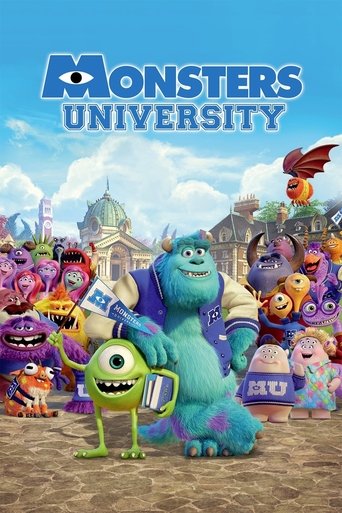
Monsters University
2013 · Film · 104 min
Part of Monsters, Inc. Collection
Directed by Dan Scanlon
A look at the relationship between Mike and Sulley during their days at Monsters University — when they weren't necessarily the best of friends.
2 positive5 negative1 mixed8 neutralfrom 16 commenters
Where to watch
No streaming data for this title.
16 comments on Hacker News
I wholeheartedly disagree. Pixar does not have a monopoly on attention to detail. They're flush with cash and their leadership has decent taste.
There are so many creators putting in intense work, and doing it on low budgets. You can't claim these folks don't have attention to detail. Check out A24, low and mid and low budget films, or independent films and you'll see a wide assortment of highly meticulous storytellers.
Pixar, on the other hand, isn't low or mid budget:
Toy Story - $30 Million A Bug’s Life - $120 Million Toy Story 2 - $90 Million Monsters, Inc. - $115 Million Finding Nemo - $94 Million The Incredibles - $92 Million Cars - $120 Million Ratatouille - $150 Million WALL-E - $180 Million Up - $175 Million Toy Story 3 - $200 Million Cars 2 - $200 Million Brave - $185 Million Monsters University - $200 Million Inside Out - $175 Million The Good Dinosaur - $200 Million Finding Dory - $200 Million Cars 3 - $175 Million Coco - $175 Million Incredibles 2 - $200 Million Toy Story 4 - $200 Million Onward - $175 Million Soul - $150 Million Luca - Unknown but probably around $150 Million Turning Red - $175 Million Lightyear - $200 Million For that amount of money, they had better pay attention to detail.
Miyazaki is doing way more with much less.
Voices of a Distant Star was one person -- Shinkai. That's the kind of thing we'll see more and more of. Small creators reaching audiences and building studios. Gooseworx, psychicpebbles, Vivienne Medrano. That's the algorithm of tomorrow.
AI, as a tool, makes this more possible. One of the first people to do it successfully was Joel Haver, and he's just the first of many to come.
I have a three year old and I can barely stand watching the Monsters University movie but Monsters Inc is easy to rewatch.
I was surprised to see Cars listed as one of the ones that people generally hate. I’m a little biased because my son absolutely adored that movie, and I have fond memories of him taking his Lightning McQueen toy around with him everywhere. But over many repeated watchings both my wife and I agreed it was a quality production.
It has a good cast with Owen Wilson, Bonnie Hunt, Paul Newman, and even Larry the Cable Guy puts in a pretty decent performance. The minor characters are charming, too (including George Carlin and Cheech Marin).
The story is fairly timeless and reminiscent of Doc Hollywood. I don’t know how they manage to make it work so well with anthropomorphic cars, but somehow they do. The main character has a good arc, and there’s a good amount of nostalgia. I don’t think I ever cried, but I definitely felt something - which is more than I can say for the Cars sequels.
Would I go and watch it now without kids? No. But Pixar put out a movie that entertained kids and adults alike. Earned $462 million at the box office. Made an absolute killing in merchandise sales (and I thought the toys were pretty high quality, especially the die cast Tomica cars here in Japan). I have a lot of respect for what they were able to do with Cars. Not so much for the sequels, though.
They also call Monsters University a mediocre sequel, but I tend to prefer it over Monsters Inc. Pretty much for the same reasons as Cars - good cast, timeless story reminiscent of Revenge of the Nerds, and my kids loved it.
This isn't Pixar's first bad or mediocre movie—Cars 2 was straight up bad, and Monsters University and The Good Dinosaur were both mediocre. Coming up after the release of some really solid titles, I'm not too worried.
Inside out was good, but not great, IMO.
Counter-counterpoints:
Cars 2, Brave, Monsters University, The Good Dinosaur, Finding Dory, Cars 3, Coco, Onward, Luca, Turning Red, Lightyear.
The (not very original) point is: You can no longer count on a Pixar movie being excellent.
Maybe domestically? Toy Story 2, Monsters University, and I'm sure others outperformed the original when you compare their global box office numbers. https://www.boxofficemojo.com/movies/?id=monstersinc2.htm (nb foreign BO is 64% of the haul).
Why are you asking about Pixar movies in a thread about ray-tracing? Most of them were not ray-traced. For example Toy Story was not ray traced. Monsters University was the first one.
Monsters University was the first pixar movie that used global illumination, which means that modern games with VXAO will be better in some aspects than any pre-MU pixar movie, but the level of detail will be obviously a great deal lower.
Gamers have long been clammering about how they can't wait until in-game graphics match those of pre-rendered cinematics (that said, a lot of cinematics these days are no longer pre-rendered). Ray tracing is such an expensive operation. According to this quora, it took 29 hours to render a single frame of "Monsters University": https://www.quora.com/How-long-does-it-take-to-render-a-Pixar-film
We're probably nowhere close to getting real-time Pixar-quality rendering in our games right now, but we've definitely made leaps and bounds over the last few decades.
Cars is not a bad movie, it did very well, it was just a little below normal Pixar quality but still above most other studios work.
The good dinosaur, Brave and Monsters university all still good but not quite Pixar.
Cars two is an absolute disaster though and it's a shame it wasn't covered in the book. Something clearly went very wrong with this movie and they redid most of it in ten weeks or so I read, it seems to go against all the values and things they talk about and it does feel as if the story they tell about themselves is perhaps worked as much as the stories they make.
The difference between Reyes and path tracing is this:
- Reyes batches camera-visible geometry into grids of micropolygons and microvoxels. These micro-elements are then shaded using any method you please (which, in the case of Pixar movies since Monsters University, has been raytraced physically based illumination). The micropolygons are projected to the image plane and stochastically sampled, much more akin to traditional rasterization. There is no raytracing for camera-visible geometry, and all projections must be linear.
This style of doing things was to exploit locality in screen space. It assumes that the image can be broken into "buckets", and the information outside the bucket can be destroyed when the bucket is finished. This used to be true when RenderMan was first designed, but now that everybody is raytracing their illumination, it is less of a useful optimization.
This also means that shading happens at discrete times. Usually everything is shaded at the shutter-open instant, so specular highlights will be smeared in an unphysical way, because their motion is not properly correlated with the geometry motion.
I should also point out that Renderman keeps an internal radiosity cache in Reyes mode, which is basically just stored colors of illuminated geometry. This cache is queried by raytracing when computing indirect illumination, and a cache of the whole scene is kept for each bounce. Pixar only uses one or two bounces in Reyes mode due to the heavy memory cost. Note that view-dependent indirect illumination is not possible with this scheme-- Second bounces (and deeper) are always diffuse only. (It is possible to avoid this, but it tends to be slow because Reyes makes all kinds of generally-untrue assumptions about its ability to batch shading which fall apart in second+ bounce shading).
- Path tracing fires rays for camera-visible geometry. In most path tracers, including RenderMan RIS, each ray hit generates a new shading exec. This means that time-jittering for camera motion blur also trivially produces time-jittered shading, so (among other things) moving specular highlights will be correct, and view-dependent indirect illumination is possible. Because of this live-shading aspect there is no radiosity cache, and so much deeper levels of indirect illumination bounces can be used (compare 8 bounces to Reyes' typical 2, for example).
Also, because camera-visible geometry is raytraced, it is possible to do interesting things like nonlinear projections.
I strongly dislike Marvel movies. I have no respect at all for films that are released in 3D (and sometimes IMAX and IMAX 3D) when they are not filmed in 3D or using IMAX cameras. It is a pure money grab. Disney does not care about quality, they care about profits. The endless sequels and prequels and spinoffs are simply greed. They will not withstand the test of time. A decade or two from now, people will look back at Nolan's Batman series as the definitive super hero films of the day. They use real sets and stunts instead of endless poor quality CGI action scenes that move too fast for you to see what is even happening (hint: it's because what's happening is meaningless, but bright colors and fast movement stimulate your brain). Marvel exists to sell children disposable plastic action figures and made in China clothing that will fall apart before the next sequel comes out.
Children are marketed to and manipulated with cartoons and "happy meal" toys. It is insidious.
On top of that, Disney expends a tremendous amount of money on marketing to force their products into the prevailing culture. Have you noticed how many television shows have references to Marvel super heroes? Those jokes aren't because the writers are fans, Disney pays for them. Actors don't wear super hero t-shirts randomly. It's all marketing.
They are doing the same thing with Star Wars. There has been an insane amount of hype for the new movie and various spinoff products already. Quite frankly I am sick of it. I am not going to see the new Star Wars movie in theaters because this type of behavior should not be rewarded.
Disney buys up treasured parts of global culture and exploits them to death. It was heart breaking to see them do this to Pixar. Cars 2, Monsters University... just shameful cash ins.
To make matters worse, Disney doesn't even pay it's fair share of taxes on the massive income generated by these franchises: http://www.bbc.com/news/world-europe-30412293
The only thing that you can do is to vote with your dollars and time. Please stop supporting this exploitative behavior.
> If raytraced scenes were hard to control, why would every single animated movie be raytraced?
That's a bit of a stretch. Pixar didn't use ray-tracing until Cars [2006]. Even then, it was only applied for secondary effects.
It wasn't until Monsters University [2013] that they produced the majority of a movie using ray-tracing [1]. That's a recent development, IMHO.
[1] http://thisanimatedlife.blogspot.com/2013/05/pixars-chris-horne-sheds-new-light-on.html
I would say it's debatable as to whether YouTube has been harmful. I think many aren't a fan of the licensing changes and other experience elements, but maybe those would have happened anyway.
I agree w/ Pixar to some extent, but it seems they have seen a slight decline in quality recently (Cars 2, Monsters University, Brave). I think particularly, they may be looking for more opportunities to exploit previous franchises vs. making quality films. Cars 2 was the best example of this, as was evident by the mounds of merchandise on store shelves following the release.
Again, both of these are debatable, but I still don't think you can say in either case that the acquisition was favorable to the consumer.
I wonder what would happen if you offloaded the rendering of a movie like Monsters University to something like Google Compute Engine. Would it cost an arm and a leg? Or would it solve a lot of scaling/cost/time challenges?
Since the movie isn't actually out, this is more of a promotional piece. Also the first image is a bit bigger http://pixartimes.com/wp-content/uploads/2012/08/Monsters-University-Research-1.png but is fairly low-quality and for some reason is scaled down to stamp-size on the page.