 Hacker Cinema
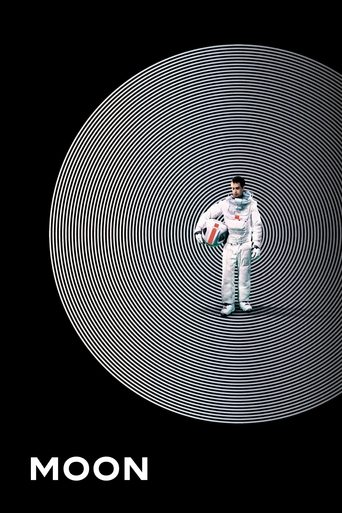
Moon
2009 · Film · 97 min
Part of Moon Collection
Directed by Duncan Jones
With only three weeks left in his three-year contract, Sam Bell is eager to return to Earth. Stationed alone at a Moon-based facility with his computer assistant GERTY, an unexpected accident sets off a series of unsettling events that shake his isolation.
59 positive5 negative35 neutralfrom 99 commenters
Where to watch
No streaming data for this title.
107 comments on Hacker News
Another fiction movie that explores this: Moon (2009) it's a very good movie!
Good sci-fi has always been few and far between. I love sci-fi, but I also dislike a lot of it because a lot of it's not well written from a prose craft or character depth point of view. When it is, it's probably my favorite genre.
I feel like we're lucky to get one outstanding sci-fi book or series per decade.
I'll rattle off some notable books and films/TV (or in some cases both) from the last 20 years. Some of these overlap with other genres like horror, lit-fic, etc., but I consider them all sci-fi to some degree. Some are well known and some are obscure.
The Expanse, Europa Report, Moon, Primer, The Arrival, Never Let Me Go, For All Mankind (the unofficial Expanse prequel), Sleep Dealer (indie film that stuck with me), The Color Out of Space (2019 film of Lovecraft's story), Banshee Chapter, The Peripheral, Blindsight, Annihilation, I'm sure I could keep going...
There was a movie where Moon was a hi-tech 'megastructure' with a white dwarf inside. I wonder if it would be theoretically possible to set up such a mini-dyson sphere around a mini-blackhole.
If data integrity is assured, and thus there is no change in the data to store/transfer, then that's the opposite of computationally transforming the data?
How do we see robot and AI and helping interactions in film and tv and games?
A curated list of films for consideration:
Mary Shelley's "Frankenstein" or "The Modern Prometheus" (1818), Metropolis (1927), I\, Robot (1940-1950; Three Laws of Robotics, robopsychology), Macy Conferences (1941-1960; Cybernetics), Tobor the Great (1954), Here Comes Tobor (1956), Jetsons' maid's name: Rosie (1962), Lost in Space (1965), 2001: A Space Odyssey (1968), THX 1138 (1971), Star Wars (1977), Terminator (1984), Driving Miss Daisy (1989), Edward Scissorhands (1990), Flubber (1997, 1961), Futurama (TV, 1999-), Star Wars: Phantom Menace (1999), The Iron Giant (1999), Bicentennial Man (1999), A.I. Artificial Intelligence (2001), Minority Report (2003), I\, Robot (2004), Team America: World Police (2004), Wall-E (2008), Iron Man (2008), Eagle Eye (2008), Moon (2009), Surrogates (2009), Tron: Legacy (2010), Hugo (2011), Django Unchained (2012), Her (2013), Transcendence (2014), Chappie (2015), Tomorrowland (2015), The Wild Robot (2016, 2024), Ghost in the Shell (2017),
Giant f robots: Gundam (1979), Transformers (TV: 1984-1987, 2007-), Voltron (1984-1985), MechWarrior (1989), Matrix II: Revolutions (2003), Avatar (2009, 2022, 2025), Pacific Rim (2013-), RoboCop (1987, 2014), Edge of Tomorrow (2014),
~AI vehicle: Herbie, The Love Bug (1968-), Knight Rider (TV, 1982-1986), Thunder in Paradise (TV, 1993-95), Heat Vision and Jack (1999), Transformers (2007), Bumblebee (2018)
Games: Portal (2007), LEGO Bricktales (2022), While True: learn() (2018), "NPC" Non-Player Character
Category:Films_about_artificial_intelligence : https://en.wikipedia.org/wiki/Category:Films_about_artificial_intelligence
List of artificial intelligence films: https://en.wikipedia.org/wiki/List_of_artificial_intelligence_films
Category:Films_about_robots: https://en.wikipedia.org/wiki/Category:Films_about_robots
Category:American_robot_films: https://en.wikipedia.org/wiki/Category:American_robot_films
Thanks for the numbers. I think it's still possible to create gists with .ipynb Jupyter notebooks which have can have latex math and code with test assertions; symbolic algebra with sympy, astropy, GIZMO-public, spiceypy
> and some way to attach them
Because of my love for old kitchens on the Moon.
(The cost then to put all of that into orbit, in today's dollars)
So, orbitally refuelling Starship(s) would be less efficient than 33 of the cited capability all at once.
This list is pretty short:
Template:Engine_thrust_to_weight_table: https://en.wikipedia.org/wiki/Template:Engine_thrust_to_weight_table
What about solar; could any solar-powered thrusters - given an unlimited amount of time - shove the ISS into a dangerous orbit towards the moon instead of the ocean?
> and some way to attach them
There's a laser welding in space spec and grants FWIU.
Can any space program do robotic spacecraft hull repair in orbit, like R2D2? With laser welding?
Or do we need to find more people like Col. McBride in brad pitt space movie, more astronauts?
It's a nice list. I've only seen a few of the movies on there. Offhand, that includes "Hotel Artemis", "Vision Quest", "Moon", "Automata", "It Follows", "Omega Doom", "Predestination", "Cube", and "Freejack". But quite a few more look very interesting and will be going on my personal "to watch" list. Thanks for sharing!
You must watch the movie Moon (2009). I strongly recommend. See https://m.imdb.com/title/tt1182345/
Collaborative writing (1), movie making (2), terrorist hunting (3), and volunteer forum moderation (4), are all things. Fanfiction (5) is also written for free.
All of these have been, in the past, variyng degrees of professional.
1. https://www.makeuseof.com/collaborative-fiction-sites-improve-writing-skills/
2. Iron Sky (2012), Moon (2009), Norwegian Ninja (2010) all involved free collaboration, to varying degrees.
3. https://www.youtube.com/watch?v=OR6epSP_Xlw
4. https://dl.acm.org/doi/pdf/10.1145/3491102.3517628
5. http://www.fanfiction.net/s/5782108/1/Harry_Potter_and_the_Methods_of_Rationality
Well, you have a point, but the separation is hardly as stark as all that. Both film and television have works that definitely qualify as Science Fiction, and some are even original rather than adaptations from books.
A few examples: 2001: A Space Odyssey, Fantastic Voyage, Moon, much of Twilight Zone and Outer Limits, Prospect, etc.
And for that matter there is plenty of SciFi in print as well, and it isn't all novelizations of movies and TV shows.
There is certainly more room for exposition in a novel (a fact which plenty of authors have abused over the decades, and plenty of directors have abdicated responsibility for by tacking on lengthy voiceover or on-screen text introductions), which often allows for more complete worldbuilding to explore whatever contrafactual premise the story is built around, but it is possible on-screen as well, as long as you don't rely solely on the dialog to convey it. For that matter, books shouldn't rely solely on the dialog for that purpose either.
Of course, on-screen dramatic works aren't the only ones that face the problem of conveying a setting in few words. Novellas, novelettes, and short stories have similar constraints to various degrees.
Firstly, I think many people will want to make the sacrifices necessary for the convenience. You don't have to have cables stretching across the floor. You can put marker tape on furniture. You can have the robot picking stuff up and putting it away rather than leaving it as a trip hazard. You can even replace human-centric objects with ones that are both human-friendly and robot-friendly (say, dinnerware that the dishwasher can easily grasp, move and clean). We already do this by buying microwave and dishwasher friendly stuff, to the point we are shocked when we discover that something isn't. Or we go to the expense of putting pet-doors in our human-doors so pets can use them independently. We are a highly adaptable species.
Secondly, I always liked the idea where your robot is suspended under rails in the ceiling (which you can see in the excellent movie 'Moon'). Advantage is it has more mobility than you because it can hover over furniture.
I had never heard of Moon and randomly picked it to watch on an airplane with no Internet. I was not prepared for that good of a movie!
You just reminded me of this little cinematic gem:
https://www.imdb.com/title/tt1182345/?ref_=nv_sr_srsg_8_tt_6_nm_1_q_moon
Edit: Movies, unsorted, from the top of my mind:
https://en.wikipedia.org/wiki/The_Limits_of_Control https://en.wikipedia.org/wiki/I_Origins https://en.wikipedia.org/wiki/The_East_(2013_film) https://en.wikipedia.org/wiki/Winter%27s_Bone https://en.wikipedia.org/wiki/Contagion_(2011_film) , seen before Covid, deemed to be realistic, and therefore better than stuff like https://en.wikipedia.org/wiki/The_Andromeda_Strain with https://en.wikipedia.org/wiki/Warning_Sign_(film) somewhere in between. https://en.wikipedia.org/wiki/Phase_IV_(1974_film) https://en.wikipedia.org/wiki/Wizards_(film) The remakes of the Planet of the Apes. https://en.wikipedia.org/wiki/28_Days_Later , https://en.wikipedia.org/wiki/28_Weeks_Later a little less so, though it had some great scenes of flying into London City Airport and the modern parts around that. Bladerunner in the original versions, the remake not so much. 2001: A Space Odyssey, the intro and first parts, spaceflight to the moon and such, the rest not. Too boring. I liked the sequel 2010: Odyssey Two better, actually. Avatar. Part one only. All of this https://en.wikipedia.org/wiki/Alien_(franchise) with the exception of the crossover stuff. https://en.wikipedia.org/wiki/Elysium_(film) for the almost cyberpunkish fuckedupness of it. https://en.wikipedia.org/wiki/Dracula_Untold https://en.wikipedia.org/wiki/The_Beach_(film) https://en.wikipedia.org/wiki/Harrison_Bergeron_(film) https://en.wikipedia.org/wiki/Idiocracy https://en.wikipedia.org/wiki/WALL-E https://en.wikipedia.org/wiki/The_Island_(2005_film) https://en.wikipedia.org/wiki/THX_1138 https://en.wikipedia.org/wiki/Logan%27s_Run_(film) https://en.wikipedia.org/wiki/Metropia_(film) https://en.wikipedia.org/wiki/Rollerball_(1975_film) https://en.wikipedia.org/wiki/Sleep_Dealer https://en.wikipedia.org/wiki/Southland_Tales https://en.wikipedia.org/wiki/They_Live https://en.wikipedia.org/wiki/Transcendence_(2014_film) https://en.wikipedia.org/wiki/V_for_Vendetta_(film) https://en.wikipedia.org/wiki/The_Puppet_Masters_(film) https://en.wikipedia.org/wiki/The_Survivalist_(2015_film) https://en.wikipedia.org/wiki/Supernova_(2000_film) https://en.wikipedia.org/wiki/Sunshine_(2007_film) https://en.wikipedia.org/wiki/The_Hidden_(1987_film) https://en.wikipedia.org/wiki/Patient_Zero_(film) https://en.wikipedia.org/wiki/Capricorn_One https://en.wikipedia.org/wiki/Hangar_18_(film) https://en.wikipedia.org/wiki/The_One_(2001_film) https://en.wikipedia.org/wiki/Timecop Ron Silverman Badass! https://en.wikipedia.org/wiki/Alternative_3 https://en.wikipedia.org/wiki/Lucy_(2014_film) https://en.wikipedia.org/wiki/Atomic_Blonde https://en.wikipedia.org/wiki/We_Are_the_Night_(film) https://en.wikipedia.org/wiki/Contact_(1997_American_film) https://en.wikipedia.org/wiki/The_Truman_Show https://en.wikipedia.org/wiki/Colombiana https://en.wikipedia.org/wiki/Knowing_(film) https://en.wikipedia.org/wiki/The_Dead_Zone_(film) https://en.wikipedia.org/wiki/Sphere_(1998_film) https://en.wikipedia.org/wiki/The_Adjustment_Bureau https://en.wikipedia.org/wiki/Arrival_(film) https://en.wikipedia.org/wiki/Lifeforce_(film) https://en.wikipedia.org/wiki/The_Fourth_Protocol_(film) https://en.wikipedia.org/wiki/The_Machine_(2013_film) https://en.wikipedia.org/wiki/Moon_(2009_film) https://en.wikipedia.org/wiki/The_Final_Countdown_(film) https://en.wikipedia.org/wiki/Firefox_(film) https://en.wikipedia.org/wiki/Paycheck_(film) https://en.wikipedia.org/wiki/Cypher_(film) https://en.wikipedia.org/wiki/Trigger_Point https://en.wikipedia.org/wiki/Echelon_Conspiracy https://en.wikipedia.org/wiki/The_Anderson_Tapes https://en.wikipedia.org/wiki/The_Parallax_View https://en.wikipedia.org/wiki/The_Last_Seduction
TV-Series: https://en.wikipedia.org/wiki/Survivors_(1975_TV_series) and the remake linked from there. https://en.wikipedia.org/wiki/The_Last_Train_(TV_series) https://en.wikipedia.org/wiki/Jericho_(2006_TV_series) https://en.wikipedia.org/wiki/The_Strain_(TV_series) https://en.wikipedia.org/wiki/Wayward_Pines https://en.wikipedia.org/wiki/Silo_(TV_series) https://en.wikipedia.org/wiki/Colony_(TV_series) https://en.wikipedia.org/wiki/For_All_Mankind_(TV_series) https://en.wikipedia.org/wiki/Yellowstone_(American_TV_series) and its prequel https://en.wikipedia.org/wiki/1883_(TV_series)
WESTWORLD!
https://en.wikipedia.org/wiki/Foundation_(TV_series) https://en.wikipedia.org/wiki/The_100_(TV_series) Praimfaya! Yeehaa! https://en.wikipedia.org/wiki/Counterpart_(TV_series) https://en.wikipedia.org/wiki/The_Ark_(TV_series) https://en.wikipedia.org/wiki/Altered_Carbon_(TV_series) All of Black Mirror! https://en.wikipedia.org/wiki/Serial_Experiments_Lain https://en.wikipedia.org/wiki/Travelers_(TV_series) https://en.wikipedia.org/wiki/Falling_Skies https://en.wikipedia.org/wiki/Devs_(TV_series) https://en.wikipedia.org/wiki/The_Peripheral_(TV_series) https://en.wikipedia.org/wiki/The_Expanse_(TV_series) https://en.wikipedia.org/wiki/Helix_(TV_series) https://en.wikipedia.org/wiki/Incorporated_(TV_series) https://en.wikipedia.org/wiki/Raised_by_Wolves_(American_TV_series) https://en.wikipedia.org/wiki/See_(TV_series) https://en.wikipedia.org/wiki/Tales_from_the_Loop https://en.wikipedia.org/wiki/Dark_(TV_series) https://en.wikipedia.org/wiki/Deutschland_83 and sequels. ÄXZÄLLÄNNT! JAWOLLJA! https://en.wikipedia.org/wiki/Humans_(TV_series) https://en.wikipedia.org/wiki/Into_the_Night_(TV_series) https://en.wikipedia.org/wiki/War_of_the_Worlds_(2019_TV_series) https://en.wikipedia.org/wiki/Terra_Nova_(TV_series) https://en.wikipedia.org/wiki/American_Gods_(TV_series) https://en.wikipedia.org/wiki/Ozark_(TV_series) https://en.wikipedia.org/wiki/The_Man_in_the_High_Castle_(TV_series) https://en.wikipedia.org/wiki/Ascension_(miniseries) https://en.wikipedia.org/wiki/Person_of_Interest_(TV_series) https://en.wikipedia.org/wiki/The_Event https://en.wikipedia.org/wiki/Origin_(TV_series) https://en.wikipedia.org/wiki/Pioneer_One https://en.wikipedia.org/wiki/Revolution_(TV_series) https://en.wikipedia.org/wiki/Resurrection_(American_TV_series) https://en.wikipedia.org/wiki/Salvation_(TV_series) https://en.wikipedia.org/wiki/Under_the_Dome_(TV_series) https://en.wikipedia.org/wiki/V_(2009_TV_series) https://en.wikipedia.org/wiki/Caprica
This all began about 2006 with https://en.wikipedia.org/wiki/Battlestar_Galactica_(2004_TV_series) after having abstained from possessing a TV, or watching that by other means (with some exceptions for news and documentaries) since 1996, and mostly no cinema either.
That stuff rehooked me in a binge-watching session. Shit happens :-)
Do yoo vanna häff fries wiff thät?
/nerdsnipe off
You can write what I know about space on the back of bus ticket, but isn't a problem that our moon is extremely hostile to life, with toxic radioactive dust, and levels of background radiation that are deadly? Was the movie "Moon" pure fiction?
Or maybe I should take my info from Wallace and Gromit's Grand Day Out and assume a Wensleydale mining operation.
Conversely, it was much more expensive than the movie `Moon`, which reportedly only cost $5M [0].
[0]https://www.wrapbook.com/blog/moon-2009
I do feel that way about sports — negatively, that they're a waste of time and resources that encourage the worst tribal instincts.
But big sports make people happy and they're only expensive compared to individuals, not compared to economies, so I don't try to campaign against what (sometimes little) joy other people can get in their lives.
Films are kinda weird now Starship — a billionaire's vanity project that doesn't have any current reasonable economic purpose (given SpaceX is already 75% of total planet-wide tonnage to orbit not just US) — is getting close to the point that Moon (2009) could reasonably be filmed on the actual Moon for the film's original ($5m) budget.
>Also, he3 is plentiful on the surface of the moon, so mining the surface of the moon will be performed to obtain the required fuel, which is the fundamental premise of the movie "Moon".
This is repeated a lot, but the practicalities are... questionable. Here's an article I consider to be the definitive criticism of the concept:
https://www.thespacereview.com/article/2834/1
I'm not that guy, but I can speak to what you're asking. I've followed Wendelstein 7-X for almost a decade.
Nuclear fusion occurs at extremely-high temperatures. As you heat your fusion fuel to sufficiently-high temperatures to allow fusion, the matter transitions into a plasma, which is great: plasmas react to electromagnetic fields. As such, a major challenge with achieving viable nuclear fusion is making a vessel capable of holding the fusion reaction. Because we can't create on-demand gravity wells, the next best option for confinement is using electromagnetic fields to hold the plasma in the air.
So, you now have an "electromagnetic bottle" capable of suspending a fusion reaction above the reactor's walls. Now, you have another issue: how do you ensure the fuel will sufficiently mix to sustain a fusion reaction? One approach is to move the plasma in a loop. The topologically-simplest method to accomplish this loop is the torus. Such a plasma-confinement device is called a tokamak. A tokamak uses two magnetic fields, torodial and polodial, to accomplish its task. The torodial field is driven through the plasma to push it forward, while the polodial field pulls the plasma in toward the center. Proper balance of these fields will allow the plasma to circuit the vessel following a helical path, achieving confinement.
However, driving two separate magnetic fields is energy-intensive, and a successful fusion reactor will want to minimize its own power consumption to maximize the amount available for external usage. Enter the stellarator. The stellarator also drives the plasma around in a circle, it but uses a single magnetic field. How? It "tricks" the plasma into "thinking" there's only one magnetic field by using computer-optimized magnets with highly-complex geometries. This provides stellarators with a major engineering advantage over tokamaks and is a primary reason Wendelstein 7-X would have chosen it.
With the confinement vessel topology largely identified, the next main step is to figure out how to build a vessel able to contain a sustained fusion reaction. For context, fusion experiments traditionally only operate on timescales of milliseconds to maybe a second. The reason? Fusion occurs at millions of degrees, and keeping the reaction vessel cool, ensuring a continuous supply of fuel, and dealing with reaction "exhaust" (e.g., alpha particles) and stray high-energy neutrons from the common deuterium-tritium reaction (which irradiate your reactor walls because neutrons don't react with electomagnetic fields) is a major, major engineering challenge. Any operational, net-positive fusion reactor must be able to operate for days, weeks, and months on end.
What Wendelstein 7-X has been attempting to do for years is demonstrate that building such a vessel is even possible. Their overall goal is to sustain a fusion reaction for about 30 minutes. Such a timescale will show a proof-of-concept system which enables sustained fusion reactions to occur.
Currently, the preferred fuel is deuterium-tritium because the fuel is generally available and has an attainable fusion temperature. The stray neutron issue can be mitigated by lining reactor walls with lithium to breed tritium fuel. Even better is to use the helium3-helium3 reaction, which completely annihilate to produce pure energy as the output (welcome to e=mc^2, enjoy your stay). The main holdups are: (1) the reaction occurs at much higher temperatures than deuterium-tritium, and (2) he(lium)3 is quite scarce on Earth. Once Wendelstein 7-X shows how to engineer a proper confinement vessel at a "lower" temperature, you can then work on the higher temperature levels required for he3-he3. Also, he3 is plentiful on the surface of the moon, so mining the surface of the moon will be performed to obtain the required fuel, which is the fundamental premise of the movie "Moon".
Someone asked for information on electromagnetic plasma containment folding. I recommend reading up on magnetohydrodynamics (MHD). It's the mathematical and physical foundation of your interest.
Watching MOON like it's a documentary.
and the movie "Moon" (2009).
"2010: The Year We Make Contact" is a much more accessible movie that holds up pretty well. It also feels like a payoff after investing so much time being confused/bored by 2001.
I was 11 when "Logan's Run" came out. Yes it's kinda loaded with 70's sex tropes for the first act, but it's also equal parts goofy and a really good film.
The original "The Day The Earth Stood Still" holds up.
"A Boy and His Dog" is a bit crude here and there, but might resonate with a 12yo.
"Quatermass and the Pit" (aka "Five Million Years to Earth") is both intense and fairly tame.
A lot of old TV series hold up - Twilight Zone, Outer Limits, UFO, Space 1999, Star Trek TOS, etc all have some excellent episodes.
I absolutely love "Dark City" and "12 Monkeys" but I'm not sure they'd have held my interest at 12.
Doctor Who, both old and new are excellent. Though I'm partial to the Tom Baker era.
The Stargate franchise is pretty good.
"Moon" (2009) is a bit cerebral but a good SF story.
I get the sense that you would like some adult themes, but not too slow?
Top of my mind (and in no specific order) would be:
- Dark City
- The Thirteenth Floor
- City of the Lost Children
- Tron (original and maybe new one)
- Interstellar
- Inception
- A Clockwork Orange
- Her (very relevant to our times)
- Dune (2021 version)
- Brazil
- The Martian
- Children of Men
- Edge of Tomorrow (most like Marvelverse on this list but still very good)
- Moon
- Twelve Monkeys
- Upgrade
- The Fifth Element
- Contact
- Okja
- District 9
- Predestination (very relevant to our times)
- Serenity (but might need some prep from the tv show before watching)
- World on a Wire
- The Abyss
- Minority Report (very relevant in our times)
- The Fly
- Videodrome
- Equilibrium
- Strange Days
- The Andromeda Strain (relevant after Covid)
- eXistenZ (trippy but I loved it when it came out and was only around your sons age)
- In Time (interesting class dynamics on display)
- Enemy Mine
- Franklyn (some interesting takes on mental illness)
- The Arrival
Gattaca, Moon, Gravity, Contact, Space Camp, Andromeda Strain, the original Westworld (1973), the first two Star Trek movies. The STTNG TV series, Another Earth (2011, PG-13), The Man from Earth.
Ghost in the Shell, Sunshine, Children of Men, 12 Monkeys, Edge of Tomorrow, Moon
The Expanse show/books are great
I’m waiting til 13 for Akira
Mine is 11 and matrix, terminator, back to the future, arrival were all too slow. He liked the Jurassic Park books but the movie was “too hokey.”
In its defense, I saw The Matrix at 12 or 13 and adored it because I felt like it was something more serious—-that I could appreciate it was a sign I was maturing, and I was grateful for that
Of course all kids are different. I always loved the Back to The Future movies from a young age. Moon is also harder fare while being less violent than The Matrix.
You might also enjoy watching the modern Doctor Who together? Or Star Trek?
As for more books, maybe introduce him to Hitchhikers Guide?
A similar topic explored in the 2009 small movie Moon w/ Sam Rockwell (and Kevin Spacey as the robot voice). The main character doing labor on the moon figures out he is one of dozens of clones, and the original guy living his happy life back on earth. If you could clone yourself and have the clone take your burdens so your life was easier, is that a fair use of your own body and mind to do so? Clearly the jump to our children says “no”.
There is no possible way you're casting your net wide enough if you don't think there are tons of good films coming out in "The West" every year. Or maybe you only like a small set of genres?
Horror's doing wonderfully, there's a bounty of good stuff, US and Europe both (since you specified the West—Asia, broadly, also puts out a few good horror films per year). 10+ films I'm very glad I watched per year, probably, and I do not manage to watch all the good ones.
Mid-budget sci-fi usually has a couple solid ones per year, too (Moon, The High Life, Annihilation, et c.), plus the rare high-budget good sci-fi film (maybe one or so per year? Dune, Blade Runner 2049, that kind of thing).
Usually a couple good-to-great westerns per year, at least, though they may not be the ones with the largest marketing budgets.
The average is trash, sure, but there's plenty of good stuff and you can just ignore the trash and still have plenty to watch.
> So why is it there is so much bad quality tv/films produced in the west? Such great opportunities wasted? I had great hopes for the Mandalorian. I couldn't watch more than 2 episodes because the story was written for 10 year old. Etc.
I'm with you on this. I think the average quality in Star Wars land is just so bad that a show that could be considered a peer of Hercules: The Legendary Journeys seems amazing by comparison. (I did finish it—playing "spot the influence/rip-off" was entertaining and occasionally made me feel smart for being familiar with whatever better thing the writers had also watched, I suppose)
Yeah, I know the one you mean. Not a bad movie either, though I think Moon did that part (and most things) better.
I looked it up and they _say_ the other movie was written before Moon came out, so it couldn't have copied, but feels like a pretty shallow denial to me. I suspect they just saw the screenplay or something, but what do I know.
This is an example of why I think "underrated" is such a difficult word in the context of movie recommendations.
In my view, Moon wasn't underrated. It was very well received overall by both critics and those who saw it[1], which is inline with how I felt about it.
However, it wasn't a blockbuster, and so the chances are there are many who don't know about it and who would enjoy seeing it.
[1]: https://www.rottentomatoes.com/m/moon
Brazil, The man from Earth, Moon, The fountain, Ad Astra, Donnie Darko, Ender's Game, Edge of tomorrow, Solaris (the old one), Westworld (70s), Metropolis (the japanese anime), Dark Star (trippy, 70s, great end), Firefly series and Serenity movie, Attack the block, Fifth Element, planet of the apes (the old one), ex machina, children of men
Importantly, it’s one of the rarest sci fi films where there’s no “supernatural” element whatsoever- no force, no Q, no monolith. Just man against nature. Only three movies I know doing this are gattaca, Martian and the moon.
Not completely related, but here a mockumentary movie about Russians visiting Moon in ~1910-1920s (I guess)
https://www.youtube.com/watch?v=ljKPnQNp_kA
It is beautiful even if you choose any random moment in the middle.
Okay, new book added to my reading list.
The book reminds me of the movie Moon from 2009 (https://en.wikipedia.org/wiki/Moon_(2009_film)) that had clone workers with limited life span. Really great story and execution, even though low budget.
After Snowpiercer, I'll watch anything Bong will do. I am sure it will be really great.
Moon and The Thirteenth Floor are two of my favourite movies which have not received the success they deserved in my opinion, compared to say The Matrix (all three as good and dealing with similar subjects IMO). It's rare but nice to see them mentioned!
I feel like I have a pretty good idea of what does and doesn't impact him; he reacts quite clearly if something is problematic (he's read/watched LOTR/Hobbit and one moment he reacted to in The Hobbit movies was Bolg vs Kili). Mal in Inception was probably the heaviest thing as the gunplay there isn't overly visceral. We've watched The Matrix together, Ready Player One (undead ballroom was fine, but skipped the old zombie in the bathroom) and Ender's Game (has a graphic bullying revenge scene). I love Moon, but the language is a bit old for him for now - one day though, as I think that's one of the tightest sci-fi stories, and will get him thinking. Blade Runner too.
He'd probably cope with recent Dune, which I thought was very polished. We should watch The Martian, as he read Project Hail Mary and liked it. From memory, Arrival would be good assuming some of the undertones went over his head. Contact is another good one in a similar vein (common element with Project Hail Mary and Arrival of decoding messages).
I really like your attitude, but I have trouble with regards to scary scenes / events (also cause I know some scenes/movies/series made a lot of impact on me as kid like the werewolves from Ghostbusters). I remember the original Tron as more peaceful / less violent. Interstellar didn't contain violence IIRC, but Inception does. The woman goes batshit crazy. I'd also like to add Moon and The Matrix. But again, be careful with suspense and children. Moon's ending was a bit lurid.
As for the point being, the movie is from 1982 and was on about a battle between sysadmin/ML/AI and users, its also a homage to a community which did not exist back then in the same effect it does now (the FOSS community).
Yes, Expanse is great.
Btw, I was talking about this sci-fi:
Moon
https://www.imdb.com/title/tt1182345/
Not sure we're talking about the same movie.
What’s wrong with the movie Moon?
What’s wrong with trying to transcend known Physics, there are so many things we don’t know, so speculating / imagining what is still unknown is part of sci-fi (as long as it’s not fantasy like the space mushroom network in Star Trek Discovery - which is not Star Trek anymore anyway)
And talking about logical consistency… Martian is good, but it had parts in it that were questionable, so I don’t understand why you’re not applying your same standards you used for Moon to the Martian.
"Moon", sci fi film. Has both an AI and a menial laborer...
Nice, thanks :)
Enjoyed the sci-fi / Moon[1] vibes at t=189[2] (those neons might be to improve visibility of the trucks in the dark and/or during storms?).
[1] - https://www.themoviedb.org/movie/17431-moon
[2] - https://www.youtube.com/watch?v=mI9R2H_KkQk&t=189
Direct harvesting is not possible with the fusion reactions we are currently working on. The products are electrically neutral, so the only way to harvest the energy is as heat.
Helium-3 fusion produces charged particles, which it might be possible to directly harvest as electricity. The He3 fusion reaction has a high activation energy, which is currently unachievable, and there is no Helium-3 on Earth. We'd have to get it from space, somehow. (The movie "Moon" was set on a Helium-3 mining outpost on the Moon.)
Moon falls just outside your "last decade or so" but would have been the exception that proves the rule. Deeply moving and intriguing sci-fi, all practical effects. I heard somewhere they used some models that were originally made for a Red Dwarf movie.
But an easier time from the Moon. The Moon's soil is apparently lousy with Helium.
There was a movie named Moon about a decade back where that was the main character's job, helium mining on the Moon.
That's not to say it would be easy, but it's closer than the Sun. Because it is everywhere.
In the various Star Trek shows, ships are made with something called "Bussard collectors" which basically scoop up particles like helium and hydrogen from space for use in the ship.
Obviously both of those example are fiction. We don't have the capability to mine on the Moon or catch elements free floating in space. But those fictions are based on the fact that those elements are that abundant.
That movie turned out an huge disappointment for me; that moon chase could have been the base to develop an interesting subplot (if not a much better main plot), but no, it was just a self contained albeit technically well made, action scene that could give nothing to a terrible movie.
Yeah, Arrival fits well and I enjoyed it. There are a number of lower budget films you could add to that list like Primer, Moon (2009), or Gattaca. Ex Machina is sci-fi + drama. I'm sure there's plenty more. There's just a tendency for sci-fi films to lean heavily into action (or occasionally horror) like The Martian film did when compared with the book.
Jurassic Park feels more action/horror focused to me, but it has a sci-fi premise.
Another similar recommendation is the movie Moon.
Movie recommendation: Moon (2009) sci-fi
Oh I didn't know that actually. Thanks.
Also, for anyone who is not familiar with Duncan's work, Moon is an amazing movie!
Stripped of the hyperbole, the article merely points out that space mining will only be profitable if the exercise is largely self-sufficient. If every piece of equipment needs to be launched from Earth's surface, then it's going to be very tough to make it profitable. I don't think the space mining start-ups he's so dismissive of were in any doubt about that.
His fictional example of "Moon" is illustrative. That film was set in a Helium-3 mining facility. Helium-3 simply doesn't exist on Earth. If we get to the point where we need it to power our advanced fusion reactors, then we'll have no alternative but to create a space-based mining industry. Once the infrastructure is in place for that, then lots of other space-mining opportunities will start to look tempting too.
Perhaps you can recommend some movies and shows then? I'd really appreciate it. Aside from Ex Machina and a few choice others like Moon and Black Mirror, I really haven't found any recent intellectual films or shows.
Same with -The Thirteenth Floor", one of my favourite movie, make sure you don't read any spoiler about it though.
Nexts on the list:
Moon
Ex Machina - I personally have no issue with nudity but I wish there were less of it in that movie because I know it turned a lot of people off
The Green Mile - not quite changed my view, but reinforced it
Westworld 3rd season (first 2 seasons revisit themes from above movies, they are good but not necessarily new themes)
Breaking Bad - I tend not to like series and this is a really long one, but it really does make you question things.
You know that movie, Moon, with Sam Rockwell? I started feeling like the first version of the clone right after finishing university. I just keep falling apart!
>The cutting device should be a small vacuum attached to the camera that can suck up a few strands at a time and trim those precisely.
Like Gerty in the movie Moon [1]? The problem is that it only works for straight hairs.
[1] https://www.youtube.com/watch?v=84Ewj-BOBuc
Pretty cool, one of them reminds me of the lettering seen in the film "Moon" with Sam Rockwell.
If you find this kind of stuff interesting you may like this blog series on creative development for Moon (2009): http://www.gavinrothery.com/they-never-went-to-the-moon
Lots of interesting insight into production tricks used for a modern low-budget sci-fi film. Including graphic/motion design, sets and visual effects.
Moon
Robot & Frank
9 (animation movie,https://en.wikipedia.org/wiki/9_(2009_animated_film))
Really? Because today, August 19th 2018, I search for Sci-Fi films and get like 20 totals results. Moon is not even in the Sci-Fi Genres for f*s sake. None of the greaty Sci-Fi indie films I used to get recommended to me 4 years ago even show up in a Sci-Fi search. Netflix has truly succumbed to their hiring/firing practices IMHO.
It seems they don't allow warehouse workers "degraded mode" with "performance targets based on previous worker performance." If a storage array were rebuilding I think most engineers would cut it some slack.
Not meaning to be flippant but I guess the difference is that with stateless processing you get disposable machines. Reminds me of Moon (film).
12 Monkeys - Travelling back in time to try and track the outbreak of a virus that wipes out most of humanity.
The Abyss - Survival and discovery on a deep water mining platform.
Apollo 13 - Look at the rescue efforts of this historical NASA moon mission. (Does it count as sci-fi?)
The Dish - Also not quite sci-fi, but a comedy about Australia's involvement in the first moon landing.
Battle for Terra - Surprisingly good animated movie about invading aliens.
District 9 - Alien refugee camp in Johannesburg.
Gravity - Astronaut stranded in orbit, trying to get back to Earth.
The Martian - Survival and rescue of a lone astronaut stranded on Mars.
Moon - After a serious accident, a solitary worker on the Moon discovers a conspiracy.
Oblivion - A veteran assigned to extract Earth's remaining resources begins to question what he knows about his mission and himself.
Predator - The classic that launched the franchise.
Predestination - Faithful adaptation of Heinlein's short story, "All You Zombies."
The Prestige - Some minor sci-fi elements. At the end of the Nineteenth Century in London, two stage magicians engage in a battle to create the ultimate illusion whilst sacrificing everything they have to outwit the other.
Source Code - Using limited time-travel to try and get information to stop a second, larger terrorist attack.
WALL E - In the distant future, a small waste-collecting robot inadvertently embarks on a space journey that will ultimately decide the fate of mankind.
Timecrimes (Los Cronicriménes) — a mind bending Spanish movie with time travel and paradoxes
AI (Artificial Intelligence) — about a little android boy who develops feelings and emotions
Gattaca
Summer Time Machine Blues (Japanese) — a hilarious movie with time travel (and all its paradoxes)
Moon
Europa Report
[I've avoided mentioning the more recent mainstream movies.]
I like the movie Moon. It deals with sending robots and people to mine Helium-3.
> I'd say you want an interesting but expect incredible production values
Smoke was an interesting movie, and cost $7M. (It didn't make much more but it wasn't a failure.)
Moon was a fantastic movie, and cost $5M. The little CGI it had was pretty obvious but didn't affect the viewing experience. (It also made near-zero returns.)
Requiem for a Dream was - and remains - an outstanding film. It flopped in box office but must have made pretty penny on home sales.
Dead Man is an interesting movie, and still one of my favourites. It works on the audience for the same reason Apocalypse Now does: episodic films in general are considered "artsy" and hard to chew, but turn them into thoughtful road movies and the audience enjoys the experience.
Pan's Labyrinth is just damn good. It cost €13.5 to make, and grossed $37M. Home sales must have added even more since then.
All the films above are both interesting and, in terms of bloated Hollywood budgets, were cheap to make. I would take any one of them over the perfumed sewage that floods the film theaters. And for reference, I did see Doctor Strange in a cinema so I do have a metric for calibration. My opinion stands.
> Glitch is a "Netflix Original" in the US, but it was made by ABC Australia.
Netflix is on the production team for the second season.
> It seems Netflix Original now just means "currently Netflix holds exclusive rights to this show in your country".
That's not really out-of-line with current industry norms though. Larger production companies buy the rights to films made by smaller production companies and put their names on them all the time. For example, Moon comes to mind. Sony didn't produce it but it's a "Sony Picture". Or Primer, StudioCanal had nothing to do with the production but is currently listed as the production company.
I agree with all of these but have to add some, because you are missing a lot of the classics.
- Alien (talk about classic Sci-Fi Horror)
- Westworld (watch the movie before the show. Trust me)
- 2001 A Space Odyssey
- The Thing (I've only seen the old one)
- Moon
- Children of Men
- 12 Monkeys
- Gattaca
- Blade Runner
- Dark City
- Akira (anime)
- Primer (my favourite time travel film)
- Interstellar
- Black Mirror
- Psycho-Pass (anime)
And of course everyone needs to watch - The Adventures of Buckaroo Banzai Across the 8th Dimension
Stargate. District 9. Inception. Equilibrium. Mad Max: Fury Road. Moon. Edge of Tomorrow.
Edit: The Man From Earth if you can dig independent cinema.
There is no fallacy. Everyone's here who is intrigued by this question but dissapointed with the rather simple and unresolving reply in this blog post, should watch Moon directed by Duncan Jones (David Bowie's son who recently directed Warcraft.) Questions like these don't have simple answers. I'm rather dissapointed with the hand wave of emotion the post author ascribes to. But it is bringing the topic up, so I am happy for that.
An old and maybe not terribly popular one is Enemy Mine. There are bad guys, but they're humans, and they only play a role near the end. But they aren't primary to the story. It's mostly a story of two people thrown together in a shitty situation and learning to get along despite their initial hatred for each other.
There are lots of scifi movies where the story only barely, rather than primarily, deals with the idea of good guys versus bad guys, if it puts them together directly at all. Moon, The Martian, Gravity are recent ones. Interstellar, in its way.
Less true of fantasy which pulls its stories from the idea of grand epics with noble warriors fighting monsters and villains.
Action movies without an idea of good guy and bad guy is a challenge. Maybe I'll think of one while I lie in bed tonight but off the top of my head there aren't any occurring to me.
The 16% score on Rotten Tomatoes suggests that he didn't. It's a shame because we could have had another movie as good as Source Code or Moon, the last two movies he directed. But instead it's this CGI waste of time that anyone could have made.
UI from Moon is not fake, it's sci-fi! :) Uhm... and it's not UI! btw, great movie.
ah, if HAL was IBM... GERTY is... ??? Apple? Linux?...
I need to rewatch Primer - it managed to twist my mind into a knot, so I honestly say I didn't understand much of what was happening. Moon is on my list, of Pandorum I haven't heard. Thanks for the titles, I'll definitely see them :).
RE shortening, I remember watching Ender's Game and leaving cinema angry, because the movie had compressed the book so much that I felt it won't make any sense for a person who hadn't read the novel. I now imagine that the Martian may have seemed similarly poor to you because of that. If you happen to read the book and find the text being crap, please get back to me, I'd really like to hear your perspective.
We, or rather - some of us - are talking not books, but book+movie combo. The Martian was quite a thing among space geeks even before the movie was announced, and doubly so after the story broke - so, like me, they probably implicitly assume others read the original too. I guess it's a lesson for me for the future, to bring up explicitly whether one had or had not read the book :).
You're right, I haven't read the book, the movie was my first exposure to this (unfortunately apparently?). To say it compresses it strongly better words so many of my issues with the movie than I could have put it. (in that it seemed like a series of set pieces attached together by musical interludes; echoing your lack of character development as well)
To answer the question from your other post, my "holy trinity" is Primer, Moon, Pandorum. (the first two on a pedestal above the third, but the third manages to fit in being an "action" movie without going too far down that road such that I can't but love it.)
If we're talking books, that's an entirely different discussion, and seems to be the one most people want to have when bringing up The Martian. I've certainly felt the same about some of my favorites. (I recall the whisper of a Foundation movie that made me want to run and hide)
Do they really? At the risk of letting my inner hipster movie snob out in force, I've found modern sci fi movies to be bottom of the barrel as far as any sort of plausibility/immersion goes. (As an example, I was screaming at the screen for the better part of The Martian, if only for the behavior and attitudes of the acting "astronauts" when compared to actual astronauts in critical situations)
Moon stands out to me as one of the few beacons of recent "hard sci fi", whereas many of the movies that got a lot of acclaim for having staff-scientists (gravity, the martian, interstellar to a lesser degree) just made me grumpy.
I've found modern movies play the same tricks as they always did, pick up on buzzwords and massage them enough such that the average joe can't tell the difference. Perhaps that's what the article means by "plausible-ISH", and I felt like they touched on this thrust in the "ten years ago everything was ElectroMagnetic Pulses" (not verbatim), nowadays we just have different tropes; I don't believe things have gotten any more sophisticated aside from that the internet forces the tropes to be "more correct" one or two levels deeper.
A lot of my bitterness is rooted in a combination of two things. One, the final sentence of the article hits the nail on the head. "You can only make so realistic a film where someone jumps over buildings"; Fine, but if you concede that, don't try and paint a thin veneer of half-assed realism over the whole thing. I will forgive just about anything in a more fantasy-directed sci fi, but if you start trying to be "hard", I'll hold a different standard. Second, the correctness seems to often play second fiddle to whatever set pieces or plot is desired. I understand this may be a pragmatic necessity, but it's very obvious when the two start to generate friction against each other (scientific realism and plot) and I long for this to be balanced elegantly, with the science as a more integral component (truly "leading the story" as the article likes to suggest they are attempting) rather than the stucco you paint on after the fact, disguising up a weak skeleton against only the most peripheral examination.
> The 3He thing may not hold water, but the film just isn't about that.
Honestly your point kinda ruins the article entirely. What does it matter that 3He mining is implausible? It's an excuse to tell a story, and the story being told is the important part, not the 3He mining. I don't watch something like Moon to learn more about 3He mining, so it's plausibility doesn't matter to me—although maybe that's not the same for the author?
On the other hand the 3He thing gave us Moon. The 3He thing may not hold water, but the film just isn't about that.
Edit: Oh, and don't worry about jeryk-cam, it's very sedately paced in that respect.
https://en.wikipedia.org/wiki/Moon_(film)
2km/s means you are limited to about 20% payload. 20% is 10x better than a normal rocket, but there are actually easier ways to get 20%.
The beamed power method gets about 20%, and works for humans (no g load). Escape Dynamics is trying it: http://escapedynamics.com/edispacelaunch/.
The difficulty here is more technical/scientific than engineering. Synchronizing microwave beams is hard, and if you don't you get destructive interference. I don't know if they have solved that problem yet (there have been a few proposed solutions, we'll see if any work).
Edit: Yes, rail would work great on the moon/mars. Actually there was a movie (Moon, with Sam Rockwell) where fuel is harvested on the moon and shot into orbit. Fun, crazy movie.
I had to think about the movies Moon and Oblivion. Not everyone can do the job so the right people are cloned to keep the job going on and on.
I really liked all of them, but episode 2 was probably my favourite of season 1. It is over the top compared to other parts of the series, but not compared to other experimental far future or alternate universe scifi. For example: Dark City, Idiocracy, Cube, Moon, Battle Royale, Maze Runner.
Completely off-topic, but if you haven't seen Moon, do it.
It's an amazing movie.
Also Moon. http://www.imdb.com/title/tt1182345/
Moon was such a wonderful movie on so many levels.
Side note: there is a really detailed blog about the typography in Moon which was on HN a while back: https://news.ycombinator.com/item?id=7236411
I think it's getting better. In Moon (2009, also spoilers ahead, depending on how you interpret it) the AI actively helps the protagonist. My dad kept wondering when the AI would go rogue or try and stop the protagonist, but the AI never does. It helps the protagonist because that's its purpose. It quips numerous times throughout the movie "I am here to help you."
I worked on the post-production of Moon, particularly the titles and the screens in the base and Gerty's face. Pretty humbling to have someone pay so much attention to what we did!
It's funny to hear about the Microstile/Eurostile differences - when we had to replace type that was on the real set we made new elements using Eurostile, so there are probably some inconsistencies.
The Bank Gothic/gradient fill/outline choice definitely haunted us for a while after - it was already a bit of a scifi poster trope but it's got out of control since. I've cringed a few times seeing posters on the tube and wished we'd picked something slightly different. I remember being keen on an outlandish faux-Cyrillic face at the time but it wasn't legible enough. I did win the argument about colour though - my boss at the time did a bunch of concept frames with translucent orange type for the main credit lines... there's a little interview with him here: http://www.artofthetitle.com/title/moon/
Maybe it's too obvious to bear mentioning but there's a big foreshadowing in the shot where Sam Rockwell's credit appears - a second copy of his name dissolves up out of focus further back inside the base...
The OCR-1A type was set by me, in a slight hurry as I recall, type-on effect and all. It had to look different to the Bank Gothic credit lines, and I'm sure we tried the obvious Eurostile and it wasn't readable or was too heavy for that amount of text. It feels a bit of a case of too many faces in succession, in retrospect. I love machine-specific typefaces. I think I first got into them after reading The Computer Contradictionary, which mentions E13B a couple of times, the type used for the numbers printed in magnetic ink on cheques: http://en.wikipedia.org/wiki/Magnetic_ink_character_recognition. That book is worth a look if you appreciate a bit of cynical tech humour... http://books.google.co.uk/books?id=tZKCZje8178C&printsec=frontcover#v=onepage&q&f=false
The dot-matrix background on the text fields of the "big board" with the countdown on it was probably my bad also... we replaced that whole board wherever it appears in the film because the real prop had light leaking into the four harvester status lines and you could see they were acetate. We definitely tried having the letters formed by the actual dots but they weren't legible enough, and making the dots smaller made them not legible enough. Sense of nerd embarrassment. I guess it's some kind of future display technology with... big dots? Err...
Trivia: the postcard reading "wish you were here" was inserted in post because we had to cover up the real one which couldn't have its rights cleared ;)
More trivia: there was a spelling mistake on one of the panels on set, the one which says "satellite uplink" when Matt Berry is yelling at Gerty. It was caught by QC and I have some memory of fixing it for that shot since we'd inserted the video into that screen anyway, but it might be visible in other shots. It had "satellite" spelled "satelite".
Looking forward to more from that blog. I've thought of starting something similarly one-track, favourites being "over-obvious ND grad filters in film" or "non-circular lens vignettes done badly in post through the ages" or "10 worst skies graded without highlight rolloff" ^_^
I don't really understand. There are plenty of examples of work that discuss films without spoilers. Professional reviewers, especially, excel at this because they are explicitly aware of what parts of the movie will be fascinating to discover. And so your idea that everyone should cover their ears and run for the hills when they hear the word Moon would prevent them from finding out whether, say, they might want to watch it in the first place.
But regardless, you're missing the point. No one is complaining about the article containing spoilers or are trying to shut down the discussion; I think you must be reading too much connotation into the term "spoiler". What we're doing is providing the advice that people haven't seen the movie may wish to do so first, because it may be a lot more fun (I understand you may disagree, which is fine, but I stand by the advice). Your diatribe against "the cult of no-spoilers" is simply misplaced.
For similar stuff, don't miss the link at the bottom to the blog of the designer behind the film:
http://www.gavinrothery.com/moon-blog-index/
I notice a recurring theme of '80s retro-futurism in Moon. It all looks like the way we imagined the future at the peak of the Space Shuttle, but with little nods to modern technology to avoid obvious anachronisms. Brilliant design.
For example, the black-backgrounded GUIs with wide text on them remind me of old DOS-era applications, but they're displayed on modern high-resolution flat-panel displays.
The T-shirt is also painfully '80s, as directly noted. The only music mentioned is an early-'90s song that was hokey the day it came out. The Flowbee and the magazine are other noted '80sisms.
The rescue-crew-manifest with poor-quality black-and-white images on a color screen? That could've been lifted directly from the '80s-era Alien films.
Which really, all makes sense - the '80s were the end of the space race. For space-travel nostalgia, that's where you go for modern Gen X movie fans.
I'm not really a font nerd, but I disagree with:
"Moon uses an interesting angular typeface for its location-establishing shot... This typeface is OCR-A, which was designed in 1968 for use in optical character recognition systems.... Moreover, it looks like THE FUTURE, and so it makes a perfect choice for on-screen interstitial positioning shots."
OCR-A does not look like THE FUTURE; it looks like the future in 1968. To me, it looks like bitterness and cynicism. Apparently, it looks that way to others, too, since it or something similar is used in the same way for every other similar movie.
I haven't seen the movie. Is that message typed out on the screen, complete with teletype noises? That has to be one of the weirdest anachronisms ever adopted as a trope.
Clint Mansell's original soundtrack is absolutely fantastic. I read they managed to get him involved in the film because it was during the writers strike 07-08 (remember that?!) and Hollywood had ground to a halt, hence Mansell and ilk were looking for projects to keep them active.
I like your song, but it's a different vibe. To my ear, it sounds a bit too military to be Moon. I do like the vintage synth sounds though!
I disagree. Even without plot twists, a movie is often a process of discovery. You explore the character, narration, allusions, themes, and language in the order they're shown in the film. And Moon in particular is such a carefully paced movie. So while I agree that the plot spoilers may not matter much in this case, I think you'd have a much different and likely inferior experience watching Moon after reading this because of all the other stuff it reveals.
So what Biot said: go watch Moon and then come back and read this excellent blog post.
Before this post, I was thinking about watching Moon again. It's such an incredible and unknown film. I will watch it again.
If you haven't seen Moon, then the following song will not make sense, but the sense of desolation and uncertainty rhymes with the film. The ending of the song captures the denouement @ 7:20.
http://grooveshark.com/#!/s/Downfall/2VQtYZ
Moon was fantastic.
Just a warning: if you haven't yet seen the movie, the article contains significant plot spoilers. Moon is a fantastic movie, so go watch it on Netflix then read all about the typography afterwards.
moon was a great movie. it was the movie oblivion could have been.
This is great.
I remember the first time I watched Moon and felt like I recognised the style of the design. Then later in the film when I saw the vehicles I thought to myself "That looks like massively like Gav's design"; referring to Gavin Rothery who I'd worked with a number of years earlier at a games company called Pure Entertainment.
We both worked on a title called Lunatik, which was a futuristic space game - I did the Playstation 3D graphics engine and he worked on the concept models for the spaceships, cities, etc. Very bladerunner-esque.
When I left the company we lost touch, so it was very nice to see his name up in lights on the credits 10 years later - and to just recognise his style without knowing that he'd worked on it.
Haven't seen that one, but the first thing that popped into my head was "What about a movie like Moon?" I mean there was really just the one main character, and I suppose he talked to his wife and daughter who were both named so it gets an A grade. But they were the only two female characters that I remember and I don't think they really added a lot to the gender equality context seeing as they were the stay-at-home family back on earth.
The formula is just so simplistic. If you wanted to build a comprehensive metric you'd probably want to take a few factors into consideration. Maybe a ratio of dialogue to on-screen time for female characters vs. male characters. Perhaps number of non-traditional female roles vs. traditional roles. I don't know. There should be something better than an eye-test some comic from the 80's threw out there.
Our algorithm tries to things: to flag the bad torrents so they're not displayed, and to not penalize the rare torrents you get for old/unpopular movies.
Moon has bad results because the title is only one word, and Twilight's sorry excuse for a movie happens to be the same year.
We'll definitely look to improve that, thanks for the feedback.
It certainly looks nice, but it's not really accurate. E.g. the page for Moon links to Twilight torrents: http://movies.io/m/9t
Your post consists almost entirely of factual errors:
You'd lose too much power in the beaming process
http://en.wikipedia.org/wiki/Wireless_energy_transfer#Microwave_method
"Rectenna conversion efficiencies exceeding 95% have been realized."
Here's another experiment that achieved 84% efficiency. http://en.wikipedia.org/wiki/Space-based_solar_power#Microwave_power_transmission
you'd have a death ray beam that destroys anything that flies between it
http://en.wikipedia.org/wiki/Microwave_transmission#Common_safety_concerns
A bird flying above a rectenna on actually proposed designs would feel warmer and keep flying.
but then you'd need a collector dish the size of montana.
There are no collector >dishes< involved, as far as I know, rectennas don't need a parabolic reflector. Parabolic dishes add directionality, but increasing the effective aperture is a better design for power receiving. Proposed collector area is typically on the order of one or a few squares mile, which compares favorably to the footprint of existing power generation schemes.
The best idea might be something like in the movie Moon where the power is stored chemically, then shipped back to earth.
The power wasn't stored >chemically< in the movie.
I think it's been shown that it's infeasible. You'd lose too much power in the beaming process, or you'd have a death ray beam that destroys anything that flies between it... you could increase the area, but then you'd need a collector dish the size of montana.
The best idea might be something like in the movie Moon where the power is stored chemically, then shipped back to earth.
Would you happen to have a list of the movies available?
And just a few recs (not really 'hidden', per se): Moon, Pi, Soylent Green, The Producers (2006), and Thank You for Smoking.
I won't spoil it, but if you think that concept is neat, you owe it to yourself to go watch _Moon_. It's one of the best sci-fi movies I've seen in a long time. Highly recommended.
Off topic—
Sam, did you enjoy the film? Yes, Siri, very much How many stars out of five would you give it? Four. Thank you, Sam. I will try to recommend similar films in the future.
Has anyone watched the 2009 film Moon? I read that whole conversation in Kevin Spacey's voice.
We can't 'force' this kind of knowledge to appear, but we can concentrate on research to speed-up the discovery of such knowledge. We have no way of saying that there isn't a reason, all we can say is that we don't know it.
Let's say there was an island that was Uranium rich and hard to reach in ships. If we were in the 1800's, would it be worth the cost of building ships to get there? The answer is obviously no. These days, however, it certainly is.
We are dealing with unknown unknowns. Both in the substances the moon can provide, and their possible uses. All we can say is that with our current knowledge, we do not have an economic reason to go to the moon. Find some abundant power source, like in the movie Moon, then it will be economically viable.
Scientists can be impulsive beasts too, ignoring the facts and trying to prove their hypothesis. They can even contribute work to a hypothesis, when they don't even believe it themselves (maybe even trying to disprove it). Schrödinger and Einstein had a rather negative view of a lot of quantum mechanics, but they both made large contributions to it.
The blog has quite a few photographs and a lot of discussion on how they merged actual models and CGI for "Moon" ( http://www.imdb.com/title/tt1182345/ ).
Additionally, there are quite a few questions and answers in this Reddit thread, as well as multiple spoilers: http://www.reddit.com/r/reddit.com/comments/f50mf/sci_fi_if_youre_interested_in_the_scifi_movie/
I find it amazing how much detail and care the designers put into the set, given how low-budget the film was. This is definitely an example of how ingenuity and conscientious problem-solving can make up for a lack of funds.
Lots of them working together means active traffic management becomes critical to prevent collisions. That'll be regulated because even if they're moving things the size of bricks rather than I beams, do you want to see what happens when two hovering robots each carrying a brick 5 metres off the ground bump into each other and suddenly stop hovering? Or if they start creating turbulence for each other and interfere with flight even without contact? Even if it doesn't get regulated by law the insurance implications would force de facto regulation.
Lots of small components means more joints. With a brick as our example that's fine but I'm not convinced the gain over a squad of fairly cheap bricklayers is there - with a girder frame structure as is more typical for large commercial premises that means for the same design it's simultaneously weaker, heavier and more expensive. Not a trio of attributes I'd want to apply to my structure.
This is a sort of technology I love, that's clearly very interesting and with all sorts of potential. But I don't see construction as the ideal target market for it, by a long way. Freight unloading would have been a great case had it not gone containerised some years ago. Warehouse order picking as with Amazon et al? Perhaps. You can have the storage floor as a controlled space without people underneath which reduces the safety issues and there wouldn't be the same problem with noise nuisance. If we wanted to go down that road though I'm not sure it's a big enough win over cranes / arms and conveyor belts, or that either is a win over fairly cheap people pushing trolleys (having worked alongside exactly that in the past).
If we want to stick with construction it would make good sense for use in hazardous environments because it would provide a way of deploying a large, highly mobile force to an area where you couldn't deploy human labour (or where that deployment becomes severely impractical / unattractive for whatever reason - see the film 'Moon' for example), but I'm not sure that's a large enough market to justify the expense of developing the tech enough to make it fully usable. There doesn't seem to currently be a shortage of labour prepared to go and work in Siberian gold mines or northern Canadian tar sands quarries, for the right price, and I can't see the power technology for these devices scaling to the point to make them likely cheaper any time soon to invest in it.
Cool tech searching for a better application IMHO. I'd love to see that better application though and would be heading down there to watch when it happened.
* Life is beautiful
* Last Train Home
* Brokeback mountain
* Slumdog Millionare
* Aftershocks (Tangshan dadizhen)
* Bus 174
* Moon
* The Wire (TV series)
* Zorba the greek
* City of God
That is quite scary. And to dig even deeper would be the ability to predict what a user is just thinking in his or her head. Or reacting or showing customized options based on a user's mood, which could be used for both good and bad purposes. Good if it's a system that's intention is to be purely helpful to a user, such as in that computer in the movie Moon. But bad if it's system meant to manipulate users into doing things they won't necessarily want, such as convincing people that they "need" to have a McDonald's Big Mac.
I saw Moon and thought it was good too. I liked how it seemed to intentionally and quite successfully avoid every cliched direction the story could have taken.
The only confusing bit is whether he was actually ever in the real world at all, or it was all a dream. This is almost the main concept of the film, and not answered when we see the spinning top still spinning at the end.
Yeah, though I didn't really see this as confusing, simply an unknown left open to interpretation.
I was half waiting for some kind of twist like say, it turns out that Cobb was dreaming the whole time and is in reality the heir to the company and is the target of the Incpetion... or something. I didn't really think that one through too deeply though and I'm not sure that a twist like this would have made the movie better in any case. I guess it just comes back again to that expectation that was built up in me of it being a full on "mind fuck" movie. In some ways I was kind of happy walking out of the cinema that my mind had not been fucked, just well entertained.
The only confusing bit is whether he was actually ever in the real world at all, or it was all a dream. This is almost the main concept of the film, and not answered when we see the spinning top still spinning at the end.
Great film, glad to see a great sci-fi film doing well at the box office as well. Moon was a great story last year, that did not do so well. Worth checking out.