 Hacker Cinema
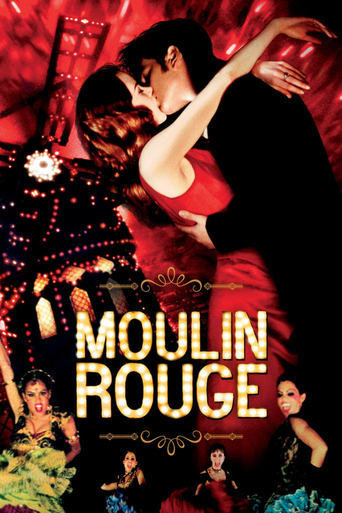
Moulin Rouge!
2001 · Film · 128 min
Directed by Baz Luhrmann
A celebration of love and creative inspiration takes place in the infamous, gaudy and glamorous Parisian nightclub, at the cusp of the 20th century. A young poet, who is plunged into the heady world of Moulin Rouge, begins a passionate affair with the club's most notorious and beautiful star.
1 positive2 negative6 neutralfrom 9 commenters
Where to watch
No streaming data for this title.
9 comments on Hacker News
Whether so intended or not, I like to think it was a response to Angell's The Great Illusion.
Both were written at, and the film Moulin Rouge! strives to depict, a time whose specific and rather rancid vibe the phrase fin de siècle (literally 'end of cycle' sharing the relevant root with 'secular,' but in proper translation 'end of the century') was adopted into English to describe. That phrase has been occurring to me with some frequency this year.
Only a small percent of people will actually produce ideas that other people are interested in. For most people, AI tools for building things will enable them to construct their own personalized worlds. Imagine watching movies, except the movies can be generated for you on the fly. Sure, no one except you might care about a Matrix Moulin Rouge crossover. But you'll be able to have it just like that.
There's much this articles doesn't mention, such as the hugely popular modern representation of the song in the movie Moulin Rouge, and the songs origin in a Yiddish song and even as far back as Dvorak: https://en.wikipedia.org/wiki/Nature_Boy
As a fan of post-modern movies, I would love if this was the case. However I’m afraid that you are misremembering history a bit here. Postmodern movies heydays have long passed. I’m afraid the reached their peak in the 90s with e.g. the Danish dogma movies (pun intended), independent American movies like Clerks, etc. In fact Pulp fiction was a counter punch to the scene by taking elements of postmodern movies, telling a pulp story and dressing it in a Hollywood film. Ironically it is a long running joke among postmodernists to over-analyze Pulp Fiction with a postmodern reading.
Postmodern films got a tiny resurgence around 2007, but never with the same popularity as the pomo scene of the 90s.
So Lord of the Rings is made between those two modes. The movie industry is living in the wake of the unexpected Titanic success, and the studios are trying to create the next big hit. Movies like Gladiator, Pearl Harbor, Cast Away, Meet the Parents, The Mummy, Moulin Rouge! or Chicken Run etc. is what most people are seeing. The themes of the post modern movies is indeed far away.
Here's a list I stole from Quora: https://www.quora.com/What-films-have-the-lowest-average-shot-length-ASL
ASL 1.55 - Doomsday (2008) : 4052 shots over 105 minutes
ASL 1.72 - Transporter 3 (2008) : 3360 shots over 96 minutes
ASL 1.73 - Domino (2005) : 4046 shots over 116 minutes
ASL 1.83 - Quantum of Solace (2008) : 3198 shots over 98 minutes
ASL 1.84 - Crank: High Voltage (2009) : 2718 shots over 84 minutes
ASL 1.92 - Transporter 2 (2005) : 2524 shots over 81 minutes
ASL 2.01 - Band of Ninja (1967) : 3424 shots over 114 minutes
ASL 2.01 - Moulin Rouge! (2001) : 3594 shots over 120 minutes
ASL 2.03 - Gamer (2009) : 2502 shots over 84 minutes
ASL 2.03 - The 6th Day (2000) : 3418 shots over 116 minutes
ASL 2.08 - Hot Fuzz (2007) : 3304 shots over 115 minutes
ASL 2.10 - Dark City (1998) : 2982 shots over 104 minutes
ASL 2.15 - Armageddon (1998) : 4025 shots over 145 minutes
ASL 2.17 - The Transporter (2002) : 2420 shots over 87 minutes
ASL 2.17 - The Bourne Ultimatum (2007) : 2910 shots over 105 minutes
Paris is a big city, that's all. The Eiffel Tower and Moulin Rouge are not among the most interesting things to see in Paris. People are not like in a Disney movie.
3D was a big part of Baz Luhrmann's The Great Gatsby. It made me wish Moulin Rouge had been done in 3D.
I think using 3D effectively is hard, and most films being made don't have a good reason to use it. It also makes my eyes feel a little uncomfortable, so I'm not crazy about it getting widespread use. Most filmmakers don't have the visual sense (and budget/tech crew) of Baz Luhrman or James Cameron.
The Wizard of Oz was a really masterful tech demo for color, because color was a pivotal part of the story. 3D's problem is that it has been totally driven by technologists and financiers rather than storytellers. If the first big 3D film were The Great Gatsby rather than Avatar I think we'd have a very different sense of what 3D is. Although The Wizard of Oz may be unique in the way the tech manages to serve the story just as much as the story serves the tech.
Well, the story is a combination of typical archetypes retold with pretty pictures. That much I cannot argue about. And I think that what you are really saying by "the plot sucked" is "it's too archetype driven". I'm basing this on:
>I personally found the warmed over "Stupid White Man penetrates exotic closed society and rises to be leader of it, seducing the native woman" plot tiresome, repetitive and tedious
Sure the characters ranged from a bit 2-d (the Col.) to well fleshed out (Neytiri (watch it again if you don't believe me)) and the acting ranged from "will probably win an award it was so good" Saldana to "thanks for showing up and picking up your paycheck" Weaver. But that's nothing different than you'll find in almost every movie -- the principles are fleshed out and the supporting cast is flat.
Why can't we have more 'smart' movies like Erin Brockovich/Schindler's List/Fight Club/District 9/Oldboy/etc. (archetypes of David vs. Goliath, Greed and Bullies) or The Incredibly True Story of Two Teenagers In Love/Léon/American Beauty/Mississippi Masala/South Pacific/Moulin Rouge/West Side Story etc. (Forbidden Love) or Lawrence of Arabia/Dune/Hunt for Red October/etc. (Lovable Turncoat)... you ask? And I'd counter that all of those are as archetype driven as any other well known flick (archetype stories provided in parens).
You see where I'm going with this. Even if you don't agree with all my movie choices as being "good" or "smart" you'll at least have to agree that most movies that are at least reasonably well known are pretty much based on a dissection or aggregation of common archetypes. How many times has Romeo and Juliet been retold almost verbatim? And by and large the audience enjoys these things and says "oh the plot was so good" when really, they are just a rehash of old story ideas. We even group movies into archetype driven categories "love story", "ghost story", "suspense", etc.
So yes, I was being "cute" with my notional art-house flick. But if you want to find something not driven by archetypes, where the artists consciously try to avoid those things, you have to go there, or to France or Italy perhaps. Here, http://www.imdb.com/chart/top this is the top 250 movies on IMDB not by dollars but by rating. How many of these are "smart" movies meaning "not a rehash of archetypes"? Very few if any.
It's pretty simple really, if you don't want your intelligence to be insulted (meaning you don't want an archetype driven story), you end up with a movie about a vapid cowgirl/model with giant thumbs or a movie director that can't focus on making movies because he's too busy with all his mistresses (which is actually just a retelling of the "guy with too many girlfriends archetype"). And given that non-archetype driven movies are typically poorly rated and attended by the open public, either you are particularly "smart" or those movies tend to suck.
No. You're wholly, unequivocally wrong.
A movie is good based on certain various aspects. There's the directorial technique. There's the cinematography. There's plot, there's acting. Donnie Darko had almost nothing.
The plot is extremely basic. The only reason people call it deep and confusing is because the director was absolutely shitty. It was his first time ever with a camera, and so the guy had no sense of timing and placement. The cuts are awful: I'm not a huge film buff but they made me cringe. The writing is thoroughly terrible. Donnie is a Mary Sue: hot, people like him (or, the right people do), he's very smart. Look at how he cuts down that strawman presenter at the start of the movie! Never mind that the arguments he makes are extraordinarily basic, or that this is a supposed professional he's arguing against. When I was 14, I had these same fantasies as myself as somebody who could say basic stuff and get away with its seeming clever. The problem is, by the time I was 15 I'd realized the valuable lesson that people tend to be smarter than you assume at first, and that they can respond to dumb stuff like that.
Other people my age didn't get that lesson, and as a result became unpopular, developed lots of weird obsessions, and left school with fantasies of themselves as supersmart supermen. Richard Kelly, the director of this movie, absolutely seems like one of these people.
In an interview I saw of Kelly, he says that the movie's not at all deep or complex. In his mind it's a straightforward movie. That shows the utter incompetence of the guy. He wasn't out to make something complex, and he made the movie so poorly that people decided it had to be complex and brooding.
Look, for instance, at the movie's much-lauded connection with the Reagan era. Once you've been told it's there, yeah, it's obvious. Beyond that? It's not a consistent theme. There are two or three moments where it's over-the-top blatant in your face, and beyond that it's completely abandoned and ignored.
The fact that you can't understand the movie without reading an external web site is a flaw. If you make the movie well, the entire thing is internal and consistent.
Acting-wise: yech. Nobody does a good job. It must have been because of the directing intent, because Jake Gyllenhall is a good actor when he's with a good director. In this he had about one tone of voice overall.
A good friend of mine who's a film buff once said of Donnie Darko and Moulin Rouge: they're the two tests of what kind of a movie person you are. If you like them, you're saying that you're willing to ignore a lot of flaws in a movie's conception for the sake of its glitzier sides. I agree with that statement, particularly about Donnie Darko.