 Hacker Cinema
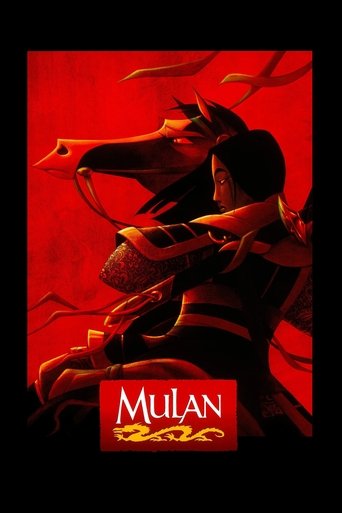
Mulan
1998 · Film · 88 min
Directed by Tony Bancroft, Barry Cook
When Imperial China calls one man from every family to defend the empire from invading Huns, a young woman disguises herself as a soldier to take her ailing father’s place. Facing ruthless invaders, brutal training, and the risk of execution if discovered, she must decide who she truly is—and what she’s willing to fight for.
7 positive7 negative10 neutralfrom 24 commenters
Where to watch
No streaming data for this title.
24 comments on Hacker News
Interesting, I think the film versions feel like they have more gravitas, especially the Lion king and Mulan scenes.
I'm not sure if I'm just young enough to be on the other side of this despite seeing all three of those Disney movies as a millennial kid (Lion King and Aladdin were VHS mainstays in my house, and I remember seeing Mulan in theaters), but I honestly don't find the film grain to look better at all and think all three of those bottom images are much more appealing. For the Toy Story ones, I think I'm mostly indifferent; I can see why some people might prefer the upper film images but don't really think I'd notice which one I was watching. I'd definitely think I'd notice the difference in the 2D animation though and would find the film grain extremely distracting.
The texture of the film grain makes Mulan and Aladdin really look better. The large simple filled sections look like they have so much more to them.
There is another film structure that is super common but is often overlooked. It is perhaps not coincidental that the protagonist is more often a woman. I found a blog post describing it once, but can't find it now.
In the typical three-act structure, the protagonist must make an internal change to themselves before they are able to resolve the conflict.
In this alternate plot structure, it is the community itself that must change. The protagonist is "right all along" and serves to the be the catalyst for that change. Almost as if society is the protagonist. It looks something like:
1. Inciting incident where problem appears.
2. Protagonist attempts to tackle problem using their "true self".
3. Family/village/community smacks them down and says they can't do that.
4. Protagonist tries to conform and solve the problem the way they are told to but fails.
5. Climax: Running out of options, the protagonist unleashes their true inner self and solves the problem.
6. The community witnesses this and realizes that they should accept the protagonist for who they are.
This is very common in Disney movies (Mulan and Frozen being stellar examples) and in family movies where the protagonist is a young person that "no one understands".
It is sometimes mixed with the typical three-act structure where the protagonist also makes an internal "change", but the change is most often simply accepting who they already were at the beginning of the film before trying to deny that throughout the second act.
I had huge hopes for Mufasa and it was extremely mediocre. Below Wish and Moana 2 IMO. The bones of the plot were good, but the directing was bad. Too much crammed into too little runtime.
The music in recent Disney movies hasn’t been great, with the exception of Encanto. I just watched Mulan again and holy crap what a good movie. (Although it’s not Disney, I also watched Prince of Egypt again and that’s better than any movie Disney has made in a decade.)
Moana
Frozen
Lego movie
Mulan
101 Dalmatians
Super Mario Bros
——
Having kids does that to you.
Which is precisely why it's impossible to point at exactly what the problem is.
Yes, all films have messaging, so why did messaging change? Was it not pro-women enough? The Little Mermaid came out in 89 with great success. Not diverse enough? If there is one thing that Disney deserves flak for is for plundering tales from all around the world. Pocahontas and Mulan were also massively successful, long ago.
The most recent "incidents" I recall are the new Little Mermaid being black, the seven little dwarves being of various ethnicities (With a Hispanic Snow White) and the whole deal regarding Star Wars. It gives the feeling that the messaging was deemed not enough. It's not enough to have films like Mulan or El Dorado, or Lilo & Stitch or Aladin, with a plethora of cultures and races, that which is white and male has to changed on top of that. I can't even imagine the reactions if Disney dared turn Mulan black, but The Little Mermaid is Danish, and since that country is predominantly white, it's fair game since that's what US left-wing politics dictate. Not to even mention what China's reaction would have been.
I think it's important to emphasize, we already had diversity, the current state of things is a different matter that, if I might add, looks ridiculous as hell from Europe.
Full disclosure, I own a significant share of Disney, not significant in the sense from the perspective of the company, but significant from the perspective of my portfolio. Against the advice of my broker I own Disney and Microsoft as individual stocks while the rest is indexed.
I love Disney, we go once a year to a disney property and I love their animation and stories. While I am neither here nor there about Marvel and have not seen a single Marvel movie, I also live Star Wars and Indiana Jones. I have been on stage at the Indiana Jones special effects show thanks to my kids volunteering me.
I also consider myself to the politically left of center.
So when I say this, it is from a position of love and real financial commitment to Disney.
Disney needs to get the hell out of identity politics. They need to return to great story telling not look for ways/excuses to inject diversity at the expense of story. Tarzan did not need a gay ape. Treasure Planet did not need a Chineese character and Mulan did not need white characters or a hero who had no journey.
This last point I find very frustrating. For some reason, Disney has seemingly abandoned the hero's journey as a plot element for many of its newer releases. Failings are what makes characters relatable and I feel Disney has lost sight of that.
All this ti say, Disney just does not seem to tell good stories any more.
Political themes in TV shows are pretty ubiquitous these days. In part this is because US politics are more interested in "culture war" issues than they are with specific political platforms. In other words, culture war issues tend to deal with moral and social values. In a previous time, political issues might be much more limited in scope: what should the government tax? Which regulations are helpful? etc.
"Culture war" issues tend to be a bit more subtle, and can usually be ignored as valid plot devices. There's not even anything explicitly wrong with adding your own cultural values to a movie, but rather it can get pretty overbearing, even if you tend to agree.
A good way to look out for these themes is to look at the characters and ask some basic questions:
- Which characters in the show are in charge? What groups (racial, sexual, etc) are they from?
- Which characters in the show are competent? What groups are they from?
- Which characters in the show are the villains? What groups are they from?
- Which characters in the show are the victims? What groups are they from?
- Which characters have "good" traits such as humility, kindness, etc?
- Which characters are shown to be bigots?
- etc.
This can get a bit more complex, too. The solutions to problems, or explanations for the ills of the world might also follow culture war lines. Who are the bad guys? Are they from a corporation? From the government? From a certain gender or ethnic group? etc.
A great example of this might be the Mulan remake vs. the original. In the remake, much of the movie is occupied with showing how Mulan is better than everyone, and then quickly cutting to show face-shots of men who are either severely intimated, cowed, afraid, or impressed. I'm not suggesting there is anything wrong with this. Rather I'm just making the point that this was added to the movie for political and cultural reasons. The original cartoon didn't really have much comeuppance in this way, because it was written during a different time.
Again, I don't think there's anything wrong with people putting their political views into shows -- really, that's inevitable at some level. But, there's also a certain level where it becomes too over the top, too sanctimonious, too pervasive, and you just want to get away from it all.
I am half Chinese and a martial artist (northern shaolin kung fu). I'm also a huge fan of philosophy as expressed via animation or science fiction.
When I saw Kung Fu Panda in the theater, I was impressed with how a mainstream American animated film captured the subtle aspects of my culture. KhoomeiK gets into the details below (I would add Buddhism to Daoism and Confucianism, but that's minor), but the general stoicism expressed by the characters (except Po) is the environment I knew as a child.
Of course Mulan had come out before this, but Mulan was more focused on the narrative and themes around the protagonist. KFP has an ensemble cast beginning-to-end, which allowed for a broader exploration of the philosophy. Each time two characters interact, you get some additional debate that paints a broader picture, leading to the amazing quotes in this article.
At the time, there were even articles about how surprisingly successful it was in China despite being made in the US about Chinese philosophy [1]. You could argue this kicked off what has now become a much larger Chinese film industry.
I'll add from a strictly technical standpoint, the subtle animations for the martial arts are superbly correct. The different animals (Tiger, Crane, etc) are explicit Kung Fu styles. The stances, forms, weapons and training they show are really exact. There's a scene where Shifu corrects young Tai Lung's stance with a stick. The stance is real down to the feet placement in the animation (bow and arrow stance), and in traditional training they do correct you with sticks.
I'll end with one last anecdote: In KFP 2, there's a scene where Tigress says she learned punching "hard style" by hitting an ironwood tree for 20 years. It's written as a joke, but I actually had a Kung Fu instructor who trained that way in real life. Now you train on progressively harder surfaces for punching over a period of 7 years or more, but when he started in the 80's you apparently did it on trees.
[1] https://www.washingtonpost.com/wp-dyn/content/article/2008/07/11/AR2008071103281_pf.html?utm_source=reddit.com
This just doesn't ring true to me, at all.
Is the Youtube algorithm directing people to make vaguely fascist feeling, "bring back the good old days", 'kids today', 'civilization is doomed' content aimed at young males? Or is that just a natural cycle that repeats throughout history?
The biggest film in history was "Birth of a Nation" until it was replaced by "Gone with the Wind", "Star Wars" may have been a rebellion against a vaguely Nazi empire, but it was still about hereditary rulers that are related to each other starting wars.
Overall, the trajectory seems fairly positive. The good old days were pretty crappy and that was reflected in their books, films and songs. Though I suppose if you're young enough that Mulan 1998 is a classic film from the good old days you might simply be ignorant of a lot of the crazy shit that went on.
Look up parents re-watching films from their youth with their children, to realise, horrified, what passed as entertainment in their youth that is now shocking to them and stuff they don't want their kids to emulate or look up to.
I kind of appreciate the gamer-style review of Mulan, just, like, not having as much difficulty or leveling up in the live-action version. Putting it in that way makes a meaningful point and is something that can actually be fixed. What can't be fixed, unfortunately, is Disney's enslavement to China. The classic Disney narrative was at one time was aimed at selling the American Dream. Which, bullshit as it may have turned out for most pepole, at least vaunted (can you use that as a verb?) the advancement of the underdog and, like, bootstrapping peasants or immigrants into responsible leadership by their talents. (It was a Universal film, but "An American Tail" was the only movie my parents took us to see TWICE in the theater when I was a kid). I think you could trace the decline in meaningful storytelling to a political posture in China that is deeply at odds with anything that smacks of peasant uprisings, or power to the people, which in spite of its corporate undertones in production Hollywood writers actually used to somewhat be allowed to champion. Remember that even though these are huge multinational corporations, most actual screenwriters were for all functional purposes extreme liberals or communists up until they were killed and replaced with regurgitating AI bots in the mid-2000s.
I'd suggest you look at how documentaries like "What the Bleep Do We Know" and "The Principle" are created out of editing together unrelated emotionally impactful set pieces and out of context statements from authorities and otherwise valid sources.
This video is using all the same editing techniques as you would to push geocentricism and make it look like Michio Kaku is onboard with it.
That's why they include crap like a The Winter Soldier from Marvel being interrogated and random clips from Mulan, while giving quotes that can't use an entire sentence of before being forced to use a jump cut.
On the contrary, not refilming Mulan would have saved Disney quite a bit of money and some respect from the fans of the original movie.
Interesting point about reviewers skewing positive for popularity. My big issue with most recommendation engines is that they're biased towards false positives rather than false negatives. The other way would lead to fewer, more focused recommendations.
In particular, I'd like to see an engine take a reviewer's dislikes into account more. If someone likes (switching to film for an accessible example) Cinderella, The Little Mermaid and Mulan, their opinion on Brave isn't going to carry much information as they're pretty indiscriminate about Disney films. But if they love Mulan, dislike Little Mermaid and hate Cinderella, their opinion on Brave is more likely to line up with my own.
I think mythology is an important metaphorical tool, but I'm inclined to agree with you. Disney movies are engineered to sell, usually by indulging kids' fantasies. One of the big numbers in The Little Mermaid is literally, "I have so many toys, and now I'm in love." It's kid-crack. Kids like candy.
I like Mulan though, and The Lion King. I think those are some very cool movies with very good life lessons.
It's not like Mulan was focused on being pretty and waiting for a prince either. Or Brave(not pre-2000, just not recent), or even Pocahontas.
I feel if anything the "pretty is everything" comes from toys, rather then the movie plots themselves.
> He told us he didn't want to see it because they(Disney) were just taking a 2D movie that he'd already seen and are just doing the same thing again with actors to make more money
On-point... next one on the pipeline is "MULAN" Cartoon to Real Human.
Any analysis is incomplete if all it look at is the protagonist without looking at the mirror image that is the antagonist. Each film is only as good as its villain, so what does a typical Disney villain look like and what gender/attributes do they have?
In Pocahontas the antagonist is the exploiter, the disrupter of natural order, and the destroyer, and male. In Hercules he is the manipulator and manifestation of evil. In Mulan he is represented as the mindless horde of destroyers. In frozen he is the liar, the cheater, the bully. In Aladdin it is the mustache-twirling, eye-rolling, leering, and old man.
There is a small minority of Disney movies that have a female antagonist, but they are all version of the same evil witch stereotype. Old, infertile, predator of children.
So what does this teach children about social behavior and crime? What about who deserve sympathy and who is redeemable? About conflict resolution and handling of blame?
Disney movies aren't the best places if we want to avoid stereotypes, and that include the newer movies like Frozen.
"With Pocahontas (1995), for example, Disney showed that not even cartoon women can “have it all”. The Indian princess must choose between success in the public sphere and a happy romantic life."
If you make a movie about life in a society which does not value women equally, how can you be surprised that the movie does not present them as such.
"Mulan is a bold Chinese warrior, respected and followed by her people…all of whom think she is a man, because she has deceived them by cutting her hair. The point here appears to be that to become a good leader, a woman should look and act like a man."
I mean....what? Is that the lesson you got out of that movie??? It's an extremely shallow interpretation of the message here, one that almost seems bent just to fit a certain narrative.
"But, the protagonist Elsa has dubious leadership skills. As the elder sister, she is responsible for governing, but when she gets nervous she lets her emotions get the better of her. Despite her good intentions, she cannot effectively wield power.
As a result, she freezes her realm and withdraws into a solitary world. In other words, she lacks emotional intelligence."
Once again, you are trying to make the interpretation fit the narration. Maybe she is just portrayed as a normal human being who has flaws, not a perfect-in-every-way robot? Wouldn't a film where the main character never makes any mistakes and has perfect control of their emotions be just.....boring? If anything, I'm really bothered by the fact that in those movies men are shown as having zero emotions whatsoever, as if men should have everything planned out beforehand - what a stupid idea.
If you aren't interested in "computer parts and tech magazines" then what exactly is it about computing that makes you want to do it?
I am a woman with a Certificate in GIS. I know some HTML and CSS. I run some blogs.
I joined an email list -- a parenting/homeschooling list -- when my now 28 year old son was 11. It led to me becoming a moderator of an email list for a time. My advice was seemingly popular on that list. Someone liked my writing and wanted to put some of it on their website. Later, she helped me move that to a site of my own and take over the coding.
There are things I would like to do in this world to help other people -- to educate them, to empower them to solve hard personal problems. I joined Hacker News in hopes of eventually learning to write code to do that. So far, life has gotten in the way.
My two adult sons are masters of framing traditionally male interests in a way that appeals to me. My oldest son got me playing Master of Magic -- now one of my favorite games -- by telling me "It's like SimCity" and then helping me to play it in a way that appealed to my interest in civilization building. My sons want to make video games for a living. If things work out, I may join them in that endeavor at some point.
Having girly motivations does not mean writing code is of no interest to you. You can be interested in people or whatever and see code as a way to accomplish your goals. Mulan is the single best movie I know of that portrays a woman having success in a man's world doing a man's job for girly reasons: She loved her father. She felt guilty that she was a daughter and not a son. If she had been born a boy, she would have been conscripted, not him. So she went in his place -- and saved a nation, to keep her beloved family member alive.
You can be a girly girl and love someone enough that you would murder others over it. We aren't all helpless whiny crybabies. Sometimes, doing things like a girl makes you a total badass.
But there are serious "marketing" problems with how we approach the problem space currently.
You are stretching on all of you examples.
The Men's Warehouse commercials are as I described before, they talk about looking good for a function - work but life also. This is the pragmatic men's marketing. It's not the 'expensive so it must be good' branding that is on a lot of female products.
When was the last Disney 'prince' movie? Aladdin? Lion King? Meanwhile, Disney has now deemed Mulan and Tinker Bell as a princesses, there is now an African-American princess (Princess and the Frog), they added another pretty, white princess (Rapunzel from Tangled), a Scottish princess (Brave) and Disney is adding a hispanic princess[1] (although light on the hispanic). Girls have been sold the knight in shining armor. Boy could care less about princesses they just want be an action hero.
Diamond advertisements that talk about 'investment' are for men, but there aren't many of those. It's all about 'forever', 'love', etc, which are emotional pleas to women.
And the Superbowl has A TON of women watching[2]. It's sexist to think otherwise. The NFL is openly courting women as a way to increase viewership[3].
[1] http://www.examiner.com/article/disney-s-princess-sofia-the-first-the-first-hispanic-disney-princess
[2] http://jamiedunham.wordpress.com/2013/02/03/marketing-to-women-women-watching-super-bowl-too/
[3] http://www.nytimes.com/2013/01/06/sports/football/nfl-hones-message-for-its-female-fans.html?_r=0
>I know that Disney stops people from taking Walt's original concepts. But is that a bad thing? What concepts did Disney steal? None: he made his own. Other people can do that too.
This is completely wrong. Nearly every famous early work of Disney's was "stolen" from others. Among the more famous are Snow White (1937), Fantasia (1940), Pinocchio (1940), Dumbo (1941), Bambi (1942), /Song of the South (1946), Cinderella (1950), Alice in Wonderland (1951), /Robin Hood (1952), Peter Pan (1953), Lady and the Tramp (1955), Mulan (1998), Sleeping Beauty (1959), 101 Dalmatians (1961), The Sword in the Stone (1963), and The Jungle Book (1967).
The first iteration of Mickey Mouse, called "Steamboat Willie", was copied directly from Buster Keaton's "Steamboat Bill."
This is an excerpt from one of Lawrence Lessig's speeches about the topic: "It was a parody, a take-off; it was built upon Steamboat Bill. Steamboat Bill was produced in 1928, no [waiting] 14 years--just take it, rip, mix, and burn, as he did [laughter] to produce the Disney empire. This was his character. Walt always parroted feature-length mainstream films to produce the Disney empire, and we see the product of this. This is the Disney Corporation: taking works in the public domain, and not even in the public domain, and turning them into vastly greater, new creativity. They took the works of this guy, these guys, the Brothers Grimm, who you think are probably great authors on their own. They produce these horrible stories, these fairy tales, which anybody should keep their children far from because they're utterly bloody and moralistic stories, and are not the sort of thing that children should see, but they were retold for us by the Disney Corporation. Now the Disney Corporation could do this because that culture lived in a commons, an intellectual commons, a cultural commons, where people could freely take and build. It was a lawyer-free zone."
To address your second point, "the idea of capitalism" does not necessarily require giving anyone permanent, state-enforced monopolies of anything, no matter how well written it is. Any justification for copyright has to stem from a benefit to society. Strong arguments can be made for giving creators temporary monopolies of a limited scope, but permanent monopolies are bad for both innovation and the public.
> especially the terrible reign of Michael Eisner from 84 to 05 which nearly killed Disney's animation.
Say what you want about the end of Eisner time, but Disney was circling the drain in 84.
Animation was still on a 3 year schedule when Eisner arrived and the quality was going down. Under Eisner, both production and quality went up.
Eisner didn't have time to affect Great Mouse Detective and Oliver and Company is no great shakes, but Little Mermaid through Mulan is pretty good. Yes, things went downhill from there (I liked Lilo and Stitch).
Eisner also did the initial Pixar deal.
The following comes from http://en.wikipedia.org/wiki/List_of_Disney_theatrical_animated_features
19 The Jungle Book October 18, 1967 20 The Aristocats December 24, 1970 21 Robin Hood November 8, 1973 22 The Many Adventures of Winnie the Pooh 3, 4 March 11, 1977 23 The Rescuers June 22, 1977 24 The Fox and the Hound July 10, 1981 25 The Black Cauldron 7 July 24, 1985 26 The Great Mouse Detective July 2, 1986 27 Oliver & Company November 13, 1988 (premiere) November 18, 1988 28 The Little Mermaid November 15, 1989 (premiere) November 17, 1989 29 The Rescuers Down Under November 16, 1990 30 Beauty and the Beast 1, 8 November 13, 1991 (limited) November 22, 1991 31 Aladdin November 11, 1992 (limited) November 25, 1992 32 The Lion King 7 June 15, 1994 (limited) June 24, 1994 33 Pocahontas June 16, 1995 (premiere) June 23, 1995 34 The Hunchback of Notre Dame June 19, 1996 (premiere) June 21, 1996 35 Hercules June 14, 1997 (premiere) June 27, 1997 36 Mulan June 5, 1998 (premiere) June 19, 1998 37 Tarzan June 18, 1999 38 Fantasia 2000 3, 4, 8 December 17, 1999 (premiere) January 1, 2000 (IMAX) June 16, 2000 (regular) 39 Dinosaur[1]3, 8 May 13, 2000 (premiere) May 19, 2000 40 The Emperor's New Groove December 10, 2000 (premiere) December 15, 2000 41 Atlantis: The Lost Empire June 3, 2001 (premiere) June 8, 2001 (limited) June 15, 2001 42 Lilo & Stitch June 16, 2002 (premiere) June 21, 2002 43 Treasure Planet 8 November 17, 2002 (premiere) November 27, 2002 44 Brother Bear October 20, 2003 (premiere) October 24, 2003 (limited) November 1, 2003 45 Home on the Range March 21, 2004 (premiere) April 2, 2004 46 Chicken Little 8, 9,10 October 30, 2005 (premiere) November 4, 2005 47 Meet the Robinsons 9, 10 March 30, 2007
1 DuckTales the Movie: Treasure of the Lost Lamp August 3, 1990 2 A Goofy Movie April 7, 1995 3 Doug's 1st Movie March 19, 1999 (premiere) March 26, 1999 4 The Tigger Movie 1 February 11, 2000 5 Recess: School's Out February 10, 2001 (premiere) February 16, 2001 6 Return to Never Land February 10, 2002 (premiere) February 15, 2002 7 The Jungle Book 2 February 9, 2003 (premiere) February 14, 2003 8 Piglet's Big Movie 1 March 16, 2003 (premiere) March 21, 2003 9 Teacher's Pet January 16, 2004 10 Pooh's Heffalump Movie February 11, 2005 11 Bambi II 2 January 26, 2006 (Argentina) February 7, 2006 (U.S. video premiere) April 24, 2006 (United Kingdom) May 26, 2006 (Australia)
Nightmare Before Christmas 1, 2, 3, 4 October 9, 1993 (premiere) October 13, 1993 (limited) October 29, 1993 2 James and the Giant Peach 2, 3, 5 April 12, 1996 1 Toy Story 1, 2 November 22, 1995 2 A Bug's Life November 25, 1998 3 Toy Story 2 1, 2 November 24, 1999 4 Monsters, Inc. November 2, 2001 5 Finding Nemo May 30, 2003 6 The Incredibles November 5, 2004 7 Cars June 9, 2006 8 Ratatouille June 29, 2007 9 WALL-E 4 June 27, 2008