 Hacker Cinema
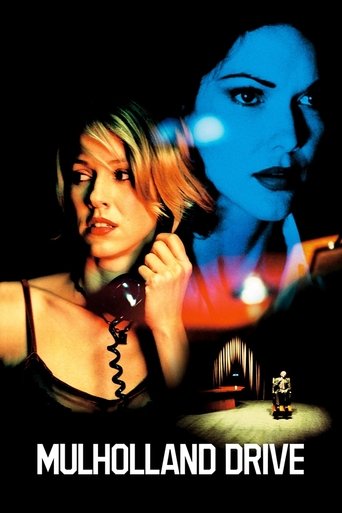
Mulholland Drive
2001 · Film · 147 min
Directed by David Lynch
Blonde Betty Elms has only just arrived in Hollywood to become a movie star when she meets an enigmatic brunette with amnesia. Meanwhile, as the two set off to solve the second woman's identity, filmmaker Adam Kesher runs into ominous trouble while casting his latest project.
32 positive5 negative25 neutralfrom 62 commenters
Where to watch
No streaming data for this title.
65 comments on Hacker News
I have not had the, ahem, privelege yet of installing Gentoo. I gave up on Linux a while back after I bricked my computer because I missed an update on Arch Linux (no joke). Got a macbook and I’ve been happy ever since…well, at least until I was trying to shareplay Mulholland Drive with my girlfriend while she’s out of town and discovered that the only way to manually adjust audio levels of facetime vs, say, the movie we were trying to watch, which was nearly muted because of the call, was to purchase and install a $20 piece of software. Now, I could go ahead and buy a windows machine which comes preloaded with this feature, but let’s be honest, windows sucks major ass and there is virtually no advantage these days to using it over Linux or a Mac. The software might be a little screwed up but Tim Cook really made some magical consumer grade hardware that outperforms virtually all its possible competitors…still, the audio levels.
I don’t have time to futz around installing Linux distros instead of getting laid like I did as a teenager. I have a job and a girlfriend and more than enough of a social life to keep me busy day to day. But something keeps nipping at my heels, telling me to return to the pen—-the sun is setting on my long sojourn in the warm fields of average life, the long night of idle tinkering approaches once more, that I might sooner forget the morning before it ends.
Thanks! Here's the full list: 2001: A Space Odyssey, 8½, Aguirre the Wrath of God, Ali: Fear Eats the Soul, All That Heaven Allows, Apocalypse Now, Ashes and Diamonds, A Woman Under the Influence, Barry Lyndon, Bicycle Thieves, Breathless, Casablanca, Céline and Julie Go Boating, Chinatown, Chinese Roulette, Citizen Kane, City Lights, City of Pirates, Contempt, Daisies, Damnation, Dishonored, Earth, Electra My Love, El Topo, Eraserhead, Eyes Wide Shut, Film Socialisme, Fitzcarraldo, Fuego en Castilla, Hiroshima Mon Amour, Holy Motors, Inauguration of the Pleasure Dome, In a Year with 13 Moons, India Song, Inland Empire, Irma Vep, Koyaanisqatsi, La Dolce Vita, La Jetée, Late Spring, L'Eau de la Seine, Le Voyage dans la Lune, Lolita, Los Olvidados, Lost Highway, Lucifer Rising, Man with a Movie Camera, Metropolis, Mirror, Mulholland Drive, Night Music, Ordet, Orpheus, Persona, Pickpocket, Playtime, Psycho, Rebecca, Rosemary's Baby, Rumble Fish, Scarface, Seven Samurai, Sherlock Jr., Singin' in the Rain, Stalker, Sunset Boulevard, Taste of Cherry, Taxi Driver, Testament of Orpheus, The 400 Blows, The Blood of a Poet, The Cabinet of Dr. Caligari, The Color of Pomegranates, The Green Ray, The Holy Mountain, The Isle, The Lady from Shanghai, The Night of the Hunter, The Passion of Joan of Arc, The Seventh Seal, The Spirit of the Beehive, The Tales of Hoffmann, The Tree of Life, The Turin Horse, Time of the Gypsies, Tokyo Story, Touch of Evil, Trans-Europ-Express, Ugetsu, Un Chien Andalou, Uncle Boonmee Who Can Recall His Past Lives, Vampyr, Videodrome, Wavelength, Werckmeister Harmonies, Wild Strawberries, Moonlight Sonata, Stellar, The Haunted House Biased toward European art cinema, experimental work, and directors who broke conventional narrative rules.
I imagine your friend is talking about specific coffee preparations like "espresso" because, for example, there are hundreds of years of traditional Arabic coffee that continue to be appreciated for generations. Your friend reminds me of this movie scene in Mulholland Drive[1].
[1] https://www.youtube.com/watch?v=aVI-Jew-iHo
> how soon an AI will be able to make a movie that you, AIPedant, will enjoy as much as you've enjoyed Mulholland Drive
As it stands, AI is a tool and requires artists/individuals to initiate a process. How many AI made artifacts do you know that enjoy the same cultural relevance as their human made counterparts? Novels, music, movies, shows, games... anything?
You're arguing that the types of film cameras play some part in the significant identity that makes Mulholland Drive a work of art, and I'd disagree. While artists/individuals might gain cultural recognition, the tool on its own rarely will. A tool of choice can be an inspiration for a work and gain a certain significance (e.g. the Honda CB77 Super Hawk[0]), but it seems that people always strive to look for the human individual behind any process, as it is generally accepted that the complete body of works tells a different story that any one artifact ever can.
Marcel Duchamp's Readymade[1] (and the mere choice of the artist) gave impact to this cultural shift more than a century ago, and I see similarities in economic and scientific efforts as well. Apple isn't Apple without the influence of a "Steve Jobs" or a "Jony Ive" - people are interested in the individuals behind companies and institutions, while at the same time also tend to underestimate the amount of individuals that makes any work an artifact - but that's a different topic.
If some future form of AI will transcend into a sentient object that isn't a plain tool anymore, I'd guess (in stark contrast to popular perception) we'll all lose interest rather quickly.
[0]: https://en.wikipedia.org/wiki/Honda_CB77#Zen_and_the_Art_of_Motorcycle_Maintenance
[1]: https://en.wikipedia.org/wiki/Fountain_(Duchamp)
> Did David Lynch make Mulholland Drive because he predicted it would be a good movie?
He made it because he predicted that it will have some effects enjoyable to him. Without knowing David Lynch personally I can assume that he made it because he predicted other people will like it. Although of course, it might have been some other goal. But unless he was completely unlike anyone I've ever met, it's safe to assume that before he started he had a picture of a world with Mullholland Drive existing in it that is somehow better than the current world without. He might or might not have been aware of it though.
Anyway, that's too much analysis of Mr. Lynch. The implicit question is how soon an AI will be able to make a movie that you, AIPedant, will enjoy as much as you've enjoyed Mulholland Drive. And I stand that how similar AI is to human intelligence or how much "true understanding" it has is completely irrelevant to answering that question.
"Making predictions about the world" is a reductive and childish way to describe intelligence in humans. Did David Lynch make Mulholland Drive because he predicted it would be a good movie?
The most depressing thing about AI summers is watching tech people cynically try to define intelligence downwards to excuse failures in current AI.
I think it's fine as a metric if you read it correctly.
100% means a film is extremely agreeable with whatever audience it has managed to get to. For major releases this can ultimately mean it's actually lacking anything particularly bold or interesting. This results in things like Frost/Nixon or Knives Out having higher ratings than broadly acclaimed films like Mulholland Drive or even There Will Be Blood; I know which ones I'd be more likely to put on with my extended family even if I don't especially like them.
But yeah, it's amazing how many people still don't grasp it after decades of getting angry about it.
Very strange choice to use Mulholland Drive as an example of conforming to the hero's journey "complicated by dream sequences" (?!)
The second half of the film reveals the hero's journey to be a self-serving narrative constructed by the protagonist to retell her own tragic and shameful history, casting herself as a hero instead of a villain. By extension, the film is a critique of Hollywood, American myth-making, and the exact trope it supposedly conforms to.
>Mulholland Drive
From the article:
"One of my favourite films, David Lynch’s Mulholland Drive (2001), conforms pretty closely to formulaic structure, even if it is complicated by dream sequences: the inciting incident of the car crash; Betty’s quest to help Rita rediscover her true identity. I believe that one reason we don’t object, don’t groan with boredom, is that the scaffolding is – crucially – hidden."
I liked the movie, and I approve of this kind of creativity, but a disguised 3-act structure is still a 3-act structure.
Classic Thing, Japan. There are plenty of western movies that don't follow the three-act structure (off the top of my head, Apocalypse Now, Mulholland Drive (and probably most Lynch), Boyhood (and other Linklaters), basically any Robert Altman) and plenty of foreign films that do.
I went into Lost thinking it was sci-fi, but in the end, it was all fantasy. So for me, Lost never really answered its core mysteries and that was before it threw in the whole purgatory flash-sideways stuff. I did actually start to lose interest because it felt like the show was stringing us along, but hung in there for answers. Instead I felt like all I got were narrative dead ends and then a conclusion where most of them die. It was immensely unsatisfying.
(I'm reflecting back now on 15 year old memories. I'm actually surprised to learn it aired from 2004-2010. Gosh, I remember this as being a show from the 90s.)
It's also not like there were a lot of options for other shows to watch at the time. I'd never stay with a show like Lost today. I punted on Yellowjackets as soon as it started bringing fantasy into the story.
You have to know that how a series wraps up is important to its viewers. A great or terrible finale can make or break how a show is later perceived. The Lost finale was the most disappointing of any show I've seen.
Great finales I recall are The Americans and Justified.
A terrible last book chapter or poor movie ending can ruin all that has come before for me. When deciding whether to read a book, I'll read the last chapter first. Spoilers don't ruin good stories for me. But bad conclusions do. And Lost's conclusion was just terrible. I'd rather it have been canceled.
It's not like I need literal answers for everything. I love Mulholland Drive. But I felt like Lost spent six seasons just jerking me around.
$0.02.
> I’m not sure if anyone could ever “get” one of his movies completely beyond the experience and the narrative.
I actually found "Mulholland Drive" to be incredibly accessible for a Lynch movie. Twin Peaks remains an absolute (and highly fascinating) enigma to me, especially the third season, but "Mulholland Drive" always felt like an enigma with a satisfying solution.
Other than the 1980's Dune movie he directed, I think it was either Lost Highway or Mulholland Drive that made me want to know more about David Lynch.
I had to watch Mulholland Drive at least 5 times to get a sense of what it's even about, and I think I must have been the audience for which he made that film, if it wasn't indeed just art to make himself happy (which is the BEST kind).
Anyway, it kind of endears another person to you when you connect with their work. So this one hit kind of hard.
I lost a fellow weirdo, and he'll be missed!
Mulholland Drive was my first Lynch movie and led me to watch pretty much everything else he released. I'd still start with Mulholland Drive if I started over again I think.
I feel the same. If Blue Velvet was the first Lynch movie I saw, I surely wouldn't have bothered with the rest, and I would have missed out on what I now consider one of my absolute favorites (Mulholland Drive). Same goes for Eraserhead and Wild at Heart.
> I’m not sure if anyone could ever “get” one of his movies completely beyond the experience and the narrative.
The plots of his movies are often more concrete than people expect. I'm not saying a movie like Mulholland Drive is easy to follow, but it does have a legible plot. Feel free to read the wiki or something if you are not sure who some character is or what they are doing.
If you are just letting the experience wash over you, you may be missing some plot points that are not meant to be mysterious.
Obviously his movies are weird and not entirely legible, but don't assume everything in them is meant to be inscrutable.
Very sad. I had the privilege of watching the late Roger Ebert deconstruct "Mulholland Drive" at the Conference on World Affairs at the University of Colorado during the daily Cinema Interruptus. Each day for a week, we spent an hour or two analyzing the film, with anyone in the audience able to shout "stop" to pause the screening and discuss any aspect of the movie with Ebert. His insights and thoughtful manner of speaking about film left a lasting impression on me. RIP.
Sad to hear. Personally I think I've only seen Mulholland Drive before, but long time ago. I enjoy surreal movies in general, so kind of weird I haven't seen more of Lynch's work. What personal favorites do other HNers have, of what he'd done?
How sad. Lost Highway, Mulholland Drive (the IMO under-appreciated pilot), and yes his Dune even though he didn't like it are some of my favourite movies of all time. RIP
I read a lot of this, had to stop. In a way, it's like the film itself. It has a lot of words, a lot of details, and it seems to mean something. But at the end, it really doesn't amount to much. "Mulholland Drive" was a much more effective comment on wealth, power, and misogyny.
Highly recommend a short movie “Meshes of the Afternoon” (1943). Watched it in a local cinema right after Mulholland Drive, that was quite an experience :)
> Pretentious is reducing the work of one of the most highly acclaimed film makers of our time to “weird for the sake of weird” and “lol an AI could make that”.
No, that isn't pretentious, that's just an opinion you personally find offensive.
Nothing you've said in an attempt to refute what I've said contradicts anything I've said. You just don't like the way I've summed it up.
> Really insightful criticism.
I mean, I've been elaborating, although it's been hard to have a fun discussion since in my opinion you've been combative from the start.
> Pretentious is suggesting his work has no substance, when a poll by BBC Culture of 177 film critics from 36 countries named Mulholland Drive the best film of the 21st century.
I didn't say his films had no substance, first of all, no where can you quote me saying anything like that. I do find them fairly superficial with the surrealism doing a lot of the heavy lifting with peopel interpreting a lot and giving more credit than is due, but that's hardly the same thing now, is it?
Besides, I bet a lot of films on that list don't have a lot of substance and are just fun, and there's nothing wrong with that.
> There are plenty of directors whose works that I don’t personally appreciate but I would never be so arrogant to suggest an AI could reproduce them.
Because you find the notion offensive, fine. I think AI could replicate even directors I do like and find to have a lot of depth, though. I think ultimately everything can be reduced to data and patterns and heuristics and an AI will be able to mimic styles frighteningly well.
> How many Palme D’ors and academy awards do you have.
If I said even 1, you realize that shouldn't affect the merit of any argument I've made, right?
> They are just regurgitating opinions like yours, many of which are overly pretentious defensive nonsense.
Pretentious is reducing the work of one of the most highly acclaimed film makers of our time to “weird for the sake of weird” and “lol an AI could make that”. Really insightful criticism.
Pretentious is suggesting his work has no substance ("90% atmosphere"), when a poll by BBC Culture of 177 film critics from 36 countries named Mulholland Drive the best film of the 21st century.
There are plenty of directors whose works that I don’t personally appreciate but I would never be so arrogant to suggest an AI could reproduce them.
> His work can have recurring themes and still be weird for the sake of weird and mostly atmosphere
Everything "weird" in his work serves the narrative and those themes. If you had spent any time thinking critically about any of his films you would understand that, but you clearly haven't.
The AIs also disagree with you. I asked Claude "what are your thoughts on this statement: "Lynch will be one of the easier things for an AI to replicate given his thing is weird for the sake of weird and being deliberately vague about it. His stuff is 90% atmosphere."
and it responds:
"I disagree with this characterization of David Lynch's work. While his films certainly feature surreal and dreamlike atmospheres, reducing them to "weird for weird's sake" misses their intricate emotional and thematic coherence.
Lynch's work often explores deeply human experiences - trauma, desire, identity, and the dark underbelly of seemingly idyllic Americana - through a distinctive visual and narrative language that draws heavily from dreams and the subconscious mind. Films like "Mulholland Drive" and "Blue Velvet" aren't merely atmospheric exercises, but carefully constructed works where the surreal elements serve specific narrative and thematic purposes.
Take "Mulholland Drive" - its dream logic and narrative fragmentation directly reflect the protagonist's psychological state and Hollywood's destructive impact on identity. The "weird" elements aren't arbitrary but emerge organically from the story's emotional core.
I think AI would actually struggle to replicate Lynch's work precisely because it's not random weirdness - it's a complex interweaving of personal obsessions, cultural critique, and psychological insight expressed through a unique artistic vocabulary he's developed over decades. The "atmosphere" in his films isn't just surface-level strangeness but rather the manifestation of deeper themes and emotions.
I agree very much that it's made to be rewatched. I found it highly unusual in that I'm a film student and have rewatched so many films and continue to rewatch a ton of favourites endlessly, but I can't remember another movie that revealed new layers and characteristics like this did over 3 watches other than Mulholland Drive. I suspect it will continue to evolve on the next couple watches at home, too.
Also agree it's a love letter to classical theatrical traditions, and I think that's where Coppola's heart has been the whole time, calling way back in time.
The movie is one big play with time as a parable with creativity, almost like Tenet but I would say it's much more effective and powerful here.
I think this is a great movie and likely a masterpiece, but it's a fascinating movie to talk about and great to see appreciation of it confirmed in others. It's a fascinating viewing experience packed with meaning, no doubt. It does many things very differently while being able to fully engage and fascinate on first watch. There's not many movies in history like that. The rest will play out as people continue to critique the film over time, and I'll be fascinated to see how that evolves.
I love that aside. The most interesting thing about Italy in the "grand political" sense (I love their culture and art) in recent history is that relatively speaking it flew under the radar post-WW2, and continues to hold deep respect for Britain through stories of great empires, lingering fixations on that kind of story that many still identify with. I'd encourage you to expand that in longer form if you are able, no doubt it would make a good read.
Finally, just to note I didn't have my account configured correctly so didn't see any notification of comments. Please excuse the late reply.
> known for cult films like Mulholland Drive, Inland Empire and Wild at Heart
Really? No, really? Not Twin Peaks? Not Lost Highway? Not Eraserhead, not The Elephant Man? Not Dune?!
If you somehow end up here without having ever watched Mulholland Drive. I encourage you to watch it! It's my favorite movie.
I don’t believe that’s true. Lynch uses characters as abstractions — they represent a concept, which when you understand them add up to a ‘statement’:
* Twin Peaks is an meta commentary about the lack of balance on the small screen (our desire for sex and violence). Interestingly this ended up being a meta-meta-commentary when the network forced them to reveal the killer of Laura Palmer prematurely. Laura Palmer is balance, Dale Cooper is the audience, Bob is our desire for sex & violence, …
* Mulholland Drive is about the casting couch and the destruction of the Hollywood dream for women. Rita is the casting couch, the cowboy is Hollywood, …
* Lost Highway appears to be a comment about plagiarism (namely other directors plagiarising David Lynch). But it also has a similar theme to Twin Peaks as a meta commentary about film — the shots of the road are meant to look like film, the vehicles are meant to represent movies, …
etc.
He always talks about being “true to the idea” — so all abstractions and all surreal elements must be true to the underlying concept. It’s up to us to work out what the underlying theme is (that links all of the abstractions together).
I love surrealism, dreamscapes and many forms of nonsense and randomness.
I loath anything that feels like it is on the edge of making sense. I hate searching for hidden meaning in something that doesn't actually have a legible hidden meaning. I suspect some of Lynch's work fits in that category.
I'm on the engineer spectrum and I just accept that others rate things that I never will enjoy. Maybe I should learn the appeal of tarot? I vicariously enjoy being around my friend that watches movies non-linearly. I don't understand another friend who watched a popular old movie thousands of times and applied their smarts to analysing it multiple different ways.
I don't think I fit your stereotype for people that want a nice linear packaged story they don't need to think about. But maybe I'm overthinking.
I do enjoy trying to understand what smart friends intensely direct their thoughts towards: so I would enjoy talking with a friend who loves Mulholland Drive.
The Room is an extreme example because it’s mostly remembered for being so bad that it’s funny, but sure: it has had a thousand times more influence than the hundreds of competent but procedural thrillers that came out at the same time. It will still be watched in fifty years.
I don’t like that list at all and think it’s basically a list of how “traditional” the Lynch film is. I’d put Mulholland Drive first personally.
I have a system that I use to rate movies: "Must see", "Worthwhile", "Wait for the video" and "Don't waste your time." After watching Mulholland Drive I had to invent a fifth rating: "I want those two hours of my life back."
Does that answer your question?
Ebert wrote beautifully. I was lucky enough to have met him once or twice at book signing events here in Boulder. He was a regular at the Conference on World Affairs dissecting movies one shot at a time. I attended all of his "Cinema Interruptus" for Mulholland Drive, La Dolce Vita, (no small commitment actually) and a few others. On top of it, Ebert was a kind, good human. I also miss Ebert. Check out his "Great Movies" book series if you can.
Interestingly there are two David Lynch movies (Lost Highway and Mulholland Drive) that can be interpreted as just that: someone's disorienting nightmare as they are dying.
The real gripe I have with the film is how they managed to totally misunderstand and butcher Baudrillard’s concept of the simulacra, while saying that it was one of their inspirations. Baudrillard wasn’t saying that the problem with current postmodern society was that the copy (the simulation) masks the real and therefore the copy should be destroyed to reveal the original (basically a Platonial ideal), the fundamental problem is that the copy masks the fact that there is no “real”. Reality has already disappeared in the way of the hyperreal, and the old Platonic distinction between “real” and “fake” became obsolete. Baudrillard speaks about the Matrix that
“Yes, but already there have been other films that treat the growing indistinction between the real and the virtual: The Truman Show, Minority Report, or even Mulholland Drive, the masterpiece of David Lynch. The Matrix’s value is chiefly as a synthesis of all that. But there the set-up is cruder and does not truly evoke the problem. The actors are in the matrix, that is, in the digitized system of things; or, they are radically outside it, such as in Zion, the city of resistors. But what would be interesting is to show what happens when these two worlds collide. The most embarrassing part of the film is that the new problem posed by simulation is confused with its classical, Platonic treatment. This is a serious flaw. The radical illusion of the world is a problem faced by all great cultures, which they have solved through art and symbolization. What we have invented, in order to support this suffering, is a simulated real, which henceforth supplants the real and is its final solution, a virtual universe from which everything dangerous and negative has been expelled. And The Matrix is undeniably part of that. Everything belonging to the order of dream, utopia and phantasm is given expression, “realized.” We are in the uncut transparency. The Matrix is surely the kind of film about the matrix that the matrix would have been able to produce.”
As a retaliation Lana Wakowski said,
“This is why, no one really mentions this, but everyone's like "'Simulacra' as in Baudrillard, you are referencing Baudrillard!", but the point of the reference is that the book is hollow! It is itself a Matrix! It is itself a construction, a projection, a tool for understanding the world, having a framework of meaning, that's what these things are, they are frameworks of meaning. So what we were trying to do was, can you encourage audiences to interrogate their own framework of meaning, and then through that interrogation, extend it into the experience of watching a piece of art, and then try to find meaning into that piece of art, in the same way that Neo has to go through that journey ..."
which is some bullshit nonsense that not only undermines the effectiveness of their work, but vulgarly defaces the work of Baudrillard (along with misleading the public to think that postmodernism = “anything goes”, further leading to some weird reactionary figures to blurt against it)
Sure. In the context of Lynch's work things that happen without sense are often intra-textual in his work or hint at some interior sense that is obscure to the characters, audience. Why do characters (dead!) from Twin Peaks show up in Mulholland Drive? Well, that _might_ be touched on in Twin Peaks season 3 or maybe it isn't. Kinda up to you.
Seems to me that's Lynch's point. In daily life we're all willing to accept on some level that we need to make sense of things ourselves so why should we expect art to be direct?
Admittedly, Kubrick is the better example here than Lynch: 2001 is a stellar example of both "Their motivations for doing that are up to you" (w/r/t HAL's behavior) and "It means whatever you want it to mean" (Kubrick quite famously refused to provide any sort of guidance whatsoever as to how it should be interpreted)
For Lynch, Mulholland Drive was on my mind--probably since it was mentioned in the article--as the ending (and, honestly, the narrative structure as a whole) requires the viewer to bring quite a lot of assuming and surmising to the table in order to arrive at something coherent. Perhaps the OP meant to purposefully exclude explicitly surreal and abstract works from their critique, but that's certainly not the tone I got from their post.
Perhaps a better counter example could've been Kelly Reichardt's filmography, as she is also quite clearly a meticulous and thoughtful filmmaker (I remember hearing a profile of her on some NPR show a number of years ago that talked about the amount of time she spent getting even the ambient bird songs in Certain Women accurate, or reading her comments about how she would've filmed First Cow in a different aspect ratio if she had known COVID was going to keep it from being widely seen in theaters), but typically cuts off the narrative abruptly, leaving plenty of loose ends dangling: Meek's Cutoff and First Cow are probably the best examples.
As an aside, I feel like the point of Nolan leaving the ending of Inception with an open-ended yes-no question is intended to highlight that, from the character's perspective, the answer no longer matters. I dislike the film for other reasons, and don't particularly like Nolan's screenplays in general, but that particular choice seems pretty reasonable in the broader narrative context of the film.
Take Dark City. I believe the studio forced a new opening that more or less explained everything rather than letting you puzzle it all out. I didn't find the movie too hard to work through, but I think Hollywood execs have a fairly low estimation of the audience's intellect.
Lynch is a bit harder. Lynch is atypical in two ways that play off of one another. First and most obviously, he has been developing as a film-maker (as one would hope over the decades), but he expects that his audience would have kept up with him, introducing a kind of filmic vocabulary. I would say that Mulholland Drive is much, much more comprehensible once you have understood what Lost Highway is on about. In turn, Lost Highway is an extended riff off of the dualism you would see in Twin Peaks and Fire Walk With Me. As to the second factor, Lynch is very heavy into TM and he would like to present images, sounds, and such to the viewer, and then find out what the viewer thinks of them. Not in a "this is up to you to puzzle out," rather he is pitching rocks and skipping stones off of what he likely believes is to be a collective unconscious or a shared cultural experience, then being excited about what might pop up. It's a genuine interest, I think.
This is a deeply predictable (and pedestrian) take, and I 100% expected to see it here (as I expect to see it in any technical forum).
Highly technical people -- developers, engineers, etc -- are much more likely (at least in my experience) to react negatively to nonlinear storytelling. Further, the reaction is almost never "wow, not for me" but instead "THIS IS STUPID".
It's essentially the equivalent of walking through, say, a Mondrian exhibit and spouting "my kid can do that."
I do not know why this correlation exists. I could make guesses, tying the exacting nature of programming with an attraction to well-defined and explicit storytelling, but it is what it is.
THE BIG SLEEP is awesome. MULHOLLAND DRIVE is a tremendous (and award-winning) film. Ambiguity and vagueness are integral to art (and life!).
Years ago, I saw a play by Maria Irene Fornes called THE DANUBE. It's a bizarre, baffling, and beautiful piece, and you cannot really approach it like you would (say) a Marvel film expecting a traditional narrative. That's not what it's FOR. It's an experience. You have to let go of the desire to tick off plot points and characters like players in a football program and just experience the art on its own terms.
Creating something that includes, or even hinges on, ambiguity is challenging in the extreme. It's like when jazz musicians break the "rules" of music and melody; you can only break the rules and have it work when you have really mastered the underlying craft.
Exploring these kinds of challenging works can be incredibly rewarding. I encourage anyone reading this to do so. I long ago decided that if I only ever saw plays/read books/watched movies that I liked, I wasn't branching out enough. Find things that challenge you, and engage them on their own terms. Figure out why (for example) a host of professional movie critics loved Lynch's film when it left you cold and maybe even angry. What do they see that you don't?
Thanks for responding! I really hope I didn't come across as too harsh, I definitely made some assumptions and probably straw-manned you.
For Twin peaks, of course the latter half of season two isn't great, but that's because David lynch left after the network made him reveal the killer, which was never a part of the plan.
So then after the incredible 3-4 lynch directed episode of early season 2 and he leaves, it falls down a cliff before what is perhaps my favorite 42 minutes of media ever in the Season 2 finale, where Lynch comes back and delivers such a dizzying and intoxicating episode with so many questions left lingering that I find it genuinely inspiring.
Then I'm guessing you haven't seen Twin Peaks The Return, but that is the thing that cements twin peaks as a masterpiece imo.
And a lot of lynch movies have an amazing second half, Mulholland Drive being the prime example where it's revealed what the film is actually about and it explores the psyche and dreams of a woman unable to live up to what she thought she could.
Of course, there is no objectivity in film and opinions; especially with Lynch. if you don't like his stuff more power to you! But my only issue is feels like you levy that people who like his stuff are pretentious, only liking it because it's 'cool' to pretend to understand his stuff.
And to be honest, I believe that his stuff has a dense internal logic that is fascinating to try to unpack and it does always have a deeper meaning.. but to take what you say I don't see the big deal if he genuinely is fumbling about because the things I draw from his best creations are so deep and inspiring to me. It's like a dream you have, where if you break it down it makes no sense yet still you ascribe meaning to these things. And to be clear, I really believe most great lynch projects are internally cohesive and do have something they are meant to say/explain; understanding what the second half of Mulholland drive actually was and connecting it all together is probably my favorite experience that I've ever had with film, I really felt like a detective finally cracking a hard case!
But again, this is not to say Lynch is objectively good, just that I'm insanely biased and really really like his specific brand of shit. My main point is just to say that I don't think the way you phrased your criticisms of him are valid because you took a very objective tone
The point he tries to make loses a lot of credibility right off the bat by calling a movie with 94% approval by critics in RT and 82/100 average rating in metacritic "mediocre". That's higher than many award/festival winners... And, amusingly enough, on par with the movie he prefers, Mulholland Drive.
It gets weirder when he later says that we should go by the average rating and what a minority found great instead of what a majority found out to be ok... Except if the movie is Star Trek (2009), I guess (it has a lower rating in imdb than in either RT or MC).
And then he says that we should like stuff that has stood the test of time... But all the examples of his favorites are within a decade and a half of each other and the oldest is 33, which is young if we take in account the history of motion picture. In fact, his anti-example is closer to most of his examples than any of them to our time. And, of course, people are still talking about that movie, including him even if to disparage it.
He finally gets to what I assume is his thesis that we should pay attention to what has stood the test of time... Except if we do that we miss a ton of great content.
Sturgeon's law is a thing and it has always been. For every Godfather part II there were a hundred exploitation films. All the time, most of what's produced is garbage, but also every year (except, of course, the anomaly known as 2020) more media is produced. So, again by Sturgeon's law, that means that more great media is produced every year.
Apropos of nothing, my two favorite movies are a biopic/lawyer drama and a campy spy action movie. I can't choose between the two, and both were released the last decade (2010-19). I've also watched dozens of classics and I've liked most of them, but I've also hated a few.
So, ultimately, this is a matter of taste, and there's nothing wrong with having different tastes.
I agree in general. But Mulholland Drive is absolute rubbish which people like because they know that most won't like it (because it's rubbish).
I've been invited to similar groups that have esoteric music tastes. They think that because I have a good taste in music I will fit into those groups. But I can't stand them. It's all about finding the most obscure thing possible. The kind of thing that isn't popular for very good reason. It's just not that good.
Beethoven's 9th Symphony has virtually universal appeal. Die Hard is considered one of the best action movies of all time. Those are the kind of things you need to make sure you see. After that, whether you watch the latest mindless popcorn thriller or crap that nobody really likes is up to you. I'd rather watch the popcorn thriller, though.
We must not travel in the same circles. :-)
Of the people I know who have seen a David Lynch movie, I haven’t met anyone who enjoyed them. Speaking for myself, Mulholland Drive is definitely in the running for worst movie I’ve ever seen.
I would argue that it is a very popular film released by a major studio, and directed by one of the most popular directors in history. Mulholland Drive is not a film that only "film buffs" saw. I'm not sure if I've every met anyone who hasn't seen a David Lynch film, and I rarely meet anyone who hasn't enjoyed a David Lynch film. He's a multi-millionaire in high demand that entirely dictates his own work conditions.
It feels like a bit of a false dichotomy to me. I love watching old shows and movies, including Mulholland Drive which I've seen a dozen times. But I also enjoy new things. Isn't that normal?
Now, that said I haven't gone to see a summer blockbuster in a decade. I don't like Marvel movies or Star wars sequels. There was only one good star wars movie in the original trilogy anyway.
> but the average rating is a measure of popularity
Not quite? Mulholland drive for example, was widely praised by critics and is remembered fondly by film nerds, but is not in most senses “popular”.
I’m not arguing that ratings are perfect, I largely agree with you; just that they’re a weird measurement and not one largely of popularity.
I originally held that David Lynch's film "Mulholland Drive" used all the conventional motifs of a horror film to construct a whole that was less than, and yet too much more than a cohesive horror story. It wasn't complete, but had the sense that it was. Stitched together in a nonsensical manner, but which felt familiar.
I'm not saying that's true, but it was my conversational theory for a while.
Maybe he made the GPT-3 of films.
I have no opinion about Mulholland Drive (it's been literally 15 years since I saw it), but this reminds a bit of a friend who keeps telling me "Lost in Translation" is a bad movie because it's story is not very compelling. In that case, I think it's completely missing the point, since the story is really about the least that makes me like Lost in Translation so much.
I realize I'm arguing against a straw-man here. The point is: A movie is not just its story.
I think Mulholland Drive is a great movie, why do you think it's not good?
Lost me at “Mulholland Drive” is a good movie.
Apt user name. TIL, thank you:
> Making The Shining, Stanley Kubrick announced Eraserhead was his favourite film and showed it to his cast and crew, “to put them in the mood”.
https://www.theguardian.com/film/2017/mar/22/david-lynch-eraserhead
So I was actually thinking of Lynch's later works (Lost Highway, Mulholland Drive, Twin Peaks) that definitely came after "The Shining" But yeah, they share things big and small, from tone to camera angles.
There's a scene in The Shining, about 3 /4 of the way through, where Jack is walking down a corridor in a rage, and it's _just weird_ (1), so reminiscent of The Man from Another Place in Twin peaks, and it's hard to say what's wrong, to unpick what's going on technically.
I only noticed this on the rewatch last week. I'd guess it's a combination of the acting and sound, camera angle and framing, lens choice, and the camera moving with him over the patterned carpet.
https://www.youtube.com/watch?v=MzZP-OXA-zY
Some more movies in no particular order if you want to explore more of psychological horror:
Pandorum
The Lighthouse
eXistenZ
Videodrome
Hellraiser (I’m a fan of the series, some are better than others)
Blue Velvet
Mulholland Drive
The Thing
American Psycho
The Fly
Invasion of the Bodysnatchers (1978 version with Leonard Nimoy)
“I think that horror following technology in its development is a dead end. We had horror films about TV, now there are films about the web, but in fifty years only scholars of culture will look at them. Meanwhile, people who want to be scared will still watch the scene from Mulholland Drive with the bum peeking around the corner. But that scene could equally be filmed in 1930 or 2030.” (Alexey Karaulov)
I still remember the vivid and strange experience when I watched Lynch's masterpiece TV show 'Twin Peaks'. Just an amazing experience! I have also enjoyed his films such as 'Blue Velvet' and 'Mulholland Drive'. When watching Lynch's shows and movies I feel his creations are similar to that of Stanley Kubrick.
Fair enough, it hadn't show up to buy, so I thought it wasn't on YT Movies. A better example is Mulholland Drive - not sold on YT, as far as a I can tell.
Yes, there are illegally pirated scenes and soundtracks, but you're assuming that companies actually wish to get them off, when in reality they upload it themselves (see the Movieclips account, which is owned by Fandango, which is itself owned by NBC and Warner). Pirated scenes and sountracks are ads for the movies, it's not in their interest to take them down.
+1 for Mulholland Drive. I used to love these movies that attempted to be mind-bending, and seeing that film made me realize that I mostly loved their wish-fulfillment/power fantasy elements.
I think Mulholland Drive was such an effective foil for power fantasies because it started in a dream state then revealed the depressing and pedestrian triggers for that state. I saw it late in graduate school and the sense of failure permeating Naomi Watts' character in the second half hit very close to home. I don't know if it would have worked if the frame for the movie had not been so mundane (in contrast to something like Inception, which relies so heavily on a black box dream-infiltration device).
Not trying to be snarky, but what's complex about Inception? Once you're past the two premises (you can infiltrate dreams; you can dream recursively) this is just a heist movie without any significant plot twist, by which I mean there is no world-changing or premise-questioning event, and only one apect of said premises (the altered length of "lived time") is explored.
To use other Nolan movies as a point of comparison, Memento and The Prestige are much more accomplished in terms of fully exploiting their concepts. And within the domain of movies exploring the theme of "your lived experience is a dream/illusion", there are much more effective and/or complex examples[1].
I have a feeling that Inception is kind of like Interstellar in terms of public perception: people are psyched by the initial concept, so they don't pay attention to the fact that its underlying narrative structure is pretty run-of-the-mill.
I guess I sound like a buzzkill! If I've missed any deep concept within Inception, I'd be glad to be schooled/enlightened, since I like understanding what makes a movie tick. Also, I don't think it's a bad movie at all, just that it's not that complicated once we're past the initial disorientation.
[1] Before anybody asks, in no particular orders: In The Mouth Of Madness, Mulholland Drive, Paprika, Written By. In a different vein: Eternal Sunshine of the Spotless Mind. Hell, even Total Recall (1990 version) and The Matrix probably apply.
It would have been amazing if Jodorowsky's Dune actually got made and released. He really was too far ahead of his time for the studio.
I feel that in order to make a roughly 2-hour long film on as complex a subject as what the novel portrays, the only way to illustrate that complexity properly is to ascribe to surrealist elements. That is the only form that can provide the necessary density, if done properly. Lynch knew this, which is why he took on the project, but was later pressured by the studio and his vision was lost. He did a pretty admirable job considering.
Lynch's pedigree speaks for itself:
Blue Velvet: http://www.imdb.com/title/tt0090756/?ref_=nm_flmg_wr_23 Lost Highway: http://www.imdb.com/title/tt0116922/?ref_=nm_flmg_wr_16 Mulholland Drive: http://www.imdb.com/title/tt0166924/?ref_=nm_flmg_wr_14 Twin Peaks... etc...
A few times I've read out a text aloud, then listened to the recording and it's been different. Remember that movie audition scene in the "Mulholland Drive" movie? Sometimes a single comma or exclamation mark in the written text can change that "inner voice" for a whole dialog!
That sure looks like the house in the movie Mulholland Drive, where the douchebag director lived.
I need to watch Lynch movies a couple of times to understand them. The first round goes with just an excitement about the themes, the atmosphere, the music. On the second round I got more pieces together and the movie finally hits me on the third watch.
Good examples are Mulholland Drive, a movie about dreams and reality. And Lost Highway, a movie about denial and jealousy.
http://www.mulholland-drive.net/studies/classical.htm
Basically, the first part of the movie is Betty's dream and the second part is harsh reallity. After watching it, I was as confused as you but still was amazed by the movie. What I like about Lynch's movies is the "trippy" experience.
It's not that most current AAA games or movies are good, it's just that I think we tend to see past ones with rose colored glasses, and to compare best of "the past" (decades) with "the present" (a few years), which is clearly unbalanced.
I was never a big fan of playing games for their stories or characters; I value gameplay over almost everything, preferring mindless fun (e.g. Metal Slug) or multiplayer games, but Portal 1 & 2 are certainly better than most of the big budget games I remember playing.
As for movies since the 2000, sure you have crap like those, but you also have decent movies like (from the top of my head) the Coen brothers', the Eternal Sunshine, Mulholland Drive, Children of Men or Crash. Were the previous decades much better? I don't think so.
+1 for recommendation of The Prestige.
Mulholland Drive is also a film worth watching if you enjoyed Inception.
If you expect an orange and get an apple, you're automatically not happy, no matter how tasty the apple is. That's where a lot of criticism comes from.
I found Inception to be a masterpiece. Yes, there was a lot of explanation to do, but it never felt unnatural and was necessary for the mind-blowing climax. Unlike Memento or Mulholland Drive, everything made sense to me right away. And ending the movie with the spinning top was just a genius move, especially since it was so carefully placed right after the intentionally dream-like airport scene. Never has such a static scene held so much tension.
But Netflix does say that. e.g.:
Twin Peaks: Season 1 (3-Disc Series)
Because you enjoyed: Mulholland Drive Brazil Videodrome
So right away I know that Twin Peaks is pretty freaky.