 Hacker Cinema
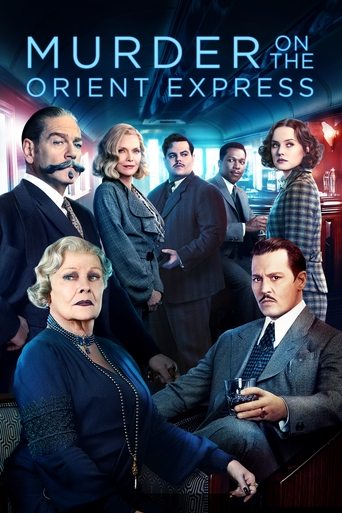
Murder on the Orient Express
2017 · Film · 114 min
Part of Hercule Poirot (Kenneth Branagh) Collection
Directed by Kenneth Branagh
Genius Belgian detective Hercule Poirot investigates the murder of an American tycoon aboard the Orient Express train.
2 positive1 negative1 mixed2 neutralfrom 6 commenters
Where to watch
No streaming data for this title.
6 comments on Hacker News
>the first rule of a good mystery story in that you need the audience to have enough information that they can plausibly solve the crime themselves
I feel like I disliked Murder on the Orient Express more for that exact rule.
But I do feel like Glass Onion does in fact deliver to some degree in that aspect. In the first part of the movie when you're lead to believe that it's about the murder of Miles, they do establish motives in order to have the viewers thinking of who it could be. And after the mid-twist that the focus shifts to the true murder mystery, there is a profound lack of good hints because it's not any one of the fingered suspects. If you watch the movie and think to yourself "Who would benefit the most from this murder?", all fingers point at the true suspect.
My biggest problem with the Glass Onion is the peashooter gun.
I agree, sadly there is nothing like Colombo produced these days, the CSI series are tangentially similar but using hitech instead of old school police work. Interesting movie recommendation would be murder on the orient express , old or new version are equally good.
Ofer Gal - Baroque Science. A highly academic history of the scientific revolution, not the most readable book. It focused quite a bit on mathematization, especially in optics (and Kepler's optics revolution in particular), and also in observation via instrumentation like telescopes and microscopes.
Paul Nahin - The Logician and the Engineer. About Boole and Shannon's work; I had already learned the material so i skimmed part of it and returned it to the library.
Ian Mortimer - The time traveler's guide to medieval england. Talks about what daily life was like for different social classes in 14th century England eg towns & cities, food, clothes, housing, employment, travel etc. I got about halfway through and lost interest in the subject matter.
Lucio Russo - The forgotten Revolution. A very readable academic history of the development of science in ptolomaic egypt (eg euclid, archimedes, etc). This was certainly the most surprising book I read all year. This time period has been almost completely deleted from history, which jumps straight from aristotle to the renaissance (with a quick stop in the islamic world if you're being spoiled), and their achievements were incredibly impressive!
Jim al-Khalili - The House of Wisdom. A pop-history book about arabic science that i got from the library. I was wary because it's written by a particle physicist and not a historian, and sure enough it is filled with so much nonsense that I through it down in disgust after a few chapters.
Colin Pask - Magnificent Principia. A brief tour of some of the highlights of Newton's Principia, using both newton's geometric diagrams and modern notation. Following the modern notation of course assumes some basic calculus. Highly recommended - it made me want to learn old fashioned celestial mechanics! Perhaps in 2019...
Randall Munroe - What if. A fun light read about whimsical scenarios.
Sigmund - Exact thinking in demented times. About the vienna circle, the philosophical group associated with logical positivism.
Newman [ed] - The world of mathematics vol 1. A varied Collection of mathematical writings, both contemporary and historical.
Richard J Evans - The Coming of the Third Reich. Evans has recently written a three volume treatment of the third Reich. this is of course the first and starts with the origins of the modern form of antisemitism in the late 19th century. I hope to read the next two in 2019!
Robert Harper - Practical foundations for programming languages. I've mostly just skimmed it so my understanding is quite superficial, maybe in a year or two I'll go through and do all the exercises. I liked that he avoided 'paradigms' and developed the subject more systematically. The book's table of contents is absolutely irresistible!
Tolkien - the Hobbit. I finally got around to reading it... I didn't care for it. I started the lord of the rings but i don't think i'm going to finish it.
Michael Chriton - Jurassic Park. The movie was better.
Agatha Christie - Murder on the Orient Express. I think i just don't like fiction. The few years before this I tried reading more fancy literature and i didn't like that, so this year I tried more popular literature... Recently i heard someone say they thought that history spoiled fiction for them. I think I've suffered the same problem.
Findlay & O'Rourke - Power and Plenty. (in progress) An economic history of the 2nd millennium, absolutely fascinating so far. The discussion of the black death was particularly memorable. It's become something of a meme to point out how the peasant survivors were economically better off than their parents and grandparents. In fact that effect was limited to western europe. In eastern europe the economics were different and feudalism deepened, and in the arab world the reaction was different still: (if i remember my reading correctly) it was certain sects of military men who came out on top. I'm bringing it up because it is a perfect reminder that reality is more complicated than memes.
Robert Harper - Programming in Standard ML. (in progress) Online notes about functional programming.
- The presentation should have to be up to 2018 standards, e.g. not like Project Gutemberg or some relic from the past. Nice photos and illustrations, quotes, etc.
- Leverage the hits: e.g. Joe Nesbo has had his books made into major movies, Uberto Eco is famous worldwide, European TV series have been remade for the US market (e.g. Forbrydelsen -> The Killing), people know Fry and Laurie, and so on. One could promote those works at the first level, point to the originals, and then expand the recommendations of other works by the same authors, and then of similar authors and directors.
- Hijack on the popularity of certain themes in general (even Hollywood-inspired) culture. E.g. the recent remake of "Murder on the Orient Express" (not the best example popularity-wise, but will do for now), could be leveraged to promote works by Agatha Christi(and expand to more European crime fiction writers).
- Build the recommendation engine with a knowledge of mainstream/US/best-selling content as well -- not to promote it, but to let someone say e.g. "I enjoy John Grisham, what EU stuff should I read" and have the system recommended the relevant authors. Or "I enjoy this and this mainstream US comic" and they get a recommendation for some French graphic novel, for example.
- Excerpts and quotes from the works could be used in campaigns in places like Twitter, Pinterest, Facebook, etc to hook people in.
- It could start by building critical mass by appealing to and connecting the European and american more intellectual audiences who already consume these works in some kind of social media for smarties.
- Play into the "hipster" aspect of it, e.g. embrace smart/multi-cultural/open ended, as something cool to be (in an advertising perspective).
- Have content made by featured authors and directors directly for the website,
Some ideas from the top of my head
>Haven't seen the new movie. Guessing it is ok, but different. At best.
I assume you mean Murder on the Orient Express? IMO, it was "OK." Perfectly serviceable and, had there not been an earlier film version, I'd have said it was perfectly fine if nothing outstanding. But I found basically nothing that I thought was better than the 70s version and a number of things that weren't as good. If I were to watch one, I'd watch the older version even today.
B Roll. This is the behind the scenes footage Hollywood studios provide. PR for a film. Usually spliced in when broadcasting a celebrity interview to give "atmosphere".
But I find the mega budget production aspects fascinating. Seeing the million dollar DaVinci Resolve boards. The robotic Oculus camera cranes. As well as the intricate stunt choreography and wire work for Guardians 2. The massive alien ship interior sets for Arrival. The ballroom in Beauty and the Beast.
Another recent good one: Murder on the Orient Express. Istanbul's Sirkeci Rail Station. And a snow bound cliff outside Vincovci. All recreated on London sound stages. And shot in vintage large format Panavision 65mm analog film cameras ;)
Behind The Scenes On Murder on the Orient Express
https://www.youtube.com/watch?v=BH_R2OauWMk