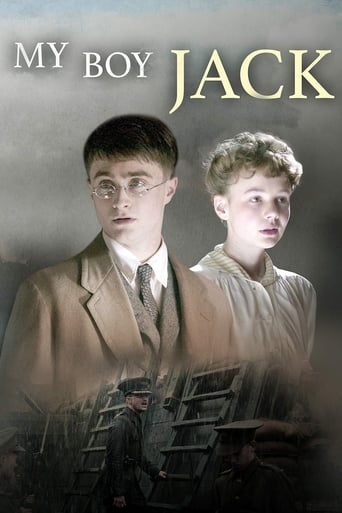
It reminds me of something else I watched in school - My Boy Jack - a film about Rudyard Kipling and his son. I recently watched it again for the first time since being a child. It’s worth a watch.
I think the first world war also changed him in this regard, but I may be wrong.
See the poem, (and play, and film adaptation - which is a moving depiction of his experience of his son being killed) my boy jack.
Although as for "product of his time" and WW1 poetry in general, remember that Wilfred Owen was writing around the same time and is very much ahead of many warmongers to this day. People are products of their circumstances, cultural and temporal.
A friend of mine's great-whatever apparently confessed on his deathbed to having shot his commanding officer who had begun summarily executing retreating soldiers for deserting (i.e. not walking directly into a wall of machine gun fire)
War had this massive technological increase in violence from about 1850 to the lats 20th century. That explains pretty much it all to my satisfaction.
The thing that is missed by these critiques of Pinker seem to be that Determinist genetic theories, which caused much of the "Hemoclysm" held sway for a long time, really until the advent of DNA.So once a better tool came on line, the justification for the violence faded. Of course, this has been uneven; so we have Rwanda. To me that's sort of the exception that proves the rule. It's tribal and unmodern violence.
I think all that's required to see how far we've come it so read Kipling - especially "My Boy Jack". There's also a stage play and a "movie" of the stage play. The horror of the end implication of the Edwardian sense of manly military honor is brought into sharp relief.
 Hacker Cinema



3 comments on Hacker News
It reminds me of something else I watched in school - My Boy Jack - a film about Rudyard Kipling and his son. I recently watched it again for the first time since being a child. It’s worth a watch.
I think the first world war also changed him in this regard, but I may be wrong.
See the poem, (and play, and film adaptation - which is a moving depiction of his experience of his son being killed) my boy jack.
Although as for "product of his time" and WW1 poetry in general, remember that Wilfred Owen was writing around the same time and is very much ahead of many warmongers to this day. People are products of their circumstances, cultural and temporal.
https://www.poetryfoundation.org/poems/46560/dulce-et-decorum-est
A friend of mine's great-whatever apparently confessed on his deathbed to having shot his commanding officer who had begun summarily executing retreating soldiers for deserting (i.e. not walking directly into a wall of machine gun fire)
War had this massive technological increase in violence from about 1850 to the lats 20th century. That explains pretty much it all to my satisfaction.
The thing that is missed by these critiques of Pinker seem to be that Determinist genetic theories, which caused much of the "Hemoclysm" held sway for a long time, really until the advent of DNA.So once a better tool came on line, the justification for the violence faded. Of course, this has been uneven; so we have Rwanda. To me that's sort of the exception that proves the rule. It's tribal and unmodern violence.
I think all that's required to see how far we've come it so read Kipling - especially "My Boy Jack". There's also a stage play and a "movie" of the stage play. The horror of the end implication of the Edwardian sense of manly military honor is brought into sharp relief.