is a listing of 2019 movie torrents ranked by seeds (number of clients holding full copies of a torrent version).
A normalization challenge is to group torrent variations (1080p rips and 720p rips and WEB-DL's and BluRay and etc.) and tally up and rank interest in various films over time.
Clearly Ne Zha (2019), a Chinese Animation, Fantasy, Adventure movie was a global pirate star of that year .. should it be "normalized" by population of country of origin to smooth out the home team having a billion+ in population "bias" ?
One advantage of ranking films by year and pirate copies is it provides a pragmatic measure of "staying power"
My Fair Lady, Dr Strangelove, Rudolph the Red-Nosed Reindeer, Mary Poppins, A Fistful of Dollars, and Goldfinger are still being hoarded 60 years after their release.
The licensing of the music on certain movies didn't anticipate the internet. And the studios never came to an agreement. As a result you can buy DVDs of movies like https://en.wikipedia.org/wiki/My_Fair_Lady and https://en.wikipedia.org/wiki/Bullets_Over_Broadway, but you can't rent them off of any streaming service. Given that most of us no longer have DVD players, they seem destined to only survive in pirated copies. If that.
I watch a lot of old movies (30s-40s-50s). A ton of them have a 40s-50s man marrying a 20s woman.
No idea if that was societal norm, mens fantasy, or whatever. I have to kind of believe movie execs would want the largest audience and so if 40s-50s men dating 20s women was not appealing to women of the time they'd been losing 1/2 the market. But, maybe these particular movies were the male equivalent of romance novels which seem to be written 99% for a female audience
Some examples:
The Girl Can't Help It (1956)
South Pacific (1958)
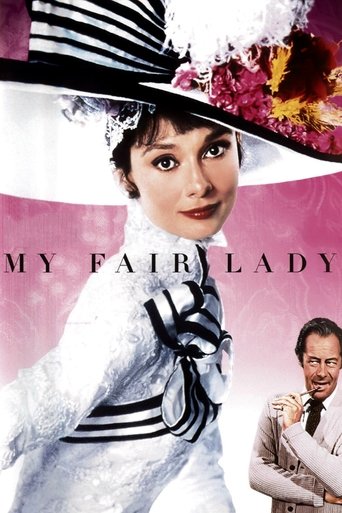
My Fair Lady (1964)
The Far Country (1954)
Casablanca (1942)
To Have and Have Not (1944)
There are literally 100s of them and I'm not recommending any of the movies above per-say, but it does stick out to me just how common that theme is of man, at least 15yrs older than woman which I believe is less common today
These may be a bit far afield, but they are fun to watch anyway:
The movies Singin' in the Rain (1952) and The Artist (2011) are both about response to technological change: the introduction of sound into the movies. The classic noir Sunset Boulevard (1950) touches on a dark side of that.
The musical My Fair Lady (1956) is about education, science, and technology for personal and social transformation. The movie version (1964) shows some early sound recording technology to comic effect.
Was just going to post about My Fair Lady. Just recently on Netflix and very striking to watch it vis a vis the culture conflict we're in yet again.
I take the lesson of the film to be that high culture can be truly graceful and enriching (ie for Eliza) but can become a hangup when take as its own end (thus Higgins' faults)
> There are some important aspects of voiceism that the author does not address. There is indeed an aspect of prejudice and stereotyping, but accents and dialects intrinsically hinder communication to someone who is unfamiliar with them.
Perhaps if it be quite far off from one's own, but in many cases it does not hinder at all.
As a more interesting example, consider that intelligent characters in U.S.A. cinema have a statistically high probability of having either a received pronunciation, or German accent, — given that the target audience is one of the U.S.A., one can assume that either, especially the latter, would hinder communication to at least some degree, however marginal.
Yet, both accents impart upon the listener an impression of intelligence. This was even referenced in The Practice, in one scene, where a lawyer for his expert witness specifically picked an expert with an English accent, on his experience that an R.P. English accent leads to U.S.A. jurors' holding the expert more credible.
I'm quite sceptical that communication is truly hampered in many of these cases. It is certainly not difficult by any margin to understand what Eliza Doolittle is saying in My Fair Lady, but the story of course highlights the absurd degree of accent discrimination that permeates British society.
At some point, the interviewer and the interviewee discuss how easy it is to tell apart the accents attached to various neighbourhoods in Paris. For those interested with the same process with the English language, I strongly recommend the film Pygmalion (1938) which I enjoyed much more than the later My Fair Lady.
https://en.wikipedia.org/wiki/Pygmalion_(1938_film)
Over the last decades living in France, I've heard several friends that lost their accent, notably from Loire and Jura. Of course some new French accents may emerge locally or in some communities, but the geography plays a lesser role.
There is only one reason that I've ever had to use bittorrent. It turns out that some musicals are not available through streaming because the copyright assignment wasn't set up correctly and nobody has been able to come to an agreement on how to split the revenue.
Movies from My Fair Lady to Bullets Over Broadway are affected. You can go onto Netflix, Amazon, and so on, and none can let you watch. They can only ship you a DVD.
After literally failing to find anyone who could take my money, I went to bittorrent. (And had to VPN to pretend not to be in the USA.)
Question 1: The key is usually long hours in a language lab where you hear words and phrases, repeat them and then listen to yourself. This, along with class, works well enough for most people.
Some people cannot, at first, hear certain sounds in a new language. Usually a language teacher makes them aware of these sounds. If that fails, one could hire a phonetician (like Henry Higgins in the movie "My Fair Lady"), a linguist skilled in the way one shapes ones vocal apparatus to make sounds in a particular language or languages. Some language textbooks provide descriptions of how to do this.
From the article: "Most people are very ignorant of the norms and values of the social classes more than one degree above or below their own." Somewhere, there must be a "how to" guide for social class. There's a questionnaire, but other than some meaningless content on Quora, not much guidance.[1]
Where there is guidance, it's about language usage.[2] The classic on this being, of course, "My Fair Lady"[1]. This is less of an issue since TV and movies imposed a standard linguistic dialect.
The author likes Paul Fussell's "Class", which is an excellent read. It's quite funny.
Social class is less social than it used to be, and more marketed. As a horse owner, I've seen this change since the 1980s. In the 1980s, it would have been considered tacky to have
advertising at a horse show. Now, Rolex ads are all over the place. Polo is the classic upper class sport (Silicon Valley has three polo fields), but polo players are usually people who were football jocks in high school, but not college.
Well into the 1980s, regular customers could sign their register receipts at Roberts of Woodside (a supermarket with an excellent deli) and be billed monthly.
50 Years ago, in 1964, My Fair Lady was #3 at the Box Office, and won the Oscar for Best Picture. In 1956, Around the World in 80 days won and was #2.
In 2014, 12 Years a Slave was #44 at the Box Office, and won the Oscar for Best Picture. In 2013, Argo won and was #22.
I think this represents that "what sells" is no longer the same "the best movies". The OP says good movies are finding it harder to get made. Good stories, good acting, good "art", are being pushed out in favor of "popular".
Not sure anything can or should be done about that. But it's definitely a trend.
I suspect any investor or investor group with enough data points to offer such a judgement would have said something similar 30 years ago (1983), or 50 years ago (1963), or 100 years ago (1913).
Long-distance communication and migration is becoming more common: native English speakers (especially in North America) are getting more chances to hear and become familiar with the speech of people who do not have English as their first language. (Without familiarity, it's easy to assume that flawed grammar and pronunciation means either flawed thinking or risky cultural differences.) So I'd surmise that the heavily-accented currently have their best opportunities ever to thrive in North American capital/recruiting/selling markets – and earlier generations of investors would have offered even harsher assessments about the impact of strong accents.
One of the points I was making with the My Fair Lady-themed joke in another thread (the SayAfter.me accent training offer) was that this is an eternal issue.
Look at her, a prisoner of the gutters; condemned by every syllable she utters…
http://www.youtube.com/watch?v=jhninL_G3Fg
That film came out in 1964 (winning Best Picture), based on a 1956 stage musical, based on a 1913 play (Pygmalion). The same ideas about accent and career-success go back further, and easily translate to many other languages and cultures.
Of course, an uneducated native (or disadvantaged local group dialect) accent is a different thing than a non-native accent. A non-native accent is more likely to indicate someone with the education and drive to dare operating in a non-native language environment. But, it takes a bit of familiarity to internalize that understanding, and stronger accents still signal a risk of slower and more error-prone communication.
When someone honestly points out that the strongest accents have been problematic, based on significant observational experience, they haven't "slipped", they've done the listeners a favor by sharing a perceived truth. Even if for some reason their observation is in error (and here I doubt it), by sharing the lesson they're helping, not hurting, the process of describing and understanding the world.
Aren't they suppose to compare this year with some of the other years
Of course not. That would be mindful. This is a mindless nostalgia piece, right out of central casting.
The fun thing to do when one of these articles arrives on the radar is to see which cherry-picked "classics" are being name-checked:
"The Godfather," "Jurassic Park," "Casablanca," "Gone with the Wind," "My Fair Lady" and "The Matrix,"
These lists are always carefully constructed. In this case we have two extremely popular classics from the 1930s, generally regarded as among the best films ever made. That's to establish your street cred as someone who has actually seen some great movies. Then one film each from the 60s, 70s, early 90s, and late 90s, to ensure that every one of your readers over the age of thirty has something to be nostalgic about, and that they believe that the author is sufficiently "hip". (No sense in listing too many films from the 2000s; twentysomethings don't read newspapers.)
Then I got as far as this line:
Where once there was "Robin Hood: Prince of Thieves," there is now "Robin Hood," prince of duds.
This line is a dead giveaway, because "Prince of Thieves" was not a good movie, let alone among the best Robin Hood movies; it was redeemed only by the presence of Alan Rickman. Why, then, is the movie praised here? Because the writer really needed to write a cute sentence, reality be damned.
That's about all you need to read. The rest just wrote itself. It can read itself as well.
 Hacker Cinema
18 comments on Hacker News
That education is a general good?
I'll have to watch it again, all I remember it as was a goofy movie. It didn't make me think "we have to kill all the stupid people".
Actually I'm inclined to think it's more like My Fair Lady and that much of what we call intelligence is down to opportunity and motivation.
There are many metrics that can be sampled, many challenges to normalization.
eg: https://ext.to/browse/?sort=seeds&order=desc&cat=1&q=2019
is a listing of 2019 movie torrents ranked by seeds (number of clients holding full copies of a torrent version).
A normalization challenge is to group torrent variations (1080p rips and 720p rips and WEB-DL's and BluRay and etc.) and tally up and rank interest in various films over time.
Clearly Ne Zha (2019), a Chinese Animation, Fantasy, Adventure movie was a global pirate star of that year .. should it be "normalized" by population of country of origin to smooth out the home team having a billion+ in population "bias" ?
One advantage of ranking films by year and pirate copies is it provides a pragmatic measure of "staying power"
https://ext.to/browse/?sort=seeds&order=desc&cat=1&q=1964
My Fair Lady, Dr Strangelove, Rudolph the Red-Nosed Reindeer, Mary Poppins, A Fistful of Dollars, and Goldfinger are still being hoarded 60 years after their release.
* https://www.themoviedb.org/movie/615453
* https://www.rottentomatoes.com/m/ne_zha
The movie My Fair Lady unpacks this quite well. Classic movie.
Which occasionally has unexpected consequences.
The licensing of the music on certain movies didn't anticipate the internet. And the studios never came to an agreement. As a result you can buy DVDs of movies like https://en.wikipedia.org/wiki/My_Fair_Lady and https://en.wikipedia.org/wiki/Bullets_Over_Broadway, but you can't rent them off of any streaming service. Given that most of us no longer have DVD players, they seem destined to only survive in pirated copies. If that.
I watch a lot of old movies (30s-40s-50s). A ton of them have a 40s-50s man marrying a 20s woman.
No idea if that was societal norm, mens fantasy, or whatever. I have to kind of believe movie execs would want the largest audience and so if 40s-50s men dating 20s women was not appealing to women of the time they'd been losing 1/2 the market. But, maybe these particular movies were the male equivalent of romance novels which seem to be written 99% for a female audience
Some examples:
The Girl Can't Help It (1956)
South Pacific (1958)
My Fair Lady (1964)
The Far Country (1954)
Casablanca (1942)
To Have and Have Not (1944)
There are literally 100s of them and I'm not recommending any of the movies above per-say, but it does stick out to me just how common that theme is of man, at least 15yrs older than woman which I believe is less common today
And yet there are places in America whose regional accents are closer to English was at the time those places were settled than Britain is now.
Even more ironic is that My Fair Lady is an American film based on a play by an Irish Brit (George Bernard Shaw, Pygmalion).
These may be a bit far afield, but they are fun to watch anyway:
The movies Singin' in the Rain (1952) and The Artist (2011) are both about response to technological change: the introduction of sound into the movies. The classic noir Sunset Boulevard (1950) touches on a dark side of that.
The musical My Fair Lady (1956) is about education, science, and technology for personal and social transformation. The movie version (1964) shows some early sound recording technology to comic effect.
Was just going to post about My Fair Lady. Just recently on Netflix and very striking to watch it vis a vis the culture conflict we're in yet again.
I take the lesson of the film to be that high culture can be truly graceful and enriching (ie for Eliza) but can become a hangup when take as its own end (thus Higgins' faults)
> There are some important aspects of voiceism that the author does not address. There is indeed an aspect of prejudice and stereotyping, but accents and dialects intrinsically hinder communication to someone who is unfamiliar with them.
Perhaps if it be quite far off from one's own, but in many cases it does not hinder at all.
As a more interesting example, consider that intelligent characters in U.S.A. cinema have a statistically high probability of having either a received pronunciation, or German accent, — given that the target audience is one of the U.S.A., one can assume that either, especially the latter, would hinder communication to at least some degree, however marginal.
Yet, both accents impart upon the listener an impression of intelligence. This was even referenced in The Practice, in one scene, where a lawyer for his expert witness specifically picked an expert with an English accent, on his experience that an R.P. English accent leads to U.S.A. jurors' holding the expert more credible.
I'm quite sceptical that communication is truly hampered in many of these cases. It is certainly not difficult by any margin to understand what Eliza Doolittle is saying in My Fair Lady, but the story of course highlights the absurd degree of accent discrimination that permeates British society.
At some point, the interviewer and the interviewee discuss how easy it is to tell apart the accents attached to various neighbourhoods in Paris. For those interested with the same process with the English language, I strongly recommend the film Pygmalion (1938) which I enjoyed much more than the later My Fair Lady. https://en.wikipedia.org/wiki/Pygmalion_(1938_film)
Over the last decades living in France, I've heard several friends that lost their accent, notably from Loire and Jura. Of course some new French accents may emerge locally or in some communities, but the geography plays a lesser role.
There is only one reason that I've ever had to use bittorrent. It turns out that some musicals are not available through streaming because the copyright assignment wasn't set up correctly and nobody has been able to come to an agreement on how to split the revenue.
Movies from My Fair Lady to Bullets Over Broadway are affected. You can go onto Netflix, Amazon, and so on, and none can let you watch. They can only ship you a DVD.
After literally failing to find anyone who could take my money, I went to bittorrent. (And had to VPN to pretend not to be in the USA.)
Question 1: The key is usually long hours in a language lab where you hear words and phrases, repeat them and then listen to yourself. This, along with class, works well enough for most people.
Some people cannot, at first, hear certain sounds in a new language. Usually a language teacher makes them aware of these sounds. If that fails, one could hire a phonetician (like Henry Higgins in the movie "My Fair Lady"), a linguist skilled in the way one shapes ones vocal apparatus to make sounds in a particular language or languages. Some language textbooks provide descriptions of how to do this.
Question 2: A language lab.
https://en.wikipedia.org/wiki/My_Fair_Lady
In addition to all those points you nailed, I want to add watch pygmalion, the British black and white movie, or my Fair Lady, the American version.
I told that to two people. Both of them had very thick accents. 6 months after watching, they lost their accents.
The movies are inspirational and full of guidance. And they are funny.
From the article: "Most people are very ignorant of the norms and values of the social classes more than one degree above or below their own." Somewhere, there must be a "how to" guide for social class. There's a questionnaire, but other than some meaningless content on Quora, not much guidance.[1]
Where there is guidance, it's about language usage.[2] The classic on this being, of course, "My Fair Lady"[1]. This is less of an issue since TV and movies imposed a standard linguistic dialect.
The author likes Paul Fussell's "Class", which is an excellent read. It's quite funny.
Social class is less social than it used to be, and more marketed. As a horse owner, I've seen this change since the 1980s. In the 1980s, it would have been considered tacky to have advertising at a horse show. Now, Rolex ads are all over the place. Polo is the classic upper class sport (Silicon Valley has three polo fields), but polo players are usually people who were football jocks in high school, but not college.
Well into the 1980s, regular customers could sign their register receipts at Roberts of Woodside (a supermarket with an excellent deli) and be billed monthly.
[1] http://www.asanet.org/introtosociology/Documents/Hidden%20Rules%20of%20Social%20Class.htm [2] http://repository.upenn.edu/cgi/viewcontent.cgi?article=1010&context=pwpl [3] https://www.youtube.com/watch?v=jhninL_G3Fg
50 Years ago, in 1964, My Fair Lady was #3 at the Box Office, and won the Oscar for Best Picture. In 1956, Around the World in 80 days won and was #2.
In 2014, 12 Years a Slave was #44 at the Box Office, and won the Oscar for Best Picture. In 2013, Argo won and was #22.
I think this represents that "what sells" is no longer the same "the best movies". The OP says good movies are finding it harder to get made. Good stories, good acting, good "art", are being pushed out in favor of "popular".
Not sure anything can or should be done about that. But it's definitely a trend.
The classic movie "My Fair Lady" is all about how accent and mannerisms mark social class.
I suspect any investor or investor group with enough data points to offer such a judgement would have said something similar 30 years ago (1983), or 50 years ago (1963), or 100 years ago (1913).
Long-distance communication and migration is becoming more common: native English speakers (especially in North America) are getting more chances to hear and become familiar with the speech of people who do not have English as their first language. (Without familiarity, it's easy to assume that flawed grammar and pronunciation means either flawed thinking or risky cultural differences.) So I'd surmise that the heavily-accented currently have their best opportunities ever to thrive in North American capital/recruiting/selling markets – and earlier generations of investors would have offered even harsher assessments about the impact of strong accents.
One of the points I was making with the My Fair Lady-themed joke in another thread (the SayAfter.me accent training offer) was that this is an eternal issue.
Look at her, a prisoner of the gutters; condemned by every syllable she utters…
http://www.youtube.com/watch?v=jhninL_G3Fg
That film came out in 1964 (winning Best Picture), based on a 1956 stage musical, based on a 1913 play (Pygmalion). The same ideas about accent and career-success go back further, and easily translate to many other languages and cultures.
Of course, an uneducated native (or disadvantaged local group dialect) accent is a different thing than a non-native accent. A non-native accent is more likely to indicate someone with the education and drive to dare operating in a non-native language environment. But, it takes a bit of familiarity to internalize that understanding, and stronger accents still signal a risk of slower and more error-prone communication.
When someone honestly points out that the strongest accents have been problematic, based on significant observational experience, they haven't "slipped", they've done the listeners a favor by sharing a perceived truth. Even if for some reason their observation is in error (and here I doubt it), by sharing the lesson they're helping, not hurting, the process of describing and understanding the world.
Aren't they suppose to compare this year with some of the other years
Of course not. That would be mindful. This is a mindless nostalgia piece, right out of central casting.
The fun thing to do when one of these articles arrives on the radar is to see which cherry-picked "classics" are being name-checked:
"The Godfather," "Jurassic Park," "Casablanca," "Gone with the Wind," "My Fair Lady" and "The Matrix,"
These lists are always carefully constructed. In this case we have two extremely popular classics from the 1930s, generally regarded as among the best films ever made. That's to establish your street cred as someone who has actually seen some great movies. Then one film each from the 60s, 70s, early 90s, and late 90s, to ensure that every one of your readers over the age of thirty has something to be nostalgic about, and that they believe that the author is sufficiently "hip". (No sense in listing too many films from the 2000s; twentysomethings don't read newspapers.)
Then I got as far as this line:
Where once there was "Robin Hood: Prince of Thieves," there is now "Robin Hood," prince of duds.
This line is a dead giveaway, because "Prince of Thieves" was not a good movie, let alone among the best Robin Hood movies; it was redeemed only by the presence of Alan Rickman. Why, then, is the movie praised here? Because the writer really needed to write a cute sentence, reality be damned.
That's about all you need to read. The rest just wrote itself. It can read itself as well.