 Hacker Cinema
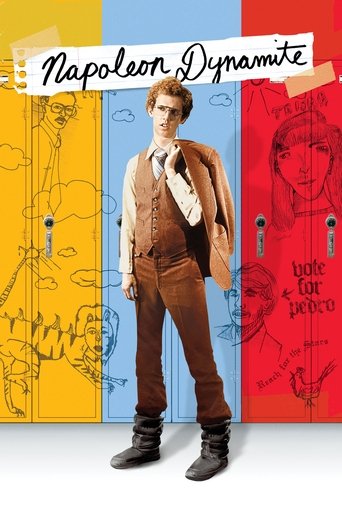
Napoleon Dynamite
2004 · Film · 95 min
Directed by Jared Hess
A listless and alienated teenager decides to help his new friend win the class presidency in their small western high school, while he must deal with his bizarre family life back home.
6 positive1 negative1 mixed18 neutralfrom 26 commenters
Where to watch
No streaming data for this title.

26 comments on Hacker News
Indeed. I read that movies like "The Blair Witch Project" and "Napoleon Dynamite" got their break at Sundance.
Like wine, and investing generally, it's the argumentum ad crumenam, problem.
The problem with movies is they're worse bets than startups and so big productions are the primary ones that get distribution and marketing. Kind of a self-reinforcing power law distribution that leads to a few getting most of the money.
The tiny ones need to find cleverer ways to get free marketing Richard Branson-style and try to include at least one celebrity.
Examples of shoestring budget success stories:
- Napoleon Dynamite 400k USD (2004) (680k USD today)
- Mad Max $200k AUD (1979) (760k USD today)
- Fruitvale Station 900k USD (2013) (1.24M USD today)
- Monty Python and the Holy Grail £ 175k (1975) (2.5M USD today)
- Easy Rider 400k USD (1969) (3.5M USD today)
- Mean Streets 500k USD (1973) (3.6M USD today)
This is a good point.
Modern movies try to appeal to everyone. Can't be too edgy or too opinionated, don't want to sick rabid hordes of haters on themselves.
And there's a huge segment of the Western population teetering on the edge of death or living in misery in various ways who are a literal matchbox waiting for a spark, no megaconglomerate film company wants to be responsible for setting them off, to the point where it's safer to sell mediocre and milquetoast movies rather than push an opinionated one and risk blowback.
Look at the Beetlejuice Beetlejuice or the Craft 2. Both movies built on a previous proven winner, both original movies had something to say.
Beetlejuice was not only a quirky romp through the afterlife but also a story about aboriginalism vs colonialism and whether it is right for the aboriginals to do horrible things to protect what is theirs, and also a story about how embracing change can help cross generational divides and how accepting people who are different from you can enrich your life.
It was very opinionated and had a lot of great subcontext. Same with the Craft.
The Craft was, on its cover, a story about what teenage girls would do if they got magical powers, which then turned into a series of biopics of the deep emotional damages caused by indifferent and hateful people. The movie dealt with racism, sexual assault, murder, mental illness, self esteem, and self acceptance all in the context of a teenybop horror movie.
Then you look at their sequels.
Beetlejuice Beetlejuice introduced 3 antagonists, Beetlejuice's wife, the boy, and Lydia's boyfriend.
It started three potential plotlines, the soul sucker, the life swapper, and the gold digger, and brought Beetlejuice in to deal with all three of them.
And then, 80% of the way through the movie, it threw all three of the antagonists and plot lines away and then rehashed the climax of the original movie with a slightly different set of clothes on.
What deeper meaning did Beetlejuice Beetlejuice have? None. No one had any value or made any sense. No one in the entire plot was irreplaceable. No one learned any lessons or grew in any measurable way. Nothing actually happened. They all woke up like they had a bad dream after Lydia's father's funeral, the mother died, the gold digger died, and then the story was over. If the movie had not happened nothing would be different for the characters except that maybe the gold digger would have dug more gold or something.
Then, the Craft 2. It's not a horror movie. It's a teenybop movie where girls get magic and do things with it. They have a trans person in it but she doesn't use her magic to address her transness in any way. There's only a tiny drop of racism, and no one has any real deep issues to resolve.
So, instead, they get David Duchovny in to play as some guy who embodies toxic masculinity, but who is also ineffective and purposeless all the way to the very end of the movie, when all of a sudden he goes murder rapey and then gets easily beaten by the power of feminism and witchcraft.
No one learned anything except GIRL POWER. Nothing really changed for anyone. There were no edges in the movie to explore. It was pointless.
Either sequel could have been much more poignant by touching on real issues that people experience. The Craft 2 could have touched on social media and the need to look like you have a perfect life. They could have touched on what a trans woman would do if she could remold her body with magic permanently or semi permanently like the girl did in the first movie. They could have made Nancy a bigger part of the movie and have her deal with David Duchovny instead of it being a girl power movie, and then Nancy could have taught the girls the things she knows being a former vessel of Manon with 25 years to learn and grow from the experience. It could have gone into a demonstration and discussion on how young women have so much to learn from women even 20 years their senior, and how working together and tearing down walls both of age differences but also gender differences can make the world a better place.
Beetlejuice Beetlejuice could have made a really fun story out of any of the three protagonists and plot lines if it had picked and chose one of them to run with and made the others the sub plots. The gold digger plotline could have been about accepting what is different about you and not allowing others to convince you to mask your weirdness. The life swapper plot could have been about learning how to accept that you're a normal person who grew up in a weird household, and how that doesn't make you weird and that it is possible to make both sides work together as long as each side values the other. The soul sucker plotline could have been played for laughs as at the end we could have seen Beetlejuice about to win Lydia only to be thwarted by his actual wife and dragged off into the underworld by the leg by her (and end up happy in the end, maybe seeing him slowly reinflate after she sucked the soul out of him, he he sex joke). All of those options were thrown out of the window and instead we get a meandering pointless movie that would have been fine if it had never existed.
Good movies have an opinion and something to say. Napoleon Dynamite is a perfect example of this. It's a bad movie in every measurable way. It's boring. It's slowly paced. It has no plot. It's like a 2 hour slice of life Jello movie. But then, the point of the movie gets driven in, that everyone has value.
It's a simple message told in a long and occasionally humorous manner, but because they didn't try to piledrive the message into you when it hits it hits hard.
Bad movies ramble even more than I do and never make a point for fear of popping a bubble. And media franchises know this and choose to make them anyway rather than be at risk of any blowback. After all, most movies released by a large franchise are profitable by default. The number of AAA movies that did not make their cost of production back in the last 10 years is vanishingly small, to the point where movies that only make 150% of their production costs are considered box office bombs and franchise killers. (Like the Golden Compass, that made $370+ million and won academy awards on a $180m production cost and was considered enough of a failure to end the entire series)
They know how to make good movies. They know how to tell satisfying stories that keep people wanting more. They know how to make a lot of money doing it.
So why do they keep not doing it?
I believe it's 2 things.
1: Fear of offending people and having massive blowback because of it.
The outrages over stupid things like the Little Mermaid being black is a good example of this. Who cares what color her skin is? She's a fish. If the story is good and told well then what does it matter?
But I get it, you can't convince someone who wants to be upset and outraged as a distraction for their own personal problems to focus on their personal problems instead of screaming about DEI or whatever 4 letter flavor of the day they have to rage about. This much is understandable. But still, that's no excuse for making a bad movie, they could have far more easily found the rage points and dealt with them and left the rest of a good movie alone.
But that brings me to my second point.
2: It's on purpose.
I've been thinking about this for a while, but I'm starting to believe that megaconglomerate media companies are intentionally making unsatisfying movies that are highly titillating for the same reason that Doritos flavors their chips in just such a way that you never get satisfied of eating them, that final burst of zest and flavor that would put you over the edge always just out of reach.
It's like the torture of Tantalus, satisfaction always being just outside of arms reach, but knowing that it's close, and occasionally actually satisfying the itch (like any good skinner box) keeps us diving in, spending money, buying merch, showing our love and support for the franchises that once scratched the itch for us in hopes that it will scratch it again next time.
They're doing it on purpose because they know that if you didn't get what you wanted out of this movie, you'll go watch another, or a TV show, or read a book, or play a game, something, because you came to get satisfaction. And if they blue ball you just right, you'll keep spending money until you can't afford to spend any more in hopes that you'll finally get what you're looking for.
I think it's on purpose and I think it will keep getting worse until it cannot get any worse, and then it will be replaced with something else that will be massively satisfying for a while at least.
Well earned. Best overall movie since Napoleon Dynamite.
I happened into the Hacker Dojo (in Mountain View) the other night after traveling in from Central Valley for the weekend and about 8 of us watched the movie glued to our seats and discussed it for another couple hours. My first thought was "this looks like Blender" when I saw the cat, and we did talk about some that resolution and information density as one layer of the movie. I had no background on the movie, had never heard of it, just happened in by chance. Massive serendipity felt tho, on a side note. Kudos to the team who did the film.
I have two thoughts on this: it's important to find contentment regardless of situation, but I would caution against settling for less.
I've noticed that as more and more aspects of the American dream have been stripped of us by the uber-rich in recent decades, a certain kind of fatalism has settled into our collective psyche. There's a sense now that the quiet life is out of reach, regardless of income. That wages will never rise fast enough to keep up with the rising cost of housing. That there are just more and more and more people everywhere, that our heritage is being gentrified. That the hustle and bustle has nearly eclipsed most personal interaction. Basically that the worsening struggle of postmodernism has replaced community, tradition, and so on.
Ironically I had welcomed tech/progress up through the late 1990s, because young people today may not realize how ignorant times were then, when shows like All in the Family may as well have been documentaries. If you watch Saved by the Bell and Napoleon Dynamite, notice how there's no real technology, and there's an impression that the future is coming, but at a glacial pace. It wasn't like today, where if something hasn't been invented yet, it just means you haven't searched hard enough for it on the internet. We still had science instead of manifestation, so nobody told us how much our dreams mattered, only that we should put our noses to the grindstone.
Now in middle age after a lifetime of hard work with little to show for it, I find myself asking what all of this is for. What's the point of tech if it just makes you work harder? Shouldn't it make life easier, and bring more money and resources your way? And I think a lot about people who are good for nothin. Energy vampires who suck the life out of you when you're trying to make progress. They used to be people like me, angstful cynics who pointed out the absurdity of the modern world, who took solace in shows like South Park. Today they're the thought leaders and billionaires who vacuum up all available capital and lobby the government to take away our freedoms. What good are they if they only take but never give?
The key part of the article was unions. You want the quiet life, you've got to organize. This lone wolf, rugged individualist, pull yourself up by your bootstraps dream of winning the internet lottery was a bill of goods. Because winner takes all, and odds are it ain't you. I've been trying for a quarter century and if I knew then what I know now, I never would have started down this road.
I'm shifting my focus to a resource economy where basic necessities are provided by scalable technologies that can't be taken away by concentrated wealth. Where the difference between what employees are billed out for and what they are paid accrues ownership in a business, the same as capital put up by investors. Or that difference is accounted for in tax write-offs, pensions, retirements, social security, and so on. Where job applicants can see that discrepancy in public accounting records and choose not to apply to businesses that exploit them. So that we can all start getting paid what we're worth and build an economic system around improving the human condition instead of feeding off it like vampires.
I wonder if that was due to how much awkwardness there was in the movie.
* It's a divisive mood. Some people find it relatable and cathartic (and hilarious in the context of comedy), while others find it intolerable to the point that they will leave the room during awkward scenes.
* It's not a common type of humor, especially in mainstream American movies, so people are unlikely to have many other awkward comedies in their viewing history.
* Napoleon Dynamite took it to such a degree that even people who enjoy it in small doses might have become exhausted by it as the film went on. (As far as I can recall, that's how I experienced the film.)
Disco Elysium.
Having played literally thousands games this one is my no. 1 recommendation for a long time.
It’s a non-fighting noir RPG where world is the main character. I made three approaches because I was confused by it. Minor spolier - confusion is part of the setting.
I always think of it as of Napoleon Dynamite movie. Reception differs depending on your mood. It can be hilarious. It can be heart breaking. It’s been 2 years and I still am reminiscing the story. True masterpiece.
The movie that comes to mind for me is Napoleon Dynamite. My first impression was that it was just aimless slapstick, but really it's about a group of misfits becoming friends. The events that lead there sometimes pay off and are sometimes are seemingly random. This really makes it feel charming and realistic.
Its such a brilliant movie. My son and I have watched this countless times as well. I only recently realized that Lazlo is also Uncle Rico from Napoleon Dynamite and Dr Roberts in Dream Corp LLC. Check out Dream Corp if you haven't its brilliant.
>That's a pretty good B-movie plot.
It can be good... in the right hands.
We're all debating various complex semantics when the only thing that ultimately really matters is talent... who ultimately is in control of these building blocks. Talent with the director, talent with the screenplay, talent with the acting, etc.
There has been plenty of dumb plots, stories, concepts, etc that have been turned into great movies by talented people. Reservoir Dogs, Clerks 1, Napoleon Dynamite, The Abyss, etc would all sound dumb, boring, or cliche on paper, but were made highly watchable by talented film makers working in their prime.
Just like startups, the only thing that matters is people, not how clever your original idea is. You could have the perfect movie idea, which many big budget have had (which translate well into trailers and per-release marketing), but turn out to be awful once it's turned into the 1.5hr+ long final product.
I think you're referring to that one M&W episode. Or are there many like that? I thought it was like thinking that every American rooms are stuck in 1970s yellow-brown color palettes based on napoleon dynamite.
One million $ was wasted in croissant and baguette.
Quality of product are not determined by the amount of money wasted. Sure the base quality is almost here, but it's why we have sooooo many bad movies but 1% of them are good.
When you get a movie (https://fr.wikipedia.org/wiki/Napoleon_Dynamite) for $ 6,000 that make 40 million, done in 27 days. Hollywood studio should stop scratching their balls.
I'm not sure there's a reasonable way past the "Napoleon Dynamite Problem". They mentioned, in the article, other movies where it's difficult to predict if someone would like them or not.
The list was “I Heart Huckabees,” “Lost in Translation,” “Fahrenheit 9/11,” “The Life Aquatic With Steve Zissou,” “Kill Bill: Volume 1” and “Sideways.”
Personally, the common thread I see across those is that the viewer would be more likely to enjoy the movie if they had the right context.
Kill Bill, for example, is far easier to enjoy if you've seen (not necessarily liked...but have seen) cheesy old Kung Fu / Karate movies.
Napoleon Dynamite is easier to appreciate if you were socially awkward yourself in high school. There's also some humor in there that's more relevant if you were a kid in the 80's, as well as some humor that might make more sense if you lived somewhere rural, or even more specifically, rural Idaho/Utah/Wisconsin.
All that to say that Netflix may not have enough data at their disposal to know if you have the right context to enjoy movies that almost require it.
> The Napolean Dynamite Problem
1. It's "Napoleon". Copy, paste would have prevented this error.
2. For some reason, an obvious issue is left out of the article -- and that issue is how much of movie ratings constitutes entropy, meaningless noise from which no pattern can be extracted, and how much constitutes actual data that an algorithm might accurately model and predict.
Those who doubt the role of entropy should try compressing the output of a pseudorandom number generator. If the PNG is any good, the compressed output will be larger than its input, implying high entropy. In fact, compressing the predictions of Netflix customers would be a good starting point in an algorithm design -- see whether there are any patterns available to exploit.
3. Along with Napoleon Dynamite on the list of hard-to-predict movies, Repo Man and Eraserhead should be considered -- they're also very hard to categorize.
Much of this is true, but I think it's important not to look at the differences just through a lens of production values. Even worse to equation production values with merit or quality of the end product.
There have been several low budget films and tv shows that have become highly successful and well regarded, the same is and will be true in the online realm. Look at Mad Max, which was made for around a third of a million dollars, Primer, or Napoleon Dynamite.
But also it's not just production value or even quality but fundamental differences in character. TV was a different sort of beast than film, and even over the last decade commercial TV has changed a lot. Look at all of the independent content that sprang up on non-network TV channels, especially from HBO. A show like The Wire, or even more so The Corner, was very unlikely to ever be made within the confines of traditional network TV. TV has a different sort of character than film in terms of the sorts of productions that are suited for TV, and online video is different as well, but we haven't seen all of the ways that's so.
One example I'd highlight is the Lizzie Bennet diaries, a modern adaptation of Jane Austen's Pride and Prejudice in vlog form of over 100 "episodes" of typical youtube length (~3-5 minutes).
Another example would be Periodic Videos (and related projects). These are educational videos about chemistry but because they don't have the length limits or requirements of traditional TV they can be focused on a single subject without being forced to add in unrelated filler.
Or, there's Lindybeige, who's likes to talk about medieval, classical, and bronze age technology and weapons. It's just a guy expressing his opinions and trying to back them up with experience or logic but it's frequently just as informative and interesting as watching a typical historical tv show.
It's not hard to predict a movie's box office right before it comes out
Well, there's the Netflix prize[0] which tells otherwise
Predicting movie appreciation is actually very hard to solve. One of the infamous examples is the "Napoleon dynamite problem"[1]
[0] http://en.wikipedia.org/wiki/Netflix_Prize
[1] http://www.techdirt.com/articles/20081123/1212542927.shtml
If you have limited resources, go after data first and then algorithms. He could have used "GIGO" [0] to make it clearer.
Anecdote: there are a few movies that completely muddy the statistics, e.g. Napoleon Dynamite [1]. More background [2].
[0] http://en.wikipedia.org/wiki/Garbage_in,_garbage_out
[1] http://www.imdb.com/title/tt0374900/
[2] http://whimsley.typepad.com/whimsley/2009/10/netflix-prize-was-the-napoleon-dynamite-problem-solved.html
Ok, get a cup of coffee, sit down and get comfortable. I am about to go into a very long dissertation as to why Y Combinator's statement is both seriously short sighted and potentially dangerous for any new media start up. Ready? Ok let's go.
As the CEO of a media start-up and someone who has been deeply entrenched with every aspect of the Entertainment industry for the last 18 years, I have a deep understanding of "Hollywood" and the ecosystem it represents. So, let's review:
Content Production - While there are some very legitimate ways to make pretty great content on a low budget, there are only a few really successful ways you can do that. First and foremost, the cost of the film or video by itself is only one very small factor. It takes relationships, knowledge of the industry, access to talented individuals and a whole lot more money to market your content in a way that will create the revenue you would actually require to consider it a successful product. So let's review what it takes in "Hollywood" to make a product that will (hopefully) resonate with viewers:
1. Money. Whether it's a few thousand dollars, or hundreds of millions of dollars, there are no productions, and I mean none, that cost nothing to make. You have to make some kind of investment whether it is in software, the camera (even an iphone), an internet connection to distribute it, what have you. So even with depreciated assets, you're still investing money somewhere. But, let's come up a few hundred feet and talk about the content that is actually made in Hollywood, with that kind of spending power:
2. Cost of Production. This is not just the money spent on the production, but the actual cost of goods sold. The first phase includes the development, the pre-production, the actual production, the post-production and the ground level marketing (shopping it around film festivals, etc.) The second phase is what happens after your content has been acquired. Now we're in the really big money. Now we're in P&A costs, which stands for Prints and Advertising. This is the cost of marketing your product. To put it into perspective, a film like Napoleon Dynamite was made for around $500K. It was acquired for $3m at Sundance. Then the studio spent another $xx million to market it. Napoleon Dynamite went on to be one of the most successful independent films ever created. It made over $140m in the video market alone. THIS. Is an outlier. Now let's talk about the median products. The ones that Studios personally finance and market. Let's say they spent $30m to produce a film. Most of that money goes to the talent and the UNION crews that work on them. (We'll get to the unions later.) They distribute the $30m picture across screens worldwide. Worldwide the picture makes $45m. Not bad, right? Wrong. Because that $30m production cost another $80m to market. That's right.. almost three times the cost of the actual production. And the $45m it made worldwide? Well that's only $22.5m back to the studio because the theaters take HALF the ticket sales. HALF. They do almost NOTHING to market the film, get paid to host the film, charge $9823598746 on snacks and they get HALF THE FREAKING REVENUE from the film. So, the studio’s net LOSS on that product is $87.5m. That’s what we like to call in this industry.. a tank. You can spend $30m on a film, get some of the best talent you can think of, and still it falls flat. Why? Well if you can answer that, then there is a job waiting for you in Hollywood. No one really knows for sure what the general public will accept as an amazing film until it’s released and the ticket sales and social buzz generate the outcome. I have seen some amazing films that I thought were some of the most creative and concept-forward films I have ever seen, and they tanked at the box office. It all comes down to the public’s taste at any given time.
Continued below...
Maybe we're making some progress:
So, we started with social graphs, social media, and social search (below I refer to these three as 'social X') and asked the questions about purposes, the utility of social X, and the means to the purposes.
For entertainment, there is a huge industry from movies and TV. One lesson is, high quality content with broad appeal is expensive to produce. In particular I don't see Internet social X doing much better at generating good entertainment content.
I will insert another point: The more such good entertainment is produced, the more expensive it is to produce even better entertainment. So, we should be moving to about enough high quality digital recordings of such entertainment to satisfy anyone for life and, thus, have less pressing reasons to produce more.
You mentioned:
"This data is usually used as you stated to find similarities . In people, for matchmaking sites, here are things purchased by people who...read the same stuff, watch the same movies, etc. It can turn out well, but for what was known by the Netflix challenge teams as the Napoleon Dynamite problem. A movie that based on similarity clusters was almost impossible to predict how a user would rate it."
I can believe that! Apparently the idea was that persons A and B are 'similar' and person A likes movie X so that then maybe person B will also like movie X. That is not promising because the 'connections' are too crude: E.g., two sisters can be very close yet be very different in the movies, music, clothes, boys, etc. they like.
It appears that the Netflix people fell into a trap: Apparently commonly in the literature of 'collaborative filtering', 'recommendation engines', and 'data mining' has been the suggestion that we should start by putting people into 'clusters' and for each cluster observe what movies, music, etc. were popular in that cluster. Then, given another person, say, a user, find what cluster they were in and then recommend to them what was popular in that cluster. Not a good idea. Interesting to hear that the idea failed!
So, we might conclude that some of the data for such clustering, recommending, etc. can be represented as social graphs, but that step appears to be just a tangential afterthought and not a good example of the utility of social graphs.
Yes, people like to communicate and form communities: Significant examples from the past include back fences, kitchen tables for coffee, lunches, dates, parties, various meetings (e.g., PTA, alumni, school board, political parties, church), school, and work. Such conversations and communities have been significant for romance, building a business, getting a job, education, skills, arts, crafts, politics, and more. But I'm failing to see that the communities that result from Internet social X are very significant.
Net, I don't see current Internet social X doing very well on entertainment, conversations, or communities.
I see the Internet as terrific for a lot, e.g., news, short video clips, technical information, the content on Wikipedia, general information on organizations, information from topical blogs and long tail Web sites, shopping, and more. But so far I don't see social media as leading to very significant utility.
Then in particular I don't see much value in the data on social graphs.
Still, Facebook has 500+ million users and is worth maybe over $50 billion; Twitter, Foursquare, etc. are significant; and Page believes that 99% of social search has yet to be done.
So, here we can look at the weakness in social X, and that might mean that there is an opportunity to do better and have some astounding success. Or, a guess is that current social media efforts are not really addressing the fundamental purposes and opportunities very directly or well so that a better effort could be quite successful.
Thats an interesting idea. I'd still be surprised though if that didn't correlate with some movies. If someone hates Napoleon Dynamite due to feature X, then they should dislike movies that have X as well. Or, at the least, avoid watching movies with X.
So, if your theory is correct then I see two possibilities:
1) The pointy bits are themselves strange and don't appear i other movies. This goes back to "the movie is strange" again though...
2) People who dislike these traits avoid movies that have them and the algorithms don't take into account what movies people haven't seen (or that taking it into account is very tough since most people haven't seen most movies).
Not sure which is more likely.
Perhaps these hard-to-predict movies simply have pointy bits sticking out. A rose is great until you get poked, then you irrationally throw it away. Napoleon Dynamite has lots of parts that make people uncomfortable - different parts for different people. Never mind its a great movie - it will get irrationally rated by a great many folks. So come up with a Beta for a movie, or cluster the folks that like it anyway, or try to detect what kind of phobias a person has - these movies could be great litmus tests for homophobia or whatever!
I draw a slightly different conclusion than the author.
>I noticed they were all similar in some way to “Napoleon Dynamite” — culturally or politically polarizing and hard to classify, including “I Heart Huckabees,” “Lost in Translation,” “Fahrenheit 9/11,” “The Life Aquatic With Steve Zissou,” “Kill Bill: Volume 1” and “Sideways.”
To me, what all these movies share in common is that they are so original that they are less accessible to the first-time viewer (or, in the case of Farenheit 9/11, completely tied to one's political leanings).
For example, I walked out of Napolean Dynamite and was bored to tears with Lost in Translation. The second time I watched those movies, I laughed my butt off at Napolean Dynamite and I found Lost in Translation to be one of the deepest movies I'd ever seen. Just the thought of Lost in Translation now gives me a yearning heartache. If I used Netflix to rate these movies after my first viewings, I probably would have given them 1 or 2 stars. Now I give them both 5 stars.
(As an aside, I highly recommend all of the above mentioned movies. I'd love to see an expanded list, so if anyone has one, please share. Going by my theory, I bet The Big Lebowski is in there. :)
From what I remember reading about the contest, the problem was that when comparing movies and using movies that were similar to others as a way to suggest movies people either hated or loved Napoleon Dynamite and it didn't match up at all with their previous movie ratings. Thats how I understood it at a basic level.
I assume it would be cheating to simply never recommend Napoleon Dynamite and the other controversial movies?
That's hilarious. The list of movies that are hard to classify reads like a list of my favorites...
[Like] “Napoleon Dynamite” — culturally or politically polarizing and hard to classify, including “I Heart Huckabees,” “Lost in Translation,” “Fahrenheit 9/11,” “The Life Aquatic With Steve Zissou,” “Kill Bill: Volume 1” and “Sideways.”
I've never been able to relate to Lebowski for some reason. Loved many of the other Coen bros films, though. Using Matt's criteria for movie greatness, I can name several other movies off the top of my head that are much more quotable than Lebowski: Caddyshack, Ghostbusters, Blues Brothers, Airplaine, Holy Grail, Fish Called Wanda, Napoleon Dynamite, Pulp Fiction.
...I must be significantly older than Matt, I guess.