 Hacker Cinema
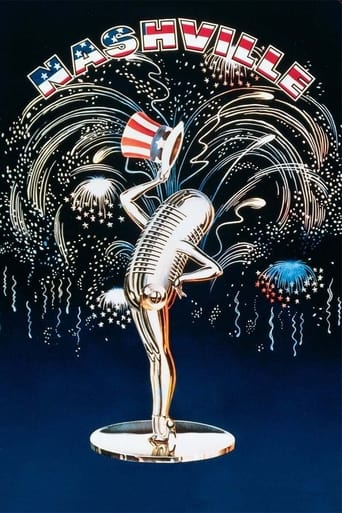
Nashville
1975 · Film · 160 min
Directed by Robert Altman
The intersecting stories of twenty-four characters—from country star to wannabe to reporter to waitress—and their connection through the music business in Nashville, Tennessee.
3 positive2 neutralfrom 5 commenters
Where to watch
No streaming data for this title.
6 comments on Hacker News
"Back when I was a Catholic-school kid in northern Wisconsin, my school lessons briefly focused on the metric system. This was in the late 1970s."
Man, the progressive school (Comanche Elementary in Overland Park, Kansas!) must have had a huge impact on my life. In addition to open classrooms (I was in Unit 5, not 4th Grade), team teaching, a focus on experimental science, a circular layout to the school with a sunken (architecturally) library in the center…
Yeah, we went over the Metric System that whole year. I can still sing the "Metric Family" song from the film on metric units ("Kilo", "Milli", etc.). And to my young and impressionable mind, the U.S. was joining the rest of the "Free World" in a kind of Star-Trek-like casting aside of the old things that divided us—joining each other with a focus on progress, science, space…
President Carter came along around the same time or shortly after. And I have a photo of a family road trip to South Dakota, Montana: the sign that indicates the altitude of a particular mountain pass has both feet and meters. I Google-mapped the same location recently and of course it's no longer in meters.
I feel like in my elementary school days (the 1970's) the U.S. was on the cusp of a future of optimism—no doubt buoyed by having put astronauts on the Moon, but I was wildly on board for it.
But then some kind of shit seemingly started to poison the country. I don't feel we have ever returned to that level of national optimism. Perhaps 1976, the Bicentennial, was the end of it. (Recently watching the film "Nashville" brought me back a bit of the vibe of the times.)
I've been missing it my entire life since.
I'd love a good literature class where we intersperse classic and contemporary writing. Often times I wonder how much of the subtext I am missing due to my ignorance of the classics. It'd be a lot of fun to read some Ralph Ellison, then a Chang Rae Lee novel.
After all in film, an area I'm a little better with the classics (although not entirely—I have massive gaps), it's really fun to point out the allusions and inspirations. The deep focus multi-narrative comedy of errors that is The Rules of the Game begets the combinatorial explosion of country music that is Nashville begets the post modern family drama of Yi Yi begets the Marvel Cinematic Universe. Or how non-linear editing in Hiroshima, Mon Amour could lead to Petulia.
I understand what you're getting at with the quite different, immersive style of Stalker. I don't necessarily agree that the lack of connection is necessarily due to people being accustomed to "voyeuristic and pornographic [experiences]". Sure, there's plenty of movies like that and many who would dislike Tarkovsky are devotees of that style.
But one can be a lover of subtle, beautiful cinema and still find Tarkovsky boring. I can easily sit through Nashville or Beau Travail or La Cienaga and still find Tarkovsky boring. Indeed, attributing dislike of Tarkovsky to being unsophisticated in one's taste is precisely what I was critiquing in my previous comment. Tarkovsky is not the arbiter of one's film taste.
> There would be no Godfather without Hollywood. No Apocalypse Now. (also no Taxi Driver, no Star Wars, no Indiana Jones, no MASH or Nashville) In the absence of Hollywood, you get movies like Youth Without Youth and Tetro - two wonderful oddities, but you'd be hard pressed to make the case for them against Coppola's early masterpieces.
Those movies you mentioned were a result of being within/outside Hollywood, not a function of Hollywood's existence.
I love FFC. I'm a current UCLA film student - Coppola's alma mater. One thing to think about: UCLA has always been the "indy, intellectual" film school. It's our rep, internally and (to an extent) externally. When Coppola left UCLA to work in Hollywood, he was branded a sell-out by his fellow students.
One thing to think about w/ this whole "crush Hollywood" thing is this: most of your favorite movies (assuming you've got a boner for the New Hollywood period like I do) were a result of an aging, out-of-touch entertainment monopoly making desperate, reactionary moves to save itself. The old system didn't work, the people in charge had no idea how to fix it, so they went crazy taking risks on young directors. FFC, Scorsese, Spielberg, Altman, de Palma, Lucas - all the really top-drawer American filmmakers, honestly - were a result of this period of blind desperation.
There would be no Godfather without Hollywood. No Apocalypse Now. (also no Taxi Driver, no Star Wars, no Indiana Jones, no MASH or Nashville) In the absence of Hollywood, you get movies like Youth Without Youth and Tetro - two wonderful oddities, but you'd be hard pressed to make the case for them against Coppola's early masterpieces.
The beautiful and horrible thing about Hollywood is that it's a system designed to throw huge stacks of cash at storytelling problems. It's fucking absurd, because money has never been capable of solving those kinds of problems - practice and gut instinct are what create good stories. But when strong storytellers are placed in an environment which supplies nearly unlimited resources, totally amazing things happen. Yes, we can all point to Heaven's Gate, New York New York, and Coppola's own One From the Heart, but flops like those are the inevitable flip side of the system I've just described: talented people can abuse unlimited resources just like anybody else.
I guess what I'm saying is: I'd be seriously depressed if Hollywood were to vanish. Yeah, it produces a lot of shit, but its high water marks have never really been replicated by any other mode of production.
To every generation there is a film technique which defines it. There was the smokey grey/green from the Matrix films. Michael Mann had his desaturated shallow-DOF look. David Fincher uses silver-retention on his film development to extend the dynamic range while underexposing his shots (thats why interiors in Seven were so "dark" yet exposed).
Part of the device of cinema is extending the mise-en-scene outward and upward to the representational devices (projection, development and treatment).
Part of the study of film is tracing how the use of technique defines generations of film makers. Often, technology serves as an impetus for a style (i.e., Robert Altman and the use of multi-track audio on Nashville precipitated very "talky" films from the 70's/80's), or the developments in computer motion controlled rigs.
Or lets not forget: lens flares.
Color grading (ie, the orange/blue compliments in this article) are also defined by outward influences like magazine photography, trends in CGI, etc.
Anyhow, in a few years a new dominate "look" will pervade cinema and we'll all have something new to complain about.