 Hacker Cinema
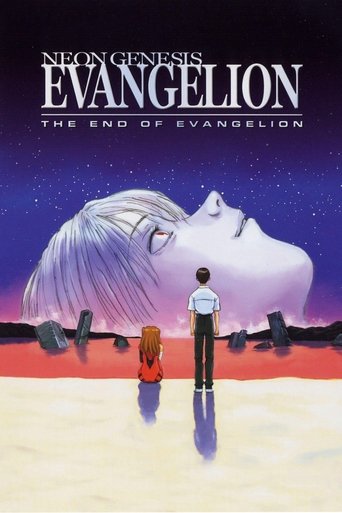
Neon Genesis Evangelion: The End of Evangelion
新世紀エヴァンゲリオン劇場版 Air/まごころを、君に
1997 · Film · 87 min
Directed by Kazuya Tsurumaki, Hideaki Anno
AnimationScience FictionDramaFantasyAction
SEELE orders an all-out attack on NERV, aiming to destroy the Evas before Gendo can advance his own plans for the Human Instrumentality Project. Shinji is pushed to the limits of his sanity as he is forced to decide the fate of humanity.
12 positive6 neutralfrom 18 commenters
Where to watch
No streaming data for this title.
18 comments on Hacker News
I love EVA, but I’ll cautiously recommend it. I feel like there are two sides to it: the mecha/alien/monster sci-fi side which has an amazing aesthetic, and the personal drama focusing on self loathing and loneliness. I think the first side is the most attractive to most people, but what really sticks with me to this day is the latter.
If you do end up watching I have to warn about the watch order. There are two timelines, the original TV series plus the movie “End of Evangelion”, and then the “Rebuild of Eva” movie series which started as a complete reboot but somehow ended as the ultimate Reboot/Remake/Sequel to the original stuff.
I feel like the easiest way to distinguish between those that get it and those that don't are asking their thoughts on the ending. If they prefer the original, they get it, and if they prefer the end of evangelion movie they don't totally get it. If they prefer the rebuild films they're in it for the yaoi and mecha which tbf I don't blame them kaworu is hot
It's similar on the surface. Another language, Effekt, does actually use interfaces for their effect declarations rather than having a separate `eff` declaration.
The difference comes in their use. There's two things of note. First, the implementation of an interface is static. It's known at compile time. For any given concrete type, there is at most one implementation of MovieApi. You're using the interface, then, to be generic over some number of concrete types, by way of only specifying what you need. Effect handlers aren't like this. Effect handlers can have many implementations, actually. This is useful in the case of ex. adding logging, or writing tests to simulate I/O without actually doing it, or just having different behavior at different places across the program / call stack...
eff MovieApi { def getPopularMovies(); } def main() { run { println("Alice's movies: ", getPopularMovies()); } with handler MovieApi { def getPopularMovies() = [ "Dr. Strangelove", "Lawrence of Arabia", "The End of Evangelion", "I Saw the TV Glow" ]; } run { println("Bob's movies: ", getPopularMovies()); } with handler MovieApi { def getPopularMovies() = [ "The Magic School Bus: Space Adventures", "Spy Kids 3-D: Game Over", "Twilight: Breaking Dawn: Part II" ]; } } Second, the effects of effect handlers are not functions. They're under no obligation to "return", and in fact, in many of the interesting cases they don't. The `resume` construct mentioned in the article is a very special construct: it is taking the "continuation" of the program at the place where an effect was performed and providing it to the handler for use. The invocation of resume(5) with a value looks much like a return(5), yes. But: a call to resume 1) doesn't have to happen and the program can instead continue after the handler i.e. in the case of an effectful exception, 2) doesn't have to be invoked and the call to resume can instead be packaged up and thunkified and saved to happen later, and 3) doesn't have to happen just once and can be invoked multiple times to implement fancy backtracking stuff. Though this last one is a gimmick and comes at the cost of performance (can't do the fast call stack memcpy you could do otherwise).
So to answer your question more briefly, effects differ from interfaces by providing 1) a decoupling of implementation from use and 2) the ability to encompass non-local control flow. This makes them not really compete with interfaces/classes even though the syntax may look similar. You'd want them both, and most effectful languages have them both.
I only liked the original ending after End of Evangelion helped explained WTF was going on. I watched the last two episodes like 6 times and couldn't figure it out.
EVA should not be missed, regardless of how weird and gross it can be for some. I watched it for the first time a year ago after hearing so much about it.
The first five or six episodes are an awful slog, and then there's an exponential curve up through 'quite good' into 'great' then 'I understand why this will print money forever'.
If you're sold but confused how to watch: start with the original release and then watch End of Evangelion; both on netflix.
Time and place sort of thing. There could easily be another timeline where Evangelion and Sailor Moon swap places popularity-wise in the US. The demographic for anime on broadcast television in the late '90s and early 2000s, when Evangelion was getting dubbed, just skewed too young for it to really be profitable in any way. If I remember correctly, it only ever had one complete run on Adult Swim, a late night block which really limited its exposure. I don't think End of Evangelion has ever aired on a major broadcast network. (The Rebuild movies did get play on the revived Toonami about a decade ago, though.)
I don't think Evangelion would ever have been a breakout hit, per se, like DBZ, but depending on the circumstances it definitely could have had moderate success.
Really? Even now it's still one of my favourites. Apart from the fantastic visual direction, soundtrack, and Anno's characteristic style, I love the way it plays with the viewer's expectations and I admire its authentic treatment of depression (Anno himself suffered from clinical depression at the time, which is reflected in the direction of the story.)
I can imagine coming away from it slightly disappointed if you didn't finish with The End of Evangelion movie, but in my opinion, the final two TV episodes are underrated.
I strongly disagree with skipping the original ending. I'm personally on the side of people who love it, but even for those who don't I think it's very interesting and absolutely worth watching. I'd say watch the original show, wait at least a few days, and then watch End of Evangelion.
Gotta be careful though, because while NGE indeed feels way past the expiration date on spoilers, the Rebuild movies definitely aren’t (the final one came out just earlier this year). And people online definitely like to bring up Rebuild movie spoilers in conversations about NGE. Mostly due to how very inter-connected, yet, at the same, disconnected NGE and Rebuild movies are from each other.
TL;DR: agreed on no need to be afraid to spoil NGE, but we gotta be explicit that it applies only to NGE (+the end of evangelion movie, which is the true ending to the show that is absolutely a must-watch; also imo past the expiration date on spoilers), and not to Evangelion as a whole (which would include recent Rebuild movies). But there is no harm in putting a spoiler warning at the beginning, and that’s a nice gesture towards those who might want to watch it for the first time without the storyline being spoiled.
The movie saves it for me. Like, I appreciate the last 3 episodes of NGE from a 'psychoanalysis of the writer' POV, but the real entertainment is in the catharsis of End of Evangelion.
I highly recommend you watch the End of Evangelion and Rebuild movies if you get a chance. Ultimately, I think Eva is ambivalent about the value of saving the world, far and away from the ability to do so. By the end of 3.0+1.0, Shinji essentially HAS saved the world, except that that's not the important victory. In the end, Eva doesn't care about canonicity, and it barely cares about narrative. It's instead more interested in characters, and their relationships to each other and the world they inhabit. Everything else is malleable to produce interesting dynamics between each actor. It's fascinating in how experimental it is, and not just because it superficially upends assumptions about how stories should play out.
I'd recommend watching it with subtitles. If you don't like subs after the first episode or two then go for dub. Once you get to episode 25 & 26, you could choose to watch the End of Evangelion movie instead.
Episodes 25 and 26 are very abstract and rushed due to initial production budget. EoE is a more watchable ending to the series.
If you're craving more after that! The plot continues with the four Rebuild of Evangelion movies on Amazon prime video.
A detail I really like is how they made the user interfaces part of the story telling. The computer screens are displayed clearly and it allows the audience to interpret the information just like the characters.
Seeing the mecha switch from external to internal power and start a five minute countdown is pretty chilling. Jet Alone booting up version 2.2.1c and then reverting back to 2.1.1c without Misato's intervention confirms that it was sabotaged. When Shinji and Asuka's combined synchronization rate with EVA-02 peaks, we know they have won. Episode 13 visually depicts the angel taking over NERV's super computers: one triggers the self-destruct, the other two overrule it and the angel starts invading the other computers. End of Evangelion also revisits this: we know Ritsuko's plan has failed because one of the computers refused to comply.
2001: A Space Odyssey is the earliest example I know of this kind of story telling. The space ship's computer kills the sleeping crew: their vital signs slowly flatline one by one and in a specific order.
https://youtu.be/Z4n3dbPqk58
One scene that sticks out to me after all these years is a brief 2 minute scene from 'End of Evangelion' where Rei is talking to Shinji about the nature of dreams.
In the background you can hear Bach's Jesu Joy of Man's Desiring being played on a piano and it transitions from animation to filmed live action footage which I think was shot around Tokyo it shows things like train lines, buildings and an empty swing set in a playground and yes there is a power line shot. Then it cuts to an audience watching a film inside a cinema as handwritten letters flash up on the screen, which were death threats the studio had received from obsessive fans.
I was blown away by the aesthetics of this scene watching it as a 15 year old and it's stuck with me.
The type script version is type checked: http://bit.ly/2lVoSgY
type State = { movies: string[] };
type Action = | {type: 'AddMovie', movie: string} | {type: 'RemoveMovie', movie: string} | {type: 'Reset'}
let defaultState:State = { movies: [] }
let reducer = (state: State, action: Action): State => { switch(action.type) { case 'AddMovie': return { movies: [action.movie, ...state.movies] } case 'RemoveMovie': return { movies: state.movies.filter(m => m !== action.movie) } case 'Reset': return defaultState; } }
/* No need for additional functions! */ let someAction = {type: 'AddMovie' as const, movie: "The End of Evangelion"}
reducer(defaultState, someAction);
The secret is that typescript doesn't actually lack variants - it does have the equivalent of polymorphic variants. Try adding a new action type, you will get a type error for the reducer return type. It won't be a pretty type error, but you can't forget to add a switch case.
Disney and American TV shows have pretty mechanical approaches to this, and you can usually tell which are the keyframes when the characters seem to settle into a pose before starting a new one. But not everyone draws that way - try and find them in End of Evangelion!
https://www.youtube.com/watch?v=iounOj1VRUU
Interestingly, the director of End of Evangelion, Hideaki Anno was mentored by Miyazaki and was an animator on Nausicaa. He did the protagonist's voice work for Miyazaki's last film "The Wind Rises" and Miyazaki has said that he would entrust a Nausicaa sequel to Hideaki Anno.
http://www.animenewsnetwork.com/news/2013-08-22/hayao-miyazaki-open-to-nausicaa-film-sequel-by-evangelion-anno
The animation is gorgeous but at times it can be a little too smooth for me. The greatest animation I've ever seen is still in End of Evangelion. It's not the best movie ever, but the way Asuka's Evangelion is animated during her final battle with the S2 engine Evas is incredible. Whoever animated it definitely groks momentum, inertia and how to create these effects with a limited budget/number of frames at his disposal. No amount of CGI or money could be thrown at that fight to make it look better.