 Hacker Cinema
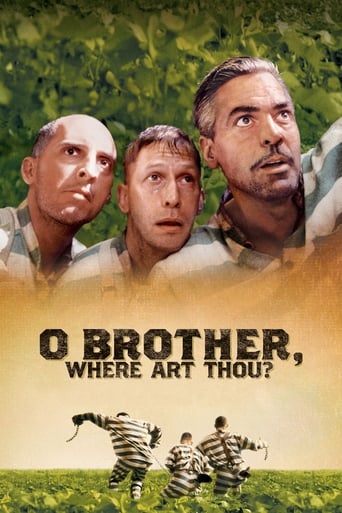
O Brother, Where Art Thou?
2000 · Film · 107 min
Directed by Joel Coen
In the deep south during the 1930s, three escaped convicts search for hidden treasure while a relentless lawman pursues them.
9 positive14 neutralfrom 23 commenters
Where to watch
No streaming data for this title.
23 comments on Hacker News
> rather than read the original work.
Look, given that the so-called "original work" is in ancient Greek, I don't think any ordinary American today is going to take the time and effort to actually "read the original work".
Even if you were to learn the Greek language well enough to "understand" the original book, you wouldn't really understand it, would you? Because it makes so many intertwined culture references, to the landscape, to the gods and myths of the period. So, what is better: for people to sit down and try to grind through the book, or to make a living production as a modern adaptation, for modern audiences to enjoy?
Furthermore, the Odyssey would have been performed by a singer or poet in its time. People in Greece wouldn't have been reading it on paper! That would be absurd even then! So, it would already be a performance, an interpretation, and it would surely be adapted by those performers to the place-and-time. There is surely a lot of space between the oral tradition that Homer originated to the written word.
Personally, I have immensely enjoyed O Brother, Where Art Thou? as a modern adaptation to Americana. I cannot pretend to understand the original, or the intricacies of the Coen Brothers' adaptation, but I love the performances, the singalong songs, and the production values of the modern film, and it gives me more insight and appreciation for the ancient epic as it was.
Isn't that "O Brother Where Art Thou"? Probably my favorite Coen brothers movie.
> People with comfortable enough lives sometimes have this attraction to the very romanticized versions of otherwise very hard lives.
The film Sullivan's Travels from 1941 is a film that explores the concept of this romanticization. It's a good movie whose storytelling and comedy still hold up today. I think more people should be aware of it.
Trivia: This is also where the movie O' Brother Where Art Thou got its name.
The last comedy that I saw that matches your description is American Fiction. It didn’t feature too many laugh out loud moments, but it was thought provoking and well done. And yet, 93% from critics and 95% from audiences.
I wonder if audiences can appreciate these movies more than you give them credit for?
Let’s try a few more
- Death of Stalin (94%, 79%) has the pattern you’ve predicted.
- O Brother Where Art Thou? (78%, 89%) has the opposite of the pattern.
- Grand Budapest Hotel (92%, 87%) was appreciated by both, like American Fiction.
I’m just not seeing a pattern here. Looking at comedies that fit your description the critics and audience scores don’t follow a predictable 95%, 70% pattern.
Reminds me of "Soggy Bottom Boys" from the movie "O Brother, Where Art Thou?"
https://en.m.wikipedia.org/wiki/O_Brother,_Where_Art_Thou%3F#Soggy_Bottom_Boys
Counterpoint: the past continues to inspire, surprise, and delight.
Your comment about “1700’s newspapers” reminded me of The Past Times podcast, where comedians read random newspapers from across American history. The episodes I’ve listened to were delightful, and they covered mundane news in mundane places.
“O brother, where art thou” is one of my favorite movies. It’s a retelling of The Odyssey (a literally prehistoric tale) set in Depression-era Mississippi, made in the early 2000’s.
The specific question of editing out these production artifacts doesn’t rile me either way, though. I didn’t see the original mistake, and I won’t notice the fix either.
I’ll also agree that just as no one steps in the same river twice, how the past is viewed and interpreted changes over time. What is valued or not also changes. 90% of everything is still crap. And quite a bit of the interest in the past is reflected in remixes or retellings for modern audiences.
Still, people also read Beowulf or Chaucer in the original or in modern translation. Others will enjoy both Jane Austen and Bridgerton. People will listen to Beethoven and Jon Batiste. Sure, not all those things are for everyone, but neither are modern music genres, sports entertainment, or most TV shows.
Adhesion and cohesion always fuck up scenes that combine scale models and water. Splashes always look very wrong, and in the case of a submersible bubbles could be a problem. Smoke chamber makes sense.
Although in the days since “O Brother Where Art Thou?”, when they added dust-yellow color to the entire movie in post, maybe there are other ways now, if you didn’t want to go entirely to CGI.
>Where did you get this stereotype of farmers?
it's not a hard guess even if you don't share the opinion ; nearly every movie where 'farmer' is a plot point demonstrates a rural-living poorly educated family living in dust-bowl conditions and barely scraping enough resource by to feed the animals.
grapes of wrath, wizard of oz, of mice and men, o brother where art thou, ballad of buster scruggs -- yes it's a stereotype , but it's a common one in movies and literature.
> "She's a gay little person goth time-traveling alien, he's an autistic left-handed incel Quaker. They live in Portland, and together they solve crimes."
I'm pretty sure a Netflix executive would have signed on this concept based on this sentence alone half a decade ago. Now it seems the entire world is waking up to these formulaic data-driven products that have been pushed by media conglomerates for a decade. This is especially apparent in the gaming world, where big productions seemingly flop out of nowhere (cough Concord cough) while indie studios keep innovating.
It's so easy to blame this phenomenon on rose-tinted glasses and older people like us thinking all old things are better than modern, but when the world wasn't decided by "data scientists" and corporate committees, there was more variety, more volatility. Lower lows but higher highs as well.
I've been thinking about this a lot the other day while watching snippets of the movie "O Brother, Where Art Thou?", wondering where pure, plain fun movies that are not pushing an agenda or pandering to some audience have gone.
And now, in the current era of the remake, which still has to reach the film industry, it is gonna get worse. When they'll find they are unable to invent the new multi-billion franchise, why not go and remake and "modernise" an older one? It's basically free money.
Of the ~700 movies I've watched (not bragging, just context - actual movie buffs watch thousands by the time they're my age), those I happily rewatch are:
The Thing (1982)
Silence of the Lambs
Alien
Little Shop of Horrors (1986)
Young Frankenstein
Rocky Horror
Raising Arizona
O Brother, Where Art Thou?
Men in Black
Primer
But even those I've only seen a handful of times each. It takes a lot for me to want to watch/read/play something multiple times, as I'm the kind of person who always thinks, "but I could be trying something new, or getting something done".
Banjo players of HN, represent! I’m the banjo player for “You, Me, Everybody” < https://youmeeverybody.bandcamp.com/album/you-me-everybody >. Our song “Stranger” was featured in S02E04 of Netflix’s “Sweet Tooth”, and that’s us (in make up!) playing it at the start of the episode.
My dubious claim to fame is that I believe I was the first person to put banjo tablature on the web, possibly the net as a whole. I used EMACS (eight megabytes and continuously swapping, indeed) in 92 or 93 to make ASCII art of tab:
+———0————— +————————- +-0—————0— +————————- +—————0———
We’re living in a real golden age of banjo today. There are technical virtuosos in all areas, prominent banjo players who don’t use it for yuks, and it’s a sound people recognise but don’t pull back from.
The article author alludes to the terrible times after “Deliverance” was released. For 20 years that movie dominated perceptions of banjo and banjo players. Every banjo player today still gets asked for Duelling Banjos but, in my experience at least, no more “squeal like a pig” comments or associations with inbreeding. Mumford and Sons, “O Brother Where Art Thou”, and Taylor Swift have all done their part to normalise the sound of the banjo.
I love it. It’s hard to be sad when you’re playing the banjo. (Insert obligatory comment about how it’s easier to be sad when someone else is playing the banjo. And yes, I’ve heard all the banjo jokes. And seen the Gary Larson cartoon. And the Thunderstruck video. And the one with the band walking down the train tracks. Every banjo player gets those sent to them on a regular basis, it’s part of the job)
> The 80s and 90s will forever be stuck in lousy low resolution.
You are off by few decades though. 35mm film photography and cinematography was still dominating until the end of 90s. Nikon D1 and Canon 1D were released in 1999 and 2001 respectively, and Star Wars EP2 in 2002 was notably first major movie recorded with digital cameras. Pleasantville (1998) and O Brother, Where Art Thou (2000) were early examples of using digital intermediates.
Its a reference to the movie "O Brother where art thou"
But there were other sorts of fame which are less popular today than yesteryear.
Secret lodges were once very popular, with their own hierarchies and (internal) fame.
Newspaper kiosks would carry a wider range of newspapers and magazines, but have now effectively disappeared.
Local clubs were also more common. When my old neighborhood was build in the 1950s, one of the lots we set aside as a clubhouse, with square dancing events. (It's since been turned into a pool.)
> go back a few decades and "everyone" watched the same lineup of TV on a Thursday night and it would probably have been something of a cultural knowledge shortcoming if you didn't know who the network news anchors were.
Sure, but godelski was talking about 50 years ago.
In the 1970s, a local TV station in Miami had "Toby the Robot" in a show to read the Sunday comics - https://www.pbase.com/donboyd/image/132365543 . Toby would also appear in local parades.
At https://www.pbase.com/donboyd/memories_tv_and_radio you can see some of the local Miami TV shows produced in the 1950s and 1960s .
Rick Shaw was an important local radio DJ - https://pbase.com/donboyd/memories_rickshaw . Read the comments about how locally famous he was.
Go back a few more years and there was even less network programming. If you saw the musical "Hairspray", that portrays a show based on Baltimore's Buddy Deane Show, which was one of several local teen dance television shows later replaced by national shows.
Remember, it wasn't until 1951 that we had a nation-wide microwave system that could carry TV broadcasts, and at the beginning most TV shows were still created locally. The Prime Time Access Rule went into place about 50 years ago to try to prevent that centralization.
(For another fictional movie portrayal, O Brother, Where Art Thou? shows The Soggy Bottom Boys achieving local fame because of their song on The Flour Hour.)
So even though there are new methods now, my observation is still that there were other ways to get famous, and some of these ways are no longer so common, making them somewhat hidden to modern viewpoints.
How then would you determine the validity of "There's way more B list and C list celebrities than ever before."?
I certainly don't know how.
I was thinking the same thing as I was reading the wiki -- this event could make for an absurd but fantastic movie. And yes, filmed in the style of "O Brother, Where Art Thou?" would be especially entertaining.
The video embedded in the Vox article is worth watching. I didn't realize the sepia tones in O' Brother, Where Art Thou were a digital effect using techniques that were very new at the time. The film was digitized, color altered and then printed back to film for distribution.
I've uploaded a before and after shot of the baptism scene here: https://imgur.com/a/yAugAV0
Painting With Pixels (O' Brother, Where Art Thou)
https://www.youtube.com/watch?v=pla_pd1uatg
Description: This short video about the Coen brother's film 'O Brother, Where Art Thou', the first feature film to employ a full digital colour grade.
Good old Piss Filter, also popular with games. From 'Ross's Game Dungeon: Deus Ex - Human Revolution' https://www.youtube.com/watch?v=vYLEuQrvND0&t=350s conclusion - art directors are Lizard People.
>The first movie to use digital color manipulation in the way we’d think of it today — i.e., shifting the colors within a film image to meet a digitally achieved palette — is generally considered to be the 2000 Coen brothers’ Great Depression picaresque O Brother, Where Art Thou?
and not 1999 green tint Matrix?
this article’s reputability is immediately damaged by the statement that intolerable cruelty is a bad film. just because it is a romantic comedy, a romcom, people immediately dismiss its brilliance. intolerable cruelty is hilarious and very much in the center of what the coen brothers do best. there is some fantastic dialogue and the on screen compatibility between the actors is fantastic.
“freddie...it’s a negotiation.”
reading further, i don’t think this person knows anything about the coens. o brother, where art thou is not really an adaptation of as much as it is inspired by homer. no country for old men is almost a direct copy of cormac mccarthy’s book. irreverent is a strange way to describe that film’s handling of the book’s story. and in talking about “true adaptations”, the author fails to mention true grit, which is even more of a direct translation to film of its source material.
I realize this article is a tongue-in-cheek fan theory. However, it does make me wonder what Tarantino was up to with Pulp Fiction.
The Ezekiel "quote" always bugged me because even without looking it up, anyone who spent any amount of time in the Old Testament, could tell that it was fabricated. "Finder of lost children" is not an OT motif in general, and certainly not in Ezekiel. Obviously, Tarantino knew people would look it up and go "what the heck is this?" Therefore I have to think it was an intentional move on his part, but why?
I think it's a tell that there's a story-under-the-story in Pulp Fiction which lends credence to the other observations. There's obviously something supernatural going on. One of the things I love about the film is that Tarantino doesn't explain anything. He lets mystery stay mystery, as any good story should.
I don't buy the Silmarillion connection. Nor do I think that this movie is a loose retelling of any specific classical tale, ala O Brother Where Art Thou. It's more likely that he doesn't have any specific story in mind, but sprinkled the supernatural element into PF to give it an air of mystery. But I'd love to be proven wrong.
I figure there'll be a few for whom this is a pleasant surprise, so: if humor, wonderful old-timey music, and a healthy dash of the Odyssey sounds like an interesting combination, "O Brother Where Art Thou" is a great film.
DCI 4K (4096x2160, very similar to consumer 4K) has been the standard resolution for digital intermediaries in the film industry for a couple decades now. Due to the popularity of digital compositing and color grading, that's going to be the maximum effective resolution of any major film made in the last 15 years or so.
("O Brother, Where Art Thou?" from 2000 was the first digitally color-graded film, and IIRC this also makes it the first live-action film where every single frame was digitized.)
The Animatrix. The best reason to watch the live action trilogy is to be sufficiently informed to watch this. It delves far deeper into the philosophy and psychedelia of technology than the live action films. And it's made and voiced by the same people.
Big Fish. How will you live if you know the exact moment you're going to die?
The Wicker Man. Weird. Christopher Lee apparently said it was his best work?
Waking Life.
The Big Lebowski.
A Serious Man
O Brother Where Art Thou.
But what country could have produced "Airplane!", or "O Brother Where Art Thou?"
You could say that something like "Seinfeld" (and "Curb Your Enthusiasm") is more the product of a very unusual subculture (in fact, this is the basis for much of the humor, how poorly new yorkers fit in the rest of US culture), but keep in mind Seinfeld had the highest ratings of any sitcom in US history, so the appeal is obviously very broad.