 Hacker Cinema
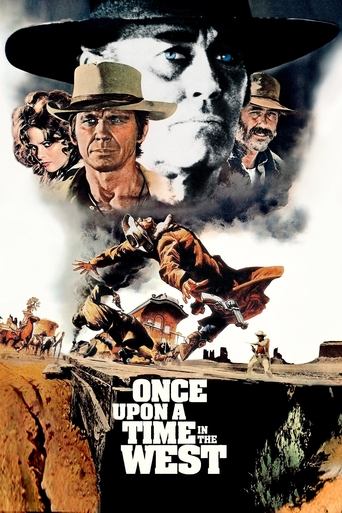
Once Upon a Time in the West
C'era una volta il West
1968 · Film · 166 min
Directed by Sergio Leone
As the railroad builders advance unstoppably through the Arizona desert on their way to the sea, Jill arrives in the small town of Flagstone with the intention of starting a new life.
9 positive3 neutralfrom 12 commenters
Where to watch
No streaming data for this title.
12 comments on Hacker News
Thank you for taking the time to say that. I really appreciate it.
When YouTube was new, a guy named JT Helms made that top one (Once Upon a Time in the West cut to Arcade Fire) and when Bruce Springsteen was asked if he liked anything on YouTube, he said that. And it made me happy because it was my favorite too. And I thought we were on the cusp of something like a new art form.
I still think that. I'd like to see short films shot to music as well.
More of a trope about the styling and colour palatte of now classic films set in Mexican territories (but often filmed elsewhere):
Spaghetti westerns were a series of western films pioneered by Sergio Leone in the 70’s mostly starring Clint Eastwood. They have a very specific style to them. Mostly shot on anamorphic widescreen, they developed a language using editing and framing for confrontations between the gunslingers as well as using and updating Akira Kurosawa’s style. A lot of them are straight up remakes of Kurosawa films (A fistful of dollars is Yojimbo, Magnificent 7 is 7 samurai). The films had a bit of a sepia look to them but that mostly came from the art direction and the wide open desert spaces they shot at. They would use a handful of shots from the west here and there but most of them were actually shot in southern Spain with Italian and Spanish crews. Widescreen aspect ratio, tight closeups (chin to eyebrows), quick cuts timed to the music (provided by the great Enio Moricone). The Good, the Bad and the Ugly is seen as the masterpiece of the series (known as the man with no name series). Another major one is Once Upon a Time in the West. Tareantino is heavily influenced by this stayle and pays direct homage to him on both Kill Bill Vol 2 and Hateful 8. This might be able to give you a slightly more modernized rendition of Leone’s style. from: https://old.reddit.com/r/colorists/comments/rs7igu/spaghetti_western_look/
but you can find similar comments across many film boards.
It expired at midnight on amazon. on google tv I was able to watch it for free on Jan 1. I did a little more research on the film and related ones.
There's the first 3 movies, https://en.wikipedia.org/wiki/Dollars_Trilogy (A Fistful of Dollars (1964), For a Few Dollars More (1965), The Good, the Bad and the Ugly (1966)).
This movie was in the second trilogy, "once upon a time", Once Upon a Time in the west, Duck you Sucker, and Once Upon a Time in America. And from wikipedia there's a much better and longer original European cut that is 3 hours 49 mins instead of the 2 hours 19 minute cut. I can't figure out how to stream that.
What a great question! Many interesting movies to check out in these comments!
My own list, I re-watch movies the same way I re-listen to music, often to get in a particular mode of thinking, as they become familiar, I mostly daydream while appreciating some particular concept and whatever new minutiae, or ways of understanding, creeps into my mind.
Hackers - 30+ times, for dreaming about a world that never was and never will be, for reminding myself how cool computers used to seem.
The Crow - 20+ times, for thinking about the world
Koyaanisqatsi - 15+ times, for thinking about my life in the world
Alien - 10+ times, for thinking about the future that passed us by
Terminator 1 and 2 - 10+ times, for examining a time that never was, or passed me by, and because Arnold is awesome!
A Clockwork Orange, 10+ times, to reflect on violence and aesthetic
Event Horizon, 10+ times, mostly for the aesthetic, and who dosen't love spaceships from hell ?
1984 - 5+ times, for thinking about humanity and society
Requiem for a Dream - 5+ times, for thinking about the value of life, and what society is
Once upon a time in the west - 5+ times, for thinking about loss, revenge and justice
Genocyber - 5+ times, to think about what life is for anyway
Stalker - 5+ times, frankly, mostly to look at the pretty pictures.
Lots of other amazing movies, I probably forgot some (time to watch again?)
Bonus:
TV Shows I've watched more than 10 times:
Star Trek TNG
Neon Genesis Evangelion
IMO a big issue with a lot of modern productions is that they are too clean and colorful. You have a movie set in 1910 and everyone is wearing colorful died fabric and their clothings are spotless, not a hair out of place, when in reality their feet would be covered in horse shit and their hair mattled with sweat from wearing all those layers, plus a lot more smoking and drinking.
I think this comes from shooting in a sound room constantly and having every shot run by hair/makeup/wardrobe to make sure everything is perfect. Meanwhile, back in the day when they would shoot, e.g., a western, that would feel a lot more real because it would be shot on an actual movie ranch. You'd feel the heat of the sun, the characters are all sweaty and dirty. Buttons may be loosened on shirts just to make it more comfortable for the actors in the heat, just like they would be by the real character in the scene due to the heat. E.g. this shot from Once upon a time in the west is a good example (1). The sun is beating down with hard shadows. The main characters shoes are dusty, his coat is dusty from brushing on the ground, his hands are dusty, his sleeves are dirty, there is dirt all over his face, he looks sunburned, he looks like he probably smells. It feels so much more authentic.
1. https://m.media-amazon.com/images/M/MV5BMTgzNDM5NTY3NF5BMl5BanBnXkFtZTcwNjA4MTc4Mw@@._V1_.jpg
You don’t have to not notice it for the cgi to make the film worse.
You could certainly for example, film ‘once upon a time in the west’ in a green room and overlay the actors upon a western themed cgi environment, and have it look believably realistic.
But are the actors going to act as if they were under the burning sun as believably ? Will they avoid looking at the sun ? Will they tend to seek the shadows ? Will they sweat ? Probably not, and the feeling you’ll get from the film will be different, without you being able to know why
A lot of people have seen the Clint Eastwood "Man with no name" westerns but if you haven't watched "Once Upon a Time in the West" I would definitely check it out. One of the best movies I've seen and if you're not fan of westerns (which I wasn't) you will appreciate the genre some more after seeing this movie.
> US-American Western film music used to be lush orchestral scores
Guess that makes "Once Upon A Time In The West" the one where he fused the US-American style with his own
[0] https://www.youtube.com/watch?v=Mcg-iCBivbw
Claudia's theme from Once Upon A Time in The West is as good as it gets.
https://youtu.be/AHe07HT5NQA
Sergio Leone and Ennio Morricone has to be one of the greatest partnerships in film history, so many unforgetable moments:
https://youtu.be/qwb3P0fuM1c
Here is a very good old interview, with several references to their collaboration:
https://scrapsfromtheloft.com/2016/12/11/morricone-interview-cinema-papers/
Their last film together:
https://youtu.be/Jj5Xczethmw
My ranking is the reverse; I prefer this film to the Godfathers, but only by a hair. Goodfellas is third. This is definitely Leone's best, though, followed closely by Once Upon a Time in the West.
Compare films made in the 1940's to those made in the 1910's, or earlier. Until the late 1910's, film was basically tech demo's. Brief shots of regular life, or maybe something a little titillating. No real plots or structure. By the 40's, most of the basics still in use today were established. Plot structure, as well as lots of little technical details, such as the 180 rule[1], were developed, and viewers instinctively rely on these even today.
However, film was not viewed as art in the 1940's. Stage was art. Film was just disposable mass entertainment. Studios churned out massive amounts of film and, in many cases, didn't bother to preserve anything. The idea that somebody would want to see Casablanca again in a few decades was alien. Even today, many films aren't seen as art. Somebody who says they're a lover of art films, especially Michael Bay's Transformer series, is going to be laughed at. However, nobody disputes the fact that films can be art today, thanks to classics like "Rashomon" or "Once Upon a Time in the West", and also thanks to more contemporary art films that challenge as much as they entertain, even if they may not prove to have lasting appeal.
Now take a look at the history of gaming. The early games of the 70's and 80's were, at first, basically tech demos. As the 80's wore on, game designers used challenging game mechanics to wring maximum engaged playtime out of extremely limited resources. Games like Pacman or Donkey Kong could certainly eat your time (and quarters), but they seldom provoked an emotional or intellectual response aside from frustration, not at all unlike a Michael Bay film.
We are entering an era in video gaming equivalent to film of the 1940's. The core mechanics are established and people know them. There now exist games that have appeal beyond the latest technology. If people are still playing Donkey Kong now, how long will games like the Stanley Parable hold up? Despite this, as for film in the 1940's, we still think of games as disposable and not as art. This is going to change, as it did for film, but slowly.
The important thing right now is for game producers to realize that their source code may be valuable in the future. Preserve that stuff!
[1]In many scenes with two participants, such as dialogue, duels in action scenes, etc., most film-makers avoid cutting back and forth between angles that exceed 180 degrees in difference. Breaking this rule usually confuses viewers, as it becomes unclear who is on which side.
The Wild Bunch.
Nevada Smith.
3:10 To Yuma, the original with Glen Ford and the remake with Russel Crowe are both excellent. Original story written by Elmore Leonard.
The Magnificent Seven. Watch it with The Seven Samurai.
Once Upon A Time in the West.
True Grit, original and remake.
Blazing Saddles.
The Naked Prey. Movie takes place in Africa, but it's based on a true story of the American West. https://en.wikipedia.org/wiki/John_Colter#Colter.27s_Run https://en.wikipedia.org/wiki/The_Naked_Prey
https://duckduckgo.com/?q=best+western+movies&t=canonical