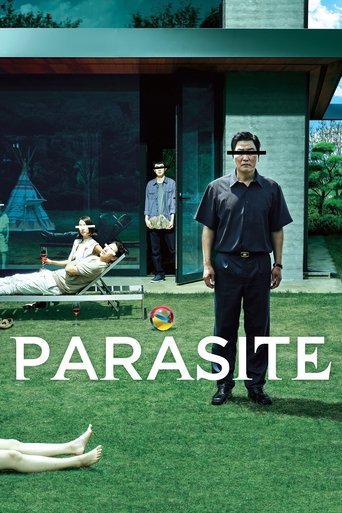
Parasite
기생충
2019 · Film · 133 min
Directed by Bong Joon Ho
All unemployed, Ki-taek's family takes peculiar interest in the wealthy and glamorous Parks for their livelihood until they get entangled in an unexpected incident.
55 positive57 neutralfrom 112 commenters
Where to watch
No streaming data for this title.
123 comments on Hacker News
It was Netflix. Only the most milquetoast pablum gets made over there and it’s all shot with the same cameras and settings and it all looks the same and every idea is ripped from either an HBO show if it’s a series, or an older film if it’s a film. They sprayed Marvel content everywhere to my dismay, I can’t think of a less interesting universe or setting than “gritty version of reality except with superheroes”. Netflix hasn’t made a single TV show or film worth watching.
It really killed filmmaking, I’ve only seen ~5 movies released since 2016: Parasite, Backrooms, Once Upon a Time in Hollywood, Get Out, Don’t Look Up. I watch plenty of movies, there are more great movies from the 1940s to 2010s than I’ll ever have time to watch. I hope interesting movies start being made again.
Hollywood also went into sequel overdrive and released very few original properties and milked X-men, Harry Potter, Star Wars, etc. That didn’t help.
'Movies' at Blockbuster level pivoted to ersatz carnival rides post-'Pirates of the Caribbean', focusing on safe IPs and simple plots designed to aid comprehension of the major story beats in the SEA markets without the need to resort to subtitles or dubbing.
'True' Cinema has been going from strength to strength the last decade, with even Netflix putting out Fincher spectacles like 'Mank' on streaming, and A24 bringing introducing a new audience to phenomenal Korean Cinema like 'Parasite' and 'Minari'.
Even in the traditional studio system we have been spoilt in recent years by a succession of Palm D'Or and Oscar winners like Anatomy of a Fall, Triangle of Sadness, Zone of Interest, The Brutalist, Oppenheimer and Killers of the Flower Moon.
Here’s how it applies to the top 10 movies on IMDb
Shawshank redemption: the well liked male protagonist righteously murders his wife for cheating on him
The Godfather: pretty much encapsulates all of my requirements
12 angry men: no women
Original LOTR: Does women characters incredibly well
Pulp fiction: Mia is in there for a few key scenes, no nonsense
The good, the bad and the ugly: self explanatory. Great male characters
Forest gump: Jenny might be the greatest villain ever for her promiscuity
I can go on and on. All these movies have gravitas. You won’t see any movie post 2015 even crack the top 100 (besides Parasite but that isn’t Hollywood) because that’s about when they lost the plot.
What I find unsettling is that large swathes of mainstream society seem to consistently tack towards safe, unchallenging pablum. Why watch Parasite when you could watch a Happy Gilmore sequel?
I'm not saying this to be contrarian or give you a hard time. You should watch whatever makes you feel joy.
However, you shouldn't be surprised that for a lot of people, music, movies, television and books (I kid, I kid) that don't surprise, challenge, shock, confuse or inspire us feels vapid, hollow and intellectually insulting.
Long live the counterculture.
https://www.youtube.com/watch?v=ujJ8talVp90
I work on campus (very very close to the engineering building) and I previously lived near Brookline. So all of this hits home.
But what got me was the tipster who blew wide open the case is reportedly a homeless Brown graduate who lived in the basement of the engineering building (a la South Korean film Parasite). It made me so sad but also not surprised, that building does have a single occupancy bathroom with showers; and no keycard access was needed in the evening until 7pm.
So it made sense to me that he or she would've used that building for shelter and comfort. Also it didn't boggle my mind at all that a Brown grad (from the picture, the tipster looked like a artistic Brown student vs. the careerist type) would be homeless - given that I known many of my classmates who have a certain personality, brilliant but also idealistic/uncompromising that made them brittle unfortunately in a society that rewards conformity, settling and stability.
I can't get over the fact that two Brown student whom presumably have fallen on the wayside of society have chosen two different paths, (1) the homeless guy who still perseveres even in the basement of Barrus & Holley for 15 years a la Parasite after 2010 graduation but still has the situational awareness and rises to the occasion to give the biggest tip to the Providence Police, (2) the other guy who harbors so much resentment over a course of 25 years to plan a trip from Florida to gun down innocent kids who are 18 and 19 and his classmate when they were 18 and 19 year old.
You are 100% correct, and this is the central limitation. An LLM like ChatGPT, trained on general web text, is a terrible movie recommendation engine for exactly the reasons you state. Its knowledge is broad but shallow, skewed toward popular discourse, and it will happily confabulate titles.
Our approach with lumigo.tv is different by necessity, and it's a direct response to the problem you've nailed. We don't use an LLM for knowledge.
Here's the technical split:
The LLM is strictly a query translator. Its only job is to take your messy, natural language prompt ("a gloomy noir set in a rainy city") and convert it into a structured set of searchable tags, genres, and metadata filters. It is forbidden from generating or hallucinating movie titles, actors, or plots. The recommendations come from a structured database. Those translated filters are executed against a traditional database of movies/shows (we've integrated with TMDB and similar sources). The results are ranked by existing metrics like popularity, rating, and release date. The LLM never invents a result; it can only return what exists in the connected data. You're right that pure collaborative filtering (like Netflix's) has a massive data advantage for mainstream tastes. Where it falls short is for edge cases and specific intent. If you want "movies like the third act of Parasite," a collaborative filter has no vector for that. Our hypothesis is that a human can describe that intent, an LLM can map it to tags (e.g., "class tension," "thriller," "dark comedy"), and a database can find matches.
So, it's not AI vs. collaborative filtering. It's AI as a natural-language front-end to a traditional database. The AI handles the "what I want" translation; the database handles the "what exists" retrieval. This avoids the hallucination problem but still allows for queries that a "Because you watched..." algorithm could never process.
Does that distinction make sense? It's an attempt to use each tool for what it's best at.
The 90s films mentioned in this post are works of art and the actors and creators were artists. Compensation sustains the art, but it’s not the primary purpose.
Netflix is a business. The content on Netflix is largely designed or purchased with a primary goal of engaging paying users.
We can find plenty of films that are works of art after the 90s. One Battle After Another is a recent one that comes to mind. Parasite, No Country for Old Men, Arrival, Moonlight, Tree of Life, Midsommar, Mandy…
Perhaps you can share some examples of the films you are referring as "mindless banter in between sex and explosions". I'm not sure that description really fits most of the films coming out recently. If you said, "Dumb comic book films", I would maybe agree with you, but there isn't typically any sex in those so I assume you are not referring to them.
Covid halted the production of a lot of movies, and changed how others were made. It also shut down theaters. So, "since covid", is really talking about before and after an era. Kind of like saying, "since 9/11", in terms of the impact on culture. A lot of creativity has moved from the movie theaters to streaming services and from films to more episodic content.
However, here is a short list of films worth seeing (imo) since covid (2019).
Zone of Interest (2023) The Holdovers (2023) Parasite (2019) Dune (2021) Dune Part Two (2024) Everything Everywhere All at Once (2022) 1917 (2019) The Banshees of Inisherin (2022) The Substance (2024) Palm Springs (2020) Oppenheimer (2023) The Lighthouse (2019) Hundreds of Beavers (2022) Barbarian (2022) Flow (2024)
> One way to get more structural variety is by watching foreign movies.
That's a great point. My recommendation: https://en.wikipedia.org/wiki/Parasite_(2019_film)
I dunno, 2015, I'm a little weak on this year: It Follows, Creed, Ex Machina, Max Max: Fury Road, Sicario, The Hateful 8. I'd watch those again with someone any time, and recommend all of them often. Several on my to-watch list most of which I expect to be good, like Queen of the Desert, While We're Young, Slow West, and The Overnight, just haven't made it to them yet. Not an exhaustive list, just gleaned from some titles I have at hand.
2016: Green Room, The Nice Guys, Hail Caesar!, The Neon Demon, Swiss Army Man, Hunt for the Wilder People, The VVitch, Train to Busan, Shin Godzilla, Moana (hey, I like this one), Arrival. Moonlight's on my to-watch and is supposed to be really good.
2017 (I've done OK on catching up with these!): The Lost City of Z, Dunkirk, Low Life, Good Time, Logan Lucky (absolutely slept on, kills it as a feel-good lightweight small-stakes heist movie), Blade Runner 2049, The Death of Stalin (I liked this less than a lot of folks, but given how widely-loved it was, I'm probably the idiot here), One Cut of the Dead, You Were Never Really Here. The Planet of the Apes movie from that year, plus Phantom Thread, and The Little Hours are to-watch for me and come highly recommended.
2018: Annihilation, Isle of Dogs, Upgrade, Sorry to Bother You, High Life, Eighth Grade, the Suspiria remake. To-watch that I expect to be good include Champion (Korean arm wrestling movie—there's another movie by the same name that year), First Reformed, BlacKkKLansman, The Favourite, The Wolf House, Climax, and some others.
2019: HUGE year for the particular (small) set I'm seeing on my list, including a ton to-watch but a bunch I've seen. Uncut Gems, The Lighthouse, Knives Out, Little Women, JoJo Rabbit, Ready or Not, Parasite, Midsommar, The Art of Self Defense, maybe Marriage Story (but if you've seen one Baumbach movie, you've kinda seen them all, and I'm not sure I'd put it above The Squid and the Whale). Midway's a well-above-average war movie and pairs great with Tora, Tora, Tora! as a crazy-long double feature in a really fun way. To-watch list is nuts and I really need to dedicate a month or so to filling out my watched-list for this year: First Cow, The Irishman, Portrait of a Lady on Fire, Bacurau, Once Upon a Time in Hollywood, The Farewell, The Souvenir, Blow the Man Down, The Vast of Night, Her Smell, Funan.
It basically just keeps going like that, year after year, and I've barely even tried to dredge up good movies for most of those years, the bulk of it's just stuff that's risen to my attention one way or another, and I'm terrible at keeping up with foreign film especially. I also left off some that a lot of folks would probably include, like at least one Mission Impossible (aside from MI2, I think these are all pretty good action movies, though quality varies a bit) and Avengers: Endgame which, opinion on the rest of Marvel aside (I think it's mostly kinda lazy crap? But was basically entertained for most of them regardless, so I guess I can't complain too much) was a hell of an event. Also Black Panther, which everyone loved but I was pretty meh on (I hate the entire end fight, and it's looooong)
They are starting to outcompete Hollywood on quality (see Godzilla minus one, Squid Game, Parasite, etc), they just don't have the hundred millions of dollars of marketing budget that Hollywood has to push and advertise their movies in foreign cinemas across the world, nor do Americans have a huge appetite of watching movies with subtitles, nor could they read even if they wanted to ("54% of adults have a literacy below sixth-grade level"[1]).
[1] https://www.crossrivertherapy.com/research/literacy-statistics#:~:text=Nationwide%2C%20on%20average%2C%2079%25,older%20are%20illiterate%20in%202022.
There are two kinds of "fascination" at play here - those who believe he is a hero and someone to be emulated (as seen on Reddit and the like) and those who are fascinated by the fascination (mostly legacy media and whoever is still on FaceBook).
Of course, the average person might remember the shooting (stressing might at this point) and almost none would know Luigi Mangione by name. Which is to say, almost any "fascination" today is just a reflection of a highly distilled internet alcove, a self-identified cohort which over time builds it's own culture and assumes that everyone around them is to some degree as "informed" as the are about their "fascination".
It does not take an obscure novel to explain the "fascination" the powerless have with the dream of somehow gaining power over the powerful - but as the movie Parasite so perfectly illustrated - that moment is likely to be fleeting, self-destructive, and ultimately meaningless as the world will quickly lose it's "fascination".
Not all the characters in season 1 had debt problems; the main girl for example wanted to bring her family from the north. Also have you seen Parasite by any chance?
I think you’re wrong, anything can be used for making money. I don’t think any major studio would refrain from funding anything if they felt it would profit.
I've logged in after 10 years to express my disagreement with this misguided and shallow post.
1. Taste is trainable, and far more malleable than the author believes. Good examples of this include "unclassifiable" films such as Parasite, which reached immense global success with both critical and popular audiences, and stood out precisely because it was so different, along with a remarkable depth in its craftsmanship (a given).
2. Overconfidence in hermeneutics. For one, little details are critical and are precisely the mark of superior craftsmanship (or shoddy work if they are neglected). You can see this in the dialogue around detecting AI-generated images. A cool example is the 4-second crowd scene in Miyazaki's The Wind Rises (2013), which took an entire year to animate.
3. A superficial and overreaching view of art. You can see this both in the way they discuss artistic value (external activity and metrics), and also their limited artistic vocabulary (the Louvre as a whole, Elvis, Abba). What about Edo period Japanese painting? What about Abbasid architecture? What about that simulated black hole in Intellerstar (to give a technological example)?
This kind of technological slop drives distrust with other industries (especially creative ones), rather than the productive and empowering dialogue we should be having. I hope we can do better on HN, and that for his own sake, the author gains some faith in art again.
You do realize that many, many movies have been edited in various versions of Final Cut Pro on Macs right? Including several Academy Award winners.
Movies like _Parasite_, _The Social Network_, and _300_, to name just a few.
If that's a toy, I'd love to hear what is industrial strength.
Believe it or not, but there’s a lot more that goes into filmmaking beyond the premise.
Parasite, The Substance, Uncut Gems, mother!, Krisha, Tangerine, and The Lighthouse are some movies from the last decade that are novel in ways beyond their premises.
No generic prompts to an LLM could create those movies, even if it could spit out a vague 2 sentence premise that matches them.
Note that I’m not saying it could never happen, but LLMs as we have them in 2024 produce regurgitated slop, and require significant creative input from the prompter to make anything artistically interesting.
> was lower in the 1960s than today?
Absolutely! Or at least the perception of financial inequality.
In the 60s after the war, the country was industrializing which increased inequality.
Only in the 80s that temporarily stopped, known as the "Miracle on the Han River”. After the 80s, inequality has just been increasing, with increased number of the population KNOWING about it. It's the reason why you have movies like Parasite, shows like Squid Games, and the rising discontent for the chaebols.
In any case, people FEEL largely so downtrodden and without access to resources, that they don't want to have children. Solve that feeling of inequality (by investing in social welfare programs and taxing the s*it out the rich), and you solve the population crisis.
https://www.imdb.com/chart/top
This is the IMDB top 250 list, which I take as a reference for "best of all times" movies. 30 of them are from this decade. Some of them may drop off (there is a slight bias towards recent movies), so let's keep 25 of them, so 1/10, the list is over 100 years, so we are about average.
Not many in the top spots though, the best being Parasite (2019), #33, which I expect to stay high, and Dune: part 2 (2024) at #35, but I expect it to drop a bit as it is a current year movie.
Anyways, it is neither a particularly good nor a particularly bad time for movies.
> Certainly looks like that motion sensor is turning the light on in the night uselessly.
Have you seen the movie Parasite?
or the film 'Parasite' by Korean director Bong Joon-ho (2020 Oscars Best Picture winner)
Each side (those using social media to highlight systemic failures / those too 'busy' contributing to said failures to use social media) thinks the other has their head buried in the sand.
It reminds me of how, depending on the type of person you ask, you'll get conflicting answers on who the 'parasites' are in the movie Parasite.
If you help enshitify the next Big Thing and get paid doing it, are you contributing to society? Or contributing to its growing problems?
Most chaebols such as Lotte and Samsung make multiple entities for each of their groups within VN (and those entities in turn try to hide taxes like crazy)
So in Lotte's case, Lotte Shopping Vietnam JSC is different from Lotte Hotels Vietnam JSC is different from Lotte Cinemas Vietnam JSC.
And I'm using Lotte as the most notable example.
Samsung does the same thing as well - Samsung Electronics VN (Samsung Galaxy) is a separate entity from Samsung SDI VN (Samsung batteries).
Most notably, Lotte Property & Development - not VinGroup (!!!) - owns the land in An Khanh Ward in District 2 of HCMC and is building Saigon's version of Pudong [0].
If you've ever been to Saigon you'll know this piece of land is easily the most expensive piece of undeveloped property in all of Vietnam as it's right across from Saigon's District 1 - the traditional CBD and Consulate quarter - and right next to the VIP neighborhood of Thao Dien.
It's called the Lotte Eco Smart City.
And this is just Saigon. If you go to Da Lat, Da Nang, Nha Trang, Cam Ranh, etc it's the same story.
> The top 10 companies in Vietnam by revenue, except for Samsung Vietnam
Where are you getting this data? The only somewhat reputable source is from one the VN trade ministries in 2018, which is towards the beginning of the Korean move to VN from China.
Also, the fact that Samsung Electronics VN was able to outcompete every single petrochemical and military owned company by revenue in 2018 [1] in a country who's economy has been built on ONG extraction (the VN claim in the South China Sea has oil reserves the size of Prudhoue Bay and Natural Gas reserves roughly the size of Urengoy Gas Fields) and VPA ownership of industries (eg. Viettel, VinGroup's founder is from Vietnamese Air Force royalty) is massive
Edit: There is a VN500 list but participation is optional. The only Korean chaebol divions that seemed to have participated were Samsung Electronics and CJ Agribusiness (part of CJ Group - the same chaebol that makes Bibigo food and produces Kdramas like Marry My Husband and movies like Parasite)
[0] - https://mycasagroup.com/lotte-eco-smart-city/
[1] - https://mof.gov.vn/webcenter/portal/tttpen/pages_r/l/detail?dDocName=MOFUCM120380
I was responding to your tl;dr not the GPs point. I think people who love Citizen Kane should encourage other people to try it, and people who love Parasite should encourage other people to try it, and we shouldn't make broad pre-judgements like "because you are younger than X years you won't like this movie that's more than Y years old." Obviously if we know someone else's particular taste we might be able to guess that they will strongly like or dislike a particular movie (e.g. my mom dislikes any violence, she would hate Parasite).
Sure. But the reason it doesn’t apply “equally” is not because citizen Kane is a classic, but because ant man 3 is mainstream blockbuster trash. People who frame marvel as the height of films today are just so… intellectually lazy.
I’ve shown quite a few people citizen Kane and, aside from a musing discomfort at the parallels of post modern trump like media manipulation (FRAUD), it really doesn’t resonate with people nearly as much as, say, Parasite, despite them probably being culturally closer to Kane.
Tl;dr if you’re going to show someone a “life changing film” pick something new that is similarly ambitious. Classics require too much effort to enjoy. It often doesn’t work.
Here I was for a minute thinking “parasite actors” are a new thing. But no, he was an actor from the movie “Parasite”
I think it's a fair point that bots should strive to be useful and not just mock people's mistakes, but in the 8 years since this was written the whole "punch up, not down" idea in comedy has gotten a lot of criticism and is kind of passe at this point, at least in my experience.
Human beings simply do not exist on a single monolith spectrum of power; who is "up" or "down" often depends quite a lot on context. If an underemployed white male comedian makes a joke about Kamala Harris, is that punching up or down? _Parasite_ is a movie that mocks a rich family even as it portrays their poorer help as scheming and untrustworthy - is that up, or down? To steal an example from this excellent Freddie de Boer post on the topic, if an adjunct professor runs afoul of a student, are they really the ones in the position of power?
Anyway Freddie sums the whole thing up much better than I could: https://freddiedeboer.substack.com/p/punching-up-and-punching-down-have
My TV provider allowes me to store up to 2000 hours high definition TV in the cloud.
Combined with 6 movie channels, which show virtually every movie synchronized and in its original language[0] version without ad interruption this setup works for me.
[0] Granted, the original version wasn't too helpful in watching Parasite, which I had to enjoy in the German dub.
How do you believe copyright is keeping the quality down in particular? As I see it, the reason is marketability and trying to conform to standards. Making a new Marvel Movie is sure to have a payoff. Making Parasite MIGHT have a higher payoff, but the risk is way higher.
Removing copyright might help to get various more spin-offs and reiterations on previous work, which does increase the scope, but taking the ability for makers to profit from their work in a traditional sense, will bring us closer (back) to a time when commissioned artwork was the main art you saw
The most popular K-Dramas are the formulaic 1 guy and 1 girl, with a 3rd person for a love triangle. Don’t worry though, true love wins and the 3rd wheel finds someone as well. Eg: Hometown Cha-Cha-Cha.
CCP would heartily endorse these brainless plots. Consumers would eat it up.
Not everything needs to be Infernal Affairs. The vast majority of Korean TV isn’t Infernal Affairs. I will admit that China could never make Parasite, but that’s ok. The metric we’ve chosen is popularity, not Oscars.
Side note I’m a bit sad that Hong Kong can’t make Infernal Affairs type of movies anymore. It would show the Party in a bad light.
To me, having this government mandated content is simply bizarre, not unlike old soviet censors looking at movies and deciding what was “soviet enough” to get the approval from the bureaucracy.
> Now if we could actually produce quality shows it would be great (right now its like 90% bad soap/romcom/cop shows)
Disney and Marvel made billions of dollars simply making content people want to watch and pay for, why not simply do the same and compete in the marketplace? Imagine how ridiculous it would be if there were quotas on iPhone sold so that BlackBerry still had a legally mandated market share.
> more money for culture in French.
By the state sponsored media?
Weren’t they making blatantly racist “historical documentary” (with taxpayers money) a few years ago? [0-4] Are people ok with this?
Aren’t the French Canadians notorious for buying and consuming their own culture? I work with a few French Canadians who have been here in the bay for decades and even their kids (born here in America) watch French Canadian content (on TikTok no less!). No need to subsidize it, they just seek it because they want to watch it.
When you make something that’s worth it, people simply watch it. That’s why Parasite won an Oscar.
[0] https://www.huffpost.com/archive/ca/entry/cbc-the-story-of-us-representation_b_15986458
[1] https://this.org/2017/07/19/where-cbcs-the-story-of-us-went-wrong/
[2] https://etcanada.com/news/217608/cbc-issues-apology-after-the-story-of-us-following-criticism-from-quebec-maritimes-viewers/
[3] https://montrealgazette.com/news/local-news/couillard-government-wants-cbc-to-apologize-for-errors-in-the-story-of-us/
[4] https://www.theglobeandmail.com/news/national/cbc-apologizes-after-canadian-history-series-sparks-uproar-in-quebec-maritimes/article34666160/
The biggest S Korean show in the “west” was Squid Game, which was nothing if not cynical.
The Oscar winning movie Parasite is also steeped with pessimism and cynicism.
> The elephant in the room here is the obsession western TV now has with being woke.
The biggest Korean series on Netflix is absurdly "woke": I don't know how one could watch Squid Game and miss how critical it is of capitalism. I also find most movies by Bong Joon-ho to be similarly "woke" - not at the periphery, but as a central theme of the work - for instance Snowpiercer, Parasite and Okja, and they are hits in Korea and abroad.
Meta commentary: your appreciation for diverse types of movies (and not just the same-old bland Hollywood ones) is pretty woke too!
I know, right? This line in particular got stuck out at me:
> They are mortally offended by the suggestion that Marvel might be somehow less good than Chris Marker, or that K-pop might be worse than Rimsky-Korasov.
Never heard of Chris Marker or Rimsky-Korasov, had to look those up. Chris Marker looks like an indie French filmmaker who 60 years ago made a 27 minute time travel film called La Jetée, using only still photographs, that William Gibson apparently considered one of his greatest influences. So yeah, this sounds like something that most mainstream people wouldn't be aware of or into and exactly the type of thing a film nerd or film hipster (who he said in the opening paragraphs were all killed because of how annoying they are) would be into.
And Rimsky-Korasov is a Russian classical music composer who's been dead for over 100 years. Someone that only a music nerd would probably be aware of nowadays, or go see a concert for.
If he didn't want to be such a hipster about it, he could have used like Martin Scorsese or Stanley Kubrick and Mozart or Bach or even Debussy or something, a name most people would probably recognize, instead of these less recognizable names, especially in an article where he's making fun of nerds for being into obscure shit (while "their" movies have been dominating the box office for well over a decade at this point).
I'm not trying to defend Marvel here either. I don't think they're the best movies ever made (I thought Everything Everywhere All At Once was the best movie I've seen since Parasite, and considering it pretty much swept the Oscars this year, and Parasite did a few years before that, critics seem to agree with me there).
Another quote that stuck out:
> The culture we produce on Planet Nerd has nothing to do with desire whatsoever. Everything is sterile, mercilessly unsexy; no eroticism, not even visual pleasure.... Nerd culture, meanwhile, is basically quite boring to consume. Instead of the sadistic fantasy of being a superhero, doing fantastic things that ordinary people don’t get to do, the Marvel movies are about nothing more than themselves.
Sounds like someone needs to watch The Boys or Invincible. You'll get your sadistic power fantasy there. (I mean, just watch The Boys episode about 'Herogasm').
Marvel can't do that because it has to get parents to take their children to see them to make all the money. You don't see sadistic power fantasies about being a wizard in Harry Potter either, or overly sensual things with any Disney movie, barring the hidden 'SEX' in flower petals in Lion King.
We had that in the 1980s as well.
No-one remembers "The Brother from Another Planet" (1984) ... but everyone remembers "E.T." (1982). Similarly, the Marvel stuff will mostly shrink together into obscurity, while actual good movies (My money is on "La La Land" as the chick-flick musical and the "John Wick" Franchise as the action cornerstone, "Parasite" for the connoisseurs) will be remembered.
The thing is, as I understand it, CGI are everywhere now, even in movies that are "grounded in reality". It saves money over building props, it can be "fixed in post", etc... Unless the film makes a statement of not using CGI, and it is often an expensive choice, you can assume there is plenty of it. Crowds, wild animals, mirrors, dust, etc... are often added digitally, because it is so much cheaper and convenient.
Edit: Here an example for the movie "Parasite" https://www.youtube.com/watch?v=J3tfIem4ckE
I can't leave this set of foreign movie recommendations on the topic without a mention of the South Korean movie Parasite which won Best Picture in 2020 https://www.imdb.com/title/tt6751668/
2022 - Kimi, After Yang, Crimes of the Future, White Noise, Official Competition, Everything Everywhere All At Once, Tar, Mona Lisa and the Blood Moon
2021 - Nightmare Alley, The Card Counter, Zola, The French Dispatch, Come True, Don't Look Up, I Care A Lot,
2020 - I'm Thinking of Ending Things, Mank, The Sound of Metal, Possessor, His House
2019 - Climax, Uncut Gems, Parasite, Vivarium, First Cow
2018 - The Clovehitch Killer, Prospect, Mute, Anon, Mandy, The House That Jack Built, Cam, Sorry to Bother You
2018 had a glut of Netflix sci-fi B-movies that I think are very solidly good if not so great. I think they're underrated so I included them. I might have also messed up on the years.
These are all films I've seen. There are many others that I suspect are even better that I haven't seen.
Just a quick glance at Letterboxd....
Banshees of Inisherin
Everything Everywhere All At Once
Both Knives Out movies
Parasite
Nope (probably just in the "good" grouping, not great)
-----
That's, uh... just from the "popular this week" screen. And only the ones I've seen, so I know they're good. But I'm pretty sure all those are last five years, or close to it.
-----
Digging back to 2018 and later (we can say 2018 counts since 2023 just started, right?):
Annihilation
Sorry to Bother You
High Life
Midsommar
Uncut Gems (god it's so good)
Jojo Rabbit
The Lighthouse
The Green Knight
CODA
Spontaneous ([EDIT] It seems very dumb but wow is it a gut punch, when you start to think about what you're watching and make some connections to real life)
Red Rocket (small-scale brilliance)
RRR
Watcher
-----
I just realized I misread you as asking for 5 good ones from just one of the last 5 years, not 5 total from the last 5 years, but I think that gets the point across? Despite my leaving off a whole bunch that may be more taste-specific, not having watched even 1/3 of the films from that span I have good reason to believe are good, not exhaustively mining that timespan (I bet I could double the size of that list without changing how I was selecting them), and also omitting a bunch of more-popular movies that I think were at least decent.
[EDIT] Hell some years you could get to 2-3 good ones just by looking at what A24 produced that year, nothing else.
> Democratized? It’s more centralized than ever.
What 'centralized' in a world that now has 'creator economy' as a thing.
> Also, giving more projects $5m is not a victory if the cost of a proper production is $20m.
Is there any objective definition of that 'proper'. Rhetorical question, obviously, for there isnt.
> it seems like you’re under the impression that a good film can be made with $100k.
It doesn't seem like it. It is like that. Many movies like Paranormal Activity, Parasite were made with low budgets.
> Give that, it doesn’t surprise me that you’re one of the ones who are looking at what’s being served as tv shows and actually enjoying it.
Yeah, people are actually enjoying TV. That shouldnt be a big surprise.
> If you ask me, “the golden age of TV” is a meme based on a handful of shows
How is that any different from the golden ages of cinema in which unending series of rehashed crap were produced to profit off of audiences that had no alternative but to pay for them.
...
Its much better for things to be distributed, democratized and in the hands of more people than small cliques of profiteering feudal lords monopolizing them and deciding what happens. Especially regarding content.
In animation or anime, Japan is still the big player and is going to be for a long time. However, in live action, South Korea is easily has an upper hand. Movies like The Old Boy, Parasite, Train to Busan and show like Squid Game have an international appeal while rarely any live-action Japanese movie made that kind of impact.
Well I don’t write blogs. Or read much. Or write literary reviews. But let’s pick two.
The odyssey is a very old classic. The framework of the adventure is still great. But Odysseus is a supremacist dick. He’s pretty similar to MCU Iron Man in terms of narrative and depth. We get the sense that it’s ok to kill the people in his home at the end because he is mighty Odysseus but I think that’s pretty lame. I could go on but it’s been too long to cite examples from memory.
A tale of two cities was another one I enjoyed a lot as a teen. The sloppy romanticism of the dude who devotes his life to a love he will never have seemed really quaint, but now seems just pathetic. I’m actually really annoyed when I see behavior like this in fiction now. It’s very frequent in token gay characters because a lot of writers seem to assume that gay people fall in love with straight people and can never get over it.
Stuff that’s resonated with me at a more thematic level recently… let’s say Parasite (Korean film), Mob Psycho 100 (anime, season 1), Over the Garden Wall, Bojack Horseman, and the midnight gospel. Not very universal, but they felt more relevant and more profound. The last one cheating a bit as it’s literally philosophical interviews.
Good literature is entertaining and conveys some greater meaning. Classics tend to do a pretty good job on this, but entertainment and thematic relevance she over time quite a bit.
The original SpongeBob SquarePants movie was a copy of the odyssey’s plot for entertainment but focused on a coming of age theme of what it means to be an adult and whether it was something to strive for. Dare I ask which of the SpongeBob SquarePants Movie and the Odyssey is a better piece of literature for a 21st century kid?
I think it’s a harder question than many would give credit. But I think regardless we should be more eager to discuss thematic comprehension of art with children for the stuff they watch. Because I spent a few years in school writing essays about how every book contained the theme of “Caring” and man that was fucking dumb.
It's hard not to be cynical or entertain thoughts of Hollywood planning these things in case the show sucks. Because they can clearly do entertainment with diverse casting, non-white people, female leads and succeed:
- Tom Holland Spider-Man does not have a red-head MJ, Flash is Indian and the made up best friend is Filipino. - Domino in the Dead Pool movies is black. NTW doesn't seem to have the same powers and is gay. But I'm not sure what the current character status is. - Everything Everywhere All at Once - Black Panther - Shang Chi - Jordan Peele does good work: Nope, Us, Candy Man, Get Out - The Expanse - Life of Pi - Sandman swaps a bunch of stuff
Appetite for completely foreign media is much slower in English speaking countries but once in a while you get a major break through: Crouching Tiger Hidden Dragon, Parasite.
For iconic female leads: Terminator has Sarah Connor, Ripley from Aliens, The Bride from Kill Bill, Charlize Therons character in the last Mad Max movie. Buffy. I apologize for how narrow the genres are here.
I don't think the popular media for anything I just mentioned was too negative (maybe Black Panther?). Is it really just the fans? I bet the overlap of Rings of Power watchers and watchers of the stuff I listed is pretty big ...
edit: formatting
Korea is the dominant movie producing country of the last decade. Not much of this boom arrived in western cinemas, but festival goers do know.
And sooner or later the superior quality will sweep over to the mainstream. Parasite is just a relatively minor movie compared to the really big ones. https://koreanfilm.org/ might give a good overview.
>The age of the "American" film has already peaked.
>edit for downvotes: Do not confuse this post for anti-American sentiment. It's an honest current and forward-looking assessment.
I don't think it's "anti-American sentiment" as much as unsubstantiated claims.
Parasite was an excellent film I thought deserves all its praise. But "Korea is starting to sweep the Oscars" is a very different statement than "Bong Joon-ho and the Parasite team swept the 2019 Oscars".
What you're claiming is that American cinema has peaked, and "Hollywood is going to be washed out". A more reasonable statement is "The age of exclusively USA/Hollywood filmmaking awards is over".
It is remarkable how the most memorable scenes in parasite (for me) were not any of the crazy plot but the flooding scenes which were nothing but aesthetic symbolism of the movie's message. It didn't matter from a plot perspective at all really, and there was no dramatic sense of danger in it either, but damn did it stand out.
I've long pondered building exactly this, an anti-recommendation engine. You'd go through and mark some favorite films or genres, and it'd come back with something great but totally unlike your usual picks.
Foreign flicks not your thing? Try Parasite.
You don't remember what it's like to be an awkward pre-teen? Eighth Grade will remind you.
Not a big action movie person? Maybe you need to watch Die Hard.
Kids movies are just for kids? Spirited Away!
You can't connect with female protagonists? You've got to see The Invisible Man.
Don't find food interesting? Try Tampopo.
Sick of movies which try to make a statement and fall flat? Promising Young Woman.
Most dramas feel too contrived? Marriage Story.
Musicals and plays aren't really your thing? Hamilton.
Parasite (movie).
Sounds similar to the movie Parasite.
I do find the thesis in the ending quite weak:
> For a longer time before the gritty period, we all dedicated ourselves to the idea that anything we’d acknowledge as very good had to be both serious and artsy. People really liked Good Will Hunting (see: very serious); it was also a good movie, so it won an Oscar. Zillions of people love movies like The Princess Bride and Happy Gilmore; it’s incredibly likely both dwarf Good Will Hunting in terms of total views, but you can’t even imagine a world where either could have possibly won an Oscar.
[...]
> This is a short article by my standards, but it does have me thinking: What kind of world could we actually live in, if we were willing to treat works of art made with the goal of making us happy as if they were important? What if we were willing to make them? We’ve seen what happens in a world where all the Oscars go to movies that make you cry, or that we pretend make us think even though they generally don't
There are plenty of widely acclaimed movies that can not be considered "very serious", picking some recent Oscar winners as examples with categorizations from wikipedia:
* Parasite ("black comedy thriller")
* Green Book ("comedy-drama")
* The Shape of Water ("romantic fantasy")
* Birdman ("black comedy drama")
* CODA ("comedy-drama")
* La La Land ("comedy-drama")
* Life Of Pie ("adventure-drama")
Are all those completely feel-good movies intended to make you happy? Maybe not, but still its not like happy/humorous/feel-good is completely disregarded category even among grumpy art critics.
Great line from Parasite:
"Even though she’s rich, she’s nice." "She’s nice _because_ she’s rich"
https://www.independent.co.uk/arts-entertainment/films/features/parasite-interview-song-kang-ho-actor-bong-joon-ho-oscars-best-picture-a9311436.html
"Also in agreement with a poster above how the Korean cinema is just now taking off since around 2019."
Oldboy, which was made in 2003, was a pretty popular South Korean film... though nowhere near as popular as Parasite.
The West (specifically in my experience, the United States) have been buying up everything tech and auto South Korean for pushing over a decade now at this point. Kia and Hyundai automobiles are now running against the Japanese cars here. Samsung and LG electronics are highly popular, as the Japanese versions were a decade or three prior. It's now more Samsung, LG, etc here in the US than it is Sony, for example. Also in agreement with a poster above how the Korean cinema is just now taking off since around 2019. Prior to the movie Parasite, I can't even think of a popular South Korean film taking root here but most have seen Parasite and quite a few were into Squid Game. This is a relatively new thing.
Thanks! I do think there's a shift there from niche audience to much more significant mainstream attention (which can of course be fleeting, which was also kind of built into the original argument: attention moves on from time to time ...). I do recall the time when movies like "Old-boy" were favorites among the arthouse track/festival circuit-going audience as well, but those were never the headlining poster in a multiplex the way that a "Parasite" now pulls off.
I lived and worked in Korea for a German tech company for a few years (since returned to Berlin), working on-site with customers, and since about 2018/19 there's a very significant uptick in other people showing an interest and asking me questions about the experience. This often takes the form of "my teenage daughter is a BTS fan and learning Korean" and things like that.
Korea and Japan have a lot of shared history and have deeply affected one another, and in particular the business culture and the economic structure of Korea are heavily informed by Japanese influence, yes.
-
On a completely separate note, re interesting depictions of fantasy-Asia in a Western popculture/punk context: The headlining novel of the biopunk subgenre, Bacigalupi's "The Windup Girl", is set in a future Bangkok. I've never been to Thailand and can't comment on how ham-fisted or not this may be, but it was also an interesting step away from the Japanese culture-dominated vibes of speculative fiction pre-2000.
We're talking in a pop culture context here, where even just in 2020-2022 Korea and Korean culture/heritage has had significant soft power success in a number of markets/media:
- Export of majorly successful pop music (e.g. BTS, Blackpink - those hits are often penned by Western composers however, so a bit murky on what product is flowing there)
- Ditto TV (e.g. Squid Game setting TV records with a lot rooted in Korean schoolyard games)
- Ditto cinema (Parasite, a story about social mobility woes in Korean society, winning all the Oscars)
- Ditto gaming (PUBG, other MMOs)
- Ditto literature (bestellers including "Kim Jiyoung, Born 1982", again on social issues in the country)
- Ditto cosmetics exports, beauty trends ("Korean Week" in malls, say), etc.
- Even some Western productions focussing specifically on Korean diaspora/ethnicity (e.g. most recently the expensive "Pachinko" on Apple TV+ (and the novel it's based on), or stuff like Kim's Convenience)
I think you can definitely make a case that Korea is the Asian-country-du-jour among the Western audience (and that's before you get into, say, Latin America, which is far deeper into Korean TV content, also bleeding over into Latin minorities in the USA).
Alternatively it becomes a play to thwart Chinese cultural ascendency. If you make a set of rules that a film’s cast an crew must have certain demographics which are only really attainable in the US, then it would exclude pretty much all East Asian cinema from winning best picture. Parasite won a few years back, but it could be made ineligible based on its homogeneous racial composition. It is hard to beat America when at a diversity contest, reframing the rules so that the contest is about diversity may have strategic benefits.
Here is an interesting analysis of the film Parasite which underlines the basement conundrum.
https://youtu.be/AvO8-925Edc?t=214
Every era is an era of horrible films. That’s Sturgeon’s law for you.
Looking at the 2010s as a whole, we got to watch some amazing films.
We got great hard sci-fi like Gravity, Arrival, Ex Machina. The coming of age genre saw entries like Ladybird, Eighth Grade and Booksmart. Animation reached new heights with films like Inside Out, Spider-Man into the Spiderverse, and Kubo and the Two Strings.
We got comedies like The Artist, Grand Budapest Hotel, Death of Stalin, and Jojo Rabbit. Dramas like Moonlight, Fences, Spotlight, Parasite, Blue Jasmine.
Even in the ever-popular comic book genre, we got Logan and Joker playing at a very different level.
But also, it was the decade of the MCU. Let’s not underestimate what Disney has achieved with that — one big overarching story spanning over twenty films, bringing much deeper character development and more serious themes than what we’d gotten used to from blockbusters.
> Free market is nice, but applying it to culture is saying you're okay to see your culture lose to another.
If people want to keep it alive, they’ll simply consume it. If you can’t sell it without having to subsidize it and make special laws to force people to watch it, maybe the people already made their choice.
> And even more so, I think it's a good idea if it should make sure to always include a little bit of First Nation material, a little bit of French Canadian material, etc., to give proportional representation to our minority groups as well, and support their culture and heritage too.
Weren’t the state media making blatantly racist “historical documentary” (with taxpayers money) a few years ago? [0-4] Are people ok with this?
I get the minority content but aren’t the French Canadians notorious for buying and consuming their own culture? I work with a few French Canadians who’s been here in the bay for decades and even their kids (born here in America) watch French Canadian content (on TikTok no less!). No need to subsidize it, they just seek it because they want to watch it.
When you make something that’s worth it, people simply watch it. That’s why Parasite won an Oscar.
[0] https://www.huffpost.com/archive/ca/entry/cbc-the-story-of-us-representation_b_15986458
[1] https://this.org/2017/07/19/where-cbcs-the-story-of-us-went-wrong/
[2] https://etcanada.com/news/217608/cbc-issues-apology-after-the-story-of-us-following-criticism-from-quebec-maritimes-viewers/
[3] https://montrealgazette.com/news/local-news/couillard-government-wants-cbc-to-apologize-for-errors-in-the-story-of-us/
[4] https://www.theglobeandmail.com/news/national/cbc-apologizes-after-canadian-history-series-sparks-uproar-in-quebec-maritimes/article34666160/
Did it take over the world? I've heard of one popular movie "Parasite" and one TV show "Squid Game." I saw Parasite and didn't see Squid Game. I've lived in Paris, Berlin, New York, LA, London, and Dubai... I see US TV taking over all those places... but I've seen WAY more people watching Japanese anime shows than people watching South Korean TV. On the other hand, SK music seems more popular than their TV, but even in that sense I wouldn't say SK music is "taking over the world." (note: my gf is Korean and even she doesn't watch SK TV or movies).
I actually didn't know that about Korea's film past. I'm pretty excited about the sudden burst and interest in Korean TV coming out now it feels like it's growing!
Parasite, Train to Busan, and Squid Game have really helped bring in a lot of eyes.
Netflix seems to be invested in growing Korean market, better yet if they can get more english language viewers of Korean language content! I just put Silent Sea on my list looks interesting.
Along with a couple of others (this [1] being an example), thanks for responding. I read paganel's follow up post [2] and was flabbergasted at how out of touch he sounded. The shock is the main reason why I chose not to respond myself this morning. You and the others gave a far more eloquent explanation than the one I would have given.
I will say this, though: just because paganel considered Bong Joon-ho's 2003 film Memories of Murder to be his best work doesn't mean that Parasite winning the Oscar for Best Picture in 2020 meant absolutely nothing in terms of South Korea's state of its cinema scene. If anything, it's even more indicative of South Korean cinema scene's stock rising in the global stage in recent years. To put it in Civilization terms (which I'm sure he won't understand due to his dismissive outlook of video games), South Korea's going for the cultural victory. Soft power really is a thing!
[1] https://news.ycombinator.com/item?id=29761879
[2] https://news.ycombinator.com/item?id=29761389
With Squid Games being one of the most watched and talked about TV-series last year, and Parasite winning the Oscar for Best Film the year before, I find it odd that you consider SK to be past it's prime.
I think many people don't reflect on the show's messaging beyond the surface level "catchy costumes and violence in a game show" aspect (which honestly wasn't even new when Arnold Schwarzenegger portrayed it in Running Man).
The social critique of Squid Game isn't the squid game. It's the world outside the game. It's why so many of the participants not only volunteer but also volunteer to come back after having already experienced it. The world outside the game show is portrayed as so bleak that hundreds of people would rather compete in a life-or-death "game" that promises fairness and a life-changing cash reward.
And the critical message of the show is that this world outside the game is not significantly different from ours. The game is a grotesque exaggeration of a get rich quick scheme but there are plenty of examples for people hoping to beat the odds or being willing to scam others for promises of great fortunes (look no further than the way the GameStock pump and dump was framed as a proletarian revolution until it was revealed most of the stock movement was the result of established investors jumping in to cash out on the gullible masses still tweeting "diamond hands" memes as the tide was starting to turn).
The cheap gore horror sells the show, but the implications of the story it tells, what people are willing to do to themselves and others for the promise of a carefree life, and how characters from all walks of life can end up in the gutter and devoid of hope, is why people dig their claws into it for more than just a few viral marketing memes. It speaks to the zeitgeist, especially during a pandemic that has repeatedly demonstrated failures of government and society, and economical interests being placed above the individual's well-being.
Before 2020 many people likely believed that their country would come together in a crisis like this, that people with power would forego their own interests for once an help out or that the wealthy wouldn't do less than even the bare minimum to contribute to the society that made them rich. In 2021 I don't think there are many people left having any such illusions about the systems they exist within.
So yeah, detached rich people betting on the dying and desperate like horses in a race strikes a chord with people right now. A show casually presenting a social reality in which poor people are willing to participate in such a "game" even more so. Note that this show's success on Netflix followed both The Platform and Snowpiercer (or the serialization thereof) as well as Parasite and Knives Out. There's a common thread between the themes of these films and Squid Game managed to strike the nerve.
Same way I would never understand appeal of WWE or super hero movies for that matter.
Did you happen to watch Parasite - it’s sorta cut from the same cloth. Curious if it didn’t interest as well.
Plenty of recent movies do that. Sorting by release date: The Father, Joker, Parasite, Three Billboards Outside Ebbing, Missouri, Hacksaw Ridge, Room, Gone Girl, Whiplash, Prisoners, 12 Years a Slave, Django Unchained.
* https://www.imdb.com/chart/top/?sort=us,desc
And that's just going back ten years.
What rotten tomatoes considers the "best films of all time" is laughable across the spectrum.
Some gems from the top 10:
4. Black Panther
6. Parasite
7. Avengers: Endgame
9. Knives Out
10. Us
Its surely just coincidence that the half of the best films ever made in human history were produced in the last 5 years.
https://www.rottentomatoes.com/top/bestofrt/
Movies: - 12 angry men - Whiplash - Prestige - American Beauty - The Thing - V for Vendetta - The Grand Budapest Hotel - Gone Girl - Three Billboards Outside Ebbing, Missouri - Parasite - ... Tarantino or Scorsese movies
Anime: - Howl's Moving Castle - Spirited Away
Not a movie but both great series: - Love, Death & Robots - Black Mirror
"You could say".
Bong Joon Ho would be a fool to write that everyone read the wrong thing into his movie.
The weak and have-nots are definitely not fighting each other in Parasite.
If you want to read his real thoughts, read the interviews surrounding the releases of The Host and Mother. Or possibly something entirely for a Korean audience beyond the release of Parasite.
Edit: Actually, I read it wrong. And I guess so did you. He is saying the same exact thing I am. Your quote from Bong Joon Ho doesn't actually reference any class fighting. It represents the lower class fighting itself.
> They literally behave like parasites
This is the whole point of the movie. You'd think that the Kims are the obvious parasites, but if you look further, you realize that the Parks are the ones benefiting the most from other people's hard work.
https://www.thisislocallondon.co.uk/youngreporter/18401889.parasites-parasite-jaiming-kang-walthamstow-school-girls/
"Something I was struck by in the movie is that there's a huge lack of class solidarity between the various working class people. What inspired you to write the relationships that way?
You point out something very important. You know, in Mother, you see the have nots and the needy clawing at each other and hurting one another. On the other hand, in The Host, you see the solidarity between them, they save each other and they gather their strengths together. And you could say Parasite is closer to Mother, where the weak and have nots are fighting one another. And that's sad, but it's also realistic. And from those moments, you get this element of sadness, but also the comedy, as well"
A direct quote from Bong Joon Ho himself.
https://www.gq.com/story/parasite-director-bong-joon-ho-interview
They said that it is good analogy to class conflict tho. And it is. But not in the "class clashing or class struggling against each other" nor "good lower class against bad upper class" interpretations. The actual class conflict does involve lower class fighting among themselves for little. All while powerful class is mostly confused, occupied by own issues until it hits them and then try to contain the violence.
I think that movie just dont conform to Hollywood tropes. Hollywood movie would make victims obvious bad guys, perpetrators obvious good guys. It would also made poor people obviously lazy. People used to American production have problem interpret movie like Parasite. They read commentary and make above assumptions.
Parasite went out of way to show the rich family as caring about each other, oblivious and easy to manipulate, but not bad people all in all. And the poor family is caring among themselves, but they are not obvious good guys. And they are in fact hard working, very hard working.
I did not found parasite to be exploitative, dystopic, zombie, monster, battle royalle movie? It was cross between comedy and something serious, but the rich family did not stricken me as all that horribly exploiting them.
Maybe all these snowpiercer, squid games, parasite narratives are having an effect? Its like all these dystopic, zombie, monster, battle royale movies and shows are just expressing the never ending exploitaion and helplessness around people.
The critically acclaimed South Korean movie "Parasite" has a story like that.
Last I checked Apple TV doesn't even list the languages their subtitles are available in before renting/buying movies. Frankly this is just plain idiotic. I rented Parasite, but my girlfriend couldn't really watch it, since she doesn't speak Swedish. It's such an obvious piece of information they should provide. (And even if it's not obvious, I did email them letting them know. Somehow I doubt my feedback will come to use.)
I think the question is “why are there only big, expensive action movies?” Or maybe it is “why aren’t you doing more goodwill hunting films?”
But I too disagree with those premises.
Matt daemon is saying there isn’t room for the ~25 million dollar movie, because cinema ticket sale now has to carry the entire revenue stream.
But I’ve seen mostly smaller movies in cinema for the past two years.
Hell, parasite, which won best picture was a $15 million production, so obviously there is room for “small” movies
> It explains why thousands of films, just like 'Parasite' and 'Money Heist' flop, why they are not on Netflix or in theatres, and why you've never heard of them
That's true in America as well. There's only so many good movies!
> Quebec consumes it's own content because they are a distinct from the rest of North America, and they invest a lot in culture.
And they buy it, they don't need a government check to make it.
"That explains why Parasite and Money Heist flopped."
It explains why thousands of films, just like 'Parasite' and 'Money Heist' flop, why they are not on Netflix or in theatres, and why you've never heard of them, and why neither Spain nor S. Korea are entertainment powerhouses in film.
KPop however, which is definitely a Korean export, has some strong 'industrial foundations' along the lines of what I'm talking about. It's a real industry there.
Here are 2021 'Canadian Films' - have a gander and see how many you recognize. [1]
Quebec consumes it's own content because they are a distinct from the rest of North America, and they invest a lot in culture. And a pretty good comparative basis for Ontario / Rest of Canada.
[1] https://en.wikipedia.org/wiki/List_of_Canadian_films_of_2021
> Once you add in language and cultural barriers, i.e. the fact that a movie about 'Captain America' will have a strong enough audience domestically, with some acceptance abroad, and you have insurmountable competitive advantage. (Nobody is going to watch a film about 'Captain France', or 'Captain Japan' - or rather, many fewer).
That explains why Parasite and Money Heist flopped.
> The new Dune film is Denis Villneuve, and his 'posse' of creatives are from Montreal. In some ways, it's a 'Canadian-led' film, but that just happens to be talent, it's not really part of the industrial base. Villneuve exists because Quebec strongly supports creative endeavours (and FYI for every Villneuve, there are 10 you've not heard of, 50 who never really had support or a shot, and 1000 who tried and failed).
From what I've been told, Quebec is the only place in Canada that consumes its own culture.
> What argument can one make when the burden of proof is to show cultural regression?
First, you will need to give examples of what kind of movies you find "creative" that were done in the past and there is no current equivalent for that level of creativity.
"Jojo Rabbit", "Parasite", "Blade Runner 2049", "Coco", "Lady Bird", "Arrival", "The Nice Guys", ... that is the past 5 years with one almost missing because the pandemic. Is any of that any good for you?
What do you think that it was so creative in the past and has no comparation today?
I understand your frustration but I still cannot get past the point that, generally speaking, an individual must make a specific, conscious, and unforced series of decisions in order to repeatedly end up in front of movies that they dislike. Their decisions must also by necessity happen in a context where there are many other media options available.
I also enjoy the cinema but I only go when there are films that I find interesting and worthwhile. In my specific case this means that over the past few years I've seen Parasite, a showing of the original Alien, a few midnight B-tier horror movies, etc. I don't get to go to the movies as often as I would prefer but the alternative of wasting my time on films that I don't find attractive while simultaneously financially supporting an industry I disagree with seems obviously non-viable to me.
Some of the films recommended in this thread..
- The Nice Guys
- I Don't Feel at Home in This World Anymore
- Scott Pilgrim vs. the World
- Don't Worry
- He Won't Get Far on Foot
- The Favourite (2018)
- Druk (2020)
- Amélie
- The Lobster
- Turist (2014)
- Parasite
- El Hoyo (The Platform)
- Quo Vadis
- Aida?
- 200 Meters
- Luzzu
- El robo del siglo (The Heist of the Century)
- Knives Out
- Us
- Get Out
- "Tokyo Story" (1953, Yasujirō Ozu)
- Aleksei German's Hard to be A God
- Edward Yang's A Better Summer's Day
- Maren Ade's Toni Erdman
- Luca Guadagnino's I Am Love
- Wings of Desire
- Do the Right Thing
- Drugstore Cowboy
- Gates of Heaven
- Beauty and the Beast
- Life Is Sweet
Thanks! I've been watching more foreign films, but my problems persist. I'll check out some of these. (I've seen some, like Parasite, The Salesman, Tehran -- they were fine movies.)
I have a lot of trouble with it too, though Parasite was very watchable (thankfully, as it is a fantastic movie).
I've seen some really fun or thought provoking movies recently: Parasite, El Hoyo (The Platform), Quo Vadis, Aida?, 200 Meters, Luzzu, El robo del siglo (The Heist of the Century). Just don't watch the mind-numbing crap that hollywood churns out every year. Truth be told, I've enjoyed some excellent american movies as well, like "Knives Out", "Us" or "Get Out".
Movies in the 90s and early 2000's were much better than the garbage we get today.
From T2, to Jurassic Park, to the Matrix, Lord of the Rings, Pulp Fiction, Eyes Wide Shut, Fight Club, Cruel Intentions, Mean Girls, 5th Element, Independence Day, etc.. etc..
Something happened after 2007-2008, perhaps it was the shift to digital, where filmmakers started relying more and more on special effects, and less on good acting and storytelling.
The first Iron Man and Avengers were great, but then the formula got very repetitive. None of the DC movies were good, Fast and the Furious are the same story on repeat, both comedies and romantic movies became dumber/more simplistic etc.. etc..
Movies became more like a circus show of forgettable digital effects and less about a good story that teaches something or leaves an impression.
I think streaming might be part of the problem (just lots of churn of a large quantity of low quality movies), but also the box industry started revolving too much around few large franchises, and everything else became a low budget niche.
I think there were still few good movies (Interstellar, Gone Girl, Midsommar, and Parasite), but still much fewer than the previous generation (91-2007), which I think it was a golden time for the movies.
My past year discovery was watching foreign film with subtitles. What an eye opener to see atypical stories. Here's a list what I've liked, sorted by recommendation:
Roma Corpus Christi Parasite Capernhaum Quo Vadis Aida The man who sold his skin 100 Metres Felicita Les miserables El Inconveniente La Belle Époque Our happy holiday Pain and Glory The salesman Tehran Wedding unplanner Aurora Atlantics
As seen in the movie Parasite depicting the stark contrast between rich and poor South Koreans, there is a scene where the entire neighborhood is flooded
My point being, you can cherry pick and see every city gets flooded. The difference with Saigon is flooding occurs throughout the city in critical areas. Government funds and projects exists to address these issues but the whole amount never gets allocated to properly developing the sewage infrastructure. Instead, hotfixes such as building the roads higher. This is a never ending back and forth with civilians building barriers or building their house higher so the water floods back into the streets. That's just one example of lack of infrastructure
Looks cool to me. I don’t speak these other languages, but I like the way the actors’ facial expressions are maintained through the dub.
I wonder how longer or shorter phrasing would affect clips or cut length and how backgrounds might also have to accommodate script line length.
This last year’s best picture went to Parasite, a “foreign” film with English subtitles.
While film people would probably always prefer the original, I bet most Americans would have watched Parasite dubbed with this technology and not even realized the actors didn’t use English in the creation.
Hollywood does butts-in-seats and I think this would put more butts in seats.
> her coworkers come across as privileged, rather than mean or otherwise morally deficient.
Yes, I find a parallel with the representation of the rich/privileged on the movie Parasite.
Maybe the Oscars should just become a proper film festival. They're definitely starting to align with the major festivals, Parasite having won the Palm d'Or and Nomadland the Golden Lion. Maybe they should just go that route. It will be admitting defeat in some ways.
Alternatively...stream the damn event on platforms people actually use. I don't want to sign into ABC one time every year to watch the stupid event. And I especially don't want to sit through regular commercial breaks. Transition to a different revenue model and have YouTube/Netflix/Facebook host it. Ffs you could make it a Twitch stream and it'd do better.
My favorite original movies of 2019: Parasite, 1917, Once upon a time in hollywood, midsommar, uncut gems, ford v. ferrari, the lighthouse, knives out, jojo rabbit, us, a number of shows that have shifted towards a streamed series format vs. traditional film
I think the film industry is alive and well.
I'd also say that dr. sleep only barely qualifies as a sequel if we're in the mood to complain about hollywood cliches.
Superhero movies pander to the largest audience possible.
The movies I mentioned were enjoyed by the masses despite being unique creative visions.
Parasite was the same way. But it's a very rare example nowadays.
There’s a HN rule against complaining that HN is becoming like Reddit. This comment is in the same genre - it was better in the good ole days.
Spoiler alert - it wasn’t. You’ve cherry picked 5 movies from each era out of thousands. There’s no reason to choose these movies instead of others. While the biggest blockbusters are more likely to be remakes or sequels, there’s no shortage of interesting movies.
Just from last year, original films that weren’t remakes or sequels and blew my mind - Parasite, Knives Out, Soul, The Father, Hamilton, White Tiger.
Best part is, we’re living in a time when you have practically unlimited entertainment a few clicks away at absurdly low prices. It’s easy to find something that suits your particular niche if you just look. That wasn’t the case in previous eras where studios had to pander to the largest audience possible.
Just like with any other media, popular and good aren't always the same, despite there being a fairly close relationship between the two.
The reason for why critical acclaim is a better measure of whether a book is good than popularity is because critical acclaim is explicitly and directly concerned with assessing the quality of the product. As opposed to popularity, which has zero explicit relationship to the quality, it is only concerned with the raw demand numbers.
Just because mcdonalds is one of the most popular (if not the most popular) restaurants in the world, it doesn't mean that the quality of food there is better than that at a random much less popular Michelin star restaurant.
In the same vein, Transformer movie series is of a pretty terrible quality, but it is insanely more popular than something very critically acclaimed like Parasite. Just looked up numbers, and the first Transformers movie alone (from 2007) had about $700mil in worldwide sales, as opposed to about $250mil for Parasite. And mind you, Parasite wasn't some unknown indie movie that was critically acclaimed. It was one of the most popular critically acclaimed movies out there.
I believed this, but watching the movie Parasite changed my perspective on personal recommendations more than a little bit.
My taste is less arthousey so I’m not the one to make the list of modern parallels for these movies. But since you asked, here is my personal list after looking at my Letterboxd (in no particular order) Parasite, Little Women, Into the Spiderverse, Portrait of a Lady on Fire, Lady Bird, Phantom Thread, Knives Out, Annihilation, and Get Out. Almost all of those movies involve some type of unconventional approach or risk by the filmmakers. For example even something as basic as the adaption of a century and a half old book is handled in a new and innovative way unlike the countless earlier adaptations. Heck even the freaking Spider-Man movie was playing with the form in ways that no other movie has ever done before. The artistry, the evolution, and everything else is still there if you look for it.
Despite the title suggesting a list of the usual US blockbusters, this is a list of Russian, South Korean, and Turkish films (and a few other countries) most of us won't have heard of before (with the possible exception of Parasite).
Quite entertaining actually.
The people you're trying to impress often only get a quick preview into your life. You only get first impressions, and no opportunity to explain why your phone has nicks in it. (Think: business meetings.)
The people spend enough time around you to know that your phone, while looking a little beaten, is actually very reliable -- they don't care what kind of phone you have.
I think the film Parasite portrays the nuances of this kind of status quite well. (Even though the film is slightly comedic, I don't think the portrayal of status is exaggerated in the film.)
Seriously? Do you have reason to be afraid of the homeless or are you simply experiencing prejudice? If the former is the case I recommend you move somewhere where there are fewer homeless.
But this dichotomy of homeless vs. the rich is really silly. You have less to fear around the rich because they are rich, the homeless might be in a desperate situation and behave accordingly, or as put in the Movie Parasite:
> Ki-taek: They are rich but still nice.
> Chung-sook: They are nice because they are rich.
The danger the rich pose is not something they do to you as you are walking home. It is something they do to the planet (like spilling oil or emitting massive amount of carbon), what they do through the legal system (like evict you), or even just fire you, paying you unfairly, stealing from or influencing your government, etc.
I'm skeptical that the food/services/entertainment is actually better. What's the Asian food scene in Minneapolis? Can you get Sichuan, Hunan, Henan, and Yunnan or is it just that one Sichuan place?
How about the movie theaters or theaters? I went from New York to Seattle and finding a theater that showed non-blockbusters was really hard. When I did find one, they were always three months behind New York. If I wanted to watch, say, Parasite, when could I do that? Four, five months after New York?
There's definitely some appeal to Minneapolis. You can't rent a jetski in New York and you certainly can't afford a mansion. But you also can't watch the latest Palm D'Or and get Yunnan noodles in Minneapolis.
This will put a lot of smaller/indie movies out of contention. Particularly from non-minority foreign countries. Meanwhile, recent best picture winners were rather homogeneous: Parasite Won in 2019. Moonlight in 2017.
> Key characters must be from under-represented groups
They use the movie Parasite as an example, but wouldn't it be disqualified under this standard? It was made in South Korea, and has zero non-ethnically-Korean characters, key or not. Surely Koreans don't qualify as an under-represented group in their own 96% ethnically-Korean country?
I found the movie so far-fetched it was hard to enjoy it. Loved Parasite though (same director)
A good triple watch is the next two movies by the director - Okja, and the much lauded Parasite. All three are themed on class struggle, and Parasite nailed the theme to perfection.
Parasite.
The movie (for me) is such a reflection of globalisation, capitalism and the hard truths of the lives of the people at the bottom as well as the top. I really enjoyed its portrayal of class in our modern society and how we, as humans in this society, can be 'parasitic' towards each other. The poor want the riches of the top, and the rich use the poor to enable their high living lifestyles. It really changed my perspective.
Occasionally he'll fawn over a movie that I like, or despise a movie I dislike, which is nice. Most of the time he'll take a perfectly good film and twist it, give some uncharitable socio-political reading (inevitably invoking Brecht, Godard or Marx), and complain that someone else did it better. That being said I do respect his opinions in the same way I respect Kael's. They may be abrasive, unfair and inconsistent, but hey, at least it's their own unique view. It gets old reading the same positive review of Parasite (even though I loved it).
You can find many east european movies on youtube. Try doing the same for Adam Sandler's netflix movie.
You could even watch Memories of Murder on youtube just until Parasite won an oscar. Then they started carring. And this is a relatively new movie of a known director.
Distribution is a problem but saying this isn't blatant piracy is wrong.
Corpus Christi is a good recent one I loved.
I love watching movies in local language, will have to look into these.
Others being Aurora and Parasite.
More modern example, Bong Joon Ho apparently storyboards the entire film before shooting.
Parasite's storyboards: https://www.indiewire.com/2020/05/parasite-bong-joon-ho-storyboards-graphic-novel-1202232085/
On the flip side, Terence Malick gives you an index card with an aphorism and lets you improvise: https://www.businessinsider.com/thomas-lennon-terrence-malick-knight-of-cups-2016-2
Its the category-defying movies that are interesting. Somebody might not click on Foreign Films but love Parasite.
This is like the movie Parasite where the two poorer groups struggle against each other below the rich.
Making 76k a month, the creators here will take 1096 years to make 1 billion dollars.
While I agree with you that universal healthcare should be "free", in most cases it's just "universal" healthcare and there is a marked difference between the two. Universal Healthcare only centralizes the insurance industry into a government managed program and determines cost by public committee rather than behind closed doors in boardrooms. That has been determined to reduce costs but not eliminate them. And the purpose is "access."
"Free Universal Healthcare" on the other hand focuses on delivering all healthcare at no cost for all common illnesses. To be clear, South Korea has Universal Healthcare and Bernie Sanders is proposing Free Universal Healthcare. But even Sanders' program would not guarantee that prescription drugs are free, they'll still be at maximum $200 per year per perscription. So, while I agree with you that it's "unethical and classist" to pick and choose who gets to live based on whether or not they can afford it, Universal Healthcare is not an end-all to this and is just part of the whole solution.
Also, to stay on topic, South Korea has the most consistently highest rated access to healthcare, but the issues presented in the movie Parasite still ring true for many Koreans.
> What struck me is that the main family has a ton of talent. They're excellent actors and planners. In a healthy society, they could use those talents to do something productive
You got it both right and wrong. In "Parasite", the family did indeed have talents, and they were often morally wrong: for most of the movie, they're bad-guys. But the movie is successful for the questions it raises:
- why should the poor always be "good" and yet if the rich are just a little bit good, they are considered saints.
- why assume that talent has anything to do with it. The poor family seemed smarter than the rich family. But how much of success is really based on "talent" rather than knowing the right people at the right time?
The movie was good because it didn't really take sides on these issues, while throwing the question directly at your face. The very fact that you're asking the question means the effect was successful.
For those who watched the movie, I found the ending interesting. I won't spoil it for everyone else, but Bong Joon-ho made his perspective unambiguous: he's not a believer in social mobility in Korea.
6 of the top 10 Forbes list in Korea are self-made; the other 4 inherited their wealth. In contrast, 10 out of top 10 are self-made in the US. There are better metrics to compare social mobility (this one was convenient!), but scanning down the Korea list, it's clear the tech boom provided opportunities for entrepreneurs to build wealth in Korea, but most of the wealth is still held by descendants of the big conglomerates (Samsung, LG, Hyundai, Lotte, etc.).
While Parasite is hit in the US, the perspective that it's impossible for basement dwellers to make it to nice mansions may be true in Korea, but it doesn't seem to be the case in the US.
[1] https://www.forbes.com/korea-billionaires/list/#tab:overall
[2] https://www.forbes.com/forbes-400/#b6d49ad7e2ff
Well, yes, that was the point of the movie, to highlight the very real problems. In fact, the resonance that it gained seems to be helping, at least a little bit [0]
[0] https://www.indiewire.com/2020/02/parasite-south-korea-improve-semi-basement-apartments-1202213182/
> You can but then it's a work to do for each language.
You make it sound like that's a bad thing. Once again, I'm not sure whether it is laziness or just learned helplessness.
> That's how science got reinvented in multiple places before virtually all papers start to be written in English and shared in international journals.
That's not why. It's because communication wasn't as global as it is today. And you seem to think that just because each nation/language has their own ecosystem that somehow the world will stop communicating with each other. You think english will cease to be the lingua franca of science. Nothing will really change except a lot of french people who wouldn't program in english would program in french. You can still program in english if you want. You can communicate in english. Your country would just have more options.
> Do you suggest adding a layer of dependencies and complexity to the build systems to preprocess the source code to make it compilable by GCC/clang/Visual?
No. Is there an added layer of dependencies and complexity to compiling languages in english?
> Just look at all the material in Chinese on Github that is just inaccessible to non-chinese speakers.
So translate it. What is with the helpless attitude? Do you feel helpless that russian literature is in russian and you can't read russian? No, you'd find a french translation of russian literature right? Would you rather 1.4 billion chinese be able to use the chinese material or would you rather the 1.4 billion learn english first?
> American are not exposed to French, German, Japanese, Chinese.
Sure, not as much, but that doesn't take away from my point. There would be far less american programmers if we had to learn another language to program. It's common sense.
Do you think more americans would watch Parasite or Amelie if we had to learn korean or french first? Or more watch the movies once those movies were subtitled/dubbed in english first?
All I'm saying is that porting the ecosystem into people's native languages would boost the numbers of programmers and advance technology. It won't take away from those like you who want to program in english and it certainly won't take away from dominance of the english language in international communication.
Just like you can watch an american movie without subs/dubs. But most of your countrymen can't. Would you be against subbing/dubbing of english language movies to disadvantage your countrymen? I doubt it.
The twist is a bit of a surprise. Totally like the change in the movie parasite. It just suddenly from text to ...
Very good video.
Even more astounding is that "Parasite" was the first Korean film to win any Oscar and the first to even be nominated for best foreign/international film.
I fell in love with driving after that scene in Parasite movie where we takes this very-very smooth turn. I now try to roll my Skoda like it's Mercedes: I stop and start smoothly, I turn wheel so that people don't spoil their imaginative coffee. It makes me feel like I'm guiding a spaceship!
Sounds like the premise of the Korean movie "Parasite". Great movie!
I'd not intended to suggest it was a problem, only that it was perhaps related to the inability to get into the flow. Merely an observation.
Parasite the korean film?
I’m the person you replied to - I’m a big film fan but I have the same “issue”. The only time I can get immersed is at a movie theater and even then it’s rare (last time I was immersed it was with Parasite). But again, I enjoy the film and am able to remember all of it so not sure if it’s a problem.
You should definitely consider korean movies (Parasite, Train to Busan, The Handmaiden, Memories of Murder, The Wailing, I Saw the Devil, ...)