 Hacker Cinema
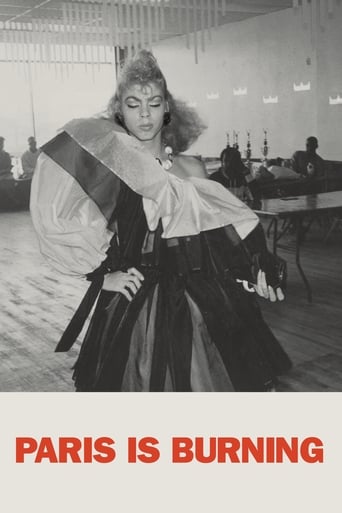
Paris Is Burning
1991 · Film · documentary · 78 min
Directed by Jennie Livingston
Where does voguing come from, and what, exactly, is throwing shade? This landmark documentary provides a vibrant snapshot of the 1980s through the eyes of New York City's African American and Latinx Harlem drag-ball scene. Made over seven years, PARIS IS BURNING offers an intimate portrait of rival fashion "houses," from fierce contests for trophies to house mothers offering sustenance in a world rampant with homophobia, transphobia, racism, AIDS, and poverty. Featuring legendary voguers, drag queens, and trans women — including Willi Ninja, Pepper LaBeija, Dorian Corey, and Venus Xtravaganza.
3 positive3 neutralfrom 6 commenters
Where to watch
No streaming data for this title.
Videos commenters linked
From YouTube links in the comments below. Most are clips and trailers; “Full” means the uploader says so.


6 comments on Hacker News
Just to riff on your list. "Reading" from the 80's NY queer scene came to mind, as talked about in the great documentary Paris is Burning:
https://www.youtube.com/watch?v=JnVSklVO-t4
This isn’t quite what you’re asking for, but Paris Is Burning is the best documentary I’ve ever seen. It’s about the drag ball scene in New York in the 80s, and watching it now is fascinating to see how such a niche culture was 40 years ahead of its time and has become dominant in 2022. On top of that, it’s just a great portrayal of a few fascinating characters.
Paris Is Burning is such a fantastic documentary. I can't recommend it enough. Such a vivid look into this unique gay community, with all the memorable characters. Also a great slice of NYC in the 80's.
According to Wikipedia [1], comedy TV shows with LGBT characters by decade (which is probably a good proxy). Ellen's "coming out" episode was in 1997.
70s: 12 80s: 11 90s: 28 00s: 45
Willing to wager the trend is similar to movies.
We had (just the ones I can recall off-hand, but had to lookup years):
Paris is Burning ('90) My Own Private Idaho ('91) Fried Green Tomatoes ('91) Philadelphia ('93) To Wong Foo, Thanks for Everything! Julie Newmar ('95) Jeffrey ('95) Birdcage ('96) Bound ('96) In & Out ('97) Boys Don't Cry ('99)
Of course, most of these role were filled by cis people.
[1] https://en.wikipedia.org/wiki/List_of_comedy_television_series_with_LGBT_characters
Just to give some numbers:
Ahead of World AIDS Day, UNAIDS has launched a new report showing that access to treatment has risen significantly. In 2000, just 685 000 people living with HIV had access to antiretroviral therapy. By June 2017, around 20.9 million people had access to the life-saving medicines.
http://www.unaids.org/en/resources/presscentre/pressreleaseandstatementarchive/2017/november/20171121_righttohealth_report
For anyone who doesn’t remember what that period was like, see contemporary works like the movie Philidelphia or the documentary Paris is Burning or the musical Rent. (Those are some that spring to mind anyway after all these years.)
>> The current incarnation of "Social Justice" is so far from what individuals like bell hooks, Paulo Freire, Maxine Greene and Henry Giroux had in mind that it's fucking ridiculous and absolutely infuriating.
http://books.google.ca/books/about/Reel_to_Real.html?id=hRtGzesft_AC
>> "Although it may not be the goal of filmmaker, most of us learn something when we watch movies. They make us think. They make us feel. Occasionally they have the power to transform lives. In Reel to Real, Bell Hooks talks back to films she has watched as a way to engage the pedagogy of cinema - how film teaches its audience. Bell Hooks comes to film not as a film critic but as a cultural critic, fascinated by the issues movies raise - the way cinema depicts race, sex, and class. Reel to Real brings together Hooks's classic essays (on Paris is Burning or Spike Lee's She's Gotta Have it) with her newer work on such films as Girl 6, Pulp Fiction, Crooklyn, and Waiting to Exhale, and her thoughts on the world of independent cinema. Her conversations with filmmakers Charles Burnett, Julie Dash, and Arthur Jaffa are linked with critical essays to show how cinema can function " - preface to bell hooks' "Reel to Real: Race, Sex, and Class at the Movies"
You're full of it. Real Social Justice philosophers have always paid heavy attention to media, because in capitalism, our media basically assimilates, swallows up, and instrumentalizes (in the service of consumption) anything else we may want to describe as our "culture" and "tradition".