Sure, but it was also very predictable. Even 20 years ago individual European states started wielding the censorship bludgeon to keep their societies from exploding.
Heck, has there ever been freedom of speech in Europe? Just consider the classic films France has censored (paths of glory, Battle for Algiers) over the last 70 years while allowing the most deprived smut unchallenged. The UK's censorship has a wiki entry (including reservoir dogs and Battleship Potemkin!!). And those are the most liberal speech countries in Europe.
I haven't checked, but I think the gaps between his movie releases roughly doubled with each release.
There are some scenes in these movies that scream "Kubrick". There always seems to be a perspective shot in which the camera is pointing down the centre of some tunnel or corridor. In Paths of Glory it's a trench; in 2001, it's the aisle of the shuttle. It's usually some grand corridor.
Indeed. And all noir films. American cinema is a lot more than just its best picture nominees. Why is OP ignoring films like Rebel Without a Cause, East of Eden, The Defiant Ones, Anatomy of a Murder, The Hustler, Paths of Glory?
I love French New Wave and Breathless is one of my favorite films, but OP overstates their case.
Say what you will about the Hays Code, but I would hardly consider Gone With the Wind, The Great Dictator, Casablanca, It's a Wonderful Life, Sunset Boulevard, The Ten Commandments, The Bridge on the River Kwai, Ben-Hur, Spartacus, Psycho, West Side Story, Lawrence of Arabia, To Kill a Mockingbird, Paths of Glory, It's a Mad, Mad, Mad, Mad World, Mary Poppins, The Sound of Music, or, you know, Citizen Kane to be especially "crappy" movies.
I think that this movie showed, besides showing the germans as barbaric/unloyal (they rescue a german pilot that ends stabbing one of them) missed a lot of what made WWI, WWI. The images are beautiful but WWI seems to only provide a backdrop for a save-private-ryan story.
I recommend the not very well known Kubrick's Paths of Glory (with Kirk Douglas!) instead
Paths of Glory would like to have a word with you.
This might sound hyperbolic, but it's not only the the most visceral depiction of execution I've seen - it's simply one of the most intense moments of all cinema. It's the film that made Stanley Kubrick famous, and for a good reason. That said, I also liked Capote.
No, obviously out of ~300 films produced in 30s and 40s each year, 90% or more were dross. What I've meant is:
1. The best films of this period far surpassed my expectations from the technical point of view. And there were a lot of decent-to-exceptional films produced at the time; I could name at least 50 american films worth watching from 1930 to 1950. In comparison, I could hardly name 10 films from 1951 to 1960 that are at least decent (and yes, Paths of Glory, named below, is the best).
I think it was mostly due to the fact that all personnel, connected with the creation of a film at the time were still largely pioneers at the field and they had all possible expertiese in it (films in the 60s and especially in the 70s became noticeably more amateur; 50s suffered due to McCarthy). Movies were still relatively new and there were a lot of innovation in it each year. On top of that, it was a time of the Great Depression and high unemploymend. Hollywood were one of the better off industries and so were able to easlily atrract best of the best.
2. Even B-movies from rich studios had high production values. From the same 1941 I could easily recommend for example The Gay Falcon - Irving Reis - RKO/Nothing But the Truth - Elliott Nugent - Paramount/Charley's Aunt - Archie Mayo - 20 Fox. All are relatively simple, but well worth the watch.
3. What's more important, the 30s and 40s cinema had its own unique style and dynamic, very different from later decades. I'd say it was closer to Imre Kalman and Franz Lehar operettas, rather than more convential movies we are used today. It was, if I may say so, a thing-in-itself, hardly comparable with what came later.
Paths of Glory is one of my favorite films, after hearing David Simon speak about how it's essentially a movie about middle management and the dangers of being giving a task that's impossible to complete yet will still let down the people who look up to you!
Kubrick has a better example in Paths of Glory. It's still not very gruesome, but in the single combat scene of the whole movie, the soldiers don't get to fire a single shot, they just advance and die.
I have recently gone back through Kubrick’s entire filmography from Paths of Glory on, the first time I had seen many of these films since I was a teenager. It was... underwhelming. I am now able to sympathize with Kubrick critics.
With regard to Borges, he shares the same problem in terms of female characters as Cormac McCarthy as mentioned above. Plus, there is a real lack of emotional depth to Borges’ work. His themes may interest anoraks like ourselves, but I don’t think he is a truly universal figure.
I bet you could task the entire production team of Pulp Fiction with creating a movie, but without Quentin Tarantino it would never reach the same heights.
That's a good point but even a total surveillance system has limits of actionability. Any given response system or mechanism is going to have limits of attention that it can apply to actual and justifiably observed behaviour. That is, if the goal is to identify, and reduce, negative behaviours, then whatever it is that your policing mechanism is can only act on some n cases in any given period of time.
The problem is that reducing negative behaviours in a just fashion is not the only, or even the most likely, possible dynamic for such a system. In a tyrannical regime (political, social, economic: this is not strictly related to politics), there's a great deal of power and control to be had by acting arbitrarily, without predictability, and without recourse, at any given time.
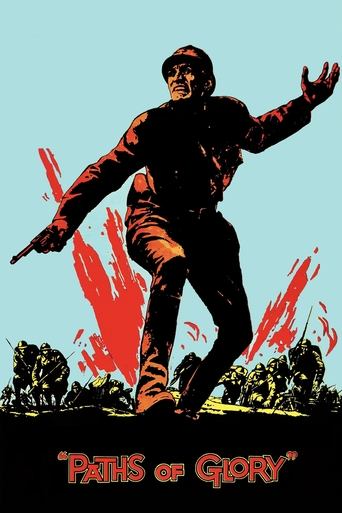
Take the example given in Paths of Glory, a 1957 film telling the story of the (arbitrary) execution of three French soldiers who had refused to undertake suicidal attacks in the trench warfare of World War I. The process draws on the ancient tradition of decimation, which is the arbitrary killing of one in ten of ones own troops* in order to instill on the remainder the consequences of failure to follow command.
The real risk of global surveillance is that it provides either the justification for, or the plausibility of justification for, arbitrary prosecution of any given individual at any given time.
A good movie about the insanity of the trench warfare and some of the French commanders of WWI is Paths of Glory - https://en.wikipedia.org/wiki/Paths_of_Glory.
Count me in as somebody with taste that knows something about film and finds this movie a waste of talent. The real Kubrick underrated masterworks are paths of glory and the killing.
Kubrick's films before 2001 (Spartacus, Paths of Glory, etc) tended to tell the story with words and pictures. From 2001 on, with the notable exception of Barry Lyndon, he seemed to become obsessed with imagery, or as you say, creating visual poems (and even Barry Lyndon with its simple plot was a visual powerhouse), but I'm afraid his storytelling became secondary.
For those of you who haven't read Clarke's book 2001, you should consider putting it on your list. As garyrob has implied, it's very different from the movie - very concrete - and yet, possibly as a result, almost more hallucinogenic than the film could ever be.
Okay, first, I just want to thank you for your excellent response.
I'll admit, I don't think art must necessarily illustrate the human condition. I think good art often does, but it can also just be something that evokes an emotion. Of course, lots of things evoke emotions, so that's obviously necessary but not sufficient. I agree that the expert exercise of craft can be quite enjoyable, but that too is not sufficient to be artistically interesting or else all skilled workers would be artists (and if you feel that way, we really aren't talking about the same thing when we use the word "art"). This is already a debatably overly-limited definition of art, but my point was to unpack the idea that art does have various motives, goals, and effects on the viewer, as well as many ways to achieve them, and that is a fine thing.
However, I wasn't trying to debate what is artistic and what I not. I was saying that for those of us interested in games as art, Bioshock is an exciting game, and it's exciting because it does something new and it does it well.
I don't understand how you can get out of what I said that I think Bioshock's story is what makes it art. To say "ahh yes, but it's not a movie!" is to miss the entire point, (which may very well be the fault of my writing). The point is that it controlled me and I enjoyed it. The point is that it told me I was a slave AND IT WAS RIGHT. Because of things I DID. And it did it in a way that only a game could, not a movie or a book or a song.
I said Bioshock was interesting and I stand by that because it did something that none of the games you've cited do: the rules of the simulation and the rules of narrative played together to make meaning that as key to the game that couldn't be made in strictly simulation or narrative forms alone.
You say the "gameplay doesn't distinguish itself much," and if you mean the combat and other kinetic elements don't particularly stand out, I don't entirely disagree, but that's missing the point. When you say that Bioshock's story isn't well told, however, that's something I disagree with strongly.
I wish I had time to discuss each of the games you listed, because we agree on some points and disagree on others, but I don't, so I'll try to address some of the themes I saw.
You defend some Nintendo games for being something other than literary, and you and I are in agreement that that's not required to be interesting. Too many people think that a game has artistic merit if and only if it has a good story. There are a whole lot of good games without a story, or with a terrible story that they tell well (e.g. Half-Life 1). This isn't the point.
However, story and how it's told is important stuff in a lot of these games. But how do games tell stories? Like literature and movies, games have character development and pacing, but there are also aspects unique to each medium. Literature has the craft of writing, movies have framing and mise en scene. Games have other means of telling stories, and we're still figuring some of them out. Bioshock tells its story and evokes something in the player in a way I haven't seen before. That's why I said initially that it's one of the most exciting games out there. It's exciting because it's trail-blazing. It's exciting because it uses this to be an indictment of its own genre conventions.
Finally, you write, "I think art means making fun games above everything," a statement that honestly makes me rather sad. There are plenty of great things to do in terms of making fun games and finding new ways to make fun games. However, you make the analogy of games to film: do you think Citizen Kane was a fun movie? Should Kubrick have worried more about making Paths of Glory more fun? I don't think fun is bad, but to limit our definition of a good game to what is fun is to put on blinders.
tl;dr - Good literature isn't about plot and neither is BioShock. Good literature and BioShock, however, both use their medium well, and BioShock is exciting because it shows us a new way of doing things.
 Hacker Cinema
21 comments on Hacker News
And T.S. Elliot was a Bostonian, but adopted British!
Kubrick made all his iconic movies (except Spartacus and Paths of Glory) while settled in Britain, and shot most of them in British studios.
Sure, but it was also very predictable. Even 20 years ago individual European states started wielding the censorship bludgeon to keep their societies from exploding.
Heck, has there ever been freedom of speech in Europe? Just consider the classic films France has censored (paths of glory, Battle for Algiers) over the last 70 years while allowing the most deprived smut unchallenged. The UK's censorship has a wiki entry (including reservoir dogs and Battleship Potemkin!!). And those are the most liberal speech countries in Europe.
Yeah.
Spartacus: Swords and sandals.
Paths of Glory: WW1 anti-war.
Strangelove: I don't know what genre that was.
2001: Space opera.
A Clockwork Orange: Dystopian sci-fi.
Barry Lyndon: Picaresque costume drama.
I haven't checked, but I think the gaps between his movie releases roughly doubled with each release.
There are some scenes in these movies that scream "Kubrick". There always seems to be a perspective shot in which the camera is pointing down the centre of some tunnel or corridor. In Paths of Glory it's a trench; in 2001, it's the aisle of the shuttle. It's usually some grand corridor.
Indeed. And all noir films. American cinema is a lot more than just its best picture nominees. Why is OP ignoring films like Rebel Without a Cause, East of Eden, The Defiant Ones, Anatomy of a Murder, The Hustler, Paths of Glory?
I love French New Wave and Breathless is one of my favorite films, but OP overstates their case.
Say what you will about the Hays Code, but I would hardly consider Gone With the Wind, The Great Dictator, Casablanca, It's a Wonderful Life, Sunset Boulevard, The Ten Commandments, The Bridge on the River Kwai, Ben-Hur, Spartacus, Psycho, West Side Story, Lawrence of Arabia, To Kill a Mockingbird, Paths of Glory, It's a Mad, Mad, Mad, Mad World, Mary Poppins, The Sound of Music, or, you know, Citizen Kane to be especially "crappy" movies.
I think that this movie showed, besides showing the germans as barbaric/unloyal (they rescue a german pilot that ends stabbing one of them) missed a lot of what made WWI, WWI. The images are beautiful but WWI seems to only provide a backdrop for a save-private-ryan story. I recommend the not very well known Kubrick's Paths of Glory (with Kirk Douglas!) instead
Paths of Glory would like to have a word with you.
This might sound hyperbolic, but it's not only the the most visceral depiction of execution I've seen - it's simply one of the most intense moments of all cinema. It's the film that made Stanley Kubrick famous, and for a good reason. That said, I also liked Capote.
No, obviously out of ~300 films produced in 30s and 40s each year, 90% or more were dross. What I've meant is:
1. The best films of this period far surpassed my expectations from the technical point of view. And there were a lot of decent-to-exceptional films produced at the time; I could name at least 50 american films worth watching from 1930 to 1950. In comparison, I could hardly name 10 films from 1951 to 1960 that are at least decent (and yes, Paths of Glory, named below, is the best).
I think it was mostly due to the fact that all personnel, connected with the creation of a film at the time were still largely pioneers at the field and they had all possible expertiese in it (films in the 60s and especially in the 70s became noticeably more amateur; 50s suffered due to McCarthy). Movies were still relatively new and there were a lot of innovation in it each year. On top of that, it was a time of the Great Depression and high unemploymend. Hollywood were one of the better off industries and so were able to easlily atrract best of the best.
2. Even B-movies from rich studios had high production values. From the same 1941 I could easily recommend for example The Gay Falcon - Irving Reis - RKO/Nothing But the Truth - Elliott Nugent - Paramount/Charley's Aunt - Archie Mayo - 20 Fox. All are relatively simple, but well worth the watch.
3. What's more important, the 30s and 40s cinema had its own unique style and dynamic, very different from later decades. I'd say it was closer to Imre Kalman and Franz Lehar operettas, rather than more convential movies we are used today. It was, if I may say so, a thing-in-itself, hardly comparable with what came later.
Paths of Glory is one of my favorite films, after hearing David Simon speak about how it's essentially a movie about middle management and the dangers of being giving a task that's impossible to complete yet will still let down the people who look up to you!
A good companion piece is Stanley Kubrick’s Paths of Glory, which gave David Simon much of his inspiration for The Wire. Excellent film.
As long as we're discussing fictional works about WWI, two great movies are La Grande Illusion and Paths of Glory.
Kubrick has a better example in Paths of Glory. It's still not very gruesome, but in the single combat scene of the whole movie, the soldiers don't get to fire a single shot, they just advance and die.
I have recently gone back through Kubrick’s entire filmography from Paths of Glory on, the first time I had seen many of these films since I was a teenager. It was... underwhelming. I am now able to sympathize with Kubrick critics.
With regard to Borges, he shares the same problem in terms of female characters as Cormac McCarthy as mentioned above. Plus, there is a real lack of emotional depth to Borges’ work. His themes may interest anoraks like ourselves, but I don’t think he is a truly universal figure.
Why is reading part of being a model citizen, but not watching movies? I'd give Paths of Glory for someone to watch over 99.9% of books out there.
I bet you could task the entire production team of Pulp Fiction with creating a movie, but without Quentin Tarantino it would never reach the same heights.
sub:
Paths of Glory : Kubrick
Seven Samurai : Kurosawa
Stalker : Tarkovsky
That's a good point but even a total surveillance system has limits of actionability. Any given response system or mechanism is going to have limits of attention that it can apply to actual and justifiably observed behaviour. That is, if the goal is to identify, and reduce, negative behaviours, then whatever it is that your policing mechanism is can only act on some n cases in any given period of time.
The problem is that reducing negative behaviours in a just fashion is not the only, or even the most likely, possible dynamic for such a system. In a tyrannical regime (political, social, economic: this is not strictly related to politics), there's a great deal of power and control to be had by acting arbitrarily, without predictability, and without recourse, at any given time.
Take the example given in Paths of Glory, a 1957 film telling the story of the (arbitrary) execution of three French soldiers who had refused to undertake suicidal attacks in the trench warfare of World War I. The process draws on the ancient tradition of decimation, which is the arbitrary killing of one in ten of ones own troops* in order to instill on the remainder the consequences of failure to follow command.
The real risk of global surveillance is that it provides either the justification for, or the plausibility of justification for, arbitrary prosecution of any given individual at any given time.
That's an absolutely despotic state.
A good movie about the insanity of the trench warfare and some of the French commanders of WWI is Paths of Glory - https://en.wikipedia.org/wiki/Paths_of_Glory.
Count me in as somebody with taste that knows something about film and finds this movie a waste of talent. The real Kubrick underrated masterworks are paths of glory and the killing.
Good lord, if it was a mini-series, with the kind of production values of Michael Shara's Gettysburg? Where can I sign up to give over my money?
Especially since there is a remarkable lack of WWI era movies after Paths of Glory that were anything like decent.
Kubrick's films before 2001 (Spartacus, Paths of Glory, etc) tended to tell the story with words and pictures. From 2001 on, with the notable exception of Barry Lyndon, he seemed to become obsessed with imagery, or as you say, creating visual poems (and even Barry Lyndon with its simple plot was a visual powerhouse), but I'm afraid his storytelling became secondary.
For those of you who haven't read Clarke's book 2001, you should consider putting it on your list. As garyrob has implied, it's very different from the movie - very concrete - and yet, possibly as a result, almost more hallucinogenic than the film could ever be.
Okay, first, I just want to thank you for your excellent response.
I'll admit, I don't think art must necessarily illustrate the human condition. I think good art often does, but it can also just be something that evokes an emotion. Of course, lots of things evoke emotions, so that's obviously necessary but not sufficient. I agree that the expert exercise of craft can be quite enjoyable, but that too is not sufficient to be artistically interesting or else all skilled workers would be artists (and if you feel that way, we really aren't talking about the same thing when we use the word "art"). This is already a debatably overly-limited definition of art, but my point was to unpack the idea that art does have various motives, goals, and effects on the viewer, as well as many ways to achieve them, and that is a fine thing.
However, I wasn't trying to debate what is artistic and what I not. I was saying that for those of us interested in games as art, Bioshock is an exciting game, and it's exciting because it does something new and it does it well.
I don't understand how you can get out of what I said that I think Bioshock's story is what makes it art. To say "ahh yes, but it's not a movie!" is to miss the entire point, (which may very well be the fault of my writing). The point is that it controlled me and I enjoyed it. The point is that it told me I was a slave AND IT WAS RIGHT. Because of things I DID. And it did it in a way that only a game could, not a movie or a book or a song.
I said Bioshock was interesting and I stand by that because it did something that none of the games you've cited do: the rules of the simulation and the rules of narrative played together to make meaning that as key to the game that couldn't be made in strictly simulation or narrative forms alone.
You say the "gameplay doesn't distinguish itself much," and if you mean the combat and other kinetic elements don't particularly stand out, I don't entirely disagree, but that's missing the point. When you say that Bioshock's story isn't well told, however, that's something I disagree with strongly.
I wish I had time to discuss each of the games you listed, because we agree on some points and disagree on others, but I don't, so I'll try to address some of the themes I saw.
You defend some Nintendo games for being something other than literary, and you and I are in agreement that that's not required to be interesting. Too many people think that a game has artistic merit if and only if it has a good story. There are a whole lot of good games without a story, or with a terrible story that they tell well (e.g. Half-Life 1). This isn't the point.
However, story and how it's told is important stuff in a lot of these games. But how do games tell stories? Like literature and movies, games have character development and pacing, but there are also aspects unique to each medium. Literature has the craft of writing, movies have framing and mise en scene. Games have other means of telling stories, and we're still figuring some of them out. Bioshock tells its story and evokes something in the player in a way I haven't seen before. That's why I said initially that it's one of the most exciting games out there. It's exciting because it's trail-blazing. It's exciting because it uses this to be an indictment of its own genre conventions.
Finally, you write, "I think art means making fun games above everything," a statement that honestly makes me rather sad. There are plenty of great things to do in terms of making fun games and finding new ways to make fun games. However, you make the analogy of games to film: do you think Citizen Kane was a fun movie? Should Kubrick have worried more about making Paths of Glory more fun? I don't think fun is bad, but to limit our definition of a good game to what is fun is to put on blinders.
tl;dr - Good literature isn't about plot and neither is BioShock. Good literature and BioShock, however, both use their medium well, and BioShock is exciting because it shows us a new way of doing things.