 Hacker Cinema
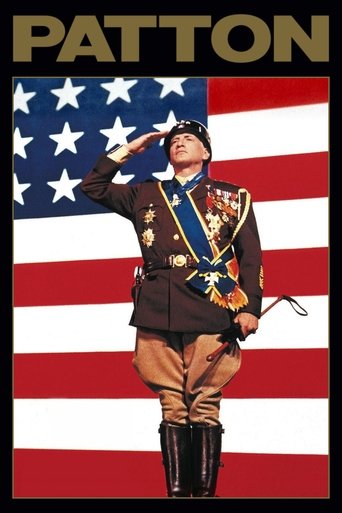
Patton
1970 · Film · 172 min
Directed by Franklin J. Schaffner
"Patton" tells the tale of General George S. Patton, famous tank commander of World War II. The film begins with Patton's career in North Africa and progresses through the invasion of Germany and the fall of the Third Reich. Side plots also speak of Patton's numerous faults such his temper and habit towards insubordination.
8 positive3 negative1 mixed7 neutralfrom 19 commenters
Where to watch
No streaming data for this title.
19 comments on Hacker News
I did no such thing. The Soviets defeated the nazis and suffered the most.
The US and their vassals merely made you believe their propaganda: Patton the movie et al.
Are you British? They play word games.
It's actually well executed how they managed to say exactly once "Amadeus" or "Patton" in their biographical films.
Just sit and watch, while not doing anything else? Die Hard. At least once a year since it came out in 1988. Die Hard and pizza have been a Christmas Day tradition since it came out on VHS in 1989. (I saw it in the theater in 1988.)
Otherwise, if I am watching a movie more than once, it's wile I am doing something else. Working from home, I often have old science fiction B-movies -- both the MST3K versions and unriffed versions -- running in the background. Others I'll "watch" while doing something else are Animal House, Blues Brothers, the Lethal Weapon films, Patton, James Bond, and some others.
I was recently reading about North Africa campaigns in ww2. One thing to note was that decisive aggressive actions that tanks allowed cause a lot more POWs because their positions could be overrun so quickly and effectively that desperate last stands weren’t feasible. Mud and hedgerows in France were a problem back then too. I also remember in desert storm 2 hearing that although many Abrams tanks were taken out of action, none of them were penetrated, it was all maintenance issues. Rommel and Patton seemed to both think of tank warfare as it’s own thing that was hard. In the Patton movie they talk of troops thinking tanks were death traps back then too. It’s touched on in the article, Ukrainian tank kill videos I’ve seen seem to be close range ambushes in urban areas. It’s my opinion that the US would have already bombed those areas to pieces and were much less willing to take risks with potential civilian combatants. But as the article says there is a lot of fog about what’s really happening and my view of the US is flavoured by the ‘atrocity’ videos that were popular ala Manning etc. Super heavy tanks like Abrams and tigers seem really cool Edit because didn’t finish: but that’s not the only way to go with tank design
Remember, also, the movie was “advised” by Bradley so he looks better and Patton looks worse. Discipline is more than just neat clothes - it’s remembering to do the boring or difficult things that reflects one training or doctrine.
And it’s not a documentary and I can’t imagine people going to a normal movie wanting to watch commentary on how to deploy infantry/tank teams, choose ground or the strengths/weaknesses of separating divisions vs. keeping them together. There are a number of good books that discuss this.
For the movie, I objected to three things:
(1) For the US loss at Kasserine Pass, the movie has Patton and Bradley blame poor discipline of the troops. Another view is that the German leadership set and baited a trap, and the US leadership -- General Fredendall -- responded to the bait and ordered the US troops into the trap where the Germans devastated the US troops and created the massive US loss. The US troops had enough "discipline" to advance as ordered and to fight and die in the trap.
Net, I would claim that the main cause of the US loss was the poor leadership of Fredendall and not anything about the "discipline" of the US troops.
(2) The movie mentions that Patton "trained" his troops, but except for some points about discipline, e.g., uniforms, there were no details on the "training". So, if wanted to learn more about Patton's leadership, e.g., as a foundation for his successes, then would want more about the "training".
(3) An important part of the Allied victory at Normandy and in France generally was their victory at the Falaise pocket. There Patton was doing well closing the pocket, but Monty ordered Patton back, and many Germans escaped east. The movie omitted the battle of the Falaise pocket.
From the comments: the two men talking about the film Patton do not seem to realize it was based on the book Patton: Ordeal and Triumph by Ladislas Farago
That seems like an incredible research failure, considering it's in the first paragraph of the Wikipedia article. If they can't be bothered to do such basic research, is there any chance their opinions are worth the time to listen?
Related to your point, George C Scott apparently didn’t want to film the opening scene of “Patton” because he thought the movie wouldn’t live up to the scene. It really gets at the heart of what the whole movie is about and I can’t imagine it without that opening. Apparently they filmed it at the end of filming.
https://en.m.wikipedia.org/wiki/Patton_(film) (The opening scene under “production” - sorry on a mobile device)
One of the scenes I enjoyed in "Patton" was when Patton defeats Rommel through knowledge of Rommel's tactics. He yells, seemingly across the field to Rommel, "I read your book". (The movie actually makes it seem like Patton could read unpublished manuscripts of his opponent [1]) This exemplifies that famous people wrote books. They wrote memoirs and they wrote manuals. I couldn't say how the gatekeepers dealt with such books, nor how the potential readership found or regarded such books.
[1] https://en.wikipedia.org/wiki/Infantry_Attacks
I have no problem with the death of those who would prefer my death.
The most memorable line from the movie Patton (I don't know if General Patton said this IRL):
Now I want you to remember that no bastard ever won a war by dying for his country. He won it by making the other poor dumb bastard die for his country.
Patton (1970)
A great movie about an impressive commander. Key takeaways for me were:
1. Don't assume that because someone isn't very personable that they are bad at their job.
2. Have the courage to have a strong sense of duty.
3. Lead from the front.
4. Be willing to learn from people you dislike (Patton read Rommel's book on tank tactics, to his great advantage).
Ah, yes. I have seen this movie over a dozen times, with my first viewing at about age 4. George C Scott's performance is more sublime than the command presence of the real Patton.
I had one quote from Patton[0] the film:
I think it was Alcibiades in the Peloponnesian War... ...415 B.C. He said, "If Syracuse falls, all Sicily falls, and then Italy." He knew that Syracuse was the jugular of the island. Old Alcibiades always went for the throat.
Good movie.
[0]https://www.imdb.com/title/tt0066206/?ref_=nv_sr_5?ref_=nv_sr_5
As a fan (not shareholder, unfortunately) of Tesla, this is great news. When I think of Elon Musk I sometimes think of the movie version of Patton. Hopefully this gets him to settle down on a bit of the drama, and focus on making Tesla succeed and getting SpaceX to Mars...
Any good history of WWII covers this.
"Patton", the movie, shows it from Patton's perspective.
"You will not find it difficult to prove that battles, campaigns, and even wars have been won or lost primarily because of logistics." - General Dwight D. Eisenhower
More detail than you probably want - Gen. George C. Marshall's comments after the war.[1] See p. 8 of the transcript.
A more modern perspective - "Moving Mountains", a book by Gen. Gus Patronis, head of logistics for Desert Storm. How the U.S. Army built up a massive force in the middle of nowhere and then won a war in four days. This is a useful perspective on "speed". If you want to go fast, having massive resources available makes it work.
[1] http://marshallfoundation.org/library/wp-content/uploads/sites/16/2014/05/Marshall_Interview_Tape13.pdf
Reminds me of that recent article that the best way to identify a narcissist is to just ask them (true narcissists will readily admit it). That line in Patton (probably my favorite movie) where he says "Hell, I know I'm a prima donna. I admit it."
Still does not pay to be an asshole though. If you want to call them assholes - I believe Jobs and Patton would have been just as successful if they had not been. But their legacies are (maybe forever) tarnished because of it.
Patton could have just as easily not gotten the chance to stage his magnificent campaign across Europe - just because of an "asshole" move. It wasn't worth it. Proves that people do still care about how others are treated.
Here's my big problem. Why do books, movies, and television not have to face this kind of crap? Why don't game developers get the same privileges as other media? Because its interactive? That's a load of crap. Because its immersive? Other media should be insulted by that assertion.
If you're a developer and you don't think your fellow developers should get the same protections as other media, then why? How does Apple sell "Patton" or "Midway" and not this?
This captures it concisely. There is years and years of experience lighting things to make them look good in the theatre. There is also years of experience in lighting things to make them look good on video. Unfortunately the video lighting people and the cinema lighting people aren't the same people.
On a related note, I saw a clip of Patton running on a television that was doing active motion compensation filtering. It made the movie look like it was shot on video, and in that mode the various prop items stood out. In one scene the jeep in the background, and the background in general, is clearly painted on a flat surface. Without the motion compensation on that jeep looked like it could be a real jeep in the scene. Very weird effect.
In
http://news.ycombinator.com/item?id=2267731
I argue that the article is just politics.
Still, education is important.
Since we are on 'Hacker News' (HN), there is some considerable irony in this article:
In computing now, the workers in information technology commonly need to understand subjects such as:
algorithms, programming languages, frameworks, development environments, user interface design and development, programming for application installation, operating system administration, networking and network administration, relational database and its administration, code repositories, application instrumentation, system monitoring, many utilities and applications, software as a service, the Cloud, the social graphs and interest graphs on the Internet, how to start a company, how to raise venture capital, how to manage software development, etc.
The content of these subjects changes significantly each 12 months.
To keep up, workers need their own 'computer center' and educational resources and mostly just must teach themselves, that is, without teachers. In particular, formal courses are nearly useless because the teachers are rarely up to date on this material.
This pattern has been rock solid for nearly all parts of the US computer industry going way back to punched cards.
Net, the readers of HN overwhelmingly learn independently and are self-taught using their own time, money, and effort.
So, claims by the formal education community in K-12 and college that their classroom instruction is crucial for education is an ironic, ROFL at HN.
But HN readers are not the only ones: (1) An auto mechanic has to keep up with the new systems on the new cars. (2) Workers in construction of houses and small commercial buildings have to keep up with new materials, construction techniques, and regulations. (3) Recently chefs in high end restaurants had to learn about 'molecular gastronomy', 'tasting menus', and intricate 'wine parings'. (4) CPAs and tax lawyers need to keep up on the tax law changes.
Workers in a huge fraction of the US economy have to keep up in their fields, independently, via self-teaching, and most of this work uses their time, effort, and money.
So, let's return to K-12: Basically what is needed from K-12 is at least, by age 18, to be able to (A) read with understanding materials commonly encountered, (B) write clearly, e.g., as well as on HN, and (C) know basic arithmetic, percentages, areas, and volumes.
Now we come to some simple facts: Joe gets sick and stays home from school for three weeks. His grandmother notices that he can't read so, in those three weeks, teaches him to read. Later she does the same for (B) writing and (C) basic math. This situation is common. Basically, normal kids can pick up the 3Rs with astounding speed. Just how they do it is not clear at all, and research on 'teaching techniques' is not promising but also mostly not needed.
The K-12 system should be able to get this teaching done by the eighth grade. So, to know, sure, give some tests. Simple enough.
But, K-12 does try to do more. Especially important topics include math through analytic geometry and trigonometry, biology, chemistry, physics, and history. For these subjects, sadly, the K-12 teachers rarely know enough of the material to teach it well. Even the K-12 'experts' don't: I understand calculus quite well, thank you (learned it at several levels, taught it, applied it, published peer-reviewed original research based on it), but the people who wrote the AP calculus materials did not. Sad. To learn calculus, just get any edition of the dozen or so college calculus texts famous over the last few decades, dig in, and f'get about AP calculus.
Yes, it would be good to teach some art. Sadly, apparently they don't. There may be more on how art works just in, say,
http://news.ycombinator.com/item?id=2246723
In the article the teacher said:
"I’m used to wild and crazy discussions about amazing novels."
"Amazing novels"? Eventually I had to conclude that, according to the standards of information safety and efficacy well established in the first half of the 20th century, novels are at most for light entertainment so that the set of all "amazing novels" is the empty set and not worth serious effort. She was largely wasting time; it's sad she didn't know that; but I can believe that most readers of 'The Daily Kos' take novels seriously. Those English majors dragged me through six years of their 'belle lettre' nonsense when I wanted to study much more in math and science. Bummer.
So, what K-12 does with these additional subjects is at best mixed.
So, net, our K-12 system is heavily for baby sitting. We shouldn't have to pay a lot for baby sitting.
So, what about education?
HN Style Solution: Put good materials on the Internet. So have careful, detailed text in PDF files. Have some lectures by some good people. And by some experts, have some lectures with some intuitive descriptions that explain the 'forest' so well that the 'trees' become mostly obvious.
With good materials, a good student could knock off grades 7-12 independently in maybe three weeks per grade except that foreign languages typically would extend the time. But, with good materials, can do well with a foreign language surprisingly quickly.
Then for 'more' in fuzzy topics such as art, human behavior, organizational behavior, civics, politics, just have some excellent lectures on the Internet and maybe some fora.
E.g., for a curiously good start on both music and painting, in one stroke, just spend right at 10 minutes with
http://www.youtube.com/watch?v=7prUFflX0_E
Likely a good start on art history is the 1969 TV series 'Civilization' by Kenneth Clark. There is also a book, but the video alone is fine.
Actually, for some good material in history, there are some starts: Some of the best material on the history of the 20th century is in some selected movies; it's not common to find better materials in print, and it is nearly impossible to find materials nearly as good in K-12 or the first two years of college.
E.g., the movie 'The Battle of Britain' is relatively good on its subject. Actual dates, numbers of planes, pilots, and bombs per day along with 'logistics' would help but are generally ignored by all of the history community.
The movie 'Midway' is relatively good on its subject, a turning point in the war in the Pacific and basically for the reasons made clear in the movie. The Charlton Heston character should be cut out. The timing, crucial, of the actual events in the battle should be made more clear. Details on times, distances, and speeds would help, yes, typically ignored by the history community. Still the movie is relatively good.
The series 'Victory at Sea' was a lot of US flag waving but still does provide a good outline of a lot of WWII.
The movie 'The Longest Day' is awash in 'entertainment values' but, still, does cover the essentials of D-Day.
The hugely long:
William L. Shirer, 'The Rise and Fall of the Third Reich: A History of Nazi Germany, Thirtieth Anniversary Edition', ISBN 0-671-72868-7, Simon and Schuster, New York, 1981.
actually is surprisingly sparse on important content.
Sadly the biographies of Eisenhower and Patton are so far from the actual details that they are not good. Bradley's biography is better (but nothing like the character Bradley in the movie 'Patton').
Net, what K-12 is teaching in history is below what is readily available just by watching some movies for a few evenings.
Net, for formal education in K-12 and the first two years of college, it's a huge waste of time, money, and effort for all concerned and can mostly be replaced by good materials (mostly not yet available but easily could be) on the Internet, thus, letting students get on with independent learning in areas of their interests and/or more advanced formal education.
People should say, "I want good education, but I'm not going to pay a lot for what's in K-12 and the first two years of college now."