 Hacker Cinema
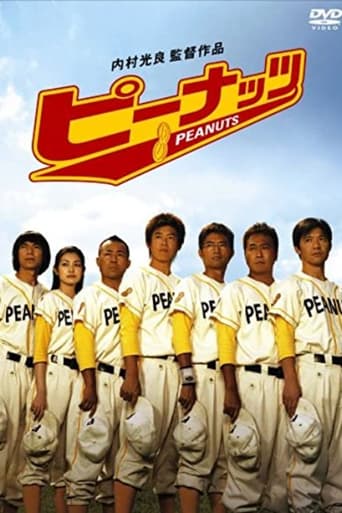
Peanuts
ピーナッツ
2006 · Film · 115 min
Directed by Teruyoshi Uchimura
A hero called the legendary third baseman in the former prestigious grass baseball team "Peanuts", will start to rebuild the peanuts that have now turned into weak teams from the outset. Peanuts are going to fight against the team of strong teams, taking advantage of the redevelopment of the city where Captain Sagara lives.
3 neutralfrom 3 commenters
Where to watch
No streaming data for this title.



3 comments on Hacker News
The comment about using Google was more a curiosity. I hadn't seen the Variety link until yesterday, when I went to Google to reproduce the answer to verify it was from a text query, not an image query. Both Google AI and one of the top answers included that Variety link. When you mentioned it again, it strongly suggested you were using Google as your primary search method.
I think the right way to interpret the Variety link is that it's a single paragraph about trying to capture the feel of the comic using 3D software. As you saw from Charlie Brown holding a baseball, Shulz didn't go for a realistic look, but still conveys the sense of grasping. Modeling all five fingers all the time would not give the movie the right feel.
I wonder now if Google AI incorporates text from the top results into its answer.
"why is it wrong when the AI generated 4 fingers?"
The original discussion was when person X used AI to generate a image "in the style f Charles Shulz" where the Peanuts characters had 5 fingers, then person Y noted the use of 5 fingers instead of the 4 which is common in comics and cartoon, and quoted Google AI as saying Peanuts was traditionally drawn with 4 fingers.
I yesterday verified that Google AI would generate the same wrong answer with a text query, so it was not an image interpretation issue.
FWIW, after looking at a few hundred Peanuts cartoons, I can confidently say the AI generated image was not in the style of Schulz. The generated fingers were too realistic, and the background too complicated and detailed. :)
This for me is another example of why using primary sources should be the first thing to consider when fact checking - not LLMs (my experience is they are horrible at details), and not secondary sources (which have their own biases).
Not everything has easily-accessed primary sources, but many do. I think it's all too easy to fall into the trap of accepting the LLM answer because it feels right and is easy to generate. At https://freethoughtblogs.com/stderr/2025/01/18/ai-art-just-regurgitate-existing-images/ you'll see someone asked about which river Marbot swam across to spy on the enemy camp. It replied "Elbe". Then I did a text search of an English translation of the book and found he used a boat to cross the Danube to spy on the enemy camp, and he swam into freezing waters to save an enemy soldier.
Again, do you ask the LLM to fact check itself every single time? If that's useful, why isn't it built into the prompt? Or, if you are supposed to double-check the LLM yourself, why would you consult a secondary source if the primary source is so easy to find and search? And in that case, why not just use the primary source?
Further, if you aren't in the habit of checking primary sources then you won't have the experience to know how to find and check primary sources.
Aha. I'm showing my age. I didn't know there was a "Peanuts" movie. I was talking about the tune "Linus and Lucy" which was the theme for the original animated TV show "A Charlie Brown Christmas."
(And I shouldn't have called it a song, as there are no words).
Children getting whisked away by a handsome protagonist and his magical sidekick to fight against "cool things" like pirates and mermaids in a world unlike our own?
Its an Isekai.
---------
Isekai is this modern trend in anime (and US movies sometimes!! Like Ready Player One), where characters are sent to another world. Sometimes due to death explicitly ("Reincarnated in a New World" plotline: like "I'm a Spider So What"), sometimes just "temporarily" transported (Sword Art Online / Ready Player One, they are "just" playing a video game).
From an "Isekai" perspective: people want two things.
1. A world very different from our own. Completely different "physics" or rules. So magic systems, history, culture, etc. etc. that's nothing like our world. Neverland easily qualifies.
2. A character who explores the new world from our perspective. The main character is always someone "like the audience", who can be ignorant about the new world. (The various characters the protagonist meets are therefore given an opportunity to explain the world to the newcomer, allowing the audience to learn about the world in a natural manner). In Peter Pan, Wendy is the Isekai protagonist.
------
Alice in Wonderland, Connecticut Yankee in King Arthur's Court, Wizard of Oz, A Lion, A Witch, and the Wardrobe. The concept happens again and again as a pattern, because its a good framing device. I'm not sure if Peter Pan can be seen as an allegory of death necessarily, any more than "I'm a Spider, so What?" (2021 Anime) could be.
The children are... children... because the main character often should match the profile of the target audience. Not always, but its a good rule of thumb to keep. Children stories will therefore have child-protagonists more often than not (Polar Express, Lion Witch Wardrobe, Harry Potter). There are exceptions (Peanuts has child protagonists but is largely written for an adult audience), but its just the rule of thumb authors seem to use.