 Hacker Cinema
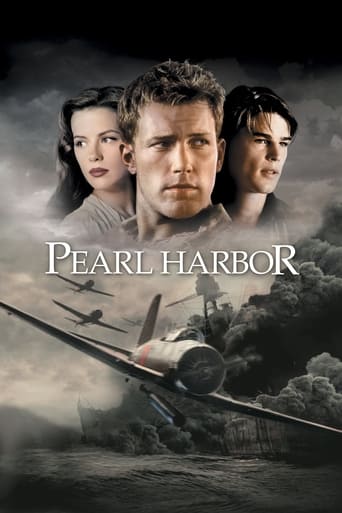
Pearl Harbor
2001 · Film · 183 min
Directed by Michael Bay
The lifelong friendship between Rafe McCawley and Danny Walker is put to the ultimate test when the two ace fighter pilots become entangled in a love triangle with beautiful Naval nurse Evelyn Johnson. But the rivalry between the friends-turned-foes is immediately put on hold when they find themselves at the center of Japan's devastating attack on Pearl Harbor on Dec. 7, 1941.
11 negative1 mixed11 neutralfrom 23 commenters
Where to watch
No streaming data for this title.
24 comments on Hacker News
I'm sure many Japanese watching the Pearl Harbor movie didn't want the American pilots to survive after nuking 2 cities either.
> If there is no objectivity....then you would have no basis to explain why a film is better or worse than another, A student first iPhone short would be equal to The Godfather. A child banging pots would be indistinguishable from a Symphony.
What is the purpose of "art": in general and/or particular works of it? What makes (a work of) 'art' 'good'?
Is PHM 'good' in its purpose? Is The Room? When a child is banging on pots, is he accomplishing his purpose in his 'creative act'?
> I think Michael Bay sometimes sucks (“Pearl Harbor,” “Armageddon,” “Bad Boys II“) but I find it possible to love him for a movie like “Transformers.” It’s goofy fun with a lot of stuff that blows up real good, and it has the grace not only to realize how preposterous it is, but to make that into an asset.
* https://www.rogerebert.com/reviews/transformers-2007
Movies like Maverick are indeed propaganda. In exchange for all that fancy military hardware, the Navy was able to exercise editorial control over the script. In fact ‘ Jerry Bruckheimer, a top producer, said that “Top Gun” and 2001’s “Pearl Harbor” simply wouldn’t exist without military approval.’
https://www.latimes.com/opinion/story/2022-05-30/top-gun-maverick-memorial-day-tom-cruise-pentagon-propaganda
Definitely worth a rewatch, I feel that it has aged better than many of its contemporaries that did better on the box office (such as Jurassic Park III or Doctor Doolittle 2 or Pearl Harbor). It's definitely got a long, slow third act, but for good narrative reason (it's trying to give a sense of scale of thousands of years passing; "Supertoys Last All Summer Long" was the title of the originating short story and a sense of time passage was important to it) and it is definitely something that feels better in home viewing than in must have felt in a theater. (And compared to the return of 3-hour epics in today's theaters and the 8-to-10-hour TV binges that Netflix has gotten us to see as normal, you find out that it is only a tight 146 minutes, despite how long the third act feels and just under 2 and a half hours today feels relatively fast paced.)
Similarly, too, 2001 was right towards the tail end of Haley Joel Osment's peak in pop culture over-saturation and I can definitely understand being sick of him in the year 2001, but divorced from that context of HJO being in massive blockbusters for nearly every year in 5 years by that point, it is a remarkable performance.
Kubrick and Spielberg both believed that without HJO the film AI would never have been possible because over-hype and over-saturation aside, he really was a remarkably good actor for the ages that he was able to play believably in that span of years. I think it is something that we see and compare/contrast in the current glut of "Live Action" and animated Pinocchio adaptations in the last year or so. Several haven't even tried to find an actual child actor for the titular role. I wouldn't be surprised even that of the ones that did, the child actor wasn't solely responsible for all of the mo-cap work and at least some of the performance was pure CG animation because it is "cheaper" and easier than scheduling around child actor schedules in 2023.
I know that I was one of the people who was at least partially burnt out on HJO "mania" at that time I first rented AI on VHS, but especially now the movie AI does so much to help me appreciate him as a very hard-working actor. (Also, he seems like he'd be a neat person to hang out with today, and interesting self-effacing roles like Hulu's weird Future Man seem to show he's having fun acting again.)
No literally the opposite. Instead of having to create blockbusters that appeal to everybody and therefore none at all, we can create stuff that appeal to smaller audiences and try new things.
If you are the type of person who complains about the fifth transformer movie, or ask why Hollywood doesn't want to take a try on new things, the cheaper a production can be made, the better the ods that somebody can make it.
In a world where you need 200 million dollars to create a game, only studios of that size can make the games, and we never get Kerbal Space Program, Rimworld or Minecraft.
As a quick example of movies: Pearl Harbor would have been a great war movie if it had toned down the rom-com part by about 80%, but then it would have lost a big part of the audience. On the other hand, it would have been a great romantic movie if it had turned down the war content by about 80%, but then it would have lost the other part of the audience.
As it is, it is too long, and not a good movie in the first place.
Now it appears to me from your comment that you want to find a way to hate this no matter the merits, but honestly most people will want to watch things they like, and then be delighted and surprised. Game of Thrones did as well as it did because of the plot twists, not because it was predictable. The CGI and general budget went up for the last seasons and they are universally looked upon as the worst ones.
As a challenge for you: which movie, that you consider art, sold at least 10 million tickets in its original theater run?
This Wiki seems to have all the details; here's Jax specifically:
https://mortalkombat.fandom.com/wiki/John_Parrish
Also, ChatGPT (sorry, but I was curious) says:
One example is Cary-Hiroyuki Tagawa, who played Shang Tsung in the 1995 Mortal Kombat movie and its 1997 sequel, Mortal Kombat: Annihilation. Tagawa has had a long and varied career in film, television, and stage, appearing in a number of popular movies and TV shows such as The Phantom, Pearl Harbor, and Hawaii Five-O.
Another actor who appeared in the Mortal Kombat movies and has had a successful career is Robin Shou, who played Liu Kang in both films. Shou has appeared in a number of action movies and TV shows over the years, including Street Fighter: The Legend of Chun-Li, DOA: Dead or Alive, and NCIS: Los Angeles.
Other actors who appeared in the Mortal Kombat movies and have gone on to have successful careers include Bridgette Wilson (Sonya Blade), Talisa Soto (Kitana), and Linden Ashby (Johnny Cage).
As a fan of post-modern movies, I would love if this was the case. However I’m afraid that you are misremembering history a bit here. Postmodern movies heydays have long passed. I’m afraid the reached their peak in the 90s with e.g. the Danish dogma movies (pun intended), independent American movies like Clerks, etc. In fact Pulp fiction was a counter punch to the scene by taking elements of postmodern movies, telling a pulp story and dressing it in a Hollywood film. Ironically it is a long running joke among postmodernists to over-analyze Pulp Fiction with a postmodern reading.
Postmodern films got a tiny resurgence around 2007, but never with the same popularity as the pomo scene of the 90s.
So Lord of the Rings is made between those two modes. The movie industry is living in the wake of the unexpected Titanic success, and the studios are trying to create the next big hit. Movies like Gladiator, Pearl Harbor, Cast Away, Meet the Parents, The Mummy, Moulin Rouge! or Chicken Run etc. is what most people are seeing. The themes of the post modern movies is indeed far away.
I didn't say anything about a historical movie. Sure if a historical documentary is more your thing, perhaps wait for it on the History or Discovery channel. But I'm thinking more like an Indiana Jones/Pearl Harbor/Apollo 13 style movie.
I dunno, I don't see the moral wrong. I'm assuming the producers didn't whisper thoughts of invasion into Putin's ear to juice the numbers on their film. On an artistic level, I'd hope their process was more of 'hmmm I wonder how these current events might turn out, what stories can I tell' rather than the more cynical, 'wow, I bet I can sell a bunch of tickets it I make some cool explosions and milk this conflict', but either way it's a way for people to explore the conflict.
But how do you feel about Michael Bay's Pearl Harbor on a moral level? It was more or less a vehicle for explosions and destruction based on real events, they just weren't current.
Currently reading: Devil in the White City by Erik Larson. A fun, quick read about something I knew nothing about.
I'm sure you'll get all the classic HN recommendations so I'll pick two that are a little different:
* Nobody's Perfect: Writings From the New Yorker, by Anthony Lane. Lane was responsible for writing reviews of many prominent movies from the 90s. We now know which of those movies hold up (Forrest Gump, Pulp Fiction) and faded away into cultural oblivion despite insane amounts of hype (Godzilla from 2000, Pearl Harbor), and I enjoyed reading contemporary treatments of both. Why spend the time to read such reviews? Because Lane is a master of his craft. The blend of dry British humor, insightful critiques, and his surprising accessibility makes for really enjoyable prose. Also, the pieces are quite short, so I can read two or three before bed and have natural points.
* Meet Me in the Bathroom -- an oral history of the NYC music scene from 2001 to 2011. You can make the argument that the Strokes are directly responsible for the money-soaked Manhattan we have today. The Strokes, LCD Soundsystem, and TV On The Radio were hugely inspirational to me growing up so it was really neat to watch them look back on this crazy time in their own words. But really, it's a story about transitions. New York transitioning after 9/11 to what it is today; the transition of the music industry (the author makes a compelling point that although the Strokes and Vampire Weekend were both NYC-based bands that blew up 5 years apart, their trajectories couldn't have been more different); the influence of blogs and the kids who ran them had on this global industry. It's a fascinating to reflect on what is really just the not-so-distant past and see how much has changed.
In some cinemas, for some especially long films.
I have only encountered breaks twice: for Titanic and Pearl Harbor.
Infinity War had no break where I went to watch it.
The same is true of all large markets. US movies generally don't put India/EU/Japan in a bad light because the goal is to maximize profits.
Consider the last Pearl Harbor (2001) at the time it was the sixth-best debut of all time in Japan. That was very much intentional and had a big impact on the film.
And the attack on Pearl Harbor was shorter than the movie version.
> Full stop, no it isn't.
It was my understanding that 18 U.S. Code § 871 included depictions enticing or encouraging such acts. I will look this up and come back with more information at a later time.
And to be clear here I mean a depiction of an actual US president. Not a fictitious president.
> Full stop, no it doesn't. Where the heck are you getting such misinformation? It is not just wrong, it is bordering on libel.
The mainstream news media is where I am getting this information. I remember it being reported on during the Pearl Harbor film some years ago (Bush Administration). Though I see it all the time: the SONY Leaks disclosed how the State Department and CIA helped to influence "The Interview" so that it would both depict the assassination of their president and to encourage civil unrest.
I take the libel statement seriously. I will pass it by my attorney. Difficult to discuss here, as neither of us are lawyers.
> There is an audience for those films.
Not a point.
There is introspection and there is revisionism.
> My observations have been that most people in America believe Japan just attacked Pearl Harbor for no good reason. This story is told in the hollywood movie Pearl Harbor. In the movie, there were just kids playing, good people BBQ'ing, and beach volleyball and then these evil bastards just attacked for no reason. They don't know who Perry was or what we did to Japan before this happened.
Admiral Perry engaged in a bit of light imperialism. Japan was luckily able to understand the threat facing it from the west and resisted heavy imperialism by modernizing. Unfortunately it modeled itself after some of the worst of Western imperialism and decided to go conquer territory. Just because the west was hypocritical doesn't make Japan good or right.
Also more importantly Pearl Harbor wasn't revenge, it was a strategic preemptive strike hoping to keep US out of the war while Japan engaged in bloody imperialism over european/american imperial possessions. It failed.
The whole total war thing (mass bombing) was ugly and arguably a war crime but nukes weren't worse then other bombs. And it's a myth that Japan was willing to surrender at best they were considering negotiating for surrender under conditions (including not demilitarizing, keeping substantial colonies, self punishment of war criminals in addition to keeping the emperor). Even after 2 nukes some argue it was the addition of the soviet invasion of manchuria that got them to surrender, barely.
> I think most Americans know that Germany committed horrible mass murder against races of people, but not that their economy was destroyed by through financial schemes (even Keynes, mainstream macroecon's hero, told of this).
https://www.reddit.com/r/AskHistorians/comments/4hneeq/was_the_versaille_treaty_effective_and_realistic/
I understand the treaty conditions that were imposed were harsh but the weren't just for punishment, they were intended to help prevent another war. Many people including American President Woodrow Wilson thought the conditions were too harsh. Others thought they were too soft. Either way history showed that the treaty failed to prevent another war.
The conditions weren't harsher then Germany imposed on France in the French-Prussian war or on the soviet union in WW1.
And a good deal of blame for the economy lies on the German government that purposefully tanked the economy trying to get out of the treaty.
https://www.reddit.com/r/AskHistorians/comments/39wikd/to_what_extent_is_the_treaty_of_versailles_cause/cs76wdm/
> The only way the Treaty of Versailles actually contributed to the downfall of the Weimar Republic is because the Germans used it as a scapegoat, not because it actually was particularly punitive.
> The "Deutsches Reich" (which was the real name of the Weimar Republic) was particularly incensed by three key factors: firstly, the so-called "stab in the back," where it seemed that a nearly triumphant Germany utterly collapsed in a matter of months, ostensibly by speculators (particularly Jews), the idea of German responsibility for the war, which (despite being true) was heavily resented by the average German: and lastly, the rise of Poland out of former German territories. Never mind that the population of those territories was primarily Polish, that the Germans had gone out of their way to antagonize the Poles (in the case of Silesia and Posen), and that the Germans had resurrected the Polish state in the first place (as part of Brest-Litvosk).
> These factors, combined with the arms limitations, meant that a large section of the population, primarily former soldiers and nobility, became extremely reactionary. This was not helped by attempted communist uprisings that were put down brutally by both German troops and paramilitary forces known as Freikorps. Incidentally, the forced disarmament of Germany was a massive boon to the government budget, so any excuse that Germany could not afford the reparations payments (which had already been diluted to a third of the face amount by the Entente powers prior to the signing) is ludicrous.
> These factors led to the German government attempting to sabotage their own economy to renegotiate the reparations. During the period known as Weimar hyperinflation, rather than do something sane like raise taxes or cut spending, the German government chose to print marks and use the marks to buy gold for reparations, thus rapidly inflating the currency and destroying the economy. This coincided with a refusal to properly pay the reparations, prompting French and Belgian troops to move into the industrial Ruhr region to force Germany to satisfy payment. But in response, Germany declared a general strike that further crippled the German economy but in return made the Franco-Belgian occupation unprofitable (and also started another communist uprising). In effect, Germany decided to be the petulant little child that whines that he's hungry and throws his food on the floor because he wants ice cream.
> This did cause the Entente to further renegotiate Germany's reparations, in what became known at the Dawes Plan. And the reactionaries were still upset about it, considering the deal to be treason. Germany still did not consistently make its reparation payments, albeit with slightly more regularity.
>Those who rule do not have the time to write about it.
History written by the losers... because those who rule cannot write about it?
I think this article is interesting, but the underlying premise of the article really bothers me.
I can think of several glaring examples of manipulation of history that we are guilty of in America today, despite how we feel about ourselves being "free" and generally too good for that.
Here are some glaring examples off the top of my head:
My observations have been that most people in America believe Japan just attacked Pearl Harbor for no good reason. This story is told in the hollywood movie Pearl Harbor. In the movie, there were just kids playing, good people BBQ'ing, and beach volleyball and then these evil bastards just attacked for no reason. They don't know who Perry was or what we did to Japan before this happened.
I have also heard people say, time and time again, that they believe the atomic bomb "saved lives," so the argument in my high school textbook goes, "more people died in the fire bombings than the atomic bombings." This is perhaps the most outrageous manipulation of history. They don't know American generals were begging to not use the bomb, or to at least not use on a civilian target. They have no idea of the history, of Japan's confusion, of our unwillingness to compromise despite they were saying they would surrender. President Dwight Eisenhower said: "the Japanese were ready to surrender and it wasn't necessary to hit them with that awful thing." Another quote from a US General: "The war would have been over in two weeks. . . . The atomic bomb had nothing to do with the end of the war at all." However, conveniently most Americans now don't believe the atomic bombs were crimes against humanity, nor that the fire bombings of Tokyo were, either! The US General who oversaw the fire bombings of Tokyo himself said they were a war crime.
I think most Americans know that Germany committed horrible mass murder against races of people, but not that their economy was destroyed by through financial schemes (even Keynes, mainstream macroecon's hero, told of this).
It takes very strong character to be able to stand up and say that you made a mistake, and make good on it and make sure it doesn't happen again. I think one of the best ways this will never happen is just erase those mistakes from history, and declaring history written by the losers would be a good way to argue for that.
You could get a completely misleading idea of the US in WWII from countless movies, even one as recent as Pearl Harbor, when people ought to have enough perspective to know better.
The idea is people who point out a movie like Pearl Harbor is inaccurate aren't attacked in the US.
I've seen a number of documentaries about it.
Are you asking for a Hollywood movie? I wouldn't want that. When the 2001 film Pearl Harbor came out, one of the quips was something like "World War II disrupts a love triangle". https://en.wikipedia.org/wiki/Pearl_Harbor_%28film%29#Reception
I saw it in the movie Pearl Harbor and if anything was a terrorist act it was that movie.
I first heard about the Doolittle raid from the movie Pearl Harbor. Despite that movie's, ahem, flaws, it was an impressive story of fearlessness, ingenuity, and focus.
Fast forward a decade, I visited the USS Hornet (http://www.uss-hornet.org/) in Alameda, CA, a decommissioned aircraft carrier that's now a museum, and found out that the Doolittle raid launched from the Hornet! (They also picked up and quarantined the Apollo 11 capsule and crew). Very, very worth a visit.
But even if the Oscar for Best Sound Editing goes to a terrible and unpopular movie which happens to have good sound editing (e.g. Pearl Harbor, 2001) then there's still a lot that can be learned about sound editing from that movie. You can, for instance, hire the sound editor from Pearl Harbor to do the sound editing on a good film.
I'm not sure what the authors of mainstream fiction can learn from Harold Pinter, though.
>Someone besides me has fantasized about bringing modern tech to the past.
Many, many, many times over the decades. Anybody remember Mark Twain's "A Connecticut Yankee in King Arthur's Court". Or more recent movies like the one around 1980 about the USS Nimitz going back in time and keeping Pearl Harbor from being totally destroyed.
I think it's good too. Consider other tragedies:
-Losing battles: Tricky to pull off. Michael Bay flubbed Pearl Harbor's execution, but being the victim of the Japanese doesn't match up to being the victim of hubris and ill-fated love. Losing a fight might work if it's Legendary Fight For Good Against Evil, like the (legendary) Alamo, but show me an Alamo movie that caught on as much as Titanic. If you want to see a battle, you want to see the good guys win. That's the instinctive human reaction to seeing people fight.
-The Hindenburg. Too many swastikas--the audience will get distracted and want the damn zeppelin to burn just because it has Nazi livery. Seriously, the Hindenburg would make an even better Titanic (you have the romantic lost era of zeppelins) if it wasn't for the fucking swastikas on the tailfins.
This is a Hollywood/James Cameron extravaganza--the mediocre love story and CGI are just assumed. "Titanic" is, in fact, the complete and full idea behind that movie.
Michael Bay tried the same thing with Pearl Harbor, but his execution was very sub-Cameron. Also, there's nothing romantic about the Japanese bombing a fleet in port. The Titanic is probably the best disaster you could do this with. There's still the Hindenberg, but the target audience for these types of movies would get distracted and confused by all the swastikas. So "Titanic" wasn't that bad an idea after all.