 Hacker Cinema
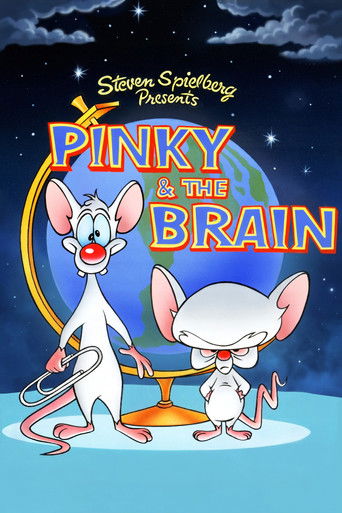
Pinky and the Brain
1995 · TV series · 21 min episodes · 4 seasons
AnimationComedyFamilyScience FictionFantasyKids
Pinky and Brain are genetically enhanced laboratory mice who reside in a cage in the Acme Labs research facility. Brain is self-centered and scheming; Pinky is good-natured but feebleminded. In each episode, Brain devises a new plan to take over the world, which ultimately ends in failure, usually due to Pinky's idiocy, the impossibility of Brain's plan, Brain's own arrogance, or just circumstances beyond their control.
3 positive7 neutralfrom 10 commenters
Where to watch
No streaming data for this title.
12 comments on Hacker News
I know this is really tangential, but one of my favorite lines from cartoons as a kid was from an episode of Pinky and the Brain and it included this kind of wordplay.
Their plan included forming a grunge band, which they called "Frog the Dry Widget" (a play on Toad the Wet Sproket).
I haven't thought about that episode of "Pinky and the Brain" in years, thanks for a chuckle.
It is simply unbelievable that the company was even able to get to the point of diving to such depths with humans aboard. If they had encountered a program-destroying but non-catastrophic failure earlier on, it is possible we wouldn't be looking at one of the many horrific outcomes that this incident will likely resolve to.
Looking at the accounts reported to date, the OceanGate engineering culture was basically non-existent. Their test program was extremely lightweight to say the least, and the results that came back from what little hull testing they did do were ignored, resulting in the dismissal of an internal whistleblower [1]. We also learned that there were flammable materials within the pressure vessel, no practical contingency plan to speak of, no emergency beacon fitted, the list goes on. The whole thing was just cobbled together, not fully thought out or vetted, and yet the intent was to journey to one of the most unforgiving environments imaginable.
But getting back to the account of the reversed motor above -- it is one of the purest examples I can now think of where life imitates art. Piloting a stolen (but seaworthy) deep-sea submersible to the wreckage of the Titanic -- that was only able to make right-hand turns due to a "sub club" anti-theft device -- was a major plot point in the pilot episode of the TV series "Pinky and the Brain". Narf.
[1] https://newrepublic.com/post/173802/missing-titanic-sub-faced-lawsuit-depths-safely-travel-oceangate
>> “I probably won’t put a lot of time into machine learning efforts,” he said, “because although machines can learn, they can’t yet explain to us what they have learned.”
So, as usual with the use of deep learning in the sciences, we had a lot of data that we couldn't understand, then we built a model that represents the data, and now we have a model that we can't understand.
I continue to be reminded of that early Pinky and the Brain episode:
The Brain plans to use a "growing ray" (originally a "shrinking ray") to grow Pinky into super-size while dressed up as Gollyzilla, while Brain would turn himself gigantic and stop him, using the name Brainodo, in exchange for world domination. However, the real Gollyzilla emerges from the ocean and starts to rampage through the city, making Brain think that the dinosaur is Pinky. The episode ends with the ray going out of control and making everything on Earth grow, including the Earth itself, to the point that Pinky, the Brain, and even Gollyzilla are mouse-sized by comparison again.
https://en.wikipedia.org/wiki/List_of_Pinky_and_the_Brain_episodes#Season_1_(1995%E2%80%9396)
> And I sometimes wonder how often it's kind of like Pinky and The Brain where the real genius of the show is actually Pinky but he never gets any credit.
I found your comment generally thoughtful and interesting, but couldn't let this part stand. The P and the B episodes I remember were all about Pinky messing up Brain's plans. Is this true or do I have a serious case of the Piaget effect??
It's kind of like that episode of Pinky and the Brain where they finally are able to take over the Earth by convincing everyone who moves to a paper mache copy of the Earth a free t-shirt. People love free t-shirts.
I'm reminded of the following episode of Pinky and the Brain:
Brain plans to use a "growing ray" (originally a "shrinking ray") to grow Pinky into super-size while dressed up as Gollyzilla, while Brain would turn himself gigantic and stop him, using the name Brainodo, in exchange for world domination. However, the real Gollyzilla emerges from the ocean and starts to rampage through the city, making Brain think that the dinosaur is Pinky. The episode ends with the ray going out of control and making everything on Earth grow, including the Earth itself, to the point that Pinky, the Brain, and even Gollyzilla are mouse-sized by comparison again.
https://en.wikipedia.org/wiki/List_of_Pinky_and_the_Brain_episodes
Being able to train deep RL models on commodity hardware is only an advantage if there isn't anyone that can train on more powerful hardware (or if somehow training on more powerful hardware fails to improve performance with respect to your model). Otherwise, you're still just a little mouse and they have all the compute.
>> the unrestrained distribution of the technology is similar to spreading the blueprint of nuclear warheads.
There's an episode of Pinky and the Brain where Brain invents a magnification ray and gigantises Pinky and himself - so they're now giant rats [1]. They walk about some human metropolis, looming larger than skyscrapers and terrorising everyone. To cut the story short, Pinky happens and eventually the gun shoots everything in the world.
... so Pinky and the Brain are now normal-sized mice again. Or, well, they're giant mice, but everything in the world is also giant, so they're small.
I think of that episode during discussions of the dangers of AGI and how "democratizing" it will eliminate those dangers. The problem is that AGI, like nuclear weapons, is not an equalizing force only- it is also a very destructive force, and so there is the danger that any loon with access to it could blow us all to kingdom come (with nuclear weapons, for sure; with AGI, perhaps).
On the other hand, when nuclear weapons, or AGI, giant rays etc are not democratized we have the situation we're in today: only a few entities have access to them and they basically have free (military) reign... and there is still the danger that some loon might get to a position of power were they can push a button and -blamo.
Which is why people are really worried about this sort of thing. Because once certain discoveries are made, there's no going back and at the same time the road ahead is full of danger.
[1] https://www.youtube.com/watch?v=-fPcqu5aMyw
Pinky and the Brain reference.
"Pinky: Gee, Brain, what do you want to do tonight? Brain: The same thing we do every night, Pinky - try to take over the world"
https://www.youtube.com/watch?v=e_mPrhwpZ-8
Pinky and Brain are genetically enhanced laboratory mice. In each episode, Brain devises a new plan to take over the world which ultimately ends in failure
> 90s sitcoms used to always entertain
They lost me in the 80s (I watched a ton in the 70s).
Never could manage to go back.
Edit: I came up with two exceptions
1. Jon Stewart 2. Pinky and the Brain.
For different reasons, both of those could get me to turn on a TV.
Don't forget Chip n Dale: Rescue Rangers, Gummy Bears and Tailspin.
On the Warner Brother's side, Animaniacs, Tiny Toons, Pinky and the Brain are almost as good as the original Looney Tunes (which I also loved as a kid and still do).
I know Looney Tunes was originally geared towards adults (as short films before movies), but grown ups and kids alike love them. I've recently gone back to watch the classic Looney Tunes[1] and was surprised at how much satire was in them related to the 30s, 40s and 50s. It's the kind of stuff you would only really noticed if you studied the history of the era and are somewhat aware of the pop culture then. They were definently not meant for children, but the slapstick comedy and music draw in all audiences. Looney Tunes was my first real introduction to classical music. I would later go on to play Violin (probably somewhat influenced from Looney Tunes) for a number of years in school and still listen to classical music when I program quite often.
I don't know what happened to cartoons, but nothing seems to be interesting that's also geared towards children these days. Most just seem like some half-hearted attempt to educate children while attempting to be entertaining, instead of being entertaining and also subtly educating at the same time.
[1] http://en.wikipedia.org/wiki/Looney_Tunes_Golden_Collection
edit: elaboration
your iPhone or other new gadget won't be invented in years, months or weeks, but hours or minutes. A human brain simply can't keep up.
What would be the point of that? A Magic iPhone Box, one that coughed out new designs so quickly that humans couldn't keep up, would be throttled back. What's the point of filling up warehouse after warehouse with beautiful new iPhones -- each unique and special -- that we don't even have time to try out? It's a waste of material resources. Why even bother building the Magic Box in the first place? Or should we build another Box that can appreciate the iPhones for us, faster than the eye can see? Who's going to pay the fuel bill for all that?
In manufacturing theory there's a concept of balancing the line: the slowest step in the manufacturing process serves as the bottleneck, and the secret to maximizing efficiency is to let that bottleneck control the speed of everything else. It doesn't pay to produce a million nuts and bolts per hour if you're only using ten thousand per hour: You just pile up expensive excess inventory -- and if the inventory rusts, or the designers eliminate nuts and bolts in the next version of your product, you lose all that inventory.
Similarly, the pace of technological change is ultimately constrained by human timescales. We're the technologists. We're the ones who control the knobs. We now have machines that can play master-level chess faster than the eye can follow, but we don't let them do that -- we don't let them run day and night, filling up our hard drives with recordings of dazzling strategic moves that we'll never have time to see. Instead, we turn the machines down to our speed, and use the leftover processing cycles for something else. Or turn them off and save some precious energy.
If you've lost the distinction between the Terminator films and real life, or have watched too many episodes of Pinky and the Brain, you might believe that a smart machine could somehow take control of the knobs from the humans. But, really, it's hard to sneak up on seven billion people, no matter how smart a toaster you are. Particularly when those people control your supply chain.