 Hacker Cinema
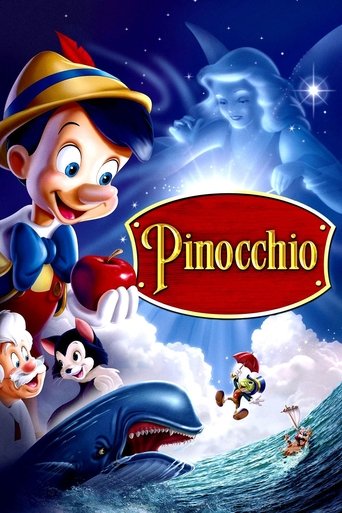
Pinocchio
1940 · Film · 88 min
Directed by Hamilton Luske, Ben Sharpsteen, T. Hee, Wilfred Jackson, Norman Ferguson, Jack Kinney, Bill Roberts
When the gentle woodcarver Geppetto builds a marionette to be his substitute son, a benevolent fairy brings the toy to life. The puppet, named Pinocchio, is not yet a human boy. He must earn the right to be real by proving that he is brave, truthful, and unselfish.
5 positive4 negative18 neutralfrom 27 commenters
Where to watch
No streaming data for this title.
29 comments on Hacker News
Would be be worse off as a society without Snow White, Pinocchio, Bambi, Jungle Book, Mary Poppins, the Herbie series, and any of the many more recent films?
If anything these films are a great example of why copyright terms should be long, because those films are still culturally relevant today, 60-80 years after they're made, and that people are still willing to pay for them over newer films shows that the creators and their families still deserve to continue to get royalties from them.
Sure, film companies often make a quick buck from sequels, but it's interesting that copyright on characters is distinct from copyright on works.
If anything it's surprising that you're arguing something other than the usual issue that's brought up around Disney, which is that their older works frequently took stories that were specifically out of copyright, and then they vigourously pursued copyright on the films they made from those stories.
>What work of Disney (company, not the man per se...) is more influential on the modern American Psyche (today, in 2026) than Ironman, X-Men or Spiderman?
All of them. None of those MCU movies really did anything to the "american psyche", forgettable entertainment.
And even if they had done, the question was "in terms of how Americans see themselves and how people around the world sees us". Nobody sees Americans in in 2026 the way Stan Lee or MCU saw them. Not even themselves. How they have been seen in general wasn't determined in 2026 or 2020 or 2000, but in the 20th century. And even how they're seen and see themselves in 2026 is not defined by the MCU either.
Concerning the general view on US, Disney movies (especially including Pixar) have had much more influence. But I mentioned other even more important things: Hollywood in general (pre-MCU, from early film to John Ford, and to Copolla and Scorsese), the western and the idea of the west/'frontier', rock n' roll...
>Sleeping Beauty? That's French. Beauty and the Beast? Also French. Great Mouse Detective? British. Alice in Wonderland? British. Pinocchio? Italian.
In their Disney treatment they're 100% American.
Pinocchio had definitely some sociopathic traits as a character. The Pinocchio movie by Walt Disney from 1940 is a masterpiece. Highly recommended.
Even the Disney Pinocchio movie is about telling kids to obey their parents, in ways that 2000s Disney movies probably wouldn't do.
I’ve never seen the Disney film. As a child I hated that story. My own children have no love for it either. If I was to guess, I’d say that there isn’t much of a character in that story to get behind and to empathize with as a child. Pinocchio is a selfish little shit. I can’t like him. As an adult I feel for his father’s desperation but even then I could never understand the story’s popularity appeal.
Walt Disney died in 1966. There were less but still many notable traditionally animated films (or films which blended some modern technology with hand drawn cels) since then.
The Jungle Book - 1967
Little Mermaid - 1989
Beauty and the Beast - 1991
Aladdin - 1992
Lion King - 1994
It's likely more a question of what you grew up with. When I was a kid I remember heavily disliking many of the earliest Disney animated movies like Pinocchio/Dumbo/Bambi but I absolutely adored the animated Robin Hood, Sword in the Stone, etc.
I hate to break it to you, but we continued that pattern of making up rules. The main difference is that we let lobbyists play a bigger role over time. The updated rules (life of the author plus 70 years) was passed in 1976, so I don't think they had global data networks in mind either. But perhaps you believe neither side has presented a persuasive argument.
I will however say that I think my comment was not just an appeal to authority. Again, I think the fact that using public domain works was critical to Disney's early success is a fairly important data point, especially considering some of those works would not have allowed to be used with the current lifespans (e.g. Pinocchio's copyright would have lasted until 1960, 20 years after the film premiered).
But again, the most important thing I want taken away from this is that we the "consumers" of the content should not consider ourselves bystanders, but understand that we do have an active stake here as well. You're first sentence is perhaps more important than you realize, making up the rules wasn't something one-off incidental property of being first to the table, we could choose to make up the rules too, so we should act like it, as opposed to trying to "deduce" the ownership of a sentence. This is unique, we don't have that ability with physical property. We can't simply declare that everyone gets Ferrari tomorrow and then have them magically appear in everyone's garage. But we could declare that everyone can have the rights to Superman tomorrow, and they would "magically just have them".
There's no real baseline here. We should just weigh the pros and cons. The fashion industry operates more or less copyright-free. The infrastructure to enforce copyright has real costs. Not to mention there is all the collateral damage from the abuse of copyright takedowns this system brings along with it. And any sort of appeal to authorship is also highly suspicious given that authors rarely end up owning these rights. Every time one of these Marvel movies comes out there's a mini outcry when people see the guy whose comic the movie is based on is just some dude who gets nothing from the making of the movie. On the flip side we take for granted that every public domain character was of course at one point created. Robin Hood, Zorro, Dracula, Sherlock Holmes. Are we unhappy with the diversity of adaptations we've gotten from these? Would it be that Earth shattering if Harry Potter joined that list? As things stand right now no one on this website will likely ever get to legally publish "their take Harry Potter". The clock doesn't start ticking until after JK Rowling dies. It would have entered the public domain 2011 under the original rules. In case you're curious, her net worth in 2011 was $500M, if you want to factor that into whether you think that would have been "fair" (and its not like she stops making money at that point, its just other people start to be able to do stuff with the first book). I think it is worthwhile to imagine a different approach to this.
It's not like this is a new thing at Disneyland or anywhere. When they opened, they sold your tickets in tiers, and that's when we coined the expression "E-ticket Ride" because they'd deem the most desirable, most exciting attractions as top-tier premium packages, and families on a budget would settle for less.
It was the abolition of these distinctions and the flattening of the price of admission that took a step forward. Since Disneyland's reputation had been established, they were more willing to let the patrons and fans decide which rides were the best and coolest, and inform future iterations of Imagineering.
By the way, to speak to the article itself, I've been reviewing "classic" Disney films and found significant occultism, a lot of "magick" and such ("Sorceror's Apprentice", "Pinocchio"); everyone knows the fairies and supernatural elements; some say that Disney has changed and Disney has lost moral character and is no longer suitable for children, but I suggest that Walt Disney's morality hasn't altered course since its foundation, when "Alice in Wonderland" was a drug-fueled sex romp written by an ephebophile; when Steamboat Willie was an arrogant bigot who violently pounded other animals into submission...
That's part of our struggle. We had an unexpected gift of $1,000 as an anniversary present from her parents. We have free childcare available anytime we want it. We had the entire summer of 2021 to find and go do something together that we could both enjoy. We didn't come up with anything.
We're compatible roommates, but we have very different languages of play. I like to explore, she prefers to stay home - if you gave her a choice of 'the same thing we did that you enjoy' or 'the new thing that you might not enjoy or is mildly inconvenient' - she'll choose 'the same thing' every time.
We've had kid-free Friday nights for years, we've only went for a 1 mile walk around the neighbourhood less than 5 times, never left our small town to go to something. Most date nights are spent sitting on the couch and failing at choosing a movie or show we'll both enjoy.
She did say I could pickout the movie once, no complaints. So I chose Airplane. She said, oh, I don't want to watch that - which then kills any Airplane related jokes you could ever make. Pinocchio was also rejected as being too weird. She'll watch entire seasons of TV shows, on her phone with headphones in, as she does work around the house. She made a reference once that a song sounded like the theme to XXXX show. She'd watched all 5 seasons and I'd never even heard of the name of it.
So, ya. Find things to do together has been well explored.
> It seems pretty telling that you didn't actually answer what should have been a simple question.
it is not.
I do think that a black woman can represent purity.
It simply doesn't fit the story as it has been written in the case of Pinocchio.
If you have to explain why things are the way they are, you're probably overthinking them.
Let's explore why the "representation era" is a smokescreen, shall we?
Imagine a no brainer: a black Tarzan.
There would be nothing strange about it, he's living in the jungle in Africa.
Except now you have to rewrite all his back story, because Tarzan is the son of a white British lord and his white British wife.
You can rewrite them too, as a black British lord and his black British wife.
Except now you also have to explain why in an all white community, the British lords, there is this odd couple.
Where do they come from?
How do they made it to becoming lords?
Are they black people living as white people or do they help the black community?
etc.
What's the problem?
The problem is that Tarzan was written by an American author of British Puritan ancestry, supporter of eugenics and scientific racism, beliefs that he used extensively in his books.
No matter how many black people they put in the story, they'll never be able to fix it.
They shouldn't adapt the story, they should write a new story or adapt a story where black people are already protagonists of the story.
That would actually mean something, but it wouldn't generate much attention I guess...
Less attention = less money (or a loss)
If Disney things that Pinocchio needs "fixing" they better leave it alone, because Pinocchio is a story from 150 years ago and it is not adherent to contemporary American standards in many ways.
Including the presence of a human eating monster fish.
See, simply putting "black person" in the cast doesn't add anything to any story,it doesn't improve representation, people don't actually feel more engaged, it's simple easy selling identity, but, tbf, it generate a lot of buzz, and buzz is all studios need right now, they won't admit they are remaking for the nth time an old story because are incapable of writing new ones, so they are distracting the audience with this silliness, hoping it will work.
Even Pixar is stagnating dramatically, take their Luca, directed by an Italian, set in Italy, I should feel oh so represented, but exactly because it plays with my culture trying to sell it to people who don't know it very well, I found it embarrassing.
The moral of this story is, I guess, that representation is overrated and there is much more to a movie than simply watching someone who looks like me for the sake of watching someone that vaguely looks like me.
> Ok, so is the portrayal in the 1940's Disney Pinocchio equally as outlandish considering she's just a white woman with blond hair? Would you be reacting the same way if they cast a white woman in the role?
Do you realize it is the same Disney both times, do you?
Two wrongs don't make a right.
> in which case the blue fairy already didn't have blue hair?
Yep.
Disney, being wrong since 1940s.
I wasn't born back then and we had no internet, but yeah, I prefer the Italian adaptation of Pinocchio with the blue fairy having blue hair.
> Because people like the Disney version of the story?
so there are times when cultural appropriation is actually OK?
As a member of the culture that story comes from, do I have a say or should I bow to the Disney overlords?
> The reality is that at least as a North American, nobody even knows it is an Italian story. We all know Pinocchio from our childhood. Nobody knows it’s Italian.
Yep, that is the problem.
USA is both pushing diversity and inclusiveness everywhere they can, while also using other cultures because "they don't know where things come from"
Which is cultural appropriation according to modern standards and it's neither inclusive nor helps diversity, it actually crushes it and make all the debates about recognizing the cultural differences as they exists look like white people complaining over minutia, or, even worse, racists that do not want women of color in movies or shows.
When It's actually the opposite, I want to see black people stories, not just black people participating in white people stories where they are not originally mentioned.
The reality is that at least as a North American, nobody even knows it is an Italian story. We all know Pinocchio from our childhood. Nobody knows it’s Italian.
So watching a Disney movie, I’m not watching an Italian movie featuring an Italian story, just watching Disney.
I’m watching a common fable. And in that case, I really don’t see why everyone HAS to be white.
Not asking to change the original Italian book here. But the reality of Disney as a global storyteller is that it became a lot more than an Italian story.
Yes, some were.
But Pinocchio (the 1940 Disney movie) was based on the 1883 Italian children's novel "The Adventures of Pinocchio" by Carlo Collodi.
Disney released it just after the copyright expired. (Copyright then was a 28-year initial term with a 28-year renewal = 56 years.)
And "Song of the South" (the 1946 movie) is based the Uncle Remus stories by Joel Chandler Harris published in 1881, so entered the public domain about 8 years before the movie.
I'm perfectly fine with a 56 year limit on copyright.
Recently an article on Bambi and how different the Disney version is hit the front page.
And now this, makes me wonder who the audience of early Disney movies was.
Sure they’ve watered down both Bambi and Pinocchio, but they couldn’t have had young children in mind when they decided to adapt such stories.
Don't forget about Pinocchio, who in the original Italian children's book is tortured and hanged for being such a "bad boy" [0][1].
0: https://en.wikipedia.org/wiki/Pinocchio#Fictional_character_description
1: https://slate.com/culture/2011/10/carlo-collodi-s-pinocchio-why-is-the-original-pinocchio-subjected-to-such-sadistic-treatment.html
The part of the movie where all of the boys on Pleasure Island begin to turn into donkeys always freaked me out as a kid.
>Disney doesn't own the rights to Pinocchio. You are free to make your own movie with book version of the the characters and the story.
This is very much an "in principle" thing. In practice, many of these traditional stories have (sadly) become synonymous with the Disney version, so Disney's work is basically the canonical version. This gives Disney a very good sword of Damocles to hang over the heads of anyone else trying to adapt these folk stories: to my understanding if you include a single copyrightable adaptation or embellishment of the original that was written by Disney without "prior art", you're liable to be steamrollered by the lawyer army and be ruined.
Disney doesn't own the rights to Pinocchio. You are free to make your own movie with book version of the the characters and the story. Carlo Collodi was dead by 1890 so Disney definitely didn't "swoop in" and benefit at his or his descendent's expense.
I believe the other stories you mention are even older.
Back then, their feature films weren’t money makers, as they didn’t make them.
Their first feature film was very profitable, but it was from about 15 years later (https://en.wikipedia.org/wiki/Snow_White_and_the_Seven_Dwarfs_(1937_film)).
However, their next two movies (Pinocchio, Fantasia) cost them money because they were released during World War Two, when they couldn’t show them in large parts of the world.
They needed Dumbo to make up for that (https://en.wikipedia.org/wiki/Dumbo#Box_office), then Bambi wasn’t a huge success, either (https://en.wikipedia.org/wiki/Bambi#Box_office)
So, I guess it wasn’t till after World War Two that their feature films became profitable. They survived, so chances are the shorts brought in money.
How many movies does your avg movie goer know or can name movies from the 40s? Maybe, maybe half a dozen (it's a wonderful life, casablanca, citizen kane, Disney Fantasia and Pinocchio, and his girl Friday. I'm pretty sure your average person can name an order of magnitude more video games from pong to mario to sonic to modern day AAA games. And over time, some will have staying power, like I hope Breath of the Wild will.
That's great! I'll be sharing that site with my homestay family, who have kids aged 6 and 9. On Monday this week I asked the older one to read a Wikipedia list of Disney films and Dreamworks Animation movies and here's the list she made, which you can compare with the ones on your site:
Alice in Wonderland; Toy Story 3; Incredibles; Pinocchio; Lion King; The Tale of Despereaux; Winnie the Pooh; Maleficent; Cinderella; Frozen; Frozen II; Moana; The Santa Clause; Coco; Pirates of the Caribbean; The Princess and the Frog; Brave 2012; Beauty and the Beast; Born in China; The Boss Baby; Abominable; Trolls World Tour; Gift of the Night Fury; Shrek (all); The Grinch; Book of Dragons; Kung Fu Panda; Puss in Boots; Dawn of the Dragon Racers; Marooned ; Prince of Egypt; Peter Rabbit; Aladdin 1992; Aladdin 2019; Shark Tale; Wallace and Gromit; Chicken Run; Bee Movie; Turbo 2013; Home 2015; Captain Underpants; Tangled 2010; Harry Potter; Despicable Me; Despicable Me 2; Minions; The Secret Life of Pets; The Little Ghost; Waking Sleeping Beauty; Cleopatra in Space; My Neighbour Totoro
The best Disney movies are in my opinion sublime artistic creations surpassing most "art movies" in quality and depth of the craft and art of visual storytelling. Just look at Bambi, Pinocchio or Fantasia. They also happen to be some of the most popular movies of all time. So I reject the premise that entertainment is in opposition to artistic or that popular means "lowest common denominator". And what is wrong with car chases and explosions? Some of the best films of all times have featured car chases and explosions. Just take the car bomb and explosion at the beginning of Touch of Evil - this is recognized as one of best scenes ever.
The problem with the Little Mermaid is that she is suffering all the way through and kills herself in the end, and then the story ends with the moral that every kid who misbehaves will prolong the suffering of this mermaids soul. I don't think even Lars von Trier could make that into a successful movie.
If you think about it this came about through laziness and to lower budgets, same deal with great programmers, programmers shouldn't want to do repetitive lazy work but innovate it away. Tedious work becomes a pain on time and budgets, so you innovate to do it faster/better.
Animators didn't want to draw all the backgrounds slightly moving and this allowed re-use and new innovations to make movies faster. This allowed animators to focus on the character cels and making characters look better, the main focus.
The multiplane camera with movable layers for parallaxing directly led to some of the best early Disney movies (Snow White and the Seven Dwarfs, Pinocchio, Fantasia, Bambi, The Adventures of Ichabod and Mr. Toad, Cinderella, Alice in Wonderland, Peter Pan, Sleeping Beauty and The Jungle Book) and helped their budget as well as made them look better. Plus at the time, it was actually an improvement that animators welcomed to speed up their tedious work.
That was the predecessor not the multiplane aspect of it with moving layers, definitely inspired it. Lotte mostly just used it to swap out colored backgrounds on her silhouette cel style to adjust placement and color.
A predecessor to the multiplane camera was used by Lotte Reiniger for her animated feature The Adventures of Prince Achmed (1926). Berthold Bartosch, who worked with Reiniger, used a similar setup in his film L'Idee (1932).
Ub Iwerks invented the multiplane camera with movable layers to create parallax and zooming [1] which created immersive depth. It also saved on budgets, tedious background animation and allowed animators to focus more on the character cels, the star of the show.
The first multiplane camera, using movable layers of flat artwork before a horizontal camera, was invented by former Walt Disney Studios animator/director Ub Iwerks in 1933, using parts from an old Chevrolet automobile. His multiplane camera was used in a number of the Iwerks Studio's Willie Whopper and Comicolor cartoons of the mid-1930s.
Fleischer Studios (Popeye/Betty Boop) also made one or copied in 1934 [1]
The technicians at Fleischer Studios created a distantly related device, called the Stereoptical Camera or Setback, in 1934. Their apparatus used three-dimensional miniature sets built to the scale of the animation artwork. The animation cels were placed within the setup so that various objects could pass in front of and behind them, and the entire scene was shot using a horizontal camera. The Tabletop process was used to create distinctive results in Fleischer's Betty Boop, Popeye the Sailor, and Color Classics cartoons.
William Garrity took Ub Iwerks invention further and that iteration was used in many large successful movies they made [1]
The most famous multiplane camera was invented by William Garity for the Walt Disney Studios to be used in the production of Snow White and the Seven Dwarfs. The camera was completed in early 1937 and tested in a Silly Symphony called The Old Mill, which won the 1937 Academy Award for Animated Short Film. Disney's multiplane camera, which used up to seven layers of artwork (painted in oils on glass) shot under a vertical and moveable camera, allowed for more sophisticated uses than the Iwerks or Fleischer versions, and was used prominently in Disney films such as Pinocchio, Fantasia, Bambi, The Adventures of Ichabod and Mr. Toad, Cinderella, Alice in Wonderland, Peter Pan, Sleeping Beauty and The Jungle Book
[1] https://en.wikipedia.org/wiki/Multiplane_camera
I don't think the target audience really matters. Film critics regularly cite Disney fare like Snow White, Fantasia, and Pinocchio as some of the best films ever made. Analogous lists of video games are pretty much required to have some Mario games on the list. Good is good.
You should look at the old Disney classics, they're scary. Pinocchio is super sketchy. I think this is what makes them interesting - kids like being scared too.
http://www.imdb.com/title/tt0032910/synopsis?ref_=tt_stry_pl
Well, his comment isn't that all the stories, or even or that Snow White specifically, were 40-50 years old. There are examples that better fit his argument, and they are not hard to find(I used wikipedia):
Pinocchio, released on 1940, was based on a novel from 1883, 57 years, then. Disney also tried to avoid Bambi copyright (book from 1923, movie released on 1942, 19 years difference), although the court did not uphold its public domain status.
He surely could have referenced better, but I do believe you should have tried to interpret better his comment instead of nitpicking and being unnecessarily aggressive.
It isn't just about "stealing." Allowing works to enter the public domain actually encourages more works to be created. People are free to remake and remix works in the public domain.
Think:
A REAL lot of old Disney movies (Alice and Wonderland, Jungle Book, Pinocchio...)
Pride and Prejudice with Zombies
That Romeo and Juliet movie with Leonardo DiCaprio and guns.
A Christmas Carol in play form (it lends itself really well to live theater, I suggest seeing it!)
West Side Story (inspired by Romeo and Juliet)
Clueless (based on Jane Austen's 1815 novel Emma)
The anime/manga Lupin III was inspired by the French gentleman thief Arsène Lupin, created by Maurice Leblanc. Japan didn't enforce copyright at the time of its creation but the Leblanc estate got mad once Lupin started being sold in North America. Some foreign releases changed his name as a result. In 2012, Leblanc's original Arsène Lupin entered the public domain in France
See this video for a different perspective: http://www.youtube.com/watch?v=tk862BbjWx4
Also read the copyright clause in the Constitution!
http://en.wikipedia.org/wiki/Copyright_Clause
Article I, Section 8, Clause 8 of the United States Constitution, known as the Copyright Clause, empowers the United States Congress:
To promote the Progress of Science and useful Arts, by securing for limited Times to Authors and Inventors the exclusive Right to their respective Writings and Discoveries.
"To promote the Progress of Science and useful Arts" is the goal and purpose of copyright, as written by the founding fathers, not "financially benefit" especially not forever.
I always wondered how old Pinocchio was. In that Disney movie he exhibited this behaviour, so now I know he was the human equivalent of between 4 and 5 years old.
>I know that Disney stops people from taking Walt's original concepts. But is that a bad thing? What concepts did Disney steal? None: he made his own. Other people can do that too.
This is completely wrong. Nearly every famous early work of Disney's was "stolen" from others. Among the more famous are Snow White (1937), Fantasia (1940), Pinocchio (1940), Dumbo (1941), Bambi (1942), /Song of the South (1946), Cinderella (1950), Alice in Wonderland (1951), /Robin Hood (1952), Peter Pan (1953), Lady and the Tramp (1955), Mulan (1998), Sleeping Beauty (1959), 101 Dalmatians (1961), The Sword in the Stone (1963), and The Jungle Book (1967).
The first iteration of Mickey Mouse, called "Steamboat Willie", was copied directly from Buster Keaton's "Steamboat Bill."
This is an excerpt from one of Lawrence Lessig's speeches about the topic: "It was a parody, a take-off; it was built upon Steamboat Bill. Steamboat Bill was produced in 1928, no [waiting] 14 years--just take it, rip, mix, and burn, as he did [laughter] to produce the Disney empire. This was his character. Walt always parroted feature-length mainstream films to produce the Disney empire, and we see the product of this. This is the Disney Corporation: taking works in the public domain, and not even in the public domain, and turning them into vastly greater, new creativity. They took the works of this guy, these guys, the Brothers Grimm, who you think are probably great authors on their own. They produce these horrible stories, these fairy tales, which anybody should keep their children far from because they're utterly bloody and moralistic stories, and are not the sort of thing that children should see, but they were retold for us by the Disney Corporation. Now the Disney Corporation could do this because that culture lived in a commons, an intellectual commons, a cultural commons, where people could freely take and build. It was a lawyer-free zone."
To address your second point, "the idea of capitalism" does not necessarily require giving anyone permanent, state-enforced monopolies of anything, no matter how well written it is. Any justification for copyright has to stem from a benefit to society. Strong arguments can be made for giving creators temporary monopolies of a limited scope, but permanent monopolies are bad for both innovation and the public.