 Hacker Cinema
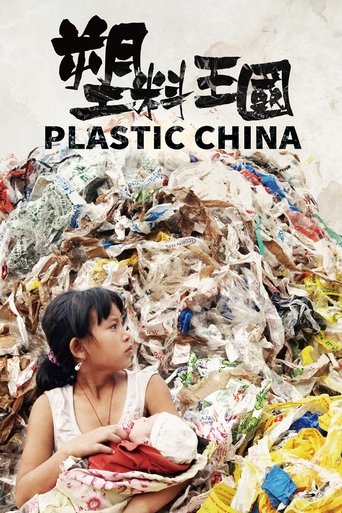
Plastic China
塑料王国
2017 · Film · documentary · 86 min
Directed by Jiuliang Wang
This film tells a story about an unschooled 11-year-old girl Yi-Jie, she's a truly global child who learns the world through the United Nations of Wastes while working with her YI minority parents in this recycle workshop thousand miles away from their mountain village home town
9 positivefrom 9 commenters
Where to watch
No streaming data for this title.
Videos commenters linked
From YouTube links in the comments below. Most are clips and trailers; “Full” means the uploader says so.




13 comments on Hacker News
Single-stream recycling was basically a greenwashing scam enabled by the ability of supply chains to hide where the product ends up. The plastics weren't being recycled; they were being shipped to China, where peasant children would sift through them for anything of value and the rest would be left in the fields. I'd recommend the documentary "Plastic China" for an expose on that; it's the reason that the Chinese government has banned new garbage imports:
https://www.cnex.tw/plasticchina
I highly suspect that recycling is in fact a terrible economic idea, and it's not at all cost effective to have people sort their garbage so it can be recovered for materials worth pennies anyway. The problem is that you cannot generally tell civilized affluent consumers that their consumption habits are going to turn this planet into the world of Wall-E, without them insisting we do something about this. The real product being sold was the myth of a sustainable future, just as it is with most other industries.
The Chinese used practically slave labour to sift through US garbage before they ended the imports. 'Recycling' was a euphemism for offshoring garbage whether plastic bottles or solar panels, but now the Chinese have tightened their standards.
2017 film 'Plastic China' trailer
https://youtu.be/jnNNnHTLjmg
As a documentary connoisseur, there are about 20 recommendations I could think of, but I'll give you my top 3: Tickled: Less of a "global problem" issue in and if itself, this is nonetheless expository of our time. Top rec.
Corked: there is no meritocracy.
Plastic China: Arguably the most important documentary film ever made in terms of impact on global policy/affairs
I remember when the film "plastic China" came out and blew the lid off this whole "industry". Looking back, I think it's in the running for one of the most impactful works ever produced on film.
We used to ship a lot of plastic waste back to China in what would be otherwise empty shipping containers. The movie "Plastic China" shows what the other end of that looks like:
https://www.amazon.com/Plastic-China-Jiu-liang-Wang/dp/B06XTWLBC7/
TL;DW: The producers find the cutest little girl in all of China, living in abject poverty amid toxic squalor.
The movie "Plastic China" is must-see, in my opinion. It is streaming on Amazon Prime:
https://www.amazon.com/Plastic-China-Jiu-liang-WANG/dp/B06XV925VL
You are absolutly right. To others seeing this comment, i‘d recommend you watch the Documentary named „Plastic China“. It is on YT, but you support the makers here:
https://www.plasticchina.org
We need to stop plastic polluttion now, or im afraid the earths ecosystem will collapse sooner or later.
The article doesn't mention Plastic China [1] the documentary that in some ways really prompted China to make this change.
1 - https://www.plasticchina.org/
Why aren’t films like the one mentioned in the article “plastic china” free to watch? They seem like a great educational piece to use but I tried searching and I had to purchase it — I understand the creators need to make money off this to survive but I think government should subsidize these films so they are free for the public to view
"Tickled" will absolutely blow your mind. It feels like you have a front-row seat to a real scandal in a way that no other documentary I've ever seen does.
All the "Dirty Money" episodes are pretty good, but the best one by far IMHO is the one about the racecar driver / payday loan scam empire. Just amazing.
"Plastic China" is really tough to watch (and may be even more deeply uncomfortable for people who pat themselves on the back for recycling) but I think it's one of the most important revelations in documentary filmmaking in the past 5 years or so.
> China is far and away the worst offender
Those data are from 2011, and at the time China was importing huge quantities of plastic from the entire world. This was documented in Plastic China[1], a censored[2] short film which rumor has it was instrumental in getting China to cut down on their mixed plastic imports.[3] I'd be curious how the situation has changed since then.
It's an important distinction. The plastic is coming from Chinese rivers, but that doesn't mean it originated from Chinese consumers. It just means China wasn't rich enough to box it up and ship it across the border (like was done to them).
[1] https://www.youtube.com/watch?v=ooRVhRt1p54
[2] https://www.nytimes.com/2017/04/28/world/asia/chinas-environmental-woes-in-films-that-go-viral-then-vanish.html
[3] https://news.ycombinator.com/item?id=1767769x8
>I don't understand why it's so hard ... we have machines that separate tiny seeds
Not hard, just expensive. And understanding how seeds are separated (not only that they are separated) makes it clear why plastics require so many more steps.
For seeds, it's a two-step process.
First comes threshing[1], which is the act of physically breaking the seeds off the plant. Basically they solved this problem by hitting the stalks against a solid surface. This works because all the plants are the same type and age, so you can dial in a force that will break the seeds _off_ without breaking them _apart_.
This won't work for plastics, because they're combined with all sorts of other materials that whacking won't dislodge. One shot of that "Plastic China" documentary[2] shows a worker using a box cutter to remove a plastic label that's shrink-wrapped around (not glued to) a crushed container.
The second step is called winnowing[3], and it's basically just blowing air through the falling seeds to separate them aerodynamically from the straw and chaff. This works because seeds have a higher ballistic coefficient (mass/drag). Winnowing is also done with screens or slats, relying on the fact that seeds are of uniform size.
But plastics have all different shapes and sizes. Wind winnowing can certainly be used as part of a processing chain (eg to separate films from bulk plastics), and so can screens, but they're nowhere near a complete solution.
Because of these complexities, automatically processing plastic at scale requires a lot more than just those two steps (which nowadays are combined together with reaping in the cleverly-named "combine harvester" or combine[4]). That means it's expensive, and that means someone in China with cheap labor and "externalized" pollution costs (read: make your neighbors get sick and die, but don't even have the decency to pay their doctor bills or keep their windowed spouses/orphaned children off the street) can outbid you.
[1] https://en.wikipedia.org/wiki/Threshing
[2] https://news.ycombinator.com/item?id=17678513
[3] https://en.wikipedia.org/wiki/Winnowing
[4] https://en.wikipedia.org/wiki/Combine_harvester
I highly recommend the documentary Plastic China. It is heartbreaking to watch the stories and struggles of the families that are filmed.
It’s available to stream on Prime video. It is a real eye opener for what happens next to some of the waste we throw into the recycle bin, long after we have forgotten about it.