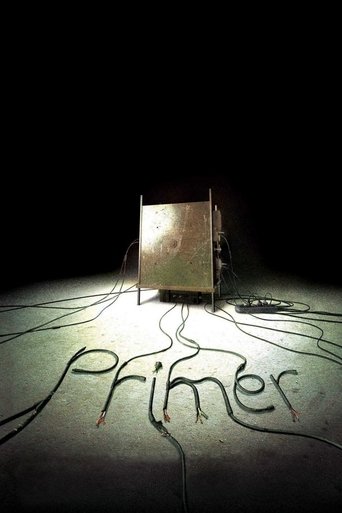
Primer
2004 · Film · 77 min
Directed by Shane Carruth
A group of fledgling inventors discover a complex method to manipulate reality. At first, they successfully game the stock market with it, but the consequences of the invention start to catch up with them.
154 positive6 negative4 mixed69 neutralfrom 233 commenters
Where to watch
No streaming data for this title.
267 comments on Hacker News
I don’t watch many movies due to time but those I do watch tend to be odd, unusual, experimental, and sometimes polarizing.
A recent one I enjoyed was Rabbit Trap, a modern take on faerie lore. It was polarizing and got poor reviews.
Years ago I adored a two season series called Hellier. I have a hard time describing this. Ghost hunting show for thinking people? You have to suspend disbelief but it reminded me of Primer in terms of a lot achieved on little budget. If you want to see some hipsters try to use transcranial magnetic stimulation to talk to aliens this is for you.
I’ve enjoyed some horror for its tendency to subvert tropes: hero to villain, villain is really hero, everybody dies, etc.
But yeah. I can only watch blockbusters if I’m in a certain kind of mood where I want light entertainment with no thought.
I do definitely watch TV and movies from time to time. Really my beef is with social media. TV and movies as media, that's a wagon I just largely fell off of at some point.
I'll still watch a good movie, for sure. Interstellar, Primer, Coherence, Run Lola Run, The Big Short, Contact, Excalibur... But The Expanse, Project Hail Mary, The Martian... I enjoyed the books more than than the movies, and the movies were good. Still haven't read Contact, shamefully.
Good sci-fi has always been few and far between. I love sci-fi, but I also dislike a lot of it because a lot of it's not well written from a prose craft or character depth point of view. When it is, it's probably my favorite genre.
I feel like we're lucky to get one outstanding sci-fi book or series per decade.
I'll rattle off some notable books and films/TV (or in some cases both) from the last 20 years. Some of these overlap with other genres like horror, lit-fic, etc., but I consider them all sci-fi to some degree. Some are well known and some are obscure.
The Expanse, Europa Report, Moon, Primer, The Arrival, Never Let Me Go, For All Mankind (the unofficial Expanse prequel), Sleep Dealer (indie film that stuck with me), The Color Out of Space (2019 film of Lovecraft's story), Banshee Chapter, The Peripheral, Blindsight, Annihilation, I'm sure I could keep going...
This article made me think of Shane Carruth. He's best known for his debut film Primer, but his follow-up Upstream Color is very Malickean.
The push to expand repressive copyright laws because machines can learn from human produced text, code and art is going to hurt us all in the long run.
People usually say contemporary media sucks because of commercial pressures, but those commercial pressures and conditions wouldn't exist without the expansion of copyright.
Yes, giant studios are struggling to introduce new ideas like 1993's Jurassic Park. But that doesn't mean Shane Carruth (of Primer fame) can't. And he could have if Jurassic Park had been released any time between 1790 and 1900.
Our stilted media landscape is directly downstream of prior legislation expanding copyright.
Expanding copyright even more so that text / art that looks stylistically similar to another work is counted as infringing will, in the long run, give Disney's lawyers the power to punish folks for making content that even looks anything like Disney's many, many, many IP assets.
Even though Steamboat Willie has entered the public domain, Disney has been going after folks using the IP, https://mickeyblog.com/2025/07/17/disney-is-suing-a-hong-kong-company-over-their-mickey-mouse-line-of-jewelry/ / https://mickeyblog.com/2025/07/17/disney-is-suing-a-hong-kong-company-over-their-mickey-mouse-line-of-jewelry/
The "infringement" in this case was a diamond encrusted Steamboat Willie style Mickey pendant.
Questionable taste aside, I think it's good for society if people are able to make diamond encrusted miniature sculptures of characters from a 1928 movie in 2025. But Disney clearly disagrees.
Disney (and other giant corps) will use every tool in their belt to go after anyone who comes close to their money makers. There has been a long history of tension between artists and media corps. But that's water under the bridge now. AI art is apparently so bad that artists are willing to hand them the keys to their castle.
"Primer" is arguably the best time travel film made/written.
I know you were going for a BTTF reference, but a Primer (2004) reference would be a better fit for a VC forum.
https://en.wikipedia.org/wiki/Primer_(film)
If you enjoyed Upstream Color, I highly recommend checking out Carruth's previous project, Primer, if you haven't already. It's a movie that takes a dozen rewatches to make full sense of. Natural dialogue, organic cinematography, and no hand-holding.
Upstream Color was a great movie as well, it's a shame what happened between Carruth and Amy Seimetz.
- Ghost in the Shell (1, then 2)
- Children of Men
- Stalker
- Solaris
- Blade Runner 2049
- Devs (a brief tv show, but just one shot the whole series)
- Contact
- Under the Skin
- Paprika
- Annihilation
- Arrival
- Ex Machina
- The 5th Element
- The Substance
- Primer
- Tenet
- Upstream Color
- 12 Monkeys
- Her
I'm surprised it's hard to understand! I see it as like recommending a cult movie or book to people -- that's not an unusual thing to do, right? Like when you're talking about time travel movies and there's always that one person who pops up and says "OK, but have you seen Primer? You should see Primer!"
It can get tedious if you overdo it, sure.
GPT missed at least one:
Primer (2004) - Really good zero budget movie about the dangers of time-travel abuse.
I wasn't aware a script existed! I've been waiting for years to see the movie, being a huge Primer fan, though I understand it probably won't get made.
These are fantastic. Reminds me of the structures ("choruses"?) from "A Topiary" script by Shane Carruth (the same bloke who made Primer). The first act's "pattern-seeking" premise is great, too. I think anyone who enjoys films such as Aronofsky's Pi, Linklater, Kaufman, etc would enjoy at least skimming through the first act.
- Script: https://indiegroundfilms.wordpress.com/wp-content/uploads/2014/01/a-topiary-numbered.pdf
- Script Reviews: https://www.goodreads.com/book/show/17338551-a-topiary
- Trailer (Not sure if legit) showing the Strandbeest-like creatures: https://www.youtube.com/watch?v=16vaQ9Tv8Lc
Of the ~700 movies I've watched (not bragging, just context - actual movie buffs watch thousands by the time they're my age), those I happily rewatch are:
The Thing (1982)
Silence of the Lambs
Alien
Little Shop of Horrors (1986)
Young Frankenstein
Rocky Horror
Raising Arizona
O Brother, Where Art Thou?
Men in Black
Primer
But even those I've only seen a handful of times each. It takes a lot for me to want to watch/read/play something multiple times, as I'm the kind of person who always thinks, "but I could be trying something new, or getting something done".
"Primer"
https://www.imdb.com/title/tt0390384
"The Man from Earth"
https://www.imdb.com/title/tt0756683
Flashbacks to Upsteam Color (if anyone hasn’t seen it, it’s the other film from the creator of Primer).
American History X was pretty jarring for me. Fight Club too. More subtly: Primer, Upstream Color, White Oleander, The Virgin Suicides - those 4 films gave me a lot to think about as a young man.
Primer, one of the great time travel movies, also had a $7000 budget.
Both Primer and El Mariachi are excellent, excellent examples of how to make a quality movie on a tight budget.
I also watch movies multiple times! Typically it's several months or years apart, but sometimes it's more frequent. I remember the first night I saw Primer, right after it ended I started it all over again because I needed to understand. Unfortunately, the second watch did not provide as much clarity as I was hoping.
The 2004 indie film Primer is a very good take on this.
Another great small budget movie is Primer (2004).
It has one of the biggest Budget to Box office multiples I know of: ~120x ($7k -> $841k)
I use Stable Diffusion family models for innovative art products.
On a small scale, you have to professionalize ComfyUI’s development. My PR to make it installable and to make a plugin ecosystem that makes sense should not be sitting unmerged (https://github.com/comfyanonymous/ComfyUI/pull/298).
On a medium scale, CLIP is holding you back. I would eagerly buy a 48GB card to accommodate a batch size 1, gradient checkpointed LoRA-trainable model with T5 for conditioning. I want PixArt-a or DeepFloyd/IF with the SDXL dataset and training. I get I can achieve so much with SDXL on 24GB, including just barely a fine tuning, I understand the engineering decisions here, but it’s too weak on prompts.
On a large scale, I’m willing to spend a little money up front. In those conditions you can be far more innovative, you don’t have to make everything for $0. Shane Carruth didn’t make Primer for $0. I’m sure you’ve seen this movie, you get how astoundingly good it is. But he still spent something. He spent only slightly more than an RTX 6000 Ada.
Innovators have budgets. It’s still worth releasing the most powerful possible model for expensive hardware, this is why everyone is talking about Mixtral, but it’s especially true of visual art.
It's a drug-fueled, vision or dream which to me makes it great. Neither movie has any qualities I like in scifi. Neither plays through interesting what-if scenarios and their impact on society. Blade Runner, Ex Machina or Primer are great examples of that.
In the movie Primer, a group of four friends start a small computer business on the side. Two of them later invent a sci-fi box and then dramatic shenanigans ensue.
Something I missed at first [1] was the significance of an event that happens early in the movie. They need to buy a $50 router because their existing one is broken. They have an impromptu meeting where one of the characters gives suggestions on how they could try to fix the existing router. The suggestions are all half spoken before being answered: "Did you try the ..." : "yes"; "well , how about resetting the ..." : "I tried that too". Clearly they're basically reading each other's minds because of how well they know each other and how much time they spend with each other.
But then comes the 'punchline'. One character says 'yes' to buying the new router. The other response with "I need an 'aye'". Their side business apparently has very strict rules about what words they need to use for voting on decisions. It doesn't matter that they all know each other so well that they're finishing each other's sentences. It doesn't matter that this is a $50 router. And it doesn't matter that their income from this side business is inconsequential. The rules say that they need an 'aye'.
My own theory with "Right Way Guys" is that some people have been able to find a lot of success by leveraging the knowledge that's stored in the hivemind of society. They don't really know what they're doing when you consider what's going on inside their skull. But they have successfully copied success up till now. The plus side is that they're able to inherit successful methodologies that have survived over time without having to do all the hard work themselves. The down side is that they literally don't understand when they're in a scenario where it will lead to failure. [2]
[1] - I didn't think much of this until I watched the director commentary. Where they explicitly talk about how they intentionally setup this interaction to showcase how certain characters took the rules too seriously and which ones didn't take them seriously enough.
[2] - My theory on my theory is that this is also why so many people encourage others to join in their favored cargo cult practice (be it software development or anything else). Social behaviors may or may not work, but the more people you can convince to follow them the greater the chance that when they fail catastrophically and/or fatally they're failing for someone who isn't you.
...also, author put Primer in the "Less Entertaining, Less Scientific" quadrant! "Entertaining" is obviously subjective, but I would argue that Primer is one of (if not the best) scientific, realistic representations of time travel in movies (if you subscribe to backwards time travel being possible at all - which I don't.)
Filmed in an actual university by the look of it. It's funny how low budget films sometimes look more realistic than big budget ones, because they can't afford to build sets, and have to use the real thing. The brief biology lab scene in Primer is the same.
theres also movies like Primer (https://en.wikipedia.org/wiki/Primer_(film)
which shows what can be create with minimal budget and crew. I heard a lot of the cast also doubled as backstage workers during the shoot.
Seconding Coherence. One of the greatest movies I've ever watched. Primer(2004) and Triangle(2009) are often recommended with it, and rightfully so.
Primer - https://www.imdb.com/title/tt0390384/
Generated content will never have social capital.
People not only watch Star Wars because it's a great movie. People watch it because other people do. They can discuss it, they can argue about it, they can share it. A teenager watches Serbian film to show off how badass he is, or Primer to show off how smart he is, plays Dark Souls to show off his skill.
With generated content, you don't have those qualities. I'm actually working on one project like this, and it's a great challenge.
Consuming media may seem like "single player" game when you just sit and watch it, but it's never really is.
If you haven't watched the movie Primer yet, you may enjoy it.
> (old enough that I should be shot according to the movie Primer)
I think you mean Looper! Both are great movies though
And Primer…
https://en.wikipedia.org/wiki/Primer_(film)
Not sure if this a common joke in the industry or you're actually quoting the movie Primer
That totally depends on what you're looking for. Some of my favorites are
- Primer (academic subjects)
- Linking your Thinking (tutorials for Obsidian)
- Stuff Made Here (Entertaining and impressive robotics projects)
- a life engineered (all sorts of career advice stuff)
- Reducible (animations of CS subjects)
- ByteByteGo (short and informative videos about system design)
- Wolfgang's Channel (all sorts of home networking/selfhosted videos)
- Jack Rhysider (entertaining and informative podcasts about cyber security and cyber crime)
- Dark History (disaster documentaries)
There's a lot of great picks here, such as Gattaca, Man from Earth, Contact, The Matrix, Wall-E, Children of Men, The Fifth Element, 12 Monkeys. I would add Truman Show.
Depending on the individual and their patience, Primer (2004) might also be a great fit. The pace is a bid subdued but thematically, it's mind bending. I don't think it includes anything particularly awkward as an early scifi movie to watch together with your own child. I would probably start with one of the spectacles from the above picks, though.
> He found 2001: space odyssey kind of slow and tedious
So do most adults. That and bladerunner are probably the two slowest sci fi movies in the canon (i love them, but they are high effort watches). Maybe literally anything else.
That said, i'd suggest trying to find out what aspect of the books he reads that he likes and go from there. We all read books for different things, and it helps to know what parts the kid likes.
Maybe the expanse tv show is a safe bet (i thought it was better than the books, but that is just me)
If he really likes the unitended technical consequences aspect of asimov, primer might be good, although the plot is very complicated. Predestination is also good.
What I don't understand about the movie business is the cost of making them. The most important ingredient to the success of a movie is the plot. We've all seen low budget movies that made lots of money - because of the plot. Casablanca, Psycho, Blair Witch Project, Cloverfield, Primer, ...
Star Trek TOS was a very low budget affair, and produced excellent results, because they hired the best scifi writers. When they threw money at the Star Trek movies, they were all terrible.
It's the plot that matters. Nothing else.
The milestones (from the source code):
//<10 seconds 'A single frame of a film': 100ms, 'It would take light to go around the Earth': 133ms, 'A blink of an eye': 400ms, 'The time it takes light to reach Earth from the moon': 1255ms, 'The fastest Formula 1 pit stop': 1820ms, 'The fastest 1/4 mile drag race time': 3580ms, 'The fastest Rubik\'s cube solve': 4221ms, 'The fastest 40-yard time at the NFL Combine': 4240ms, 'The fastest 1 liter beer chug': 4370ms, 'A skippable Youtube ad': 5000ms, 'A full bull ride': 8000ms, 'The fastest 100m sprint': 9580ms, //10 Seconds 'The Wright Brothers first flight': 12000ms, 'The fastest 200m sprint': 19190ms, 'The fastest 50m freestyle swim lap': 21300ms, 'The Westminster Kennel Club dog agility record': 28440ms, 'A typical television ad': 30000ms, 'The fastest NASCAR lap at Daytona': 40364ms, 'The fastest 400m sprint': 43030ms, 'The fastest NASCAR lap at Talladega': 44270ms, 'The fastest 100m freestyle swim lap': 47050ms, //1 Minute '"Just a minute"': 60000ms, 'The fastest Formula 1 lap at Monaco': 74260ms, 'The fastest Formula 1 lap at Monza': 81046ms, 'The fastest 800m sprint': 100910ms, 'The fastest 200m freestyle swim lap': 102960ms, 'The fastest Kentucky Derby time': 119400ms, 'An NHL penalty box time for slashing, tripping, or holding': 120000ms, 'How long it takes to drive across the Golden Gate Bridge (without traffic)': 135000ms, 'The duration of the "Millenium Force" roller coaster': 140000ms, 'The longest Super Bowl national anthem': 156000ms, 'One round of a boxing match': 180000ms, 'The average song length on Spotify': 183000ms, 'The fastest 1,500m run': 206000ms, 'The song "Never Gonna Give You Up" by Rick Astley': 215000ms, 'The fastest 400m freestyle swim lap': 220140ms, 'The fastest 1 mile run': 223130ms, 'The duration of the "Steel Dragon" roller coaster': 240000ms, 'The duration of "The Beast" roller coaster': 250000ms, 'The song "4:33" by John Cage': 273000ms, 'The longest sky diving freefall': 276000ms, 'The Any% speedrun of Super Mario Bros for NES': 294948ms, //5 Minutes 'An NHL penalty box time for fighting': 300000ms, 'The average duration of a typical sky dive': 330000ms, 'The average time for a drive-thru order': 356800ms, 'The time it takes Jeff Bezos to make $1 million': 402000ms, 'The fastest race car lap around the Nurburgring': 403300ms, 'The time it takes light to reach Earth from the sun': 500000ms, 'The time it takes a rocket ship to reach outer space': 510000ms, 'A typical marching band show': 515000ms, //10 Minutes 'The length of the first space walk': 600000ms, 'The longest a human has held their breath (non-oxygen assisted)': 695000ms, 'The average duration of popular Youtube videos': 702000ms, 'The time it takes an average human to walk 1km': 710000ms, 'The fastest 5K run': 757350ms, 'The average time to bake a pizza': 810000ms, '1% of the entire day': 864000ms, //15 Minutes 'A typical commute in the United States': 960000ms, 'The fastest superbike lap of the Isle of Man TT': 1002778ms, "MLK's \"I Have A Dream\" Speech": 1020000ms, 'An average baseball inning': 1200000ms, 'The song "2112" by Rush': 1233000ms, 'The first angels to appear in the movie "Angels in the Outfield" (1994)': 1275000ms, 'An episode of The Office, Seinfeld, or Rick & Morty': 1320000ms, 'The time it takes to drive the entire Chesapeake Bay Bridge Tunnel': 1380000ms, 'The song "Octavarium" by Dream Theater': 1440000ms, 'A typical Super Bowl halftime show': 1500000ms, 'The fastest 10K run': 1584000ms, 'It takes for Bobby Boucher to get his first game snap in the movie "The Waterboy" (1998)': 1719000ms, //30 Minutes 'The average time to bake a cake': 1950000ms, 'The time it takes until the launch in the movie Apollo 13 (1995)': 2081000ms, 'It takes WALL-E to arrive at the Axiom in the movie "WALL-E" (2008)': 2164000ms, 'The shortest war in history (Anglo-Zanzibar War)': 2280000ms, 'It takes Harry Potter to arrive at Hogwarts in "Harry Potter and the Sorcerer\'s Stone" (2001)': 2381000ms, 'The album "Thriller" by Michael Jackson': 2539000ms, 'The album "Dark Side of the Moon" by Pink Floyd': 2589000ms, 'An episode of Breaking Bad, House, or Firefly': 2640000ms, 'The boot camp sequence in the movie "Full Metal Jacket" (1987)': 2730000ms, 'The album "Abbey Road" by The Beatles': 2823000ms, 'It takes Simba to become an adult in the movie "The Lion King" (1994)': 2849000ms, '10% of a typical work day in the United States': 2880000ms, 'The album "Kid A" by Radiohead': 2996000ms, 'The time limit for the essay portion of the SATs': 3000000ms, 'The time it takes a standard ice cube to melt at room temperature': 3150000ms, '0.01% of an entire year': 3155692ms, 'The album "Fearless" by Taylor Swift': 3221000ms, 'The time it takes for the basketball game to start in the movie "Space Jam"': 3222000ms, 'An episode of Game of Thrones, True Detective, or The Sopranos': 3300000ms, 'It takes Harry and Lloyd arrive in Aspen in the movie "Dumb and Dumber" (1994)': 3394000ms, 'The album "Jagged Little Pill" by Alanis Morissette': 3443000ms, 'The fastest half-marathon': 3451000ms, //1 Hour 'An episode of Top Gear': 3600000ms, 'The inception of Robert Fischer begins in the movie "Inception" (2010)': 3847000ms, 'Riding the longest subway line in NYC from Queens to Inwood': 3900000ms, 'The time it takes Jeff Bezos to make $10 million': 4017600ms, 'It takes before Sean Connery says "Welcome to the Rock" in the movie "The Rock" (1996)': 4022000ms, 'A flight from Syracuse to New York City': 4140000ms, '5% of the entire day': 4320000ms, 'The album "Goodbye Yellow Brick Road" by Elton John': 4580000ms, 'The album "Scenes From A Memory" by Dream Theater': 4626000ms, 'The movie "Primer" (2004)': 4740000ms, 'It takes to fully charge a Tesla (at 440V)': 4788000ms, 'The ferry duration from Long Island, NY to New London, CT': 4800000ms, 'The movie "Toy Story" (1995)': 4860000ms, 'A drive from Syracuse, NY to Rochester, NY (87.5 miles)': 4920000ms, 'The movie "The Lion King" (1994)': 5280000ms, 'The longest State of the Union address': 5280000, //Duplicate time... //1.5 Hours 'The movie "Mony Python and the Holy Grail" (1975)': 5460000ms, 'The movie "Monsters, Inc." (2001)': 5520000ms, 'An average duration of a soccer game': 5700000ms, 'The movie "Reservoir Dogs" (1992)': 5940000ms, 'The longest Innaugural address': 6300000ms, 'A drive from Orlando, FL to Tampa, FL (84.6 miles)': 6660000ms, 'An SR-71 flight from New York City to London': 6896400ms, 'The movie "Alien" (1979)': 7020000ms, //2 Hours //'25% of a typical work day in the United States': 7200000ms, 'The average duration of an NCAA basketball game': 7200000ms, 'The movie "Star Wars: A New Hope" (1977)': 7260000ms, 'The fastest marathon time ever ran': 7299000ms, 'The time it takes to listen to every studio album by Nirvana': 7667000ms, 'The movie "Dogma" (1999)': 7680000ms, 'The average duration of an NBA basketball game': 7860000ms, 'The movie "The Matrix" (1999)': 8160000ms, 'The movie "Fight Club" (1999)': 8340000ms, 'The movie "The Shawshank Redemption" (1994)': 8520000ms, 'The movie "Forrest Gump" (1994)': 8520000ms, 'A drive from New York City to Philadelphia (94.6 miles)': 8520000ms, '10% of the entire day': 8640000ms, 'The movie "Inception" (2010)': 8880000ms, 'The movie "Avengers: Infinity War" (2018)': 8940000ms, 'The movie "Pulp Fiction" (1994)': 9240000ms, 'It takes Voyager 1 to travel 100,000 miles': 9360000ms, 'The movie "Avatar" (2009)': 9720000ms, 'The average duration of an NHL hockey game': 9750000ms, 'The movie "Saving Private Ryan" (1998)': 10140000ms, 'The movie "The Godfather" (1972)': 10500000ms, 'The movie "Lord of the Rings: The Fellowship of the Ring" (2001)': 10680000ms, //3 Hours 'The average duration of an NFL football game': 10800000ms, 'The total time limit of the SATs': 10800000ms, 'The movie "Avengers: Endgame" (2019)': 10860000ms, 'The average duration of an MLB baseball game': 11280000ms, 'The time it takes for a standard ice cube to freeze in a freezer': 11700000ms, 'The movie "Titanic" (1997)': 12600000ms, 'A drive from Boston to New York City (215.9 miles)': 13560000ms, 'Alex Honnold\'s free solo climb of El Capitan': 14160000ms, //4 Hours 'Half of a typical work day in the United States': 14400000ms, 'The flight time from New York City to Los Angeles': 19800000ms, 'The time limit of one session of the Bar exam': 21600000ms, 'It takes Voyager 1 to travel 250,000 miles': 23400000ms, 'The fastest swimmer to cross the English Channel': 24900000ms, //>8 Hours 'A full typical work day in the United States': 28800000ms, '0.1% of an entire year': 31536000ms, 'The time it takes Jeff Bezos to make $100 million': 40173000ms, 'The time it takes to assemble a car': 57600000ms, '1% of an entire year': 315360000ms, 'It takes for the Lōʻihi volcano to rise above the surface of the ocean becoming a new Hawaiian island': Number.MAX_SAFE_INTEGER //285,616 years
Some classify Truman Show as sci fi.
And depends on what you mean by "supernatural". There are many many movies without magic, but with possible future inventions. The category of hard scifi.
Europa report, primer, deep impact, robocop, starship troopers, blade runner, matrix, eternal sunshine of the spotless mind, total recall, arrival, Jurassic Park, the man from earth, ...
But yeah, Gattaca is still my favourite movie.
Cypher - https://www.imdb.com/title/tt0284978/
Primer - https://www.imdb.com/title/tt0390384/
Quiet Earth - https://www.imdb.com/title/tt0089869/
Primer (2004) is good time travel movie too. Low budget that was written, directed and acted by the same few people if i remember.
If copyright laws were removed, would we still have movies that cost $200 million to make? Probably not. Do we really need them? Not really. Cheaper movies would still be made, though.
I've seen a lot of low budget movies that were better than the $200m ones. I don't need special effects to enjoy a movie, I need a plot. Check out "Dark Star", made for $50,000. It's far, far better than 95% of the scifi movies out there. Because it had an interesting plot. "Primer" is another example.
Not quite to the same level of technical complexity, but this short story about the horrors of mind upload is formatted like a future-Wikipedia article [0]. qntm, its author, is a great source of... outsider art science fiction? His written work feels similar to the movie Primer, which was created by engineers without much formal training in filmmaking; namely, it's impressive and imaginative and well-polished, but obviously without the mien and certain stylistic elements of those who learned the "rules" of the medium by rote rather than derivation and imitation.
[0] https://qntm.org/mmacevedo
This type of discussion comes up every once in a while and there are always a couple points that circulate in the discussion:
1. "It's not the tools, it's the artist."
2. "But tools matter."
I would love it if we could skip rehashing the obvious stuff. Yes, obviously, tools matter. However, there are a lot of loud people online (and lout people you meet in person) who spend hours hashing out the pros and cons of different tools, why tool X is awful, why tool Y is underrated, why "pros" use tool Z, tool W is overpriced and outdated, and tool Q is missing features A and B which should really be considered "standard" nowadays.
These discussions are valuable because tools matter, but people will also lose sight of the fact that tools are only one part of the picture. Novices, especially, sometimes focus on getting better tools or working on their tools instead of working on their craft. It's nice to see examples of very successful projects made with simple tools on a low budget to remind us that we can work that way too, and remind us that our low-end tools aren't really holding us back--that much.
Some examples of films shot on small budgets:
- Blair Witch Project ($60k)
- Clerks ($28k) (B&W not because the film is cheaper, but so they don't have to get lighting equipment)
- Primer ($7k)
I'm just hoping we can skip the "tools don't matter" "yes they do" back-and-forth. Nobody really believes that tools don't matter at all, people just get caught up in arguing about how much tools matter, or what the right way to communicate that is.
Same thing also happens with photography. I recently saw a photography exhibit where all of the photos were shot on an iPhone. Same thing happens with music. Some famous artist recorded an album with a Telecaster and a Supro because they were cheap and sounded decent. Some of your favorite songs were recorded out of the back of a van.
Think indie movies aren't worth watching? Primer.
Tbh, almost all of the recommendations I follow are word of mouth, so I'd really appreciate such an engine.
I don't think Primer is something everyone should watch. There's a specific audience for that movie and most people aren't in it.
The single novel (to me) idea I pulled out of that is the idea that distance is the inverse of entanglement.
So the hamming distance between states would also be the real world distance (in effect) That's a very interesting theory, that could go places. (No pun intended)
If this theory is correct, you might be able to modify spacetime within a superconducting container, as at least some of the electrons in them are in superposition. It's a small mass fraction, but could be a starting point. It true, there could be some basis to the plot of the movie Primer.
Also, Dimensional Engineering? Maybe you could shove an aircraft sized structure inside something the size of a phone booth... ;-)
Off topic, but you might enjoy aovie called primer. Super short, low budget film about time travel. It's got a convoluted, but consistent timeline and the fun of the movie is going back and watching it over and over to fully understand what's happening. It's really good
Here you go!
https://thecinemaholic.com/primer-explained/
https://unrealitymag.com/at-last-a-definitive-timeline-for-primer/
Or, as recommended here, watch again with the commentary found half-way down this page: https://www.kevinmuldoon.com/primer-film/
Hacker Culture, to me atleast is somewhat broad.
Here are some places where I found good representations:
1. Halt and Catch Fire: 70s/80s tech scene. Full stack hackers building products, companies. Depicts the hackers, code monkeys, visionary types, managers, financers- everyone. Also shows the transition of the business scene from analog to digital.
2. Westworld (Season 1 only) is brilliant. It depicts the ambition, the hubris involved in creating something new and grand.
3. The Travelling Salesman: P vs NP is solved. What are the implications, what are the uses, how will the State react? What is the role of the people imvolved?
4. Primer: Mind bending movie on time machine.
5. and 6. Imitation Game and A Beautiful Mind: I believe most people on HN will like these.
7. Agora is a hidden gem not many know about. It is anout Hypatia.
8. Dangerous Knowledge is a documentary about paradigm changing science. Godel, Turing, Boltzmann are covered.
9. Fractals is also a nice documentary with interviews from Mendelbrot.
10. Codebreaker is a mich more accurate biography of Turing that covers other aspects of his, not limited to his codebreaking and homosexuality.
11. Internet's Own Boy: The Story of Aaron Swartz: very nice and left a deep impression in me.
____
I am yet to watch:
1. Hidden Figures
2. Stand and Deliver
3. I'm In
4. TPB: AFK
5. Pirates of Silicon Valley
6. Triumph of the Nerds
____
Harvard Professor Oliver Knill has a list and clips from movies where math appears: https://people.math.harvard.edu/~knill/mathmovies/
____
I came to know a lot of these movies through Kagi search and Reddit search. "Best movies for mathematicians and computer scientists" and similar searches.
Yes, Primer! Have no idea what happened in that movie, but it was amazing.
It really gave a good reproduction of Silicon Valley corporate culture.
Hehe, this sounds like fun :) I should probably improve a bit at standard chess first, but I'll give it a try some time. Thanks for sharing!
An unrelated tangent: Have you watched Primer[1]?
[1] - https://en.wikipedia.org/wiki/Primer_(film)
True, to the extent that any 90 minutes of smartphone footage uploaded to youtube is technically "a movie". In order to be "a movie" in the sense that Evil Dead or Primer are movies, I would say you need a bit more than that.
I feel like CGI has increased productivity a lot. Not so much in big, effects driven movies, but in everyday type shots where they can change backgrounds or remove things so they don't need to make big elaborate sets or control environments quite so much. That's my guess at least. Film was also a huge cost of production and especially distribution that's essentially gone now. I think Hollywood unions also add a lot of jobs - look up the job of focus puller sometime.
On the other hand to all the expensive stuff - you can just not do those. I'd take Primer as an example. I believe it was shot for the cost of a Toyota Corolla and became a fairly significant film. I've also seen "low budget" movies (meaning $3-5 million or so) in the last decade or so that probably would not have been possible 20 years or more ago, so I feel like there has been some progress.
Have you been time travelling recently?
(https://en.m.wikipedia.org/wiki/Primer_(film))
> Clean Room Technician: You know what they do with engineers when they turn forty?
> [to Aaron, who shakes his head]
> Clean Room Technician: They take them out and shoot them.
Dialogue from the 2004 movie Primer.
My fear is the joke from the movie Primer:
- "How did you get over here?"
- "Do you know what they do with engineers when they turn forty? They take them out and shoot them."
I've read in other threads that the ageism fear is overblown, and also that it's not overblown at all.
My plan is to develop enough of a professional network (whatever that means) that I won't be doing leetcode problems for a twenty-five-year-old interviewer when I'm fifty.
Great suggestions here, many that I've either never heard of or never considered - I look forward to checking them out and please keep them coming, I'm hopeful this can turn into a masterthread to keep coming back and discovering motivational media.
Should maybe have done this earlier but adding a few of the ones I've already watched.
Technical Motivation:
- Silicon Valley (TV show, 2014-2019) - The Social Network (2010) - The Imitation Game (2014) - Halt & Catch Fire (TV show, 2014-2017) - Iron Man (2008) - Primer (2004) - The Martian (2015) - Hidden Figures (2016) - Flight of the Phoenix (1965 original or 2004 remake)
"Sales" Motivation:
- The Pursuit of Happyness (2006) - Door to Door (2002) - Underrated straight-to-TV film about a man with cerebral palsy who wants to become a door-to-door salesman - Glengarry Glen Ross (1992) - Pure sales, persistence and Pacino - Salesman (1969 documentary) (As above, but instead of Pacino it's real door-to-door bible salesmen and what they go through)
Honorable Mentions:
- Mr Robot (2015-2019): probably the most thrilling and technically accurate depiction of technology and hacking ever put to a screen, but as someone else said it's also very dystopian and depressing, and not too motivational except in the brief bursts that they show Elliot setting up a hack. Either way no VisualBasic GUIs here.
- Flash of Genius (2008): about the inventor of the modern windshield wiper who had it stolen from Ford and sued them. The premise is motivational, but I personally found it more of a cautionary tale on what you can lose for your principles when you go up against the giants.
I heard the 10:1 ratio a while ago, and for "Hollywood films". So I'm guessing on-film, but where film/processing budget isn't much of a limiting factor. Primer was released in 2004 so at that time most things would have been on film.
That said, I'm not in the industry, this is just what I've read about the production of Primer, so if your experience was of 2-3:1 that may be more accurate!
It was $7,500. $5,000 of that was the camera hire, $1,400 was the single paid actor (the rest were friends and family). The used expired film stock that a film company donated to the production. It was all edited in Premier Pro on a home PC. Shane Carruth wrote, directed, edited, composed, acted, produced, everything.
My favourite fact is that they only had ~80 mins of film donated to them. This meant they couldn't afford retakes. Normally there's a ~10:1 ratio of shot film to final run length. With Primer and their constraints, they storyboarded everything in such detail and rehearsed so much that they managed to shoot just 74 minutes for a 72 minute run length.
Primer, both for the discovery within the film and the fact they were able to make an aware winning, cult movie for like $70,000.
Thanks for that perspective! I think about this all the time, and though my tastes are different I think you're exactly right.
I think of narrative as a combination of several elements: character, plot, world-building, execution (word choice, visual choices and performance for film or games), concepts and ideas. I tend to be drawn to strong characters first, but not always. Some examples off the top of my head:
Clerks: strong characters, mediocre almost everything else
Reservoir Dogs: strong characters, strong execution, minimal plot and world-building
Portal: strong characters, plot, world building, concepts, and execution
Brazil (the Terry Gilliam movie): strong world-building and execution, weak characters and plot
Lolita (the book): strong execution and characters
Harry Potter: strong characters, world-building, and concepts, goofy plot and execution
Primer: mind-bending concepts, good execution, weak characters and plot
Don’t know why, but I could go on and on thinking about it.
Edit: this list would imply I have pretty narrow tastes but really I like a little bit of everything; these are just some notable examples that came to mind as being particularly strong or weak in certain areas.
Yes, Arrival was terrible and bloodless. The central conceit was what I called the sundered triforce but this tropes page calls the Dismantled Macguffin [1]. It was Villeneuve's first real stepping out into becoming whatever Hollywood needed him to be and it shows every step of the way.
> This is the easy way out. Revering the old is easy. In 40 years people will be saying how new films don’t compare to Dune (2021) or Blade Runner 2049.
Startlingly rare within our generation means what I say. I would expect there to be a strong corpus this round given film history but it defied my own expectations. That doesn't mean I don't think good examples exist just that they're, well, startlingly rare.
Upstream Color was courageous I'll give you that. But I think it took real moxy from Carruth to make it happen: he did the music, shot the film, wrote it, directed it, and starred in it and for basically no money just like Primer. And I think directors like Ana Lily Amirpour who did A Girl Walks Home Alone At Night are the courage we need to see. The problem doesn't appear to be a lack of directing talent so much that the media machine takes that talent and corrupts it absolutely.
Look what happened to Ridley Scott or Taika Waititi. They became owned and operated by the industries behind them which must ensure a broad appeal for the highest ROI. It's market forces at their most efficient at a global scale we've never seen before.
[1] https://tvtropes.org/pmwiki/pmwiki.php/Main/DismantledMacGuffin
You only chose older films to contrast with Dune (2021). Blade Runner being the newest at nearly 40 years old. It’s a lot easier to bring up old media. Be it music or movies. People revere the old, the classics.
Apocalypse Now, which is amazing, in my opinion, didn’t get amazing reviews upon release.
Fall from grace means you didn’t like Arrival too much either? I loved Arrival as I loved Sicario and Enemy.
> Alien or Blade Runner?
I love the concept of time so personally I enjoyed Arrival more than either of these. Same with Ex Machina, Annihilation, Primer, and Upstream Color. I also think these films are better too. I admit I must have a bias against glorifying the classics because of it being done so much. Obviously everyone has biases.
> There is good cinema within our generation but it is startlingly rare. Most of what makes it to the theaters is bloodless, drained of anything to say about anything at all.
Yes. This is the easy way out. Revering the old is easy. In 40 years people will be saying how new films don’t compare to Dune (2021) or Blade Runner 2049.
You said what makes it to theaters. Not wide release films. That would include a lot of indie and other films. In that case, I completely disagree. I believe it has gotten better. I get to see movies with a wider range with the easier access and technology for smaller films that get to be made. Same with music.
> A number of publications have labeled The Room as one of the worst films ever made.
From the wikipedia page.
> Normally, when I see the same name in all of the roles, I get nervous
I can see why. Lol.
But Primer is really good film. Ofcourse, you will have to checkout an explainer on youtube afterwards.
Two movies worth adding to the list are:
1. Perks of being a wallflower
Written and Directed by the Stephen Chbosky. It's originally a book written by Stephen. I think the movie is great because it's well directed and overall good coming of age film.
2. Primer
Cult famous mindfcuk movie. Checkout this xkcd comic (https://xkcd.com/657/) to see how complicated this movie is. The film was written, directed, produced, edited and scored by Shane Carruth.
Coincidentally, I also created Primer (https://primerlabs.io).
So if I put something in a superconducting cavity, and seal it closed, then put that inside a vacuum chamber, and magnetically suspend the whole thing, the contents of that cavity break off into their own reality until the container is re-opened?
Interesting idea, seems like part of the plot device of the movie Primer.
This is backwards.
And whatever this is, does not make sense to me.
1. You can just go to the show's subreddit and browse, or browse with filters such as top, hot, etc. And you can filter the time period.
2. You can use Google. This works great for me. Just type "the wire reddit" or "site:reddit.com the wire", and the first result will be the subreddit page, but if you scroll down, you will start to see threads from other subs as well. This way you can access more discussions outside of the dedicated subreddit.
____
In a more general note, you can find all sorts of different stuff by using Google to browse reddit this way.
I have watched quite a few really good movies by searching "your top 5 movies reddit", "your favorite movies reddit", or "best movies reddit". I just go through the past viral threads and find highly upvoted responses, or responses with some of movies I liked and some that I haven't watched.
I have discovered Clue, Primer, Hot Fuzz, Tropic Thunder, The Big Short, etc. this way.
My takeaway from Primer (perhaps my favorite movie) is that the confusion is the message of the movie. If a time machine existed, and was used repeatedly, it would become impossible even for the persons involved to maintain a clear understanding of what had happened and what was happening.
The great thing about Primer is that most of its important events don't even appear in the movie itself.
If you like Primer, I highly recommend Shane Carruth's other movie, Upstream Color. Very different from Primer, but similar in that both movies let viewers figure things out for themselves.
Primer has got to be the most baffling movie ever made, impossible to keep track of the timelines! Still an awesome movie!
It's a matter of setting up expectations and balancing that with good story telling.
Ambiguity, elision, out-of-order story telling, etc. are all part of art but it's a delicate balance. There's a contract that artists set up with the audience that will allow them to use these techniques. Primer is one of those where I'm OK with my confusion because the story was interesting without all the answers, and it was setup pretty early on that this wasn't an A to B story. On the other hand, the fade-to-black ending of The Sopranos was, in my opinion, a total violation of that contract. Nowhere did they setup that kind of ambiguity. Yes, it's a series vs. a movie but my point still stands.
No Country for Old Men, again IMO, rides that line a little close. Sure the Bardem character checks his boots at the end but there were some other major gaps that I don't think were set up. It was well acted and produced but expectations were not managed so it still goes into my meh pile.
When it works the it's a lot of fun figuring things out. I'll have to give The Big Sleep a try.
Edit: At the other end of the spectrum, expository lumps are no fun either.
A similar explanation, the "ideomotor effect," has been put forward for the Ouija board and several other divination techniques that sometimes seem to do better than chance or produce other kinds of "spooky" results.
The idea is that you have subconscious thought processes, sensory awareness, or knowledge, and when you put yourself into an observation/motor feedback loop this subtile cognition can influence fine motor responses which are then amplified by feedback as you observe your own movements. You're putting weak neural "noise" through a feedback amplifier, but the noise is not random and could contain information. There is no way to control for this because the test is not blind.
It's become popular in recent years to chase "chains of synchronicity." A very entertaining semi-documentary about this can be found here:
https://www.hellier.tv
There's even an app for it called Randonautica.
A very similar phenomenon could be at work in that. It might start with subconsciously biased paradolia and as you follow a "chain of synchronicities" you are running an amplification and filtration feedback loop similar to what happens when you watch a planchette move across a Ouija board or watch a dowsing rod move. You've grabbed a set of weak neural signals and amplified them.
It's not supernatural but it might be neurologically and cognitively interesting. I've had the intuition for a long time that all creativity probably involves processes like this. An artist or a musician doesn't just emerge with a fully formed work from nowhere. They "noodle around..."
BTW...
Hellier is a great bit of independent film. I've compared it to the cult sci-fi film "Primer" in terms of quality, originality, and creativity on a shoestring budget, and if you liked that film you'll probably like it. Also heard it described by someone as "like Ghost Hunters or Paranormal State but for thinking people." It's a fun ride if you suspend disbelief. There's a scene in season two where a practicing witch uses a transcranial magnetic stimulation device to try to talk to aliens. It's worth it just for that, gives it a hint of "post-cyberpunk."
Edit:
Has anyone ever experimented with these techniques as a cognitive or creativity enhancer without the "woo woo" assumptions? Treat it like a brain hack to get at subconscious thought processes, sort of like what you can do with psychedelics but without the drugs.
Yeah, Arrival fits well and I enjoyed it. There are a number of lower budget films you could add to that list like Primer, Moon (2009), or Gattaca. Ex Machina is sci-fi + drama. I'm sure there's plenty more. There's just a tendency for sci-fi films to lean heavily into action (or occasionally horror) like The Martian film did when compared with the book.
Jurassic Park feels more action/horror focused to me, but it has a sci-fi premise.
If you enjoy time travel movies, Dark on Netflix is an incredible series. Easier to follow then Primer, but I still needed diagrams once the second season really got going
Primer!!! Still one of my all time favorite movies. Glad to see it at number one on the list.
Promoting Primer as anything but a movie about "A Startup company struggles to get off the ground" is a massive spoiler.
I went in uninitiated and it didn't fully click until the binoculars came out. It made the rest of the movie an absolutely insane ride.
It's a shame people have normalized talking about its premise in the first sentence.
I loved primer. If you like time travel movies (and if you are on hackernews the chances are high you do), definitely give this one a watch. It is definitely among my favorites. It is an awesome film which goes to show low budgets can go a long way with a great script.
If you liked Primer, the film "Timecrimes" does an excellent job at the physical consistency of time travel.
Glad to see Primer as the first movie mentioned.
Primer is perhaps the best time-travel movie I’ve seen.
Have they accidentally invented time travel yet?
https://en.wikipedia.org/wiki/Primer_(film)
Their $600 camera links to a search which produces 4K body at $1200 as the cheapest camera option... Maybe it once included an 1080p one, but it does not at this point.
Relevant:
"Primer" won many rewards on a similar budget ($7K)
"House" had an episode shot entirely on a Canon 5D (A $2000 camera at the time, IIRC; however, the production likely cost >$1M per episode at the time)
That's interesting. Slightly off topic, but this seems to reveal a small error in the movie Primer.
The two main characters travel back in time one day to use their knowledge of the stock market to make money on some good trades. Their doubles are of course also in the past, so they make efforts to avoid them at all costs so that they don't interfere with causality.
One of the characters mistakenly brings his cellphone with him back in time. When his wife calls, they assume that since the his phone is ringing that the double's phone couldn't be ringing, so he decides to answer it and pretend to be at work as his double is.
In reality it seems both phones would have rung?
It isn't explained, which is my main fault with Primer. Primer leads you in with a crystal clear beginning that makes sense, but goes off the rails by the 2nd half.
A lot of people are tricked by the crystal clear beginning and assume that the end makes sense, but the movie goes into ambiguous mode about half-way through. Its audience interpretation, as opposed to a singular answer. (Contrast with something like Inception, which doesn't really have more than one interpretation).
Some people like ambiguous movies. I don't, which is why I kind of prefer Stein's Gate, where all actions are clear.
---------
Either way, its clear that the powerful organization is Aaron's goons. Aaron was the guy who played the stock market with the time machine, so its obvious that Aaron used the time-machine for ill-gotten gains at that point... and is using the money to fund a bigger time machine.
> OK. So they're planning an invasion of the past?
No, you can only go back to the point where you start the time machine. Secondly, its Aaron, so its probably his private corporation running the new machine. Aaron is the one who is manipulating the stock market and in it for the profit.
Its the "success" story for Aaron, he rebuilds a bigger time machine, but with the power of a corporation / large money backing him now (probably funded from repeatedly winning in the stock market). Aaron cannot stop the original experiment or otherwise travel to the past, but he can make money in the future.
------
There are roughly 3 machines you need to be aware of.
1. Machine #1 is what the movie is mostly about.
2. Partway through the movie, Machine#2 (failsafe) is revealed. The main character turned on the failsafe simultaneously with Machine #1, so if the time-travel got too confusing, he could always go back to the beginning and turn off Machine #1, cancelling the entire experiment.
3. The other main character, reset Machine #2. Instead of sending you back to the beginning, it now sends you to Day2 or so, preventing the change of the early days.
4. The conclusion, where Machine #3 is revealed. There was no leadup to machine#3, its just a bit of closure for the greedy Aaron.
-------
The movie goes off the rails and really stops making sense. I've put a lot of effort into trying to understand what they were going for... and ultimately came to the conclusion that Stein;s Gate is just a better thought out time travel plot.
I give Primer credit for being a relatively consistent time-travel movie with more thought put into it than the average time-travel timeline. But the ending is still in the "audience's hands", and still leaves ambiguity for the audience to figure out on their own.
A lot of actions in the middle of the movie don't seem to have any relevance to other events. The father (Thomas Granger) randomly coming in through the time machine but unconscious for example. While it is clear that Thomas Granger is from "some future timeline", such an interpretation naturally conflicts with the Primer theory thus far (which has no "multiple timeline", everything should be consistent)
There is also an Aaron clone running around, but it isn't really clear from what time the time-clone is from.
Primer is a movie that while it has a time machine it really explores the personal and social implications and complications of time travel.
Using time travel as a plot device versus using time travel to explore part of our humanity is a mark of great science fiction.
I wouldn't really call it better, they operate on different scales. Primer is much less bombastic and doggedly grounded to reality, which is really an anomaly in sci-fi media. Failure of the protagonists in Primer does not mean a World War 3 will happen or the planet will be destroyed, the biggest stake in the movie is one of the characters getting shot at their birthday party by an ex.
Personally I find this much more refreshing than the usual the-world-will-collapse scenarios. It's easily one of my favorite films, just because of how different it is than it's ilk, I've yet to find something like it again.
> Stiens;Gate is the only time traveller story that I know that establishes rules for time travel early on and actually sticks to these rules till the end.
There's also Primer, but Stein's gate is better than that movie.
You might enjoy the movie Primer [0].
[0] https://www.youtube.com/watch?v=x_HHnXeMWT0
Everyone in this thread should try Primer! Great little movie about a similar concept (smaller in scale though). Tries really hard to stick to its own rules.
From Primer (2004 film):
"You know what they do with engineers when they turn 40? They take them out and shoot them."
I wish there were a lot more movies like Primer.
$7k budget. I'm not so interested in time travel but I have an unlimited appetite for normal people inventing things in garages. I don't need super-stars, exotic locations or special effects, just good ideas and good dialogue.
“Primer” is the one exception. It deals with time travel in a physically realistic way (not surprising given it is an independent artsy film school movie by a writer/director with a math background).
Try reading about Shane Carruth and what he did. He quit an engineering job to make Primer (which won grand jury at Sundance) for around $7,000 by doing everything himself--editing, scoring, directing, cinematography, writing, acting and producing.
https://en.wikipedia.org/wiki/Primer_(film)
Some of my favorite movies were made on small budgets, such as most classic horror and splatter films.
For a newer example, Primer was made on a tiny budget and it's great. I like films that aren't just yet another CGI blowout, and I'm not alone.
Big budget cinema could die off today, and we would be better off.
Tarkovsky's my favorite director, but I really did not like Solaris. For me, Tarkovsky's Stalker is the infinitely better film.
The Man Who Fell to Earth, Primer, Videodrome, Blade Runner, Brazil, A Clockwork Orange, Open Your Eyes (aka Abre Los Ojos), and Empire Strikes Back would be others I'd put on my favorite scifi movie list.
"the time for jacking around with Tesla coils and ball lightning in the garage is over." -Abe, PRIMER
Few additions http://amasci.com/news.html The Trafficwaves article made the WSJ, even with video. And Crown Flash (leaping sundogs) is now all over the place (see my upcoming bit on TV show Strange Evidence.) Magnetic analogy: https://www.youtube.com/watch?v=tH-CAhtXBfQ
Fortunately (unfortunately?) I only posted examples of my somewhat-kid-friendly magic. Nobody died in microwave oven accidents. That plus a couple of minor inventions (made public as a test to see how fast the idea-thieves would pounce on them.) None of my frightening demos using vacuum pumps and Spellman supplies. Well, I guess I did write about our hypergun which fired a small plastic slug through a clay block twelve inches thick (a spinoff of the very first quarter-shrinker capacitor bank,) and no little kids yet tried building one: http://amasci.com/amateur/capexpt.html#shrink
An unexamined backwater is at http://amasci.com/weird/wtext.html
I still haven't tried out the giant version of Lord Armstrong's water-bridge, from an eyewitness report where a liquid "snake" several feet thick was extending itself thousands of feet across desert land during a thunderstorm. If such things are possible, then an HV supply of a few hundred watts and a couple hundred kilovolts should produce something similar (the recent water-bridge experiments use 10 to 20KV supplies at under ten watts, a 2cm bridge, a mm or two in diameter.) Rainwater or ddw on very clean sand? Needs a big Cockroft-Walton diode stack http://amasci.com/freenrg/wasser.html
And the infamous invisible wall at the 3M factory, recently someone claims to have seen an example caused by electrodes connected to a reversed pole-pig transformer, where coins would bounce off the empty space. This is silghtly conceivable: a corona in air may develop a stable annular double-layer with a significant space-charge and pressure-gradient of air. But would a metal object bounce off? Or just short it out? Plasmas do tend to avoid cold bulk metal surfaces (Tesla managed to make an opaque "neon sign" with a metal tube rather than glass, but skeptics refused to believe it was real. The plasma in near-vacuum can travel many inches through thin metal tubes without leaping to the metal! Try it, it's really weird: pipes full of glowing "electricity" rather than water.)
Speaking of PRIMER, did they actually base the plot on meissner maglev "null coils," placed in a circle rather than parallel rows? Then, put it all inside a "One Atmosphere Plasma Globe" full of argon? But then, where do platinum catalytic converters figure in that? Or maybe they were just huddling inside a styrofoam version of the USS Eldridge hull, covered with active magnetic shielding coils, but not turning invisible.
:)
The joke as shown in the movie Primer:
https://youtu.be/fN-VAdAnoZ4?t=25
https://en.wikipedia.org/wiki/Primer_(film) with a budget of $7000.
"Upstream Color"[0] by Shane Carruth, the writer and director of "Primer"[1] is another example of this kind of filmmaking. He aspired to create a film that you could watch in the same way one listens to albums/CDs over and over again and discover something new with each listen.[2]
[0]https://www.youtube.com/watch?v=5U9KmAlrEXU
[1]https://www.youtube.com/watch?v=3nj5MMURCm8
[2]http://www.indiewire.com/2013/04/interview-shane-carruth-talks-trying-to-make-the-perfect-album-film-with-upstream-color-99842/
Sounds like the movie Primer
I think it's a stretch by far to call either Interstellar or 2001: A Space Odyssey most scientifically accurate movie. Using a correct simulation of black hole is one thing, but this alone does not make necessarily make it very accurate. This is not the first time I am seeing this, and I don't know it pops up everywhere. There are parts in the movies which make me cringe, like bending gravity by hands inside a black hole, and giving some strange bar code. Or the highly incorrect approximation of probability from TARS. If I were to select an interesting scientifically accurate sci-fi movie, I would select martian or primer. The later is more consistent than what is evident on watching it for first time.
Primer is extremely hard to follow as shot (on purpose) but it's actually fairly reasonable once it's all laid out on paper. I think an "implementation" wouldn't be too hard.
https://en.wikipedia.org/wiki/Primer_(film)#/media/File:Time_Travel_Method-2.svg
Your topic is kind of wide-ranging and it's difficult to know if something will be off-topic or not. Let's try:
In terms of someone hacking the system, not for himself, but for the benefit of the people, there's this guy Edward, with a documentary made about him called 'CitizenFour' (2014). It's pretty good! It doesn't end like 'The Founder' though.
In terms of continuously hacking an invention to find new ways of exploiting it, I'd say the hard sci-fi indie movie 'Primer' (2004) pretty much revolves around that (although it might not be completely obvious during the first viewing).
I have to mention 'Spin' (1995), about the 1992 US election candidates. The hack here is not really the subject, but the documentary itself: it is entirely made of unauthorized satellite feeds of pre- and post-interview scenes not meant to be broadcast, i.e. you see all politicians talking unfiltered and off-the-record, as they were all unaware that, even though they were not being broadcast at those very moments, the cameras were still on and transmitting over satellite -- and their feed could be easily intercepted.
Rant on actual/software hacking movies: it might be different for some other medium, but I don't know of any movie that depicts hacking in a realistic way and is a decent movie. In my opinion, this is because there is nothing cinematic in hacking. As far as I know, the only one that marketed itself as 'realistic' on this topic was 'Blackhat', but that aspect of the movie was boring, and almost everything else was lazy and/or dumb. Maybe something on TV?
Not for the hacker or cyberpunk genre but I do think that 'Primer' needs to be in this list. Haven't seen more realistic time travel movie than this yet.
I know that a lot of people don't frequent the boards so they might not see value in them, but I have a few experiences over the years that endeared this community to me. One was right after watching the second movie in the Matrix trilogy: the cliffhanger left so many open questions that the conversations around it were immensely interesting. I think actually that a few of the theories then (Zion in a zion and others) ended up being way more interesting than what actually happened in the third movie. In fact I think the Watchowskis were reading and following these theories themselves too or maybe I'm not remembering that correctly (it's been a while).
Another interesting one was right after watching Primer. A movie like that is meant to be talked about. I remember reading these boards and watching the movie again because there were so many interesting theories about what happened.
These are only two instances but over the years there were so many others where I'd watch a movie and then go to read about theories about the plot. The movie has to have a plot worth discussing for this to have value though, so in as non-condescending way as possible I wonder if perhaps people don't value that type of movie any more at all. Or maybe the number of boards where nothing interesting is being said dwarfs the ones that do. I don't know is, but I do feel like this is a huge loss because there are so many theories that will be lost forever.
> Glitch is a "Netflix Original" in the US, but it was made by ABC Australia.
Netflix is on the production team for the second season.
> It seems Netflix Original now just means "currently Netflix holds exclusive rights to this show in your country".
That's not really out-of-line with current industry norms though. Larger production companies buy the rights to films made by smaller production companies and put their names on them all the time. For example, Moon comes to mind. Sony didn't produce it but it's a "Sony Picture". Or Primer, StudioCanal had nothing to do with the production but is currently listed as the production company.
> You are actually distorting time too.
That explains the significance of the floating hole-puncher confetti in the movie Primer.
When hackers hack in Mr. Robot, they talk about it in ways that actual hackers talk about hacking.
Mr Robot exists as it does because there are now enough people familiar with computers and the relevant concepts to constitute an audience, rather than due to any sudden insight on the part of screenwriters (of which I am one). We know, and have always known, that there's a distinct hacker subculture with its own linguistic tropes, ethos, etc. etc. and that there's been a big gap between reality and how it's portrayed in movies.
We also know (or learn the hard way) that there's a big gap between including enough detail for verisimilitude that will satisfy people who are competent in a particular field, and what the general public wants to watch - which is why you'll continue to see shallow or outright stupid portrayals of hacking in the entertainment industry's output. Why? Primarily [1] because the mass of people are just not interested in any given field that requires nerd-level commitment to understand. The larger the budget required for the film, the larger and more general the audience has to be, and the more accuracy and authenticity will be sacrificed in favor of spectacle and symbolism, which is the most reliable method for getting people to fork over their money in the first place.
Take a recent example from a different context - Jurassic World. The 'plot': capitalists and scientists employ DNA technology to produce a bigger, smarter, more aggressive dinosaur than has ever existed in nature; said dinosaur escapes from confinement and menaces everyone in the vicinity, especially the attractive hero, anti-heroine, and small children that are introduced early in the story. It's basically Frankenstein only with dinosaurs. Spoiler alert, the attractive proxy for the family unit survives and the bad dinosaur is defeated, though not before killing off the most ethically deficient characters by eating them like ham sandwiches.
Now, any biologists worth their salt would cringe at many scenes (if they watch such nonsense at all). Any genetic scientists had to suffer through yet another scene of an annoying smartass mumbling a few meaningless phrases about 'advanced gene splicing' while screens in the background display animations of double helixes and molecules. I think they might have mentioned CRISPR, I'm not sure and have no intention of watching it again to check.
Would Jurassic World have been better if it was more like Primer or Mr Robot, with in-depth discussions of structural factors and real-world constraints, and a hard-science approach that admitted of 1 (one) speculative assumption, from which the rest of the plot flowed organically? Sure,,,if you wanted to make Gattaca - Herpetology Edition. But though gattaca is one of my all-time favorite sci-fi films, neither it nor Primer will ever appeal to a mass audience and so films like that will never have the most recognizable actors or the most astonishing visual spectacles or the same sort of short-term existential anxieties that would result from having to run or your life from a creature the size of an apartment building.
People go to Big Movies to allay their quotidian existential anxieties (about which they often feel helpless) by seeing them safely reflected [2] in contexts that are outside normal human experience. How far outside is primarily inversely proportional to the budget and corresponding box-office performance requirements, while being secondarily proportional to the depth of the underlying existential anxiety.
Hacking in films has simply been a proxy for magic, in line with Clarke's observation that any sufficiently advanced technology is indistinguishable from magic. Magic serves an important dramatic function as the source of the unknowable solution to the Intractable Problem with which the story's characters are presented.Thus, magic and its various proxies (specialist bodies of knowledge, from hacking to legal procedure to medical knowledge) is not a black hole which encapsulates the ignorance of the writer (although many inferior or lazy writers abuse it for that purpose) but a singularity which offers the possibility of escape from the otherwise-inexorable logic of the story world; it symbolizes the hope of a future discoverable solution to an otherwise insoluble problem.
A few examples from popular films may illuminate this. In Star Wars the insoluble problem is a spaceship that can blow up an entire planet. The magical device is The Force, a limited but still useful psychokinetic ability. In the Alien films the insoluble problem is an ambulatory disease; the magic device is an artificially intelligent android that can approach the alien closely enough to observe a weakness of some kind (but which has to be temporarily decommissioned first, like Dumbo losing the magic feather). In the Terminator films, the insoluble problem is nuclear conflagration as the crystallization of war in general; the magical device is industrial capitalism's promise of reducing economic inequality (represented by the vast technological superiority of the Terminators themselves).
To wrap up, Mr Robot hasn't killed the Hollywood hacker at all; it has just crushed his dreams and forced him into getting a day job, which is the function that television shows perform relative to movies. You'll still see hackers in movies, but strictly as lip service to a real and increasingly less aspirational employment demographic. This might seem like an odd conclusion to draw, but it's worth bearing in mind that that serial television dramas are general occupational comedies (I'm using the term 'comedy' in the technical sense of everything basically going back to normal at the end of the episode, even if the subject matter isn't funny at all). Consider cop shows; they follow a nice steady formula with an initial outrage, a bit of detective work, an uncomfortable moral confrontation, a setback, and finally a little bit of legal procedure. On the other hand if you watch a movie about cops, they almost invariably take place at the beginnings or ends of the lead characters' careers, and the Best Person in the movie almost invariably has to die.
1. there are other reasons but I don't want to turn this into an essay on screenwriting.
2. A few films address this dichotomy as their subject matter, albeit indirectly. All films have a political dimension insofar as the choice of subject matter and its portrayal reflect some aspect of their originating policy which the creators aim to praise or criticize, but relatively few dramatize the critical process itself; invariably, the subtext of such films is that critical awareness forces us to choose sides in an ongoing moral conflict; or put another way, moral agency comes at the price of other kinds. Generally in these films the lead has to either die or give up the old life completely in an anti-hero pattern.
Shane Carruth, the guy who gave us Primer and Upstream Color, wrote a screenplay for a movie that would have been called A Topiary. It's essentially an exploration of this idea. It starts with a traffic engineer in the 80's finding strange patterns in accident data, and ends with a group of adolescents building a device of non-human design. The key idea is that spectra are the manifestation that ties it all together. The screenplay is available online and would make an excellent SF novel.
Also recommended: Primer commentary track. Run it beside the movie, and it'll drop in to explain things as they happen.
https://qntm.org/commentary
It's a REALLY confusing film, but absolutely brilliant in the way that it shows just how confusing a world with time travel would be[1]. The way everything escalates in the latter half of the film is insane. For a "simple" explanation of the plot, see [2]. Since this analysis was done by a third party, it's obviously hard to be sure that this is fully correct, but it at least seems very close.
[1] For anyone able to observe the multiple time lines, obviously. :)
[2] https://i0.wp.com/media2.slashfilm.com/slashfilm/wp/wp-content/images/primer-chart.jpg (massive SPOILERS, obviously)
A pretty substantial flaw in the piece, almost enough to sink it, is the suggestion that Looper is somehow more worthy of calling out than Primer. Tsk... somebody sack the fact checkers...
Primer: http://www.imdb.com/title/tt0390384/
(Interesting not least because its budget was about 50p)
I do disagree with one point: that there would be no correlation between time posted and upvotes if the reddit algorithm were completely fair. If I post a link to r/tipofmytongue asking "What was that low-budget movie that had engineers inventing a time machine in it?" and the first comment correctly tells me I was thinking of Primer, then it'll be highly upvoted. But later commenters won't get to grab that easy karma since it's already answered. There are only so many "great" things to say in response to most posts. Also, if someone posts in a thread after it has dropped off the front page, they'll get fewer upvotes regardless of what the algorithm does.
I agree with all of these but have to add some, because you are missing a lot of the classics.
- Alien (talk about classic Sci-Fi Horror)
- Westworld (watch the movie before the show. Trust me)
- 2001 A Space Odyssey
- The Thing (I've only seen the old one)
- Moon
- Children of Men
- 12 Monkeys
- Gattaca
- Blade Runner
- Dark City
- Akira (anime)
- Primer (my favourite time travel film)
- Interstellar
- Black Mirror
- Psycho-Pass (anime)
And of course everyone needs to watch - The Adventures of Buckaroo Banzai Across the 8th Dimension
The Thing (1982), Slither, Dark Skies, Intacto (spanish), Another Earth, Coherence
Primer is on here a bunch, but really worth watching if you like time travel conundrums.
The article is... Definitely longer than it needs to be. Aristotle's "final cause" - that a thing could be considered to be caused by the ultimate purpose for its existence; the beauty of art, as an example - is pretty interesting.
That said, I really just wanted to link some interesting thinking / writing on time travel, that treats it pretty well:
- Primer (http://www.imdb.com/title/tt0390384/)
Probably the most popular. Engineers accidentally invent time travel, and then VERY CAUTIOUSLY begin to experiment. Takes more than one viewing to follow. Something resembling multiversal-style TT.
- Time is Like a River (https://www.fictionpress.com/s/3138462/1/Time-is-Like-a-River)
A little girl discovers she can time travel, but cannot make paradoxes, but can still make choices... Although the writing itself is not the best, the gradual exploration of the ability - how to use it, what is possible - is incredible. Single timeline, zero paradoxes, uses something like self-reinforcing probability as the underlying "rule"
- Continuum RPG http://www.aetherco.com/continuum/
"The universe doesn't prevent paradoxes, people do". An attempt to make a playable single timeline, zero paradox, time travel RPG. The underlying reality is extremely well thought out, presenting reasonable ways for such a universe to function, although sacrifices are made so that humans can actually successfully play the game.
Been doing it for 2 years. Funnily enough I just had a discussion on this topic with my current CTO/co-founder (I'm the business guy).
Pros:
- indeed you bill much more per hour, so in theory spend less hours.
- your work actually gets implemented, because you bill much more per hour. Generally "project management" is much better because they are buying a product and are incentivised to get a return on their investment.
- you deal with CEOs/managers as a peer, and learn (faster) from successful CEOs as a result.
- you will rapidly learn to sell. How do you differentiate yourself from the other 1,000 consulting outfits out there? How do you justify charging 5x what that Bangalore outsourcer is charging?
- it's a series of small successes that give you a boost psychologically when the product is so far away and the startup side seems not to be progressing.
- you think you're different because you're not taking money from "these risk-averse people" who "don't understand" your product. You'll get there the hard way but own everything at the end! Once this feeling becomes less important to you, you are ready for seed investment.
Cons:
- by far the biggest is the time suck, and focus suck. You're context switching constantly. My first CTO quit in part because he was consulting as well, and the product got nowhere for months because we invested too much time in our main client. This time around I'm the only one consulting, CTO is full time on the product. It's still exhausting and inefficient, and he's justifiably annoyed when I'm unable to do startup stuff because I'm focusing on clients. Client takes precedence because you cannot screw up with them, you're delivering a professional product at certain standards. The business stuff is very important, more than it looks, and so the product launches later, sales happen later, marketing happens later, etc. which hurts the company because time is also a currency, arguably your most precious. The dynamics are well depicted in the movie Primer, where one of the group is working full time to pay for the others to build their time machine experiment. Watch the group dynamics when he returns home late at night.
- at some point you'll have to cut off clients, when your startup takes off. When this happens, if you were actually good at consulting, it's going to suck for them. If you are professional and ethical, this hurts you as much if not more as it hurts them, you grow to like a good client.
- Clients quit without notice. In my case, one sold to a larger group, another ran out of money. Then you're scrambling to fill the gap and spending time doing consulting sales instead of startup sales, because cash is king.
- should probably point out: what you bill and what you do is not exactly the same. If my client wants me on site for a 1h meeting, I'll probably commute half an hour there, then have lunch with the PM afterwards, then commute back to my office - total 3 hours for 1 billable. On top of which you are now on the Manager's Schedule [1] and have important opportunity costs from not having blocks of time to yourself.
A nice parallel is when I was a student and many of my colleagues had this idea in their head that they could be "everything" - have a phenomenal career, be a helicopter parent always there for the kids, retain a cool and active social life with Facebook worthy trips. After a few years they all ended up picking one of the three, because there's only so many hours in the day, and sleep deprivation actively harms your ability to think, which is a prerequisite to making progress in at least two of the above. You can't be an MD at Goldman and know what your kid was up to at school today.
Money buys you the time to focus on the startup and that's much more valuable than it looks. Of course this comes up on HN all the time, I just wanted to add a bit of flavour and an extra data point.
[1] http://www.paulgraham.com/makersschedule.html
My impressions in order from positive to negative are that the visual appearance is great, the UI is OK, and the actual recommendations are poor.
For the UI, I think a verb like "Rate" would be much better than "I've seen this". I like the in-place popup with the stars. Unlike some others, I felt like having 4 options didn't let me distinguish between movies that were enjoyable, and movies that I'd call my favorites.
Showing a movie summary on hover would be helpful. Clicking the image and then going back scrolls to the top of the page if you rated the movie on the details page. Inability to click to see details on movies already rated was awkward, as sometimes I'd rate a movie and then be unsure if it was the movie I thought it was. Would be nice to know if "Hide" implies "Not Interested" for the recommendations, or just doesn't show it again.
I liked the ability to just jump in and rate things, but forced sign up to proceed felt slimy. Better to nag here ("Your ratings might be lost if you leave the site before you create an account") than sneak up on the user and force them to comply. If it hadn't been a Show HN, I would have bailed here.
The real problem for me was the quality of recommendations. I rated 300+ movies, and didn't feel like I got any recommendations for movies that I felt at all compelled to act on. I don't think any of the recommendations were ones that I'd rate as "Amazing", and I didn't see any drop off in "likability" from the top to middle of the list. Obviously some of this is preconception (maybe I'd love that particular Disney film despite disliking all the others) but preconception needs to be considered to build the user's trust.
The recommended movies that I knew about were generally in the "classic that everyone likes but I don't care about" class. It felt like many of the movies that I didn't know about were mostly in the "popular sequel to a movie I've already ranked as awful". If I've already ranked multiple Batman and Superman movies as awful, suggesting that I have a 63% match the "Batman vs Superman: Dawn of Justice" makes it hard to trust your methods.
Much of the problems for me are probably caused by the small dataset you are using, not just in terms of ratings but in the catalog itself. I was able to find some of my favorite movies by searching directly for them (Primer, Adam's Apples, Once Were Warriors), but many just weren't in your dataset (Ararat, Metropolitan, Fast Cheap and out of Control, Incident at Loch Ness). Bootstrapping a recommendation engine is difficult, but for me I didn't feel I got any return on effort.
The things that would most improve the site for me would be browsing with item-by-item similarity (people who loved this also loved), ability to directly see ratings by people with similar tastes (needs to be opt-in), ability to see "sandbox" recommendations (if I liked X and hated Y, and if my wife like Y but hated Z, what movie would be both enjoy?), ability to browse by director (I presume others would want actor), and ability to filter recommendations by date (in my case, exclude any pre-1980 films).
Good luck!
After watching The Prestige, I decided that I would probably not enjoy dying while an exact copy of me completely replaced me in every aspect of my former life. Then I remembered that Star Trek: the Next Generation episode in which a transporter malfunction created an exact duplicate of Cmdr. Riker, and decided I would not enjoy living while an exact copy of me took over my life, either. Between those two, I totally understand how Dr. McCoy would prefer shuttlecraft to the transporter.
After seeing Primer, I decided I probably wouldn't have to worry about an exact duplicate of myself ever kidnapping or murdering me, or vice versa. But then I played Bioshock Infinite and realized that it would no longer be an exact duplicate after the divergence point, so maybe I would have to worry, and think about what might cause me to turn against me.
So I'm definitely having wires plugged into my head before I die, rather than resorting to having my brain exhaustively scanned so that some emulated copy can go around pretending to be me after I'm dead (or while I'm alive). And if I ever do the latter, I'm definitely adding a feature similar to "reinitialize MAC address" when cloning a VM. If I'm ever going to wake up in a featureless white room surrounded by me, I want every last one of me to know our own serial numbers, so we can all follow my personality differentiation plan.
But no matter what, I'm definitely giving my original meat-body at least a 10% discount on whatever it is that I do, for as long as it can manage to last. I'm remembering that now, so I'd better uphold my end of the deal, if I happen to end up being a digital copy later.
Nice !!! just browsing through the indy scifi section showed Primer and Upstream Color, two of my favorite movies :)
> I'm trying to build a resonant tuned polywell device. The tldr is polywell + tesla coil power source + microwave oven = fusion? I have no idea if it will work but is something I wanted to try.
I hope you thought about all the consequences this may have. See Primer.[1]
[1]https://en.wikipedia.org/wiki/Primer_(film)
I find Primer interesting for the relatable human story. What are they doing with this knowledge and why?
Even Primer is fairy dust. The plot makes enough up to suspend your disbelief. For instance, I just made a rule up for my hypothetical new movie: travelling through time drops the traveler in the same location of the frame of reference they inhabit. This is always a fixed location relative to the Earth if the traveller is static relative to the Earth, and hence in the same frame of reference.
I think he meant in terms of technical accuracy. Primer is one of those rare movies that got time travel right.
A movie similar to Primer would have been so cool
reminds me of the movie primer: https://en.wikipedia.org/wiki/Primer_%28film%29
I've thought for years that fundamental technological innovation basically stopped around 1970, and that almost everything since then has been refinement and broadening existing technology.
I've observed a similar thing in areas like film: most of today's films are reboots, rehashes, and remakes or at least are exploring themes and plot templates already laid down. Musical innovation lasted longer but seems to have effectively stagnated since the late 1990s. I haven't heard anything in a long time that doesn't just riff on something pioneered before the year 2000.
There are pockets here and there: films like Primer and Upstream Color, experimental electronic music, deep learning. But none of these things are quite as dramatic as, say, the film 2001, Pink Floyd or Kraftwerk, or the integrated circuit.
There's objective evidence of something "breaking" around that time in economics, too. Wage growth basically stopped shortly after 1970: http://si.wsj.net/public/resources/images/BN-HY153_realwa_G_20150417085212.jpg
I've wondered if future historians might not look back at ~1970 as the end of the enlightenment and the beginning of the next dark age.
But what happened?
I haven't got a clue. Explanations I've toyed around with include things like:
- Philosophy: the 1970s saw the rise of both religious fundamentalism and its secular "Skeptic" counterpart -- dogmatic, fundamentalist ideologies that assert that we already know everything and there is nothing new to discover. When I go back before 1970 I'm often struck by the boldness and fearlessness of scientists and other intellectuals back then. The rise of "new age" thinking, which is also hostile to reason and enlightenment ideas, might also play a role. It seems like since 1970 people have become either total woo-woo new-age flakes (no rigor) or closed-minded fundamentalists (no creativity or imagination). Before that time it seems like you had more who were both rigorous and visionary.
- Economics: did we "cancel progress" by shifting from a progressive economic system that invested in the future to a conservative one that only invests in the present? Or was the decoupling of wages from productivity the actual root cause of the rest of the apparent stagnation?
- Psychological: did we experience "future shock" and double down on retro and nostalgia? This sort of fits in with what I discuss under philosophy.
- Television: before the popularity of TV people read books and interacted socially and kids played outside. TV is a passive medium that pulls people in and then feeds them all the same information, and it takes time that people might otherwise spend on interactive, social, and exploratory pursuits. Did TV make us stupid? The generation who grew up watching TV started to enter the workforce around 1970.
- The War on Drugs: To what extent were the geniuses of the past "augmenting" with over-the-counter amphetamines, easily obtainable psychedelics, etc.? I've heard anecdotes but has anyone ever even asked this question in anything approaching a rigorous way? Or is it too taboo? There was a general worldwide crackdown on mind-altering substances around 1970. Perhaps the kind of crazy creativity and extreme achievement we saw during the glory days is simply not something the human mind tends to do in its natural state.
- Slow Malthusian Collapse: was the "limits to growth" more or less correct, but the effect is unfolding a lot slower than predicted and with strain and collapse manifesting in less obvious ways?
- Bureaucratization: Was there a shift during that time toward a more bureaucratic academic and scientific community that is more hostile to "maverick" thinkers and new ideas? Do today's researchers spend more time sucking up to grant funding and tenure committees and making sure to walk the straight and narrow to avoid being labeled "cranks" instead of really thinking and investigating? Or do the systems for selecting for scientific careers select good bureaucrats over geniuses? The same processes might be at work in other areas, e.g. the takeover of music and film industries by "MBA thinking" over people who actually care about art.
- Educational System Decline: Did we over-bureaucratize or otherwise compromise education somehow? Were older teaching methods better?
- Demographics: We're having smaller families, which might affect both growth and parenting styles (more "helicopter parenting"). Nothing obvious here but who knows?
Shrug. But it is alarming to say the least.
Edit: here are some explanations I don't buy:
- Political Correctness / Diversity: There's a wing of the right that thinks that runaway equality and diversity ideology has some responsibility for this. If that's true then why are some of today's most innovative places also left-of-center culturally and why are the bastions of Red State America not centers of innovation? At best I see no correlation in either direction.
- Dysgenics: Even if "stupid people" are breeding more, genetic changes are too slow to account for this. Then you have things like the Flynn Effect, which argue the opposite. Again I see at best no correlation.
- Lack of War: Was it all WWII? I personally don't buy it. WWI didn't result in anything close to the postwar boom, and before that we had millennia of running around and hacking each other up with swords without inventing any integrated circuits or jet engines. Why didn't the Crusades or the endless wars of late Rome lead to a technological explosion? Why didn't Genghis Khan or the Aztecs land on the Moon?
I need to rewatch Primer - it managed to twist my mind into a knot, so I honestly say I didn't understand much of what was happening. Moon is on my list, of Pandorum I haven't heard. Thanks for the titles, I'll definitely see them :).
RE shortening, I remember watching Ender's Game and leaving cinema angry, because the movie had compressed the book so much that I felt it won't make any sense for a person who hadn't read the novel. I now imagine that the Martian may have seemed similarly poor to you because of that. If you happen to read the book and find the text being crap, please get back to me, I'd really like to hear your perspective.
We, or rather - some of us - are talking not books, but book+movie combo. The Martian was quite a thing among space geeks even before the movie was announced, and doubly so after the story broke - so, like me, they probably implicitly assume others read the original too. I guess it's a lesson for me for the future, to bring up explicitly whether one had or had not read the book :).
You're right, I haven't read the book, the movie was my first exposure to this (unfortunately apparently?). To say it compresses it strongly better words so many of my issues with the movie than I could have put it. (in that it seemed like a series of set pieces attached together by musical interludes; echoing your lack of character development as well)
To answer the question from your other post, my "holy trinity" is Primer, Moon, Pandorum. (the first two on a pedestal above the third, but the third manages to fit in being an "action" movie without going too far down that road such that I can't but love it.)
If we're talking books, that's an entirely different discussion, and seems to be the one most people want to have when bringing up The Martian. I've certainly felt the same about some of my favorites. (I recall the whisper of a Foundation movie that made me want to run and hide)
> Alien & Primer are excellent counterexamples.
Oddly, Prometheus was an excellent example. It's like Ridley Scott documented all the different ways you can make a character totally uninteresting and loathsome, and made sure to include at least one example of each in that movie. What a turd.
While Sleep Dealer had a bigger budget than Primer's $7000 (I still loved primer), as you can see in the trailer/etc they were obviously limited in the CG they could afford. I think they work around that limitation quite well.
A mostly-spoiler-free example might be the "simstim social media" service: by looks it's pretty cheesy, but in concept it's a perfect caricature of modern monetized youtube. (from 2008, well before the modern "youtuber" phenomena).
Some people may not like that it's in Spanish (subtitled).
As a long-time fan of everything "cyberpunk", I stand by my claim that Sleep Dealer is the best cyberpunk film ever made - even if the filmmakers were dreaming somewhat larger than their budget.
thanks for this recommendation, this sounds really interesting. Would you stay it stands on the level of Primer for quality/budget film making?
There are more plausible depictions of travelling through time out there than using a DeLorean travelling at 88 mph. Take Primer for instance:
"Primer (2004)" http://www.imdb.com/title/tt0390384/
Netflix recommendations have essentially never worked for me. It occasionally identifies a category I might be interested in, but essentially drops the ball on actual content. I think the best film I've seen recommended in a genre was Charlie Victor Romeo.
There are still some excellent movies (Primer, Metropolis, Ronin, Barton Fink, The Man Who Wasn't There, etc...), particularly classics. And the documentaries are probably under appreciated (Genius on Hold, Cave of Forgotten Dreams, both Cosmos, etc...). So, someone is probably paying attention. I have to randomly search for specific things from time to time though. Sometimes sites like https://reddit.com/r/bestofnetflix help.
One of the bigger problems I've noticed is that some movies tend to be cut short though. It's almost never a director's cut.
Yes, it's a lot of work, which is one reason, even on a short you'll see a long list of credits (specialization definitely improves the product). You can make a film for nearly nothing and occasionally someone will have the idea and talent to put together a film on a shoestring budget that cuts through (Pi, Primer, This Is Martin Bonner, Paranormal Activity, etc). And shoestring budget has different definitions for different people, everything from couple hundred bucks to low millions. The Duplass Brothers made a short for nearly nothing, whatever camera they had and an answering machine that launched their career (following it up with the micro-budget feature The Puffy Chair). Robert Rodriquez shot El Mariachi for $7500 (couple hundred thousand was poured into after it was bought to make it ready for theatrical release). It's easier now with so many great digital cameras and editing software. But first and foremost, filmmaking is a collaborative art. If you're trying to do it all by yourself, you're doing it wrong (unless it works, then you're doing it right) and people cost money, especially talented well trained people.
Primer is awesome, one of the few (if not the only) time-travel movies worth watching. It's the only movie I ever watched in entirety the very next day after seeing it the first time.
I have too many to list. Here are some of the highlights that come to mind.
2001: A Space Odyssey -- had a profound effect on me as a child. It both reinforced my interest in science and opened my mind to the sheer size and scale and mystery of the universe. The original Cosmos series did likewise, and I think it's far better than the remake with Tyson. Sagan just communicates the sense of awe and wonder a lot better.
Wargames -- definitely made an impression on my pre-teen self and helped get me into "hacking" (sense #2), which led here through a long and winding road.
Stand By Me -- a profound film about the end of childhood. (The Stephen King novella 'The Body' is good too, probably almost his best work.)
Primer -- the best sci-fi of the past decade. When you don't have a big budget to plaster FX all over the screen, it's got to be in the writing. Big budgets do sometimes ruin cinema.
Enter the Void -- this is a weird recent one that stuck with me. This is definitely a binary reaction film. I loved it, others hate it. It communicated the profound sense of loss that comes when you're forced to leave a thing unfinished and move on, followed by the sense of hope that comes with a new beginning. It was also just the visual aesthetic of that film. It haunts me. The artistic ethos of this film felt as if someone lifted dreams directly from my soul and rendered them on screen. Night flights over neon cities is probably what I'll dream about as I die.
Primer was great! I liked the gritty, detailed, realistic but fictional engineering in the story as much as anything. That aspect reminds me of the Neill Blomkamp films - District 9, Elysium, Chappie.
Along similar lines to Primer (both in terms of story and production), you might enjoy the film Coherence...
Primer is the best film featuring time travel that I've ever seen. And yes, the plot is highly convoluted, and there is virtually no explanation. Also, it was filmed on a very low budget, and some of the key dialog is hard to understand.
Sneakers is wildly entertaining on many levels. Plus it was an early hacker movie which was cool. Primer is trippy, one of those rare movies where you will instantly watch it again after the first viewing. Then you'll google the plot and read for an hour and watch it a third time in the same day. It works though.
As the interminable stream of kitten free videos demonstrates, entertainment does not need to be expensive.
I like me some kittens as much as the next guy, but it's a different sort of product. When I want to watch a movie, 2 hours of kittens aren't a good substitute, the same way that I sometimes prefer to curl up with a good book rather than spend more time reading comments on HN or tweets on Twitter.
It's not that you should be sympathetic to those media with higher costs, as that such art forms couldn't come to be absent some system of copyright in the first place, and the fact of consistent demand over the last century shows that those kinds of entertainment have huge economic utility for consumers. Again, I'm not arguing for the Disney perpetual copyright approach here, but especially in this era of virtually cost- and effort-free digital copying, you can't realistically plan to recoup your production investment without some sort of way to assert authorship.
film a relatively minimalist production of "Hamlet" for less than the cost of a new economy car (assuming your small cast and crew work for shares of revenue)
You can, indeed. But this is itself a problem: actors and crew need to work to gain experience and exposure, but more and more often they're asked to work for free. It's very very hard to get those shares of revenue to turn into anything resembling cash, especially if you don't have a budget for marketing, and so people, especially crew, are constantly being asked to work long days without even getting paid minimum wage, because returns are so uncertain. Without some sort of reasonably robust copyright system, the incentives to do that get even worse.
I think critically successful movies like "Primer" and "El Mariachi" demonstrate that rather well.
Not as well as you imagine; bear in mind that the tiny #s you hear about associated with films like this are part of the marketing in just the same way as big budgets on blockbuster movies. Primer is a very good idea in a pretty bad film - a fair bit of its apparent complexity comes from obscurity, eg the scenes at the party later in the film are hard to figure out because you can't see what's going on on the screen very well. I like reading the script more than watching it. And I think it's kind of significant that despite the success of Primer Carruth has only made one other film, Upstream Color, which most people outside the experimental film community find incoherent at best.
El Mariachi got nearly $1m of additional post-production work (paid for by the distributor) to fix the soundtrack - originally the scenes were recorded without sound and Rodriguez had the actors repeat their lines into a tape recorder afterwards - and to do a proper film transfer, vs the videotaped version shown at Sundance. But nobody outside of the filmmaker community talks about that (although it's no secret, Rodriguez detailed it at length in a book he wrote and is great about sharing his knowledge in general). Plus, even the figure for production costs are a bit deceptive; Rodriguez got loaned a lot of equipment for free, and shot in a town in Mexico where he was able to borrow guns from the local police through a personal connection, among various other freebies.
> Now compare the costs of staging a theatrical work or making an independent film. It's not that that type of artwork is fundamentally better, but that the up front costs are much higher because of the resources involved.
It's hard for me to be sympathetic for some media just because they have higher costs. As the interminable stream of kitten free videos demonstrates, entertainment does not need to be expensive.
So maybe we are talking about "art" in some sense? Even art doesn't need to be expensive now. Cameras are cheap. Simple video editing software is relatively cheap (or free even). You could remake classics like "Twelve Angry Men" and film a relatively minimalist production of "Hamlet" for less than the cost of a new economy car (assuming your small cast and crew work for shares of revenue). I think critically successful movies like "Primer" and "El Mariachi" demonstrate that rather well.
> ...while having very little appreciation of how the majority of films get made...
I get how they're made. But I honestly don't care. Cheap media are just new forms of disruption, if you ask me.
You've fallen into the classic trap:
No one is obliged to give you money. Finding a business model that works is your problem, not your customers.
Forced lock-in is a model, but it's a violent one that makes people want to leave, and it's entirely predicated on there never being an escape hatch for your trapped customers.
There is now an escape hatch for content customers. They're no longer beholden to the choice of cinema or TV for their content, and haven't been for years. Whining about how much more money you made in the old days when people couldn't escape the cage really doesn't enamor you to people.
It's on hollywood to find a new business model that works in a post-cage world. If they can't, they'll go bankrupt and vanish, and I won't care. There's a lot, and I mean a lot, of good content out there that's either low investment (think Primer) or can pay for itself in box office and/or merchandising alone (marvel, star wars, lord of the rings).
If your content creation is predicated on selling DVD's or subscriptions, and your DVD/subscription mechanism is so bad people are willingly buying VPN's to other countries to avoid using it (netflix in aus), that's not your customers problem in any fashion, it's yours.
The Primer director, Shane Carruth, released a new film last year - Upstream Color. Exceptionally strange, beautiful film. One of my favorites for sure.
> There are also deep paradoxes which arise when one character with this power runs into another character with the same power. What does this person perceive when you rewind time, and vice versa? In a fight between you, who wins? How far back can you go? How much of your life are you willing to unravel and experience again just for the sake of a particular confrontation? How much of your life would you simply go back and re-experience over and over again?
This reminds me of the plot of the movie "Primer" (which, if you haven't seen, you owe it to yourself to go watch).
I don't normally go on "pop culture rants", but as an ex-whedon fan, he's the worst of the bunch for me, and I'd be more than happy to see his work relegated in favor of more unique IP. I can't deny the "technical quality" of his work, but eventually you watch enough sci-fi and realize that while of course everyone pulls heavily from their predecessors, Whedon takes the kitchen sink. Dollhouse was the breaking point for me, both in terms of it being a weak, less predictive imitation of RuR, and the fact that at the end of the day, he has a pattern. He has good actors for that pattern, but you see them enough times and seeing them more times isn't really adding to anything.
There's a lot of noise about mourning the death of sci-fi/cinema etc, but the gems have always been the outliers. Metropolis and later Dark City, Delicatessen/City of Lost Children, Firefly(yes, I'll give him that one, outlaw star has some things to say, but that plot trope was already as old as the Romans.), Primer, Dark Mirror, I'm rambling at this point and this is totally going to spawn another sci fi binge, but my takeaway is that there's been a reasonable stream of surprisingly good sci fi that has popped up in unpredictable places over the years, even into the torrent era. I have some faith it will continue to bubble to the top. My theory is that the only reason good sci fi seems so rare now is that it has become so swamped by bad sci fi as it has begun to fill the mainstream.
Interstellar is one of the best movies ever made. If you like scify just see it. It's up there with The Matrix, Primer, and Inception.
I love it! Lovelovelove!
I thought "what a nice wind sound effect" until I realized it was the CPU fan in my laptop. Heh. But that's not really a big deal, at least for now, and I'm sure you can optimize.
Experiments like this show us that graphics and VFX are overrated. It's true for games, and it's true for movies too. Primer is still one of the best sci-fi flicks I've seen in the last ten years, and they used what looked like surplus air conditioning equipment as props. Sometimes too much FX actually gets in the way of your imagination. When I visit a virtual world, I kind of want it to be unlike the physical.
I tried a Rift the other day too, and that has its appeal as well. But it's a different appeal.
Noticed it was a tad laggy and then tracerouted and found that it's in London and I'm in Southern California. I suppose that's understandable. I guess if things take off you'd be able to geo-locate a bit via other cloud services.
Sadly some people do make that exact argument.
I have to disagree that supply is infinite. The marginal cost of supply is near zero, but the fixed costs are considerable. It's almost impossible to make a saleable film for under $100k. There are little breakout movies like Primer that are famous for being cheap ($7000 in Primer's case), but that's sort of marketing BS - the low number is what it cost to make a playable copy that could be submitted to film festivals but nobody talks about all the extra work involved to get it consumer ready.
The problem with SciFi is that the "harder" it is the less appealing/entertaining is for mass audiences. Take Primer for example, its a great film about time travel but even the average aficionado has trouble getting it the first time.
2001 is another case of a movie that was very realistic but most people consider downright boring and confusing. I think its a great movie and while it started the trend of evil AI this article talks about it isn't even close to the worst offender.
And of course this also sells tickets, nobody wants to watch a movie about an AI solving all the problems of the world because in that case nothing happens. A deranged AI with power over UAVs is a great set-up for a summer blockbuster, Watson curing cancer is not.
Isn't it the premise of the movie Primer?
I think the model of time and space in Primer is more consistent because it's a very specific kind of time machine.
If I recall correctly, you'd turn on the machine, wait N hours, go inside the machine, and in the next N hours you'd be going back in time and come out the other end at the moment the machine was turned on. So you would have spent 2*N extra hours, the machine would have always been in the same spot, so there'd be no problem with traveling through space.
There are still problems with the paradoxes, but that's part of the plot of the movie.
It's a good film, if a little amateur.
Reminds me a bit of the style of Primer.
Much less cringeworthy than Hackers. 6/10
Is this what the technology in the movie "Primer" was based on?
Oh no - now you have me thinking about what movies are important for HN types.
e.g. "Primer" - would having a time machine help with downtime?
Easy to explain cronology of new X-Men movie. I want to see you do the same with Primer!
This is dead wrong.
Indies don't make nearly as much money as studio titles, nor do they have such a huge investment on the line. Consider that for something like a new superhero movie, the production costs are easily >$100 million and marketing costs are about the same (a 50:50 ratio of production to marketing investment turns out to produce the optimal return, based on empirical measurements). $200 million and up is a lot of money, so films like this are largely financed by presale agreements with distributors. Yes, this can be offset by stars taking a profit share instead of up-front payment and by wealthy investors with deep pockets - but there are limits to both approaches, and neither is sufficient for really expensive projects of the kind the public has come to expect.
Of course things like Kickstarter and so on are great and will continue to gain in importance. However, they are much ,much better for established media properties (eg cancelled cult TV shows with an existing fan base, or projects by existing celebrities in other media, like if Justin Bieber decided to start making movies) than they are for innovative products (with new actors/ directors/ writers/ characters).
No doubt it will continue to grow and before the end of the decade a crowdfunded project by a bunch of unknowns will turn into a monster runaway cinema hit. But then it will revert to the mean. Anyone who is a filmmaker is familiar with the 'first time director X made a hit movie with a tiny budget of $Y' story. Blair Witch Project! El Mariachi! Primer! We love stories like this but there are a few things to bear in mind. First, the low-budget figure is not what it cost for you, the consumer, to see it, but what it cost to get it in front of a studio executive who OKed spending the money on making it market-ready. Second, it's untrue because there was a list of free stuff as long as your arm in the way of donations from friends of favors owed or suchlike, that most people don't have access to. Third, there were hidden costs in time or lost production quality. And fourth, and by far the most important, only one film every few years out of many thousands made every year hits a sweet spot and recoups some very large multiple of its original budget. It's like getting a royal flush in poker, or successfully splitting your blackjack hand multiple times: it's always a possibility, you could hit an enormous jackpot if you succeed, but odds are that you won't.
To paraphrase the famous Dov Simens, that's why they call it 'show business' and not 'show luck.' The business model is that you make an entertaining movie that people want to watch, movie theater owners rent it from you in order to rent out seats and sell expensive snacks, and then later streamers rent it from you and a you make some additional money on hard copies. (There's whole additional business model built around merchandise/franchise income like toys and theme park rides, but those are generally limited to family-friendly sci-fi and fantasy films with vast marketing budgets.) You can't run a business around the idea of producing surprise movie hits on a shoestring. You build one around the idea of being able to reliably pick projects with commercial potential and reliably match your investment with the profit potential. Essentially it's fund management in a market where many of the producers and consumers behave irrationally and unpredictably. If you want to do big deals, then you need to be able to sell the film before it gets made. Publishers are hard-headed about these things not because they are stupid, but because the alternative is losing a ton of other people's money and having to exit the industry in fairly short order.
So there's more DRM-free content every year, yippee. That's wonderful. It's wonderful in the same way that you can get better digital cameras for less every year and so on. But tell me what fraction of industry revenues this content accounts for, and what the economic inputs and outputs are. It's great to see Louis CK put out DRM-free editions of his stand-up performance, but his downside risk on that was maybe $10,000, $25,000 at most. Plus he was already famous. It's great that Veronica Mars raised $5.7 million on Kickstarter, but it only made 2/3 of that back at the box office although I anticipate it will break even by the end of its second financial year. And again, that was from a base of a multi-awarded hit cable show that ran for 3 years and had already had several million invested in it. Kickstarter works extremely well if you already have a franchise to leverage, because the marginal cost to the fan-investors of backing the project is pretty low relative to the opportunity-cost value of the time they have already invested in the franchise. But if you don't already have a brand, it's a very different situation.
I've brought this up again and again on DRM-related threads here. Publishers don't want to make consumers' lives difficult or prevent you from enjoying yourself - that's a juvenile and inaccurate picture. They're businesses that compete intensively against each other and launch a large number of extremely high-risk products each year, many of which never break even. The portion of the public that goes out and expends effort to discover artistic quality is tiny. Most people want to be entertained - and given that the #1 whine about DRM is the 'inconvenience' it imposes on consumers (eg the original article's complaint that having to stop the movie so one family member can let the cat out is an unacceptable loss of enjoyment), I'm pretty sure that the anti-DRM lobby is not champing at the collective bit to free starving artists held hostage by studios, but rather to watch more or less the same expensively-produced and marketed blockbuster entertainment as everyone else in their demographic cohort.
To those saying that the $200-$800 shouldn't be a factor:
Some time in 2004, I went to a pre-release screening of a movie in Hollywood. The director was there, and afterwards he did a Q&A. Someone asked "Is there anything you would have changed about your movie?" The director's response: "If I had had $400 more, I would have [filmed a scene much differently]".
So the immediate follow-up was "Wait, $400? How much did your movie cost?" The answer: $7000.
It turns out that you may have even heard of this particular movie: it was Shane Carruth's Primer. It's one of those small indie films that managed to break out and make a profit. But I guarantee for every Primer there are 100 other films that don't make it, and some of them are quite good. The question is do we really want to lose access to those films?
(I personally think the answer is trying to get that $800 down to under $100 through automation and tools, but we're not there yet.)
https://en.wikipedia.org/wiki/Primer_(film)
"pirating" costs cameramen nothing.
If only one person thinks that way, and pirates a movie, your statement holds true.
If 1,000 people think that way, it probably still holds true.
Extending this, however, you reach an obvious tipping point, where a critical mass of people pirate the movie and the production costs are not recouped (and the cameraman is out of work and his children starve in the street).
It's the logical conclusion of your line of thinking. What if everybody believed pirating the movies they want to watch will not affect the cameramen. What if nobody paid for the movies they're watching? Obviously, high-budget movies would no longer be possible, and we'd all be reduced to watching shoe-string-budget art house shlock (I know, I know... Primer).
Obviously, that is not sustainable. So what makes you special? Why should you not pay for the movie you're watching, while other people should foot the bill?
> 1. You hijack the taxi and demand the driver take you to your destination for free. This creates an equivalent or better experience for the consumer at zero or near-zero cost.
For completeness, this is true only if the consumer prefers the taxi ride over walking and considers it to be a better experience.
> 2. Instead of clicking a button and watching 12 Years a Slave, you get a crudely animated version pieced together by drawings crowdsourced from 1st grade students around the nation, and voiced entirely by Gilbert Gottfried.
A counterpoint to this is Primer ($7,000 budget, 70% RT, 7.0 IMDb): https://en.wikipedia.org/wiki/Primer_(film)
Heh, sounds like the (great) movie Primer shows a more accurate view of tech start-ups (and I assume the similarities end there...).
http://www.imdb.com/title/tt0390384/
Much of this is true, but I think it's important not to look at the differences just through a lens of production values. Even worse to equation production values with merit or quality of the end product.
There have been several low budget films and tv shows that have become highly successful and well regarded, the same is and will be true in the online realm. Look at Mad Max, which was made for around a third of a million dollars, Primer, or Napoleon Dynamite.
But also it's not just production value or even quality but fundamental differences in character. TV was a different sort of beast than film, and even over the last decade commercial TV has changed a lot. Look at all of the independent content that sprang up on non-network TV channels, especially from HBO. A show like The Wire, or even more so The Corner, was very unlikely to ever be made within the confines of traditional network TV. TV has a different sort of character than film in terms of the sorts of productions that are suited for TV, and online video is different as well, but we haven't seen all of the ways that's so.
One example I'd highlight is the Lizzie Bennet diaries, a modern adaptation of Jane Austen's Pride and Prejudice in vlog form of over 100 "episodes" of typical youtube length (~3-5 minutes).
Another example would be Periodic Videos (and related projects). These are educational videos about chemistry but because they don't have the length limits or requirements of traditional TV they can be focused on a single subject without being forced to add in unrelated filler.
Or, there's Lindybeige, who's likes to talk about medieval, classical, and bronze age technology and weapons. It's just a guy expressing his opinions and trying to back them up with experience or logic but it's frequently just as informative and interesting as watching a typical historical tv show.
> But what are the books that you do still find brilliant?
With every Vonnegut novel I re-read, I discover something new, more insightful, more brilliant and more compelling than I was able to grasp the last time I read it. This is true for just about every Vonnegut book I've bothered to re-read.
The same holds true for Mark Twain (so far). I recently re-read Tom Sawyer, which I only re-read after realizing that I couldn't really remember anything from my first reading of it. Phenomenal.
There are more, I'm sure, but I'd have to give it thought. The only non-print thing I can think of that is as compelling is "Primer", which is a must-watch movie, but I don't know why I'm mentioning it here, except to remark that it takes more than a single viewing to digest the entire film.
So as I understand it, the author is suggesting that NetFlix produce a bunch of low-rent pilots (or half seasons or so) throw them against their wall of subscribers with a bit of recommendation-targeted magic, see what sticks, then spend the money to produce the "grown up" versions.
At first glance, that isn't a terrible idea, but even if it were their eventual strategy, I still think it makes sense to spend big bucks on top shelf series to start. For one thing, they weren't totally "blind": If you believe their spin, they spent a lot of time analyzing their audience to target exactly the kinds of shows they should make, and they have a lot more data to go on than, say, AMC had seven years ago. For another, if they wanted their subscribers to take them seriously as an HBO-like content producer, it helps to actually produce some HBO-level content right out of the gate. Once subscribers trust that you can make Emmy-worthy shows, they're more likely to tolerate your ultra-targeted but cut-rate test-batch series.
Even so, I'm not sure how the suggested strategy is supposed to play out: Say they made 100 cheap shows instead of 5 expensive ones. In order to be more interesting to any particular audience to overcome the fact that they aren't (yet) Hollywood-quality, one would think they'd have to appeal deeply to a narrow audience (I'd give a science fiction show about a generational ship a chance no matter how cheaply it was produced, for example). But now your show is in a trap: It's too focused, and will have a hard time gaining an audience even when the production values go up (and how do you "scale" to more expensive actors?) Time travel geeks loved the movie "Primer", which cost about the same as a small car to produce, but a million-dollar-an-episode show based on the concept has roughly 0 chance of making its money back.
You see the same problems in students going to film school because they like to see themselves as a director. You see the same problems in big studios making blockbusters for money.
To be Primer, you have to have a specific, burning idea. To be Fassbinder, you need to have something to say (and be a genius).
Else, you can only aspire to be Cars 2 or The Phantom Menace.
Primer - Arguably the best time travel movie ever made. I've watched it about four times now and I still can't quite wrap my head around it.
I saw this film at the premiere in Philadelphia about a year ago... I was prepared for it to be awful, but I thought it was actually pretty good, albeit a) a bit more like a filmed play in structure than a film (largely takes place in one room with 4 or 5 actors), and b) comically low budget means you have to excuse a few places it's... lacking production value. But I think if you enjoyed, say, Primer and/or Twelve Angry Men, than you're likely to enjoy the film overall, or at least not think it's nearly as bad as the trailer may have made you fear!
I'm hesitant to totally dismiss the movie, but the trailer definitely left me cold. In addition to all the problems you mentioned, I feel like they blew the "____ simplified" gimmick, which almost worked to tie the trailer together.
In some ways the trailer reminded me of Primer but it didn't quite make the low-budget vibe work in it's favor. Having made a few student films, but never having made a good short film, it's still hard for me to put my finger on the little differences that make something like this work.
Interesting concept. Probably worthwhile as a teaching tool, but don't get your hopes up about it being good. The trailer doesn't impress, the 4.8 rating on IMDB is nothing to ignore, and I think wikipedia is being dishonest when it says "early reviews have been favorable" when in fact the two supporting citations both link to the same article that actually says this:
>Unfortunately, this means that the majority of the film consists of five men having a heated discussion in a stark, washed-out blue room in some anonymous government building. Other than Horton, we never even learn the characters’ names. The low-budget aesthetic and grounding in hard science is reminiscent of the excellent time-travel film Primer, but Travelling Salesman is far less ambitious. A few flashbacks help break up the film, but you can’t help think this particular story would be better served as an hour-long play.
And yea, it's clear that the film is at least partially inspired by Primer. I'm not sure if this really bothers me, though I once made a short film vaguely inspired by Primer and was harshly called out for it. Compare the trailers:
http://youtu.be/4CC60HJvZRE
http://youtu.be/6ybd5rbQ5rU
I won't say that movies with huge fiery explosions are always boring, but there's a pretty strong correlation.
Sometimes, spectacle is worthwhile, such as in Ben Hur, but BH didn't omit the plot.
But I look for movies like Memento, Primer and The Man From Earth, which are entirely plot driven.
I just have no interest anymore in jump scares and explosions.
"Given the incredible horsepower we have at hand as of yet, I just can't believe it's not possible."
I'm reminded of this line from near the beginning of the movie Primer:
"The rest of it is the mercury bath... which you wouId know better than I do, but they're probabIy just showing off. I mean, you have it, you got to use it, right?"
I think the analogy is quite apt. Even more apt if you include visual fx.
A lot of the most popular movies rely heavily on lush cinematography and advanced computer generated visual effects. Just as many of the most popular games rely on advanced graphics. However, not all do. For every Minecraft or FTL there's a Clerks or Blair Witch or Primer.
Many enjoyable films posted already. No one has mentioned 'Primer' (2004/Shane Carruth). Respectable as hard sci-fi, and inspiring as an independent project (Carruth did almost everything himself.) I suggest watching before you read anything about it.
For non sci-fi, 'Old boy' (2003/Chan-wook Park) was memorable - fun concept, well acted and a good ending too.
"Primer" was made for $7000.
http://en.wikipedia.org/wiki/Primer_(film)
It's certainly possible. As with anything, it's a trade-off, and making the most of what resources you have and being willing to do the hard work and make the sacrifices necessary seems to be key.
Some notable examples made under $10,000 USD:
http://en.wikipedia.org/wiki/Primer_(film) http://en.wikipedia.org/wiki/Following_(film) http://en.wikipedia.org/wiki/El_Mariachi http://en.wikipedia.org/wiki/The_Apu_Trilogy
I might just be missing something, but I don't really see the distinction between film, writing, and coding. Sure, there are power structures which expect certain things. But you can also ignore those power structures, and many people do. You can put code on github, or produce indie films. What's interesting is that even in that case people tend to be older in a number of fields. The film Primer, which was made on a $10,000 budget with no studio support, and is probably the best film about time-travel in existence, was made by Shane Carruth when he was 32— and not because he spent a decade going to film school or paying any other kinds of film-dues before that.
With novels there is even less of a formal dues-paying apparatus. Nobody cares what degrees you have, and there is no way to move up in the ranks by spending 10 years making coffee for someone. Yet there are not many successful novelists in their 20s. Same with programming: you could be successful in your 20s, it's just uncommon.
This looks awesome
Could compete with 'Primer' as Best Indie Nerd Film
The copy cost directly feeds into the cost of production.
Take the recent machinima for Halo Forward Unto Dawn. Microsoft produced this web miniseries, which looks as good as any other tv or movie series, much cheaper than if they had to deal with the current Hollywood apparatus.
They worked with the director directly and hired other film experts for say erection/lighting/etc... on direct contract.
If it costs less than 50% or more by avoiding the current hollywood way of doing things, how could that not be disruptive to the overall cost of a copy of a film for example?
Take Primer, which only cost about $60,000 to "produce", it is much easier to charge less than $20 for a copy of the film when it is simple to produce and recoup your cost than if you invested over $100 million into a film total.
I know this last example is really stretching it but the costs for production are going down and in doing so creating a market that will be offering up competition to drive down costs. Note I'm not talking at all about piracy here. I rent videos from itunes/amazon all the time mainly due to only watching them once. But not having to pay $20 is the primary motivating factor, I don't personally think "owning/leasing" a copy to watch makes financial sense.
* Primer (fantastic puzzle movie, filmed on a $7,000 budget)
* Abre Los Ojos (Vanilla Sky is the shitty American remake of this film)
* Revolution #9 (best fictional depiction of schizophrenia I've ever seen)
* Memento (filmed backwards, about a man with a 5 minute memory)
* Fight Club
* The Game
* Naked Lunch (the last good Cronenberg movie)
* Videodrome
* Dead Ringers
* Zoo: A Zed and Two Noughts
* Last Year at Marienbad
* Requiem for a Dream
I interpret this as a roundabout way of saying you haven't seen Primer, which is smart probably to the point of alienating Joe Moviegoer, but perfect for the HN crowd. http://www.imdb.com/title/tt0390384/
Should definitely add Primer to the list. I've never seen another movie that uses scientific language that is not dumbed down -at all- for the audience.
Who WOULD mention primer? It's an excellent movie about how engineers work on stuff though
That said, I did not entirely agree with them :)
I agree that Kickstarter is unlikely to raise 300 million dollars for the next Hobbit trilogy. I disagree that a huge blockbuster will never be crowdfunded. Transformers, Harry Potter, and Avatar all cost less than 300 million dollars. 30 million people pre-paying 10 dollars is not ridiculous, when you look at how many people use Google, and how many users Facebook claims to have.
Surprisingly, movie studios don't necessarily fund the projects that they profit from. Since you mentioned LotR universe:
"New Line made enough pre-sales in foreign markets, and there were enough subsidies to pretty much cover their costs. New Zealand was not the only subsidy. There was also the British Commonwealth subsidy and the German tax subsidy in those days. New Line didn't have to put up any cash to make that movie."
Also movie studios consistently claim to not make profits from their movies.
"However, New Line later produced accounts showing that instead of making a profit, the movies made "horrendous losses". According to Hubbard: "We found it surprising because it was one of the biggest box office success of all time.""
Other funding options: a company could start making short films and then transition into making larger, more expensive ones once it gains the trust of its audience. The films could be broken into "episodes" to reduce the amount of money that each chunk would cost. This all ignores patronage, another alternative funding mode.
Lastly, most movies aren't blockbusters. Even if everything I just said is a lie, the vast majority of movies will be just fine, because their budgets are laughably small. District 9 was shot for 30 million dollars. Primer was shot for 7000 dollars. When Harry Met Sally cost 16 million dollars. Citizen Kane cost 15 million. Pretty Woman cost 14 million. The government funded BBC has produced such things like The Office, Monty Python, and Billy Elliot on less than 5 million each.
http://www.nzherald.co.nz/business/news/article.cfm?c_id=3&objectid=10693123
http://en.wikipedia.org/wiki/Hollywood_accounting#Examples
This is good info.
I'm a fairly intelligent guy, can follow the plots of Primer, Terminator, and other scifi time travel movies. I have a decent understanding of relativity, spatial reference frames, etc.
But any time I have to deal with slightly more-than-simple time issues in any language, my brain starts more or less falling to pieces. Python and js have good libraries that help, but its still a confounding bugger of an issue.
Well, it all goes down to run some numbers. My problem is that I have to assume too many things, somebody with a little bit of experience in movie making/distribution might help?
I mean, Primer is rare, ok. But you don't need that. Depending on your costs, you can decide to keep thinkgs pretty lean.
I think the biggest problem here is distribution. Sure, you can find some small cinemas, but how much you get of the ticket price? How many people you can reach out? Would paid streaming on the web be a suitable thing (are people ready to pay for low budget movies on the web?).
For how bad a movie is, there will be always an audience (even if audience equals to your mom). My problem with this all reasoning (25 k per movie I mean) is estimating how big and scattered is this audience.
> My guess is, it would be pretty tricky to turn a profit: movies like Primer are going to be rare.
It sounds quite a bit like betting on a batch of startups in the hope that one or two of them will break big...
If you're talking about movies as an industry then that's different, but if you're talking about finding great work like Primer or Herzog's documentaries, throwing money at filmmakers isn't going to make great work and kickstarter-for-movies may just flood us with more mediocre product that doesn't follow through on the director/writer's promise. You can't make a movie with a community controlling the outcome: you need absolute creative control to make a good film.
Shooting gear, special fx: these things are already so inexpensive compared to 10 years ago that having a nice HD camera and lenses and access to After Effects isn't stopping anyone. I've got friends making films after hours and on the weekends because they decided a long time ago it's what they wanted to do, and they'll keep doing it until they make that one beautiful, promising piece.
You just can't kick-starter this: good work happens serependitiously, not because of a bigger budget.
Could somebody take this further and build up a studio that seeds those kind of movies?
I mean, look at Primer (posted here, thanks!): a budget of 7000$ and a 424000$ revenue. Even if they had a margin of 10% on that, 42000$ is still a great payback.
I was reading on HN of a guy proposing budgets of 25k per movie. That means 4 movies with 100 k. Is somebody doing this? Why nothing like this comes up or more mainstream?
Thoughts?
Primer (2004) is surprisingly good indie film made for just $7000:
https://en.wikipedia.org/wiki/Primer_%28film%29
Awesome reference to Shane Carruth's movie, Primer, on the homepage. Funny, I seem to be the only one who noticed it, judging from the comments.
I know it's poor HN etiquette to pile on 'Me too' responses, and I'm ordinarily very good at refraining, but in this particular case, Primer can't be recommended enough.
I've watched it about 8 times now, and I'm only 'mostly' sure that I understand all of it. It's brilliant beginning to end, and is sometimes on Netflix.
1. Ghost in the Shell 2. Ghost in the Shell Stand Alone Complex - series not a movie 3. Primer 4. Zizek The Movie 5. Pi 6. Gattaca 7. Waydowntown
Primer.
Wonderful movie, the script is smart and complex, budget is tiny, ideas are huge. Watched it 5 times, still don't get parts of it, but it's brilliant.
Well, I want to see movies not made for everyone. Like "Primer" for example.
It doesn't even have to be some art-house thing (although those can be very good too). Even a movie like "Fight Club" is NOT made for everyone.
Do you only want to watch generic shit targeted to the average moviegoer?
I don't think the general public has the attention span to keep several hundred Primer type titles being released all year round in their consciousness.
I think the big "change" will be streaming videos over DVD/Blu-Ray rather than everything suddenly becoming an Indie movie.
Shane Caruth also starred in the movie, wrote it, directed it, edited, and wrote the soundtrack all on his own dime.
http://en.wikipedia.org/wiki/Primer_(film)
I sort of disagree. I've seen Primer several times, and am a fan of the movie, but I get the feeling that the writers purposefully made the movie confusing just for the sake of being confusing.
The complexity doesn't seem to arise organically out of the plotline. A lot of the confusion is generated out of not hearing the one time in the movie someone explained something, or from the movie not explaining something that is easily explainable. It's almost as if the writers could have made the plotline easier to follow while keeping the plot the same, but at times purposefully chose to obfuscate it solely for the purpose of making a "complex" movie.
You’re not alone.
If you want a movie with actual complexity, watch Primer. Oh, you’ll probably think you get it the first time through, because the writing is great. Then you’ll rewatch it a couple times and see just how much you missed, because the writing is brilliant.
It works great. In fact, it recommends such good movies that I'm almost guaranteed to have seen them many times already. Ferris, Outlaw Josie Wales, Back to the Future. All are perfect picks for me, but it might be neat to add a few lesser known selections. I find myself keeping a google doc of movie recommendations from reddit threads, then renting when I have the time. Found Primer this way.
How was Primer democratic? It was made the same way every other great low-budget film was made: a talented, single-minded and dedicated director.
I'm not sure if Amazon Studios represents real democratization of movie-making, or if Primer: http://en.wikipedia.org/wiki/Primer_(film) does. Of course cult classics like Primer are few and far between, just like successful startups.
Not totally apropos, but calling Primer "minimally viable" does it a bit of a disservice. The low-budget aesthetic feels perfect, and it's executed flawlessly-- one of my favorite films, full stop.
Carry on.
Cheap doesn't mean minimally viable. The story which the Director was telling was able to be told in a 'present day' simple way. There's no way you can tell the story of "Star Wars" without scale models, expensive cameras, good actors, and special effects.
However, even though Primer only cost a few $K to make, there was nothing "minimal" about it. The entire story needed to be told, and the process of filmmaking already includes editing and pairing down the story. I think that the notion of thinking of products and movies as both things which have unique and compartmentalizable "features" (which lead to the notion of MVP) is a flawed analogy for this reason.
I think that we agree the process of MAKING movies is OK, but the process of distribution and consumption is what needs the change.
Oh, and these movies are awesome.
If you think you can't make a minimally viable movie check out 'Primer'.
http://en.wikipedia.org/wiki/Primer_%28film%29 ($7K)
Another one would be 'The man from Earth'
http://en.wikipedia.org/wiki/The_Man_from_Earth ($200K)
Both are (I believe) awesome movies, especially taken into account the very limited budgets.
Indeed. There is an opportunity for those kind of productions as evidenced by some movies already out there (Primer, Blairwitch Project, Paranormal activity), but not all of content is suited for those productions (2001: A Space Odyssey, Alien, Schindler's List... actually most aren't well suited).
But, you make an interesting point. Ultra low budget movies, character or story driven ideas could get funded and developed via kickstarter, but you still have most of productions which aren't suitable for low budgets no matter what.
You have to consider there are story driven movies/shows which can get made for lower budgets (Primer for example) as well as setpiece driven shows or spectacles which simply can't be made for smaller amounts of money (setpiece cnostruction can get pricey and can't be replaced with VFX).
As for TV costs, I was involved in a Big Brother show as a director for example - reality shows are among the cheapest content you can produce (hence why there are so many of them)... 3 months of that show production was I believe in 3-5 million euros range. And that was the cheapest content you can produce, with producers that watched every penny spent with relatively cheap workforce.
Movies like Primer are a great rarity. There are many, many, low-budget movies out there; very few of them are created by bona fide visionaries.
Movies like Primer are just the beginning, and a Y-combinator for movies/tv could push the change even quicker. I'm thinking of a forum of 1000 movie/tv enthusiasts putting up maybe $100 each and funding 5-10 creators or maybe one larger project, holding open talent calls online.
I think a problem with "rewatchability" is that it can vary drastically with the amount of viewings. I'm going to substitute Aliens for Transformers, because "watchable" is not a word I would use to describe Transformers.
Aliens is very rewatchable. It has tense but predictable action (the aliens kill everyone, "get away from her", etc.). Sure, it's best the first time, but Aliens only ceases to be rewatchable when you get tired of watching Aliens.
Films like Primer, Fight Club, and The Usual Suspects, are very rewatchable once, with a sharp decline afterwards. The Soze/Durden effect is incredible once. The next time, you want to watch very closely to catch all of the obvious hints that you missed. You might still miss some, but not many. By the fourth time, it's almost pointless.
I think this is why they have both ratings. A quality rating and a rewatchability. As the site appears to be in private beta I can't play with it directly, but I would assume both ratings are exposed when you look at a movie, which will help you decide if you want to watch it. For example, if I come home on a friday night and I want something light and enjoyable to watch, I definitely don't want to watch Primer no matter how good it is. I'd instead go for something with a high rewatchability score. But if I'm in a mood for a "truly good" film then I can go for the quality rating score and ignore rewatchability.
I really disagree with the premise of this post. Emotional impact (United 93), psychological impact (Black Swan), intellectual demands (Primer) all equate to a lower rewatchability score, since watching the movie takes a lot out of me. However, the more of an impact a movie makes, the higher my opinion of a movie. Because something is light and fluffy doesn't make that movie "better", it just means it's easier to watch.
Rating films this way may do a good job of the "so bad it's good" camp (Snakes on a Plane), but will do an incredible disservice to movies like Black Swan.
Phew. Thought this was going to be another explanation of the movie Primer using git.
I have to say inception wasn't too difficult to understand. I still don't understand Primer: http://en.wikipedia.org/wiki/Primer_(film) though.
Primer (2004) - http://www.imdb.com/title/tt0390384/
Classic entrepreneurs hacking in the garage, with some unanticipated science fiction side effects.
What about limited forms of time travel such as the one in the film Primer - where they have a device that does indeed allow travel through time but only back to the point where it was turned on and only at the normal rate (i.e. it takes an hour subjectively to go back an hour in time).
There's a reason Inception was so popular. It was very easy to follow for just how convoluted it was. The average consumer of Hollywood just can't ever hope to follow Primer, but they followed Inception well enough to debate it, or want to see it a second or third time.
Great popcorn movie.
I don't really understand the buzz about Inception. I found it very easy to follow and not all that exciting. Primer was a lot more mind bending and more interesting to boot. Inception just felt like the actors were spending the entire movie saying "look at us! This is exciting! And confusing! Now be confused!".
To each his own, didn't do it for me though.
I'm not sure if I'm reading the visualizations correctly, but thankfully, they put Christopher Nolan on there, so I can have a reference as to whose work is best. ;-)
I do have to agree with AndrewO though, there are many movies that I consider to be of the highest quality that I would consider as eliciting heavy polar reactions. Primer is perhaps the best geek example.
So Primer was a documentary?
Don't overlook the obvious: The Matrix
Also: Primer, Amadeus, Ratatouille
Older movies: The General and other Buster Keaton movies, Trouble in Paradise and other Lubitsch movies.
It's not necessary, but it's damn convenient. That's mostly the fault of the content distributors, IMO, that actively prevent honest consumers of legaly acquiring things due to outdated regional distribution models.
I don't live in the US either and saw this more times than I care to remember: "you can't buy this digital download because it's not available in your region. print and fill out this form, mail to your local distributor and you'll get it in a few weeks".
Want to watch Lost finale? Wait a couple months until it's been spoiled to death. The lastest album from your favorite band? A technical book, games, it's all the same. Sure, it's all purely convenience, unnecessary things, but it's digital bits that have people all around the world, with their credit card in their hand waiting to consume them.
I've seen people use proxies and whatnot to be able to give their money, say, to Apple to buy music in iTunes which is not available here. I think it's absurd to pay to get something that end up being infriging anyway.
Not to mention all the hoops customers have to jump through (quotas, DRM, exclusive content, DLC) that pirates don't have to worry.
I like the honest position Shane Carruth (who written, directed, produced the movie Primer pretty much by himself) about torrenting his movie:
http://primermovie.com/phpBB2/viewtopic.php?p=1626#1626
(somewhere else he says he received several tips through paypal from people who downloaded but rejected them all due to legal issues)
All that said, I think there's a huge market for someone to provide a way for people around the world to purchase legal bits of pretty much anything, if they can work through the legal issues. Steam is already doing a good job at this in the gaming market, but there's still plenty of space there.
> How does this not apply? How about AutoDesk, Apple, HP, Dell, Sony Vaio? All those names create a different and unique mental image and perception. The name matters just as much in software as in fashion.
And in the world I propose where software patents don't exist, it would matter even more. But the GGP didn't talk about banning software patents, he talked about banning all patents. If you must respond, please try to respond to the actual thrust of my argument.
> And are you actually referring to the movie Primer as evidence?
I made an allusion to it in a fictional example to illustrate a point. You sound like you're itching to argue for some reason.
>Second, fashion survives without patents because names matter.
How does this not apply? How about AutoDesk, Apple, HP, Dell, Sony Vaio? All those names create a different and unique mental image and perception. The name matters just as much in software as in fashion. And are you actually referring to the movie Primer as evidence?
Agree - along with Primer, which granted lacked any real special effects but is non-the-less an incredible film considering its (Primers) roughly 6k budget.
I quite enjoyed this flick, it has a sort of District-9 feel to it and the story was interesting and not entirely what I expected.
No it couldn't. There is no car chase, no explosions and only a couple of violent deaths.
Plus it has all this plot stuff that you have to 'like' concentrate on ...
I'm sure if you went back to read the movie reviews from the year Blade Runner came out, you'd find them full of similar sentiments. "Blah blah, they don't make sophisticated movies any more, people only care about spectacle and car chases and explosions." No doubt people will be making similar complaints in another 30 years while completely ignoring the sophisticated movies being produced in their own time ("Man, nobody makes movies like Primer or District 9 any more, do they?)
(Yes, I know District 9 has explosions.)
People seem to make this movie out to be far more confusing than it actually was. I found it pretty straightforward, so although there is a lot to keep track of, it's not really difficult to follow.
Now something like Primer, on the other hand...
I disagree with this review. I was told I had to pay close attention so I concentrated on every last detail (a rarity for me in movies) and was able to follow the movie pretty effortlessly. My girlfriend was able to do so with no such hint (but maybe she is a lot smarter than me.)
This movie is a THINKER not unlike the mind-bender Primer, which almost certainly requires multiple viewings and a wiki page to fully grok. Understanding these movies is not supposed to be passive (giving you exactly what you need to know when you need to know it would enable you to be a passive viewer) and when the movie is over you're supposed to be thinking about what you just saw for more than 5 minutes and on more than a superficial level.
This movie was very good at what it tried to do. It didn't get bogged down by in-depth explanation of the technology involved in dream-diving, didn't give us super complex character back-stories, and didn't overwhelm the user with technologies to that world. I felt we were provided with a set of basic building blocks (in the form of world-unique jargon) and then given a tour of a complex world based on these blocks - and it was damn cool. If it had tried to do more than his the movie would have gotten bogged down.
I found the movie didn't make a whole lot of sense at times. It felt like the writer cut a lot of corners when it came to the whole logical coherency of the plot. Maybe if we blow something up they won't notice!
The plot was entertaining and a good idea, but it left a lot to be desired. It's not destined to become a classic like: Fight Club, 12 Monkeys, Requiem for a Dream, Primer. If you enjoyed Inception, do yourself a favor and check those out if you haven't seen them.
Primer; both its content and the fact that the entire movie was made on a budget of $6000. https://secure.wikimedia.org/wikipedia/en/wiki/Primer_(film)
Just not possible... That's not fun.
Let me just clarify a little bit. Traveling to the past is not possible. "Traveling" to the future is already known how to.
At least some fiction make a coherent history for how time travel works, like Primer or Asimov's book 'The End of Eternity'... Unlike for example Donnie Darko, a movie that i love, but the ending....
I just wanted to clarify that it's very misleading to say that this film cost $7000. It cost $7000 and several years of Shane's life, as well as a torrent of favours from his friends, family and others.
Why is this an important distinction? Because you can't calculate or quote business investment and return while discarding the cost of people working for several years on a project for free.
Saying that Primer cost Shane Carruth $7000 to make is like saying that The Harry Potter Book Series cost J K Rowling 19 ink cartridges.
It's important to appreciate what Shane achieved with such few resources though, and it's interesting to note also that he was a software engineer before making his way into filmmaking.
>After principal photography, Carruth took two years to fully post-produce Primer. He has since said that this experience was so arduous that he almost abandoned the film on several occasions.
Wow. This particular fact really stood out to me. I'm glad he chose to be resilient and finish the project. Theres a lot of parallels founders can draw upon from the making of this film (budget, style, technique, etc.).
I loved Primer.
But The man from Earth was just boring, I don't get why so many people liked it.
Bad actors, the hero claims are either dull or ridiculous (I laughed a lot when he pretended to be J.), and most important of all, not surprising. I knew what the movie was about before I saw it, and if it can't show me more than I can imagine myself, it just sucks.
I'll be happy to get some downvotes so that some of you could save 2 hours by not viewing this movie.
I have to say I felt that Memento was only good for a single watching. This may be an oversimplification, but if you reorganized the movie with all the scenes in reverse it would just be a mediocre movie about a guy who can't remember anything and the people he interacts with. I guess I just felt it was gimmicky.
Primer, on the other hand doesn't use a single editing gimmick or plot twist, but rather does a deep drive in the mind bending situations that can occur when time travel becomes possible.
Primer was a fantastic movie. Total mindf*, but then that is what made the rewatch worth it.
Exactly. I don't get all the Avatar hate. The story was bad, but the cinematic experience was excellent. It was a summer blockbuster style movie. I didn't go into it expecting a plot, I went into it expecting action, explosions, and shiny things. It delivered superbly on those things. Don't judge Avatar against hard sci-fi, judge it against something like Star Wars or the new Star Trek movie. Its purpose was to entertain, not to leave you thinking about it for days. Personally, I find nothing wrong with that. I generally prefer movies like Primer, but sometimes it's nice to kick back with a bucket of popcorn and marvel at the pretty lights.
Some spoilers, beware.
Honestly, I'm rarely a fan of time travel stories. They tend to be full of plot holes and half-baked logic. Since everything is theoretical, it seems like many writers just pull whatever rules they feel like out of a hat, and use it as a sort of deus ex machina. Very rarely is it used well in my opinion. Primer is one of the rare exceptions because it's well structured and thought out (maddeningly so), but overall I tend to skip such things.
Also, it could be noted that Primer being about time travel could be considered a spoiler. I didn't know what it was about until it was actually revealed in the movie, and I was kind of happy having it that way.
Triangle was ok, but it has another feel to the movie. It's a bit of a horror with some mystical explanation to it.
But Primer is pure mind-bending sci-fi. You could feel the atmosphere of the guys inventing something like few other movies.
Actually - this is how I think a startup should feel and look like: the way the movie portrays it at the beginning, while the guys are still figuring things out.
If you like films like Primer you will like Triangle. I clearly want to watch it again to understand every time loop. Plus there's Melissa George in the lead role, which doesn't hurt.
http://www.imdb.com/title/tt1187064/
If you're broke, it's available on Bittorrent (I am broke). Otherwise you won't regret your purchase.
Seconded, watch the movie! Don't read too much about it first. Primer is totally awesome, seriously confusing though it is :)
Primer is one of my all time favorite movies. I had goose bumps watching it the first time.
The linked timeline from the article is actually pretty "easy" to read and really helped me understand what I've just seen. Just watch the movie beforehand :)
http://neuwanstein.fw.hu/primer_timeline.html
Edit: The entire movie is officially(?) available on Google Video, though the quality is not that good. You should find yourself a better copy...
http://video.google.com/videoplay?docid=3909854615539675694#
Primer. It's the only time travel movie that gets it right.
Not only is it about plucky young geek entrepreneurs, but by the end of the movie you'll be constructing Feynman diagrams to explain the plot.
You won't believe the movie cost only $6,000
http://www.imdb.com/title/tt0390384/
This was wonderful. I'm a guy but I can definitely relate to never fitting in with the typical CS-crowd. I don't game, I don't play D&D or any RPGs, and I don't watch/read Sci-Fi. All of this is completely orthogonal to my skills/knowledge. I like reading celebrity gossip and watch cheesy movies that geeks despise. Sure, I watched and liked Primer but I also liked Wanted. People need to stop stereotyping. That's also kinda why I like HN and reddit because there is such a huge amount of diversity on these sites that transcending past stereotypes is an everyday occurrence.
Are you arguing that because one person made it, Primer is the greatest film of all time? If not, my point still stands, that people can work together and still create great art.
http://en.wikipedia.org/wiki/Primer_(film)
I'd never heard of the film "Primer," but during my usual check-up of the XKCD site I found the above graphic. The plotting of "Lord of the Rings" was, to my mind, brilliant. I'm a graphical thinker at the best of times, and this is an excellent representation of the travels, alliances, and action.
So then I saw "Primer" and I thought - that's my kind of film/book, so I've gone to find out more about it. There are explanations on the web, but now I want to see the film.
Obligatory connection to hacking/web: Would your web site benefit from a diagram like this, to assist those whose thought processes aren't the same as the sheeple? Is that niche market worth worrying about? Your early adopters might think in that sort of graphical manner.
Primer is a great movie. It is in fact "startup themed," although it is a little light on the business side of things; it's more focused on the product they design...
Primer
http://www.imdb.com/title/tt0390384/
One idea for a non-tech field where it might work: film!
All the prerequisites are there:
1. Loads of young people with good ideas but needing funding, advice and connections
2. $20,000 is enough to make a worthwhile full-length film nowadays (have you seen Primer? It cost $7,000.)
3. A successful yet cheap film can easily make back many, many times its production cost.
4. A single well-connected individual (the pg of film) could provide enough connections to give the films the maximum chance of being shown at festivals etc and eventually picked up for distribution. Alternatively, even the ones that weren't picked up for distribution could be marketed on DVD, and the fact that they were made as part of the "YC-of-film" program would attract at least some interest for them.
Foreseeable problems: the existing studios and unions might have a problem with it. I'm not sure exactly what they would do about it, though.
Conclusion: If I were a bored, well-connected Hollywood guy with money to throw around I'd be totally doing this right now.
Primer is an excellent film, especially when you consider that it was made for a total of only $7,000. That's not a typo: only seven thousand dollars!
Hollywood could really learn a lot from this movie.
I'm one of those few people who completely hated Primer. I found it to be masquerading poor narrative as intellectual mystery. It's possible to present an intricate, complex logic puzzle as story without being totally incoherent, but Primer doesn't even bother.
For a movie that matches Primer in everything it does right, but none of what it does wrong, check out Timecrimes (Los Cronocrimenes). It is far superior.
I highly recommend you stop recommending Primer when time travel is brought up. The movie is better viewed not knowing anything about it. It could be a character drama before the weird shit starts going on. By the way, this is an awesome timeline http://neuwanstein.fw.hu/primer_timeline.html
What makes a time travel story good isn't the machine or lack thereof, it's the consistency. A good time travel story sets up its rules for time travel, sticks to them, and makes a good plot out of it. This is what makes the story pass the "suspension of disbelief" test--not the believability of the machine or devices involved, but whether the story has a self-consistent set of rules and abides by it. Of course, it isn't a coincidence that the stories that don't try to fit hard science into the mix are the same ones that tend to violate their own rules.
A simple example of this being violated is the case of having a story that tries to use both the "many worlds" theory of time travel and the "paradox" theory of time travel. Obviously, they're mutually incompatible. Another common example is the concept of "San Dimas Time"--having a "race against the clock" situation in a time travel story, even though this makes absolutely no sense at all. To quote TVTropes:
"As a result, events in two different time periods are shown to happen concurrently, so that people two years in the past may only have X minutes to stop the villain from committing some terrible act in the present, even though they should technically have X minutes plus two years to sort it all out. This, of course, makes no sense at all."
The best time travel film I've seen recently is Primer. The story is quite convoluted--enjoy your multiple temporal paradoxes and the fact that most of the timelines are merely implied to exist, not shown--but it is still quite a good watch. And for when you're done, there are charts on the internet explaining the full extent of all the events involved, so you can figure out those last few loose ends for yourself.
I've found that video game music can make fantastic background music while working - there's hardly ever any distracting vocals and it feels like you're attacking something mythic.
Movie soundtracks have a similar effect on me: The Incredibles, Dark Knight, Primer.
Anybody having any views on Primer? I watched it after reading about it on Kottke. Around the sametime a few days earlier I had watched Memento. And the contrast was as clear as heaven and earth.
Memento was v.intellectually stimulating and if you watched it closely (maybe twice) everything was there in the movie itself to figure out the 'mindfuck' elements. The very minute details which you may still miss were clearly explained in some article online, so all in all it was a comprehensive experience. It made you feel good at the end of it because everything had an explanation.
Whereas Primer just seemed like a bad movie and maybe partially because it was low budget. Throughout the movie I just thought I couldn't clearly see what was there in the scene. Many scenes felt like there was no proper light or sound.(youtubeish). And the storyline seemed so out of whack, and I remember watching it thrice, and lurking on the official movie forums trying to figure out the timeline and 'mindfuck'ness of the movie, but it just seemed like the whole movie could sort of come together only if you could imagine that half the movie was not shown. There were so many timelines in forums, and all of them seemed to miss out on major plotlines, which they would explain with a handwave as "director is v.smart and intended it to be so and you could feel that's what he wanted to portray... it was just not shown on screen...blah blah". The director himself lurked out on forums and gave conflicting and deliberately confusing interviews at the time on indie media sites and honestly he never seemed to explain wtf was going on.
In the end instead of a real mindfuck movie (like Memento), to me it just felt like a bad movie, where nothing could be explained and everything was left half-finished. I am still open to be convinced otherwise though it seems unlikely.
Bill and Ted's Excellent Adventure and Bogus Journey
Seriously. The timeline in those movies is an awesome puzzle. Not quite Primer, but the same vein.
still a few more (some are in the works)
* Stargate
* "startup.com" - about the formation of 'govworks.com' i wonder what these guys think about Obama.
* Takedown - 'Kevin Mitnick's story'
* Serenity
* Star Trek: the Voyage Home
* The Last Starfighter
* Johnny Mnemonic
* Short Circuit 1 & 2
* Crest of the Stars (anime)
* Fahrenheit 451
* Equilibrium
* Batman (begins, dark night, the tim burten one)
* Edward Scissor Hands
* Space Balls
* Avalon ( http://www.cyberpunkreview.com/movie/decade/2000-current/avalon/#comments)
* LAIN: The Serial Experiments (anime)
* Cherry 2000
* Dune
* Ender's Shadow (in the works)
* Ender's Game (in the works)
* Diamond Age (in the works for sci-fi, 'a young girls illustrated primer')
* The Arrival
* The Terminator 1,2,3
* The Sarah Conner Chronicles
* D.A.R.Y.L
* Flight of the Navigator
* Explorers
* AI
* Batteries Not Included
* Blade Runner
* IRobot
* Appleseed (anime)
* Bubble Gum Crisis (anime)
* Ergo Proxy (anime)
* Virtuosity
* Metropolis (all of them are good)
* The Last Exile (anime)
* Cherry 2000
* Robocop (this so hold up)
* Primmer
* Probe ( the TV series, it took me 3 months to find the copies of this Issac Asimov based TV series on ABC ) http://en.wikipedia.org/wiki/Probe_(TV_series)
* Infest Wisely
* Logan's Run
* Planet of the Apes
* Star Trek: First Contact
* CQ ( if you get it, you'll get why this is a hacker movie , 'la resistance')
* Amelie
* 2046
* Trigun (anime)
* Escaflone (anime)
* Tank Girl
* Twelve Monkeys
* THX 1138
* Bicentennial Man
* The Philadelphia Experiment http://en.wikipedia.org/wiki/The_Philadelphia_Experiment_(film)
* Seaquest ( some episodes )
* Strange Days ( new yeas hacker style )
* Freejack
Primer - Ultra low budget film about a couple of engineers who accidentally invent a time machine in their garage while working on a startup.
Blow - Not really a hacker movie, but it's rags-to-riches-to-rags storyline should be interesting to a lot of entrepreneurs.
Day of the Jackal - Not a hacker movie either, but the main character's methodical preparation for an assassination will appeal to a lot of hackers.
The Net - A pretty good thriller about a hacker who has her identity stolen in a big conspiracy.
Fat Man and Little Boy - Slow but well done movie about the Manhattan Project.
You already had the best (Primer) After that, in no particular order:
Sneakers. Brilliant film.
Hackers - I think it's old enough now to be allowed but it was really laughable at the time - in the kind of way swordfish will be almost respected 20 years from now.
Wargames is the Hackers of the early 80s.
Pirates of Silicon Valley is also worth a watch.
Three Days of the Condor is a fantastic film if you're even slightly old school.
The nines is one of those films you'll either get and love or won't - I loved it.
Battle Royale is an amazing film that happens to have some hacking in it.
2001 is the ultimate hacker film, even though there's not much that you could associate hacking with it. The way it's put together, the dedication to realism, the way the special effects were implemented a year before man went to the moon defines it as a hacker film for me, although YMMV.
The Prestige (competing magicians inventing new tricks, cameo by Nikola Tesla):
http://www.metacritic.com/film/titles/prestige
Iron Man (fun movie where the main character is hacker/inventor):
http://www.metacritic.com/film/titles/ironman
There Will Be Blood (not a hacker movie per se, but still kind of startup-relevant, it's about creation of the oil empire from scratch):
http://www.metacritic.com/film/titles/therewillbeblood
Odyssey 5 (TV series about a group of astronauts sent back in time to prevent destruction of Earth, AI plays a significant role):
http://www.imdb.com/title/tt0318236/
Few Japanese cyberpunk animated classics:
Ghost in the Shell 1 & 2:
http://www.imdb.com/title/tt0113568/
http://www.imdb.com/title/tt0347246/
Akira:
http://www.imdb.com/title/tt0094625/
Bonus: if you liked Primer, you may like also Timecrimes (even though it's not a hacker movie):
http://www.metacritic.com/film/titles/timecrimes
I'm 85% sure Primer was shot on film.
"Primer premiered at the 2004 Sundance Film Festival, where it won the coveted Grand Jury Prize for dramatic film."
Now showing on the Independent Film Channel (IFC) this month. Two showings today, Saturday 10/11. Running time: 80 minutes
Saturday, Oct. 11 at 11:15 AM EDT
Saturday, Oct. 11 at 4:00 PM EDT
Wednesday, Oct. 29 at 7:35 PM EDT
Thursday, Oct. 30 at 4:00 AM EDT
http://www.ifc.com/movies/301328/Primer
People here might also enjoy the film "Primer" http://en.wikipedia.org/wiki/Primer_(film)
There's a 2004 movie called Primer where the main characters made a time machine and the first thing they think of is making money off the stock market(though at lower levels, since their machine can only go back to the point it's turned on)
After that, though, it gets weird.
There are two movies I watched a second time immediately after finishing the first time through. Usual Suspects and Primer.
I'm torn whether the confusion in the end is am emblem of the loss of control, or bad editing.
I like how the movie helped me boil down all time travel sci-fi into a series of categories.
For example: can you stop yourself from going back in time?
Back to the Future: no. If you stop yourself, you won't exist in the past. Paradox.
Primer: yes. You will now enjoy a double.
Another idea I love about time travel: a paradox of ideas or substance. Give yourself a book to publish from the future. Who wrote it?
Star Trek 4: McCoy gives Kirk a pair of vintage reading glasses. Kirk leaves them in the past knowing McCoy will buy them in the future. Who made the glasses?