 Hacker Cinema
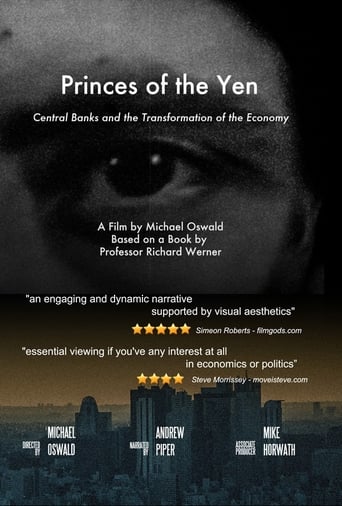
Princes of the Yen
2014 · Film · documentary · 93 min
Directed by Michael Oswald
Set in 20th Century Japan the documentary explores the role and power of Central Banks and how they can be used to change a country's economic political and social structures A documentary adaption off the book by Professor Richard Werner.
5 positivefrom 5 commenters
Where to watch
No streaming data for this title.
Videos commenters linked
From YouTube links in the comments below. Most are clips and trailers; “Full” means the uploader says so.






5 comments on Hacker News
"Princes of the Yen" - both a book and documentary - well worth watching:
https://www.youtube.com/watch?v=jsO0JYu_5WI
CBDCs could upturn existing assumptions about the role of currencies, e.g. from June of this year, https://www.msn.com/en-gb/money/other/bank-of-england-tells-ministers-to-intervene-on-digital-currency-programming/ar-AALhtDP
> Tom Mutton, a director at the Bank of England, said during a conference on Monday that programming could become a key feature of any future central bank digital currency ... what happens if one of the participants in a transaction puts a restriction on [future use of the money]? ... Sir Jon Cunliffe, a deputy Governor at the Bank, said digital currencies could be programmed for commercial or social purposes ... “You could think of giving your children pocket money, but programming the money so that it couldn’t be used for sweets. There is a whole range of things that money could do, programmable money, which we cannot do with the current technology.”
At an IMF meeting in Oct 2020, Swiss BIS director Carstens commented on CBDCs, https://www.youtube.com/watch?v=mVmKN4DSu3g&t=1451s
> With cash, we don't know who is using the 100 dollar bill today ... a key difference with CBDC is that the central bank will have absolute control on the rules and regulations that determine the expression of that central bank liability .. also we will have the technology to enforce that ... if an advanced economy issues a CBDC, and someone in a 3rd country wants to use it, it will require the consent of the central bank of the residence of that person, therefore the degree of control will be far bigger.
Well-intentioned initiatives like Linux Foundation's global vaccine passport (https://www.goodhealthpass.org/), EU digital health certificate and Apple+Android digital driver's license can all be drafted into the service of CBDC initiatives which require digital identity for digital currency wallets, unifying online and offline policy for programmable "permissions" like carbon/food quotas or other social credits. If western citizens acclimate to "showing papers" for routine daily movement, then real-time currency policy can be applied for admission and activity control. This could replace fungible currency with "colored credits", with policy attached to both the origin of money and a whitelist of possible destinations, goods or services. As a current example, PayPal has amended their ToS to include merchant content regulation as a condition of payment processing.
That's just scratching the surface. Some proposals would eliminate the ability of retail banks to issue loans/money, restricting this function to central banks. Retail banks could then be repurposed as fintech data custodians and risk management, similar to Chinese social credit. Some of these ideas are discussed in the "FedAccounts" paper and related testimony to Congress, https://scholarship.law.vanderbilt.edu/cgi/viewcontent.cgi?article=2215&context=faculty-publications.
> Congress should authorize the FederalReserve to give everyone-individuals, businesses, and institutions-the option to maintain accounts at the central bank. We call these accounts FedAccounts. Unlike the CBDC approaches currently under discussion, which would use complicated and inefficient distributed ledger technology and be walled off from the existing system of money and payments, FedAccounts would be seamlessly interoperable with the mainstream payment system, relying on technologies that the Federal Reserve has used for decades.
What are the options for those who prefer physical currency? In the US, pre-1965 ("junk") silver coins can be used to conduct local commerce based on the value of silver content, rather than face value. In theory, regional digital currencies could be created that are backed by precious metals or other physical, non-fiat assets. Texas has a state-administered bullion depository. CBDCs will require enabling legislation in each country, so there will be political debate in the next year or two, including the fates of decentralized cryptocurrencies and corporate digital currencies (e.g. Facebook, Amazon).
For historical background on central bank policy, see the 2014 documentary "Princes of the Yen", https://www.youtube.com/watch?v=p5Ac7ap_MAY & https://moviesteve.com/review-princes-of-the-yen-2014/ or the upcoming 2021 documentary "The Trust Game", https://vimeo.com/ondemand/trustgame/626995630?autoplay=1
Read "The Princes of the Yen", by Richard Werner. He coined (no pun intended) the term QE and his analysis of the Japanese, European and American government/central banks monetary interventionism is spot on.
There's a documentary based on his book, which may be a quick introduction to the content (although I'd still recommend the book): https://www.youtube.com/watch?v=5-IZZxyb1GI
I would recommend the 'Princes of the Yen' as an incredibly insightful documentary based on Werner's analysis of the Japanese economy.
For a very interesting commentary of the immense power of central banks, I'd recommend the documentary "Princes of the Yen", a film adaptation of Richard Werner's[1] book of the same name.
https://www.youtube.com/watch?v=p5Ac7ap_MAY
[1] http://en.wikipedia.org/wiki/Richard_Werner