 Hacker Cinema
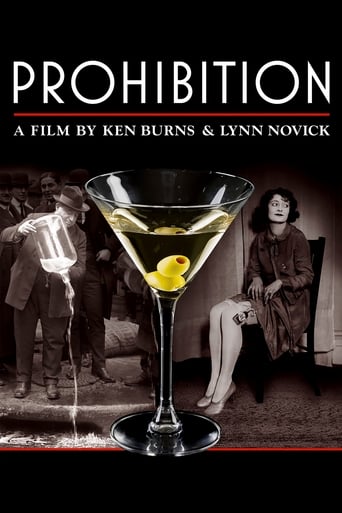
Prohibition
2011 · TV series · documentary · 110 min episodes · 1 season
Created by Ken Burns, Lynn Novick
The history of the rise, rule and fall of the Eighteenth Amendment to the United States Constitution and the entire era it encompassed (1920-33). After nearly a century of activism, Prohibition was intended to improve the lives of all citizens by protecting individuals, families and society at large from the devastating effects of alcohol abuse; but paradoxically it made millions of people rethink their definition of morality.
18 positive1 mixed5 neutralfrom 24 commenters
Where to watch
No streaming data for this title.
32 comments on Hacker News
The average American drinks about 2.3 gallons of pure alcohol per year (in 2014), compared to 7.1 gallons per year in 1830, just as the temperance movement started to gain momentum.
America drank so much back then that the Federal Government was fully funded on liquor taxes, the first Federal income tax was not collected until prohibition took effect.
Not saying things are perfect now, but they used to be much, much worse. Highly recommend the Ken Burns Prohibition documentary for a deep dive.
[0]: https://www.archives.gov/files/publications/prologue/2014/winter/spirited.pdf
> Some peoole beat their wives when they drink, so the state has decided that it is in everyone's best interest for alcohol to become illegal.
If anyone is curious about the history in the US, Ken Burns' doc (based on a book) is really good:
* https://en.wikipedia.org/wiki/Prohibition_(miniseries)
Any of Ken Burns' documentaries are good, The Civil War and Vietnam being two of the best. Even his take on Prohibition and Baseball are very watchable.
> After a recent bad experience around an alcoholic, I now understand, at least in part, why prohibition happened.
Ken Burns did a good doc on Prohibition in the US:
* https://en.wikipedia.org/wiki/Prohibition_(miniseries)
The societal problems that the then-new process of distilling caused were enormous. Previously the strongest drinks were beer (<8%) and wine (<20%), but with high-proof spirits people got into all sorts of problems.
Humans/society eventually adapted, but the intervening decades had a lot of people suffering.
Wow. I love Ken Burns. Did not know he did Ali as well. The Vietnam War, The Roosevelts and Prohibition by him are among my favorite documentaries.
I would highly recommend everyone to watch the documentary Prohibition by Ken Burns:
https://www.pbs.org/kenburns/prohibition/
https://www.imdb.com/title/tt1950799/
> Ken Burns’ fantastic documentary series on prohibition.
I love Ken Burn's work, but haven't heard of this one. Looks like it is PBS. Do you know if it is available to stream anywhere (Netflix, Hulu, Amazon, Disney, Vudu, etc?)
>> America (and a few other places) actually did have a War On Booze, they just gave up because it's too socially normalised
> They might've given up because alcohol prohibition increased the crime and alcohol poisoning rates; because it was killing more people than it was saving.
> They might've given up because the state prohibition laws had exceptions for religious and medical purposes and so were explicitly unequal ("de jure discriminatory")
They might've repealed the Amendment authorizing alcohol prohibition when they realized they were unintentionally ensuring tax-free funding for organized crime. The whole Gangsters vs G-men thing was a direct product of prohibition.
Where US Marshalls (Justice branch) and Secret Service (Executive branch) had been more or less sufficient, we then needed another new 'bureau' to handle interstate organized crime headed up by a German guy; amidst Irish Rabbis (during prohibition)
Where we had had men drinking in saloons and not going home to their families, we then had men and women drinking in illegal literally underground speakeasies (on like every other corner of New York) breathing leaded gasoline (which, apparently, noone ever went to jail for)
https://en.wikipedia.org/wiki/Prohibition_(miniseries) episodes: "A Nation of Drunkards", "A Nation of Scofflaws", "A Nation of Hypocrites"
That documentary is definitely on my top 10 list.
It's amazing (especially in hindsight) how both prohibition's opponents didn't take the movement seriously, to how it's proponents didn't take the problems it caused seriously.
I recently watched (and highly recommend) Ken Burns’ fantastic documentary series on prohibition.
I learned so much about that era that wasn’t really covered much in school (i.e. prohibition gave rise to the first federal income tax, women’s suffrage was very closely tied to the prohibition movement, bootleggers were delivering shipments to congressmen at their offices in the capitol, etc.)
It was an incredible look into America’s failed attempt to govern morality. It reminded a lot of how we see cannabis today.
Watched an interesting Ken Burns documentary on Prohibition the other day. At the time of banning alcohol it was blamed for all kinds of complex social issues, from the breakdown of the family to the loss of moral rectitude. Really, though, it was just a very visible scapegoat for things like changing economic structures (industrial revolution) and social structures (immigration).
To whit, my take is that the smartphone is the new opiate of the masses only to the extent to which it (and social media) are the newest things we like to blame for far more complex social problems.
Prediction: banning smartphones won't stop kids from being depressed, nor will regulating Facebook fix extreme nationalism.
Reminded me of the theory that early humans ate tons of psychedelic fungus and that is what helped us create the neural pathways towards sentience. (if you think we are sentient now that is)
Between that, and the cannabis receptors in our brains, perhaps we're not supposed to be sober.
Maybe everything is going to shit in the world because we as a species are going through a collective withdrawal from the substances that made us in the first place.
Edit: I think this is the documentary that I saw that referenced weaker beer. http://www.pbs.org/kenburns/prohibition/watch-video/#id=2082675582
I recommend you watch the PBS special Prohibition. It does a great job of explaining how the prohibition on alcohol was a grass-roots movement by women and Protestants. It was actually against the government's interest, because alcohol taxes at the time made up 1/3 of federal revenue. It'll disabuse you of this notion that "government" is always to blame for how people vote.
Specific background: https://en.wikipedia.org/wiki/Twenty-first_Amendment_to_the_United_States_Constitution
And the Ken Burns documentary is fantastic: http://www.pbs.org/kenburns/prohibition/
Is it really? The vast majority of Prohibition era issues were relatively substance independent, and given that we've seen the EXACT same public response, political/buzzword currents surrounding the pro-prohibition movements, and emergent criminal enterprise, I think it's fair to say that "prohibition of *" is a reasonable class to abstract by.
(Watching Ken Burns "Prohibition" is something I'd strongly recommend to just about anyone, not only is it a fantastic documentary as par for the course for Burns, but it was a steady stream of "HISTORY REPEATS ITSELF" in such stark terms as you rarely see.)
I gained a different perspective from watching the Ken Burns Prohibition documentary
http://www.pbs.org/kenburns/prohibition/
Before I watched it I thought "how could people be so stupid as to think they would ever ban alcohol". After I watched it I was like "oh wow, people drank on average 1.5 bottles of hard alcohol a week? Drunks were everywhere? Opening a bar was super cheap because the alcohol companies subsidised them. Ok, maybe I get why people would vote for prohibition".
I'm not saying it was a good idea. It was clearly stupid idea which the rest of the doco made clear and is directly analogous to the war on drugs.
Another POV that gave me a new perspective was the idea that legal drugs (alcohol) kill way more people than the war on drugs kills. 3+ million a year die from alcohol. (http://www.who.int/substance_abuse/facts/alcohol/en/). Legalizing a bunch more drugs may have the unintended consequences of killing an order of magnitude more people than the war on drugs.
I'm not saying I'm for the war on drugs. All the unintended consequences of that are horrible as well. The USA's police state, seizure laws, militarization, etc. But, the idea that we'll end up possibly causing 10x more death from legalization makes me wonder if there's some middle position
Before prohibition, big brewers owned most of the bars and you could only buy their brand. Ken Burn's "prohibition" documentary explains how a single brand of beer owned all the bars for several blocks in a city.
State legislatures had this in mind and adopted the 3 tier system barring producers from controlling distribution and/or owning the bars.
The same story is given in the Ken Burns's prohibition documentary. Alcoholism was rampant in America at the turn of the century because americans were drinking whiskey like they'd been previously drinking beer.
According to the Ken Burns documentary Prohibition [1], it was both - especially if you replace "people" with "men". I don't remember all the facts and details leading up to Prohibition, but the documentary did make me more sympathetic to the temperance movement.
[1] http://www.pbs.org/kenburns/prohibition/watch-video/
Before prohibition breweries owned the bars to the point sometimes you could only buy a single brand of beer for blocks to no end. That squeezed small breweries out of the market. When lifting prohibition, Congress created the tier system to prevent something like it from happening again.
Ken Burns' documentary about prohibition explains it really well.
I strongly recommend watching the PBS series on the topic: http://www.pbs.org/kenburns/prohibition.
It's worth looking at first-generation prohibition through the proper historical lens: it was a womens' issue, largely a proxy for addressing domestic violence and unemployment as a result of untreated alcoholism in men (this was before AA).
Prohibition may be immoral and/or counter-productive, but to those who have experienced the worst elements of alcoholism (personally or societally), the drive to outlaw it is at least understandable, whether or not it is irrational.
I strongly recommend Ken Burns' documentary series on the subject: http://www.pbs.org/kenburns/prohibition
There's a really good mini-series on PBS called "Prohibition" that gave me a totally new perspective on the Drug War: http://www.pbs.org/kenburns/prohibition.
The ban of alcohol in the United States was actually a triumph of democracy over moneyed interests and the government. At the time, alcohol manufacturers had tremendous political power, and excise taxes on alcohol made up about 1/3 of federal revenue. What made prohibition pass legislatures around the country was a concerted effort by devoted constituencies: Christians and women. Indeed, one of the primary drivers of women's suffrage in the United States was prohibition--alcohol was seen by many leading suffragists as being at the root of social ills like domestic violence.
One of the most interesting charts I've seen with regards to the modern drug war is this one: http://www.people-press.org/2013/04/04/majority-now-supports-legalizing-marijuana. My recollection of childhood, of school assemblies with adults shrieking "Just Say No!" wasn't wrong. When I was a kid in the early 1990's, the popular position was in favor of keeping marijuana illegal by an almost 80-20 margin. This is a country that couldn't agree on anything (in 1992, they voted for Bill Clinton over George Bush by a 43-37 margin), yet they almost all agreed that marijuana (we're not even talking about harder drugs) should be illegal.
You mean the Ken Burns' documentary? Panning over still photos is sort of his thing. iPhoto even has a slideshow mode called, appropriately enough, "Ken Burns".
Prohibition is excellent, by the way, I recommend you give it another chance.
If you find this interesting, I highly recommend the book "Last Call: Rise and Fall of the Prohibition" by Daniel Okrent. There is a PBS documentary as well, but I found it difficult to watch (narration with lots of panning over still photos).
The prohibition is a really great example of the unintended consequences of (mostly well-intentioned) morality-by-legislation.
Ken Burns' excellent documentary miniseries Prohibition goes over this more in-depth in its overview of how disparate voting blocs banded together to accomplish the improbable -- passing a Constitutional amendment to ban alcohol.
It's also an eye-opener in revealing the historical origins of the expansion of police powers like wiretapping, and IIRC, overreaches of the Interstate Commerce Clause.
Once you've watched it, it's easy to draw some very damning "learn from history of be doomed to repeat it" parallels between Prohibition and the War on Drugs at a more detailed level than "drug prohibition doesn't work, just look at Prohibition."
This is a must-see documentary, not just for its coverage of prohibition, but for the historical insights you can glean about American politics: http://www.pbs.org/kenburns/prohibition.
In a nutshell, prohibition was far more invasive and far more corrupt than today's drug war. Al Capone was a billionaire in today's money, and the drug lords of yore were willing to exert political influence in a way that maybe happens today in Mexico, but certainly does not in the U.S. Al Capone once walked into City Hall and pushed the Mayor of Cicero (which was a former independent city in the Chicago area) down the stairs and nobody touched him. Politicians and police were openly on the take from bootleggers in a way that is totally foreign to our modern sensibilities (unless you have any familiarity with the developing world).
Yeah, take a real close look at what led to our needing RICO (another non-sensical law): prohibition of alcohol and gambling. Without those two legal battles, the mob would have still been shaking down the corner grocer for a couple of bucks protection money (which our country's law enforcement should have been taking care of, instead of chasing down bootleggers and betting operations).
Watch Ken Burn's documentary on prohibition and soak in all the parallel's to today's war on drugs: http://www.pbs.org/kenburns/prohibition/
I seriously encourage you to watch this documentary: http://movies.netflix.com/WiMovie/Ken_Burns_Prohibition/70199184?locale=en-US. The veneer used to be a lot thinner.
Except it was worse 30-50 years ago. Do you really think what the NSA is doing now compares, vis-a-vis outrage (not scale), to what the FBI was doing in the 1960's? To analogize to the OWS protests, you think anything that happened with that is as bad as the Kent State shootings in 1970?
Going back further, watch this movie on Prohibition: http://www.pbs.org/kenburns/prohibition.
You think 4th amendment rights are being violated now, back then Prohibition Bureau agents were just sweeping houses looking for illegal alcohol. Seriously, watch the video. It should be eye-opening for anybody who thinks that the trajectory of this country has been towards less freedom and more corruption.
I don't see a boiling frog situation, I see the opposite: people getting more used to stronger protections against government and reacting more strongly to lesser outrages. That doesn't mean the outrages are less valid, but rather it means that the defeatism inherent in the "boiling frog" analogy is unwarranted.
Privacy advocates need to get their act together and form a single-issue organization. I need to be seeing teenagers coming to my house peddling privacy the way they do for churches and baby seals. The tech industry needs to sack up and realize that their business interests are at stake, and put some serious money in PACs behind the whole effort. It needs to have a focused mission, no getting distracted in related issues (e.g. copyright reform or reform of hacking laws), but be a big tent (don't care what else your other viewpoints are). There needs to be a diversity of messages, targeted at different demographics. There has to be something in it not just for techie yuppies in San Francisco, but also church-going grandmothers in small-town Iowa (any political movement that can't capture at least some old people is dead on arrival). That's a key strength of the NRA: it has vigorous support across a wide diversity of voting demographics.
The EFF and the ACLU are fine for what they are, but they've got too broad of a mandate to have the kind of focused impact you want. You can't be an effective mainstream advocacy organization when you're off defending unsympathetic people for principled purposes. That's an important thing too, but it's a different thing.
For people interested in effecting real political change, I seriously recommend watching this documentary on the Prohibition: http://www.pbs.org/kenburns/prohibition. One group of people got a nation that until (and during and after!) prohibition drank 140 million gallons of liquor a year to outlaw alcohol. The money wasn't on their side (the government made 1/3 of its revenues from liquor taxes and the beer makers had tremendous power), but they accomplished their goal by masterful politicking: http://en.wikipedia.org/wiki/Wayne_Wheeler.
"Under Wheeler's leadership, the League focused entirely on the goal of achieving Prohibition. It organized at the grass-roots level and worked extensively through churches. It supported or opposed candidates based entirely on their position regarding prohibition, completely disregarding political party affiliation or other issues. Unlike other temperance groups, the Anti-Saloon League worked with the two major parties rather than backing the smaller Prohibition Party."
Google had the best idea. Just search for the show you want to watch, don't worry about the source. Unfortunately, big media companies – in their infinite shortsightedness – decided to torpedo the project.
By contrast, the app solution would be totally voluntary on the part of the content owners, but less elegant.
It would also mean that your access to content would be even more subject to corporate whims than they are now. Say a bug was introduced into the ESPN app. Now suddenly you've missed a quarter of the season because ESPNs app programmers couldn't post a patch fast enough. Or the PBS app gets taken down due to a patent infringement case and you miss the airing of the Prohibition documentary.