 Hacker Cinema
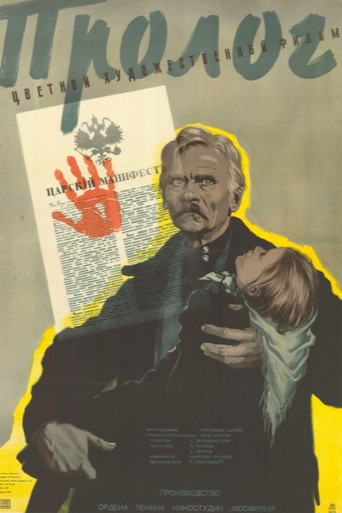
Prolog
Пролог
1956 · Film · 100 min
Directed by Efim Dzigan
After the brutal massacre of a peaceful demonstration of the working people on their way to the Tsar, Lenin and other Party members in exile call for an armed uprising of the workers. At Presnya build barricades. The people are arming themselves. But the heroic armed uprising of the workers of Presnya is brutally suppressed by the tsarist troops. However, the struggle of the workers under the leadership of Lenin continued.
1 neutralfrom 1 commenter
Where to watch
No streaming data for this title.
Videos commenters linked
From YouTube links in the comments below. Most are clips and trailers; “Full” means the uploader says so.



1 comment on Hacker News
Thanks for trying to correct me, if I'm wrong (but thanks anyway). What I write is the impression I've formed after reading various sources on the history of Prolog, over the years. Some of them are even by Kowalski himself and my impression that he was the "neat" and Colmerauer the "scruffy" comes from his comments on their relation. I certainly could have misunderstood his comments, or be misremembering them. Unfortunately it will take me some time to dig out the specific sources and check my assumptions [1].
One such recent source is this documentary (in French) about Alain Colmerauer by a lady who shares his surname (a relative, I'm guessing):
https://youtu.be/74Ig_QKndvE?t=311
I've pointed the link to just before the start of an interview with Kowalski where he says (in English) what I transfer above, that Colmerauer was more practically minded and coming from a computer science side point of view while he (Kowalski) was more theoretically minded and coming from a mathematical logic point of view, and also that this tension created an "alchemy" that would not have transpired otherwise. I watched this documentary very recently and I guess it coloured my comment above.
More generally, it's easy to find discussion of the "pure" subset of Prolog and about its purported advantages compared to the rest. I'd have to go back to those textbooks to be sure, but I think I first encountered this idea in The Art of Prolog (O'Keefe) or "The Craft of Prolog" (Sterling & Shapiro), or probably both. And I have heard Ivan Bratko's coding style in his Prolog Programming for AI described as being too imperative and not the recommended style today [2].
I guess what people mean when they talk about "purity" is the lack of side-effects, and other concessions to the everyday needs of the working programmer. I understand the occurs-check flag to be one such concession, for example [3].
So I don't think that all this is just my imagination. In my experience, there really is a divide between Prolog users that think of Prolog as a kind of mathematical notation for computers and smart at the thought of its "dirty" side-effects, and those who just want to use it as a powerful, and beautiful, tool. Like myself.
But I should try to be less sentimental in my analysis in the future. Again, thanks for reminding me to check my assumptions and try to remember where my knowledge comes from.
_____________
[1] I spent four years during my PhD at Imperial College literally down the corridor from Kowalski's office, but I never had the guts to go and talk to him and ask him about Prolog's history, that I am always very curious about. I regert that now that my PhD is ended and I'm no longer in the same building, or the same city :/
[2] Which is nonsense. Also Bratko said I'm good with Prolog, so there.
[3] What does the DEC10 Prolog manual say about the occurs check?