 Hacker Cinema
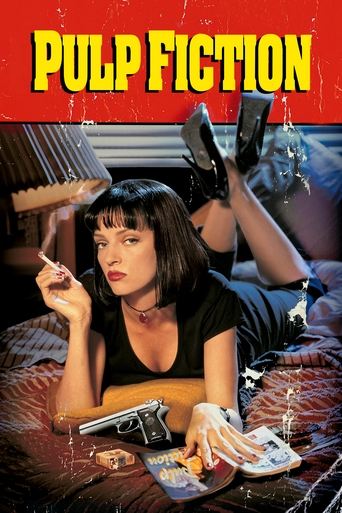
Pulp Fiction
1994 · Film · 154 min
Directed by Quentin Tarantino
A burger-loving hit man, his philosophical partner, a drug-addled gangster's moll and a washed-up boxer converge in this sprawling, comedic crime caper. Their adventures unfurl in three stories that ingeniously trip back and forth in time.
44 positive8 negative110 neutralfrom 162 commenters
Where to watch
No streaming data for this title.
177 comments on Hacker News
To be fair: the quality of movies produced by Hollywood has gone rapidly downhill already in the 1990s. You only need to compare the movies Quentin Tarantino makes; now personally I think Pulp Fiction is still by far his best work, but I concede that the movies he created lateron were above average (though I would not go as far as many others, who'd rate these in the 8 to 10 point ranges; I'd go more between 6 to 7 or 7.5, largely because there are a few smaller issues cropping up and I always notice these when I compare them with Pulp Fiction, which was really good; actually really well-made).
I noticed this in the 1990s in many movies. For instance, Independence Day - the computer animation pissed me off. I found them bad. Even Terminator 2, where evidently many people say it was great, I was nowhere near as convinced; I found the first terminator better and more "logical" and more consistent, too. But things decayed quickly in the 1990s really. Even movies such as Avatar I find total garbage. And while I am not totally against superhero comic/marvel adaptations (I liked xmen and in particular Hugh Jackman as wolverine), these are always the same formula. Tons of CGI, big fights where nobody knows what is going on, very little thought elsewhere in that formula. There are exceptions, but by and large these things keep on happening. Individual directors manage to break out of the mold (Chris Nolan) but by and large movies really SUCK now compared to the "oldschool days". And while some of this may be due to me becoming more critical, the production quality just sunk. Take movies such as Megalopolis - this captures what is going wrong. It seems as if the whole movie industry has partially collapsed in the last +25 years and they don't really know what to do to change this. The same has happened to games, by the way. It is almost as if only one formula exists only now.
> style and mood are closely aligned with the original 1989 manga, which is to say it's more cartoonish and light-hearted
Did you get your manga the same place they sell the 15 minute long Tarantino movie Pulp Fiction?
Just FYI, this question was a quote from Pulp Fiction, the other commenter (mdre) replied also with a quote, that was an answer to this question in the movie.
Here’s how it applies to the top 10 movies on IMDb
Shawshank redemption: the well liked male protagonist righteously murders his wife for cheating on him
The Godfather: pretty much encapsulates all of my requirements
12 angry men: no women
Original LOTR: Does women characters incredibly well
Pulp fiction: Mia is in there for a few key scenes, no nonsense
The good, the bad and the ugly: self explanatory. Great male characters
Forest gump: Jenny might be the greatest villain ever for her promiscuity
I can go on and on. All these movies have gravitas. You won’t see any movie post 2015 even crack the top 100 (besides Parasite but that isn’t Hollywood) because that’s about when they lost the plot.
Yes, I cited it an above comment: https://www.xach.com/gg/1997/1/profile/1/
Here is the full quote:
> > Your home page says that you created GIMP to address the lack of free or inexpensive Unix graphics tools. How did you guys actually get together to tackle this? Was it like in Blues Brothers? Were you on a mission from God?
> Spencer was my brother's roommate for four years. (He's been my roommate for the past six months). So I knew who he was when we decided to take the compilers course here together. Big mistake. During one of the impossibly boring assignments we decided we wanted to do something which wouldn't suck. The idea of doing the GIMP actually fell out fairly naturally.
> It took us a little while to come up with the name. We knew we wanted an image manipulation program like Photoshop, but the name IMP sounded wrong. We also tossed around XIMP (X Image Manipulation Program) following the rule of when in doubt prefix an X for X11 based programs. At the time, Pulp Fiction was the hot movie and a single word popped into my mind while we were tossing out name ideas. It only took a few more minutes to determine what the 'G' stood for.
I'm gen Z, we know what Pulp Fiction is. Even the gen alphas do. We just had a crossover in Fortnite, and Pulp Fiction is in the Chainsaw Man opening.
I'm anti-Puritan as well, but there are far better hills to die on. In either case, it's moot, since "gimp" is also used as an ableist slur.
I haven't seen Footloose, but we don't need analogies to fictional movie villains. The facts are that they decided to give GIMP a stupid name, and so they missed out on investment and adoption because of that decision. It doesn't matter what you or I think, I'm just describing something that already happened.
To repeat, it's not a collision, because it was not accidental. Kimball and Mattis named their image editor after the full-body sex-slave suit, on purpose. GIMP is a backronym.
It's also worth emphasizing that "Pulp Fiction" is not an obscure movie, it was actually a very very popular movie from the 1990s and it's still relevant today. It won awards from every organization that gave movies awards. It was recently quoted by the US Secretary of Defense during a prayer, who thought he was quoting the Bible.
While I believe you when you say you're personally not familiar with the usage of the word, it's a word that you can expect most people would recognize.
Oddly, I found the bios as interesting as the behind the scenes photos (though I enjoyed the full life T-Rex on the wall!)
Jurassic Park came out before Pulp Fiction, and stars Samuel L Jackson:
> Jackson made his indelible mark on film with his portrayal of a crack addict, Gator, in Spike Lee's "Jungle Fever." For this searing characterization, Jackson received the first Best Supporting Performance award ever given out by the judges at the Cannes Film Festival. Jackson's versatile career, which includes film, television and stage work began...
Thirty years later, to me, he is indelibly associated with Pulp Fiction. Bios like this are a mark into how people were seen in the past. I's fascinating seeing what an impressive career he had (he was a stage actor, too, which I -- I'm really marking my generation with this whole comment -- only learned reading this) that has been almost erased by the subsequent career trajectory he had.
Just as I was reading your comment I remembered that Samuel Jackson used "retort" in his speech in the "Pulp Fiction" movie and was wondering whether he was openly antagonistic there (I mean, he killed a bunch of guys with a pistol shortly afterwards but still) or was it a witticism.
I admit I am lost on these nuances and I usually kind of use whatever idiom comes to mind, which yes, likely would net me some weird looks depending on where I am geographically.
> Within days, the question that organised the coverage was whether Claude, a chatbot made by Anthropic, had selected the school as a target.
I don't buy into that story. While in theory many possibilities may exist, I think this was a targeted hit by the decision-makers in the US military. There are some reasons as to why I think this is the case - for instance, under Hegseth and Trump the lies amplified in general, and truth dies first in war. Fishing boats were claimed to be drug boats. Or the iranian ship that was taken down by a torpedo - that was also deliberate. So, all of what the current mafia in charge does, has a purpose: an evil purpose, but a purpose. I could list some more reasons I think this was not an accident, but I believe the most convincing one is actually that there is a prior incident to this. Not of a school (or, at the least perhaps there was, but I don't quite recall it), but of the chinese embassy.
https://en.wikipedia.org/wiki/United_States_bombing_of_the_Chinese_embassy_in_Belgrade
This happened in 1999. The USA initially also claimed it was an accidental hit. Various other sources then pointed out that this explanation made no sense; a simple one I remember is that a statistics scientist pointed out that the "random hit" theory made no sense. There were others who came to the same conclusion but from a different angle; the statistics example I remember because I read it in a book about statistics a few years after that (that is, I read the book a few years lateron, the initial writing happened much closer to 1999).
The current invasion Trump is doing also carries a strong "contain China" attempt with it. To me, I think it is much more likely that the hit on the school was deliberate. The tactic that is being employed here is to commit to the invasion. This is why you can not buy anything Trump says - you'll see that there is a step-wise escalation path coming from the USA right now. Trump is just the decoy on top; the commitment already happened. You'll see more ground troops being committed as the next step.
People really should not buy into ANYTHING that is coming out of the current US administration. Hegseth also recently went for a copy/paste job from the movie Pulp Fiction, when Samuel Jackson cites a bible verse before violence. Hegseth did not use the same words, of course, and the objective was more aimed on christian fanatics in the country, but they are really trying to push every button here. See also how they tried to sell this as a video game via ads. This government is a lost cause and dictators who want war, be it Putin or Trump, should never ever be trusted anywhere.
Yeah yeah, it isn't arthouse but, is it a less of a thinker than Pulp Fiction? I have the suspicion that GP would find IMDb Top movies agreeable and they aren't all deeply introspective films, which isn't a bad thing.
I think it's just survivorship bias, we don't remember the pre-2000 schlock because it's schlock. The two real "things used to be better before" situations IMO are:
- The loss of DVD revenue killed mid-budget productions, in the US the options are mostly indie darling or outrageous budget blockbuster.
- Big productions look flatter than before due to VFX crew exploitation. The VFX must be reworked 100 times with minimal time because planning is for suckers. No complex lighting for you and only crunch for the non-unionized Korean.
Thanks for correcting me, I should have read the interview more carefully.
>That's not how you title software. You don't say "The Photoshop" or "The EMACS."
Nitpick: The Sims, The WELL, TheFacebook are all attestable. But yeah, fair.
>The number one association most of the population of Earth have with the word "GIMP" is:
>Bring Out the Gimp - Pulp Fiction (9/12) Movie CLIP (1994) HD:
I suppose that here you didn't mean that most of the population of Earth watched and understood the English version of Pulp Fiction, or that the majority of people in the world will associate the word "gimp" with anything else than the graphics editor (certainly neither would be true), but that the second most-common association among all anglophones taken together after the GIMP editor itself is the Gimp character from Pulp Fiction.
mikolajw> I am not aware of any evidence that there was an intent to offend. The only source for etymology I know here is an old interview with one of the original developers where he said that he blended the words GNU and Image Manipulation Program, and soon afterwards realized that he heard that word before in a film.
That's wrong on every count. The primary source is Peter Mattis' own words in the GIMP Gazette interview, January 1, 1997, by Zachary Beane:
https://www.xach.com/gg/1997/1/profile/1/
Mattis> "It took us a little while to come up with the name. We knew we wanted an image manipulation program like Photoshop, but the name IMP sounded wrong. We also tossed around XIMP (X Image Manipulation Program) following the rule of when in doubt prefix an X for X11 based programs. At the time, Pulp Fiction was the hot movie and a single word popped into my mind while we were tossing out name ideas. It only took a few more minutes to determine what the 'G' stood for."
So the sequence was: IMP (rejected) -> XIMP (rejected) -> Pulp Fiction inspires "GIMP" -> they reverse-engineered "General" as the G. The Pulp Fiction reference was the generative act, not an afterthought.
The GNU backronym came later. Same interview:
Mattis> "the GIMP originally stood for General Image Manipulation Program, but has since been dubbed GNU software by Richard Stallman (with our agreement). Spencer and I decided that GNU Image Manipulation Program is a better usage of the 'G'."
He didn't "blend GNU and Image Manipulation Program." He didn't "realize afterwards he'd heard the word in a film." He was a college kid at UC Berkeley in 1995, Pulp Fiction was everywhere, they needed a name, and the word popped into his head. He says so plainly.
Note Mattis' original Usenet announcement uses the phrase "The GIMP" -- with the definite article, exactly like the movie character is called "The Gimp." That's not how you title software. You don't say "The Photoshop" or "The EMACS." You say "The Gimp" because there's a character called The Gimp, and everybody in 1995 knew exactly which one.
Peter Mattis' original Usenet announcement, comp.os.linux.development.apps, November 21, 1995:
https://groups.google.com/g/comp.os.linux.development.apps/c/4_lmEfiVvi0
Nobody needs to speculate about intent when Mattis spelled it out himself more than 30 years ago.
GIMP project history, written ~1998 by Seth Burgess:
https://www.gimp.org/about/ancient_history.html
The number one association most of the population of Earth have with the word "GIMP" is:
Bring Out the Gimp - Pulp Fiction (9/12) Movie CLIP (1994) HD:
https://www.youtube.com/watch?v=S8kPqAV_74M
It's quintessential-Tarantino, but I don't ever recommend it anymore (start with Django or Reservoir Dogs). Decades ago I shared this movie with college friends — mostly because we enjoyed decadence.
If you've not seen Pulp Fiction by 2026 [0], how can I safely recommend you submit yourself to hours of semi-disconnected robberies, rapes, and deceit? It's a great movie, EEAaO is just better storytelling.
[0] similarly, how does one recommend the acclaimed Deliverance without blushing?
I think you're going to see more and more people saying things like that as the audience gets younger and more people see the antecedents of Pulp Fiction before they see Pulp Fiction itself. There wouldn't be an EEAaO without Pulp Fiction.
Even setting its influence aside, Pulp Fiction is the better movie.
Everything Everywhere... is a much better movie than the incredible Pulp Fiction. Some of the visual effects are actually psychedelic (I've "seent" them), and the storytelling is exceptional.
The scene where the antagonist is walking down a hallway while the background keeps changing — is among the best fight scenes / visuals in any film, ever.
> can barely name one good movie a year these days
Not really.
Of the recent movies, Everything Everywhere All at Once is a storytelling masterpiece. Since you mentioned it, I personally rate it alongside Tarantino's Pulp Fiction.
For the academy awards, to its defense, it was competing against Pulp Fiction, Forrest Gump, Four Weddings and a Funeral, or the Madness of King George. I can barely name one good movie a year these days, and certainly none that makes it to the oscars. The contrast with the 90s is brutal.
> But because this is not the case, we appreciate Tarantino more than we appreciate gangster movies.
Do we? I don't think people appreciate tarantino more than gangster movies. Don't think people appreciate tarantino more than pulp fiction. Frankly, tarantino doesn't factor in at all.
> It is about the process.
I never considered the process when watching pulp fiction. It's the finished product, not the process, that matters.
Put it this way, we know who tarantino is because of pulp fiction. Not the other way around.
Pulp Fiction, like many Tarantino movies, also gets much of its effect from using existing songs rather than using an all new soundtrack
> But Pulp Fiction would not have been a masterpiece if Tarantino just typed “Write a gangster movie.” into a prompt field.
Doesn’t that prove the point? You could do that right now, and it would be absolute trash. Just like how right now we are nowhere close to being able to make great software with a single prompt.
I’ve been vibecoding a side project and it has been three months of ideating, iterating, refining and testing. It would have taken me immeasurably longer without these tools, but the end result is still 100% my vision, and it has been a tremendous amount of work.
> No, your favorite movie is not crap because the creators didn't grind their own lens.
But Pulp Fiction would not have been a masterpiece if Tarantino just typed “Write a gangster movie.” into a prompt field.
I've got to admit to being somewhat disappointed that the "wolf" in question wasn't the character from the film 'Pulp Fiction', because - at least in my mind - it's an apt example for Rand's original article.
So in American English, the term “gimped” refers to someone who has a physical disability, usually affecting the way they walk. This term has largely fallen out of fashion though and isn’t used much anymore unless someone is very deliberately trying to be edgy.
Nowadays in America, if someone over the age of 30 (and many people under the age of 30) hear the word “gimp” or more specifically “the gimp”, their mind immediately flashes back to this scene from the incredibly popular movie Pulp Fiction (this clip is not safe for work and depicts sexual assault) https://youtu.be/PcZUjEWFpKs
If you check the first paragraph of the History section of GIMP’s Wikipedia page, you can see that this is not a coincidence, the creators did in fact name it after the character from that clip: https://en.wikipedia.org/wiki/GIMP
So no, I don’t think this is an issue of “any interesting name being too controversial”. There are many places you could draw the line before getting to “let’s name our software after the Gimp from Pulp Fiction”.
I have "Battle Royal" on CD so:
- I hate Fortnite for trivialising killing
- CD is damaged in one place, boo...
I also have "Matrix" and "Pulp Fiction" on DVD etc. but imagine this: you login to Netflix or HBO and there is no "Matrix" or PF to watch ! HOW idiotic and dumb by platforms owners... Maybe it is limited to other streaming platform because of ownership or something but putting it somewhere online is basic SANITY ! But no, _they_ do limit accesibility... I can't grasp that...
On top of that so many older films are not available ! Eg. where is Toy Story number 1 ?? I saw somewhere 2 or 3 but skipped becouse you need to keep order ;)
And when I log to streaming platform I have max 2 weeks or less of material to watch and then just thing to rewatch. But they want _monthly_ subscriptions ! Are they intentionally suicide their own platforms ??
So DVD is best thing after CD ;)
Where did I refuse to watch anything? No amount of this attitude is going to make Casablanca or The Godfather or Pulp Fiction or Infinity War or Star Wars or Fight Club or 2001 or Top Gun be in any framerate other than 24fps.
If they start making films in higher frame rates today, that won’t change that fact. Do you think people are going to stop watching films from the 50s, 60s, 70s, 80s, 90s, and 2000s?
It would take a concerted effort, beginning now, at least an entire generation (30-50 years) to remove or reduce the cultural impact of the 24 frames per second widescreen tradition. No such effort is presently underway, because higher framerates don’t help movies’ visual storytelling, and they may hurt it.
The Hobbit was Peter Jackson’s attempt. It went nowhere.
https://gizmodo.com/the-hobbit-an-unexpected-masterclass-in-why-48-fps-fai-5969817
Depends on how you enjoy them. I'm re reading Harry Potter off and on. I already bought the books before JK Rowling expressed her views. My reading does not give her another dime.
Same thing with Blu-Ray of Pulp Fiction though I believe Weinstein Company has given up all rights to most of their movies.
There are probably many such movies, but most people don't know about them, because they usually never become popular. Pulp Fiction is an exception insofar it is (was) very popular.
> almost every film and TV series, as well as a good many plays and novels, have exactly the same plot?
This is what makes Pulp Fiction[1] such a masterpiece. Three interwoven story lines chopped up and served out of order make for a wild ride.
Restating TFA's question, then: why are we not seeing more art of Pulp Fiction caliber? Instead, the bulk of what is on offer seems a regression to the franchise mean.
But is it worse than that? Has technology begotten an epidemic of ADD, where few have the attention span to re-compile Pulp Fiction in their heads, much less, sit through a 90min flick?
[1] https://en.wikipedia.org/wiki/Pulp_Fiction
What?
I'm not sure I understand what you're trying to say?
How exactly does one "judge a work in its own merit?"
How do you determine whether a movie is good or not? In a vacuum? Measuring its traits against itself?
How can anything at all be judged "on its own merits" without considering the scope of other things related to it?
How does this person writing the article judge the story against itself when they make the claim that this story is bad because men are never sexually assaulted in stories. I can name 2 popular movies off the top of my head (Pulp Fiction and The Shawshank Redemption) that had graphic depictions of men being raped and sexually assaulted.
The writer measured the story they were reviewing against the broader world. Not against itself. Therefore, considering the broader world, there's nothing particularly miscreant about a story portraying violence against a human being (male or female).
The writer's incorrect belief that men are never sexually assaulted in film and TV shows is simply limited by their immaturity and lack of knowledge of the many stories that have been told in different mediums for decades.
Moving read, what it does not touch on is having a moment of hype young and never reaching that level of success again. Plenty of people have one visible successful moment young in their career and never have a notable follow up.
"You always want to be warm, never want to be hot" as the film director Roger Avary (who directed the film adaption of Bret Easton Ellis' Rules of Attraction) said about a career in the arts. He himself winning his only Oscar at 29 for working on the story for Pulp Fiction.
On another note, I just watched Frances Ha and for the first time watching a mid-to-late-20s coming of age story about a young artist trying to make it I found myself just barely on the other side of being older and more stable than the characters in the film. So it goes.
It’s the same in both, it was deliberate. Wikipedia lists a potential reason.
> The title “Wolfs”, a grammatically incorrect plural of Wolf, is an apparent reference to the character of Winston Wolfe (aka “Mr Wolf”) - an iconic “fixer” in the Quentin Tarantino film Pulp Fiction. https://en.wikipedia.org/wiki/Wolfs_(film)
> his piece of software (...) will never do this unless it changes its name.
Why?
Honestly, why?
As a non-native English speaker (like the vast majority of people in this planet), the word "gimp" to me means "the free software image processing program". If I search google, duckduckgo, bing, whatever, the entire first page of results refers to that very program. Digging deeper, I start to find some references to the Pulp Fiction movie, where a minor character is named like that. I remember that character, but in my language it was called by a different name. Is that all?
Is there any other meaning to this word? If so, it must be so obscure as to be completely irrelevant.
Please, take into account that most English speakers are not native speakers, and many words will have a different meaning to us. English as a lingua franca may be comfortable to native speakers, but it also means that it's no longer yours.
The name of the program does not seem to be a serious issue for its adoption. Now, if you want to talk about its user interface... I don't think it does, either (but I may be open to discussion). I have taught my kids to do simple image processing tasks in gimp: copy-pasting parts of an image into another, removing some stuff, blurring, simple layer operations, etc. Anyhow, they got it in a few minutes. Important to say: they are not at all tech-savvy (to my dismay! but this is another story). If they use adobe or krita they will surely find it slightly confusing at the beginning, but no big deal either. Just like a regular person moving from photoshop to gimp.
https://www.imdb.com/search/title/?title_type=feature&release_date=1994-01-01,1994-12-31
Pulp Fiction
Lion King
The Mask
Four Weddings and a Funeral
Dumb and Dumber
The Crow
Speed
True Lies
Interview with the Vampire
Natural Born Killers
Ace Ventura
Stargate
Clerks
The list goes on. Lot's of movies that turned out to be classics or cult classics, or the start of some great careers.
Well, if for any reason you went "hey, what the hell does that mean" and decided to look it up:
- (informal offensive) an unpleasant or stupid person: - (informal offensive) a person with a physical disability, especially one that affects someone's legs - (informal) a limp (= a way of walking slowly and with difficulty because of having an injured or painful leg or foot ) - a person who gets sexual pleasure from being hurt or treated badly (https://dictionary.cambridge.org/dictionary/english/gimp)
And it's not like this is super obscure or anything. The "most influential film of the 90s", Pulp Fiction, literally had a character that was "the gimp". This is pretty mainstream.
This is along the lines of "Hey co-worker, I found the best text editor the other day. It's called pizdă, you should give it a try! Pizdă seems like it would help you!"
But hey, GIMP is taking it back (https://www.gimp.org/docs/userfaq.html#i-dont-like-the-name-gimp-will-you-change-it) any day now. It's only been 25+ years. Any day now.
Some movies in various genres that I like:
* Everything Everywhere All At Once
* The Matrix
* Fight Club
* Weird: The Al Yankovic Story
* Pulp Fiction
* Shutter Island
* Inception
It's hard to pick one "best" movie.
I have a 1994 Jeep Wrangler. I have a fancy (for 1994) Sony cassette deck that was sitting in my basement for actual decades. My plan was to install the fab 90s tape deck in the fab 90s Jeep.
Unfortunately rubber doesn't do well sitting around for decades, Jeep or Sony. Lucky for me I was able to locate a new-old-stock tape transport on ebay and swap out the mechanical bits.
Result - all the $0.50 thrift store tapes I want to play stashed in the center console where nobody wants to steal them any more. Favorites are the Pulp Fiction soundtrack, Eiffel 95 and The Doors movie soundtrack.
I was a tape guy, I couldn't afford vinyl so taping records and the radio was my thing. The shortcomings of the Compact Cassette format are not particularly bothersome in an old Jeep, but I also strapped a Bluetooth receiver on the back so I can stream audio like a not-luddite.
</old>
For convenience, I asked ChatGPT to create this table, which summarizes how many times each movie has been mentioned in this conversation so far. It got a few counts wrong (as usual), but it still gives a good sense of the frequency. I hope it can be useful to someone:
| Movie | Number of Mentions | |-------------------------------------------|---------------------| | The Matrix | 9 | | Lord of the Rings Trilogy | 8 | | Pulp Fiction | 8 | | Alien | 7 | | Fight Club | 7 | | Ghostbusters | 6 | | Die Hard | 5 | | Back to the Future | 5 | | Inception | 5 | | Star Wars Trilogy (original) | 5 | | Groundhog Day | 5 | | Terminator 1 & 2 | 5 | | Jurassic Park | 4 | | The Thing | 4 | | The Fifth Element | 4 | | Monty Python and the Holy Grail | 4 | | Ghost in the Shell | 4 | | Interstellar | 4 | | Casablanca | 3 | | Office Space | 3 | | Shawshank Redemption | 3 | | The Godfather Trilogy | 3 | | The Blues Brothers | 3 | | Blade Runner | 3 | | Mad Max: Fury Road | 3 | | Unforgiven | 3 | | Total Recall (1990) | 3 | | The Crow | 3 | | The Princess Bride | 3 | | Akira | 3 | | The Big Lebowski | 3 | | Guardians of the Galaxy | 3 | | American Psycho | 3 | | Indiana Jones Trilogy | 3 | | Kiki’s Delivery Service | 2 | | Ratatouille | 2 | | A Clockwork Orange | 2 | | Mission Impossible (various) | 2 | | Casino Royale | 2 | | Skyfall | 2 | | Ferris Bueller's Day Off | 2 | | Star Trek: The Wrath of Khan | 2 | | Apocalypse Now | 2 | | The Shining | 2 | | Groundhog Day | 2 | | Donnie Darko | 2 | | Dune (2021) | 2 | | Gladiator | 2 | | Predator | 2 | | Seven/Se7en | 2 | | The Dark Knight | 2 | | Snatch | 2 | | Prometheus | 2 | | Schindler’s List | 2 | | The Wolf of Wall Street | 2 | | Dr. Strangelove | 2 | | Silence of the Lambs | 2 | | Kill Bill | 2 | | Real Genius | 2 | | Top Secret! | 2 | | Tenet | 2 | | Tinker Tailor Soldier Spy | 2 | | The Adjustment Bureau | 2 | | The Expanse | 2 | | Pulp Fiction | 2 |
I found that I actually only really like a movie or tv show if it is infinitely (aka a lot; more than 50x without getting bored) rewatchable (for me obviously); not many movies are. Some favorites which fall in that category; Alien, Aliens, The Thing, Das Boot, Cold Lazarus (the Dennis P one), ...
It is very personal as looking through what other people mention ; many of those I couldn't sit through once, but if friends tell me to give it another go, I watch 2-10 times to see if it grows. Rarely it does, but there have been cases. Notably everyone likes Pulp Fiction; I saw it at least 15 times and find it unwatchable.
I watch movies with intensity - 110% pure focus (and never, ever with any distractions). So, it's extremely rare I watch any movie twice. Maybe a total of around five movies ever, usually viewed years apart. Pulp Fiction is the only movie I ever watched twice on consecutive days. I saw it in the theater the first week it came out and went back again the next night.
Of course, it's obviously an incredible movie but the key reason for my immediate rewatch is that the film's structure is just so fascinating. BTW, Blade Runner is the only film I've watched five or more times.
Original Star Wars trilogy. Lord of the Rings American Psycho Total Recall (1990) Blade Runner Love Actually The Fifth Element Unbreakable Pulp Fiction Four Weddings and a Funeral Guardians of the Galaxy X-Men X-Men the Last Stand Showing my age here, but I started to lose interest in movies after the 2000s. No I do not want to watch a remake of [Blade Runner, X-Men, etc...]. Also X-Men was great, but my interest didn't stretch to Captain America and Iron Man, so the MCU was a loss for me.
My most (deliberately) rewatched movies include:
* Breakfast Club
* Rosencrantz and Guildenstern are Dead
* Penn and Teller Get Killed
* Chungking Express
* Pink Floyd PULSE
* Black People Hate Me and They Hate My Glasses
* Pulp Fiction
* Fringe (not a movie)
You can probably identity my real identity from this list alone. YOLO.
I first watched Pulp Fiction when I was ~13. I had it on DVD and didn't know what to expect. Watched it alone at the farm when I was just bored. I was blown away. For some reason I watched each scene twice in a row, first the scene, then again with the directors commentary. I don't think I ever did that again, but it was one of the most enjoyable movie experiences of my life.
- Hair (and listened soundtrack hundreds of times)
- Coffee and Cigarettes
- Before Sunrise (and to less extent - Before Sunset)
- Pulp Fiction
- Clerks, Chasing Amy
- Leon Professional
- Motorcycle Diaries
These are not as interesting since I assume they're on everyone's list, but I must admit I'm rewatching all movies in the series, even those which are considered weak:
- Lotr, Godfather, Indiana Jones, Star Wars, Matrix
I would put Pulp Fiction near the top of the list for "films with surprisingly wholesome moral examples". The overdose, Butch coming back to help Marcellus and their subsequent parting ways, Jules' acknowledgement that he's "buying" not "giving"... to top it off, nobody is trying to moralize or patronize the viewer. Jules was getting close enough to agitate Vince but that just strengthens the film; it's okay to feel Vince's side more and not feel what someone else does despite witnessing the same thing. I was probably late teens when I first saw it but pretty sure if I saw it as a kid that I'd have gotten the good with the bad.
> Show them a Quentin Tarantino film?
Mia's OD scene in Pulp Fiction definitely scared me away from drugs
even though I wasn't supposed to be old enough to see it >_>
These are just my favorites, and in the order of which the popped into my mind.
- Office Space, 1999 (especially for people who work at offices) - The Matrix, 1999 - Fight Club, 1999 :)
Umm, what else? - Spirited Away, 2001 (and many others from Miyazaki) - Requiem for a Dream, 2000 (Very Heavy addiction-related film! I actually got watery eyes just by typing this, I've seen it too many times.) - Joker, 2019 - Full Metal Jacket, 1987 (and many others from Kubrick, such as Dr. Strangelove and The Shining) - Django Unchained, 2012 (and many others from Tarantino, at least Pulp Fiction) - Alien, 1979 - The Silence of the Lambs, 1991 - Saw, 2004
I made a bit longer list, so that I can share the link to my friends.
Actually there are many quirky ones which came to my mind, such as Borat, the South Park movie, Team America, Airplane! (alternatively titled Flying High!), Idiocracy and Hangover, but I wouldn't say these are in the must-see category. Actually I wouldn't even recommend these to most people, if I didn't know what kind of humor they like.
i've witnessed the incredible normalization of cocaine use during the last 40 years and it's getting out of control. The first symptom is holywood.
Back in the days, a scene with someone taking cocaine was always dark and sordid. The guy was obviously the bad guy, and it ended pretty bad for him (or her, as in pulp fiction for example). Fast forward 30 years and you now regularly see scenes of people doing hard drug as a mean of having fun without any kind of repercussions. It is totally absurd.
I've always wondered if that wasn't a symptom of some kind of infiltration of the drug cartel into the movie industry. Holywood is now basically routinely showing ads for hard drugs.
Hah, true story, I had a college history professor who went on a screed about Pulp Fiction and how it was nihilistic and obscene and that Tarantino would make the world a better place by just offing himself. He said he believed the film and other films in a similar vein made the world a worse place and had literally negative value as a literary work.
It was a wild semester.
Look at Mr. Movie Critic here - next you'll tell me there's no moral lesson in Pulp Fiction?
> I'm an American in my 40s. I've never seen "glorification of scams" in any mainstream culture
Some very popular movies that come to mind (Some of these may not be intended to be glorifying scams, but to many unsophisticated viewers, they absolutely are):
- The Social Network
- The Wolf of Wall Street
- Uncut Gems
- The Godfather
- Scarface
- Ocean's Eleven (and Twelve and Thirteen)
- Emily the Criminal
- I Care a Lot
- Nine Queens
- Punch-Drunk Love
> I've also never seen any sort of "hyper-masculization" shown in a positive light in mainstream culture
More movies!
- The Godfather (again)
- Pulp Fiction
- Fight Club
- American History X
- Gangster Squad
- Django Unchained
- Expendables
- Every Fast and Furious movie
- (Nearly?) Every Arnold Schwarzenegger movie
> it's common to see masculinity referred to as as "toxic" and equated with negative traits or externalities
I think this is (usually?) a misunderstanding. People refer to toxic masculinity, a set of problematic behaviors some men exhibit as part of attempting to appear "manly" that includes traits such as: homophobia, glorifying unhealthy habits (e.g., drinking like a man, don't cry like a woman, mental health issues depicted as "weakness", etc.) They're not referring to masculinity, itself, as being toxic.
A Rolex watch will roughly cost $600 to $1000 USD in servicing every 10 years to run properly (plus an upfront cost of, let's say, $10,000 USD for a certain model of a Rolex Submariner), whereas the Apple Watch Ultra (choosing a high-end model) will cost roughly $799 USD to purchase the latest version every four years or so.
Dollars-wise, there is not much of a gap between the two over a lifetime (unless you skip the servicing of a Rolex watch, which increases the odds of a breakdown and costly repair).
The main value of keeping the same watch would be sentimentality, as shown in the film Pulp Fiction. But the main advantage of mechanical watches over Apple Watches, it seems, is drawn from their aesthetics and an appreciation of their design—rather than as a practical preference based on cost.
If longevity and practicality were a concern, a Casio watch—such as the famous F91W or updated alternative with a better backlight such as a W86 or F201WA—would be a better selection.
Yeah and that was stupid I thought, and hotline miami was a good game. I hope they have a hotline miami movie but they need to make it like pulp fiction
Could they have studied a more obvious thing? Doesn’t this result completely fit intuition?
When I think about loyalty I immediately think about people who would do things for me that are uncomfortable.
Haven’t they seen the documentary “Pulp Fiction?”
I use ChatGPT fairly frequently, but am frequently annoyed at how hesitant it is to answer any question that is somewhat subjective.
From it's Pulp Fiction response: "...However, whether you personally consider "Pulp Fiction" a good movie depends on your taste in film."
To avoid this noise I often add something like this to my queries "skip any preamble or qualifications about how x is subjective" and the results are much better.
Every year, fewer and fewer co-workers get all my little jokes and references from 90s (and 2000s) movies. Really nails home how old you're getting. I made a silly Pulp Fiction reference in front of a group of developers, and nobody got it. I explained it and one of them said, "Man, that movie came out years before most of us were even born." Wow, arrow to the chest.
I don't think it would be too wild to imagine that, maybe, this article isn't meant for you. It does seem perfect for other people that might benefit from a primer on the background.
Good storytelling comes in many shapes and forms, maybe the author was trying to use anticipation as the main element!
I really don't understand the surprise you're apparently filled with when coming across an article that's not presented in the way you expected; an imaginary problem that stops existing once you scroll down or do a keyword search.
Unsolicited recommendation, if I may: do not watch Pulp Fiction.
He was in Do the Right Thing and Jungle Fever, two of the most talked-about films in urban America in the late 1980s and early 1990s. Wikipedia claims that his role in the latter film even drew attention at Cannes, so he wasn’t entirely no-name, even if Pulp Fiction made him a big star.
spent decades learning about cinema the hard way -- watching it, studying it, absorbing the logic/form of cinema. It is (and Pulp Fiction is) not a work of pure intuition; it's clearly a work of homage.
So you think he took an academic approach? Dude dropped out of high school and worked in a video rental store. You are only applying the pastel of studious (the puns are just flying today) because he didn't make absolute shit. If he did make absolute shit, we'd say "gee my god, that's what happens when you drop out of high school and think watching movies is enough to write a good movie".
Right? No seriously, right?
Me and you disagreeing is proof enough we have no idea where this stuff comes from.
> Now imagine either of those two writers gave you a list of rules to follow. You’d throw that piece of paper in the garbage.
https://en.wikipedia.org/wiki/The_Manual
This book has been the inspiration for/method for a lot of hit records.
I think you are underestimating how much method, methodology, effort and development goes into something like Reservoir Dogs. Tarantino may have apparently emerged fully-formed, but he had spent decades learning about cinema the hard way -- watching it, studying it, absorbing the logic/form of cinema. It is (and Pulp Fiction is) not a work of pure intuition; it's clearly a work of homage.
This seems like a dubious leap. What is the substance of this argument? In the absence of movies, people would still buy firearms, either because they hunt, seek to arm themselves for protection, or simply to collect them, not unlike how some collect knives, stamps, or Precious Moments figurines. We know this because people have been buying firearms long before there was cinema.
Other than some terrible movies, Hollywood has never actually tortured anyone.
It is important to remember that Hollywood is a reflection of our society. It seeks to entertain and sometimes (wrongly) to exert influence on that society. It has limited effect because humans are more than the entertainment that we consume. That being said, people like to see the bad guy get his fingernails pulled out, we recoil at horror movies while secretly laughing to ourselves, and weep when the hero is put through agony. The film was written purposely for this emotional effect. That doesn't seem like glorification; a gratuitous worship for worship's sake. (Think Stolz der Nation.)
Films and other entertainment exists because it moves us emotionally. Few act on those emotions after the fact. Not many people identify with the two shop keepers and their pet in Pulp Fiction, but everyone cheered when Butch and Wallace dealt with them. And few can relate to Calvin Candie or Steven, but rejoiced when they got theirs.
Is being shot in both knees and dynamited torture?
Is that glorification, or is it catharsis? A closing of a loop that was opened when you were introduced to a well-written villain.
I also don't remember torture being "glorified" in Gone with the Wind, the Wizard of Oz, or There Will Be Blood. Like all topics, there are nuances and details that cannot be ignored. Generalizations are a precipice.
For any significant market, I doubt we will have movies or shows go to a full 3D experience. These are storytelling, not interactive experiences.
You aren't going to be able to pause and get up and see what is inside the briefcase in a 3D Pulp Fiction remake. You won't be able to watch Jaws entirely from the point of view of the shark. What is being shown in the shot is the story being told.
People can and do make fully interactive experiences where you could do that. I would argue once you let the audience all walk around on the stage and asking if they can go back to the previous scene in the middle of the performance, you're no longer putting on a play. You're doing something entirely new.
"Pulp Fiction: The gun, the clock, and× the bed are all iconic scenes from the movie."
The movie was Inception, but the response is better than the original suggestion imho!
The acronym was coined first, with the letter G being added to -IMP as a reference to "the gimp" in the scene from the 1994 Pulp Fiction film.[8]
- Wikipedia https://en.wikipedia.org/wiki/GIMP#History
Eh, the fact a phone can resolve the question of whether Pulp Fiction or Reservoir Dogs was released first doesn't stop us discussing which is the better film.
We know what a gimp is, the film Pulp Fiction and the internet exist here :-)
But this isn’t true at all. Look at a movie like The Conversation. Or Mon Oncle. Or Pulp Fiction. The lighting when intended to look natural very much does, although the latter also makes intentional use of stylized lighting (such as the taxi ride scene).
The milestones (from the source code):
//<10 seconds 'A single frame of a film': 100ms, 'It would take light to go around the Earth': 133ms, 'A blink of an eye': 400ms, 'The time it takes light to reach Earth from the moon': 1255ms, 'The fastest Formula 1 pit stop': 1820ms, 'The fastest 1/4 mile drag race time': 3580ms, 'The fastest Rubik\'s cube solve': 4221ms, 'The fastest 40-yard time at the NFL Combine': 4240ms, 'The fastest 1 liter beer chug': 4370ms, 'A skippable Youtube ad': 5000ms, 'A full bull ride': 8000ms, 'The fastest 100m sprint': 9580ms, //10 Seconds 'The Wright Brothers first flight': 12000ms, 'The fastest 200m sprint': 19190ms, 'The fastest 50m freestyle swim lap': 21300ms, 'The Westminster Kennel Club dog agility record': 28440ms, 'A typical television ad': 30000ms, 'The fastest NASCAR lap at Daytona': 40364ms, 'The fastest 400m sprint': 43030ms, 'The fastest NASCAR lap at Talladega': 44270ms, 'The fastest 100m freestyle swim lap': 47050ms, //1 Minute '"Just a minute"': 60000ms, 'The fastest Formula 1 lap at Monaco': 74260ms, 'The fastest Formula 1 lap at Monza': 81046ms, 'The fastest 800m sprint': 100910ms, 'The fastest 200m freestyle swim lap': 102960ms, 'The fastest Kentucky Derby time': 119400ms, 'An NHL penalty box time for slashing, tripping, or holding': 120000ms, 'How long it takes to drive across the Golden Gate Bridge (without traffic)': 135000ms, 'The duration of the "Millenium Force" roller coaster': 140000ms, 'The longest Super Bowl national anthem': 156000ms, 'One round of a boxing match': 180000ms, 'The average song length on Spotify': 183000ms, 'The fastest 1,500m run': 206000ms, 'The song "Never Gonna Give You Up" by Rick Astley': 215000ms, 'The fastest 400m freestyle swim lap': 220140ms, 'The fastest 1 mile run': 223130ms, 'The duration of the "Steel Dragon" roller coaster': 240000ms, 'The duration of "The Beast" roller coaster': 250000ms, 'The song "4:33" by John Cage': 273000ms, 'The longest sky diving freefall': 276000ms, 'The Any% speedrun of Super Mario Bros for NES': 294948ms, //5 Minutes 'An NHL penalty box time for fighting': 300000ms, 'The average duration of a typical sky dive': 330000ms, 'The average time for a drive-thru order': 356800ms, 'The time it takes Jeff Bezos to make $1 million': 402000ms, 'The fastest race car lap around the Nurburgring': 403300ms, 'The time it takes light to reach Earth from the sun': 500000ms, 'The time it takes a rocket ship to reach outer space': 510000ms, 'A typical marching band show': 515000ms, //10 Minutes 'The length of the first space walk': 600000ms, 'The longest a human has held their breath (non-oxygen assisted)': 695000ms, 'The average duration of popular Youtube videos': 702000ms, 'The time it takes an average human to walk 1km': 710000ms, 'The fastest 5K run': 757350ms, 'The average time to bake a pizza': 810000ms, '1% of the entire day': 864000ms, //15 Minutes 'A typical commute in the United States': 960000ms, 'The fastest superbike lap of the Isle of Man TT': 1002778ms, "MLK's \"I Have A Dream\" Speech": 1020000ms, 'An average baseball inning': 1200000ms, 'The song "2112" by Rush': 1233000ms, 'The first angels to appear in the movie "Angels in the Outfield" (1994)': 1275000ms, 'An episode of The Office, Seinfeld, or Rick & Morty': 1320000ms, 'The time it takes to drive the entire Chesapeake Bay Bridge Tunnel': 1380000ms, 'The song "Octavarium" by Dream Theater': 1440000ms, 'A typical Super Bowl halftime show': 1500000ms, 'The fastest 10K run': 1584000ms, 'It takes for Bobby Boucher to get his first game snap in the movie "The Waterboy" (1998)': 1719000ms, //30 Minutes 'The average time to bake a cake': 1950000ms, 'The time it takes until the launch in the movie Apollo 13 (1995)': 2081000ms, 'It takes WALL-E to arrive at the Axiom in the movie "WALL-E" (2008)': 2164000ms, 'The shortest war in history (Anglo-Zanzibar War)': 2280000ms, 'It takes Harry Potter to arrive at Hogwarts in "Harry Potter and the Sorcerer\'s Stone" (2001)': 2381000ms, 'The album "Thriller" by Michael Jackson': 2539000ms, 'The album "Dark Side of the Moon" by Pink Floyd': 2589000ms, 'An episode of Breaking Bad, House, or Firefly': 2640000ms, 'The boot camp sequence in the movie "Full Metal Jacket" (1987)': 2730000ms, 'The album "Abbey Road" by The Beatles': 2823000ms, 'It takes Simba to become an adult in the movie "The Lion King" (1994)': 2849000ms, '10% of a typical work day in the United States': 2880000ms, 'The album "Kid A" by Radiohead': 2996000ms, 'The time limit for the essay portion of the SATs': 3000000ms, 'The time it takes a standard ice cube to melt at room temperature': 3150000ms, '0.01% of an entire year': 3155692ms, 'The album "Fearless" by Taylor Swift': 3221000ms, 'The time it takes for the basketball game to start in the movie "Space Jam"': 3222000ms, 'An episode of Game of Thrones, True Detective, or The Sopranos': 3300000ms, 'It takes Harry and Lloyd arrive in Aspen in the movie "Dumb and Dumber" (1994)': 3394000ms, 'The album "Jagged Little Pill" by Alanis Morissette': 3443000ms, 'The fastest half-marathon': 3451000ms, //1 Hour 'An episode of Top Gear': 3600000ms, 'The inception of Robert Fischer begins in the movie "Inception" (2010)': 3847000ms, 'Riding the longest subway line in NYC from Queens to Inwood': 3900000ms, 'The time it takes Jeff Bezos to make $10 million': 4017600ms, 'It takes before Sean Connery says "Welcome to the Rock" in the movie "The Rock" (1996)': 4022000ms, 'A flight from Syracuse to New York City': 4140000ms, '5% of the entire day': 4320000ms, 'The album "Goodbye Yellow Brick Road" by Elton John': 4580000ms, 'The album "Scenes From A Memory" by Dream Theater': 4626000ms, 'The movie "Primer" (2004)': 4740000ms, 'It takes to fully charge a Tesla (at 440V)': 4788000ms, 'The ferry duration from Long Island, NY to New London, CT': 4800000ms, 'The movie "Toy Story" (1995)': 4860000ms, 'A drive from Syracuse, NY to Rochester, NY (87.5 miles)': 4920000ms, 'The movie "The Lion King" (1994)': 5280000ms, 'The longest State of the Union address': 5280000, //Duplicate time... //1.5 Hours 'The movie "Mony Python and the Holy Grail" (1975)': 5460000ms, 'The movie "Monsters, Inc." (2001)': 5520000ms, 'An average duration of a soccer game': 5700000ms, 'The movie "Reservoir Dogs" (1992)': 5940000ms, 'The longest Innaugural address': 6300000ms, 'A drive from Orlando, FL to Tampa, FL (84.6 miles)': 6660000ms, 'An SR-71 flight from New York City to London': 6896400ms, 'The movie "Alien" (1979)': 7020000ms, //2 Hours //'25% of a typical work day in the United States': 7200000ms, 'The average duration of an NCAA basketball game': 7200000ms, 'The movie "Star Wars: A New Hope" (1977)': 7260000ms, 'The fastest marathon time ever ran': 7299000ms, 'The time it takes to listen to every studio album by Nirvana': 7667000ms, 'The movie "Dogma" (1999)': 7680000ms, 'The average duration of an NBA basketball game': 7860000ms, 'The movie "The Matrix" (1999)': 8160000ms, 'The movie "Fight Club" (1999)': 8340000ms, 'The movie "The Shawshank Redemption" (1994)': 8520000ms, 'The movie "Forrest Gump" (1994)': 8520000ms, 'A drive from New York City to Philadelphia (94.6 miles)': 8520000ms, '10% of the entire day': 8640000ms, 'The movie "Inception" (2010)': 8880000ms, 'The movie "Avengers: Infinity War" (2018)': 8940000ms, 'The movie "Pulp Fiction" (1994)': 9240000ms, 'It takes Voyager 1 to travel 100,000 miles': 9360000ms, 'The movie "Avatar" (2009)': 9720000ms, 'The average duration of an NHL hockey game': 9750000ms, 'The movie "Saving Private Ryan" (1998)': 10140000ms, 'The movie "The Godfather" (1972)': 10500000ms, 'The movie "Lord of the Rings: The Fellowship of the Ring" (2001)': 10680000ms, //3 Hours 'The average duration of an NFL football game': 10800000ms, 'The total time limit of the SATs': 10800000ms, 'The movie "Avengers: Endgame" (2019)': 10860000ms, 'The average duration of an MLB baseball game': 11280000ms, 'The time it takes for a standard ice cube to freeze in a freezer': 11700000ms, 'The movie "Titanic" (1997)': 12600000ms, 'A drive from Boston to New York City (215.9 miles)': 13560000ms, 'Alex Honnold\'s free solo climb of El Capitan': 14160000ms, //4 Hours 'Half of a typical work day in the United States': 14400000ms, 'The flight time from New York City to Los Angeles': 19800000ms, 'The time limit of one session of the Bar exam': 21600000ms, 'It takes Voyager 1 to travel 250,000 miles': 23400000ms, 'The fastest swimmer to cross the English Channel': 24900000ms, //>8 Hours 'A full typical work day in the United States': 28800000ms, '0.1% of an entire year': 31536000ms, 'The time it takes Jeff Bezos to make $100 million': 40173000ms, 'The time it takes to assemble a car': 57600000ms, '1% of an entire year': 315360000ms, 'It takes for the Lōʻihi volcano to rise above the surface of the ocean becoming a new Hawaiian island': Number.MAX_SAFE_INTEGER //285,616 years
I’m not necessarily disagreeing with your list, even though some of those are mediocre at best, but yeah I did mean per year, and limited to Hollywood (Parasite for instance not counting). And no, ok, I will also straight up disagree with the second Knives out Movie which I thought was absolute trash. A perfect example of poor storytelling and the form over substance of modern cinema.
But just taking say 1992 you have Last of the Mohicans, The Unforgiven, My Cousin Vinny, Malcolm X, Bad Lieutenant, Scent of a Woman, Reservoir Dogs, Dracula, Chaplin.
And then a bunch of fun schlomp like Arizona Dream, Basic Instinct, Sister Act, Army of Darkness, Home Alone 2, Buffy the Vampire Slayer, The Mighty Ducks, Wayne’s World.
These are all undoubtedly great movies.
And then another huge bunch of watchable stuff easily comparable to some of your mentions like Watcher or High Life.
And 1992 is not an outlier.
In 1993 you have Jurrasic Park, Groundhog Day, Whats Eating Gilbert Grape, Scindlers List, Meanace 2 Society, Alive, Dazed and Confused, Falling Down, In The Name of The Father, True Romance, Demolition Man, Carlitos Way, The Secret Garden, Philadelphia, A Perfect Workd, Cool Runnings, Short Cuts.
In 1991 Silence of The Lambs, Ternimator 2, JFK, Point Break, Thelma and Louise, Boyz in the Hood, The Doors, My Own Private Idaho, Barton Fink, The Fisher King, Naked Lunch.
In 1990 Goodfellas, Hunt for Red October, Total Recall, Edward Scissorhands, Home Alone, Godfather 3, Dances with Wolves, Tremors, Back to the Future 3, Awakenings, The Witches, Wild at Heart, Jacobs Ladder, Nikita, Slacker, Millers Crossing.
And the quality difference is massive too, not just somewhat better. Like just Millers Crossing is miles better than anything that has been made in the last 5 years, and I’m picking at random.
In 1994 Shawshank Redemption, Pulp Fiction, Forrest Gump, The Lion King, Speed, Ace Ventura, Dumb and Dumber, Stargate, Natural Born Killers, The Crow, Clercs, Maverick, Ed Wood, In the Mouth of Madness, Interview With The Vampire.
I could go on.
And this is not even talking about how the 80s is a better decade for cinema, or how the 70s is the peak of the power of the author with far more experimental, artistic, and substantial productions.
Has quality declined? Yes. Massively. Humongously. Stupendously.
> They clean up everyone's mess when the interface between human and system is compromised.
Yeah, that reminds me of the Pulp Fiction movie.
It's just hard to hear the dialog in some movies, and I'm not hard of hearing. I think it was always like this, but you'd crank up the volume to overcome it. Now that I often watch on a laptop, that's not an option.
Also there was the diner robbery scene in "Pulp Fiction." My brother said, "Let's turn on subtitles despite the fact that this guy is speaking English. I can't deal with the accent."
Worked at a movie theater in high school and college as well that used film. It was amazing.
Everything you say about it being a thrill. Building the movies and keeping some frames after splicing the movie reels/trailers together was great [1]. It did feel in some weird way like part of Hollywood though really it was just the very end of the line. So right on those Xenon bulbs, you had to wear a special suit that looked like the cover of The Thing or like you were in radiation experiments, it was freaky to change. There were stories of them exploding or bad things happening, never did but everyone was always like "a bulb went out" and kind of looked at each other with dread deciding who would change it.
A cool aspect was seeing the info on the upcoming movies prior to IMDB. This info was hard to come across unless you worked with movies and it was exciting to see what was coming up, felt like insider info.
Every Thursday night I had to build the movies and then watch them then or Friday to make sure for any scratches. There was nothing to rent for years after working there in high school and most of college. Though I loved seeing everything come out a day early.
Fun fact: Movies back in the day were built backwards that is why the previews are called trailers in old school film, they go at the end as the film feeds in forward, but the build machines reeled it from end to start. In the projectors we had the trailers and reels go in order then you'd feed the film from the platter into the center part that would ebb and flow through the shock absorbers/gates as needed [2][3][4][5]. It was fun to watch the projector feed in until the last few wraps. The reels would be delivered Thursday night in 2-3 containers, then you'd have to build late into Thursday night / Friday morning. Sometimes a movie distributor would mess up and it would have to be done Friday morning. I worked Thurs night and Friday morning all the time.
I remember building Pulp Fiction three times as it returned to the theater. The first time I built it I glanced in while it was playing and thought maybe the reels were out of order as films that were from other theaters or re-released sometimes would be out of order. The movie was just that way, Vincent was dead then alive at the end.
We used to all hang out at the theater on the roof for various things like Thursday night or Friday night late night movies, when we built them we'd bring in drink and smoke and it was a blast. I let all my friends and family in for free. My Mom and Aunt watched just about everything as well as many of my friends.
There were lots of people that worked there and cycled through so lots of parties and different characters. The pay sucked but it was a fun job. Not to work concession but being on floor wasn't too bad, though later in high school and college I got to be supervisor then manager and it was just a chill job. I could do homework in between movies and after the last showing. The theater had 10 projectors and usually there was 30-50 minutes in between all the rushes, lots of time to chat and get to know people. I met my wife there!
The projectors we had were good. We didn't have a Hell's Angel to maintain them but there was a dude that was from India that fixed all the projectors in the company, it was a United Artist chain theater. He worked his magic when one of them would go down.
The worst thing to happen is a platter on the projector might have a problem and then you have a mess to clean up when it unravels [6]. We had a few trouble ones that the slack was off and it would spin off too fast at part of the movie. Larger movies that sometimes happened. You'd get a complaint about a movie and go up in the booth and see it on the floor. Then you'd have to pass out free passes. Projectors usually had three platters, it would play from one to the other, larger movies would fill up two of the three platters and you'd have to switch them at the midpoint. Got pretty good at making that almost seamless.
The projector booth was just rad. It was dark and all the projectors just felt like movie magic [7]. The sound of projectors is really peaceful and calming almost like waves or wind through trees. It was college so working and school, one could craftily sneak in a 10 minute power nap and it was damn wonderful. The booth you could spy on the entire theater as well, each theater and the lobby, concession and managers office. It was like being Sauron or the all seeing eye. The booth also had access to the roof so it was fun to go up there. We sometimes would watch fireworks on 4th of July up there or just hang out and chill.
Working there was a bit like Waiting... the movie, but was a great group of people. I sometimes think I should write about all the characters there or make a show of it, maybe a movie.
[1] https://www.roxytheatre.net/images/booth%26basement/1003-splicer-closeup.jpg
[2] https://en.wikipedia.org/wiki/Movie_projector#/media/File:Nonrewind.jpg
[3] https://www.sprocketschool.org/wiki/Platter_Systems
[4] https://www.roxytheatre.net/pages/Projectionbooth/booth3.html
[5] https://en.wikipedia.org/wiki/Movie_projector#/media/File:Movie_projection_4_stages_en.png
[6] https://davidecrowley.com/wp-content/uploads/Minor-platter-mishap.jpg
[7] http://www.film-tech.com/warehouse/pics/smgc/smgc57.JPG
so, censoring a film is editing the intended form. this seems damaging to creators. also, if a movie has a bunch of sex and violence that gets censored out, what remains is still the intended context for the sex and violence, so why would a concerned person even watch it in the first place? absurd! like, for example, pulp fiction...how the fuck would a censored version make any sense, and who in gods fucking name would watch it!? i think selling edited material via censorship and providing censorship as a service is criminal. if you dont like porn, dont watch edited porn ;(
> (1) distorting Chinese and other countries’ culture and society;
Then no sarcasm is allowed which is an important measure to critize a state and its behaviour.
> (2) defaming Chinese military forces, policemen, and judiciary;
Same as for (1), making these groups "untouchable" and "uncritizeable" (if that's a word)
> (3) showcasing obscenity content, either visual or verbal;
Who defines "obscene"? The Ministry of Truth? The president? The government? Your mother?
> (4) showcasing “excessive” images of murder, violence, horror, interrogation, drug-taking, and even gambling;
Is there any movie where such display is not used as a negative example in the end or to explore the boundaries of human downfall? Tony Montana is not really the hero in the end, same goes for Pulp Fiction, Kill Bill or Fight Club.
> (5) advertise negative and decadent values or deliberately exaggerate the negative part of society;
Yeah, please don't put your finger where it hurts, we don't like that so much, someone could have a bad opinion of a broken state.
> (6) advocate religious extremism;
"Being Christian" is enough to be considered extremist in China, I think. Or let's ask the Uigurs how well these rules work for them.
> (7) advocate environmental destruction and animal torture;
Especially China is very good at the practical side of this, really no need to make movies about that. Besides that: Are there any movies where animals are tortured?
> (8) excessively showcase alcohol addiction, smoking, or other bad habits;
Same as with (4).
> (9) demonstrate other illegal content.
Bingo. Wildcard.
> How would simply not putting this kind of negative stuff in our media not benefit us?
You can't simply close your eyes and hope everything will get better by itself.
'Stranger Things', 'Lock, Stock, and Two Smoking Barrels', 'The Usual Suspects', 'Pulp Fiction'... all immediately come to mind as man-in-hole stories.
Reductive/deconstructive literary criticism helps highlight novel elements of the subject story. I can't fathom being upset about it, but then again, I didn't watch 'Cars'. Maybe it is a particularly bad movie?
As a fan of post-modern movies, I would love if this was the case. However I’m afraid that you are misremembering history a bit here. Postmodern movies heydays have long passed. I’m afraid the reached their peak in the 90s with e.g. the Danish dogma movies (pun intended), independent American movies like Clerks, etc. In fact Pulp fiction was a counter punch to the scene by taking elements of postmodern movies, telling a pulp story and dressing it in a Hollywood film. Ironically it is a long running joke among postmodernists to over-analyze Pulp Fiction with a postmodern reading.
Postmodern films got a tiny resurgence around 2007, but never with the same popularity as the pomo scene of the 90s.
So Lord of the Rings is made between those two modes. The movie industry is living in the wake of the unexpected Titanic success, and the studios are trying to create the next big hit. Movies like Gladiator, Pearl Harbor, Cast Away, Meet the Parents, The Mummy, Moulin Rouge! or Chicken Run etc. is what most people are seeing. The themes of the post modern movies is indeed far away.
From the top of my mind that movie is "Terminator 2".
Runners-up: "Scent of a woman" and "The talented Mr. Ripley". Several Woody Allen movies are worth to revisit. "Deliverance" and "Pulp fiction" also.
Pulp Fiction. The combination of the upbeat music and memorable dialogue used to make me rewatch it at least once a month, as a feel good movie. I've since dialled it down but will still occasionally watch parts of it.
The funny thing is the first time I saw it I didn't like it all due to it's mixed-up order of story telling and, once you put it all together, fairly mundane plot. It was over time that I realised the plot is not really what you watch it for but you watch it for the overdrawn, yet interesting, character interactions in combination with the music and general vibe.
Yup, this makes a lot of sense to me. I could even see models broken down by director/film. So many combinations could be used - the possibilities are endless. A Tarantino model like that of Pulp Fiction might be a good one.
Maybe I was too young to know any better, but I loved the 90s movies - from T2 all the way to matrix including 5th element.
> but I believe that after Terminator 2 and Jurassic park there was garbage for a few years
But lion king, toy story, pulp fiction, shawshank redemption, fargo, forrest gump, etc were released soon after jurassic park. Garbage isn't the word I'd use to describe these movies.
Yes! I recently went on a little trip and the AirBnB host had Netflix. This is the first time I’ve ever used Netflix. And oh my god how do people find anything with it?? I didn’t realize that you could scroll horizontally for about a day. And the categories are… useless. +1 for traditional “action” categories. And the content was mostly straight to DVD B-movies with a few “80s oldies.” I did manage to watch the new Blade Runner there so ok they did have something I could recognize.
And the TV shows were awful. Nothing I’ve never heard of. I couldn’t even find Seinfeld reruns or something normal. And after watching a random selection of them I am so glad we never wasted our money on the service. My wife picked a show (neither of us ever heard of) apparently about a narcissist woman who moves to Paris for work and it was just a low budget list of every “arrogant American visits France” trope and stereotype ever invented.
The experience was very much like visiting my devout Christian friend who has a huge bookshelf full of religious movies I’ve never heard of, and nothing “mainstream popular”. Like when you turn on Netflix you enter an alternate universe where nobody’s ever heard of The Wrath of Khan, The Godfather or Pulp Fiction.
I don't know about in sync but I think there might have been more common ground in the past. Movies like The Godfather, Jaws, Goodfellas, Pulp Fiction or Shawshank Redemption sometimes feature highly on both critics and the public's favourite movie lists. I doubt many serious film critics are going to be putting any of the Marvel movies in their top 10 of all time yet there are large numbers of people out there who would.
I think the '90s had a bit more variety than the '10s and (for now) '20s. E.g. we seem to have lost good legal procedurals, thrillers, weird fiction, and "small scale" sci-fi.
Fo example, what are the'10s equivalents of "A Few Good Men", "Seven", "Dark City" and "The 13th Floor"?
There is _some_ stuff, but less than before, replaced by a massive amount of super hero movies or long-running franchises.
As a support clue, I invite you to consider the winners of the MTV Movie Awards, which are more "popular" than other Awards:
92 Terminator 2: Judgment Day 93 A Few Good Men 94 Menace II Society 95 Pulp Fiction 96 Seven 97 Scream 98 Titanic 99 There's Something About Mary 00 The Matrix (bonus: not 90s)
compare with the 10s
10 The Twilight Saga: New Moon 11 The Twilight Saga: Eclipse 12 The Twilight Saga: Breaking Dawn – Part 1 13 Marvel's The Avengers 14 The Hunger Games: Catching Fire 15 The Fault In Our Stars 16 Star Wars: The Force Awakens 17 Beauty and the Beast 18 Black Panther 19 Avengers: Endgame
I have the feeling most "risky" movies, for lack of a better word, have moved to streaming services.
Context is important.
I've heard young people argue that the Beatles weren't all that great, and then go on to name modern artists who would have never existed without them.
I'm late Gen-X and my wife is late millennial. We watched Pulp Fiction together and she didn't get it. I realized then how much of it was groundbreaking because of the time of its release. Someone watching it now just won't be blown away like I was when I first saw it. I imagine if we went back and watched Blade Runner it would be another forgettable movie to her and not the groundbreaking masterpiece it was when I saw it for the first dozen times.
Reminds me of the Steely Dan song 'Hey Nineteen'...
It's an homage. It's easier to argue the "rip-off" case when the movie being stenciled is commercially successful, like when 2 Days in the Valley tried to ride the success of Pulp Fiction. Filmmakers are film nerds and they reference other works constantly, given the freedom (I'm watching Euphoria on HBO and suddenly there's a tracking shot lifted from the 1927 silent film Wings?). I like identifying these homages and connecting the linage of the art form. A few years ago I made an algo for it that doubles as a recommendation engine: https://cinetrii.com/
> But they started demanding I send them my passport and utility bills before I could do that.
They wanted me to send them ID so they'd let me look at an "age restricted video" on youtube. Namely a compilation of every time Samuel L Jackson says "motherfucker" in his first 10 movies or so.
Seriously. I'd rather rewatch pulp fiction.
>Notice the color differences. Every movie now takes place as if it were in The Matrix, appearing in deep greens or blues or in gray shades, like the complex colors of the world have been bleached out.
Could this reflect that we as a society have progressed towards a more advanced state? Maybe we have reached a more 'real' reality, a bit like Quentin Tarantino movie characters. As a consequence, the movies that we are watching now look different.
>There's the realer than real universe, alright, and all the characters inhabit that one. But then there's this movie universe. And so From Dusk Till Dawn, Kill Bill, they all take place in this special movie universe. So basically when the characters of Reservoir Dogs or Pulp Fiction, when they go to the movies, Kill Bill is what they go to see. From Dusk Till Dawn is what they see. [1]
[1] https://www.esquire.com/entertainment/movies/news/a41379/quentin-tarantino-movies-connected/
> "did we allow passionate, talented people to do work they are now proud of?".
That's what independent movie studios used to do like Miramax, It gave us Pulp Fiction, There Will Be Blood, No country for old men, and dozens of gems. Even Miramax failed in their quest.
Anyway, Netflix has produced solid movies regardless of what you think, well rated by critics and public. Not all or most of them, but no way worse than competitors studios.
If it is true that NFTs don't matter, I would think Miramax has no standing in this suit as any NFT sold doesn't actually have anything to do with pulp fiction the copyrighted film
Mass produced food stuff(buy it at a store)relies on packaging to draw in the customer. Best example: Poptarts. Package pic show pastries brimming with rich filling when in fact its a thin layer of some colored paste. Poptarts have survived and are "cult classic" that gets a shout out in movies; Pulp Fiction, WW1984.. Begin with the end in mind.
My mom used to tell me a story about how she watched Pulp Fiction in theaters when it came out. Some of the scenes were so gross, offensive, horrific and bland that they drove the audience away in waves, until she and her friends were the only ones still there, laughing at how one film could make so many people upset.
I don’t know if I agree that the audience needs to care about the MacGuffin for it to be a well written story though. I think in some circumstances it can help, but it’s not necessary (or sufficient) for a good story.
I mean, I read that Lucas thought of R2D2 as the MacGuffin of “A New Hope”, and thought that it was important for the audience to care deeply about him. And it worked. However, as a film device, I think it’s more important that the audience cares that the protagonist cares about the MacGuffin. I still don’t know why I should care about the Maltese Falcon, but I know that Bogart certainly cared. And for me, that was enough to make the story compelling.
I do agree though about Pulp Fiction. The briefcase was a very meta reference where the audience is assumed to know what is going on. And in that case it helped to provide a common thread through the different plot lines. But from a higher level, it was done with a wink and a nod to the audience. It was basically using the MacGuffin as a foil to use as the “typical linear storyline” when what Tarantino was really doing was playing with time lines and points of view.
One of the things that made Quentin Tarantino's early films, particularly Pulp Fiction, such a breath of fresh air is that they did this with abandon. John Travolta and Samuel L Jackson would chat away about McDonald's in France or whether or not they were prepared to eat pork and it was of no consequence whatsoever to subsequent events, other than to give characters a bit more depth. Too many films and novels have things happen for no other reason than that the plot is going to require it in the next act and it's great when a writer takes a different approach.
The Pulp Fiction briefcase is more of a "pure MacGuffin", where the film director / scriptwriters are playing with the concept of MacGuffin more than actually using it as its intended purpose.
After all, its a Tarantino film. He basically expects the audience to be familiar with film theory (or at minimum: expects the audience to already be familiar with "typical plotlines").
----------
Your typical action movie / popcorn movies: Raiders of the Lost Arc (The Arc of the Covenant), Mission Impossible (The Rabbit's Foot), and Men In Black (Orion's Belt), and pretty much every James Bond movie, has MacGuffins galore and are better examples of it.
The scriptwriter doesn't care about the MacGuffin. But a well written story has the __audience__ care deeply about it. Otherwise, the escalation and conflict has no purpose. Pulp Fiction / Tarantino used the briefcase as an exercise in how to make the audience care for an object, despite never really explaining why that object is the center of all this conflict.
-----------
Golden Fleece, Apples of the Hesperides (aka: Heracle's 11th task), Holy Grail. It doesn't really matter what these objects do, we just use them as storytelling devices to get the characters thrust into conflict.
Not sure the source but there is a rule in fiction that everything has a purpose, as opposed to reality. If the camera stops in an axe, you can be sure someone is going to wield it later.
There is no purpose in those alternate realities, other than being a sadistic fantasy, as another comment points to. Tarantino's universe is very familiar to me. It's based on the series B (or worse) films that we watched as teens.
There is an interesting exploration in Reservoir Dogs, Pulp Fiction and Kill Bill of the obsessive thoughts that old movies raised presenting extreme situations.
I do enjoy goofy details like Uma Thurman in the plane with a katana in the hand luggage. But this is part of the assumed over-the-top tone. Like you said, it's clearly delineated and presented as fiction. The others not so much. A counterfactual historic movie? Now it seems I'm supposed to learn about the plot before watching the movie, or just avoid Tarantino, because I've had enough of that bs.
I'll go further than this, and say that this is practically the only use case I would have for a movie theater.
As-is, movies air in theaters for only a couple months, and then they're gone. Like, what the hell. Every time in recent memory that I've ever suggested to someone that we go see a movie, I've had to find out that the movie was no longer in theaters, or was even already available for streaming. That's basically a non-starter for people with jobs. Not that I haven't also gone to a theater with no particular movie in mind and just watched whatever was playing, but if anything that seems way more niche to me.
The last times I went to the movies were March 2019 and October 2017, and both of those were special cases (the latest installments in a series I was heavily invested in, Fate/stay night, each with a limited one-day release and a long expected wait before it would be available for illegal download via Blu-Ray rip). I haven't been to the movies with any kind of regularity since I was a teenager.
Anyway, point being, I think movie theaters would actually be more compelling for more people if they included a revolving door of well regarded classics, rather than only whatever films happen to be the latest releases. I'm unlikely to wander into a theater with no idea what's playing or whether any of it is worth watching*, but if I could rely on them also having one or two that were known great and/or on my bucket list (Citizen Kane, Fight Club, Matrix trilogy, Dark Knight trilogy, Star Wars, Pulp Fiction, Schindler's List, Shawshank Redemption, etc.) then I might just take the gamble that something playing will be worth the time.
*: I suspect that this is also a generational gap in play. Older folks who primarily watch traditional TV with ads probably have a much better idea of current and upcoming movies.
I could not disagree more with the author. I think their argument should be debated on the merits, but it bears mentioning that the author is still in their twenties, and has only seen ~74 movies a year since 2010. That's ... not a lot of movies, by cinema snob standards (or even by prolific Netflix viewer standards).
1. One simply does not run out of great movies to watch after 700 movies, even if all 700 have been great. You have to be way, way more in to movies than that for that to happen. When your go-to examples of great movies are Eyes Wide Shut and Pulp Fiction (two great movies to be sure, but they have over 300k ratings each on IMDb), the problem is obvious: your selections are too mainstream. You can definitely run out of blockbusters that are also great movies very quickly. This author didn't name a single movie I haven't seen, and I'm nowhere close to having seen enough to join the cinema snob club.
2. "Every couple of days I curl up on the couch at 10pm, scroll through Amazon Prime video..." Yes. This is the problem. Their source for movies is an aggregator that makes money primarily through getting you to stay subscribed while reducing the cost of content acquisition as much as possible. Most of what's on Amazon prime is trash, low budget attempts at blockbusters, with a handful of rotating blockbuster films to grab your attention on the front page. Meanwhile, The Criterion Collection has released over a thousand films on DVD and Blu-ray. Get your media from better sources!
Note that I'm not blaming the author for this specifically. The media landscape sucks right now. Everything is fragmented and if you only have access to one or two sources it's easy to see how you could get the idea that prestige TV is where all the serious work goes nowadays.
3. "Most Stories are the Same. Kurt Vonnegut once said that there are only six types of story." Doesn't this claim go precisely against the claim made earlier in the article that the books you read just get better and better as you read more?
4. I can't agree that David Lynch is a hack. I'd say this goes beyond a question of taste into a factually incorrect account of a director who is obviously very capable and knows what he's trying to do. Some movies are going to require more work to appreciate than others. Ironically, the essay itself complains about movies being too accessible! Likewise, Lost in Translation is not unrelatable simply because the main character is older than you are.
5. The idea that we can't make good comedies any more is laughable culture-war nonsense. The idea that adult comedy must utilize irreverence is silly, to begin with. The Favourite (2018), Druk (2020), Amélie, The Lobster, Turist (2014), etc etc are all good comedies that aren't unduly irreverent. It's also strange to see Superbad and The Hangover given as examples of comedy done right in an article about a supposed dearth of good movies.
Even if you want out-and-out comedies (instead of my suggested serious movies with comedic tones), there were plenty of those last decade too. I liked The Nice Guys, I Don't Feel at Home in This World Anymore, Scott Pilgrim vs. the World, Knives Out, Don't Worry, He Won't Get Far on Foot, and so on. Several of these are rather irreverent, I'd say. I guess if you're looking for more Hangover, they made Part III in 2013, less than a decade ago, and Jackass 4 is coming out later this year! I don't see what there is to complain about. (In the vein of low-brow comedy, there are some movies like Psycho Goreman and Mandy that are much more interesting than a lot of mainstream fare.)
6. Burnout is a thing. Maybe trying to write a review for every single movie you see can lead to enjoying them less, if you're not the kind of person who's wired to do that.
Movies in the 90s and early 2000's were much better than the garbage we get today.
From T2, to Jurassic Park, to the Matrix, Lord of the Rings, Pulp Fiction, Eyes Wide Shut, Fight Club, Cruel Intentions, Mean Girls, 5th Element, Independence Day, etc.. etc..
Something happened after 2007-2008, perhaps it was the shift to digital, where filmmakers started relying more and more on special effects, and less on good acting and storytelling.
The first Iron Man and Avengers were great, but then the formula got very repetitive. None of the DC movies were good, Fast and the Furious are the same story on repeat, both comedies and romantic movies became dumber/more simplistic etc.. etc..
Movies became more like a circus show of forgettable digital effects and less about a good story that teaches something or leaves an impression.
I think streaming might be part of the problem (just lots of churn of a large quantity of low quality movies), but also the box industry started revolving too much around few large franchises, and everything else became a low budget niche.
I think there were still few good movies (Interstellar, Gone Girl, Midsommar, and Parasite), but still much fewer than the previous generation (91-2007), which I think it was a golden time for the movies.
I am not going to send my ID card to Google period. Neither will I give them a credit card # unless I'm ... you know ... paying for one of their services. Which isn't likely to happen either.
Edit: especially since it's US age ratings which have no connection to EU age ratings. I ran into it while trying to view some collection of every time Samuel L Jackson says "motherfucker" in a movie. For example Pulp Fiction - which is one of the movies - is rated 18 in the US but ... 12 to 16 in various EU countries?
My favorite story is about the actor (who else, to be honest?) Samuel L. Jackson, born in 1948, who was in his mid 40s when Pulp Fiction (1994) and Die Hard: With a Vengeance (1995) were released.
Some might argue that he had notable roles before that, but I think most people will argue that his career really kicked off after those two movies in particular.
EDIT: According to Wikipedia, "he rose to fame with films such as Coming to America (1988), Goodfellas (1990), Patriot Games (1992), Juice (1992), Menace II Society (1993), True Romance (1993), Jurassic Park (1993), and Fresh (1994)", which means that he was exactly-ish 40 years old when Coming to America (1988) was released.
> “ Let's not forget, we are talking about a US movie star from a time period probably before most of HN readers were even born.”
Ha! First, let’s not forget. Grant was a “movie star”. But seriously, he was a star from a time even before I was born.
The difference probably has to do with the difference between people who grew up during the ages of broadcast television, cable television, video rentals (prolly add PC video games here), internet entertainment, and internet ‘television’.
If you grew up in the age of broadcast television you watched everything or went outside.
As an aside, I was talking to an intern at work. Somehow movies were mentioned and I guess I cited a quote from Pulp Fiction (1994).
Me: Oh? You haven’t seen it? It’s a great movie.
Intern: I don’t watch old movies.
(>_<)
PDS: Let's parse this a bit better... in English (you know, like in the movie Pulp Fiction: "English, do you speak it?" <g>)
To do this, first let's get rid of the fancy, not really necessary, somewhat misleading language constructs...
Susceptor = Transducer
There!
That's better!
That's because a "susceptor" IS a transducer -- at least as far as Microwave radiation goes...
Here, for reference:
https://en.wikipedia.org/wiki/Transducer
>"A transducer is a device that converts energy from one form to another."
Microwave = Energy, Heat = Energy, if a Susceptor converts microwave energy to heat energy, then by definition it is a transducer.
(That or Wikipedia is wrong... and we all know that that never happens...<g>)
OK, so now that we know that a Susceptor is really a Transducer, what next?
Well, here's the thing...
If you read the last line, it said that Susceptors, er, Microwave Transducers, can apparently be made with "carbon-based coatings".
Why is that interesting or important?
Well, consider the following...
If you put metal into a microwave... the metal acts as a transducer, but no so much for heat, so much as electricity, high voltage electricty! That metal will turn that microwave into high voltage electricity sooner than quick!
That's why metal objects -- should not be placed in microwave ovens...
But now, here's the thing!
Carbon (at least in its common forms, like charcoal and graphite (note we are not talking about graphene here!)) is a semiconductor.
In other words, it's sort of electrically conductive, and it sort of isn't!
It's sort of the halfway point between a non-conductor and metal!
And here we see that apparently it could be used in a microwave, to generate heat!
So now, with all of that background... I have to ask the following set of questions:
1) What's the exact relationship between heat, electricity, and microwaves?
2) How does that relationship vary by the underlying material placed in a microwave, specifically by the electrical conductivity of the underlying material?
3) Electrical transistors can be made; we know all about them; they are commonplace; but can microwave transistors, and/or heat transistors be made? And again, if so, what is their exact relationship to the underlying material?
I think I read somewhere that they have microwave transistors -- so they probably already exist. But, that doesn't invalidate the other questions...
Note To Future Self: Research this phenomena...
Also... how does/would frequency of the microwaves, as well as positioning in the microwave cavity (that is, the microwave oven) affect things?
And... can other types of transducers (sound, light, other ranges on the EM spectrum) be made for microwaves?
Believe it or not, people used to physically borrow movies from shops and return them 2 days later!!! That doesn't mean that I can still walk to my newsagents and borrow a copy of Pulp Fiction on VHS.
Things change, and Facebook and Google are now the big players in online advertising, accounting for a large majority of the ad market. Other platforms exist, of course, but by cutting out Google Ads and Facebook you're going to be targetting a very different user base and are cutting out a significant share of the market.
GIMP's name comes from Pulp Fiction.
> It took us a little while to come up with the name. We knew we wanted an image manipulation program like Photoshop, but the name IMP sounded wrong. We also tossed around XIMP (X Image Manipulation Program) following the rule of when in doubt prefix an X for X11 based programs. At the time, Pulp Fiction was the hot movie and a single word popped into my mind while we were tossing out name ideas. It only took a few more minutes to determine what the 'G' stood for.
https://en.wikipedia.org/wiki/GIMP#cite_note-GG1Jan1997-6
Fun fact: the name is a Pulp Fiction reference :) https://www.xach.com/gg/1997/1/profile/1/
"It took us a little while to come up with the name. We knew we wanted an image manipulation program like Photoshop, but the name IMP sounded wrong. We also tossed around XIMP (X Image Manipulation Program) following the rule of when in doubt prefix an X for X11 based programs. At the time, Pulp Fiction was the hot movie and a single word popped into my mind while we were tossing out name ideas. It only took a few more minutes to determine what the 'G' stood for."
It's a shame how so many people these days want to change the name and destroy such an early and enduring example of gay representation in Free Software.
> There isn't a point in the last 30 years that that movie could have been made.
Why not? Pulp Fiction was made in that time frame, features roughly as many racial slurs and even won awards.
Currently reading: Devil in the White City by Erik Larson. A fun, quick read about something I knew nothing about.
I'm sure you'll get all the classic HN recommendations so I'll pick two that are a little different:
* Nobody's Perfect: Writings From the New Yorker, by Anthony Lane. Lane was responsible for writing reviews of many prominent movies from the 90s. We now know which of those movies hold up (Forrest Gump, Pulp Fiction) and faded away into cultural oblivion despite insane amounts of hype (Godzilla from 2000, Pearl Harbor), and I enjoyed reading contemporary treatments of both. Why spend the time to read such reviews? Because Lane is a master of his craft. The blend of dry British humor, insightful critiques, and his surprising accessibility makes for really enjoyable prose. Also, the pieces are quite short, so I can read two or three before bed and have natural points.
* Meet Me in the Bathroom -- an oral history of the NYC music scene from 2001 to 2011. You can make the argument that the Strokes are directly responsible for the money-soaked Manhattan we have today. The Strokes, LCD Soundsystem, and TV On The Radio were hugely inspirational to me growing up so it was really neat to watch them look back on this crazy time in their own words. But really, it's a story about transitions. New York transitioning after 9/11 to what it is today; the transition of the music industry (the author makes a compelling point that although the Strokes and Vampire Weekend were both NYC-based bands that blew up 5 years apart, their trajectories couldn't have been more different); the influence of blogs and the kids who ran them had on this global industry. It's a fascinating to reflect on what is really just the not-so-distant past and see how much has changed.
Miramax Films, too. Except that was via Disney acquisition in 1993 and not homegrown like Touchstone was.
It's always fun to say that technically Pulp Fiction (released 1994, post-acquisition) is a "Disney" film.
Pulp Fiction is only one of the greatest films of all time. So anybody who hasn't heard of that particular meaning of the term has been living locked up in a small dark room under the basement staircase for the past 26 years.
https://www.thegreatestfilms.com/Film/1994/Pulp-Fiction
It's a reference from the movie Pulp Fiction
Interestingly a lot of films (like Transformers and Fast and Furious franchises) cost a lot, yet are incredibly boring. Pulp Fiction, Blade Runner had much smaller budget. And Youtube rocks on modest earnings.
It is like AAA vs indie games - Undertale is incredible (as many AAA games are).
I do not argue against ownership. Just of ability of big money to hide lack of story. It happens that books live in most open (paper) and most close (DRM hardware) variants. Somehow reminds Elsevier and arXiv. I'm glad I don't have to run DRM hardware for software development and this conversation.
I'm working on a kind of human-curated recommendation engine for movies. As a movie buff, I'm often frustrated by the film recommendations apps that return results too out of context for me. I also find them quite depressing, they're often nothing more than echo chambers that favor the same movies again and again.
Actually, I didn't become a movie buff with tools like this but with watching the movies liked by the directors of my favorite films. For instance: Pulp Fiction -> Quentin Tarantino -> Bande à part -> Jean-Luc Godard -> Robert Bresson -> ...
In addition to giving you some ideas about films that you could like, this helps you to better see the big picture (no pun intended). You learn about the important movie periods and movements (French New Wave, Italian neorealism, New Hollywood...), you develop a more serious approach to film, and you can live these mind-blowing moments when you notice similarities between two movies done 50 years apart and that looked at first glance totally different.
I already created the engine (which is giving good results for my profile! It recommends me movies that I never thought of). The challenge was mostly to found all the data required by the engine. Now, I must admit I'm procrastinating a little bit for developing the actual web app!
(and thank you everyone for your messages, your projects are awesome!)
Roughly 40% of the lyrics are dialogue from two of his movies or describing scenes from those movies (Pulp Fiction and Reservoir Dogs), so a 40% cut of the songwriters' share of royalties is appropriate.
I'll concede Tarantino films are a good example. I think maybe the difference is that Hateful Eight, Jackie Brown, Pulp Fiction, and Django aren't comedies, and it tends to be a lot less casual. I recall most cases in Django being very hateful, used for a purpose. BS dropped it very casually, as if the characters were normal people talking that way every day (which is pretty accurate).
I'm not claiming anything should be whitewashed or censored at all, just that language in a modern context has an effect on how a movie comes across to the audience. I don't think that a modern audience would find it funny without the social atmosphere of the 1970s. I'm making no claims about the quality of the movie itself, as it actually was made. Similarly, if Huck Finn was written today, I do think it would have a really hard time. It works because of the place it has in history.
I have to agree with Scorsese here. I don't remember the last superhero movie I saw where I didn't walk out with a yawn. They're just so predictable. Everyday guy or gal gets bestowed with or discovers powers of some sort and cut to blowing a bunch of stuff up. End credits with some teaser afterwards. And that's just the first of what will inevitably be many more movies culminating in blowing even bigger things up (has any of them gotten to the point of blowing up a whole planet yet?)
If I'm being fair, this predictability problem is pretty rampant in Hollywood. I rewatched Pulp Fiction recently and I remember seeing it for the first time and being blown away. It was anything but predictable. It was hilarious and disturbing at the same time but, most of all, it was creative. To my mind, there's little true creativity to movies anymore.
After reading the comments here, I've started to wonder...
Does elitist mean "Doesn't like the same things I do?"
---
While I wouldn't phrase it the way Scorcese did, I sort of share his opinion. Super hero movies bore me to death in most cases. As do most things created and A/B tested by a committee, i.e. most Disney movies. Despite having all the time in the world, I do not go to the movies any more. There's very little I want to see...
When will there be new movies in the same vein as Pulp Fiction, Tombstone, Donnie Brasco, True Romance, The Godfather, Goodfellas or hell, even the Rocky movies.
/Old man yells at clouds
Named partially after the movie Pulp Fiction and Ving Rhames's scene. "General Image Manipulation Program" was kind of fit onto it. Not quite a backcronym, but definitely thought of at the same time.
For video there's Lightworks (https://www.lwks.com/), which was used for cutting Pulp Fiction and Wolf of Wall Street for example.
Da Vinci Resolve (https://www.blackmagicdesign.com/products/davinciresolve/) is another professional video editor used for popular movies (Avengers: Infinity War, Deadpool 2 for example).
Both work on Linux.
I feel like the majority of good movies came out before 2000. The Dark Knight is an exception.
https://www.imdb.com/search/title/?groups=top_250&sort=user_rating,desc
There are very few good movies coming out anymore. When is the next Pulp Fiction or The Godfather going to come out? It is very hard to get excited for whatever is being released these days. It's just not even comparable/close.
> I only run Linux, so I'm not sure what I would've done without Kdenlive since I don't see what else I could have possibly used.
Lightworks should run on Linux. It was used to edit Pulp Fiction, The Wolf of Wall Street and other blockbuster movies.
I used it on Windows a while ago and my basic requirements were met, despite the free version having some limitations (like export resolution and formats).
https://www.lwks.com
I'm just amazed somebody can come to this conclusion.
20 years ago you had to go to the shop, buy ONE film for $15 from a limited shelve, bring it back home, put it in a device you bought specifically for that film format and that does only that, navigate through a dubious UI, be forced to watch ads, then eventually get to the film. If you didn't like it... too bad.
Now for the same price, you have access to thousand of movies __and__ TV shows. No ads. Instant watching. Most of them were release on TV or on theater so basically same quality than other channels.
And people complain ?
I mean I do think the general level of quality of movies and TV shows is going down, but it has nothing to do with netflix. The good/sucks ratio is plummeting much the same on every medium (and I think it's because of us voting for crap with our money, like for most things in our society).
Well, I guess it's beautiful some people arrived at such a level of comfort in their life that they consider that amazing commercial offer to be not up to their standard.
> PC propaganda
While their original content do try to target specific niches including PC and SJW trends (it makes sense IMO), there are plenty of excellent content on netflix that don't follow this trend. Just opening my front page: Ajin, Rick and Morty, black mirror, battle royal, altered carbon, lastman, dirk gently, breaking bad, american beauty, pulp fiction, drive, trainspotting, house of cards, david chapelle, mad max furry road...
Yes, things like Sabrina, disenchantmenent, etc are pandering to a certain crowd. So what ? You can just click on something else. There is a lot of something else.
Pulp Fiction and True Romance would be a harder sell these days.
For me (white, non-American) the racial slurs come across as self-indulgent and detract from the movies.
"If you all are anything like me then you had no idea what was in the briefcase in Pulp Fiction. So, through a friend of a friend of a friend who had a two hour conversation with Quentin Tarantino himself, I now know, and I thought I would pass along the information because it makes the movie even 100 times better than it already is.
Remember the first time you were introduced to Marsellus Wallace. The first shot of him was of the back of his head, complete with band-aid. Then, remember the combination of the lock on the briefcase was 666. Then, remember that whenever anyone opened the briefcase, it glowed, and they were in amazement at how beautiful it was; they were speechless. Now, bring in some Bible knowledge, and remember that when the devil takes your soul, he takes it from the back of your head.
Yep, you guessed it. What is the most beautiful thing about a person: his soul. Marsellus Wallace had sold his soul to the devil, and was trying to buy it back. The three kids in the beginning of the movie were the devil’s helpers. And remember that when the kid at the end came out of the bathroom with a 'hand cannon,' Jules and Vincent were not harmed by the bullets. 'God came down and stopped the bullets' because they were saving a soul. It was divine intervention."
https://www.snopes.com/movies/films/pulpfiction.asp
> The movie Pulp Fiction centers around a mysterious briefcase. We’re never told exactly what’s inside
"Tarantino has admitted that there is no official explanation behind the briefcase’s contents, and that it was simply written into the screen play as an intriguing McGuffin."
I liked the soul theory better i.e. Marcelus's soul was in the briefcase and he sold it to the devil.
There's nothing supernatural going on, except that the film is a very obvious and self-aware pastiche of, uh, pulp fiction plots. The Ezekiel quote is borrowed from an old martial arts movie, and the characters fully admit they just say it because it sounds cool before killing someone.
I realize this article is a tongue-in-cheek fan theory. However, it does make me wonder what Tarantino was up to with Pulp Fiction.
The Ezekiel "quote" always bugged me because even without looking it up, anyone who spent any amount of time in the Old Testament, could tell that it was fabricated. "Finder of lost children" is not an OT motif in general, and certainly not in Ezekiel. Obviously, Tarantino knew people would look it up and go "what the heck is this?" Therefore I have to think it was an intentional move on his part, but why?
I think it's a tell that there's a story-under-the-story in Pulp Fiction which lends credence to the other observations. There's obviously something supernatural going on. One of the things I love about the film is that Tarantino doesn't explain anything. He lets mystery stay mystery, as any good story should.
I don't buy the Silmarillion connection. Nor do I think that this movie is a loose retelling of any specific classical tale, ala O Brother Where Art Thou. It's more likely that he doesn't have any specific story in mind, but sprinkled the supernatural element into PF to give it an air of mystery. But I'd love to be proven wrong.
I bet you could task the entire production team of Pulp Fiction with creating a movie, but without Quentin Tarantino it would never reach the same heights.
sub:
Paths of Glory : Kubrick
Seven Samurai : Kurosawa
Stalker : Tarkovsky
I do, yes. Disney took incredible heat and a number of shareholders bailed as a result of Miramax releasing Pulp Fiction, and Weinstein had to fight for it, if I recall my film history. Disney also refused to allow Miramax to release Dogma, which is history that is guiding my surprise. That studio is part of the reason they started being more careful, and they finally divested Miramax in 2010.
It’ll be interesting to see how they handle their portfolio going forward.
The name was "terrible" right after the film "Pulp Fiction" was released. Decades later, is that still true?
On the other hand missing completely it in 3 out of 30 tests (samples with a number of selected "optimizations") is a "terrible" 10% is awfully worse (in an alarm system).
>For the experiments, we selected 30 scenes from the previously used videos with the next requirements. Each scene is made up of at least 5 frames, filmed in a fixed scenario, i.e., in the same place, and the pistols are clearly visible to a human viewer. ... The model successfully detects the pistol in 27 scenes with an average time interval AATpI=0.2 seconds, which is good enough for an alarm system. The detector fails to detect pistols only in three scenes.
I am probably particularly picky but (from the paper):
>This section analyzes the performance of our best detection model on seven public videos, with low qualities, downloaded from youtube. Six of them are pieces of well known films from the 90s, James Bon: The World is Not Enough (video 1), 3 pieces from Pulp Fiction (video 2, 3 and 4), Impossible Mission: Rogue Nation (video 5) and Mister Bin (video 6). The seventh video is a long pistol threatening video (video 7).
... if you cannot spell Bond or Mister Bean, and you classify Mission Impossible: Rogue Nation as a 90's movie (calling it Impossible Mission) you don't look like having been particularly accurate when writing the article, if the same accurateness is in the actual numbers, there is a problem.
Anyway the "final" sample (30 scenes) is so small that it makes very little sense to derive anything from it.
Pulp Fiction was a popular (and extremely violent) movie which depicted exactly what you're describing. John Travolta is comfortable with his heroin guy - they banter, talk about travel, and then discuss the dope in genial terms. When money changes hands, it's practically a formality between two people who are acting out a ritual, like a regular at a coffee shop.
I guess it doesn't end up too well for Travolta, but I think his dealer made it out okay. Come to think of it, that guy had a negative body count by the end of the film; he saved Uma Thurman's life.
After reading this article I re-watched videos of Fred Rogers' speaking in front of the Senate committee (highly recommended watching), his lifetime emmy acceptance, and his brief appearance on Letterman.
While watching them I was trying to figure out, what is it about this gentle, soft-spoken person that is so utterly captivating? Had he been speaking in front of the Senate today, I can't imagine a single person stopping to check their phone.
I'm sure the answer is multi-faceted, but I think a huge aspect is his head-to-toe, 100% Authenticity. I think there's an important lesson to draw there, and its something I see repeated elsewhere (blogosphere, TV, etc.). There's something captivating about authenticity.
The interesting thing is that it doesn't have to be as pure as Rogers'. Sometimes it is just an undercurrent with lots of stylization on top, but that authenticity somehow resonates with humans.
It also reminds me of an old Charlie Rose interview with Quentin Tarantino (to jump to the other end of the spectrum). He is talking about the process of writing, and how he has this inner voice constantly reminding him, "tell the truth", and how he can't watch his movies with some family / friends because it's too embarrassing: he's put a bit of himself up on the screen.
Now obviously Pulp Fiction is not a true story, but I think what he means is that under the hyper-stylized veneer, there is an authentic voice, even in a bizarre made-up world, and that, as much as the shocking revival scene, or hilarious Walken monologue, struck a nerve with audiences.
So my takeaway from Fred Rogers is to be authentic. Even if not as completely as him, make sure in whatever you do, there is some aspect of your true self in it. It resonates with people, and it probably feels good for you, too.
I slightly disagree with everything you said.
> Pulp Fiction wasn't created at a time where > home movies were so widespread
VHS: 1976
Pulp Fiction: 1994
I'm not sure what you mean, then, by "home movies." If you mean "home theater," well, even middle-class people were spending loads of dough on big-screen TVs and hi-fi surround sound.
By "home movie" do you mean the ultraconvenience of streaming Netflix, Amazon, and Youtube? Then you probably have a point, even though it wasn't that hard to drive down to Blockbuster.
> If a movie is character-driven, > there's not a lot of benefit to seeing it in a cinema these days > as opposed to the comfort of your own home. > Big effects on the other hand, they benefit from the cinema experience.
I think seeing a movie in a theater is more social than technical.
>> The point is that people want interesting, >> well written movies with great stories.
> If they did, then these films would be the blockbusters. > Whereas Adam Sandler's films were routinely panned for being crap, > yet routinely pulled in 8 figures.
I think you two are talking past each other. He's talking about Star Wars and Lord of the Rings, which check all the boxes in Joseph Campbell's The Hero with a Thousand Faces. But you think he means The Remains of the Day or some other literary adaptation that nobody really likes. So as a contrast you pull out low-brow comedies, the cinematic equivalent of going out and getting drunk. But those same audiences also went to see Lord of the Rings.
However, Pulp Fiction wasn't created at a time where home movies were so widespread. If a movie is character-driven, there's not a lot of benefit to seeing it in a cinema these days, as opposed to the comfort of your own home. Big effects on the other hand, they benefit from the cinema experience.
> The point is that people want interesting, well written movies with great stories.
If they did, then these films would be the blockbusters. Whereas Adam Sandler's films were routinely panned for being crap, yet routinely pulled in 8 figures.
Pulp Fiction was one of the first movie that came to my mind as well. It's a beautiful movie (visually), and could be made today for the same cost as it was in 1994.
Looking back at movies from several decades ago, the credit scroll had a few hundred people at most. Now there are a few hundred animators for something like Arrival. Interestingly, Arrival's credits list about the same number of people as Terminator 2. Both excellent movies, but one is small and intimate, and the other grand and explosive - same size crew, much higher balance on visual effects in Arrival vs. practical engineering and effects in T2. Would Arrival have been significantly different or less effective if made with 1991 technology? Probably not.
"[They] were so preoccupied with whether or not they could, they didn’t stop to think if they should."
Agreed.
I don't think there's any CGI in Pulp Fiction (1994) and it cost around $9 million to make in 1994 dollars. It made around $200 million worldwide. Whiplash (2014) , a more recent movie with little to no CGI, cost $3.3 million to make and made around $49 million worldwide.
The point is that people want interesting, well written movies with great stories. If that warrants CGI sure, but it's not a requirement.
A boring movie is not good. But a boring and expensive movie is terrible and that's what's mainly being put out: boring and expensive movies.
As far as movies with huge production budgets for every great movie with a justified fair amount of CGI there's tens of crappy ones many that break even or don't make their money back.
Creatively speaking there's probably never been a worse time for big Hollyood movies.
For those who are confused, the above line is just quoting the movie Pulp Fiction.
On a lighter note, I had a good chuckle when the article mentioned that the director deliberately avoided depiction of cellphones to avoid creating an unintentional period piece[0].
The last movie I watched in the treatre is Clint Eastwood's "Sully" and I distinctly remember the main character using a chronologically appropoaite Samsung flip phone and that single prop instantly dates the movie to the first decade of the 20th century. Just as much as Pulp Fiction is locked in the early 90s with Vincent Vega pulling the antenna out of his Motorola brick phone in one exaggerated motion, albeit these choices are probably intentional.
Some long running manga series take another approach by quietly giving its cast the latest gear despite the timeline moving at a much slower pace.[1] It works until you start revisiting the earlier episodes and get reminded of how old the series really is with its depiction of personal electronics.
[0]: http://tvtropes.org/pmwiki/pmwiki.php/Main/UnintentionalPeriodPiece
[1]: http://anime.stackexchange.com/questions/77/how-much-time-has-passed-in-universe-in-detective-conan
The movies in the 7's are more consistently appealing to me than the top 250. Some movies just become "great" so everyone gives them 10's or are more receptive to love them I think. There are some movies I love in the top 250 but also a lot of movies just get buoyed up from their "greatness." Just glancing at the top 10 I honestly didn't like Pulp Fiction at all and didn't feel the Godfathers were special. I almost always like a movie in the 7's that has a lot of votes.
Very few countries are successful in exporting culture at all.
For instance, the EU is requiring that 20% of content on Netflix be European in origin and considering the population size and economic weight of Europe that is more a guarantee that Europe doesn't get shut out instead of a level playing field.
India has a huge movie industry (which is unusual enough) but it gets almost no attention from outside India except by expats.
See https://en.wikipedia.org/wiki/The_Global_Trap
Another aspect is that Anime has developed a postmodernism that is very different from the navel-gazing postmodernism of Hollywood which could be characterized by the movie "Pulp Fiction" Anime is easy to relate to, if you are inclined to relate to it, is because it is about a very small world. When you see anime for the first time (for me some early inputs were "Star Blazers", "Urusei Yatsura" and "Nadia") it looks like a huge world. Nadia in particularly uses the trick of making it seem like the world gets bigger in every episode.
After you have seen enough anime you realize that Ataru Morobishi, Usagi Tsukino, and Haruhi Suzumiya all go to the same high school, that the monsters in "Nadia" and "Neon Genesis Evangelion" look the same, etc. It's not about a large universe, but it is really one of those closed spaces that Haruhi wants to move into.
no, i'm actually being genuine. i can only watch pulp fiction so many times before i realize the same movie is being made over and over again
Oh, come on. I learned "the metric system" in elementary school in the United States of America nearly 50 years ago. I was in no way confused when it appeared in the movie Pulp Fiction.
It's not like Americans don't know the metric system, it's that there is no political will to change.
But it really doesn't matter. Large parts of industry in the USA are already "hard metric". Anybody in STEM certainly knows metric, because that's often what they exclusively use every day.
Which one is it?
Bear with me on this one ...
I loved the movie Pulp Fiction. In it, Jules and Vincent are stone cold killers. They do their job with cool nonchalance. But when something goes wrong they fall apart; they can't cope with changed circumstances. They're utterly helpless until Winston Wolfe rescues them. In summary, the domain over which they can be considered "experts" is very limited.
Another example is Charles Barkley, a great basketball player of the not-too-distant past. When someone questioned him about his off-court behavior, he said: "I'm not a role model... Just because I dunk a basketball doesn't mean I should raise your kids."
Same with Scott Adams. I like him as a cynical observer of the contemporary American workplace. As for who he thinks will win the election, I couldn't care less. And I surely don't won't let him influence who I vote for.
You can enjoy Dilbert without knowing anything about Scott Adams.
I think that once all the people of my generation are dead, and all the people I can relate to, who had the same formative experiences I had are gone, I won't want to live much longer.
I think even if we engineer away death, you will still have the psychological structure from the "formative years" -- adolescence to early adulthood-- that sort of fundamentally make you personality-wise.
The songs and movies that gave you emotional experiences, the events that happened, etc. For me and my cohort it would be groups like Nirvana, Pearl Jam, Beck, and movies like Reality Bites and Pulp Fiction. These were the things that spoke to us as we were becoming adults.
It's not that those groups or movies mean much to me nowadays, but I feel that, socially, I am a peer with someone who lived through those years at the same age I did. It's not simply that we share the same cultural references, nor is it just that we happen to be the same age. I think rather that we were formed by the same events at that age and time.
If I live to be 230, I might feel somewhat disconnected from a 200-year-old, even as the age difference becomes relatively smaller and smaller, because that offset of 30 years made for a completely different formative experience. I'd still want to be friends with people who _get_ me.
My grandpa lived into his 90s. It got to the point where the children of his peers were dying. His main thing to do was read the obits and note how he knew that person. He had lots of family and friends, but no one could relate to his stories of old sports games, WWII, etc. etc. He was in good health and will mentally alert, but after my grandma died, it was just a matter of time. He died of a blood infection, no illness or anything.
So even if we can undo aging and death, we still might need to address the developmental process-- tweak it in some direction. Either have eternal formation, or re-formations-- something.
Yeah, this is refreshing to read. One of my favorite scenes in movies is the Wolf in Pulp Fiction, because the comedy of it is how there's no magic to the Wolf. My own entry into consulting was similar to this guy's story - it felt huge and mysterious and forbidding beforehand, but in hindsight it was just a bunch of breaking problems down to stuff that felt boring and mundane in hindsight, even if the solutions were stylized to my own needs.
One thing that was important to me was to be able to max out retirement contributions even while being self-employed. (I think a lot of folks that go into business for themselves will too easily convince themselves to sacrifice that early on.) So I had a spreadsheet that basically factored in my needed take-home income after taxes and retirement contributions, and added in those taxes and contributions, and I turned it into a daily (weekday) dollar amount that I needed to earn, complete with 7-day and 30-day moving averages. Being able to check that daily helped me to know whether I was on the right track. For the first few years, I think that was around $300-$400 per day - later on, I was able to stop paying attention to it since I was exceeding it so much.
Soviet cinema had lots of masterpieces without "fair allocation of capital" (and lots of corruption one would presume).
And I wouldn't call the Hollywood situation of giving multi-million dollar budgets to BS like Transformers and spare change to far better movies a "fair allocation" either when it comes to artistic merit.
When it comes to art, allocation of capital and "efficient markets" just means more popular works get more money -- it doesn't say anything about their quality, which is part of what the article is about.
(Expecting accusations of 'elitism', I'm not talking about esoteric, self-congratulatory arthouse films either. The Godfellas for example, a mighty good movie, is anything but that, or Pulp Fiction (or, at their era, The Searchers, Vertigo etc.).
Because the police told us! And I'm also pretty sure my friend was told the same when he was at the hospital.
I should have left the part about the paramedics out because it's not really central to what I feel is important about that story -- that our laws exist in a way that makes drug users afraid to seek medical attention. I don't mean to malign the paramedics, and perhaps my perception of their behaviour was off since it was a really traumatic night for me.
You're free to believe me or not. With regard to the Naloxone thing, I told it that way because that's just how I thought Naloxone had to be administered... I guess I've seen too many stupid movies (Pulp Fiction in this case, perhaps). If you knew the full context of what happened it might make more sense. My friends had never done heroin before and I've never around people who do it either, so I don't know anybody who carries around Naloxone.
mainstream: American beauty, Pulp fiction, No country for old men, American History X, Saving Private Ryan, Taken, The pianist
classics: Lawrence of Arabia, The Shawshank Redemption, 2001: A Space Odyssey, Terminator I & II
hipster: Knife in the water (Polanski), Come and See (Idi i smotri - best war movie I've seen), Haute Tension (french horror movie), Requiem for a Dream, Trainspotting, City of God, Blue Is the Warmest Color, Goodbye Lenin, The cube
>> The current incarnation of "Social Justice" is so far from what individuals like bell hooks, Paulo Freire, Maxine Greene and Henry Giroux had in mind that it's fucking ridiculous and absolutely infuriating.
http://books.google.ca/books/about/Reel_to_Real.html?id=hRtGzesft_AC
>> "Although it may not be the goal of filmmaker, most of us learn something when we watch movies. They make us think. They make us feel. Occasionally they have the power to transform lives. In Reel to Real, Bell Hooks talks back to films she has watched as a way to engage the pedagogy of cinema - how film teaches its audience. Bell Hooks comes to film not as a film critic but as a cultural critic, fascinated by the issues movies raise - the way cinema depicts race, sex, and class. Reel to Real brings together Hooks's classic essays (on Paris is Burning or Spike Lee's She's Gotta Have it) with her newer work on such films as Girl 6, Pulp Fiction, Crooklyn, and Waiting to Exhale, and her thoughts on the world of independent cinema. Her conversations with filmmakers Charles Burnett, Julie Dash, and Arthur Jaffa are linked with critical essays to show how cinema can function " - preface to bell hooks' "Reel to Real: Race, Sex, and Class at the Movies"
You're full of it. Real Social Justice philosophers have always paid heavy attention to media, because in capitalism, our media basically assimilates, swallows up, and instrumentalizes (in the service of consumption) anything else we may want to describe as our "culture" and "tradition".
There was a guy at the last place we worked we jokingly referred to as "the wolf" (pulp fiction man cite your sources). It basically worked like the movie where you'd come over to his cubicle and describe your problem - he'd go "yeah yeah aight mmmmhm" point by point like an interpreter. And the first time this happen you think he isn't paying attention but when you are done he'd process for a bit and the reliably spit out a usually great solution that took in balance the effort required and the business needs.
Los Angeles, Local Only.
Slated is an online marketplace for film financing and dealmaking — connecting a global network of investors, filmmakers and industry professionals.
For filmmakers, Slated is a platform to promote viable films to an engaged audience. For investors and the industry, Slated provides access to qualified filmmakers and leading organizations to facilitate targeted introductions and help discover viable projects.
Backed by prominent angel investors in the entertainment and finance communities, Slated has built a passionate management team with experience from major studios, technology, and financing companies.
Members include some of the world's most prolific filmmakers and actors from films such as: Pulp Fiction, Good Will Hunting, Iron Man, The Kids Are All Right, An Inconvenient Truth, and The Descendants.
Gotta have...
.Python
.Django or similar Python web stack
.Linux command line tools, i.e., bash and everything else
Nice to have - not all, but some...
.Django Rest Framework endpoint design and dev
.App performance optimization (used newrelic.com? awesome!)
.RabbitMQ and Celery backend task design
.Python Fabric deploy scripting
Apply through StackOverflow: (Mention HN if you see this posting first. ) http://careers.stackoverflow.com/jobs/65775/python-django-developer-slated
Curation and organization is one. For example, search a good movie tracker for Pulp Fiction and you'll get a dedicated page for that film--including stuff like poster image, YouTube trailers, and IMDB link--with torrents organized by quality, resolution, special features, and so forth.
The other is, well, you're wrong about the long-tail stuff. TPB, for example, has lots of audiobooks but is very short on printed material. A dedicated book tracker may have a much better selection of fiction, textbooks, and other sorts of specialty books (tabletop RPGs, for example).
Swedes evidently think "too much of a good thing can be wonderful": they have had a Minister of Gender Equality since the 50's (http://en.wikipedia.org/wiki/Minister_for_Gender_Equality_(Sweden)) and there are efforts to introduce a gender-neutral pronoun (http://www.slate.com/articles/double_x/doublex/2012/04/hen_sweden_s_new_gender_neutral_pronoun_causes_controversy_.html, although this has been tried in English, too). In the Global Gender Gap Report 2012, Sweden is named as a world leader in gender equality (http://www.weforum.org/reports/global-gender-gap-report-2012), etc. etc. I mean, the country even has an official gender equality webpage in English (http://sweden.se/society/gender-equality-in-sweden/). It seems they can't go any further. And then this.
Even Jezebel (http://jezebel.com/sweden-introduces-new-movie-rating-system-based-on-the-1459696241) has to admit the "test" is not perfect:
"Sure, the Bechdel test is imperfect (Kathryn Bigelow's The Hurt Locker doesn't pass, for instance, but you could hardly argue that a female-helmed war movie doesn't empower at least one woman), but that doesn't make it useless as a starting line for sniffing out broad trends in gender bias. And that's what we're talking about here. Trends. Analysis. Examination. Critical thought. Information. I'm sure there are plenty of people who consider themselves scrupulously egalitarian who never even noticed that there are only like THREE WOMEN IN ALL OF MIDDLE EARTH."
I understand that this is just a thing introduced by a a few movie theaters, i.e. it's not the law or anything (yet). Yet, that's what riles me most: as librarians are the first to defend any censorship, movie professionals should push back on any arbitrary limitation on what can be shown. Some examples of movies that fail the test are given, e.g. LOTHR Trilogy, Pulp Fiction, Pacific Rim, etc. However, the test would also exclude many art films such as Tarkovski's Stalker and Solaris. How about movies with only a single female lead that don't quite fit the purpose of the test, e.g. Bergman's Through a Glass Darkly? How to handle movies with no dialog, or experimental movies such as Eraserhead? One can easily see that this sort of simplistic testing can have little artistic or practical merit.
My favorite so far is Samuel L. Jackson
Highest rated film: Pulp Fiction (1994) - 9.0 Lowest rated film: Hail Caesar (1994)- 2.9
Well, I don't know what you will take for a valid measure or observation, but for most film directors, their best movies are often considered to be their first few. The few last movies from Ridley Scott are pure crap compared to his first one. Same for Spielberg, Milos Forman, and so many others. They did their best work when they were hungry, starving to make a place for themselves. And let's not mention George Lucas, no, let's not.
It's certainly very close to be a "rule". Have you ever heard of the concept "Art from Adversity" ? This idea says that people give their best when they are challenged by others and their environment. They day they "get there" and make it big, they become lazy and stop fighting and end up having their way no matter what crap they produce.
PS: As for Samuel Jackson, I don't really like the guy because he's just too much into money and wants to put his face on every movie possible out there, but he can play very well some types of characters, just like the one you mentioned in Pulp Fiction. He's great when shouting and swearing. It was just very poor casting to put S. Jackson as a Jedi Master because he certainly lacks all the composure to pass as a calm, wise Jedi.
Your posting is rife with an "elitist" mentality.
The Census asks people if they have a computer in their home...
http://www.census.gov/hhes/computer/publications/2011.html
...and one out of four households does not.
"Here is computer". Well, for one out of four households, no one has ever said to them "here is computer".
I used to volunteer at a hackerspace/ISP which gave away very old, cobbled together PCs to black kids in the nearby housing projects. For most of them, these cobbled together PCs from old DIMMs, hard drives, motherboards, etc. they were given were the only computer in their apartments. They lucked out being located near us. Some of their parents migrated from a southern state where their family couldn't vote, ride in the front of city buses, own property in certain areas, take a leak in certain bathrooms, drink from certain bathrooms, go to decent schools etc. In 1963. Which I guess must be ancient history to all the 18 year olds here who were not alive yet when Pulp Fiction was in movie theaters...
Silicon Valley is full of people born on third base thinking they hit a triple. Look at YC founder Robert Morris. He wrote a virus and crashed the Internet, did zero jail time, then went to an Ivy League school, started a company and sold it for millions. Now he's pointed to in HN circles as an example - some smart, hard-working guy who had the personality to hack the system and win. But the guys I knew who hacked into systems with much less damage at the exact same time went to real federal prisons. The spark in their eye was seen as a threat to the system, they should be "made an example of" as the judge said. They were just "spics, niggers and white trash" as a security consultant said at the time. Not a Brahmin WASP whose father had high connections in the government and intelligence establishment. My point is that I learned these lessons of how the world works long ago. People can go on for a long time oblivious, decades, but at some point in time, the real world comes crashing into the palaces of the Louis the Sixteenths and Czar Nicholas's of the world...or the Pentagons...
Of course none of this happened, the system is fair, everyone is born on a level playing field in this American system of Horatio Alger stories where anyone with gumption and a work ethic can be rich...
Actually, I read "Save the Cat!" last night, just for fun. And while the rockstar geniuses here on HN were enlightening us on "pathologically risk averse" studio execs, "perspective scripts", "Hollywood's struggles", and "roller coaster rides of the visuals", I actually decided to give Mr. Snyder's beat sheet a spin, on the admittedly pedestrian "Jack Reaper".
And so, with my stop-watch and kindle at hand, I ticked off, one-by-one, every single major element predicted by his beat sheet -- a dozen or so --, and they were all within a minute or two (that's a page or two) from where they were supposed to be. Theme stated at 5. The debate from 12-25 (IIRC), "fun and games" from 30-55, "whiff of death" at 85,... you get the picture.
Now, before all of you monad-wielding virtuosos retort -- "well, that's a crap blockbuster movie anyway -- his silly beat sheet that would never work on truly original films like Pulp Fiction": he specifically mentions Tarantino films. Ditto Scorcese.
So, maybe a guy who regularly writes spec screeplays at $1MM a pop, who's worked with Steven Spielberg (as he humbly mentions twice -- whadya know, looks like the hacker community and "Hollywood" might have something in common after all), and who's had at least one movie grossing $100MM domestically, is a total idiot and doesn't know as much about "how to write a story" as you. Alternatively, is it perhaps possible that your towering authority on the matter of how "to be a good screenwriter" is just a tad oversold?
In all seriousness though (no, really!), I can definitely recommend the book; it's a light, entertaining read. (It is movies we're talking about, after all!) And having read what he writes about the preferences of nerds, I'm having a blast reading this entire thread. Thank you, HN!
This actually supports my theory that the 90s were the greatest decade in popular culture history. It jibes so well with the (arguable) Golden Age of Rap/Hip-Hop music as well as the Seattle Grunge and Hard Rock renaissance.
Rap in the 90s had Biggie, Tupac, Wu-Tang, NWA, Nas, Outkast, De La Soul, Snoop Dogg, Jay-Z and a Tribe Called Quest.
Rock in the 90s had Nirvana, Pearl Jam, Soundgarden, Radiohead, the Smashing Pumpkins, Oasis, Weezer, Green Day, Nine Inch Nails, and Rage Against the Machine.
It also had some of the greatest movies of all time in the 90s as well: Goodfellas, Terminator 2, Trainspotting, Fight Club, the Matrix, Shawshank Redemption, Fargo, the Big Lebowski, Boogie Nights, Schindler's List, Rushmore, and Pulp Fiction.
Now, I may be looking through with rose-tinted glasses (and having my adolescence back then, how could I not?), but let's just make it official, and not only with just cartoons. It's almost empirical that the 90s were the greatest decade of American Popular Culture.
This echoes my usage patterns as well, and I'm 37; the only difference is I had a reasonable CD collection (~250 discs) before I met Napster and AudioGalaxy back in the late 90s.
I only ever rented VHS/DVDs and I buy blu-ray used and only if I want to own a re-watchable experience (Dark Knight, The 300, Pulp Fiction, etc.) First-run blu-ray movies are RedBoxed or downloaded in 720p x264 from usenet (RIP NZBmatrix) and deleted after viewing.
Netflix, Amazon Prime, Hulu, and Pandora/Spotify round out content. I watch more stuff now that I don't have cable (around 2hrs/day) than when I did (30min. or less/day).
The problem with these rankings (assuming they are from IMDB) is that they are more friendly to contemporary, Internet-age movies and TV. Anything older than about 30 years is significantly down further in the list.
As an example, I can't imagine a world where 'The Avengers' is better than 'Schindler's List', 'Godfather, Part 2', or 'Pulp Fiction' (just 3 examples).
A few stupid entries: #1721 'I Love Lucy' - easily considered by critics as the best TV comedy of all time yet barely in the top 20% of all tv and movies? I can't even find the MASH TV show, only the movie. Pretty weird considering that it's considered the 2nd best TV comedy of all time. #74 'Seinfeld' - considered the 3rd best TV comedy of all time. The internet is more friendly to this one. #15 'Game of Thrones (TV)' - fanboys strike again, or they just really like irrelevant nudity[1].
#1636 'The Constant Gardener' - it is an abomination that this is here, it's lower ranked than 'Super Troopers' (#1626), 'Iron Man 2' (#1610), and 'Soul Surfer' (#1599), just to name a few.
[1] http://gawker.com/5902076/snl-explains-the-nudity-in-game-of-thrones
Which is funny, because my mom gets more k-dramas than I ever dreamed existed and yet last I checked I couldn't find Pulp Fiction on any of these services, save for what looks like 35 different trailers for the feature length movie...
Not the same. For example, sites that can be banned without court order include sites containing:
- any information about drugs, methods of their use and places where they could be bought (i.e. if your travel guide would contain a sentence like something like "in Goa, marijuana is frequently sold in bars" - it can be blacklisted, same if you host a book that contains chemical formula of cocaine or Pulp Fiction movie that depicts drug usage).
- information about chemical substances used in manufacturing of illegal drugs (which include such substances as iodine, sulfuric acid, acetone, hydrochloric and acetic acids and many other basic chemical substances)
- information about methods of committing suicide
Unfortunately, most English translations lose the nuance of the original text, so here I give Russian wikipedia link with the summary of the changes: http://ru.wikipedia.org/wiki/%D0%97%D0%B0%D0%BA%D0%BE%D0%BD%D0%BE%D0%BF%D1%80%D0%BE%D0%B5%D0%BA%D1%82_%E2%84%96_89417-6
Unfortunately, the server of Russian legislative acts that contains the original text is down currently, but once it's back you'd be able to see it here: http://www.duma.gov.ru/systems/law/?number=89417-6&sort=date
The site can be banned without a court order, but can be unbanned only by court order. Given almost complete absence of independent judiciary in Russia and the widespread practice of expansive understanding of such laws by the security services, you can imagine how it's different from France.
Actually this is a better situation than getting a bad reel or worse not receiving the movie at all the day or two before release on film.
I used to manage a theatre and sometimes had issues (more often re-releases than new releases) for instance our copy of Pulp Fiction was missing a reel, had to wait days for another one to ship rather than just making a call. Sometimes movies came reeled backwards, missing reels, missing entire canisters with multiple reels, scratched reels etc. Digital removes all those distribution problems (and that is some heavy material). And not to mention the times when a platter would break and drop the entire film on the ground every now and again. I'd say digital has less problems.
I did have fun building movies on Thursday nights and watching them for quality but digital is much better in terms of distribution. The reel feeling will be missed though.
My rule of thumb: if I LOL, it's satire. If I don't, it doesn't matter. I remember a couple of times it was embarrasing, though.
One was at the movies. Pulp Fiction. Christopher Walken is telling the story of the watch. When it reaches certain level, I am the only laughing person around. The more I feel everybody throwing me vicious looks in the dark, the less I can't stop.
Edit: BTW, I enjoyed the story a lot, thanks cstross!
The DMCA obviously hasn't killed the internet, but it is having some subtle and (IMO) pernicious effects on our culture. I wrote about some of them in this post on the Atlantic Tech Blog: http://www.theatlantic.com/technology/archive/2012/01/the-startup-challenging-the-centralized-internet/250008/
Here's the relevant excerpt:
An interesting example, as Ben Fino-Radin reports, is YouTube's removal of a video that incorporates spammy metadata into its conception as artwork.
> The video, likely known to most readers, features Cortright mundanely clicking through the stock effects of a $20 webcam, gazing bored into the screen of her computer, trance playing in the background. Far from offensive content. The violation lies in Cortright's use of keywords. The video description contained 733 keywords, ranging from "tits, vagina, sex, nude, boobs" to "san francisco, diego, jose, puto, taco bell, border patrol, mcdonalds, KFC, kentucky fried chicken, trans fat".
Andy Baio investigates another vector on which emerging art and culture are colliding headlong with proprietary services and broad legislation. YouTube's necessarily automated and algorithmic enforcement of copyright simply cannot make distinctions about fair use, and as a consequence is in some sense destroying the notion altogether. Mashups, remixes, and cover songs are routinely taken down with very little recourse for users.
Here's another interesting Andy Baio piece about someone who put up the movie Pulp Fiction in its entirety in chronological order:
A couple things struck me about this video.
First, I'm surprised that a full-length, 2.5-hour very slight remix of a popular film can survive on YouTube for over six weeks without getting removed. Now that it's on Kottke and Buzzfeed, I'm guessing it won't be around for much longer.
But I was just as amused by the video description:
> "The legendary movie itself placed into chronological order. If you'd like me to put the full movie itself up, let me know and I'll be glad to oblige. Please no copyright infringement. I only put this up as a project."
These "no copyright infringement intended" messages are everywhere on YouTube, and about as effective as a drug dealer asking if you're a cop. It's like a little voodoo charm that people post on their videos to ward off evil spirits.
http://waxy.org/2011/12/no_copyright_intended/
Or there's the recent incident in which Universal issued DMCA takedowns of a youtube video that they had absolutely no rights to: http://searchengine.tvo.org/blog/search-engine-blog/audio-podcast-116-megamutiny
http://www.techdirt.com/articles/20111209/14234917026/universal-music-issues-questionable-takedown-megaupload-video-that-featured-their-artists.shtml
Right, thats an excellent point and I glossed over that. A lot of this touches on a very gray area. In general I'm for copyright and I'm talking about the huge number of people who think there's nothing wrong with pirating movies, music, and software and have a long list of excuses for it. Now, even I can get on board with what you're saying. The 15 year old kid who uses some copyrighted video or audio in a YouTube video should not be prosecuted. And there are lots of cases like that where it would be silly to prosecute. Now, in the case of the Pulp Fiction scene reordering from the post, I don't think anyone should get in trouble and I personally think there's no need to take it down but that's not my call and I think if the creators decide that it shouldn't be published we need to respect that.
We have to remember that the YouTube system is automated though so they can't review things manually. That means no one is there to judge that gray area. So even in cases where we think something has been taken down for some silly copyright related reason we really can't bitch because A) it's automated and B) copyright is the law and the holders do have their rights.
I'm right there with you. Unfortunately it's really hard to use a physical analogy to describe it so I'll make an argument without one.
People are taking this issue which exists in a gray area and trying to frame it as black and white. These kids who put the disclaimers up grew up in a time when Napster and MP3 sharing was huge and since they didn't understand the issues then (or thought they did) they aren't trying to now nor do they have any interest in trying. Copyright is just fine. What's wrong with demanding to be paid for your creation? Why should people think they're entitled to not pay for use of your work because they believe copyright is wrong?
What if I believed tht murder was okay, went around murdering people in broad daylight then threw a fit about how "well, the laws against this are outdated and lame so you shouldn't punish me because the law sucks"?
The arguments about people not paying anyway and free marketing are both lame and they're excuses to make pirates and copyright infringers feel better. People who can't afford to buy a creation will eventually try to save up to get it. If they still can't afford it then why should they get it free anyway? I can't afford a new BMW even if I save for it, so should I be able to walk into the dealership and just take one and drive off screaming "well, I wouldn't have bought it anyway so it's not really anyone's loss!" And the only free marketing you get from this sort of thing is links to the free pirated version! No one markets the paid, original work and those who see the pirate version are more likely to have been looking to steal other digital media so it's not like they saw a recommendation for it on Amazon, they saw a link to a free copy and it's doubtful they'll search out a paid copy.
The thing about this issue is that many times you have to judge on a case by case basis. Remember the "remembering Steve" variation on the Apple logo? It very clearly used someone else's intellectual property but I think even Apple could agree that there was nothing to get upset over. This Pulp Fiction remix is kind of a gray area. The entire movie is online but just not in order. Is it different enough from the original to consider it not harmful to Tarentino ans the studio? I guess my point is that copyright isn't all bad, no one is entitled to free work as many believe these days, the reasons given for pirated material not being harmful are just excuses, and we really have to judge on a case by case basis.
I know it's not popular to defend copyright but I am anyway because there are parts of the issue that are right on. I'm with corin here and I don't get why he was downvoted like that. That little down arrow isn't there to silence unpopular opinions, it's for getting rid of trolls and off topic posts.
Close. Pulp Fiction. :)
http://www.imdb.com/title/tt0110912/quotes
Success isn't measured in critical acclaim. He was in many popular movies including some blockbusters like Jurrassic Park and was quite successful long before Pulp Fiction. Pulp Fiction was far more notable for reviving John Travolta's career than doing anything for Sam Jackson.
You'll also get a version where Hamlet says to Ophelia "Get thee to a bunnery", and she becomes a baker, and they all live happily ever after.
One where he says "Get thee to a funnery", where they invent aeroplanes and go to Coney Island, where a bad corn dog leads Hamlet to declare "Something is rotten in the State of New York."
The one where he tells his mother "Methinks the lady both protest too much", which eventually turns into an Oliver Sacks-esque exploration of split personality.
And one where Rosencrantz & Guildenstern aren't actually dead, meaning Tim Roth never gets a film career and Reservoir Dogs is never created. In that story, the infinite monkeys eventually write Pulp Fiction so normality is restored.
Thanks for the comment and sorry if my writing style's not to your liking. My post was not written to hurt anyone, quite the opposite. I have my own writing style, yes. It's not for everyone, yes. But you don't need to come here and try to organize a mob against, to try to force me to conform to your joy-sucking rules.
It's your choice and your right not to accept people who are different from yourself. God knows half of America is full of rabid, Jesus-loving attack dogs who try to force their beliefs on the rest of us. If you don't mind, however, could you please try to suffer in silence and keep your crying, bitching, and trolling to yourself. Thanks :)
BTW, if you don't like words like "ass" and "fuck" and all the rest of those naughty words that cause you cry out and try to rally a mob for a witch hunt, you might want to avoid blogs such as "500 Hats" by Dave McClure. Here's Dave's bio: http://500hats.typepad.com/500blogs/about-dave-mcclure.html here's one of his posts: http://500hats.typepad.com/500blogs/2006/11/why_you_want_yo.html and here's every post he's written with the words "ass" or "fuck" in it: http://www.google.com/search?hl=en&source=hp&q=ass+or+fuck+site%3A500hats.typepad.com&aq=f&aqi=&oq= Can you still see, or did all those naughty words blind you?
Better stay away from TechCrunch, too. That Arrington has a mouth on him! Of course, it's nothing like that Zed Shaw. Hehe, I love those guys. You know, what really burns me up, though, is little people who use words like "shit" and "fuck." Who do they think they are! We gotta teach them a lesson, don't we. We gotta stomp them back down where they belong. After all, only "important" people are allowed to use "bad" words.
Oh shit, better not read any William Shakespeare, either: http://socyberty.com/education/evolution-of-profanity-how-swear-words-came-to-be/
Damn, or watch award-winning movies, such as "Pulp Fiction," "Mystic River," "The Departed," etc. Or any of those award-winning HBO shows, such as "Sopranos," "Deadwood," "Entourage," "The Wire," etc.
Fuck, fuck, fuck, what's left for you?! Well, at least you've still got your Fox news, church, and tea party friends, right? Speaking of which, where you at the rally? I heard Palin's speech was great! She's so smart and wholesome and funny and right. I love her! She's got my vote in 2012, I've had about all the "hopey changey" stuff I can handle outta that Obama guy!
Do you now see how ridiculous your attack was, Brett? And do your employers and university (Amazon.com, Trilogy, LiquidPlanner, and Yale, if this is you: http://www.linkedin.com/in/brettbender) know you're harassing people on Hacker News when you should be working and making them look good? In both cases, probably not, but I'm not going to argue. Life's too short to waste time with miserable people. Good luck. Seriously.
Cheers!
PS: I took out the asterisks and did some polishing and now the post is making the rounds all over again. Thks.
No this is more like the movie studios making a new, not quite as cool, movie poster for Pulp Fiction for the re-release of the unchanged movie. The IKEA catalog is not their product, its their advertising. It's not like their catalog has any effect of the product (their furniture), much like a movie poster has no actual effect of the quality of the movie.
Isn't it more like an annual Seattle screening of Pulp Fiction switching to, I dunno, Die Hard? Perhaps a change for the worse, but one you are rarely (if ever) actually affected by, and one the majority of people who are affected by it wouldn't care about?
Movies are a tough example because a LOT more people care about movies than fonts -- so perhaps many people would care about that switch -- but you get the idea.
Agreed, this debate may sound silly to some, but for those of us that are passionate about typography, making this sort of change is akin to the movie studio going in and recutting Pulp Fiction to "make it better" or having the staff at the Louvre adding a little something to the Mona List to "make it better".
It's a reference to a famous scene from the movie Pulp Fiction (http://www.imdb.com/title/tt0110912/).
You can find a transcript of the original dialogue at http://www.imdb.com/title/tt0110912/quotes#qt0447135 .
I think this is an excellent point and really gets into what David was talking about in his (absolutely inspiring) Startup School presentation and how it relates to this post.
To many people, being in a startup is about selling the same thing to the same people - eyeballs to VCs or Google. That's it. There frequently isn't a lot of concern over what exactly it is that draws them there. In these situations, long hours are required (or at least mandated) because the target moves so frequently because someone has a "better idea" or needs to implement "just this one thing" to appease some VC who ends up not funding you anyway. This lack of focus and constraints leads to middle of the road products that can only be worked on by people working 14 hour days to adapt to the ongoing changes.
It's sort of like when Hollywood is out to make a "blockbuster." They buy a popular comic book character, get a dozen hack writers to work on it - even while the scenes are being shot - and they put in a bunch of crap special effects. Sure, sometimes it works, but most of the time it's a bunch of dreck that will never make back its $200 million budget. Contrast that to the lifestyle business - er, independent film - being written and directed by the guy who LOVES what he's doing and making it for himself and you get Pulp Fiction.
Me, I'd much rather make "Pulp Fiction" than "Daredevil."
I've never been able to relate to Lebowski for some reason. Loved many of the other Coen bros films, though. Using Matt's criteria for movie greatness, I can name several other movies off the top of my head that are much more quotable than Lebowski: Caddyshack, Ghostbusters, Blues Brothers, Airplaine, Holy Grail, Fish Called Wanda, Napoleon Dynamite, Pulp Fiction.
...I must be significantly older than Matt, I guess.